







 Chat with AI

Deck 18: Integrated Marketing Communications
Full screen (f)

Question

Question
Question
Question
Question
Question
Question
Question
Question
Question
Question
Question
Question
Question

Unlock Deck
Sign up to unlock the cards in this deck!
Unlock Deck
Unlock Deck
1/14

Play

Full screen (f)
Deck 18: Integrated Marketing Communications
1
What are the different steps in the communication process
2. What is the AIDA model
2. What is the AIDA model
Integrated Marketing Communication
Communication is a part of promotion that includes advertising, personal selling, sales promotion, public relation, online marketing, and direct marketing. The following are the three main elements of the communication:
• Consumer
• Channels of communication
• Evaluation of the results
1.
Communication process:
In the present days, it is a back-breaking task for a firm to understand, reach, and satisfy the customers. The marketing communication helps the firm to influence the consumers toward buying the product. The following diagram illustrates the process of communication:
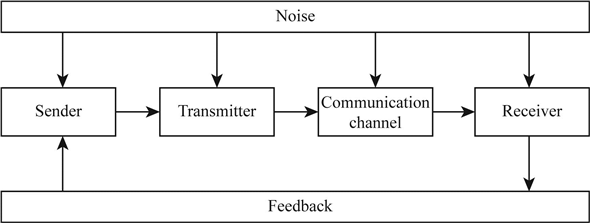 Explanation for the diagram:
• Sender: A message is initiated by a sender to the receiver. The sender of the message is a firm.
• Transmitter : A firm through its ad agency or marketing departments transmits the message of the product to the consumer. It can be done by various medium of communication. Transmission involves encoding of a message. Encoding transforms the sender's ideas and innovations to a message through words and pictures.
• Communication channel : Communication channel is used as a sender's medium to interact with the customers. The selection of proper communication channel is based on the target audience. The various forms of communication channels are blogs, websites, internet, print advertisements, broadcasting, social media sites, in-store displays, and direct mail.
• Receiver : The message initiated by the sender is received by the receiver. He reads, hears, or processes the message that he received. The process of receiver interpreting the sender's message is decoding. Many times, the receiver does not decode the message properly because of the noises that surround the message.
• Feedback : Feedback ensures that the receiver has received the message properly though the medium and decoded properly. It is necessary for both oral and written communication.
• Noise : Noise is a barrier to an effective communication process. It creates interference or causes distractions for the receiver to receive the message. It affects the clarity of the message. The difference between the encoded message and decoded message is the noise.
2.
AIDA Model
An advertisement should grab the attention of audience and motivate them towards purchase of that particular product. An effective advertisement can make the customer to buy a product. AIDA model is a model used by the marketers to express what happens when a customer connects himself with an advertisement.
AIDA is acronym. It is also called as "think, feel, do" model. AIDA is a four stage process that helps the marketers to develop a marketing strategy. The following diagram illustrates what AIDA stands for:
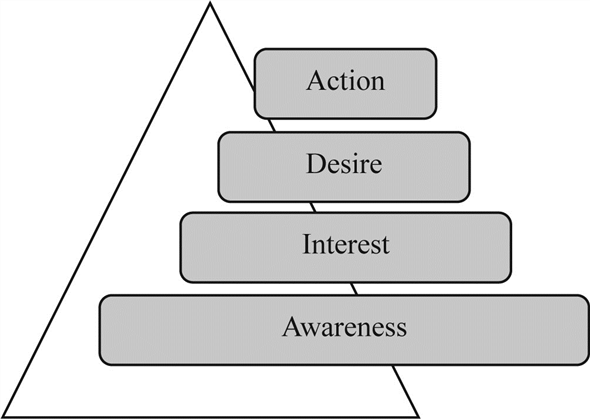 Explanation for the acronym:
Awareness : A product must have the consumer's awareness to become successful. A customer must be able to recognize the brand and hence the brand awareness is very important.
Interest : Once the marketer has grabbed the attention of the customer, he has to boost the interest level. It is fulfilled by advertisements with attributes that increases the audience's interest levels.
Desire : The marketer needs to convert the interest of a customer toward a product to desire for a product. An advertisement should motivate the buyer to purchase a product even when there is no need for that particular product.
Action : It is an ultimate goal for any marketer to make the customer purchase their product. So, any marketer will create awareness among the target audience, then boost the interest level and induce them to buy the product. The final process is the action where the customers purchase the product.
Communication is a part of promotion that includes advertising, personal selling, sales promotion, public relation, online marketing, and direct marketing. The following are the three main elements of the communication:
• Consumer
• Channels of communication
• Evaluation of the results
1.
Communication process:
In the present days, it is a back-breaking task for a firm to understand, reach, and satisfy the customers. The marketing communication helps the firm to influence the consumers toward buying the product. The following diagram illustrates the process of communication:
Explanation for the diagram: • Sender: A message is initiated by a sender to the receiver. The sender of the message is a firm.
• Transmitter : A firm through its ad agency or marketing departments transmits the message of the product to the consumer. It can be done by various medium of communication. Transmission involves encoding of a message. Encoding transforms the sender's ideas and innovations to a message through words and pictures.
• Communication channel : Communication channel is used as a sender's medium to interact with the customers. The selection of proper communication channel is based on the target audience. The various forms of communication channels are blogs, websites, internet, print advertisements, broadcasting, social media sites, in-store displays, and direct mail.
• Receiver : The message initiated by the sender is received by the receiver. He reads, hears, or processes the message that he received. The process of receiver interpreting the sender's message is decoding. Many times, the receiver does not decode the message properly because of the noises that surround the message.
• Feedback : Feedback ensures that the receiver has received the message properly though the medium and decoded properly. It is necessary for both oral and written communication.
• Noise : Noise is a barrier to an effective communication process. It creates interference or causes distractions for the receiver to receive the message. It affects the clarity of the message. The difference between the encoded message and decoded message is the noise.
2.
AIDA Model
An advertisement should grab the attention of audience and motivate them towards purchase of that particular product. An effective advertisement can make the customer to buy a product. AIDA model is a model used by the marketers to express what happens when a customer connects himself with an advertisement.
AIDA is acronym. It is also called as "think, feel, do" model. AIDA is a four stage process that helps the marketers to develop a marketing strategy. The following diagram illustrates what AIDA stands for:
Explanation for the acronym: Awareness : A product must have the consumer's awareness to become successful. A customer must be able to recognize the brand and hence the brand awareness is very important.
Interest : Once the marketer has grabbed the attention of the customer, he has to boost the interest level. It is fulfilled by advertisements with attributes that increases the audience's interest levels.
Desire : The marketer needs to convert the interest of a customer toward a product to desire for a product. An advertisement should motivate the buyer to purchase a product even when there is no need for that particular product.
Action : It is an ultimate goal for any marketer to make the customer purchase their product. So, any marketer will create awareness among the target audience, then boost the interest level and induce them to buy the product. The final process is the action where the customers purchase the product.
2
Assume that the contemporary apparel company Juicy Couture has embarked on a new IMC strategy. It has chosen to advertise on TV during the NBC Nightly News and in print in Time magazine. The message is designed to announce new styles for the season and uses a 17-year-old woman as the model. Evaluate this strategy.
Instructor Notes
To succeed, each element of an IMC strategy must have a well-defined purpose and support and extend the message delivered by all the other elements. This question challenges students to determine which elements of Juicy Couture's IMC strategy might miss the mark.
Juicy Couture's new IMC strategy will not be very successful, because its target audience of teenaged, fashion-forward girls probably do not watch NBC Nightly News or read Time Magazine. The message might be right, but the media for delivery are not. The company might be better of showing the advertisement during American Idol and putting the print ad in a magazine like YM.
To succeed, each element of an IMC strategy must have a well-defined purpose and support and extend the message delivered by all the other elements. This question challenges students to determine which elements of Juicy Couture's IMC strategy might miss the mark.
Juicy Couture's new IMC strategy will not be very successful, because its target audience of teenaged, fashion-forward girls probably do not watch NBC Nightly News or read Time Magazine. The message might be right, but the media for delivery are not. The company might be better of showing the advertisement during American Idol and putting the print ad in a magazine like YM.
3
Visit http://thephelpsagency.com and click on the "Work" tab at the top. Compare the IMC for the different companies. What were the goals of the integrated marketing campaign Which IMC components were used in that particular campaign How do those components contribute to the success of the IMC campaign in achieving its stated goals
NO ANSWER
4
RETURN ON MARKETING EXPENDITURES
Suppose Jay Oliver (marketing manager of Transit sneaker store) is considering two search engine marketing (SEM) options to reach out to new customers to market Transit. In particular, he is using Google Ad- Words, a search engine marketing tool offered by Google that allows firms to show up in searches based on the keywords potential customers use. Transit is targeting young adults aged 17 to 28. The sneaker market is about $500,000,000 sales annually, and the target market is about 35 percent of that. Their gross margins are 20 percent. Oliver estimates that Transit will capture a 2 percent market share of the target market with a $500,000 advertising and keyword budget (option 1) and a 3 percent market share with a $1,000,000 advertising and keyword budget (option 2). Which marketing plan produces the higher ROI for the year Please use the toolkit provided in your instructor's Connect course to assess the ROI of the two options.
Suppose Jay Oliver (marketing manager of Transit sneaker store) is considering two search engine marketing (SEM) options to reach out to new customers to market Transit. In particular, he is using Google Ad- Words, a search engine marketing tool offered by Google that allows firms to show up in searches based on the keywords potential customers use. Transit is targeting young adults aged 17 to 28. The sneaker market is about $500,000,000 sales annually, and the target market is about 35 percent of that. Their gross margins are 20 percent. Oliver estimates that Transit will capture a 2 percent market share of the target market with a $500,000 advertising and keyword budget (option 1) and a 3 percent market share with a $1,000,000 advertising and keyword budget (option 2). Which marketing plan produces the higher ROI for the year Please use the toolkit provided in your instructor's Connect course to assess the ROI of the two options.
Unlock Deck
Unlock for access to all 14 flashcards in this deck.
Unlock Deck
k this deck
5
HOW INTEGRATED IS VOLVO'S IMC STRATEGY
For consumers, Volvo means one thing. For businesses that rely on the automotive manufacturer for their delivery trucks and large-capacity vehicles, it means something else. In turn, the company faces the challenge of communicating about its offers to a wide variety of audiences, promising different solutions to different needs while still maintaining a consistent positioning.
A long-running joke once held that a truthful advertising campaign for Volvo's cars would read, "We're boxy, but we're safe." That is, the company tended to ignore stylish designs or fashionable add-ons in its single-minded focus on making the safest automobiles on the road. The business-to-business (B2B) side of the company similarly designed and marketed itself as technically superior. In both consumer and business markets, Volvo made relatively straightforward promises of safety and effectiveness that, while not particularly exciting, seemed consistent.
However, consistency is not enough in the modern, cut-throat competition for automotive sales. In response, Volvo has undergone several renewed attempts at communicating and positioning itself as something exciting, mainly because it is so dependable.
For example, in B2B markets, Volvo began issuing a series of award-winning marketing films designed to demonstrate just how precise the engineering is on its trucks. Through recent innovations, Volvo's designers and engineers have enhanced the maneuverability, sensitivity, and driving precision of the big rigs that it sells worldwide. To reveal the sensitivity of Volvo Dynamic Steering on the FMX truck line, it filmed "The Hamster Stunt," in which a hamster named Charlie runs on a hamster track built into the steering wheel and thereby determines the direction of the massive semitrailer vehicle.
In "The Technician," a live engineer who worked on designing the truck series agrees to be buried in dirt up to his neck. His head protrudes 275 millimeters (11 inches) out of the ground, which is enough for the truck, with its 300-mm (12-inch) clearance to the undercarriage, to literally drive over him.
The steadiness and ease of handling the trucks is a significant benefit, especially for long-haul truckers. Therefore, Volvo used two different films to highlight this promise: In "The Ballerina Stunt," a woman dressed in a tutu walks a tightrope strung between two moving trucks. Not to be outdone by a ballerina, the martial arts expert and actor Jean-Claude Van Damme holds himself in the splits between the windows of two trucks while they drive-in reverse in this case.28 As Volvo has been quick to assure viewers, there are no special effects or computer graphics in any of these shots. The 53-year-old action star really did do the splits, and the trucks truly were moving in reverse.
Each of the short films is available exclusively on YouTube, where they have attracted more than 100 million views. In addition, traditional news media reported widely on the campaign, especially after the spots started earning awards in marketing competitions such as the "best in show" winner of The One Show advertising event. Not only did people who viewed the films start following Volvo more readily on YouTube, Twitter, and Facebook, but they also left YouTube to visit Volvo's own branded site. According to the company's calculations, unique buyer visits to the Volvo trucks website increased from around 175,000 to 300,000 per month in the aftermath of the campaign.
But few regular consumers worry about whether their station wagons or sedans can hold Van Damme in a splits. Instead, they want a strong, reliable car that offers some sense of luxury. Volvo is a relatively higher-priced brand, which means that it regards its main competitors as other luxury car brands, including Mercedes-Benz, Audi, BMW, and Lexus. Even as it competes with them, though, Volvo recognizes and seeks to build on its distinctiveness, in that it has never been primarily about "looking good."
Accordingly, its consumer marketing focuses on how the benefits of driving a Volvo are unique from those associated with driving other luxury brands. The theme is consistent across several marketing channels. For example, one comparative television spot shows a perfectly coiffed, stylish female driver of a Mercedes SUV checking her makeup in her rearview mirror. The shot pans to the car in the next lane-a Volvo, of course-in which the female driver also is checking her rearview mirror. But in this case, she is checking on and making funny faces at two children in the backseat, who giggle in response. The tagline-"Volvos aren't for everyone, and we kinda like it that way," gives buyers and potential buyers a means to distinguish themselves from a stereotype of conspicuous consumption.
The linked Facebook element of this same campaign features a small dog in a purse, with the tagline, "If your dog has a wardrobe, the Volvo S60 probably isn't for you." On billboards and outdoor media in the greater Los Angeles area, Volvo also promises that its S60 is "100% real. Can't say that about everything around here." Although this ad ran mainly in Southern California, Volvo also has moved to consolidate its communications globally, such as by working with a single global marketing firm and strongly encouraging collaboration between its U.S. and European in-house marketing teams.
The campaigns are thus a little cheeky and funny, while also promising a distinct benefit to consumers who prefer not to appear ostentatious or flashy. To coincide with these advertising campaigns, Volvo also has introduced some new, updated, slightly sportier models. In these categories, it recognizes that it competes most directly with Audi, which similarly seeks a "new luxury" positioning, rather than the "old luxury" widely associated with BMW or Mercedes. In this head-to-head competition, Volvo made a daring promise: For any consumer who test drove both its S60 and the Audi A4, then purchased the A4, Volvo would pay the first month's car payment.
Even as Volvo has undergone changes in ownership and some fluctuations in its share of both B2B and consumer markets, it has maintained a sense of uniqueness and distinction. Its goal in its marketing communications, across the board, is to make sure that identity-or "what the brand is all about"-is clear to all its customers in all its markets and across all channels of communication.
What step(s) in the AIDA process do each of these marketing communications attempt to achieve
For consumers, Volvo means one thing. For businesses that rely on the automotive manufacturer for their delivery trucks and large-capacity vehicles, it means something else. In turn, the company faces the challenge of communicating about its offers to a wide variety of audiences, promising different solutions to different needs while still maintaining a consistent positioning.
A long-running joke once held that a truthful advertising campaign for Volvo's cars would read, "We're boxy, but we're safe." That is, the company tended to ignore stylish designs or fashionable add-ons in its single-minded focus on making the safest automobiles on the road. The business-to-business (B2B) side of the company similarly designed and marketed itself as technically superior. In both consumer and business markets, Volvo made relatively straightforward promises of safety and effectiveness that, while not particularly exciting, seemed consistent.
However, consistency is not enough in the modern, cut-throat competition for automotive sales. In response, Volvo has undergone several renewed attempts at communicating and positioning itself as something exciting, mainly because it is so dependable.
For example, in B2B markets, Volvo began issuing a series of award-winning marketing films designed to demonstrate just how precise the engineering is on its trucks. Through recent innovations, Volvo's designers and engineers have enhanced the maneuverability, sensitivity, and driving precision of the big rigs that it sells worldwide. To reveal the sensitivity of Volvo Dynamic Steering on the FMX truck line, it filmed "The Hamster Stunt," in which a hamster named Charlie runs on a hamster track built into the steering wheel and thereby determines the direction of the massive semitrailer vehicle.
In "The Technician," a live engineer who worked on designing the truck series agrees to be buried in dirt up to his neck. His head protrudes 275 millimeters (11 inches) out of the ground, which is enough for the truck, with its 300-mm (12-inch) clearance to the undercarriage, to literally drive over him.
The steadiness and ease of handling the trucks is a significant benefit, especially for long-haul truckers. Therefore, Volvo used two different films to highlight this promise: In "The Ballerina Stunt," a woman dressed in a tutu walks a tightrope strung between two moving trucks. Not to be outdone by a ballerina, the martial arts expert and actor Jean-Claude Van Damme holds himself in the splits between the windows of two trucks while they drive-in reverse in this case.28 As Volvo has been quick to assure viewers, there are no special effects or computer graphics in any of these shots. The 53-year-old action star really did do the splits, and the trucks truly were moving in reverse.
Each of the short films is available exclusively on YouTube, where they have attracted more than 100 million views. In addition, traditional news media reported widely on the campaign, especially after the spots started earning awards in marketing competitions such as the "best in show" winner of The One Show advertising event. Not only did people who viewed the films start following Volvo more readily on YouTube, Twitter, and Facebook, but they also left YouTube to visit Volvo's own branded site. According to the company's calculations, unique buyer visits to the Volvo trucks website increased from around 175,000 to 300,000 per month in the aftermath of the campaign.
But few regular consumers worry about whether their station wagons or sedans can hold Van Damme in a splits. Instead, they want a strong, reliable car that offers some sense of luxury. Volvo is a relatively higher-priced brand, which means that it regards its main competitors as other luxury car brands, including Mercedes-Benz, Audi, BMW, and Lexus. Even as it competes with them, though, Volvo recognizes and seeks to build on its distinctiveness, in that it has never been primarily about "looking good."
Accordingly, its consumer marketing focuses on how the benefits of driving a Volvo are unique from those associated with driving other luxury brands. The theme is consistent across several marketing channels. For example, one comparative television spot shows a perfectly coiffed, stylish female driver of a Mercedes SUV checking her makeup in her rearview mirror. The shot pans to the car in the next lane-a Volvo, of course-in which the female driver also is checking her rearview mirror. But in this case, she is checking on and making funny faces at two children in the backseat, who giggle in response. The tagline-"Volvos aren't for everyone, and we kinda like it that way," gives buyers and potential buyers a means to distinguish themselves from a stereotype of conspicuous consumption.
The linked Facebook element of this same campaign features a small dog in a purse, with the tagline, "If your dog has a wardrobe, the Volvo S60 probably isn't for you." On billboards and outdoor media in the greater Los Angeles area, Volvo also promises that its S60 is "100% real. Can't say that about everything around here." Although this ad ran mainly in Southern California, Volvo also has moved to consolidate its communications globally, such as by working with a single global marketing firm and strongly encouraging collaboration between its U.S. and European in-house marketing teams.
The campaigns are thus a little cheeky and funny, while also promising a distinct benefit to consumers who prefer not to appear ostentatious or flashy. To coincide with these advertising campaigns, Volvo also has introduced some new, updated, slightly sportier models. In these categories, it recognizes that it competes most directly with Audi, which similarly seeks a "new luxury" positioning, rather than the "old luxury" widely associated with BMW or Mercedes. In this head-to-head competition, Volvo made a daring promise: For any consumer who test drove both its S60 and the Audi A4, then purchased the A4, Volvo would pay the first month's car payment.
Even as Volvo has undergone changes in ownership and some fluctuations in its share of both B2B and consumer markets, it has maintained a sense of uniqueness and distinction. Its goal in its marketing communications, across the board, is to make sure that identity-or "what the brand is all about"-is clear to all its customers in all its markets and across all channels of communication.
What step(s) in the AIDA process do each of these marketing communications attempt to achieve
Unlock Deck
Unlock for access to all 14 flashcards in this deck.
Unlock Deck
k this deck
6
What are the different elements of an IMC program
Unlock Deck
Unlock for access to all 14 flashcards in this deck.
Unlock Deck
k this deck
7
Using the steps in the AIDA model, explain why a potential consumer in Question 1 who views Juicy Couture's advertising may not be ready to go out and purchase a new pair of jeans.
Unlock Deck
Unlock for access to all 14 flashcards in this deck.
Unlock Deck
k this deck
8
Why is the objective-and-task method of setting an IMC budget better than the rule-of-thumb methods
2. How do firms use GRP to evaluate the effectiveness of traditional media
3. How would a firm evaluate the effectiveness of its Google advertising
2. How do firms use GRP to evaluate the effectiveness of traditional media
3. How would a firm evaluate the effectiveness of its Google advertising
Unlock Deck
Unlock for access to all 14 flashcards in this deck.
Unlock Deck
k this deck
9
Suppose a snack company introduces a new product called SumSeeds-sunflower seeds with energy boosters like caffeine, taurine, lysine, and ginseng. How would you expect this product's IMC program to differ from that for regular sunflower seeds sold as snacks
Unlock Deck
Unlock for access to all 14 flashcards in this deck.
Unlock Deck
k this deck
10
It's holiday time, and you've decided to purchase a box of chocolates for the person of your choice. Evaluate how Godiva's advertising, personal selling, public relations, and electronic media might influence your purchase decision. How might the relative importance of each of these IMC elements be different if your parents were making the purchase
Unlock Deck
Unlock for access to all 14 flashcards in this deck.
Unlock Deck
k this deck
11
Suppose you saw your instructor for this course being interviewed on TV about the impact of a big storm on an upcoming holiday's sales. Is this interview part of your college's IMC program If so, do you believe it benefits the college How
Unlock Deck
Unlock for access to all 14 flashcards in this deck.
Unlock Deck
k this deck
12
A retail store places an ad in the local newspaper for Capri pants. The sales of the featured pants increase significantly for the next two weeks; sales in the rest of the sportswear department go up as well. What do you think are the short- and long-term objectives of the ad Justify your answer.
Unlock Deck
Unlock for access to all 14 flashcards in this deck.
Unlock Deck
k this deck
13
As an intern for Coca-Cola, you have been asked to help with developing an IMC budget. The objective of the IMC strategy is to raise Diet Coke's market share by 2 percent in the United States in the next 18 months. Your manager explains, "It's real simple; just increase the budget 2 percent over last year's." Evaluate your manager's strategy.
Unlock Deck
Unlock for access to all 14 flashcards in this deck.
Unlock Deck
k this deck
14
You were sitting in the school cafeteria yesterday, and a young man from your marketing class, whom you don't know well, asked if he could sit down. He then started telling you about this very cool new Google app, "WordLens," that allows you to translate signs into different languages in real time using the camera on your smartphone. Although you recognize the merit in the product, you later find out that he works for Google. Do you believe his action constitutes an ethical IMC strategy How will it affect your attitude toward Google and the potential that you will purchase the product
Unlock Deck
Unlock for access to all 14 flashcards in this deck.
Unlock Deck
k this deck
Unlock Deck
Unlock for access to all 14 flashcards in this deck.






