







 Chat with AI

Deck 10: Income and Expenditures Equilibrium
Full screen (f)

Question
NARRBEGIN: Table 10.2
The table given below shows the levels of national income (Y) and the corresponding levels of saving (S), investment (I), export (X), and import (M) of an open economy.
Table 10.2
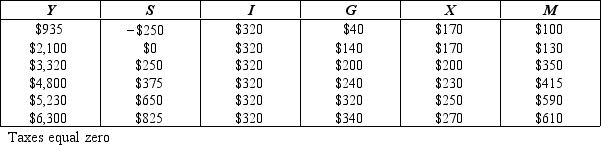
Consider the economy described in Table 10.2. If autonomous saving decreases by $200, what will happen at the current equilibrium level of income?
A) Autonomous consumption spending will also decrease by $200, and so no change in equilibrium income occurs.
B) Total leakages in the economy will exceed total injections.
C) There will be pressure on real GDP to rise.
D) There will be pressure on the economy to contract.
E) Unplanned inventories in the economy will grow.
The table given below shows the levels of national income (Y) and the corresponding levels of saving (S), investment (I), export (X), and import (M) of an open economy.
Table 10.2
Consider the economy described in Table 10.2. If autonomous saving decreases by $200, what will happen at the current equilibrium level of income?
A) Autonomous consumption spending will also decrease by $200, and so no change in equilibrium income occurs.
B) Total leakages in the economy will exceed total injections.
C) There will be pressure on real GDP to rise.
D) There will be pressure on the economy to contract.
E) Unplanned inventories in the economy will grow.

Question
NARRBEGIN: Table 10.1
The table given below states the value of the GDP and the different components of aggregate expenditure for two years.
Table 10.1

Refer to Table 10.1. What is the equilibrium level of real GDP in year 1?
A) $940
B) $1,040
C) $1,100
D) $1,050
E) $920
The table given below states the value of the GDP and the different components of aggregate expenditure for two years.
Table 10.1
Refer to Table 10.1. What is the equilibrium level of real GDP in year 1?
A) $940
B) $1,040
C) $1,100
D) $1,050
E) $920
Question
NARRBEGIN: Table 10.2
The table given below shows the levels of national income (Y) and the corresponding levels of saving (S), investment (I), export (X), and import (M) of an open economy.
Table 10.2
Consider the economy described in Table 10.2. What is the equilibrium level of real GDP?
A) $935
B) $2,100
C) $3,320
D) $4,800
E) $5,230
The table given below shows the levels of national income (Y) and the corresponding levels of saving (S), investment (I), export (X), and import (M) of an open economy.
Table 10.2
Consider the economy described in Table 10.2. What is the equilibrium level of real GDP?
A) $935
B) $2,100
C) $3,320
D) $4,800
E) $5,230
Question
Question
Question
NARRBEGIN: Table 10.1
The table given below states the value of the GDP and the different components of aggregate expenditure for two years.
Table 10.1
Refer to Table 10.1. If real GDP equals $1,000 in year 1, then:
A) unplanned inventory investment is zero.
B) unplanned inventories increase by $50.
C) inventories decrease by $100.
D) inventories increase by $60.
E) real GDP is less than aggregate expenditure.
The table given below states the value of the GDP and the different components of aggregate expenditure for two years.
Table 10.1
Refer to Table 10.1. If real GDP equals $1,000 in year 1, then:
A) unplanned inventory investment is zero.
B) unplanned inventories increase by $50.
C) inventories decrease by $100.
D) inventories increase by $60.
E) real GDP is less than aggregate expenditure.
Question
Question
NARRBEGIN: Figure 10.1
The figure given below shows the aggregate expenditure curve of an open economy.
Figure 10.1
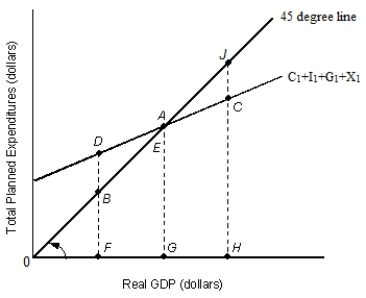 In the figure:
C1: Consumption
I1: Investment
G1: Government spending
X1: Net Exports
According to Figure 10.1, the economy will expand when aggregate expenditures are at:
A) point D.
B) point A.
C) point B.
D) point C.
E) point E.
The figure given below shows the aggregate expenditure curve of an open economy.
Figure 10.1
In the figure:C1: Consumption
I1: Investment
G1: Government spending
X1: Net Exports
According to Figure 10.1, the economy will expand when aggregate expenditures are at:
A) point D.
B) point A.
C) point B.
D) point C.
E) point E.
Question
Question
NARRBEGIN: Figure 10.1
The figure given below shows the aggregate expenditure curve of an open economy.
Figure 10.1
In the figure:
C1: Consumption
I1: Investment
G1: Government spending
X1: Net Exports
Consider the economy described in Figure 10.1. Which of the following is true if the real GDP is equal to 0H?
A) Aggregate expenditures are greater than total income.
B) All economic resources are being used efficiently.
C) Households are dissaving an amount equal to DC.
D) Businesses accumulate unwanted inventories.
E) Unplanned investment will decline.
The figure given below shows the aggregate expenditure curve of an open economy.
Figure 10.1
In the figure:C1: Consumption
I1: Investment
G1: Government spending
X1: Net Exports
Consider the economy described in Figure 10.1. Which of the following is true if the real GDP is equal to 0H?
A) Aggregate expenditures are greater than total income.
B) All economic resources are being used efficiently.
C) Households are dissaving an amount equal to DC.
D) Businesses accumulate unwanted inventories.
E) Unplanned investment will decline.
Question
Question
NARRBEGIN: Table 10.1
The table given below states the value of the GDP and the different components of aggregate expenditure for two years.
Table 10.1
Refer to Table 10.1. What would be the new equilibrium level of real GDP in year 2 if net exports equaled zero?
A) $1,205
B) $1,095
C) $1,050
D) $1,170
E) $1,120
The table given below states the value of the GDP and the different components of aggregate expenditure for two years.
Table 10.1
Refer to Table 10.1. What would be the new equilibrium level of real GDP in year 2 if net exports equaled zero?
A) $1,205
B) $1,095
C) $1,050
D) $1,170
E) $1,120
Question
Question
NARRBEGIN: Figure 10.1
The figure given below shows the aggregate expenditure curve of an open economy.
Figure 10.1
In the figure:
C1: Consumption
I1: Investment
G1: Government spending
X1: Net Exports
According to Figure 10.1, when real GDP is at G:
A) there is pressure for the economy to expand.
B) there are unplanned reductions in inventory.
C) aggregate expenditures are less than real GDP.
D) the economy has achieved macroeconomic equilibrium.
E) there is pressure for the economy to contract.
The figure given below shows the aggregate expenditure curve of an open economy.
Figure 10.1
In the figure:C1: Consumption
I1: Investment
G1: Government spending
X1: Net Exports
According to Figure 10.1, when real GDP is at G:
A) there is pressure for the economy to expand.
B) there are unplanned reductions in inventory.
C) aggregate expenditures are less than real GDP.
D) the economy has achieved macroeconomic equilibrium.
E) there is pressure for the economy to contract.
Question
NARRBEGIN: Table 10.2
The table given below shows the levels of national income (Y) and the corresponding levels of saving (S), investment (I), export (X), and import (M) of an open economy.
Table 10.2
Consider the economy described in Table 10.2. Calculate the level of consumption spending when the economy is in equilibrium.
A) $4,425
B) $4,010
C) $4,050
D) $5,175
E) $4,800
The table given below shows the levels of national income (Y) and the corresponding levels of saving (S), investment (I), export (X), and import (M) of an open economy.
Table 10.2
Consider the economy described in Table 10.2. Calculate the level of consumption spending when the economy is in equilibrium.
A) $4,425
B) $4,010
C) $4,050
D) $5,175
E) $4,800
Question
Question
NARRBEGIN: Table 10.2
The table given below shows the levels of national income (Y) and the corresponding levels of saving (S), investment (I), export (X), and import (M) of an open economy.
Table 10.2
Consider the economy described in Table 10.2. At an income level of $2,100:
A) leakages exceed injections by $800.
B) total output exceeds aggregate expenditures by $500.
C) injections exceed leakages by $500.
D) injections are equal to total output.
E) aggregate expenditures exceed total output by $500.
The table given below shows the levels of national income (Y) and the corresponding levels of saving (S), investment (I), export (X), and import (M) of an open economy.
Table 10.2
Consider the economy described in Table 10.2. At an income level of $2,100:
A) leakages exceed injections by $800.
B) total output exceeds aggregate expenditures by $500.
C) injections exceed leakages by $500.
D) injections are equal to total output.
E) aggregate expenditures exceed total output by $500.
Question
NARRBEGIN: Table 10.2
The table given below shows the levels of national income (Y) and the corresponding levels of saving (S), investment (I), export (X), and import (M) of an open economy.
Table 10.2
Consider the economy described in Table 10.2. Calculate the value of leakages from the economy when the economy is in equilibrium.
A) $770
B) $720
C) $790
D) $600
E) $410
The table given below shows the levels of national income (Y) and the corresponding levels of saving (S), investment (I), export (X), and import (M) of an open economy.
Table 10.2
Consider the economy described in Table 10.2. Calculate the value of leakages from the economy when the economy is in equilibrium.
A) $770
B) $720
C) $790
D) $600
E) $410
Question
NARRBEGIN: Table 10.1
The table given below states the value of the GDP and the different components of aggregate expenditure for two years.
Table 10.1
Refer to Table 10.1. Assume that the economy is at equilibrium in both years. What are net exports for year 2?
A) $60
B) $125
C) $70
D) $55
E) $195
The table given below states the value of the GDP and the different components of aggregate expenditure for two years.
Table 10.1
Refer to Table 10.1. Assume that the economy is at equilibrium in both years. What are net exports for year 2?
A) $60
B) $125
C) $70
D) $55
E) $195
Question
NARRBEGIN: Table 10.1
The table given below states the value of the GDP and the different components of aggregate expenditure for two years.
Table 10.1
Refer to Table 10.1. What is the equilibrium level of imports in year 2?
A) $20
B) $50
C) $70
D) $100
E) $120
The table given below states the value of the GDP and the different components of aggregate expenditure for two years.
Table 10.1
Refer to Table 10.1. What is the equilibrium level of imports in year 2?
A) $20
B) $50
C) $70
D) $100
E) $120
Question
Question
NARRBEGIN: Figure 10.3
The figure given below represents the leakages and injections in an economy.
Figure 10.3
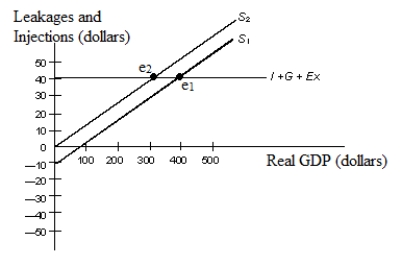 In the figure:
S1 and S2: Saving functions
I: Investment
G: Government spending
EX: Net exports
Refer to Figure 10.3. If saving is represented by S1, at a real GDP level of $500:
A) leakages are greater than injections which will cause income to increase.
B) leakages are greater than injections which will cause income to decrease.
C) leakages are less than injections which will cause income to increase.
D) leakages are less than injections which will cause income to decrease.
E) leakages are equal to injections which will cause no change in income.
The figure given below represents the leakages and injections in an economy.
Figure 10.3
In the figure:S1 and S2: Saving functions
I: Investment
G: Government spending
EX: Net exports
Refer to Figure 10.3. If saving is represented by S1, at a real GDP level of $500:
A) leakages are greater than injections which will cause income to increase.
B) leakages are greater than injections which will cause income to decrease.
C) leakages are less than injections which will cause income to increase.
D) leakages are less than injections which will cause income to decrease.
E) leakages are equal to injections which will cause no change in income.
Question
Question
NARRBEGIN: Figure 10.3
The figure given below represents the leakages and injections in an economy.
Figure 10.3
In the figure:
S1 and S2: Saving functions
I: Investment
G: Government spending
EX: Net exports
Refer to Figure 10.3. The paradox of thrift might not be a problem if:
A) the average price level does not change in the short run.
B) the I + G + EX line were downward-sloping.
C) the I + G + EX line were constant at an intercept of $30.
D) the increase in saving was used to fund investment expenditures.
E) the I + G + EX line were constant at an intercept of $50.
The figure given below represents the leakages and injections in an economy.
Figure 10.3
In the figure:S1 and S2: Saving functions
I: Investment
G: Government spending
EX: Net exports
Refer to Figure 10.3. The paradox of thrift might not be a problem if:
A) the average price level does not change in the short run.
B) the I + G + EX line were downward-sloping.
C) the I + G + EX line were constant at an intercept of $30.
D) the increase in saving was used to fund investment expenditures.
E) the I + G + EX line were constant at an intercept of $50.
Question
Question
Question
Question
Question
Question
NARRBEGIN: Figure 10.2
The figure given below represents the leakages and injections in an economy.
Figure 10.2
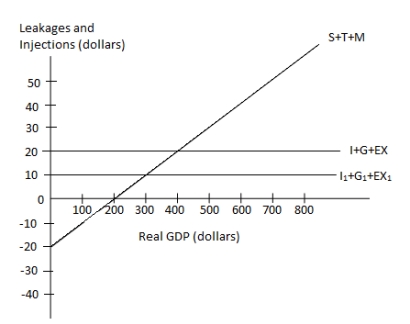 In the figure:
I, I1: Investment;
G: Government spending;
EX, EX1: Exports;
T: Taxes; and
M: Imports.
Refer to Figure 10.2. Suppose that I+G+EX equals $20 and the economy is in equilibrium. What is the amount of saving when T = $0 and M = $5 at the equilibrium level?
A) $0
B) $10
C) $15
D) $20
E) $25
The figure given below represents the leakages and injections in an economy.
Figure 10.2
In the figure:I, I1: Investment;
G: Government spending;
EX, EX1: Exports;
T: Taxes; and
M: Imports.
Refer to Figure 10.2. Suppose that I+G+EX equals $20 and the economy is in equilibrium. What is the amount of saving when T = $0 and M = $5 at the equilibrium level?
A) $0
B) $10
C) $15
D) $20
E) $25
Question
NARRBEGIN: Figure 10.2
The figure given below represents the leakages and injections in an economy.
Figure 10.2
In the figure:
I, I1: Investment;
G: Government spending;
EX, EX1: Exports;
T: Taxes; and
M: Imports.
According to Figure 10.2, real GDP of $200 indicates a point where:
A) total leakages exceed total injections.
B) aggregate expenditures exceed total output.
C) consumers engage in dissaving.
D) the economy is in macroeconomic equilibrium.
E) unplanned inventory changes will be positive.
The figure given below represents the leakages and injections in an economy.
Figure 10.2
In the figure:I, I1: Investment;
G: Government spending;
EX, EX1: Exports;
T: Taxes; and
M: Imports.
According to Figure 10.2, real GDP of $200 indicates a point where:
A) total leakages exceed total injections.
B) aggregate expenditures exceed total output.
C) consumers engage in dissaving.
D) the economy is in macroeconomic equilibrium.
E) unplanned inventory changes will be positive.
Question
Question
Question
Question
Question
NARRBEGIN: Figure 10.2
The figure given below represents the leakages and injections in an economy.
Figure 10.2
In the figure:
I, I1: Investment;
G: Government spending;
EX, EX1: Exports;
T: Taxes; and
M: Imports.
Refer to Figure 10.2. When total injections equal $20, the equilibrium level of real GDP is:
A) $100.
B) $200.
C) $300.
D) $400.
E) $500.
The figure given below represents the leakages and injections in an economy.
Figure 10.2
In the figure:I, I1: Investment;
G: Government spending;
EX, EX1: Exports;
T: Taxes; and
M: Imports.
Refer to Figure 10.2. When total injections equal $20, the equilibrium level of real GDP is:
A) $100.
B) $200.
C) $300.
D) $400.
E) $500.
Question
NARRBEGIN: Figure 10.3
The figure given below represents the leakages and injections in an economy.
Figure 10.3
In the figure:
S1 and S2: Saving functions
I: Investment
G: Government spending
EX: Net exports
In Figure 10.3, which of the following represents the paradox of thrift?
A) A shift of the saving curve from S2 to S1.
B) A shift of the saving curve from S1 to S2.
C) A change in equilibrium from e2 to e1.
D) A change in equilibrium real GDP from $300 to $400.
E) A change in equilibrium real GDP from $100 to $400.
The figure given below represents the leakages and injections in an economy.
Figure 10.3
In the figure:S1 and S2: Saving functions
I: Investment
G: Government spending
EX: Net exports
In Figure 10.3, which of the following represents the paradox of thrift?
A) A shift of the saving curve from S2 to S1.
B) A shift of the saving curve from S1 to S2.
C) A change in equilibrium from e2 to e1.
D) A change in equilibrium real GDP from $300 to $400.
E) A change in equilibrium real GDP from $100 to $400.
Question
NARRBEGIN: Figure 10.2
The figure given below represents the leakages and injections in an economy.
Figure 10.2
In the figure:
I, I1: Investment;
G: Government spending;
EX, EX1: Exports;
T: Taxes; and
M: Imports.
Refer to Figure 10.2. A decline in total injections by $10:
A) will cause equilibrium income to rise to $400.
B) will result in a disequilibrium of $200 in the economy.
C) will cause the total leakages curve to shift inward by $10.
D) will cause equilibrium income to fall to $300.
E) will not affect equilibrium income.
The figure given below represents the leakages and injections in an economy.
Figure 10.2
In the figure:I, I1: Investment;
G: Government spending;
EX, EX1: Exports;
T: Taxes; and
M: Imports.
Refer to Figure 10.2. A decline in total injections by $10:
A) will cause equilibrium income to rise to $400.
B) will result in a disequilibrium of $200 in the economy.
C) will cause the total leakages curve to shift inward by $10.
D) will cause equilibrium income to fall to $300.
E) will not affect equilibrium income.
Question
Question
Question
Question
NARRBEGIN: Table 10.3
The table given below reports the value of real GDP and its components consumption (C), investment (I), exports, and imports for two consecutive years.
Table 10.3
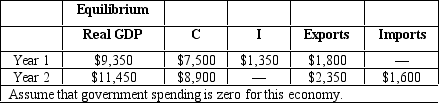
Consider Table 10.3 to calculate the value of the MPC.
A) 0.75
B) 0.67
C) 0.25
D) 0.33
E) 0.80
The table given below reports the value of real GDP and its components consumption (C), investment (I), exports, and imports for two consecutive years.
Table 10.3
Consider Table 10.3 to calculate the value of the MPC.
A) 0.75
B) 0.67
C) 0.25
D) 0.33
E) 0.80
Question
NARRBEGIN: Table 10.3
The table given below reports the value of real GDP and its components consumption (C), investment (I), exports, and imports for two consecutive years.
Table 10.3
Refer to Table 10.3. To increase equilibrium real GDP in an open economy to $12,000 in year 3, all else equal to that in year 2, investment would have to increase by:
A) $258.
B) $550.
C) $2,262.
D) $1,100.
E) $1,155.
The table given below reports the value of real GDP and its components consumption (C), investment (I), exports, and imports for two consecutive years.
Table 10.3
Refer to Table 10.3. To increase equilibrium real GDP in an open economy to $12,000 in year 3, all else equal to that in year 2, investment would have to increase by:
A) $258.
B) $550.
C) $2,262.
D) $1,100.
E) $1,155.
Question
Question
Question
NARRBEGIN: Table 10.3
The table given below reports the value of real GDP and its components consumption (C), investment (I), exports, and imports for two consecutive years.
Table 10.3
Refer to Table 10.3. What will be the value of the spending multiplier?
A) 1
B) 0.47
C) 5
D) 1.25
E) 2.13
The table given below reports the value of real GDP and its components consumption (C), investment (I), exports, and imports for two consecutive years.
Table 10.3
Refer to Table 10.3. What will be the value of the spending multiplier?
A) 1
B) 0.47
C) 5
D) 1.25
E) 2.13
Question
Question
Question
Question
NARRBEGIN: Table 10.3
The table given below reports the value of real GDP and its components consumption (C), investment (I), exports, and imports for two consecutive years.
Table 10.3
Refer to Table 10.3. The change in investment spending from year 1 to year 2 is:
A) $1,800.
B) $450.
C) $945.
D) $214.
E) $2,100.
The table given below reports the value of real GDP and its components consumption (C), investment (I), exports, and imports for two consecutive years.
Table 10.3
Refer to Table 10.3. The change in investment spending from year 1 to year 2 is:
A) $1,800.
B) $450.
C) $945.
D) $214.
E) $2,100.
Question
Question
Question
NARRBEGIN: Table 10.3
The table given below reports the value of real GDP and its components consumption (C), investment (I), exports, and imports for two consecutive years.
Table 10.3
Refer to Table 10.3. The equilibrium value of imports in year 1 is:
A) $1,600
B) $1,450.
C) $1,400.
D) $1,300.
E) $1,200.
The table given below reports the value of real GDP and its components consumption (C), investment (I), exports, and imports for two consecutive years.
Table 10.3
Refer to Table 10.3. The equilibrium value of imports in year 1 is:
A) $1,600
B) $1,450.
C) $1,400.
D) $1,300.
E) $1,200.
Question
NARRBEGIN: Table 10.3
The table given below reports the value of real GDP and its components consumption (C), investment (I), exports, and imports for two consecutive years.
Table 10.3
According to the information provided in Table 10.3, the MPI equals _____.
A) +0.12
B) -0.33
C) -0.21
D) +0.14
E) MPS
The table given below reports the value of real GDP and its components consumption (C), investment (I), exports, and imports for two consecutive years.
Table 10.3
According to the information provided in Table 10.3, the MPI equals _____.
A) +0.12
B) -0.33
C) -0.21
D) +0.14
E) MPS
Question
Question
Question
Question
Question
Question
Question
NARRBEGIN: Figure 10.7
The figure given below shows the macroeconomic equilibrium of a country.
Figure 10.7
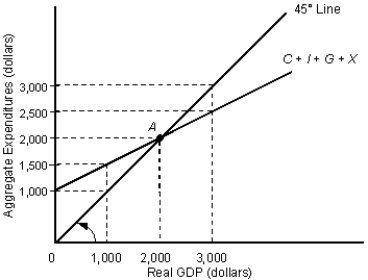
Refer to Figure 10.7. What is the size of the GDP gap if potential GDP equals $3,000?
A) $500
B) $1,000
C) $2,000
D) $2,500
E) $3,000
The figure given below shows the macroeconomic equilibrium of a country.
Figure 10.7
Refer to Figure 10.7. What is the size of the GDP gap if potential GDP equals $3,000?
A) $500
B) $1,000
C) $2,000
D) $2,500
E) $3,000
Question
NARRBEGIN: Figure 10.5
The figure given below depicts macroeconomic equilibrium in a closed economy. Assume that the spending multiplier in this economy is 1.5.
Figure 10.5
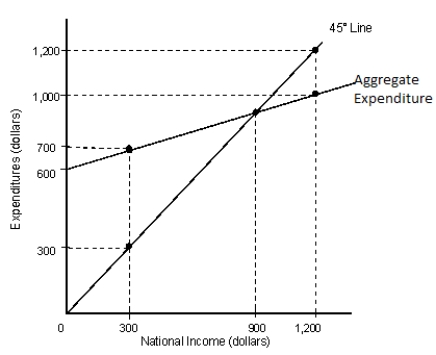
Refer to Figure 10.5. Assume that there is a recessionary gap that can be closed by a $500 increase in planned aggregate expenditures. If the economy is initially in equilibrium with a real GDP level of $900, then the target or potential level of real GDP must be:
A) $333.33.
B) $400.
C) $750.
D) $1,400.
E) $1,650.
The figure given below depicts macroeconomic equilibrium in a closed economy. Assume that the spending multiplier in this economy is 1.5.
Figure 10.5
Refer to Figure 10.5. Assume that there is a recessionary gap that can be closed by a $500 increase in planned aggregate expenditures. If the economy is initially in equilibrium with a real GDP level of $900, then the target or potential level of real GDP must be:
A) $333.33.
B) $400.
C) $750.
D) $1,400.
E) $1,650.
Question
NARRBEGIN: Figure 10.5
The figure given below depicts macroeconomic equilibrium in a closed economy. Assume that the spending multiplier in this economy is 1.5.
Figure 10.5
Refer to Figure 10.5. Suppose that instead of there being a recessionary gap, the economy is characterized by an equilibrium real GDP level of $900 that exceeds the natural unemployment or potential real GDP level by $600. This so-called expansionary gap can be closed by:
A) increasing planned aggregate expenditures by $400.
B) lowering government purchases by $600.
C) lowering autonomous consumption spending by $400.
D) increasing planned aggregate expenditures by $900.
E) lowering autonomous net exports by $600.
The figure given below depicts macroeconomic equilibrium in a closed economy. Assume that the spending multiplier in this economy is 1.5.
Figure 10.5
Refer to Figure 10.5. Suppose that instead of there being a recessionary gap, the economy is characterized by an equilibrium real GDP level of $900 that exceeds the natural unemployment or potential real GDP level by $600. This so-called expansionary gap can be closed by:
A) increasing planned aggregate expenditures by $400.
B) lowering government purchases by $600.
C) lowering autonomous consumption spending by $400.
D) increasing planned aggregate expenditures by $900.
E) lowering autonomous net exports by $600.
Question
Question
NARRBEGIN: Figure 10.4
The figure given below represents the macroeconomic equilibrium in the aggregate income and aggregate expenditure framework. Assume that MPI is equal to zero.
Figure 10.4
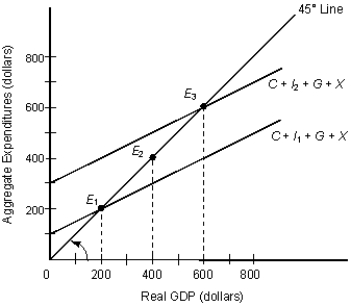 In the figure:
C: Consumption
I1 and I2: Investment
G: Government Spending
X: Exports
Refer to Figure 10.4. Starting at equilibrium level E3 equilibrium level E1 will be reached if aggregate expenditure:
A) decreases by $200.
B) increases by $200.
C) decreases by $100.
D) increases by $100.
E) increases by $50.
The figure given below represents the macroeconomic equilibrium in the aggregate income and aggregate expenditure framework. Assume that MPI is equal to zero.
Figure 10.4
In the figure:C: Consumption
I1 and I2: Investment
G: Government Spending
X: Exports
Refer to Figure 10.4. Starting at equilibrium level E3 equilibrium level E1 will be reached if aggregate expenditure:
A) decreases by $200.
B) increases by $200.
C) decreases by $100.
D) increases by $100.
E) increases by $50.
Question
NARRBEGIN: Table 10.4
The table given below shows the real GDP, aggregate expenditures, saving, and imports of an economy.
Table 10.4
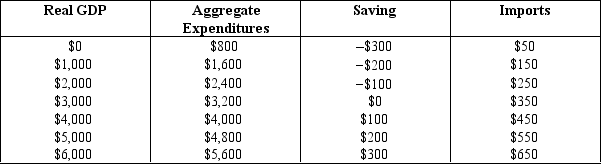
Refer to Table 10.4. Given a potential GDP of $6,000, the recessionary gap equals _____.
A) $200
B) $400
C) $1,000
D) $2,000
E) $5,000
The table given below shows the real GDP, aggregate expenditures, saving, and imports of an economy.
Table 10.4
Refer to Table 10.4. Given a potential GDP of $6,000, the recessionary gap equals _____.
A) $200
B) $400
C) $1,000
D) $2,000
E) $5,000
Question
NARRBEGIN: Figure 10.4
The figure given below represents the macroeconomic equilibrium in the aggregate income and aggregate expenditure framework. Assume that MPI is equal to zero.
Figure 10.4
In the figure:
C: Consumption
I1 and I2: Investment
G: Government Spending
X: Exports
Refer to Figure 10.4. Compute the increase in investment spending from I1 to I2.
A) $600.
B) $100.
C) $200.
D) $400.
E) $300.
The figure given below represents the macroeconomic equilibrium in the aggregate income and aggregate expenditure framework. Assume that MPI is equal to zero.
Figure 10.4
In the figure:C: Consumption
I1 and I2: Investment
G: Government Spending
X: Exports
Refer to Figure 10.4. Compute the increase in investment spending from I1 to I2.
A) $600.
B) $100.
C) $200.
D) $400.
E) $300.
Question
Question
NARRBEGIN: Figure 10.4
The figure given below represents the macroeconomic equilibrium in the aggregate income and aggregate expenditure framework. Assume that MPI is equal to zero.
Figure 10.4
In the figure:
C: Consumption
I1 and I2: Investment
G: Government Spending
X: Exports
Refer to Figure 10.4. If autonomous government expenditures increase by $250 billion, equilibrium real GDP will:
A) rise by $250 billion.
B) fall by 300 billion
C) rise by $500 billion.
D) rise by $75 billion.
E) rise by $100 billion.
The figure given below represents the macroeconomic equilibrium in the aggregate income and aggregate expenditure framework. Assume that MPI is equal to zero.
Figure 10.4
In the figure:C: Consumption
I1 and I2: Investment
G: Government Spending
X: Exports
Refer to Figure 10.4. If autonomous government expenditures increase by $250 billion, equilibrium real GDP will:
A) rise by $250 billion.
B) fall by 300 billion
C) rise by $500 billion.
D) rise by $75 billion.
E) rise by $100 billion.
Question
NARRBEGIN: Table 10.4
The table given below shows the real GDP, aggregate expenditures, saving, and imports of an economy.
Table 10.4
Refer to Table 10.4. Suppose the economy is currently in equilibrium and the potential GDP of the economy is $6,000. The current GDP gap equals _____.
A) $400
B) $1,000
C) $2,000
D) $3,000
E) $6,000
The table given below shows the real GDP, aggregate expenditures, saving, and imports of an economy.
Table 10.4
Refer to Table 10.4. Suppose the economy is currently in equilibrium and the potential GDP of the economy is $6,000. The current GDP gap equals _____.
A) $400
B) $1,000
C) $2,000
D) $3,000
E) $6,000
Question
NARRBEGIN: Figure 10.6
The figure given below represents the leakages and injections of an economy.
Figure 10.6
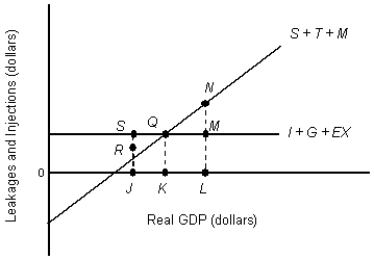
In Figure 10.6, if 0L is the potential level of real GDP, then KL represents:
A) excess GDP.
B) real GDP.
C) the multiplier effect.
D) the GDP gap.
E) the recessionary gap.
The figure given below represents the leakages and injections of an economy.
Figure 10.6
In Figure 10.6, if 0L is the potential level of real GDP, then KL represents:
A) excess GDP.
B) real GDP.
C) the multiplier effect.
D) the GDP gap.
E) the recessionary gap.
Question
Question
Question
Question
NARRBEGIN: Figure 10.6
The figure given below represents the leakages and injections of an economy.
Figure 10.6
Refer to Figure 10.6. If 0L represents potential GDP, the GDP gap can be closed by increasing autonomous expenditures by an amount equal to line segment _____.
A) NM
B) NL
C) ML
D) OK
E) QK
The figure given below represents the leakages and injections of an economy.
Figure 10.6
Refer to Figure 10.6. If 0L represents potential GDP, the GDP gap can be closed by increasing autonomous expenditures by an amount equal to line segment _____.
A) NM
B) NL
C) ML
D) OK
E) QK
Question
NARRBEGIN: Figure 10.6
The figure given below represents the leakages and injections of an economy.
Figure 10.6
In Figure 10.6, the economy is in equilibrium at point _____.
A) S
B) Q
C) N
D) R
E) M
The figure given below represents the leakages and injections of an economy.
Figure 10.6
In Figure 10.6, the economy is in equilibrium at point _____.
A) S
B) Q
C) N
D) R
E) M
Question
NARRBEGIN: Figure 10.5
The figure given below depicts macroeconomic equilibrium in a closed economy. Assume that the spending multiplier in this economy is 1.5.
Figure 10.5
Refer to Figure 10.5. If the target or potential level of real GDP is $1,200, then at an equilibrium real GDP level of $900:
A) the GDP gap is zero.
B) there exists a recessionary gap that could be closed by a $200 decrease in planned aggregate expenditures.
C) the GDP gap is $200.
D) actual real GDP exceeds potential real GDP by $300.
E) there exists a recessionary gap that could be closed by a $200 increase in autonomous investment spending.
The figure given below depicts macroeconomic equilibrium in a closed economy. Assume that the spending multiplier in this economy is 1.5.
Figure 10.5
Refer to Figure 10.5. If the target or potential level of real GDP is $1,200, then at an equilibrium real GDP level of $900:
A) the GDP gap is zero.
B) there exists a recessionary gap that could be closed by a $200 decrease in planned aggregate expenditures.
C) the GDP gap is $200.
D) actual real GDP exceeds potential real GDP by $300.
E) there exists a recessionary gap that could be closed by a $200 increase in autonomous investment spending.
Question
NARRBEGIN: Figure 10.4
The figure given below represents the macroeconomic equilibrium in the aggregate income and aggregate expenditure framework. Assume that MPI is equal to zero.
Figure 10.4
In the figure:
C: Consumption
I1 and I2: Investment
G: Government Spending
X: Exports
Refer to Figure 10.4. The spending multiplier is _____.
A) 2
B) 3
C) 6
D) 0.5
E) 1.2
The figure given below represents the macroeconomic equilibrium in the aggregate income and aggregate expenditure framework. Assume that MPI is equal to zero.
Figure 10.4
In the figure:C: Consumption
I1 and I2: Investment
G: Government Spending
X: Exports
Refer to Figure 10.4. The spending multiplier is _____.
A) 2
B) 3
C) 6
D) 0.5
E) 1.2
Question
Question
NARRBEGIN: Figure 10.4
The figure given below represents the macroeconomic equilibrium in the aggregate income and aggregate expenditure framework. Assume that MPI is equal to zero.
Figure 10.4
In the figure:
C: Consumption
I1 and I2: Investment
G: Government Spending
X: Exports
In Figure 10.4, calculate the marginal propensity to consume.
A) 0.67
B) 0.50
C) 0.25
D) 0.33
E) 4
The figure given below represents the macroeconomic equilibrium in the aggregate income and aggregate expenditure framework. Assume that MPI is equal to zero.
Figure 10.4
In the figure:C: Consumption
I1 and I2: Investment
G: Government Spending
X: Exports
In Figure 10.4, calculate the marginal propensity to consume.
A) 0.67
B) 0.50
C) 0.25
D) 0.33
E) 4

Unlock Deck
Sign up to unlock the cards in this deck!
Unlock Deck
Unlock Deck
1/135

Play

Full screen (f)
Deck 10: Income and Expenditures Equilibrium
1
NARRBEGIN: Table 10.2
The table given below shows the levels of national income (Y) and the corresponding levels of saving (S), investment (I), export (X), and import (M) of an open economy.
Table 10.2
Consider the economy described in Table 10.2. If autonomous saving decreases by $200, what will happen at the current equilibrium level of income?
A) Autonomous consumption spending will also decrease by $200, and so no change in equilibrium income occurs.
B) Total leakages in the economy will exceed total injections.
C) There will be pressure on real GDP to rise.
D) There will be pressure on the economy to contract.
E) Unplanned inventories in the economy will grow.
The table given below shows the levels of national income (Y) and the corresponding levels of saving (S), investment (I), export (X), and import (M) of an open economy.
Table 10.2
Consider the economy described in Table 10.2. If autonomous saving decreases by $200, what will happen at the current equilibrium level of income?
A) Autonomous consumption spending will also decrease by $200, and so no change in equilibrium income occurs.
B) Total leakages in the economy will exceed total injections.
C) There will be pressure on real GDP to rise.
D) There will be pressure on the economy to contract.
E) Unplanned inventories in the economy will grow.
C
2
NARRBEGIN: Table 10.1
The table given below states the value of the GDP and the different components of aggregate expenditure for two years.
Table 10.1
Refer to Table 10.1. What is the equilibrium level of real GDP in year 1?
A) $940
B) $1,040
C) $1,100
D) $1,050
E) $920
The table given below states the value of the GDP and the different components of aggregate expenditure for two years.
Table 10.1
Refer to Table 10.1. What is the equilibrium level of real GDP in year 1?
A) $940
B) $1,040
C) $1,100
D) $1,050
E) $920
A
3
NARRBEGIN: Table 10.2
The table given below shows the levels of national income (Y) and the corresponding levels of saving (S), investment (I), export (X), and import (M) of an open economy.
Table 10.2
Consider the economy described in Table 10.2. What is the equilibrium level of real GDP?
A) $935
B) $2,100
C) $3,320
D) $4,800
E) $5,230
The table given below shows the levels of national income (Y) and the corresponding levels of saving (S), investment (I), export (X), and import (M) of an open economy.
Table 10.2
Consider the economy described in Table 10.2. What is the equilibrium level of real GDP?
A) $935
B) $2,100
C) $3,320
D) $4,800
E) $5,230
D
4
If aggregate expenditures are less than real GDP, then:
A) both inventories and real GDP will decline.
B) inventories will decline but real GDP will increase.
C) inventories will increase and real GDP will decline.
D) both inventories and real GDP will increase.
E) inventories will increase but real GDP will remain unchanged.
A) both inventories and real GDP will decline.
B) inventories will decline but real GDP will increase.
C) inventories will increase and real GDP will decline.
D) both inventories and real GDP will increase.
E) inventories will increase but real GDP will remain unchanged.
Unlock Deck
Unlock for access to all 135 flashcards in this deck.
Unlock Deck
k this deck
5
Assume that an economy is in equilibrium with a budget deficit of $130 billion, positive net exports of $453 billion, and a saving level of $1,550 billion. If taxes are zero, then planned investment spending must be equal to:
A) $1,550 billion.
B) $130 billion.
C) $1,873 billion.
D) $1,227 billion.
E) $967 billion.
A) $1,550 billion.
B) $130 billion.
C) $1,873 billion.
D) $1,227 billion.
E) $967 billion.
Unlock Deck
Unlock for access to all 135 flashcards in this deck.
Unlock Deck
k this deck
6
NARRBEGIN: Table 10.1
The table given below states the value of the GDP and the different components of aggregate expenditure for two years.
Table 10.1
Refer to Table 10.1. If real GDP equals $1,000 in year 1, then:
A) unplanned inventory investment is zero.
B) unplanned inventories increase by $50.
C) inventories decrease by $100.
D) inventories increase by $60.
E) real GDP is less than aggregate expenditure.
The table given below states the value of the GDP and the different components of aggregate expenditure for two years.
Table 10.1
Refer to Table 10.1. If real GDP equals $1,000 in year 1, then:
A) unplanned inventory investment is zero.
B) unplanned inventories increase by $50.
C) inventories decrease by $100.
D) inventories increase by $60.
E) real GDP is less than aggregate expenditure.
Unlock Deck
Unlock for access to all 135 flashcards in this deck.
Unlock Deck
k this deck
7
The equilibrium level of income will rise when:
A) planned consumption spending is less than real GDP.
B) taxes exceed saving.
C) supply exceeds demand.
D) planned inventory investment is negative.
E) aggregate expenditures exceed real GDP.
A) planned consumption spending is less than real GDP.
B) taxes exceed saving.
C) supply exceeds demand.
D) planned inventory investment is negative.
E) aggregate expenditures exceed real GDP.
Unlock Deck
Unlock for access to all 135 flashcards in this deck.
Unlock Deck
k this deck
8
NARRBEGIN: Figure 10.1
The figure given below shows the aggregate expenditure curve of an open economy.
Figure 10.1
In the figure:
C1: Consumption
I1: Investment
G1: Government spending
X1: Net Exports
According to Figure 10.1, the economy will expand when aggregate expenditures are at:
A) point D.
B) point A.
C) point B.
D) point C.
E) point E.
The figure given below shows the aggregate expenditure curve of an open economy.
Figure 10.1
In the figure:C1: Consumption
I1: Investment
G1: Government spending
X1: Net Exports
According to Figure 10.1, the economy will expand when aggregate expenditures are at:
A) point D.
B) point A.
C) point B.
D) point C.
E) point E.
Unlock Deck
Unlock for access to all 135 flashcards in this deck.
Unlock Deck
k this deck
9
At the equilibrium level of income, which of the following is true?
A) Unplanned inventory changes are positive
B) Firms are unable to produce the desired rate of output
C) Autonomous consumption spending is equal to induced consumption spending
D) Aggregate expenditures equal real GDP
E) Unplanned investment spending is positive
A) Unplanned inventory changes are positive
B) Firms are unable to produce the desired rate of output
C) Autonomous consumption spending is equal to induced consumption spending
D) Aggregate expenditures equal real GDP
E) Unplanned investment spending is positive
Unlock Deck
Unlock for access to all 135 flashcards in this deck.
Unlock Deck
k this deck
10
NARRBEGIN: Figure 10.1
The figure given below shows the aggregate expenditure curve of an open economy.
Figure 10.1
In the figure:
C1: Consumption
I1: Investment
G1: Government spending
X1: Net Exports
Consider the economy described in Figure 10.1. Which of the following is true if the real GDP is equal to 0H?
A) Aggregate expenditures are greater than total income.
B) All economic resources are being used efficiently.
C) Households are dissaving an amount equal to DC.
D) Businesses accumulate unwanted inventories.
E) Unplanned investment will decline.
The figure given below shows the aggregate expenditure curve of an open economy.
Figure 10.1
In the figure:C1: Consumption
I1: Investment
G1: Government spending
X1: Net Exports
Consider the economy described in Figure 10.1. Which of the following is true if the real GDP is equal to 0H?
A) Aggregate expenditures are greater than total income.
B) All economic resources are being used efficiently.
C) Households are dissaving an amount equal to DC.
D) Businesses accumulate unwanted inventories.
E) Unplanned investment will decline.
Unlock Deck
Unlock for access to all 135 flashcards in this deck.
Unlock Deck
k this deck
11
In macroeconomics, equilibrium is defined as the point at which:
A) the economy attains the highest level of GDP.
B) there is no unemployment in the economy.
C) people's plans match the reality.
D) people adjust their behavior to match plans with reality.
E) there is no inflation in the economy.
A) the economy attains the highest level of GDP.
B) there is no unemployment in the economy.
C) people's plans match the reality.
D) people adjust their behavior to match plans with reality.
E) there is no inflation in the economy.
Unlock Deck
Unlock for access to all 135 flashcards in this deck.
Unlock Deck
k this deck
12
NARRBEGIN: Table 10.1
The table given below states the value of the GDP and the different components of aggregate expenditure for two years.
Table 10.1
Refer to Table 10.1. What would be the new equilibrium level of real GDP in year 2 if net exports equaled zero?
A) $1,205
B) $1,095
C) $1,050
D) $1,170
E) $1,120
The table given below states the value of the GDP and the different components of aggregate expenditure for two years.
Table 10.1
Refer to Table 10.1. What would be the new equilibrium level of real GDP in year 2 if net exports equaled zero?
A) $1,205
B) $1,095
C) $1,050
D) $1,170
E) $1,120
Unlock Deck
Unlock for access to all 135 flashcards in this deck.
Unlock Deck
k this deck
13
Which of the following can be considered an injection that can offset leakages in an economy and help it attain equilibrium?
A) Imports
B) Investment
C) Aid to foreign countries
D) Saving
E) Taxes
A) Imports
B) Investment
C) Aid to foreign countries
D) Saving
E) Taxes
Unlock Deck
Unlock for access to all 135 flashcards in this deck.
Unlock Deck
k this deck
14
NARRBEGIN: Figure 10.1
The figure given below shows the aggregate expenditure curve of an open economy.
Figure 10.1
In the figure:
C1: Consumption
I1: Investment
G1: Government spending
X1: Net Exports
According to Figure 10.1, when real GDP is at G:
A) there is pressure for the economy to expand.
B) there are unplanned reductions in inventory.
C) aggregate expenditures are less than real GDP.
D) the economy has achieved macroeconomic equilibrium.
E) there is pressure for the economy to contract.
The figure given below shows the aggregate expenditure curve of an open economy.
Figure 10.1
In the figure:C1: Consumption
I1: Investment
G1: Government spending
X1: Net Exports
According to Figure 10.1, when real GDP is at G:
A) there is pressure for the economy to expand.
B) there are unplanned reductions in inventory.
C) aggregate expenditures are less than real GDP.
D) the economy has achieved macroeconomic equilibrium.
E) there is pressure for the economy to contract.
Unlock Deck
Unlock for access to all 135 flashcards in this deck.
Unlock Deck
k this deck
15
NARRBEGIN: Table 10.2
The table given below shows the levels of national income (Y) and the corresponding levels of saving (S), investment (I), export (X), and import (M) of an open economy.
Table 10.2
Consider the economy described in Table 10.2. Calculate the level of consumption spending when the economy is in equilibrium.
A) $4,425
B) $4,010
C) $4,050
D) $5,175
E) $4,800
The table given below shows the levels of national income (Y) and the corresponding levels of saving (S), investment (I), export (X), and import (M) of an open economy.
Table 10.2
Consider the economy described in Table 10.2. Calculate the level of consumption spending when the economy is in equilibrium.
A) $4,425
B) $4,010
C) $4,050
D) $5,175
E) $4,800
Unlock Deck
Unlock for access to all 135 flashcards in this deck.
Unlock Deck
k this deck
16
Assume we are at an income level where the C+I+G+X (consumption+investment+government spending+net exports) function lies above the 45-degree line. We can conclude that at this income level:
A) unplanned inventories are likely to accumulate.
B) the economy is in equilibrium.
C) households will save more money than they spend.
D) aggregate expenditures are less than output.
E) there will be pressure to expand production.
A) unplanned inventories are likely to accumulate.
B) the economy is in equilibrium.
C) households will save more money than they spend.
D) aggregate expenditures are less than output.
E) there will be pressure to expand production.
Unlock Deck
Unlock for access to all 135 flashcards in this deck.
Unlock Deck
k this deck
17
NARRBEGIN: Table 10.2
The table given below shows the levels of national income (Y) and the corresponding levels of saving (S), investment (I), export (X), and import (M) of an open economy.
Table 10.2
Consider the economy described in Table 10.2. At an income level of $2,100:
A) leakages exceed injections by $800.
B) total output exceeds aggregate expenditures by $500.
C) injections exceed leakages by $500.
D) injections are equal to total output.
E) aggregate expenditures exceed total output by $500.
The table given below shows the levels of national income (Y) and the corresponding levels of saving (S), investment (I), export (X), and import (M) of an open economy.
Table 10.2
Consider the economy described in Table 10.2. At an income level of $2,100:
A) leakages exceed injections by $800.
B) total output exceeds aggregate expenditures by $500.
C) injections exceed leakages by $500.
D) injections are equal to total output.
E) aggregate expenditures exceed total output by $500.
Unlock Deck
Unlock for access to all 135 flashcards in this deck.
Unlock Deck
k this deck
18
NARRBEGIN: Table 10.2
The table given below shows the levels of national income (Y) and the corresponding levels of saving (S), investment (I), export (X), and import (M) of an open economy.
Table 10.2
Consider the economy described in Table 10.2. Calculate the value of leakages from the economy when the economy is in equilibrium.
A) $770
B) $720
C) $790
D) $600
E) $410
The table given below shows the levels of national income (Y) and the corresponding levels of saving (S), investment (I), export (X), and import (M) of an open economy.
Table 10.2
Consider the economy described in Table 10.2. Calculate the value of leakages from the economy when the economy is in equilibrium.
A) $770
B) $720
C) $790
D) $600
E) $410
Unlock Deck
Unlock for access to all 135 flashcards in this deck.
Unlock Deck
k this deck
19
NARRBEGIN: Table 10.1
The table given below states the value of the GDP and the different components of aggregate expenditure for two years.
Table 10.1
Refer to Table 10.1. Assume that the economy is at equilibrium in both years. What are net exports for year 2?
A) $60
B) $125
C) $70
D) $55
E) $195
The table given below states the value of the GDP and the different components of aggregate expenditure for two years.
Table 10.1
Refer to Table 10.1. Assume that the economy is at equilibrium in both years. What are net exports for year 2?
A) $60
B) $125
C) $70
D) $55
E) $195
Unlock Deck
Unlock for access to all 135 flashcards in this deck.
Unlock Deck
k this deck
20
NARRBEGIN: Table 10.1
The table given below states the value of the GDP and the different components of aggregate expenditure for two years.
Table 10.1
Refer to Table 10.1. What is the equilibrium level of imports in year 2?
A) $20
B) $50
C) $70
D) $100
E) $120
The table given below states the value of the GDP and the different components of aggregate expenditure for two years.
Table 10.1
Refer to Table 10.1. What is the equilibrium level of imports in year 2?
A) $20
B) $50
C) $70
D) $100
E) $120
Unlock Deck
Unlock for access to all 135 flashcards in this deck.
Unlock Deck
k this deck
21
Suppose an economy operates at a real GDP level of $855, where saving = $400; investment = $95; government spending = $365; taxes = $130; imports = $210; exports = $170. Which of the following statements is true in the light of the given information?
A) Aggregate expenditures will fall, because total injections exceed total leakages by $110.
B) Real GDP will increase, because total injections are less than $855.
C) The economy will be in equilibrium, because leakages equal injections.
D) Real GDP will fall, because total leakages exceed total injections by $110.
E) Inventories will rise, because planned saving exceeds planned investment.
A) Aggregate expenditures will fall, because total injections exceed total leakages by $110.
B) Real GDP will increase, because total injections are less than $855.
C) The economy will be in equilibrium, because leakages equal injections.
D) Real GDP will fall, because total leakages exceed total injections by $110.
E) Inventories will rise, because planned saving exceeds planned investment.
Unlock Deck
Unlock for access to all 135 flashcards in this deck.
Unlock Deck
k this deck
22
NARRBEGIN: Figure 10.3
The figure given below represents the leakages and injections in an economy.
Figure 10.3
In the figure:
S1 and S2: Saving functions
I: Investment
G: Government spending
EX: Net exports
Refer to Figure 10.3. If saving is represented by S1, at a real GDP level of $500:
A) leakages are greater than injections which will cause income to increase.
B) leakages are greater than injections which will cause income to decrease.
C) leakages are less than injections which will cause income to increase.
D) leakages are less than injections which will cause income to decrease.
E) leakages are equal to injections which will cause no change in income.
The figure given below represents the leakages and injections in an economy.
Figure 10.3
In the figure:S1 and S2: Saving functions
I: Investment
G: Government spending
EX: Net exports
Refer to Figure 10.3. If saving is represented by S1, at a real GDP level of $500:
A) leakages are greater than injections which will cause income to increase.
B) leakages are greater than injections which will cause income to decrease.
C) leakages are less than injections which will cause income to increase.
D) leakages are less than injections which will cause income to decrease.
E) leakages are equal to injections which will cause no change in income.
Unlock Deck
Unlock for access to all 135 flashcards in this deck.
Unlock Deck
k this deck
23
The percentage of a change in income that is spent domestically is:
A) the sum of the MPC and the MPI.
B) the sum of the MPC and the MPS.
C) the difference between the MPC and the MPI.
D) the difference between the MPC and the MPI.
E) the sum of the MPS and the MPI.
A) the sum of the MPC and the MPI.
B) the sum of the MPC and the MPS.
C) the difference between the MPC and the MPI.
D) the difference between the MPC and the MPI.
E) the sum of the MPS and the MPI.
Unlock Deck
Unlock for access to all 135 flashcards in this deck.
Unlock Deck
k this deck
24
NARRBEGIN: Figure 10.3
The figure given below represents the leakages and injections in an economy.
Figure 10.3
In the figure:
S1 and S2: Saving functions
I: Investment
G: Government spending
EX: Net exports
Refer to Figure 10.3. The paradox of thrift might not be a problem if:
A) the average price level does not change in the short run.
B) the I + G + EX line were downward-sloping.
C) the I + G + EX line were constant at an intercept of $30.
D) the increase in saving was used to fund investment expenditures.
E) the I + G + EX line were constant at an intercept of $50.
The figure given below represents the leakages and injections in an economy.
Figure 10.3
In the figure:S1 and S2: Saving functions
I: Investment
G: Government spending
EX: Net exports
Refer to Figure 10.3. The paradox of thrift might not be a problem if:
A) the average price level does not change in the short run.
B) the I + G + EX line were downward-sloping.
C) the I + G + EX line were constant at an intercept of $30.
D) the increase in saving was used to fund investment expenditures.
E) the I + G + EX line were constant at an intercept of $50.
Unlock Deck
Unlock for access to all 135 flashcards in this deck.
Unlock Deck
k this deck
25
NARRBEGIN: Scenario 10.1
Scenario 10.1
Imagine an economy that does not have international trade and is originally in equilibrium. Then the government increases the level of spending by $350 million because it received a gift from abroad. In this economy, only 65 cents of every dollar is spent, and the rest is saved.
Refer to Scenario 10.1. What is the marginal propensity to save for this economy?
A) 0.5
B) 0.25
C) 0.65
D) 0.35
E) Cannot be determined
Scenario 10.1
Imagine an economy that does not have international trade and is originally in equilibrium. Then the government increases the level of spending by $350 million because it received a gift from abroad. In this economy, only 65 cents of every dollar is spent, and the rest is saved.
Refer to Scenario 10.1. What is the marginal propensity to save for this economy?
A) 0.5
B) 0.25
C) 0.65
D) 0.35
E) Cannot be determined
Unlock Deck
Unlock for access to all 135 flashcards in this deck.
Unlock Deck
k this deck
26
Suppose an economy has a government budget surplus of $100, net exports of -$400, and a planned investment level of $1,000. For this economy to be in equilibrium, saving must equal:
A) $700.
B) $500.
C) $750.
D) $250.
E) $300.
A) $700.
B) $500.
C) $750.
D) $250.
E) $300.
Unlock Deck
Unlock for access to all 135 flashcards in this deck.
Unlock Deck
k this deck
27
NARRBEGIN: Scenario 10.1
Scenario 10.1
Imagine an economy that does not have international trade and is originally in equilibrium. Then the government increases the level of spending by $350 million because it received a gift from abroad. In this economy, only 65 cents of every dollar is spent, and the rest is saved.
What is the marginal propensity to consume for the economy described in Scenario 10.1?
A) 0.45
B) 0.85
C) 0.65
D) 0.35
E) Cannot be determined
Scenario 10.1
Imagine an economy that does not have international trade and is originally in equilibrium. Then the government increases the level of spending by $350 million because it received a gift from abroad. In this economy, only 65 cents of every dollar is spent, and the rest is saved.
What is the marginal propensity to consume for the economy described in Scenario 10.1?
A) 0.45
B) 0.85
C) 0.65
D) 0.35
E) Cannot be determined
Unlock Deck
Unlock for access to all 135 flashcards in this deck.
Unlock Deck
k this deck
28
The spending multiplier measures the change in equilibrium income that results from a change in:
A) consumption.
B) planned investment.
C) savings.
D) net exports.
E) autonomous expenditures.
A) consumption.
B) planned investment.
C) savings.
D) net exports.
E) autonomous expenditures.
Unlock Deck
Unlock for access to all 135 flashcards in this deck.
Unlock Deck
k this deck
29
Assume that an increase of $300 in exports leads to an increase of $750 in equilibrium income. If the marginal propensity to import equals 1/10, the marginal propensity to save must be _____.
A) 0.60
B) 0.50
C) 0.40
D) 0.30
E) 0.25
A) 0.60
B) 0.50
C) 0.40
D) 0.30
E) 0.25
Unlock Deck
Unlock for access to all 135 flashcards in this deck.
Unlock Deck
k this deck
30
NARRBEGIN: Figure 10.2
The figure given below represents the leakages and injections in an economy.
Figure 10.2
In the figure:
I, I1: Investment;
G: Government spending;
EX, EX1: Exports;
T: Taxes; and
M: Imports.
Refer to Figure 10.2. Suppose that I+G+EX equals $20 and the economy is in equilibrium. What is the amount of saving when T = $0 and M = $5 at the equilibrium level?
A) $0
B) $10
C) $15
D) $20
E) $25
The figure given below represents the leakages and injections in an economy.
Figure 10.2
In the figure:I, I1: Investment;
G: Government spending;
EX, EX1: Exports;
T: Taxes; and
M: Imports.
Refer to Figure 10.2. Suppose that I+G+EX equals $20 and the economy is in equilibrium. What is the amount of saving when T = $0 and M = $5 at the equilibrium level?
A) $0
B) $10
C) $15
D) $20
E) $25
Unlock Deck
Unlock for access to all 135 flashcards in this deck.
Unlock Deck
k this deck
31
NARRBEGIN: Figure 10.2
The figure given below represents the leakages and injections in an economy.
Figure 10.2
In the figure:
I, I1: Investment;
G: Government spending;
EX, EX1: Exports;
T: Taxes; and
M: Imports.
According to Figure 10.2, real GDP of $200 indicates a point where:
A) total leakages exceed total injections.
B) aggregate expenditures exceed total output.
C) consumers engage in dissaving.
D) the economy is in macroeconomic equilibrium.
E) unplanned inventory changes will be positive.
The figure given below represents the leakages and injections in an economy.
Figure 10.2
In the figure:I, I1: Investment;
G: Government spending;
EX, EX1: Exports;
T: Taxes; and
M: Imports.
According to Figure 10.2, real GDP of $200 indicates a point where:
A) total leakages exceed total injections.
B) aggregate expenditures exceed total output.
C) consumers engage in dissaving.
D) the economy is in macroeconomic equilibrium.
E) unplanned inventory changes will be positive.
Unlock Deck
Unlock for access to all 135 flashcards in this deck.
Unlock Deck
k this deck
32
Suppose in an economy, investment = $40, saving = $50, government spending+export = $100 and taxes+imports = $110. Then for this economy, total leakages exceed total injections by:
A) $30.
B) $25.
C) $10.
D) $45.
E) $20.
A) $30.
B) $25.
C) $10.
D) $45.
E) $20.
Unlock Deck
Unlock for access to all 135 flashcards in this deck.
Unlock Deck
k this deck
33
Ceteris paribus, a downward shift in the net exports function will cause:
A) equilibrium real GDP to decrease.
B) equilibrium real GDP to increase.
C) savings to decrease.
D) net exports to increase.
E) government budget deficit to decline.
A) equilibrium real GDP to decrease.
B) equilibrium real GDP to increase.
C) savings to decrease.
D) net exports to increase.
E) government budget deficit to decline.
Unlock Deck
Unlock for access to all 135 flashcards in this deck.
Unlock Deck
k this deck
34
If Saving+Tax+Import > Investment+Government spending+Export, then _____ must fall to establish macroeconomic equilibrium.
A) net exports
B) gross exports
C) nominal GDP
D) real GDP
E) government spending
A) net exports
B) gross exports
C) nominal GDP
D) real GDP
E) government spending
Unlock Deck
Unlock for access to all 135 flashcards in this deck.
Unlock Deck
k this deck
35
At each round of the multiplier process, increases in income:
A) leak out of the expenditures stream in the form of investment and taxes.
B) leak out of the expenditures stream in the form of saving and imports.
C) are matched by a smaller increase in expenditures.
D) result in even greater increases in expenditures due to investment and exports.
E) result in no change in total expenditures.
A) leak out of the expenditures stream in the form of investment and taxes.
B) leak out of the expenditures stream in the form of saving and imports.
C) are matched by a smaller increase in expenditures.
D) result in even greater increases in expenditures due to investment and exports.
E) result in no change in total expenditures.
Unlock Deck
Unlock for access to all 135 flashcards in this deck.
Unlock Deck
k this deck
36
NARRBEGIN: Figure 10.2
The figure given below represents the leakages and injections in an economy.
Figure 10.2
In the figure:
I, I1: Investment;
G: Government spending;
EX, EX1: Exports;
T: Taxes; and
M: Imports.
Refer to Figure 10.2. When total injections equal $20, the equilibrium level of real GDP is:
A) $100.
B) $200.
C) $300.
D) $400.
E) $500.
The figure given below represents the leakages and injections in an economy.
Figure 10.2
In the figure:I, I1: Investment;
G: Government spending;
EX, EX1: Exports;
T: Taxes; and
M: Imports.
Refer to Figure 10.2. When total injections equal $20, the equilibrium level of real GDP is:
A) $100.
B) $200.
C) $300.
D) $400.
E) $500.
Unlock Deck
Unlock for access to all 135 flashcards in this deck.
Unlock Deck
k this deck
37
NARRBEGIN: Figure 10.3
The figure given below represents the leakages and injections in an economy.
Figure 10.3
In the figure:
S1 and S2: Saving functions
I: Investment
G: Government spending
EX: Net exports
In Figure 10.3, which of the following represents the paradox of thrift?
A) A shift of the saving curve from S2 to S1.
B) A shift of the saving curve from S1 to S2.
C) A change in equilibrium from e2 to e1.
D) A change in equilibrium real GDP from $300 to $400.
E) A change in equilibrium real GDP from $100 to $400.
The figure given below represents the leakages and injections in an economy.
Figure 10.3
In the figure:S1 and S2: Saving functions
I: Investment
G: Government spending
EX: Net exports
In Figure 10.3, which of the following represents the paradox of thrift?
A) A shift of the saving curve from S2 to S1.
B) A shift of the saving curve from S1 to S2.
C) A change in equilibrium from e2 to e1.
D) A change in equilibrium real GDP from $300 to $400.
E) A change in equilibrium real GDP from $100 to $400.
Unlock Deck
Unlock for access to all 135 flashcards in this deck.
Unlock Deck
k this deck
38
NARRBEGIN: Figure 10.2
The figure given below represents the leakages and injections in an economy.
Figure 10.2
In the figure:
I, I1: Investment;
G: Government spending;
EX, EX1: Exports;
T: Taxes; and
M: Imports.
Refer to Figure 10.2. A decline in total injections by $10:
A) will cause equilibrium income to rise to $400.
B) will result in a disequilibrium of $200 in the economy.
C) will cause the total leakages curve to shift inward by $10.
D) will cause equilibrium income to fall to $300.
E) will not affect equilibrium income.
The figure given below represents the leakages and injections in an economy.
Figure 10.2
In the figure:I, I1: Investment;
G: Government spending;
EX, EX1: Exports;
T: Taxes; and
M: Imports.
Refer to Figure 10.2. A decline in total injections by $10:
A) will cause equilibrium income to rise to $400.
B) will result in a disequilibrium of $200 in the economy.
C) will cause the total leakages curve to shift inward by $10.
D) will cause equilibrium income to fall to $300.
E) will not affect equilibrium income.
Unlock Deck
Unlock for access to all 135 flashcards in this deck.
Unlock Deck
k this deck
39
Savings are good for a family. If all families increase savings, the economy is better off. This fallacy of composition is called:
A) the paradox of time.
B) the paradox of dissaving.
C) the paradox of thrift.
D) the paradox of value.
E) the paradox of choice.
A) the paradox of time.
B) the paradox of dissaving.
C) the paradox of thrift.
D) the paradox of value.
E) the paradox of choice.
Unlock Deck
Unlock for access to all 135 flashcards in this deck.
Unlock Deck
k this deck
40
Assume that the marginal propensity to consume equals 0.75 and the marginal propensity to import equals 0.10. By how much does spending on domestic goods increase if income increases by $300?
A) $195
B) $225
C) $30
D) $300
E) $75
A) $195
B) $225
C) $30
D) $300
E) $75
Unlock Deck
Unlock for access to all 135 flashcards in this deck.
Unlock Deck
k this deck
41
NARRBEGIN: Scenario 10.1
Scenario 10.1
Imagine an economy that does not have international trade and is originally in equilibrium. Then the government increases the level of spending by $350 million because it received a gift from abroad. In this economy, only 65 cents of every dollar is spent, and the rest is saved.
Refer to Scenario 10.1. Calculate the value of the spending multiplier.
A) 2.86
B) 0.286
C) 1.54
D) 0.154
E) 0.35
Scenario 10.1
Imagine an economy that does not have international trade and is originally in equilibrium. Then the government increases the level of spending by $350 million because it received a gift from abroad. In this economy, only 65 cents of every dollar is spent, and the rest is saved.
Refer to Scenario 10.1. Calculate the value of the spending multiplier.
A) 2.86
B) 0.286
C) 1.54
D) 0.154
E) 0.35
Unlock Deck
Unlock for access to all 135 flashcards in this deck.
Unlock Deck
k this deck
42
NARRBEGIN: Table 10.3
The table given below reports the value of real GDP and its components consumption (C), investment (I), exports, and imports for two consecutive years.
Table 10.3
Consider Table 10.3 to calculate the value of the MPC.
A) 0.75
B) 0.67
C) 0.25
D) 0.33
E) 0.80
The table given below reports the value of real GDP and its components consumption (C), investment (I), exports, and imports for two consecutive years.
Table 10.3
Consider Table 10.3 to calculate the value of the MPC.
A) 0.75
B) 0.67
C) 0.25
D) 0.33
E) 0.80
Unlock Deck
Unlock for access to all 135 flashcards in this deck.
Unlock Deck
k this deck
43
NARRBEGIN: Table 10.3
The table given below reports the value of real GDP and its components consumption (C), investment (I), exports, and imports for two consecutive years.
Table 10.3
Refer to Table 10.3. To increase equilibrium real GDP in an open economy to $12,000 in year 3, all else equal to that in year 2, investment would have to increase by:
A) $258.
B) $550.
C) $2,262.
D) $1,100.
E) $1,155.
The table given below reports the value of real GDP and its components consumption (C), investment (I), exports, and imports for two consecutive years.
Table 10.3
Refer to Table 10.3. To increase equilibrium real GDP in an open economy to $12,000 in year 3, all else equal to that in year 2, investment would have to increase by:
A) $258.
B) $550.
C) $2,262.
D) $1,100.
E) $1,155.
Unlock Deck
Unlock for access to all 135 flashcards in this deck.
Unlock Deck
k this deck
44
If an economy consumes 75 percent of any increase in real GDP and spends 10 percent of this increased income on imports, then a decline in government spending by $60 million will result in a total reduction in equilibrium income of:
A) $171.43 million.
B) $123.47 million.
C) $151.63 million.
D) $73.47 million.
E) $71.43 million.
A) $171.43 million.
B) $123.47 million.
C) $151.63 million.
D) $73.47 million.
E) $71.43 million.
Unlock Deck
Unlock for access to all 135 flashcards in this deck.
Unlock Deck
k this deck
45
NARRBEGIN: Scenario 10.2
Scenario 10.2
A hypothetical open economy has a marginal propensity to import (MPI) equal to 0.2 and a marginal propensity to consume equal to 0.7. Assume that the economy is initially in equilibrium.
Refer to Scenario 10.2. What is the marginal propensity to save of this economy?
A) 0.2
B) 0.3
C) 0.7
D) 0.9
E) 0.6
Scenario 10.2
A hypothetical open economy has a marginal propensity to import (MPI) equal to 0.2 and a marginal propensity to consume equal to 0.7. Assume that the economy is initially in equilibrium.
Refer to Scenario 10.2. What is the marginal propensity to save of this economy?
A) 0.2
B) 0.3
C) 0.7
D) 0.9
E) 0.6
Unlock Deck
Unlock for access to all 135 flashcards in this deck.
Unlock Deck
k this deck
46
NARRBEGIN: Table 10.3
The table given below reports the value of real GDP and its components consumption (C), investment (I), exports, and imports for two consecutive years.
Table 10.3
Refer to Table 10.3. What will be the value of the spending multiplier?
A) 1
B) 0.47
C) 5
D) 1.25
E) 2.13
The table given below reports the value of real GDP and its components consumption (C), investment (I), exports, and imports for two consecutive years.
Table 10.3
Refer to Table 10.3. What will be the value of the spending multiplier?
A) 1
B) 0.47
C) 5
D) 1.25
E) 2.13
Unlock Deck
Unlock for access to all 135 flashcards in this deck.
Unlock Deck
k this deck
47
Consider an economy that is in equilibrium with real GDP = $5,000, MPS = 1/4 and MPI = 1/5. What will be the new equilibrium level of income if planned investment spending increases by $500?
A) $15,000
B) $7,000
C) $6,111
D) $5,500
E) $5,000
A) $15,000
B) $7,000
C) $6,111
D) $5,500
E) $5,000
Unlock Deck
Unlock for access to all 135 flashcards in this deck.
Unlock Deck
k this deck
48
If equilibrium income is $500 billion, MPC = 0.8, MPI = 0.2 and autonomous government spending increases by $20 billion, the new equilibrium income will be _____.
A) $600 billion.
B) $550 billion.
C) $525 billion.
D) $520 billion.
E) $500 billion.
A) $600 billion.
B) $550 billion.
C) $525 billion.
D) $520 billion.
E) $500 billion.
Unlock Deck
Unlock for access to all 135 flashcards in this deck.
Unlock Deck
k this deck
49
What is the value of the spending multiplier when MPC = 0.85 and MPI = 0.3?
A) 1.82
B) 0.85
C) 2.22
D) 1.18
E) 2.50
A) 1.82
B) 0.85
C) 2.22
D) 1.18
E) 2.50
Unlock Deck
Unlock for access to all 135 flashcards in this deck.
Unlock Deck
k this deck
50
NARRBEGIN: Table 10.3
The table given below reports the value of real GDP and its components consumption (C), investment (I), exports, and imports for two consecutive years.
Table 10.3
Refer to Table 10.3. The change in investment spending from year 1 to year 2 is:
A) $1,800.
B) $450.
C) $945.
D) $214.
E) $2,100.
The table given below reports the value of real GDP and its components consumption (C), investment (I), exports, and imports for two consecutive years.
Table 10.3
Refer to Table 10.3. The change in investment spending from year 1 to year 2 is:
A) $1,800.
B) $450.
C) $945.
D) $214.
E) $2,100.
Unlock Deck
Unlock for access to all 135 flashcards in this deck.
Unlock Deck
k this deck
51
If MPS is equal to 0.15 and MPI is equal to 0.10, an initial change in expenditures of $19,000 would result in a total change in income equal to _____.
A) $19,000
B) $16,150
C) $20,000
D) $76,000
E) $126,667
A) $19,000
B) $16,150
C) $20,000
D) $76,000
E) $126,667
Unlock Deck
Unlock for access to all 135 flashcards in this deck.
Unlock Deck
k this deck
52
In a closed economy that does not have international trade, the spending multiplier equals _____.
A) 1/MPS
B) 1/MPC
C) 1/(MPC-1)
D) 1/(1-MPS)
E) 1/(1+MPS)
A) 1/MPS
B) 1/MPC
C) 1/(MPC-1)
D) 1/(1-MPS)
E) 1/(1+MPS)
Unlock Deck
Unlock for access to all 135 flashcards in this deck.
Unlock Deck
k this deck
53
NARRBEGIN: Table 10.3
The table given below reports the value of real GDP and its components consumption (C), investment (I), exports, and imports for two consecutive years.
Table 10.3
Refer to Table 10.3. The equilibrium value of imports in year 1 is:
A) $1,600
B) $1,450.
C) $1,400.
D) $1,300.
E) $1,200.
The table given below reports the value of real GDP and its components consumption (C), investment (I), exports, and imports for two consecutive years.
Table 10.3
Refer to Table 10.3. The equilibrium value of imports in year 1 is:
A) $1,600
B) $1,450.
C) $1,400.
D) $1,300.
E) $1,200.
Unlock Deck
Unlock for access to all 135 flashcards in this deck.
Unlock Deck
k this deck
54
NARRBEGIN: Table 10.3
The table given below reports the value of real GDP and its components consumption (C), investment (I), exports, and imports for two consecutive years.
Table 10.3
According to the information provided in Table 10.3, the MPI equals _____.
A) +0.12
B) -0.33
C) -0.21
D) +0.14
E) MPS
The table given below reports the value of real GDP and its components consumption (C), investment (I), exports, and imports for two consecutive years.
Table 10.3
According to the information provided in Table 10.3, the MPI equals _____.
A) +0.12
B) -0.33
C) -0.21
D) +0.14
E) MPS
Unlock Deck
Unlock for access to all 135 flashcards in this deck.
Unlock Deck
k this deck
55
Suppose equilibrium income decreases by $600 as a result of a change in government spending. If the multiplier is 3, what is the change in government spending?
A) Government sending will decrease by $1,800
B) Government sending will decrease by $600
C) Government sending will decrease by $200
D) Government sending will increase by $400
E) Government sending will increase by $1,200
A) Government sending will decrease by $1,800
B) Government sending will decrease by $600
C) Government sending will decrease by $200
D) Government sending will increase by $400
E) Government sending will increase by $1,200
Unlock Deck
Unlock for access to all 135 flashcards in this deck.
Unlock Deck
k this deck
56
Consider a closed economy described by AE (aggregate expenditures) = 800,000 + 0.75Y Assume that this economy is initially in equilibrium. But now the government implements a program to improve highways that will cost $1 million. This implies that equilibrium real GDP will:
A) decrease by $1 million.
B) decrease by $4 million.
C) increase by $1 million.
D) increase by $4 million.
E) decrease by $800,000.
A) decrease by $1 million.
B) decrease by $4 million.
C) increase by $1 million.
D) increase by $4 million.
E) decrease by $800,000.
Unlock Deck
Unlock for access to all 135 flashcards in this deck.
Unlock Deck
k this deck
57
In an economy that has no foreign trade, if real GDP declines by $160 million following a decline in investment spending of $40 million, then the marginal propensity to consume must be equal to _____.
A) 2
B) 0.33
C) 4
D) 0.75
E) 0.4
A) 2
B) 0.33
C) 4
D) 0.75
E) 0.4
Unlock Deck
Unlock for access to all 135 flashcards in this deck.
Unlock Deck
k this deck
58
NARRBEGIN: Scenario 10.2
Scenario 10.2
A hypothetical open economy has a marginal propensity to import (MPI) equal to 0.2 and a marginal propensity to consume equal to 0.7. Assume that the economy is initially in equilibrium.
Refer to Scenario 10.2. What is the spending multiplier of this economy?
A) 2
B) 1.4
C) 0.7
D) 0.9
E) Cannot be determined with the information given
Scenario 10.2
A hypothetical open economy has a marginal propensity to import (MPI) equal to 0.2 and a marginal propensity to consume equal to 0.7. Assume that the economy is initially in equilibrium.
Refer to Scenario 10.2. What is the spending multiplier of this economy?
A) 2
B) 1.4
C) 0.7
D) 0.9
E) Cannot be determined with the information given
Unlock Deck
Unlock for access to all 135 flashcards in this deck.
Unlock Deck
k this deck
59
NARRBEGIN: Scenario 10.2
Scenario 10.2
A hypothetical open economy has a marginal propensity to import (MPI) equal to 0.2 and a marginal propensity to consume equal to 0.7. Assume that the economy is initially in equilibrium.
Refer to Scenario 10.2. If a tourist visits the country and spends $100 that she brought with her, then what will happen to the equilibrium real GDP?
A) It will not change
B) It will increase by $100
C) It will increase by $200
D) It will increase by $143
E) It will increase by $90
Scenario 10.2
A hypothetical open economy has a marginal propensity to import (MPI) equal to 0.2 and a marginal propensity to consume equal to 0.7. Assume that the economy is initially in equilibrium.
Refer to Scenario 10.2. If a tourist visits the country and spends $100 that she brought with her, then what will happen to the equilibrium real GDP?
A) It will not change
B) It will increase by $100
C) It will increase by $200
D) It will increase by $143
E) It will increase by $90
Unlock Deck
Unlock for access to all 135 flashcards in this deck.
Unlock Deck
k this deck
60
NARRBEGIN: Scenario 10.1
Scenario 10.1
Imagine an economy that does not have international trade and is originally in equilibrium. Then the government increases the level of spending by $350 million because it received a gift from abroad. In this economy, only 65 cents of every dollar is spent, and the rest is saved.
Refer to Scenario 10.1. The new equilibrium level of GDP for the economy will be:
A) one billion higher.
B) 350 millions higher.
C) 65 millions higher.
D) 227.5 millions higher.
E) 227.5 millions lower.
Scenario 10.1
Imagine an economy that does not have international trade and is originally in equilibrium. Then the government increases the level of spending by $350 million because it received a gift from abroad. In this economy, only 65 cents of every dollar is spent, and the rest is saved.
Refer to Scenario 10.1. The new equilibrium level of GDP for the economy will be:
A) one billion higher.
B) 350 millions higher.
C) 65 millions higher.
D) 227.5 millions higher.
E) 227.5 millions lower.
Unlock Deck
Unlock for access to all 135 flashcards in this deck.
Unlock Deck
k this deck
61
NARRBEGIN: Figure 10.7
The figure given below shows the macroeconomic equilibrium of a country.
Figure 10.7
Refer to Figure 10.7. What is the size of the GDP gap if potential GDP equals $3,000?
A) $500
B) $1,000
C) $2,000
D) $2,500
E) $3,000
The figure given below shows the macroeconomic equilibrium of a country.
Figure 10.7
Refer to Figure 10.7. What is the size of the GDP gap if potential GDP equals $3,000?
A) $500
B) $1,000
C) $2,000
D) $2,500
E) $3,000
Unlock Deck
Unlock for access to all 135 flashcards in this deck.
Unlock Deck
k this deck
62
NARRBEGIN: Figure 10.5
The figure given below depicts macroeconomic equilibrium in a closed economy. Assume that the spending multiplier in this economy is 1.5.
Figure 10.5
Refer to Figure 10.5. Assume that there is a recessionary gap that can be closed by a $500 increase in planned aggregate expenditures. If the economy is initially in equilibrium with a real GDP level of $900, then the target or potential level of real GDP must be:
A) $333.33.
B) $400.
C) $750.
D) $1,400.
E) $1,650.
The figure given below depicts macroeconomic equilibrium in a closed economy. Assume that the spending multiplier in this economy is 1.5.
Figure 10.5
Refer to Figure 10.5. Assume that there is a recessionary gap that can be closed by a $500 increase in planned aggregate expenditures. If the economy is initially in equilibrium with a real GDP level of $900, then the target or potential level of real GDP must be:
A) $333.33.
B) $400.
C) $750.
D) $1,400.
E) $1,650.
Unlock Deck
Unlock for access to all 135 flashcards in this deck.
Unlock Deck
k this deck
63
NARRBEGIN: Figure 10.5
The figure given below depicts macroeconomic equilibrium in a closed economy. Assume that the spending multiplier in this economy is 1.5.
Figure 10.5
Refer to Figure 10.5. Suppose that instead of there being a recessionary gap, the economy is characterized by an equilibrium real GDP level of $900 that exceeds the natural unemployment or potential real GDP level by $600. This so-called expansionary gap can be closed by:
A) increasing planned aggregate expenditures by $400.
B) lowering government purchases by $600.
C) lowering autonomous consumption spending by $400.
D) increasing planned aggregate expenditures by $900.
E) lowering autonomous net exports by $600.
The figure given below depicts macroeconomic equilibrium in a closed economy. Assume that the spending multiplier in this economy is 1.5.
Figure 10.5
Refer to Figure 10.5. Suppose that instead of there being a recessionary gap, the economy is characterized by an equilibrium real GDP level of $900 that exceeds the natural unemployment or potential real GDP level by $600. This so-called expansionary gap can be closed by:
A) increasing planned aggregate expenditures by $400.
B) lowering government purchases by $600.
C) lowering autonomous consumption spending by $400.
D) increasing planned aggregate expenditures by $900.
E) lowering autonomous net exports by $600.
Unlock Deck
Unlock for access to all 135 flashcards in this deck.
Unlock Deck
k this deck
64
Assume that potential GDP is $200 billion and the multiplier equals 5. The recessionary gap is $10 billion. What is the actual level of equilibrium income?
A) $200 billion
B) $150 billion
C) $100 billion
D) $80 billion
E) $50 billion
A) $200 billion
B) $150 billion
C) $100 billion
D) $80 billion
E) $50 billion
Unlock Deck
Unlock for access to all 135 flashcards in this deck.
Unlock Deck
k this deck
65
NARRBEGIN: Figure 10.4
The figure given below represents the macroeconomic equilibrium in the aggregate income and aggregate expenditure framework. Assume that MPI is equal to zero.
Figure 10.4
In the figure:
C: Consumption
I1 and I2: Investment
G: Government Spending
X: Exports
Refer to Figure 10.4. Starting at equilibrium level E3 equilibrium level E1 will be reached if aggregate expenditure:
A) decreases by $200.
B) increases by $200.
C) decreases by $100.
D) increases by $100.
E) increases by $50.
The figure given below represents the macroeconomic equilibrium in the aggregate income and aggregate expenditure framework. Assume that MPI is equal to zero.
Figure 10.4
In the figure:C: Consumption
I1 and I2: Investment
G: Government Spending
X: Exports
Refer to Figure 10.4. Starting at equilibrium level E3 equilibrium level E1 will be reached if aggregate expenditure:
A) decreases by $200.
B) increases by $200.
C) decreases by $100.
D) increases by $100.
E) increases by $50.
Unlock Deck
Unlock for access to all 135 flashcards in this deck.
Unlock Deck
k this deck
66
NARRBEGIN: Table 10.4
The table given below shows the real GDP, aggregate expenditures, saving, and imports of an economy.
Table 10.4
Refer to Table 10.4. Given a potential GDP of $6,000, the recessionary gap equals _____.
A) $200
B) $400
C) $1,000
D) $2,000
E) $5,000
The table given below shows the real GDP, aggregate expenditures, saving, and imports of an economy.
Table 10.4
Refer to Table 10.4. Given a potential GDP of $6,000, the recessionary gap equals _____.
A) $200
B) $400
C) $1,000
D) $2,000
E) $5,000
Unlock Deck
Unlock for access to all 135 flashcards in this deck.
Unlock Deck
k this deck
67
NARRBEGIN: Figure 10.4
The figure given below represents the macroeconomic equilibrium in the aggregate income and aggregate expenditure framework. Assume that MPI is equal to zero.
Figure 10.4
In the figure:
C: Consumption
I1 and I2: Investment
G: Government Spending
X: Exports
Refer to Figure 10.4. Compute the increase in investment spending from I1 to I2.
A) $600.
B) $100.
C) $200.
D) $400.
E) $300.
The figure given below represents the macroeconomic equilibrium in the aggregate income and aggregate expenditure framework. Assume that MPI is equal to zero.
Figure 10.4
In the figure:C: Consumption
I1 and I2: Investment
G: Government Spending
X: Exports
Refer to Figure 10.4. Compute the increase in investment spending from I1 to I2.
A) $600.
B) $100.
C) $200.
D) $400.
E) $300.
Unlock Deck
Unlock for access to all 135 flashcards in this deck.
Unlock Deck
k this deck
68
Calculate the marginal propensity to save for the economy from the information given in Table 10.4.
A) 0.9
B) 0.8
C) 0.5
D) 0.2
E) 0.1
A) 0.9
B) 0.8
C) 0.5
D) 0.2
E) 0.1
Unlock Deck
Unlock for access to all 135 flashcards in this deck.
Unlock Deck
k this deck
69
NARRBEGIN: Figure 10.4
The figure given below represents the macroeconomic equilibrium in the aggregate income and aggregate expenditure framework. Assume that MPI is equal to zero.
Figure 10.4
In the figure:
C: Consumption
I1 and I2: Investment
G: Government Spending
X: Exports
Refer to Figure 10.4. If autonomous government expenditures increase by $250 billion, equilibrium real GDP will:
A) rise by $250 billion.
B) fall by 300 billion
C) rise by $500 billion.
D) rise by $75 billion.
E) rise by $100 billion.
The figure given below represents the macroeconomic equilibrium in the aggregate income and aggregate expenditure framework. Assume that MPI is equal to zero.
Figure 10.4
In the figure:C: Consumption
I1 and I2: Investment
G: Government Spending
X: Exports
Refer to Figure 10.4. If autonomous government expenditures increase by $250 billion, equilibrium real GDP will:
A) rise by $250 billion.
B) fall by 300 billion
C) rise by $500 billion.
D) rise by $75 billion.
E) rise by $100 billion.
Unlock Deck
Unlock for access to all 135 flashcards in this deck.
Unlock Deck
k this deck
70
NARRBEGIN: Table 10.4
The table given below shows the real GDP, aggregate expenditures, saving, and imports of an economy.
Table 10.4
Refer to Table 10.4. Suppose the economy is currently in equilibrium and the potential GDP of the economy is $6,000. The current GDP gap equals _____.
A) $400
B) $1,000
C) $2,000
D) $3,000
E) $6,000
The table given below shows the real GDP, aggregate expenditures, saving, and imports of an economy.
Table 10.4
Refer to Table 10.4. Suppose the economy is currently in equilibrium and the potential GDP of the economy is $6,000. The current GDP gap equals _____.
A) $400
B) $1,000
C) $2,000
D) $3,000
E) $6,000
Unlock Deck
Unlock for access to all 135 flashcards in this deck.
Unlock Deck
k this deck
71
NARRBEGIN: Figure 10.6
The figure given below represents the leakages and injections of an economy.
Figure 10.6
In Figure 10.6, if 0L is the potential level of real GDP, then KL represents:
A) excess GDP.
B) real GDP.
C) the multiplier effect.
D) the GDP gap.
E) the recessionary gap.
The figure given below represents the leakages and injections of an economy.
Figure 10.6
In Figure 10.6, if 0L is the potential level of real GDP, then KL represents:
A) excess GDP.
B) real GDP.
C) the multiplier effect.
D) the GDP gap.
E) the recessionary gap.
Unlock Deck
Unlock for access to all 135 flashcards in this deck.
Unlock Deck
k this deck
72
If the spending multiplier equals 5 and equilibrium income is $2 billion below potential GDP, then _____ to reach the potential real GDP level.
A) total spending needs to increase by $0.1 billion
B) real GDP needs to increase by $1.2 billion
C) total spending needs to decrease by $6 billion
D) real GDP needs to decrease by $12 billion
E) total spending needs to increase by $0.4 billion
A) total spending needs to increase by $0.1 billion
B) real GDP needs to increase by $1.2 billion
C) total spending needs to decrease by $6 billion
D) real GDP needs to decrease by $12 billion
E) total spending needs to increase by $0.4 billion
Unlock Deck
Unlock for access to all 135 flashcards in this deck.
Unlock Deck
k this deck
73
Calculate the marginal propensity to consume for the economy from the information given in Table 10.4.
A) 0.9
B) 0.8
C) 0.5
D) 0.2
E) 0.1
A) 0.9
B) 0.8
C) 0.5
D) 0.2
E) 0.1
Unlock Deck
Unlock for access to all 135 flashcards in this deck.
Unlock Deck
k this deck
74
Assume that a GDP gap can be closed by a $200 initial change in planned spending. The MPS is 0.3 and the MPI equals 0.1. If the economy is currently in equilibrium with an income level of $600, potential GDP equals:
A) $1,600.
B) $1,100.
C) $800.
D) $600.
E) $400.
A) $1,600.
B) $1,100.
C) $800.
D) $600.
E) $400.
Unlock Deck
Unlock for access to all 135 flashcards in this deck.
Unlock Deck
k this deck
75
NARRBEGIN: Figure 10.6
The figure given below represents the leakages and injections of an economy.
Figure 10.6
Refer to Figure 10.6. If 0L represents potential GDP, the GDP gap can be closed by increasing autonomous expenditures by an amount equal to line segment _____.
A) NM
B) NL
C) ML
D) OK
E) QK
The figure given below represents the leakages and injections of an economy.
Figure 10.6
Refer to Figure 10.6. If 0L represents potential GDP, the GDP gap can be closed by increasing autonomous expenditures by an amount equal to line segment _____.
A) NM
B) NL
C) ML
D) OK
E) QK
Unlock Deck
Unlock for access to all 135 flashcards in this deck.
Unlock Deck
k this deck
76
NARRBEGIN: Figure 10.6
The figure given below represents the leakages and injections of an economy.
Figure 10.6
In Figure 10.6, the economy is in equilibrium at point _____.
A) S
B) Q
C) N
D) R
E) M
The figure given below represents the leakages and injections of an economy.
Figure 10.6
In Figure 10.6, the economy is in equilibrium at point _____.
A) S
B) Q
C) N
D) R
E) M
Unlock Deck
Unlock for access to all 135 flashcards in this deck.
Unlock Deck
k this deck
77
NARRBEGIN: Figure 10.5
The figure given below depicts macroeconomic equilibrium in a closed economy. Assume that the spending multiplier in this economy is 1.5.
Figure 10.5
Refer to Figure 10.5. If the target or potential level of real GDP is $1,200, then at an equilibrium real GDP level of $900:
A) the GDP gap is zero.
B) there exists a recessionary gap that could be closed by a $200 decrease in planned aggregate expenditures.
C) the GDP gap is $200.
D) actual real GDP exceeds potential real GDP by $300.
E) there exists a recessionary gap that could be closed by a $200 increase in autonomous investment spending.
The figure given below depicts macroeconomic equilibrium in a closed economy. Assume that the spending multiplier in this economy is 1.5.
Figure 10.5
Refer to Figure 10.5. If the target or potential level of real GDP is $1,200, then at an equilibrium real GDP level of $900:
A) the GDP gap is zero.
B) there exists a recessionary gap that could be closed by a $200 decrease in planned aggregate expenditures.
C) the GDP gap is $200.
D) actual real GDP exceeds potential real GDP by $300.
E) there exists a recessionary gap that could be closed by a $200 increase in autonomous investment spending.
Unlock Deck
Unlock for access to all 135 flashcards in this deck.
Unlock Deck
k this deck
78
NARRBEGIN: Figure 10.4
The figure given below represents the macroeconomic equilibrium in the aggregate income and aggregate expenditure framework. Assume that MPI is equal to zero.
Figure 10.4
In the figure:
C: Consumption
I1 and I2: Investment
G: Government Spending
X: Exports
Refer to Figure 10.4. The spending multiplier is _____.
A) 2
B) 3
C) 6
D) 0.5
E) 1.2
The figure given below represents the macroeconomic equilibrium in the aggregate income and aggregate expenditure framework. Assume that MPI is equal to zero.
Figure 10.4
In the figure:C: Consumption
I1 and I2: Investment
G: Government Spending
X: Exports
Refer to Figure 10.4. The spending multiplier is _____.
A) 2
B) 3
C) 6
D) 0.5
E) 1.2
Unlock Deck
Unlock for access to all 135 flashcards in this deck.
Unlock Deck
k this deck
79
Calculate the spending multiplier from the information given in Table 10.4.
A) 5
B) 4
C) 2
D) 0.2
E) 0.1
A) 5
B) 4
C) 2
D) 0.2
E) 0.1
Unlock Deck
Unlock for access to all 135 flashcards in this deck.
Unlock Deck
k this deck
80
NARRBEGIN: Figure 10.4
The figure given below represents the macroeconomic equilibrium in the aggregate income and aggregate expenditure framework. Assume that MPI is equal to zero.
Figure 10.4
In the figure:
C: Consumption
I1 and I2: Investment
G: Government Spending
X: Exports
In Figure 10.4, calculate the marginal propensity to consume.
A) 0.67
B) 0.50
C) 0.25
D) 0.33
E) 4
The figure given below represents the macroeconomic equilibrium in the aggregate income and aggregate expenditure framework. Assume that MPI is equal to zero.
Figure 10.4
In the figure:C: Consumption
I1 and I2: Investment
G: Government Spending
X: Exports
In Figure 10.4, calculate the marginal propensity to consume.
A) 0.67
B) 0.50
C) 0.25
D) 0.33
E) 4
Unlock Deck
Unlock for access to all 135 flashcards in this deck.
Unlock Deck
k this deck
Unlock Deck
Unlock for access to all 135 flashcards in this deck.






