







 Chat with AI

Deck 17: Global Marketing
Full screen (f)

Question

Question
Question

Unlock Deck
Sign up to unlock the cards in this deck!
Unlock Deck
Unlock Deck
1/3

Play

Full screen (f)
Deck 17: Global Marketing
What are the different steps in the communication process?
2. What is the AIDA model?
2. What is the AIDA model?
Integrated Marketing Communication
Communication is a part of promotion that includes advertising, personal selling, sales promotion, public relation, online marketing, and direct marketing. The following are the three main elements of the communication:
• Consumer
• Channels of communication
• Evaluation of the results
1. Communication process:
In the present days, it is a back-breaking task for a firm to understand, reach, and satisfy the customers. The marketing communication helps the firm to influence the consumers toward buying the product. The following diagram illustrates the process of communication:
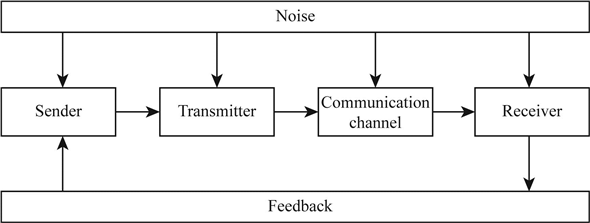 Explanation for the diagram:
• Sender: A message is initiated by a sender to the receiver. The sender of the message is a firm.
• Transmitter : A firm through its ad agency or marketing departments transmits the message of the product to the consumer. It can be done by various medium of communication. Transmission involves encoding of a message. Encoding transforms the sender's ideas and innovations to a message through words and pictures.
• Communication channel : Communication channel is used as a sender's medium to interact with the customers. The selection of proper communication channel is based on the target audience. The various forms of communication channels are blogs, websites, internet, print advertisements, broadcasting, social media sites, in-store displays, and direct mail.
• Receiver : The message initiated by the sender is received by the receiver. He reads, hears, or processes the message that he received. The process of receiver interpreting the sender's message is decoding. Many times, the receiver does not decode the message properly because of the noises that surround the message.
• Feedback : Feedback ensures that the receiver has received the message properly though the medium and decoded properly. It is necessary for both oral and written communication.
• Noise : Noise is a barrier to an effective communication process. It creates interference or causes distractions for the receiver to receive the message. It affects the clarity of the message. The difference between the encoded message and decoded message is the noise.
2. AIDA Model
An advertisement should grab the attention of audience and motivate them towards purchase of that particular product. An effective advertisement can make the customer to buy a product. AIDA model is a model used by the marketers to express what happens when a customer connects himself with an advertisement.
AIDA is acronym. It is also called as "think, feel, do" model. AIDA is a four stage process that helps the marketers to develop a marketing strategy. The following diagram illustrates what AIDA stands for:
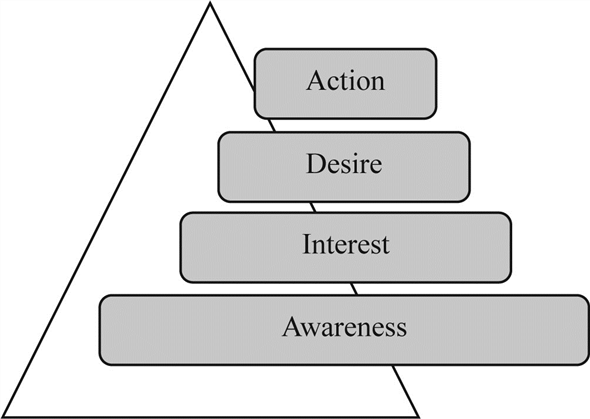 Explanation for the acronym:
Awareness : A product must have the consumer's awareness to become successful. A customer must be able to recognize the brand and hence the brand awareness is very important.
Interest : Once the marketer has grabbed the attention of the customer, he has to boost the interest level. It is fulfilled by advertisements with attributes that increases the audience's interest levels.
Desire : The marketer needs to convert the interest of a customer toward a product to desire for a product. An advertisement should motivate the buyer to purchase a product even when there is no need for that particular product.
Action : It is an ultimate goal for any marketer to make the customer purchase their product. So, any marketer will create awareness among the target audience, then boost the interest level and induce them to buy the product. The final process is the action where the customers purchase the product.
Communication is a part of promotion that includes advertising, personal selling, sales promotion, public relation, online marketing, and direct marketing. The following are the three main elements of the communication:
• Consumer
• Channels of communication
• Evaluation of the results
1. Communication process:
In the present days, it is a back-breaking task for a firm to understand, reach, and satisfy the customers. The marketing communication helps the firm to influence the consumers toward buying the product. The following diagram illustrates the process of communication:
Explanation for the diagram: • Sender: A message is initiated by a sender to the receiver. The sender of the message is a firm.
• Transmitter : A firm through its ad agency or marketing departments transmits the message of the product to the consumer. It can be done by various medium of communication. Transmission involves encoding of a message. Encoding transforms the sender's ideas and innovations to a message through words and pictures.
• Communication channel : Communication channel is used as a sender's medium to interact with the customers. The selection of proper communication channel is based on the target audience. The various forms of communication channels are blogs, websites, internet, print advertisements, broadcasting, social media sites, in-store displays, and direct mail.
• Receiver : The message initiated by the sender is received by the receiver. He reads, hears, or processes the message that he received. The process of receiver interpreting the sender's message is decoding. Many times, the receiver does not decode the message properly because of the noises that surround the message.
• Feedback : Feedback ensures that the receiver has received the message properly though the medium and decoded properly. It is necessary for both oral and written communication.
• Noise : Noise is a barrier to an effective communication process. It creates interference or causes distractions for the receiver to receive the message. It affects the clarity of the message. The difference between the encoded message and decoded message is the noise.
2. AIDA Model
An advertisement should grab the attention of audience and motivate them towards purchase of that particular product. An effective advertisement can make the customer to buy a product. AIDA model is a model used by the marketers to express what happens when a customer connects himself with an advertisement.
AIDA is acronym. It is also called as "think, feel, do" model. AIDA is a four stage process that helps the marketers to develop a marketing strategy. The following diagram illustrates what AIDA stands for:
Explanation for the acronym: Awareness : A product must have the consumer's awareness to become successful. A customer must be able to recognize the brand and hence the brand awareness is very important.
Interest : Once the marketer has grabbed the attention of the customer, he has to boost the interest level. It is fulfilled by advertisements with attributes that increases the audience's interest levels.
Desire : The marketer needs to convert the interest of a customer toward a product to desire for a product. An advertisement should motivate the buyer to purchase a product even when there is no need for that particular product.
Action : It is an ultimate goal for any marketer to make the customer purchase their product. So, any marketer will create awareness among the target audience, then boost the interest level and induce them to buy the product. The final process is the action where the customers purchase the product.
What are the different elements of an IMC program?
Integrated Marketing Communication
Communication is a part of promotion that includes advertising, personal selling, sales promotion, public relation, online marketing, and direct marketing. The following are the three main elements of the communication:
• Consumer
• Channels of communication
• Evaluation of the results
Elements of Integrated Marketing Communication (IMC)
Integrated marketing communication strategy helps to convey a right message to a right individual at a right time. The sender of a message can reach the right individual through following two axes:
• Passive and interactive (based on the customers)• Offline and Online
The following diagram illustrates expansion of elements of the IMC and the ways through which the sender (marketer) communicates the customers:
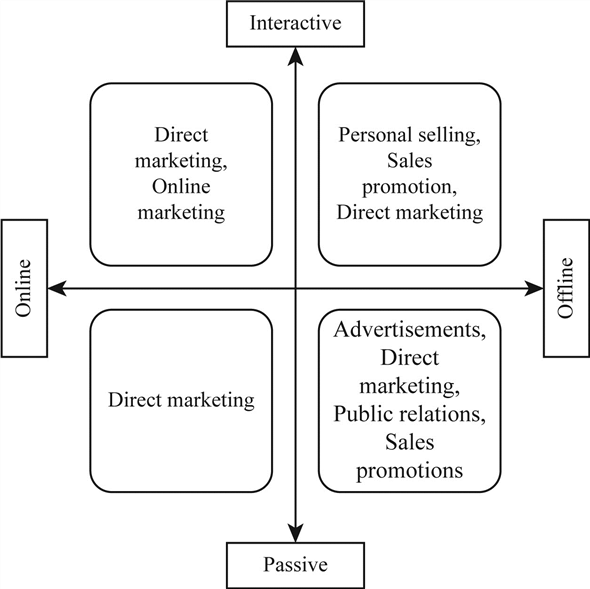 • The diagram explains that the direct marketing appears in all the boxes. It might be interactive and offline, offline and passive, passive and online, and interactive and online.
• The traditional media such as advertising, public relations, and sales promotions have expanded themselves from offline to combination of offline and online.
The following are some of the elements of IMC:
• Advertising : A particular time or space is purchased by a marketer for placing their announcements and messages about the product. Traditional advertising was persuasive and offline. However, presently the marketers use interactive and online advertisements to attract more customers.
• Public relations : It is a communication strategy followed by marketers to spread information among the public. It helps the organization to maintain a positive image and maintain proper relationship. The public relations is passive and offline.
• Sales promotions : It is a special incentive given to a customer to induce them to purchase a product or service. These special incentives include coupons, rebates, free samples, and point-of-purchase displays. The sales promotions are passive and offline.
• Personal selling : It is a communication technique that happens between a buyer and seller. The seller directly influences buyer's purchase decision through face-to-face video teleconferencing and internet. Although personal selling costs high, it is very effective. The personal selling is interactive and offline.
• Direct marketing : It is a marketing technique where the targeted customers are directly communicated and responses are being gathered. It includes mail, mobile marketing, and catalogs. The direct marketing might be interactive and offline, offline and passive, passive and online, and interactive and online.
• Online marketing : It is a form of marketing technique done through electronic media such as websites, blogs, and social media. The online marketing is interactive and online.
Communication is a part of promotion that includes advertising, personal selling, sales promotion, public relation, online marketing, and direct marketing. The following are the three main elements of the communication:
• Consumer
• Channels of communication
• Evaluation of the results
Elements of Integrated Marketing Communication (IMC)
Integrated marketing communication strategy helps to convey a right message to a right individual at a right time. The sender of a message can reach the right individual through following two axes:
• Passive and interactive (based on the customers)• Offline and Online
The following diagram illustrates expansion of elements of the IMC and the ways through which the sender (marketer) communicates the customers:
• The diagram explains that the direct marketing appears in all the boxes. It might be interactive and offline, offline and passive, passive and online, and interactive and online.• The traditional media such as advertising, public relations, and sales promotions have expanded themselves from offline to combination of offline and online.
The following are some of the elements of IMC:
• Advertising : A particular time or space is purchased by a marketer for placing their announcements and messages about the product. Traditional advertising was persuasive and offline. However, presently the marketers use interactive and online advertisements to attract more customers.
• Public relations : It is a communication strategy followed by marketers to spread information among the public. It helps the organization to maintain a positive image and maintain proper relationship. The public relations is passive and offline.
• Sales promotions : It is a special incentive given to a customer to induce them to purchase a product or service. These special incentives include coupons, rebates, free samples, and point-of-purchase displays. The sales promotions are passive and offline.
• Personal selling : It is a communication technique that happens between a buyer and seller. The seller directly influences buyer's purchase decision through face-to-face video teleconferencing and internet. Although personal selling costs high, it is very effective. The personal selling is interactive and offline.
• Direct marketing : It is a marketing technique where the targeted customers are directly communicated and responses are being gathered. It includes mail, mobile marketing, and catalogs. The direct marketing might be interactive and offline, offline and passive, passive and online, and interactive and online.
• Online marketing : It is a form of marketing technique done through electronic media such as websites, blogs, and social media. The online marketing is interactive and online.
Why is the objective-and-task method of setting an IMC budget better than the rule-of-thumb methods?
2. How do firms use GRP to evaluate the effectiveness of traditional media?
3. How would a firm evaluate the effectiveness of its Google advertising?
2. How do firms use GRP to evaluate the effectiveness of traditional media?
3. How would a firm evaluate the effectiveness of its Google advertising?
Integrated Marketing Communication
Integrated marketing communication (IMC) is a part of promotion that includes advertising, personal selling, sales promotion, public relation, online marketing, and direct marketing. The following are the three main elements of the communication:
• Consumer
• Channels of communication
• Evaluation of the results
1. Allocation of IMC budget:
Firms use various methods to setup and allocate IMC Budget. The following are the common methods used for allocation:
• Objective-and-task method
• Rule-of-thumb method
Objective-and-task method:
In objective-and-task method, the firm first determines the amount of budget required to set up a specific tasks that further helps to attain the communication objectives. The following are steps to use the method:
• Determine the communication objectives
• Determine the media to reach the customers
• Calculate the amount of cost to achieve the set objectives
Follow the above set of steps for various products of the firm. Then, add all the cost of individual plans to arrive at the total marketing communication budget.
Rule-of-thumb method:
In rule-of-thumb method, the firms use the cost of prior sales and communication activities to find out the present communication budget. It is very easy for a firm to implement. The various methods of rule-of-thumb method are as follows:
• Competitive party
• Percentage-of-sales
• Available budget
Conclusion:
It is very essential for a firm that it must use all the methods for various rounds with the managers and finally IMC budget should be implemented. No one method can be used separately.
2. Traditional Media:
It is the oldest form of media used for marketing the products and services. It includes advertising, sales promotions, public relations, and direct marketing using televisions, newspapers, magazines, and books. The traditional media marketing is evaluated using the gross rating points.
Use of Gross Rating Points:
The gross rating points (GRP) are expressed as a percentage. It is calculated as follows:
 It is very difficult for a firm to determine the single exposure toward the communication. Therefore, the firm uses the total number of consumers as frequency. These gross rating points refer to the percentage of the target audience who are allowed to specific marketing communication.
The GRP can be used to measure the advertisements, print, radio, and televisions. Comparisons should be made on single medium. It is not possible to compare two different medium.
3. Effectiveness of G Advertising:
G is an eminent search engine used by many users. Many firms in the world use this search engine to advertise their products and to reach the end customers. The firms determine the effectiveness of search engine advertising by measuring the following factors:
• Reach
• Relevance
• Return on investment
• Firms determine the reach as follows:
• Number of impressions: Number of times that advertisement appears on the screen and click-through rate.
• Click-through rate : It is the number of users clicked on the advertisement link. The formula to calculate the click-through rate is
 .
.
• Firms determine the relevance as follows:
• Relevance is determining the measure of usefulness of the advertisement message, for a customer using the search engine.
• It is determined by a system designed for G search engine.
• It provides a quality score in order to measure the relevancy of the keyword between the customers and query for a product and the keyword for the advertisement.
• Firms determine the return on investment as follows:
The firms can determine the return on investment for an advertisement using the following formula:

Integrated marketing communication (IMC) is a part of promotion that includes advertising, personal selling, sales promotion, public relation, online marketing, and direct marketing. The following are the three main elements of the communication:
• Consumer
• Channels of communication
• Evaluation of the results
1. Allocation of IMC budget:
Firms use various methods to setup and allocate IMC Budget. The following are the common methods used for allocation:
• Objective-and-task method
• Rule-of-thumb method
Objective-and-task method:
In objective-and-task method, the firm first determines the amount of budget required to set up a specific tasks that further helps to attain the communication objectives. The following are steps to use the method:
• Determine the communication objectives
• Determine the media to reach the customers
• Calculate the amount of cost to achieve the set objectives
Follow the above set of steps for various products of the firm. Then, add all the cost of individual plans to arrive at the total marketing communication budget.
Rule-of-thumb method:
In rule-of-thumb method, the firms use the cost of prior sales and communication activities to find out the present communication budget. It is very easy for a firm to implement. The various methods of rule-of-thumb method are as follows:
• Competitive party
• Percentage-of-sales
• Available budget
Conclusion:
It is very essential for a firm that it must use all the methods for various rounds with the managers and finally IMC budget should be implemented. No one method can be used separately.
2. Traditional Media:
It is the oldest form of media used for marketing the products and services. It includes advertising, sales promotions, public relations, and direct marketing using televisions, newspapers, magazines, and books. The traditional media marketing is evaluated using the gross rating points.
Use of Gross Rating Points:
The gross rating points (GRP) are expressed as a percentage. It is calculated as follows:
It is very difficult for a firm to determine the single exposure toward the communication. Therefore, the firm uses the total number of consumers as frequency. These gross rating points refer to the percentage of the target audience who are allowed to specific marketing communication.The GRP can be used to measure the advertisements, print, radio, and televisions. Comparisons should be made on single medium. It is not possible to compare two different medium.
3. Effectiveness of G Advertising:
G is an eminent search engine used by many users. Many firms in the world use this search engine to advertise their products and to reach the end customers. The firms determine the effectiveness of search engine advertising by measuring the following factors:
• Reach
• Relevance
• Return on investment
• Firms determine the reach as follows:
• Number of impressions: Number of times that advertisement appears on the screen and click-through rate.
• Click-through rate : It is the number of users clicked on the advertisement link. The formula to calculate the click-through rate is
.• Firms determine the relevance as follows:
• Relevance is determining the measure of usefulness of the advertisement message, for a customer using the search engine.
• It is determined by a system designed for G search engine.
• It provides a quality score in order to measure the relevancy of the keyword between the customers and query for a product and the keyword for the advertisement.
• Firms determine the return on investment as follows:
The firms can determine the return on investment for an advertisement using the following formula:
Unlock Deck
Unlock for access to all 3 flashcards in this deck.






