







 Chat with AI

Deck 2: Guidelines for Designing a Healthy Diet
Full screen (f)

Question

Question
Question
Question
Question
Applying the Nutrition Facts Label to Your Daily Food Choices
Imagine that you are at the supermarket looking for a quick meal before a busy evening. In the frozen food section, you find two brands of frozen cheese manicotti (see labels a and b). Which of the two brands would you choose? What information on the Nutrition Facts label in the figure contributed to this decision?______________________________________________________________________________________________________________________________________________________________________________________________________________________________________________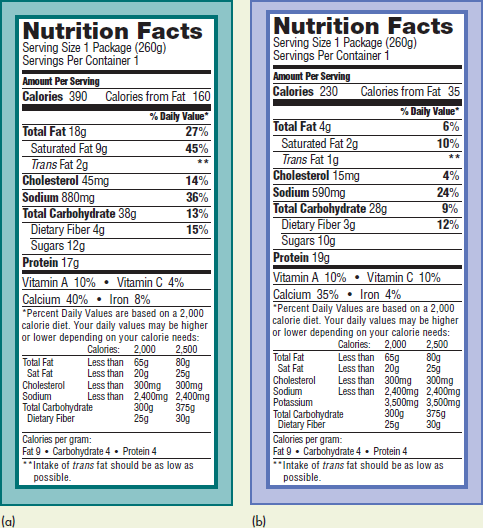
Imagine that you are at the supermarket looking for a quick meal before a busy evening. In the frozen food section, you find two brands of frozen cheese manicotti (see labels a and b). Which of the two brands would you choose? What information on the Nutrition Facts label in the figure contributed to this decision?______________________________________________________________________________________________________________________________________________________________________________________________________________________________________________
Question
Question
Question
Question
Question
Question
Question
Question
Question
Question
Question
Question
Question
Does your Diet Compare to MyPlate?
Using your food-intake record from Chapter 1, place each food item in the appropriate group of the accompanying MyPlate chart. That is, for each food item, indicate how many servings it contributes to each group based on the amount you ate (see Food Composition Table Supplement for serving sizes). Many of your food choices may contribute to more than one group. For example, spaghetti with meat sauce contributes to three categories; grains, vegetables, and protein. After entering all the values, add the number of servings consumed in each group. Finally, compare your total in each food group with the recommended number of servings shown in Table 2-6 or obtained from the www.ChooseMyPlate.gov website. Enter a minus sign (-) if your total falls below the recommendation or a plus sign (+) if it equals or exceeds the recommendation.
Indicate the number of servings from MyPlate that each food yields: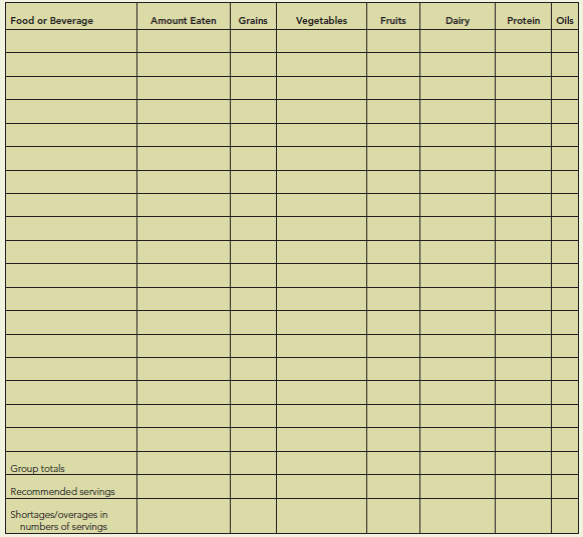
Using your food-intake record from Chapter 1, place each food item in the appropriate group of the accompanying MyPlate chart. That is, for each food item, indicate how many servings it contributes to each group based on the amount you ate (see Food Composition Table Supplement for serving sizes). Many of your food choices may contribute to more than one group. For example, spaghetti with meat sauce contributes to three categories; grains, vegetables, and protein. After entering all the values, add the number of servings consumed in each group. Finally, compare your total in each food group with the recommended number of servings shown in Table 2-6 or obtained from the www.ChooseMyPlate.gov website. Enter a minus sign (-) if your total falls below the recommendation or a plus sign (+) if it equals or exceeds the recommendation.
Indicate the number of servings from MyPlate that each food yields:
Question
Question
Question
Question
Question
Question
Are You Putting Health Advice into Practice?
The broad range of diet and physical activity advice provided by the 2010 Dietary Guidelines for Americans, 2008 Physical Activity Guidelines for Americans, and MyPlate can seem overwhelming. Fill out the following inventory to see how well you comply with the basic intent of these consumer health guidelines and identify areas in which you need improvement.
Build a Healthy Plate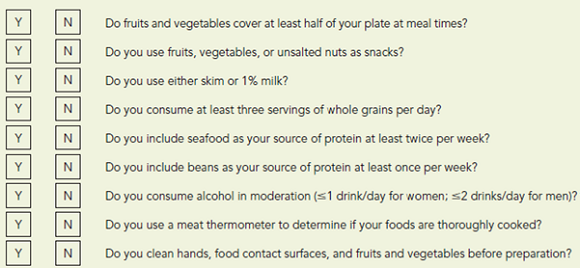
Cut Back on Foods High in Solid Fats, Added Sugars, and Salt
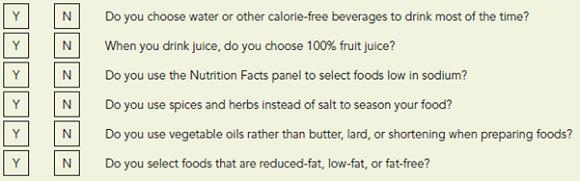
Eat the Right Amount of Calories for You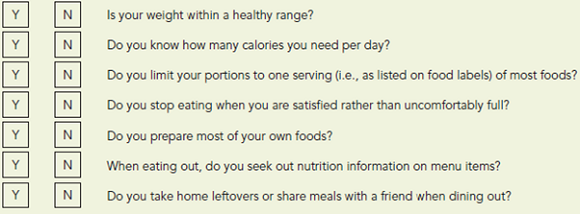
Be Physically Active Your Way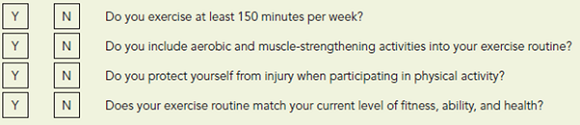
The broad range of diet and physical activity advice provided by the 2010 Dietary Guidelines for Americans, 2008 Physical Activity Guidelines for Americans, and MyPlate can seem overwhelming. Fill out the following inventory to see how well you comply with the basic intent of these consumer health guidelines and identify areas in which you need improvement.
Build a Healthy Plate
Cut Back on Foods High in Solid Fats, Added Sugars, and Salt
Eat the Right Amount of Calories for You
Be Physically Active Your Way
Question

Unlock Deck
Sign up to unlock the cards in this deck!
Unlock Deck
Unlock Deck
1/25

Play

Full screen (f)
Deck 2: Guidelines for Designing a Healthy Diet
1
How would you explain the concepts of nutrient density and energy density to a fourth-grade class?
We usually prefer foodstuffs having higher nutrient value compared to calories. Similarly, when comparing foodstuffs based on calories, we prefer those having lesser calories. Every food has nutrients we desire and calories that we less prefer. To identify the better foodstuff, they are classified as nutrient dense and energy dense.When a food item provides more nutrients and less calories compared to another one that provides the same nutrients but more calories, we refer to the former as being nutrient dense. A nutrient dense food is one that has a lot of nutrients but very less calories.
Vegetables and eggs are nutrient-dense foods, while food items such as alcohol and beverages are not considered nutrient-dense due to their high sugar content.
When it comes to consuming calories, we prefer to eat a foodstuff that provides lesser calories. But it is possible that two ingredients provide the same amount of energy but weigh differently. When a food item provides more energy but weighs less than any other food item that provides the same number of calories, that food item is called energy dense.We must prefer lower energy-density items that are low in energy such as fish, poultry, egg-white and legumes, instead of beverages and candies which are high energy-density items and provide a greater number of calories. Low energy-density items help in providing satiety without adding more calories.
Vegetables and eggs are nutrient-dense foods, while food items such as alcohol and beverages are not considered nutrient-dense due to their high sugar content.
When it comes to consuming calories, we prefer to eat a foodstuff that provides lesser calories. But it is possible that two ingredients provide the same amount of energy but weigh differently. When a food item provides more energy but weighs less than any other food item that provides the same number of calories, that food item is called energy dense.We must prefer lower energy-density items that are low in energy such as fish, poultry, egg-white and legumes, instead of beverages and candies which are high energy-density items and provide a greater number of calories. Low energy-density items help in providing satiety without adding more calories.
2
The most common type of undernutrition in industrialized nations, such as the United States, is
A) anorexia.
B) protein deficiency.
C) obesity.
D) iron deficiency.
A) anorexia.
B) protein deficiency.
C) obesity.
D) iron deficiency.
Anorexia is a psychological or emotional disorder that makes an individual refuse to take food. Hence, option (a) is incorrect.
Obesity is a disorder that occurs due to over weight gain. Hence, option (b) is incorrect.
Protein deficiency occurs due to lack of protein in diet. As the major food types of countries like the United States include protein food such as meat, protein deficiency is not a common type of undernutrition. Hence, option (c) is incorrect.
One of the reasons for iron deficiency is the dietary intake that lacks iron. Most processed foods lack iron. So, individuals who adapt to consuming processed foods, suffer from iron deficiency. As chances of processed food intake is more in developed nations like the United States, iron deficiency is the most common type of undernutrition that prevails.
Hence, option (d) is correct.
Obesity is a disorder that occurs due to over weight gain. Hence, option (b) is incorrect.
Protein deficiency occurs due to lack of protein in diet. As the major food types of countries like the United States include protein food such as meat, protein deficiency is not a common type of undernutrition. Hence, option (c) is incorrect.
One of the reasons for iron deficiency is the dietary intake that lacks iron. Most processed foods lack iron. So, individuals who adapt to consuming processed foods, suffer from iron deficiency. As chances of processed food intake is more in developed nations like the United States, iron deficiency is the most common type of undernutrition that prevails.
Hence, option (d) is correct.
3
A meal of a bean burrito, tossed salad, and glass of milk represents foods from all MyPlate food groups except
a. dairy.
b. protein.
c. vegetables.
d. fruits.
a. dairy.
b. protein.
c. vegetables.
d. fruits.
Bean burrito is an exclusive protein rich vegetarian recipe that has various vegetables and beans as its ingredients. Tossed salad is a vegetable salad that is prepared along with cheese, and almonds. Milk is a liquid food that is a dairy product.
The above mentioned foods represent dairy, vegetables and proteins of a MyPlate except Fruits. So, the option (d) is correct , while the rest of the options are incorrect.
The above mentioned foods represent dairy, vegetables and proteins of a MyPlate except Fruits. So, the option (d) is correct , while the rest of the options are incorrect.
4
What would you list as the top five sources of reliable nutrition information? What makes these sources reliable?
Unlock Deck
Unlock for access to all 25 flashcards in this deck.
Unlock Deck
k this deck
5
Applying the Nutrition Facts Label to Your Daily Food Choices
Imagine that you are at the supermarket looking for a quick meal before a busy evening. In the frozen food section, you find two brands of frozen cheese manicotti (see labels a and b). Which of the two brands would you choose? What information on the Nutrition Facts label in the figure contributed to this decision?______________________________________________________________________________________________________________________________________________________________________________________________________________________________________________
Imagine that you are at the supermarket looking for a quick meal before a busy evening. In the frozen food section, you find two brands of frozen cheese manicotti (see labels a and b). Which of the two brands would you choose? What information on the Nutrition Facts label in the figure contributed to this decision?______________________________________________________________________________________________________________________________________________________________________________________________________________________________________________
Unlock Deck
Unlock for access to all 25 flashcards in this deck.
Unlock Deck
k this deck
6
Andy would benefit from more variety in his diet. What are some practical tips he can use to increase his fruit and vegetable intake?
Unlock Deck
Unlock for access to all 25 flashcards in this deck.
Unlock Deck
k this deck
7
Trace the progression, in terms of physical results, of a person who went from an overnourished to an undernourished state.
Unlock Deck
Unlock for access to all 25 flashcards in this deck.
Unlock Deck
k this deck
8
Shannon has grown up eating the typical American diet. Having recently read and heard many media reports about the relationship between nutrition and health, she is beginning to look critically at her diet and is considering making changes. However, she doesn't know where to begin. What advice would you give her?
Unlock Deck
Unlock for access to all 25 flashcards in this deck.
Unlock Deck
k this deck
9
The Dietary Guidelines for Americans were recently revised in
A) 2000.
B) 2005.
C) 2008.
D) 2010.
A) 2000.
B) 2005.
C) 2008.
D) 2010.
Unlock Deck
Unlock for access to all 25 flashcards in this deck.
Unlock Deck
k this deck
10
How could the nutritional state of the person at each state in question 3 be evaluated?
Unlock Deck
Unlock for access to all 25 flashcards in this deck.
Unlock Deck
k this deck
11
The term Daily Value is used on
A) restaurant menus.
B) food labels.
C) medical charts.
D) None of the above.
A) restaurant menus.
B) food labels.
C) medical charts.
D) None of the above.
Unlock Deck
Unlock for access to all 25 flashcards in this deck.
Unlock Deck
k this deck
12
Describe the philosophy underlying the creation of MyPlate. What dietary changes would you need to make to comply with the healthy eating guidelines exemplified by MyPlate on a regular basis?
Unlock Deck
Unlock for access to all 25 flashcards in this deck.
Unlock Deck
k this deck
13
The Tolerable Upper Intake Level, or UL, is used to
A) estimate calorie needs of the average person.
B) evaluate the highest amount of daily nutrient intake unlikely to cause adverse health effects.
C) evaluate your current intake for a specific nutrient.
D) compare the nutrient content of a food to approximate human needs.
A) estimate calorie needs of the average person.
B) evaluate the highest amount of daily nutrient intake unlikely to cause adverse health effects.
C) evaluate your current intake for a specific nutrient.
D) compare the nutrient content of a food to approximate human needs.
Unlock Deck
Unlock for access to all 25 flashcards in this deck.
Unlock Deck
k this deck
14
Describe the intent of the Dietary Guidelines for Americans. Point out one criticism for their general application to all North American adults.
Unlock Deck
Unlock for access to all 25 flashcards in this deck.
Unlock Deck
k this deck
15
The current food label must list
A) a picture of the product.
B) a uniform and realistic serving size.
C) the RDA for each age group.
D) ingredients alphabetically.
A) a picture of the product.
B) a uniform and realistic serving size.
C) the RDA for each age group.
D) ingredients alphabetically.
Unlock Deck
Unlock for access to all 25 flashcards in this deck.
Unlock Deck
k this deck
16
Anthropometric measurements include
A) height, weight, skinfolds, and body circumferences.
B) blood concentrations of nutrients.
C) a diet history of the previous days' intake.
D) blood levels of enzyme activities.
A) height, weight, skinfolds, and body circumferences.
B) blood concentrations of nutrients.
C) a diet history of the previous days' intake.
D) blood levels of enzyme activities.
Unlock Deck
Unlock for access to all 25 flashcards in this deck.
Unlock Deck
k this deck
17
Based on the discussion of the Dietary Guidelines for Americans, suggest two key dietary changes the typical North American adult should consider making.
Unlock Deck
Unlock for access to all 25 flashcards in this deck.
Unlock Deck
k this deck
18
Does your Diet Compare to MyPlate?
Using your food-intake record from Chapter 1, place each food item in the appropriate group of the accompanying MyPlate chart. That is, for each food item, indicate how many servings it contributes to each group based on the amount you ate (see Food Composition Table Supplement for serving sizes). Many of your food choices may contribute to more than one group. For example, spaghetti with meat sauce contributes to three categories; grains, vegetables, and protein. After entering all the values, add the number of servings consumed in each group. Finally, compare your total in each food group with the recommended number of servings shown in Table 2-6 or obtained from the www.ChooseMyPlate.gov website. Enter a minus sign (-) if your total falls below the recommendation or a plus sign (+) if it equals or exceeds the recommendation.
Indicate the number of servings from MyPlate that each food yields:
Using your food-intake record from Chapter 1, place each food item in the appropriate group of the accompanying MyPlate chart. That is, for each food item, indicate how many servings it contributes to each group based on the amount you ate (see Food Composition Table Supplement for serving sizes). Many of your food choices may contribute to more than one group. For example, spaghetti with meat sauce contributes to three categories; grains, vegetables, and protein. After entering all the values, add the number of servings consumed in each group. Finally, compare your total in each food group with the recommended number of servings shown in Table 2-6 or obtained from the www.ChooseMyPlate.gov website. Enter a minus sign (-) if your total falls below the recommendation or a plus sign (+) if it equals or exceeds the recommendation.
Indicate the number of servings from MyPlate that each food yields:
Unlock Deck
Unlock for access to all 25 flashcards in this deck.
Unlock Deck
k this deck
19
Dietary supplements are tightly regulated by the
A) FDA.
B) USDA.
C) FTC.
D) None of the above.
A) FDA.
B) USDA.
C) FTC.
D) None of the above.
Unlock Deck
Unlock for access to all 25 flashcards in this deck.
Unlock Deck
k this deck
20
Among your classmates, you observe that students who consume coffee get better grades. Provide an example of how you could use the scientific method to examine the effects of coffee consumption on academic performance.
Unlock Deck
Unlock for access to all 25 flashcards in this deck.
Unlock Deck
k this deck
21
How do RDAs and AIs differ from Daily Values in intention and application?
Unlock Deck
Unlock for access to all 25 flashcards in this deck.
Unlock Deck
k this deck
22
Foods with high nutrient density offer the ______ nutrients for the ______ calories.
A) least, lowest
B) least, most
C) most, lowest
D) most, most
A) least, lowest
B) least, most
C) most, lowest
D) most, most
Unlock Deck
Unlock for access to all 25 flashcards in this deck.
Unlock Deck
k this deck
23
The scientific method begins with
A) a hypothesis.
B) research experiments.
C) publication of research findings.
D) observations made and questions asked.
A) a hypothesis.
B) research experiments.
C) publication of research findings.
D) observations made and questions asked.
Unlock Deck
Unlock for access to all 25 flashcards in this deck.
Unlock Deck
k this deck
24
Are You Putting Health Advice into Practice?
The broad range of diet and physical activity advice provided by the 2010 Dietary Guidelines for Americans, 2008 Physical Activity Guidelines for Americans, and MyPlate can seem overwhelming. Fill out the following inventory to see how well you comply with the basic intent of these consumer health guidelines and identify areas in which you need improvement.
Build a Healthy Plate
Cut Back on Foods High in Solid Fats, Added Sugars, and Salt
Eat the Right Amount of Calories for You
Be Physically Active Your Way
The broad range of diet and physical activity advice provided by the 2010 Dietary Guidelines for Americans, 2008 Physical Activity Guidelines for Americans, and MyPlate can seem overwhelming. Fill out the following inventory to see how well you comply with the basic intent of these consumer health guidelines and identify areas in which you need improvement.
Build a Healthy Plate
Cut Back on Foods High in Solid Fats, Added Sugars, and Salt
Eat the Right Amount of Calories for You
Be Physically Active Your Way
Unlock Deck
Unlock for access to all 25 flashcards in this deck.
Unlock Deck
k this deck
25
Dietitians encourage all people to read labels on food packages to learn more about what they eat. What four nutrients could easily be tracked in your diet if you read the Nutrition Facts panels regularly on food products?
Unlock Deck
Unlock for access to all 25 flashcards in this deck.
Unlock Deck
k this deck
Unlock Deck
Unlock for access to all 25 flashcards in this deck.






