







 Chat with AI

Deck 19: Star Formation: a Traumatic Birth
Full screen (f)

Question

Question
Question
Question
Question
Question
Question
Question
Question
Question
Question
Question
Question
Question
Question
Question
Question
Question
Question
Question
Question
Question
Question
Question
Question
Question
Question
Question
Question
Question
Question
Question
Question
Question
Question
Question
Question
Question
Question
Question
Question
Question
Question
Question
Question
Question
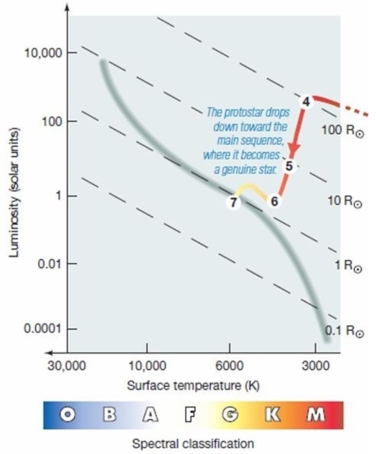 The red evolutionary track illustrated in the figure above (similar to fig 19.6 in your textbook),that goes from point 4 to 5 to 6 to 7 shows:
A)a star nearing the end of its life and becoming a red giant.
B)a star nearing the end of its life and becoming a white dwarf.
C)a protostar forming into a main sequence star.
D)the changes that happen to a star during its red giant phase.
E)the locations on the H-R diagram for a small cluster of stars.
Question
Question
Question
Question
Question
Question
Question
Question
Question
Question
Question
Question
Question
Question
Question
Question
Question
Question
Question
Question
Question
Question
Question
Question
Question
Question
Question
Question
Question
Question
Question
Question
Question
Question

Unlock Deck
Sign up to unlock the cards in this deck!
Unlock Deck
Unlock Deck
1/114

Play

Full screen (f)
Deck 19: Star Formation: a Traumatic Birth
1
If a star is spinning rapidly, this may limit its final mass.
True
2
At the end of the Kelvin-Helmholtz contraction, a star is hundreds of times brighter than itwill be as a main sequence star.
True
3
The fundamental difference between a protostar and a star is that the latter has nuclear fusionas its energy source and the former does not.
True
4
The evolution of a protostar slows significantly as it approaches the main sequence.
Unlock Deck
Unlock for access to all 114 flashcards in this deck.
Unlock Deck
k this deck
5
The birth of stars is a battle between gravity and radiation pressure.
Unlock Deck
Unlock for access to all 114 flashcards in this deck.
Unlock Deck
k this deck
6
Rotation and magnetism both play key roles in protostar formation.
Unlock Deck
Unlock for access to all 114 flashcards in this deck.
Unlock Deck
k this deck
7
A stage 4 protostar may temporarily be thousands of times more luminous than the Sun.
Unlock Deck
Unlock for access to all 114 flashcards in this deck.
Unlock Deck
k this deck
8
Rotation causes the cocoon of dust to flatten into a dusty disk around protostars.
Unlock Deck
Unlock for access to all 114 flashcards in this deck.
Unlock Deck
k this deck
9
Magnetic fields enhance the collapse of a gas cloud in star formation with bipolar flows.
Unlock Deck
Unlock for access to all 114 flashcards in this deck.
Unlock Deck
k this deck
10
It takes about 1032 hydrogen atoms to make a star.
Unlock Deck
Unlock for access to all 114 flashcards in this deck.
Unlock Deck
k this deck
11
As a protostar evolves from stage 4 to stage 6, it gets hotter but much less bright.
Unlock Deck
Unlock for access to all 114 flashcards in this deck.
Unlock Deck
k this deck
12
Stars evolve to the upper left along the main sequence, after forming in the middle.
Unlock Deck
Unlock for access to all 114 flashcards in this deck.
Unlock Deck
k this deck
13
A protostar of 20 solar masses will probably turn into a type O main sequence star.
Unlock Deck
Unlock for access to all 114 flashcards in this deck.
Unlock Deck
k this deck
14
Brown dwarfs most commonly form in the nebular disk around another object, much like aplanet.
Unlock Deck
Unlock for access to all 114 flashcards in this deck.
Unlock Deck
k this deck
15
Rotation of the protostar helps generate the magnetic fields and bipolar flows.
Unlock Deck
Unlock for access to all 114 flashcards in this deck.
Unlock Deck
k this deck
16
Many of the brightest stars we see are only a few million years old.
Unlock Deck
Unlock for access to all 114 flashcards in this deck.
Unlock Deck
k this deck
17
Collisions between galaxies tend to destroy, not create, stars.
Unlock Deck
Unlock for access to all 114 flashcards in this deck.
Unlock Deck
k this deck
18
A protostar of 20 solar masses should form a star that will stay on the main sequence twentytimes longer than our Sun.
Unlock Deck
Unlock for access to all 114 flashcards in this deck.
Unlock Deck
k this deck
19
Type M stars evolve to the main sequence faster than our G type Sun.
Unlock Deck
Unlock for access to all 114 flashcards in this deck.
Unlock Deck
k this deck
20
Brown dwarfs are failed stars, never igniting their hydrogen fusion.
Unlock Deck
Unlock for access to all 114 flashcards in this deck.
Unlock Deck
k this deck
21
As a star forms, the photosphere first appears:
A)when the planetary nebula is expelled.
B)when the protostar forms.
C)when contraction slows down.
D)when nuclear fires ignite.
E)when the star reaches the main sequence.
A)when the planetary nebula is expelled.
B)when the protostar forms.
C)when contraction slows down.
D)when nuclear fires ignite.
E)when the star reaches the main sequence.
Unlock Deck
Unlock for access to all 114 flashcards in this deck.
Unlock Deck
k this deck
22
What is the force that keeps a main sequence star from collapsing on itself?
A)magnetism
B)gravitation
C)the strong force
D)radiation pressure
E)electron degeneration pressure
A)magnetism
B)gravitation
C)the strong force
D)radiation pressure
E)electron degeneration pressure
Unlock Deck
Unlock for access to all 114 flashcards in this deck.
Unlock Deck
k this deck
23
A newly formed protostar will radiate primarily at which wavelength?
A)visible light
B)X-ray
C)infrared
D)ultraviolet
E)radio
A)visible light
B)X-ray
C)infrared
D)ultraviolet
E)radio
Unlock Deck
Unlock for access to all 114 flashcards in this deck.
Unlock Deck
k this deck
24
Stars form from a collapsing cloud that fragments into smaller and smaller pieces. Thisprocess takes about:
A)10,000 years.
B)25,000 years.
C)100,000 years.
D)a few million years.
E)100 million years.
A)10,000 years.
B)25,000 years.
C)100,000 years.
D)a few million years.
E)100 million years.
Unlock Deck
Unlock for access to all 114 flashcards in this deck.
Unlock Deck
k this deck
25
Which event marks the birth of a star?
A)formation of the planetary nebula
B)fusion of hydrogen atoms into helium atoms
C)collapse of an interstellar cloud
D)formation of a photosphere
E)instability in an interstellar cloud
A)formation of the planetary nebula
B)fusion of hydrogen atoms into helium atoms
C)collapse of an interstellar cloud
D)formation of a photosphere
E)instability in an interstellar cloud
Unlock Deck
Unlock for access to all 114 flashcards in this deck.
Unlock Deck
k this deck
26
At what stage of evolution do T Tauri stars occur?
A)just as the collapsing cloud becomes luminous
B)when a protostar is on the verge of becoming a main sequence star
C)just prior to the protostar stage
D)just after the planetary nebula is expelled
E)after the star has established itself as a main sequence star
A)just as the collapsing cloud becomes luminous
B)when a protostar is on the verge of becoming a main sequence star
C)just prior to the protostar stage
D)just after the planetary nebula is expelled
E)after the star has established itself as a main sequence star
Unlock Deck
Unlock for access to all 114 flashcards in this deck.
Unlock Deck
k this deck
27
What is the force that keeps a main sequence star from blowing apart?
A)magnetism
B)gravitation
C)the strong force
D)radiation pressure
E)electron degeneration pressure
A)magnetism
B)gravitation
C)the strong force
D)radiation pressure
E)electron degeneration pressure
Unlock Deck
Unlock for access to all 114 flashcards in this deck.
Unlock Deck
k this deck
28
What happens when an interstellar cloud fragment shrinks?
A)It first becomes opaque.
B)Density rises.
C)Temperature rises.
D)Pressure rises.
E)all of the above
A)It first becomes opaque.
B)Density rises.
C)Temperature rises.
D)Pressure rises.
E)all of the above
Unlock Deck
Unlock for access to all 114 flashcards in this deck.
Unlock Deck
k this deck
29
Most stars are usually formed singularly or as binaries, not in clusters.
Unlock Deck
Unlock for access to all 114 flashcards in this deck.
Unlock Deck
k this deck
30
A typical protostar may be several thousand times more luminous than the Sun. What is thesource of this energy?
A)chemical combustion of hydrocarbons
B)nuclear fusion in its core
C)from the release of gravitational energy as the protostar continues to shrink
D)the ionization of the gas as it heats up
E)from nearby hot stars or supernovae that have initiated the star formation process
A)chemical combustion of hydrocarbons
B)nuclear fusion in its core
C)from the release of gravitational energy as the protostar continues to shrink
D)the ionization of the gas as it heats up
E)from nearby hot stars or supernovae that have initiated the star formation process
Unlock Deck
Unlock for access to all 114 flashcards in this deck.
Unlock Deck
k this deck
31
On an H-R diagram, a protostar would be:
A)above and to the right of the main sequence.
B)below and to the left of the main sequence.
C)below and near the right side of the main sequence.
D)above and near the upper left of the main sequence.
E)on the main sequence at the extreme lower right.
A)above and to the right of the main sequence.
B)below and to the left of the main sequence.
C)below and near the right side of the main sequence.
D)above and near the upper left of the main sequence.
E)on the main sequence at the extreme lower right.
Unlock Deck
Unlock for access to all 114 flashcards in this deck.
Unlock Deck
k this deck
32
During a protostar's T Tauri phase, it:
A)begins a period of reduced activity.
B)expands dramatically.
C)lies on the main sequence.
D)may develop very strong winds.
E)changes its spin direction.
A)begins a period of reduced activity.
B)expands dramatically.
C)lies on the main sequence.
D)may develop very strong winds.
E)changes its spin direction.
Unlock Deck
Unlock for access to all 114 flashcards in this deck.
Unlock Deck
k this deck
33
How long does it take for a star like our Sun to form?
A)100 thousand years
B)two million years
C)fifty million years
D)one billion years
E)4.6 billion years
A)100 thousand years
B)two million years
C)fifty million years
D)one billion years
E)4.6 billion years
Unlock Deck
Unlock for access to all 114 flashcards in this deck.
Unlock Deck
k this deck
34
Our Sun, along with most of the stars in our neighborhood, probably formed:
A)a few million years ago.
B)about 10 million years ago.
C)hundreds of millions of years ago.
D)billions of years ago.
E)at the beginning of the universe.
A)a few million years ago.
B)about 10 million years ago.
C)hundreds of millions of years ago.
D)billions of years ago.
E)at the beginning of the universe.
Unlock Deck
Unlock for access to all 114 flashcards in this deck.
Unlock Deck
k this deck
35
Shock waves from supernovae disrupt an interstellar cloud and prevent it from forming stars.
Unlock Deck
Unlock for access to all 114 flashcards in this deck.
Unlock Deck
k this deck
36
Most stars, probably all stars, formed:
A)in a binary system.
B)in a triple system.
C)in a cluster of stars.
D)all by themselves.
E)There is no theory to predict this.
A)in a binary system.
B)in a triple system.
C)in a cluster of stars.
D)all by themselves.
E)There is no theory to predict this.
Unlock Deck
Unlock for access to all 114 flashcards in this deck.
Unlock Deck
k this deck
37
Which statement about the stages of starbirth is FALSE?
A)At stage 1, only the cloud exists.
B)By stage 3, the star has formed a photosphere.
C)Nuclear reactions begin in the core by stage 4.
D)The T Tauri wind is prevalent in stage 5.
E)By stage 7, the star has reached the main sequence.
A)At stage 1, only the cloud exists.
B)By stage 3, the star has formed a photosphere.
C)Nuclear reactions begin in the core by stage 4.
D)The T Tauri wind is prevalent in stage 5.
E)By stage 7, the star has reached the main sequence.
Unlock Deck
Unlock for access to all 114 flashcards in this deck.
Unlock Deck
k this deck
38
Most stars in our part of the Galaxy are formed:
A)alone.
B)in open clusters of a few dozen.
C)in associations of thousands of stars across a spiral arm of the Galaxy.
D)in globular clusters of millions of stars.
E)in a singular event just after the Big Bang.
A)alone.
B)in open clusters of a few dozen.
C)in associations of thousands of stars across a spiral arm of the Galaxy.
D)in globular clusters of millions of stars.
E)in a singular event just after the Big Bang.
Unlock Deck
Unlock for access to all 114 flashcards in this deck.
Unlock Deck
k this deck
39
What is characteristic of a main sequence star?
A)It has a mass less than the Sun's.
B)It has rapid rotation and a strong stellar wind.
C)Nuclear fusion in the core varies due to the amount of gravitational contraction that occursand which heavy elements are produced.
D)The rate of nuclear energy generated in the hydrogen to helium fusing core equals the rateradiated from the surface.
E)All of the above are correct.
A)It has a mass less than the Sun's.
B)It has rapid rotation and a strong stellar wind.
C)Nuclear fusion in the core varies due to the amount of gravitational contraction that occursand which heavy elements are produced.
D)The rate of nuclear energy generated in the hydrogen to helium fusing core equals the rateradiated from the surface.
E)All of the above are correct.
Unlock Deck
Unlock for access to all 114 flashcards in this deck.
Unlock Deck
k this deck
40
What makes the subject of star formation so difficult and complex?
A)It is so slow that no visible proof of it exists.
B)Star formation is too expensive to study in detail.
C)Stars live too long to be observed from birth to death.
D)Clouds, fragments, protostars, stars, and nebulae all interact and influence each other.
E)Shock waves disrupt the orderly evolution of stars.
A)It is so slow that no visible proof of it exists.
B)Star formation is too expensive to study in detail.
C)Stars live too long to be observed from birth to death.
D)Clouds, fragments, protostars, stars, and nebulae all interact and influence each other.
E)Shock waves disrupt the orderly evolution of stars.
Unlock Deck
Unlock for access to all 114 flashcards in this deck.
Unlock Deck
k this deck
41
Which relationship concerning the mass of protostars is FALSE?
A)The more massive ones will reach the main sequence first.
B)The more massive ones will be the hottest and most luminous.
C)The more massive ones will be made of the heaviest elements.
D)The more massive ones are so luminous they ionize the gas, hence red H II regions.
E)The more massive ones create a lot of ultraviolet as well as visible light.
A)The more massive ones will reach the main sequence first.
B)The more massive ones will be the hottest and most luminous.
C)The more massive ones will be made of the heaviest elements.
D)The more massive ones are so luminous they ionize the gas, hence red H II regions.
E)The more massive ones create a lot of ultraviolet as well as visible light.
Unlock Deck
Unlock for access to all 114 flashcards in this deck.
Unlock Deck
k this deck
42
The single most important determinant of the temperature, density, radius, luminosity, andpace of evolution of a protostar is its:
A)chemical composition.
B)magnetic field.
C)spin.
D)mass.
E)molecular composition.
A)chemical composition.
B)magnetic field.
C)spin.
D)mass.
E)molecular composition.
Unlock Deck
Unlock for access to all 114 flashcards in this deck.
Unlock Deck
k this deck
43
Higher mass protostars enter the main sequence:
A)faster and at a higher luminosity and temperature.
B)faster and at a lower luminosity and temperature.
C)slower and at a higher luminosity and temperature.
D)slower and at a lower luminosity and temperature.
E)at the same rate, but at a higher luminosity and temperature.
A)faster and at a higher luminosity and temperature.
B)faster and at a lower luminosity and temperature.
C)slower and at a higher luminosity and temperature.
D)slower and at a lower luminosity and temperature.
E)at the same rate, but at a higher luminosity and temperature.
Unlock Deck
Unlock for access to all 114 flashcards in this deck.
Unlock Deck
k this deck
44
From stage 4 to stage 7 of star formation, the object plotted on the H-R diagram moves sothat:
A)its luminosity decreases, while its temperature increases.
B)its luminosity decreases, while its temperature stays the same.
C)its luminosity increases, while its temperature increases.
D)its luminosity increases, while its temperature stays the same.
E)its luminosity stays the same, and its temperature stays the same.
A)its luminosity decreases, while its temperature increases.
B)its luminosity decreases, while its temperature stays the same.
C)its luminosity increases, while its temperature increases.
D)its luminosity increases, while its temperature stays the same.
E)its luminosity stays the same, and its temperature stays the same.
Unlock Deck
Unlock for access to all 114 flashcards in this deck.
Unlock Deck
k this deck
45
A cloud fragment too small to form a star becomes:
A)a red giant.
B)a black hole.
C)a brown dwarf.
D)a T Tauri object.
E)a Herbig-Haro object.
A)a red giant.
B)a black hole.
C)a brown dwarf.
D)a T Tauri object.
E)a Herbig-Haro object.
Unlock Deck
Unlock for access to all 114 flashcards in this deck.
Unlock Deck
k this deck
46
The red evolutionary track illustrated in the figure above (similar to fig 19.6 in your textbook),that goes from point 4 to 5 to 6 to 7 shows:A)a star nearing the end of its life and becoming a red giant.
B)a star nearing the end of its life and becoming a white dwarf.
C)a protostar forming into a main sequence star.
D)the changes that happen to a star during its red giant phase.
E)the locations on the H-R diagram for a small cluster of stars.
Unlock Deck
Unlock for access to all 114 flashcards in this deck.
Unlock Deck
k this deck
47
Stage 4 of star formation is when the object can exhibit violent surface activity producingextremely strong protostellar winds. This phase is also called the:
A)protostar phase.
B)Herbig-Haro phase.
C)brown dwarf phase.
D)T Tauri phase.
E)protoplanetary nebula phase.
A)protostar phase.
B)Herbig-Haro phase.
C)brown dwarf phase.
D)T Tauri phase.
E)protoplanetary nebula phase.
Unlock Deck
Unlock for access to all 114 flashcards in this deck.
Unlock Deck
k this deck
48
A collapsing cloud fragment that will form a star of one solar mass (like our Sun)has a massof about:
A)2 solar masses.
B)10 solar masses.
C)200 solar masses.
D)1020 solar masses.
E)1040 solar masses.
A)2 solar masses.
B)10 solar masses.
C)200 solar masses.
D)1020 solar masses.
E)1040 solar masses.
Unlock Deck
Unlock for access to all 114 flashcards in this deck.
Unlock Deck
k this deck
49
A fragment of a collapsing gas cloud that comes to equilibrium with a central temperature of4 million K will become a:
A)black hole.
B)brown dwarf.
C)black dwarf.
D)T Tauri star.
E)stage 1 protostar.
A)black hole.
B)brown dwarf.
C)black dwarf.
D)T Tauri star.
E)stage 1 protostar.
Unlock Deck
Unlock for access to all 114 flashcards in this deck.
Unlock Deck
k this deck
50
How long does it take an O-type star to form, compared to the time for a solar-type star toform?
A)1/300 as long
B)1/30 as long
C)about the same time
D)30 times longer
E)300 times longer
A)1/300 as long
B)1/30 as long
C)about the same time
D)30 times longer
E)300 times longer
Unlock Deck
Unlock for access to all 114 flashcards in this deck.
Unlock Deck
k this deck
51
How long does it take an M class star to reach the main sequence, compared to a solar typestar?
A)a tenth as long
B)about the same, 30 million years
C)about twice as long
D)about twenty times longer
E)longer than the age of the Galaxy
A)a tenth as long
B)about the same, 30 million years
C)about twice as long
D)about twenty times longer
E)longer than the age of the Galaxy
Unlock Deck
Unlock for access to all 114 flashcards in this deck.
Unlock Deck
k this deck
52
What is the key factor that determines the temperature, density, radius, luminosity, and paceof evolution of a protostellar object?
A)composition of the nebula
B)rotation of the nebula
C)mass of the nebula
D)temperature of the nebula
E)magnetism of the nebula
A)composition of the nebula
B)rotation of the nebula
C)mass of the nebula
D)temperature of the nebula
E)magnetism of the nebula
Unlock Deck
Unlock for access to all 114 flashcards in this deck.
Unlock Deck
k this deck
53
If the initial interstellar cloud in star formation has a mass sufficient to form hundreds ofstars, how does a single star form from it?
A)One star forms at its center and blows the rest of the matter back into space.
B)The cloud fragments into smaller clouds and forms many stars at one time.
C)One star forms and the rest of the matter goes into making planets, moons, and other objectsof a solar system.
D)The cloud is disrupted by rotation so that it reduces its mass down to that of a typical star.
E)A supernova blows the cloud up and dissipates the majority of the gas.
A)One star forms at its center and blows the rest of the matter back into space.
B)The cloud fragments into smaller clouds and forms many stars at one time.
C)One star forms and the rest of the matter goes into making planets, moons, and other objectsof a solar system.
D)The cloud is disrupted by rotation so that it reduces its mass down to that of a typical star.
E)A supernova blows the cloud up and dissipates the majority of the gas.
Unlock Deck
Unlock for access to all 114 flashcards in this deck.
Unlock Deck
k this deck
54
During stage 3 of star formation, the dense, opaque region at the center of the cloud is calleda
A)Herbig-Haro object.
B)T Tauri star.
C)protostar.
D)protoplanetary nebula.
E)zero-age main sequence star.
A)Herbig-Haro object.
B)T Tauri star.
C)protostar.
D)protoplanetary nebula.
E)zero-age main sequence star.
Unlock Deck
Unlock for access to all 114 flashcards in this deck.
Unlock Deck
k this deck
55
A cloud fragment too small to collapse into a main sequence star becomes a:
A)white dwarf.
B)pulsar.
C)T Tauri object.
D)brown dwarf.
E)planet of another star.
A)white dwarf.
B)pulsar.
C)T Tauri object.
D)brown dwarf.
E)planet of another star.
Unlock Deck
Unlock for access to all 114 flashcards in this deck.
Unlock Deck
k this deck
56
In the collapsing cloud fragment stage (stage 2)of star formation, the size of the cloudfragment is about:
A)the size of the solar system.
B)10 times the size of the solar system.
C)100 times the size of the solar system.
D)1,000 times the size of the solar system.
E)10,000 times the size of the solar system.
A)the size of the solar system.
B)10 times the size of the solar system.
C)100 times the size of the solar system.
D)1,000 times the size of the solar system.
E)10,000 times the size of the solar system.
Unlock Deck
Unlock for access to all 114 flashcards in this deck.
Unlock Deck
k this deck
57
Which is characteristic of globular star clusters?
A)old age and hundreds of thousands of stars, only about 30 ly wide
B)no remaining MS stars, but millions of white dwarfs
C)only brown dwarfs in a yellow ball 100 ly across
D)bright blue main sequence stars, and thousands of them
E)a mix of old and young stars, about 100,000 ly across
A)old age and hundreds of thousands of stars, only about 30 ly wide
B)no remaining MS stars, but millions of white dwarfs
C)only brown dwarfs in a yellow ball 100 ly across
D)bright blue main sequence stars, and thousands of them
E)a mix of old and young stars, about 100,000 ly across
Unlock Deck
Unlock for access to all 114 flashcards in this deck.
Unlock Deck
k this deck
58
While a star develops from a protostar to a main sequence star, a higher mass star'sevolutionary track, compared to the evolutionary track of a lower mass star:
A)shows that the high mass protostar forms into a star at the same location on the mainsequence.
B)shows that the high mass protostar forms into a redder star on the main sequence.
C)shows that the high mass protostar forms into a bluer star on the main sequence.
D)shows that the evolutionary track of these stars cross as they develop into a main sequencestar.
E)tells us nothing about the main sequence star that will form.
A)shows that the high mass protostar forms into a star at the same location on the mainsequence.
B)shows that the high mass protostar forms into a redder star on the main sequence.
C)shows that the high mass protostar forms into a bluer star on the main sequence.
D)shows that the evolutionary track of these stars cross as they develop into a main sequencestar.
E)tells us nothing about the main sequence star that will form.
Unlock Deck
Unlock for access to all 114 flashcards in this deck.
Unlock Deck
k this deck
59
Besides mass, the other factor that influences where a star appears on the main sequence is:
A)distance from Earth.
B)number of stars in the cluster.
C)chemical composition of the cloud.
D)the motion of the star.
E)the type of cluster the star is formed in.
A)distance from Earth.
B)number of stars in the cluster.
C)chemical composition of the cloud.
D)the motion of the star.
E)the type of cluster the star is formed in.
Unlock Deck
Unlock for access to all 114 flashcards in this deck.
Unlock Deck
k this deck
60
A stage 4 object can be plotted on the H-R diagram. At this stage, the star will appear:
A)in the middle left of the diagram.
B)in the middle right of the diagram.
C)just on the bottom right of the main sequence.
D)down and to the left of where it will be when it is a main sequence star.
E)in the middle of the main sequence.
A)in the middle left of the diagram.
B)in the middle right of the diagram.
C)just on the bottom right of the main sequence.
D)down and to the left of where it will be when it is a main sequence star.
E)in the middle of the main sequence.
Unlock Deck
Unlock for access to all 114 flashcards in this deck.
Unlock Deck
k this deck
61
Most stars in the Milky Way probably formed:
A)alone.
B)in intergalactic space, then were swept up into the Galaxy.
C)in clusters in the Galaxy's spiral arms.
D)from planetary nebulae.
E)in the galactic Nucleus, then migrated outward later.
A)alone.
B)in intergalactic space, then were swept up into the Galaxy.
C)in clusters in the Galaxy's spiral arms.
D)from planetary nebulae.
E)in the galactic Nucleus, then migrated outward later.
Unlock Deck
Unlock for access to all 114 flashcards in this deck.
Unlock Deck
k this deck
62
In stage 6 or 7 of the formation of a large cluster of stars, a nebula is formed around thecluster. This happens because:
A)the number of stars is so great and so intense that the gas from the original cloud is ionized.
B)the stars are out of their cocoons of dust and their radiation ionizes the gas from the originalcloud.
C)there are brown dwarfs everywhere in between the stars, so the gas is lit up by their low-intensity light.
D)there are thousands of Sun-like stars with planets around them and the formation of planetsionizes the leftover gas.
E)there are massive O and B stars emitting high energy photons that ionize the remainder of thecloud.
A)the number of stars is so great and so intense that the gas from the original cloud is ionized.
B)the stars are out of their cocoons of dust and their radiation ionizes the gas from the originalcloud.
C)there are brown dwarfs everywhere in between the stars, so the gas is lit up by their low-intensity light.
D)there are thousands of Sun-like stars with planets around them and the formation of planetsionizes the leftover gas.
E)there are massive O and B stars emitting high energy photons that ionize the remainder of thecloud.
Unlock Deck
Unlock for access to all 114 flashcards in this deck.
Unlock Deck
k this deck
63
Protostars can be observed in:
A)the Crab Nebula.
B)the Andromeda Galaxy.
C)the Orion Nebula.
D)our Solar System.
E)the Helix Nebula.
A)the Crab Nebula.
B)the Andromeda Galaxy.
C)the Orion Nebula.
D)our Solar System.
E)the Helix Nebula.
Unlock Deck
Unlock for access to all 114 flashcards in this deck.
Unlock Deck
k this deck
64
All globular clusters in our Milky Way are about how old?
A)less than a million years
B)ten to fifty million years old
C)one to three billion years old
D)around ten billion years old
E)a variety of ages, from newly born to twenty billions years old
A)less than a million years
B)ten to fifty million years old
C)one to three billion years old
D)around ten billion years old
E)a variety of ages, from newly born to twenty billions years old
Unlock Deck
Unlock for access to all 114 flashcards in this deck.
Unlock Deck
k this deck
65
Atomic bomb tests demonstrated which aspect of star formation?
A)a shock wave surrounding and compressing a molecular cloud
B)the ignition of fusion that changes a protostar to a star
C)a protostar's movement on the Hayashi track
D)the fragmentation of a molecular cloud
E)a shock wave pushing a molecular cloud from one side
A)a shock wave surrounding and compressing a molecular cloud
B)the ignition of fusion that changes a protostar to a star
C)a protostar's movement on the Hayashi track
D)the fragmentation of a molecular cloud
E)a shock wave pushing a molecular cloud from one side
Unlock Deck
Unlock for access to all 114 flashcards in this deck.
Unlock Deck
k this deck
66
Brown dwarfs are most easily detected on which portion of the electromagnetic spectrum?
A)X-ray
B)ultraviolet
C)visible light
D)infrared
E)radio
A)X-ray
B)ultraviolet
C)visible light
D)infrared
E)radio
Unlock Deck
Unlock for access to all 114 flashcards in this deck.
Unlock Deck
k this deck
67
The stars found in nebulae like the Orion Nebula probably formed:
A)a few million years ago.
B)about 10 million years ago.
C)hundreds of millions of years ago.
D)billions of years ago.
E)at the beginning of the universe.
A)a few million years ago.
B)about 10 million years ago.
C)hundreds of millions of years ago.
D)billions of years ago.
E)at the beginning of the universe.
Unlock Deck
Unlock for access to all 114 flashcards in this deck.
Unlock Deck
k this deck
68
Most open clusters in our Milky Way are about how old?
A)less than a million years old
B)There's no specific age for an open cluster; stars in a single open cluster vary greatly in age.
C)less than a billion years old
D)around ten billion years old
E)a variety of ages, from newly born to twenty billions years old
A)less than a million years old
B)There's no specific age for an open cluster; stars in a single open cluster vary greatly in age.
C)less than a billion years old
D)around ten billion years old
E)a variety of ages, from newly born to twenty billions years old
Unlock Deck
Unlock for access to all 114 flashcards in this deck.
Unlock Deck
k this deck
69
Brown dwarfs form:
A)in the nebular disk around another object.
B)outside of a galaxy.
C)in planetary nebulae.
D)as the result of a supernova.
E)in their own contracting fragment of a molecular cloud.
A)in the nebular disk around another object.
B)outside of a galaxy.
C)in planetary nebulae.
D)as the result of a supernova.
E)in their own contracting fragment of a molecular cloud.
Unlock Deck
Unlock for access to all 114 flashcards in this deck.
Unlock Deck
k this deck
70
What are the characteristics of globular cluster stars?
A)no stars as hot as our Sun
B)old age and hundreds of thousands to millions of member stars
C)no main sequence stars left, with billions of member stars
D)a few hundred stars, most still on the main sequence
E)hundreds of light-years across, with bright OB stars dominant
A)no stars as hot as our Sun
B)old age and hundreds of thousands to millions of member stars
C)no main sequence stars left, with billions of member stars
D)a few hundred stars, most still on the main sequence
E)hundreds of light-years across, with bright OB stars dominant
Unlock Deck
Unlock for access to all 114 flashcards in this deck.
Unlock Deck
k this deck
71
The most important fact about a cluster of stars that makes them useful for studying starformation is that:
A)all the stars formed from the same cloud.
B)all the stars formed at about the same time.
C)all the stars are at the same distance from Earth.
D)all the stars have the same chemical composition.
E)all the stars are the same spectral type.
A)all the stars formed from the same cloud.
B)all the stars formed at about the same time.
C)all the stars are at the same distance from Earth.
D)all the stars have the same chemical composition.
E)all the stars are the same spectral type.
Unlock Deck
Unlock for access to all 114 flashcards in this deck.
Unlock Deck
k this deck
72
Whether an object is a brown dwarf or a planet can be determined by:
A)the mass of the object.
B)the temperature of the object.
C)the composition of the object.
D)the diameter of the object.
E)whether the object is inside or outside of the galaxy.
A)the mass of the object.
B)the temperature of the object.
C)the composition of the object.
D)the diameter of the object.
E)whether the object is inside or outside of the galaxy.
Unlock Deck
Unlock for access to all 114 flashcards in this deck.
Unlock Deck
k this deck
73
Which of these is NOT typical of a condensing protostar?
A)magnetic fields producing polar flows
B)dusty disks around their equators
C)Herbig-Haro objects projecting a light-year out in space
D)fusion of helium into carbon in their cores
E)more infrared than visible light given off from the cocoon of dust around the star
A)magnetic fields producing polar flows
B)dusty disks around their equators
C)Herbig-Haro objects projecting a light-year out in space
D)fusion of helium into carbon in their cores
E)more infrared than visible light given off from the cocoon of dust around the star
Unlock Deck
Unlock for access to all 114 flashcards in this deck.
Unlock Deck
k this deck
74
Star clusters have been observed within dark nebulae with:
A)optical movies made over decades.
B)radio interferometers.
C)infrared observations.
D)the Chandra X-ray Observatory.
E)ultraviolet light creating the emission nebulae.
A)optical movies made over decades.
B)radio interferometers.
C)infrared observations.
D)the Chandra X-ray Observatory.
E)ultraviolet light creating the emission nebulae.
Unlock Deck
Unlock for access to all 114 flashcards in this deck.
Unlock Deck
k this deck
75
What kind of variable stars are pre-Main Sequence stars undergoing gravitational contractionand exhibiting erratic changes in their luminosities?
A)R Coronae Borealis
B)RR Lyrae
C)Cepheid
D)T Tauri
E)Herbig-Haro
A)R Coronae Borealis
B)RR Lyrae
C)Cepheid
D)T Tauri
E)Herbig-Haro
Unlock Deck
Unlock for access to all 114 flashcards in this deck.
Unlock Deck
k this deck
76
What are the characteristics of an open cluster of stars?
A)mostly found above and below the galactic plane
B)old age and millions of members
C)a few hundred, mainly main sequence stars
D)All stars are much more massive than our Sun.
E)All stars are about the same age and luminosity.
A)mostly found above and below the galactic plane
B)old age and millions of members
C)a few hundred, mainly main sequence stars
D)All stars are much more massive than our Sun.
E)All stars are about the same age and luminosity.
Unlock Deck
Unlock for access to all 114 flashcards in this deck.
Unlock Deck
k this deck
77
How are T Tauri stars characterized observationally?
A)by sudden changes in their brightness
B)by very high temperatures
C)by very high magnetic fields and large starspots
D)by very rapid rotation
E)They are newly formed stars that are short period binaries.
A)by sudden changes in their brightness
B)by very high temperatures
C)by very high magnetic fields and large starspots
D)by very rapid rotation
E)They are newly formed stars that are short period binaries.
Unlock Deck
Unlock for access to all 114 flashcards in this deck.
Unlock Deck
k this deck
78
Why are star clusters almost ideal "laboratories" for stellar studies?
A)All stars in the cluster are the same size and luminosity.
B)Their combined light makes them much easier to spot from a distance.
C)Stars in clusters have the same age, similar composition, and are at the same distance away.
D)Stars in clusters are all relatively young and therefore shine brightly.
E)Like our Sun, stars in clusters are always located in the plane of the Milky Way Galaxy.
A)All stars in the cluster are the same size and luminosity.
B)Their combined light makes them much easier to spot from a distance.
C)Stars in clusters have the same age, similar composition, and are at the same distance away.
D)Stars in clusters are all relatively young and therefore shine brightly.
E)Like our Sun, stars in clusters are always located in the plane of the Milky Way Galaxy.
Unlock Deck
Unlock for access to all 114 flashcards in this deck.
Unlock Deck
k this deck
79
Which of these is NOT a source of the shock waves that lead to protostars?
A)radiation from the OB stars in emission nebulae
B)expanding Herbig-Haro objects
C)expanding planetary nebula shells
D)violent supernovae explosions
E)collisions between galaxies
A)radiation from the OB stars in emission nebulae
B)expanding Herbig-Haro objects
C)expanding planetary nebula shells
D)violent supernovae explosions
E)collisions between galaxies
Unlock Deck
Unlock for access to all 114 flashcards in this deck.
Unlock Deck
k this deck
80
When a typical open cluster forms, which type of stars are formed most often?
A)solar type stars of class G
B)OB associations
C)red giants
D)low mass M type dwarfs
E)white dwarfs
A)solar type stars of class G
B)OB associations
C)red giants
D)low mass M type dwarfs
E)white dwarfs
Unlock Deck
Unlock for access to all 114 flashcards in this deck.
Unlock Deck
k this deck
Unlock Deck
Unlock for access to all 114 flashcards in this deck.






