







 Chat with AI

Deck 3: Amino Acids and Peptides
Full screen (f)

Question

Question
Question
Question
Question
Question
Question
Question
Question
Question
Question
Question
Question
Question
Question
Question
Question
Question
Question
Question
Question
Question
Question
Question
Question
Question
Question
Question
Question
Question
Question
Question
Question
Question
Question
Question
Question
Question
Question
Question
Question
Exhibit 3A (for this chapter) 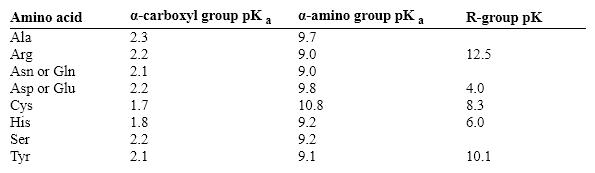 Refer to Exhibit 3A. Calculate the pI of ASN:
A) 2.5
B) 5.0
C) 5.5
D) 6.0
E) 10.7
Refer to Exhibit 3A. Calculate the pI of ASN:A) 2.5
B) 5.0
C) 5.5
D) 6.0
E) 10.7
Question
Question
Exhibit 3A (for this chapter) 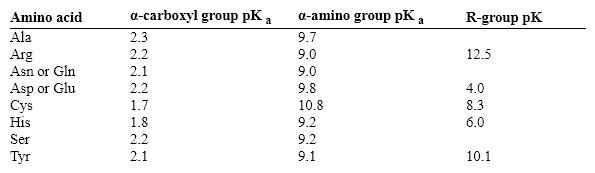 Refer to Exhibit 3A. Which one has a pI of 5.0?
A) Alanine
B) Arginine
C) Histidine
D) Cysteine
E) Glutamic acid
Refer to Exhibit 3A. Which one has a pI of 5.0?A) Alanine
B) Arginine
C) Histidine
D) Cysteine
E) Glutamic acid
Question
Exhibit 3B A titration curve. 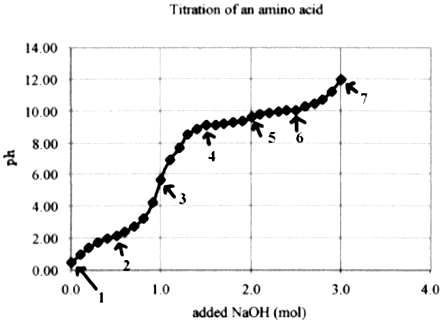 Refer to Exhibit 3B. Which point most likely represents the pK for the carboxyl group?
A) 1
B) 2
C) 3
D) 4
E) 5
Refer to Exhibit 3B. Which point most likely represents the pK for the carboxyl group?A) 1
B) 2
C) 3
D) 4
E) 5
Question
Exhibit 3A (for this chapter) 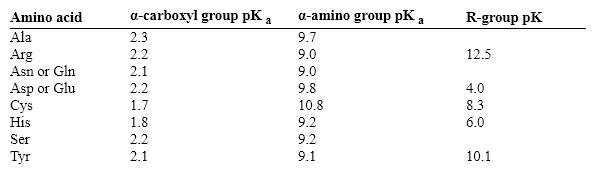 Refer to Exhibit 3A. Calculate the pI of CYS?
A) 1.7
B) 5.0
C) 8.3
D) 9.6
E) 10.8
Refer to Exhibit 3A. Calculate the pI of CYS?A) 1.7
B) 5.0
C) 8.3
D) 9.6
E) 10.8
Question
Question
Exhibit 3A (for this chapter) 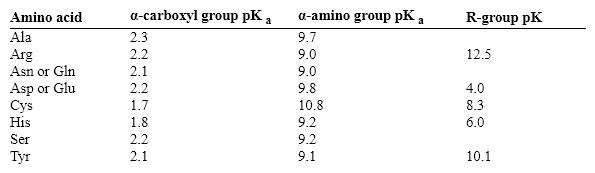 Refer to Exhibit 3A. At pH 7, what percent of histidine has a neutral charge?
A) 9%
B) 50%
C) 91%
D) 100%
Refer to Exhibit 3A. At pH 7, what percent of histidine has a neutral charge?A) 9%
B) 50%
C) 91%
D) 100%
Question
Question
Question
Exhibit 3A (for this chapter) 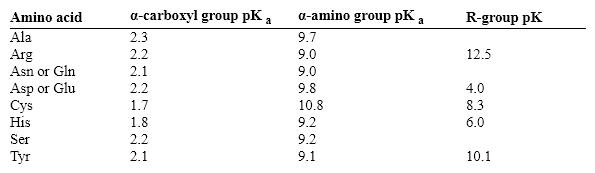 Refer to Exhibit 3A. The pI of an amino acid is the pH at which it has a zero net charge. What is the increasing order of isoelectric points (low pH to high) for these three amino acids?
A) ALA, HIS, ASP
B) ASP, ALA, HIS
C) HIS, ALA, ASP
D) ALA, ASL, HIS
E) ASP, HIS, ALA
Refer to Exhibit 3A. The pI of an amino acid is the pH at which it has a zero net charge. What is the increasing order of isoelectric points (low pH to high) for these three amino acids?A) ALA, HIS, ASP
B) ASP, ALA, HIS
C) HIS, ALA, ASP
D) ALA, ASL, HIS
E) ASP, HIS, ALA
Question
Exhibit 3A (for this chapter) 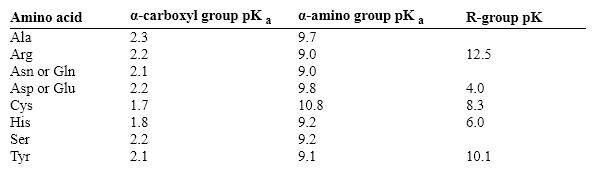
Refer to Exhibit 3A. Which of these amino acids could act as a good buffer at pH = 4.5
A) Alanine
B) Arginine
C) Asparagine
D) Cysteine
E) Aspartic Acid
Refer to Exhibit 3A. Which of these amino acids could act as a good buffer at pH = 4.5
A) Alanine
B) Arginine
C) Asparagine
D) Cysteine
E) Aspartic Acid
Question
Question
Question
Question
Exhibit 3A (for this chapter) 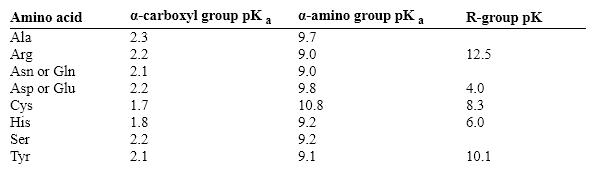 Refer to Exhibit 3A. What is the order of the pIs in increasing order (from acid to base)?
A) Alanine, Arginine, Asparagine, Cysteine, and Aspartic Acid
B) Aspartic Acid, Alanine, Asparagine, Cysteine, and Arginine
C) Aspartic Acid, Cysteine, Asparagine, Alanine, and Arginine
D) Arginine, Alanine, Asparagine, Cysteine, and Aspartic Acid
E) Aspartic Acid, Cysteine, Arginine, Alanine, and Asparagine,
Refer to Exhibit 3A. What is the order of the pIs in increasing order (from acid to base)?A) Alanine, Arginine, Asparagine, Cysteine, and Aspartic Acid
B) Aspartic Acid, Alanine, Asparagine, Cysteine, and Arginine
C) Aspartic Acid, Cysteine, Asparagine, Alanine, and Arginine
D) Arginine, Alanine, Asparagine, Cysteine, and Aspartic Acid
E) Aspartic Acid, Cysteine, Arginine, Alanine, and Asparagine,
Question
Question
Question
Exhibit 3A (for this chapter) 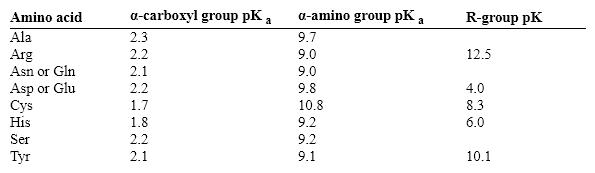 Refer to Exhibit 3A. The pI of the peptide ALA-GLN-ARG-SER-HIS would be:
A) Strongly acid
B) Weakly acid (4-6)
C) About neutral (6-8)
D) Weakly basic (8-10)
E) Strongly basic
Refer to Exhibit 3A. The pI of the peptide ALA-GLN-ARG-SER-HIS would be:A) Strongly acid
B) Weakly acid (4-6)
C) About neutral (6-8)
D) Weakly basic (8-10)
E) Strongly basic
Question
Exhibit 3A (for this chapter) 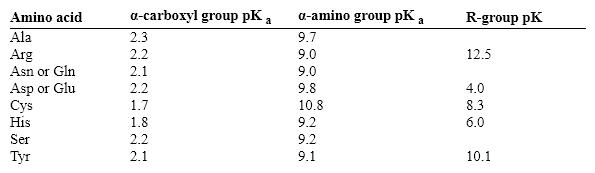 Refer to Exhibit 3A. Which one has the R-group with the highest pK?
A) Alanine
B) Arginine
C) Histidine
D) Cysteine
E) Aspartic Acid
Refer to Exhibit 3A. Which one has the R-group with the highest pK?A) Alanine
B) Arginine
C) Histidine
D) Cysteine
E) Aspartic Acid
Question
Exhibit 3B A titration curve. 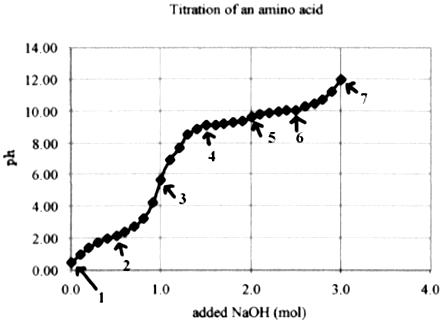 Refer to Exhibit 3B. Which points on the graph represent pK's?
A) 1 and 7
B) 2, 4 and 6
C) 3 and 5
D) 2, 3, 4, 5 and 6
E) The pKs cannot be determined without more information.
Refer to Exhibit 3B. Which points on the graph represent pK's?A) 1 and 7
B) 2, 4 and 6
C) 3 and 5
D) 2, 3, 4, 5 and 6
E) The pKs cannot be determined without more information.
Question
Question
Question
Question
Question
Exhibit 3B A titration curve. 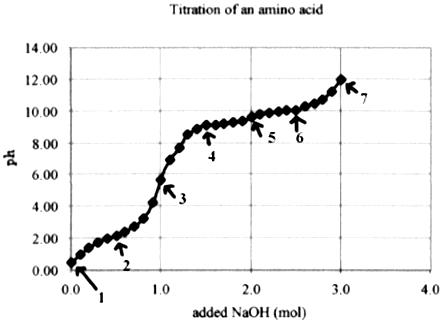 Refer to Exhibit 3B. The point labeled #1 represents:
A) The fully protonated form
B) The pH with maximum negative charge
C) The end point of titration with base (OH − )
D) The pI of the amino acid
E) None of these
Refer to Exhibit 3B. The point labeled #1 represents:A) The fully protonated form
B) The pH with maximum negative charge
C) The end point of titration with base (OH − )
D) The pI of the amino acid
E) None of these
Question
Question
Exhibit 3B A titration curve. 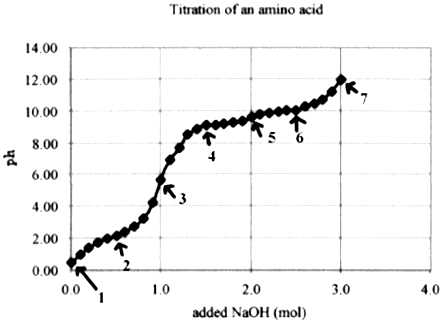 Refer to Exhibit 3B. The amino acid depicted by the titration curve is
A) aspartic acid
B) histidine
C) lysine
D) tyrosine
E) lysine or tyrosine
Refer to Exhibit 3B. The amino acid depicted by the titration curve isA) aspartic acid
B) histidine
C) lysine
D) tyrosine
E) lysine or tyrosine
Question
Question
Question
Question
Question
Question
Question
Exhibit 3B A titration curve. 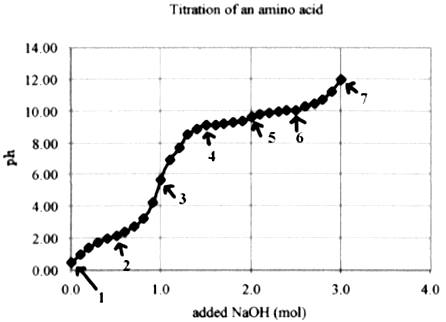 Refer to Exhibit 3B. At which point would the amino acid have its maximum negative charge?
A) 1
B) 2
C) 4
D) 6
E) 7
Refer to Exhibit 3B. At which point would the amino acid have its maximum negative charge?A) 1
B) 2
C) 4
D) 6
E) 7
Question
Question
Question
Question
Question
Question

Unlock Deck
Sign up to unlock the cards in this deck!
Unlock Deck
Unlock Deck
1/80

Play

Full screen (f)
Deck 3: Amino Acids and Peptides
1
Which group consists only of amino acids with basic side chains?
A) leucine and lysine
B) arginine and leucine
C) lysine and arginine
D) arginine and isoleucine
A) leucine and lysine
B) arginine and leucine
C) lysine and arginine
D) arginine and isoleucine
lysine and arginine
2
Which of the following amino acids has a side chain that can make hydrogen bonds to other molecules?
A) Leu
B) Ser
C) Ala
D) Gly
A) Leu
B) Ser
C) Ala
D) Gly
Ser
3
Which of the following is an amino acid not found in proteins?
A) asparagine
B) ornithine
C) isoleucine
D) proline
A) asparagine
B) ornithine
C) isoleucine
D) proline
ornithine
4
The side chain groups of amino acids are bonded to which carbon?
A) The α -carbon.
B) The β -carbon.
C) The carbonyl carbon.
D) Different amino acids have their side chains attached to different carbons.
A) The α -carbon.
B) The β -carbon.
C) The carbonyl carbon.
D) Different amino acids have their side chains attached to different carbons.
Unlock Deck
Unlock for access to all 80 flashcards in this deck.
Unlock Deck
k this deck
5
Which amino acid has the three-letter symbol asn?
A) aspartic acid
B) asparagine
C) alanine
D) arginine
A) aspartic acid
B) asparagine
C) alanine
D) arginine
Unlock Deck
Unlock for access to all 80 flashcards in this deck.
Unlock Deck
k this deck
6
Which group consists only of amino acids with polar side chains?
A) serine, threonine, and leucine
B) serine, threonine, and cysteine
C) serine, threonine, and valine
D) serine, threonine, and isoleucine
A) serine, threonine, and leucine
B) serine, threonine, and cysteine
C) serine, threonine, and valine
D) serine, threonine, and isoleucine
Unlock Deck
Unlock for access to all 80 flashcards in this deck.
Unlock Deck
k this deck
7
Which amino acid has the one-letter symbol E?
A) lysine
B) phenylalanine
C) histidine
D) glutamic acid
A) lysine
B) phenylalanine
C) histidine
D) glutamic acid
Unlock Deck
Unlock for access to all 80 flashcards in this deck.
Unlock Deck
k this deck
8
Thr and Ser both have hydroxyls as side chains.
Unlock Deck
Unlock for access to all 80 flashcards in this deck.
Unlock Deck
k this deck
9
Which of the following has no L or D configuration?
A) Glyceraldehyde
B) Proline
C) Glycine
D) All of these have an L or D configuration
A) Glyceraldehyde
B) Proline
C) Glycine
D) All of these have an L or D configuration
Unlock Deck
Unlock for access to all 80 flashcards in this deck.
Unlock Deck
k this deck
10
Which of the following has a hydrophilic side chain?
A) Asn
B) Leu
C) Ile
D) Gly
A) Asn
B) Leu
C) Ile
D) Gly
Unlock Deck
Unlock for access to all 80 flashcards in this deck.
Unlock Deck
k this deck
11
Which group consists only of amino acids with carboxylate side chains?
A) glutamate and cysteine
B) aspartate and glycine
C) glutamate and lysine
D) aspartate and glutamate
A) glutamate and cysteine
B) aspartate and glycine
C) glutamate and lysine
D) aspartate and glutamate
Unlock Deck
Unlock for access to all 80 flashcards in this deck.
Unlock Deck
k this deck
12
Which is a correct pair of abbreviations for an amino acid?
A) Gln \ N
B) Tyr \ T
C) Asn \ N
D) Phe \ P
E) Pro \ Q
A) Gln \ N
B) Tyr \ T
C) Asn \ N
D) Phe \ P
E) Pro \ Q
Unlock Deck
Unlock for access to all 80 flashcards in this deck.
Unlock Deck
k this deck
13
The side chain of Met is a poor hydrogen bond donor.
Unlock Deck
Unlock for access to all 80 flashcards in this deck.
Unlock Deck
k this deck
14
The amino and carboxyl groups of amino acids are bonded to which carbon?
A) Both are bonded to the α -carbon.
B) Both are bonded to the β -carbon.
C) The amino is bonded to the α -carbon, and the carboxyl is bonded to the β -carbon.
D) The amino is bonded to the β -carbon, and the carboxyl is bonded to the α -carbon.
A) Both are bonded to the α -carbon.
B) Both are bonded to the β -carbon.
C) The amino is bonded to the α -carbon, and the carboxyl is bonded to the β -carbon.
D) The amino is bonded to the β -carbon, and the carboxyl is bonded to the α -carbon.
Unlock Deck
Unlock for access to all 80 flashcards in this deck.
Unlock Deck
k this deck
15
Chiral objects
A) are cyclic compounds in the chair form.
B) are not superimposable on their mirror images.
C) never occur in nature.
D) do not form crystals.
A) are cyclic compounds in the chair form.
B) are not superimposable on their mirror images.
C) never occur in nature.
D) do not form crystals.
Unlock Deck
Unlock for access to all 80 flashcards in this deck.
Unlock Deck
k this deck
16
The amino acids which occur in proteins
A) are all of the L- form.
B) are all of the D- form.
C) can be either the L- or D- form.
D) do not have L- and D- forms.
A) are all of the L- form.
B) are all of the D- form.
C) can be either the L- or D- form.
D) do not have L- and D- forms.
Unlock Deck
Unlock for access to all 80 flashcards in this deck.
Unlock Deck
k this deck
17
Asp and Glu both have amides as side chains.
Unlock Deck
Unlock for access to all 80 flashcards in this deck.
Unlock Deck
k this deck
18
Which amino acid is classified as polar?
A) L
B) H
C) P
D) I
A) L
B) H
C) P
D) I
Unlock Deck
Unlock for access to all 80 flashcards in this deck.
Unlock Deck
k this deck
19
The absolute configuration of amino acids are denoted by their relationship to the L- or D- forms of
A) glyceraldehyde
B) glucose
C) tartaric acid
D) alanine
A) glyceraldehyde
B) glucose
C) tartaric acid
D) alanine
Unlock Deck
Unlock for access to all 80 flashcards in this deck.
Unlock Deck
k this deck
20
Which amino acid has a benzene-like ring?
A) Glutamic Acid
B) Histidine
C) Isoleucine
D) Serine
E) Tyrosine
A) Glutamic Acid
B) Histidine
C) Isoleucine
D) Serine
E) Tyrosine
Unlock Deck
Unlock for access to all 80 flashcards in this deck.
Unlock Deck
k this deck
21
The pKa values of the amino groups of common amino acids
A) occur at very low pH values
B) occur in a range from pH 9 to pH 11
C) all occur at pH 8
D) all occur above pH 12
A) occur at very low pH values
B) occur in a range from pH 9 to pH 11
C) all occur at pH 8
D) all occur above pH 12
Unlock Deck
Unlock for access to all 80 flashcards in this deck.
Unlock Deck
k this deck
22
Given the R-groups in the peptide, ALA-GLN-ARG-SER-HIS, it would likely be:
A) Very water soluble
B) Somewhat water soluble
C) Not very water soluble
D) Not soluble at all
E) You cannot tell from the sequence
A) Very water soluble
B) Somewhat water soluble
C) Not very water soluble
D) Not soluble at all
E) You cannot tell from the sequence
Unlock Deck
Unlock for access to all 80 flashcards in this deck.
Unlock Deck
k this deck
23
Which amino acid would have the greatest negative charge at pH = 7.0?
A) Glutamic Acid
B) Histidine
C) Isoleucine
D) Serine
E) Tyrosine
A) Glutamic Acid
B) Histidine
C) Isoleucine
D) Serine
E) Tyrosine
Unlock Deck
Unlock for access to all 80 flashcards in this deck.
Unlock Deck
k this deck
24
Which amino acid has a basic R group?
A) Glutamic Acid
B) Histidine
C) Isoleucine
D) Serine
E) Tyrosine
A) Glutamic Acid
B) Histidine
C) Isoleucine
D) Serine
E) Tyrosine
Unlock Deck
Unlock for access to all 80 flashcards in this deck.
Unlock Deck
k this deck
25
The pKa values of the side chains of the common amino acids
A) are always at low pH
B) are always at high pH
C) depend on the chemical nature of the side chain
D) are not known
A) are always at low pH
B) are always at high pH
C) depend on the chemical nature of the side chain
D) are not known
Unlock Deck
Unlock for access to all 80 flashcards in this deck.
Unlock Deck
k this deck
26
Which amino acid would likely be least water-soluble at pH 7.0
A) Histidine
B) Isoleucine
C) Isoleucine or Tyrosine, you cannot tell
D) Serine
E) Tyrosine
A) Histidine
B) Isoleucine
C) Isoleucine or Tyrosine, you cannot tell
D) Serine
E) Tyrosine
Unlock Deck
Unlock for access to all 80 flashcards in this deck.
Unlock Deck
k this deck
27
Which amino acid takes on a positive charge when the R-group gains a proton?
A) Glutamic Acid
B) Histidine
C) Glutamine
D) Tyrosine
E) Glycine
A) Glutamic Acid
B) Histidine
C) Glutamine
D) Tyrosine
E) Glycine
Unlock Deck
Unlock for access to all 80 flashcards in this deck.
Unlock Deck
k this deck
28
Which of the following can be considered a unique characteristic of histidine?
A) Its side chain is attached to the alpha carbon
B) It has a basic side chain
C) It has a side chain that is chemically basic but has an acidic pKa
D) It is technically an "imino" acid
A) Its side chain is attached to the alpha carbon
B) It has a basic side chain
C) It has a side chain that is chemically basic but has an acidic pKa
D) It is technically an "imino" acid
Unlock Deck
Unlock for access to all 80 flashcards in this deck.
Unlock Deck
k this deck
29
Which amino acid has a polar, non-ionic R-group
A) Glutamic Acid
B) Histidine
C) Isoleucine
D) Serine
E) Tyrosine
A) Glutamic Acid
B) Histidine
C) Isoleucine
D) Serine
E) Tyrosine
Unlock Deck
Unlock for access to all 80 flashcards in this deck.
Unlock Deck
k this deck
30
Which amino acids would migrate furthest toward the anode (positive electrode) during electrophoresis?
A) Aspartic acid.
B) Arginine.
C) Tyrosine.
D) Histidine.
E) Glutamine.
A) Aspartic acid.
B) Arginine.
C) Tyrosine.
D) Histidine.
E) Glutamine.
Unlock Deck
Unlock for access to all 80 flashcards in this deck.
Unlock Deck
k this deck
31
Which of the following is true about uncommon amino acids?
A) They are found in all proteins
B) When they are found in proteins, they are first created by modification of the parent amino acid and then incorporated into the protein
C) They are formed in the protein by post-translational modification of the parent amino acid
D) They are always based on modification of tyrosine
E) none of the choices
A) They are found in all proteins
B) When they are found in proteins, they are first created by modification of the parent amino acid and then incorporated into the protein
C) They are formed in the protein by post-translational modification of the parent amino acid
D) They are always based on modification of tyrosine
E) none of the choices
Unlock Deck
Unlock for access to all 80 flashcards in this deck.
Unlock Deck
k this deck
32
Which amino acid takes on a negative charge when the R-group loses a proton?
A) Glutamic Acid
B) Histidine
C) Glutamine
D) Tyrosine
E) Glutamic Acid and Tyrosine
A) Glutamic Acid
B) Histidine
C) Glutamine
D) Tyrosine
E) Glutamic Acid and Tyrosine
Unlock Deck
Unlock for access to all 80 flashcards in this deck.
Unlock Deck
k this deck
33
Which amino acids contain sulfur?
A) cysteine and lysine
B) cysteine and methionine
C) arginine and methionine
D) cysteine and isoleucine
A) cysteine and lysine
B) cysteine and methionine
C) arginine and methionine
D) cysteine and isoleucine
Unlock Deck
Unlock for access to all 80 flashcards in this deck.
Unlock Deck
k this deck
34
Which statement is true about the classification of amino acids?
A) Alanine and valine are basic amino acids.
B) Lysine and arginine are acidic amino acids.
C) Glutamic acid and asparagine are hydrophobic amino acids.
D) Tryptophan and phenylalanine are aromatic amino acids.
E) Methionine and cysteine are hydroxyl-containing amino acids.
A) Alanine and valine are basic amino acids.
B) Lysine and arginine are acidic amino acids.
C) Glutamic acid and asparagine are hydrophobic amino acids.
D) Tryptophan and phenylalanine are aromatic amino acids.
E) Methionine and cysteine are hydroxyl-containing amino acids.
Unlock Deck
Unlock for access to all 80 flashcards in this deck.
Unlock Deck
k this deck
35
Which of the following is not considered an uncommon amino acid?
A) thyroxine
B) Hydroxylysine
C) Hydroxyproline
D) Tryptophan
A) thyroxine
B) Hydroxylysine
C) Hydroxyproline
D) Tryptophan
Unlock Deck
Unlock for access to all 80 flashcards in this deck.
Unlock Deck
k this deck
36
Which of the following is NOT a correct combination of an amino acid, its three-letter designation, and its one-letter designation?
A) Lysine, lys, L
B) Glycine, gly, G
C) Histidine, his, H
D) Tryptophan, Trp, W
E) Arginine, arg, R
A) Lysine, lys, L
B) Glycine, gly, G
C) Histidine, his, H
D) Tryptophan, Trp, W
E) Arginine, arg, R
Unlock Deck
Unlock for access to all 80 flashcards in this deck.
Unlock Deck
k this deck
37
The pKa values of the alpha carboxyl groups of common amino acids are around
A) pH 2
B) pH 5
C) pH 7
D) pH 9
A) pH 2
B) pH 5
C) pH 7
D) pH 9
Unlock Deck
Unlock for access to all 80 flashcards in this deck.
Unlock Deck
k this deck
38
Which amino acid has the least polar R-group H?
A) Glutamic Acid
B) Histidine
C) Isoleucine
D) Serine
E) Tyrosine
A) Glutamic Acid
B) Histidine
C) Isoleucine
D) Serine
E) Tyrosine
Unlock Deck
Unlock for access to all 80 flashcards in this deck.
Unlock Deck
k this deck
39
Which is the correct one-letter designation for tryptophan?
A) E
B) T
C) W
D) Q
E) none of the choices
A) E
B) T
C) W
D) Q
E) none of the choices
Unlock Deck
Unlock for access to all 80 flashcards in this deck.
Unlock Deck
k this deck
40
What is the charge on the tetrapeptide lys-lys-his-glu at pH 7?
A) 0
B) +1
C) +2
D) − 1
A) 0
B) +1
C) +2
D) − 1
Unlock Deck
Unlock for access to all 80 flashcards in this deck.
Unlock Deck
k this deck
41
Exhibit 3A (for this chapter) Refer to Exhibit 3A. Calculate the pI of ASN:
A) 2.5
B) 5.0
C) 5.5
D) 6.0
E) 10.7
Refer to Exhibit 3A. Calculate the pI of ASN:A) 2.5
B) 5.0
C) 5.5
D) 6.0
E) 10.7
Unlock Deck
Unlock for access to all 80 flashcards in this deck.
Unlock Deck
k this deck
42
Which of the following correctly lists the isoelectric pH's of asp, asn, and arg from lowest to highest?
A) D N R
B) D R N
C) R N D
D) R D N
E) N R D
F) N D R
A) D N R
B) D R N
C) R N D
D) R D N
E) N R D
F) N D R
Unlock Deck
Unlock for access to all 80 flashcards in this deck.
Unlock Deck
k this deck
43
Exhibit 3A (for this chapter) Refer to Exhibit 3A. Which one has a pI of 5.0?
A) Alanine
B) Arginine
C) Histidine
D) Cysteine
E) Glutamic acid
Refer to Exhibit 3A. Which one has a pI of 5.0?A) Alanine
B) Arginine
C) Histidine
D) Cysteine
E) Glutamic acid
Unlock Deck
Unlock for access to all 80 flashcards in this deck.
Unlock Deck
k this deck
44
Exhibit 3B A titration curve. Refer to Exhibit 3B. Which point most likely represents the pK for the carboxyl group?
A) 1
B) 2
C) 3
D) 4
E) 5
Refer to Exhibit 3B. Which point most likely represents the pK for the carboxyl group?A) 1
B) 2
C) 3
D) 4
E) 5
Unlock Deck
Unlock for access to all 80 flashcards in this deck.
Unlock Deck
k this deck
45
Exhibit 3A (for this chapter) Refer to Exhibit 3A. Calculate the pI of CYS?
A) 1.7
B) 5.0
C) 8.3
D) 9.6
E) 10.8
Refer to Exhibit 3A. Calculate the pI of CYS?A) 1.7
B) 5.0
C) 8.3
D) 9.6
E) 10.8
Unlock Deck
Unlock for access to all 80 flashcards in this deck.
Unlock Deck
k this deck
46
The net charge on the peptide abbreviated CAKE in a solution at pH 7 is closest to
A) − 2
B) − 1.
C) 0.
D) +1.
A) − 2
B) − 1.
C) 0.
D) +1.
Unlock Deck
Unlock for access to all 80 flashcards in this deck.
Unlock Deck
k this deck
47
Exhibit 3A (for this chapter) Refer to Exhibit 3A. At pH 7, what percent of histidine has a neutral charge?
A) 9%
B) 50%
C) 91%
D) 100%
Refer to Exhibit 3A. At pH 7, what percent of histidine has a neutral charge?A) 9%
B) 50%
C) 91%
D) 100%
Unlock Deck
Unlock for access to all 80 flashcards in this deck.
Unlock Deck
k this deck
48
What is the predominant form of the amino acid abbreviated R at pH 7?
A) positive
B) neutral
C) negative
A) positive
B) neutral
C) negative
Unlock Deck
Unlock for access to all 80 flashcards in this deck.
Unlock Deck
k this deck
49
The isoelectric pH of glycine is closest to
A) pH 4
B) pH 6
C) pH 8
D) pH 10
A) pH 4
B) pH 6
C) pH 8
D) pH 10
Unlock Deck
Unlock for access to all 80 flashcards in this deck.
Unlock Deck
k this deck
50
Exhibit 3A (for this chapter) Refer to Exhibit 3A. The pI of an amino acid is the pH at which it has a zero net charge. What is the increasing order of isoelectric points (low pH to high) for these three amino acids?
A) ALA, HIS, ASP
B) ASP, ALA, HIS
C) HIS, ALA, ASP
D) ALA, ASL, HIS
E) ASP, HIS, ALA
Refer to Exhibit 3A. The pI of an amino acid is the pH at which it has a zero net charge. What is the increasing order of isoelectric points (low pH to high) for these three amino acids?A) ALA, HIS, ASP
B) ASP, ALA, HIS
C) HIS, ALA, ASP
D) ALA, ASL, HIS
E) ASP, HIS, ALA
Unlock Deck
Unlock for access to all 80 flashcards in this deck.
Unlock Deck
k this deck
51
Exhibit 3A (for this chapter)
Refer to Exhibit 3A. Which of these amino acids could act as a good buffer at pH = 4.5
A) Alanine
B) Arginine
C) Asparagine
D) Cysteine
E) Aspartic Acid
Refer to Exhibit 3A. Which of these amino acids could act as a good buffer at pH = 4.5
A) Alanine
B) Arginine
C) Asparagine
D) Cysteine
E) Aspartic Acid
Unlock Deck
Unlock for access to all 80 flashcards in this deck.
Unlock Deck
k this deck
52
What is the predominant form of the amino acid abbreviated val at pH 7?
A) positive
B) neutral
C) negative
A) positive
B) neutral
C) negative
Unlock Deck
Unlock for access to all 80 flashcards in this deck.
Unlock Deck
k this deck
53
Which of the following amino acids has a net charge of +1 at pH 4 and a net charge of 0 at pH 8?
A) glu
B) arg
C) his
D) tyr
A) glu
B) arg
C) his
D) tyr
Unlock Deck
Unlock for access to all 80 flashcards in this deck.
Unlock Deck
k this deck
54
What is the predominant form of the amino acid abbreviated E at pH 7?
A) positive
B) neutral
C) negative
A) positive
B) neutral
C) negative
Unlock Deck
Unlock for access to all 80 flashcards in this deck.
Unlock Deck
k this deck
55
Exhibit 3A (for this chapter) Refer to Exhibit 3A. What is the order of the pIs in increasing order (from acid to base)?
A) Alanine, Arginine, Asparagine, Cysteine, and Aspartic Acid
B) Aspartic Acid, Alanine, Asparagine, Cysteine, and Arginine
C) Aspartic Acid, Cysteine, Asparagine, Alanine, and Arginine
D) Arginine, Alanine, Asparagine, Cysteine, and Aspartic Acid
E) Aspartic Acid, Cysteine, Arginine, Alanine, and Asparagine,
Refer to Exhibit 3A. What is the order of the pIs in increasing order (from acid to base)?A) Alanine, Arginine, Asparagine, Cysteine, and Aspartic Acid
B) Aspartic Acid, Alanine, Asparagine, Cysteine, and Arginine
C) Aspartic Acid, Cysteine, Asparagine, Alanine, and Arginine
D) Arginine, Alanine, Asparagine, Cysteine, and Aspartic Acid
E) Aspartic Acid, Cysteine, Arginine, Alanine, and Asparagine,
Unlock Deck
Unlock for access to all 80 flashcards in this deck.
Unlock Deck
k this deck
56
At its isolectric pH, glycine will have
A) both of its ionizable functional groups dissociated.
B) neither of its ionizable functional groups dissociated.
C) only its carboxyl group dissociated.
D) only its amino group dissociated.
A) both of its ionizable functional groups dissociated.
B) neither of its ionizable functional groups dissociated.
C) only its carboxyl group dissociated.
D) only its amino group dissociated.
Unlock Deck
Unlock for access to all 80 flashcards in this deck.
Unlock Deck
k this deck
57
The net charge on the amino acid cys in a solution at pH 7 is closest to
A) − 2
B) − 1.
C) 0.
D) +1.
A) − 2
B) − 1.
C) 0.
D) +1.
Unlock Deck
Unlock for access to all 80 flashcards in this deck.
Unlock Deck
k this deck
58
Exhibit 3A (for this chapter) Refer to Exhibit 3A. The pI of the peptide ALA-GLN-ARG-SER-HIS would be:
A) Strongly acid
B) Weakly acid (4-6)
C) About neutral (6-8)
D) Weakly basic (8-10)
E) Strongly basic
Refer to Exhibit 3A. The pI of the peptide ALA-GLN-ARG-SER-HIS would be:A) Strongly acid
B) Weakly acid (4-6)
C) About neutral (6-8)
D) Weakly basic (8-10)
E) Strongly basic
Unlock Deck
Unlock for access to all 80 flashcards in this deck.
Unlock Deck
k this deck
59
Exhibit 3A (for this chapter) Refer to Exhibit 3A. Which one has the R-group with the highest pK?
A) Alanine
B) Arginine
C) Histidine
D) Cysteine
E) Aspartic Acid
Refer to Exhibit 3A. Which one has the R-group with the highest pK?A) Alanine
B) Arginine
C) Histidine
D) Cysteine
E) Aspartic Acid
Unlock Deck
Unlock for access to all 80 flashcards in this deck.
Unlock Deck
k this deck
60
Exhibit 3B A titration curve. Refer to Exhibit 3B. Which points on the graph represent pK's?
A) 1 and 7
B) 2, 4 and 6
C) 3 and 5
D) 2, 3, 4, 5 and 6
E) The pKs cannot be determined without more information.
Refer to Exhibit 3B. Which points on the graph represent pK's?A) 1 and 7
B) 2, 4 and 6
C) 3 and 5
D) 2, 3, 4, 5 and 6
E) The pKs cannot be determined without more information.
Unlock Deck
Unlock for access to all 80 flashcards in this deck.
Unlock Deck
k this deck
61
Which of the following correctly describes peptide bonds?
A) They are special type of amide bond.
B) They are a very stable bonds.
C) They are formed when water is split out from an amino group and a carboxylic acid.
D) They are a bond which displays resonance.
E) All of these
A) They are special type of amide bond.
B) They are a very stable bonds.
C) They are formed when water is split out from an amino group and a carboxylic acid.
D) They are a bond which displays resonance.
E) All of these
Unlock Deck
Unlock for access to all 80 flashcards in this deck.
Unlock Deck
k this deck
62
This amino acid displays a free amino group in the peptide ALA-GLN-ARG-SER-HIS:
A) ALA
B) GLN
C) SER
D) HIS
A) ALA
B) GLN
C) SER
D) HIS
Unlock Deck
Unlock for access to all 80 flashcards in this deck.
Unlock Deck
k this deck
63
How many possible tetrapeptides can be made using all four of the amino acids D, W, F, and R?
A) 4
B) 6
C) 12
D) 24
E) none of the choices
A) 4
B) 6
C) 12
D) 24
E) none of the choices
Unlock Deck
Unlock for access to all 80 flashcards in this deck.
Unlock Deck
k this deck
64
Which is the C-terminal amino acid in the peptide ALA-GLN-ARG-SER-HIS?
A) ALA
B) GLN
C) ARG
D) SER
E) HIS
A) ALA
B) GLN
C) ARG
D) SER
E) HIS
Unlock Deck
Unlock for access to all 80 flashcards in this deck.
Unlock Deck
k this deck
65
Exhibit 3B A titration curve. Refer to Exhibit 3B. The point labeled #1 represents:
A) The fully protonated form
B) The pH with maximum negative charge
C) The end point of titration with base (OH − )
D) The pI of the amino acid
E) None of these
Refer to Exhibit 3B. The point labeled #1 represents:A) The fully protonated form
B) The pH with maximum negative charge
C) The end point of titration with base (OH − )
D) The pI of the amino acid
E) None of these
Unlock Deck
Unlock for access to all 80 flashcards in this deck.
Unlock Deck
k this deck
66
Which of the following types of amino acids has uncharged side chains at neutral pH?
A) Nonpolar amino acids
B) Acidic amino acids
C) Polar-neutral amino acids
D) Basic amino acids
A) Nonpolar amino acids
B) Acidic amino acids
C) Polar-neutral amino acids
D) Basic amino acids
Unlock Deck
Unlock for access to all 80 flashcards in this deck.
Unlock Deck
k this deck
67
Exhibit 3B A titration curve. Refer to Exhibit 3B. The amino acid depicted by the titration curve is
A) aspartic acid
B) histidine
C) lysine
D) tyrosine
E) lysine or tyrosine
Refer to Exhibit 3B. The amino acid depicted by the titration curve isA) aspartic acid
B) histidine
C) lysine
D) tyrosine
E) lysine or tyrosine
Unlock Deck
Unlock for access to all 80 flashcards in this deck.
Unlock Deck
k this deck
68
The order in which amino acids are linked in peptides is given
A) from the C-terminal to the N-terminal end
B) from the N-terminal to the C-terminal end
C) in alphabetical order
D) in order of increasing molecular weights of the amino acid residues
A) from the C-terminal to the N-terminal end
B) from the N-terminal to the C-terminal end
C) in alphabetical order
D) in order of increasing molecular weights of the amino acid residues
Unlock Deck
Unlock for access to all 80 flashcards in this deck.
Unlock Deck
k this deck
69
The method for separating molecules on the basis of the ratio of their charge to size is called _____.
A) electrolysis
B) electrophoresis
C) electroplating
D) electroporation
A) electrolysis
B) electrophoresis
C) electroplating
D) electroporation
Unlock Deck
Unlock for access to all 80 flashcards in this deck.
Unlock Deck
k this deck
70
Which groups of a pair of amino acids must react to form a peptide bond?
A) the two carboxyls
B) the two aminos
C) the two R-groups
D) the carboxyl of one and the amino of the other
A) the two carboxyls
B) the two aminos
C) the two R-groups
D) the carboxyl of one and the amino of the other
Unlock Deck
Unlock for access to all 80 flashcards in this deck.
Unlock Deck
k this deck
71
The peptide bond
A) is planar
B) can be written as a resonance hybrid
C) is the basis of protein structure.
D) all of the above
A) is planar
B) can be written as a resonance hybrid
C) is the basis of protein structure.
D) all of the above
Unlock Deck
Unlock for access to all 80 flashcards in this deck.
Unlock Deck
k this deck
72
Explain how thyroxine differs from its parent amino acid, tyrosine.
Unlock Deck
Unlock for access to all 80 flashcards in this deck.
Unlock Deck
k this deck
73
The peptide bond
A) is formed by elimination of water between two amino groups in an amindo acid
B) limits the possible orientations of the peptide backbone in a protein
C) has acidic and basic characteristics
D) all of these
A) is formed by elimination of water between two amino groups in an amindo acid
B) limits the possible orientations of the peptide backbone in a protein
C) has acidic and basic characteristics
D) all of these
Unlock Deck
Unlock for access to all 80 flashcards in this deck.
Unlock Deck
k this deck
74
Exhibit 3B A titration curve. Refer to Exhibit 3B. At which point would the amino acid have its maximum negative charge?
A) 1
B) 2
C) 4
D) 6
E) 7
Refer to Exhibit 3B. At which point would the amino acid have its maximum negative charge?A) 1
B) 2
C) 4
D) 6
E) 7
Unlock Deck
Unlock for access to all 80 flashcards in this deck.
Unlock Deck
k this deck
75
How many different tripeptides can be assembled using one molecule each of the amino acids glycine, glutamic acid, and lysine?
A) 3
B) 6
C) 9
D) 27
A) 3
B) 6
C) 9
D) 27
Unlock Deck
Unlock for access to all 80 flashcards in this deck.
Unlock Deck
k this deck
76
Which of the following is true about oxytocin?
A) it is a peptide hormone
B) during pregnancy the number of receptors for oxytocin increases
C) it is involved in stimulating the flow of milk during nursing
D) all of the choices
A) it is a peptide hormone
B) during pregnancy the number of receptors for oxytocin increases
C) it is involved in stimulating the flow of milk during nursing
D) all of the choices
Unlock Deck
Unlock for access to all 80 flashcards in this deck.
Unlock Deck
k this deck
77
Which of the following is the most similar between oxytocin and vasopressin?
A) their biological function
B) their amino acid sequences
C) their isoelectric point
D) their overall structure
A) their biological function
B) their amino acid sequences
C) their isoelectric point
D) their overall structure
Unlock Deck
Unlock for access to all 80 flashcards in this deck.
Unlock Deck
k this deck
78
Which of the following statements is true of resonance structures?
A) Resonance structures differ from one another only in the positioning of electrons.
B) Resonance structures differ from one another only in the number of electrons.
C) Two resonance structures will always have the same number of single bonds and double bonds.
D) Two resonance structures will always have single bonds and double bonds in the same position.
A) Resonance structures differ from one another only in the positioning of electrons.
B) Resonance structures differ from one another only in the number of electrons.
C) Two resonance structures will always have the same number of single bonds and double bonds.
D) Two resonance structures will always have single bonds and double bonds in the same position.
Unlock Deck
Unlock for access to all 80 flashcards in this deck.
Unlock Deck
k this deck
79
Oxytocin and vasopressin
A) differ from each other by a single amino acid
B) do not contain sulfur
C) are peptide hormones
D) are tripeptides
A) differ from each other by a single amino acid
B) do not contain sulfur
C) are peptide hormones
D) are tripeptides
Unlock Deck
Unlock for access to all 80 flashcards in this deck.
Unlock Deck
k this deck
80
What do amino acids such as alanine, leucine, isoleucine, tryptophan, and valine have in common?
A) They all are polar-neutral amino acids.
B) They all are nonpolar amino acids.
C) They all are acidic amino acids.
D) They all are basic amino acids.
A) They all are polar-neutral amino acids.
B) They all are nonpolar amino acids.
C) They all are acidic amino acids.
D) They all are basic amino acids.
Unlock Deck
Unlock for access to all 80 flashcards in this deck.
Unlock Deck
k this deck
Unlock Deck
Unlock for access to all 80 flashcards in this deck.






