







 Chat with AI

Deck 14: Gene Regulation
Full screen (f)

Question

Question
Question
Question
Question
Question
Question
Question
Question
Question
Question
Question
Question
Question
Question
Question
Question
Question
Question
Question
Question
Question
Question
Question
Question
Question
Figure 14-1 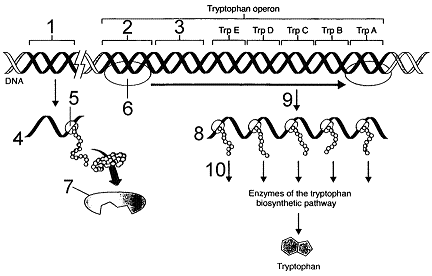 Refer to the accompanying figure. The area of the tryptophan operon labeled as 3 is the:
A) promoter.
B) repressor gene.
C) ribosome.
D) RNA polymerase.
E) operator.
Refer to the accompanying figure. The area of the tryptophan operon labeled as 3 is the:A) promoter.
B) repressor gene.
C) ribosome.
D) RNA polymerase.
E) operator.
Question
Question
Question
Question
Question
Question
Question
Question
Question
Figure 14-1 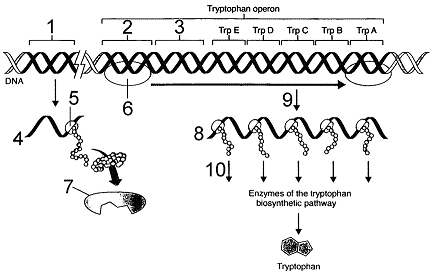 The promoter in the accompanying figure is labeled as ____.
A) 6
B) 3
C) 1
D) 2
E) 7
The promoter in the accompanying figure is labeled as ____.A) 6
B) 3
C) 1
D) 2
E) 7
Question
Question
Question
Question
Figure 14-1 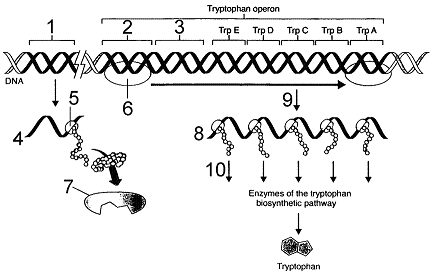 Refer to the accompanying figure. The structure labeled as 7 in the figure of the tryptophan operon is a(n):
A) active repressor protein.
B) inactive repressor protein.
C) active RNA polymerase.
D) inactive RNA polymerase.
E) ribosome.
Refer to the accompanying figure. The structure labeled as 7 in the figure of the tryptophan operon is a(n):A) active repressor protein.
B) inactive repressor protein.
C) active RNA polymerase.
D) inactive RNA polymerase.
E) ribosome.
Question
Question
Question
Question
Question
Question
Question
Question
Question
Question
Question
Question
Question
Question
Question
Question
Question
Question
Question
Question
Question
Question
Question
Question
Question
Match between columns
Question
Match between columns
Question
Question
Question
Question
Question
Question
Question
Question
Question
Question
Question
Question

Unlock Deck
Sign up to unlock the cards in this deck!
Unlock Deck
Unlock Deck
1/77

Play

Full screen (f)
Deck 14: Gene Regulation
1
Repressible genes are usually actively transcribed when:
A) repressor molecules bind to the promoter.
B) the end product of the enzymes encoded by these genes is low.
C) tryptophan accumulates in the cell.
D) quantities of precursor materials are high.
E) there is no other substrate that can be used by the cell.
A) repressor molecules bind to the promoter.
B) the end product of the enzymes encoded by these genes is low.
C) tryptophan accumulates in the cell.
D) quantities of precursor materials are high.
E) there is no other substrate that can be used by the cell.
B
2
The organization of the lac operon, from upstream to downstream sequences, is represented by:
A) repressor gene -> lacZ -> lacY -> lac A
B) lacZ -> lacY -> lac A
C) lacZ -> lacY -> lac A -> operator -> promoter
D) operator -> promoter -> lacZ -> lacY -> lac A
E) promoter -> operator -> lacZ -> lacY -> lac A
A) repressor gene -> lacZ -> lacY -> lac A
B) lacZ -> lacY -> lac A
C) lacZ -> lacY -> lac A -> operator -> promoter
D) operator -> promoter -> lacZ -> lacY -> lac A
E) promoter -> operator -> lacZ -> lacY -> lac A
E
3
Eukaryotes require more complex methods of gene regulation than prokaryotes because:
A) eukaryotes have more operons than prokaryotes.
B) transcriptional regulation is the only form of gene regulation in eukaryotes.
C) all eukaryotic genes are constitutive.
D) eukaryotes have more genes.
E) individual genes must be regulated differentially in each cell type.
A) eukaryotes have more operons than prokaryotes.
B) transcriptional regulation is the only form of gene regulation in eukaryotes.
C) all eukaryotic genes are constitutive.
D) eukaryotes have more genes.
E) individual genes must be regulated differentially in each cell type.
E
4
Gene expression in bacteria is regulated primarily by:
A) controlling the rate of DNA replication.
B) protein modifications.
C) protein degradation.
D) transcriptional control.
E) translational control.
A) controlling the rate of DNA replication.
B) protein modifications.
C) protein degradation.
D) transcriptional control.
E) translational control.
Unlock Deck
Unlock for access to all 77 flashcards in this deck.
Unlock Deck
k this deck
5
An inducible operon is usually controlled by:
A) an inducer molecule that keeps it in the "off" state.
B) an active repressor that keeps it in the "off" state.
C) being active at all times.
D) allolactose.
E) being turned "off," usually by the end product of the pathway.
A) an inducer molecule that keeps it in the "off" state.
B) an active repressor that keeps it in the "off" state.
C) being active at all times.
D) allolactose.
E) being turned "off," usually by the end product of the pathway.
Unlock Deck
Unlock for access to all 77 flashcards in this deck.
Unlock Deck
k this deck
6
In the tryptophan operon, the repressor actively binds to the operator when:
A) tryptophan binds to an allosteric site on the repressor protein, thereby activating it.
B) tryptophan levels are low.
C) lactose levels are low.
D) there is a great need for proteins.
E) allotryptophan levels are low.
A) tryptophan binds to an allosteric site on the repressor protein, thereby activating it.
B) tryptophan levels are low.
C) lactose levels are low.
D) there is a great need for proteins.
E) allotryptophan levels are low.
Unlock Deck
Unlock for access to all 77 flashcards in this deck.
Unlock Deck
k this deck
7
A new operon is discovered in bacteria. Transcription of the genes in this operon is blocked by the binding of a protein to DNA sequences upstream of the operon. This is an example of ____ control.
A) positive
B) negative
C) constitutive
D) posttranscriptional
E) inducible
A) positive
B) negative
C) constitutive
D) posttranscriptional
E) inducible
Unlock Deck
Unlock for access to all 77 flashcards in this deck.
Unlock Deck
k this deck
8
In the lac operon, cAMP binds to:
A) lacZ.
B) lacA .
C) lacY .
D) the operator.
E) CAP.
A) lacZ.
B) lacA .
C) lacY .
D) the operator.
E) CAP.
Unlock Deck
Unlock for access to all 77 flashcards in this deck.
Unlock Deck
k this deck
9
An activator protein would have which of the following effects on an operon with a positive control mechanism?
A) Stimulate transcription.
B) Turn off transcription.
C) Stimulate transcription when a coactivator is bound to the allosteric site.
D) Inhibit transcription when a coactivator is bound to the allosteric site.
E) Activator proteins only work on operons under negative control.
A) Stimulate transcription.
B) Turn off transcription.
C) Stimulate transcription when a coactivator is bound to the allosteric site.
D) Inhibit transcription when a coactivator is bound to the allosteric site.
E) Activator proteins only work on operons under negative control.
Unlock Deck
Unlock for access to all 77 flashcards in this deck.
Unlock Deck
k this deck
10
How does the lactose repressor block transcription of the lactose operon?
A) By "turning off" the lacA intron
B) By degrading the lacZ protein product
C) By binding allosterically to the lacZ gene
D) By slowing the uptake of lactose into the cell
E) By binding to the operator
A) By "turning off" the lacA intron
B) By degrading the lacZ protein product
C) By binding allosterically to the lacZ gene
D) By slowing the uptake of lactose into the cell
E) By binding to the operator
Unlock Deck
Unlock for access to all 77 flashcards in this deck.
Unlock Deck
k this deck
11
Many genes encode proteins that are always needed by a cell, and therefore are always expressed. Such genes are known as:
A) repressible.
B) promoter.
C) constitutive.
D) inducible.
E) operons.
A) repressible.
B) promoter.
C) constitutive.
D) inducible.
E) operons.
Unlock Deck
Unlock for access to all 77 flashcards in this deck.
Unlock Deck
k this deck
12
Considering that virtually all cells in any given individual contain the same genetic information, how is it possible to have different cell types with unique functions?
A) Gene expression is regulated such that different cell types produce different proteins.
B) All cells express all proteins encoded in an organism's genes, but turn them on selectively.
C) Gene expression is regulated based on the age of the organism.
D) Only some cell types make protein products, while others do not.
E) Cells lose unneeded genes with each cell division.
A) Gene expression is regulated such that different cell types produce different proteins.
B) All cells express all proteins encoded in an organism's genes, but turn them on selectively.
C) Gene expression is regulated based on the age of the organism.
D) Only some cell types make protein products, while others do not.
E) Cells lose unneeded genes with each cell division.
Unlock Deck
Unlock for access to all 77 flashcards in this deck.
Unlock Deck
k this deck
13
cAMP levels decrease when __________. This results in __________ of CAP.
A) lactose levels increase; activation
B) lactose levels decrease; inhibition
C) glucose levels increase; inhibition
D) glucose levels decrease; activation
E) glucose levels decrease; inhibition
A) lactose levels increase; activation
B) lactose levels decrease; inhibition
C) glucose levels increase; inhibition
D) glucose levels decrease; activation
E) glucose levels decrease; inhibition
Unlock Deck
Unlock for access to all 77 flashcards in this deck.
Unlock Deck
k this deck
14
A repressible operon is usually controlled by:
A) an inactive repressor that allows it to be in the "on" state.
B) the supply of the precursor product for the enzymes.
C) an inactive repressor that keeps it in the "off" state.
D) tryptophan.
E) being turned "on," usually by the end product of the pathway.
A) an inactive repressor that allows it to be in the "on" state.
B) the supply of the precursor product for the enzymes.
C) an inactive repressor that keeps it in the "off" state.
D) tryptophan.
E) being turned "on," usually by the end product of the pathway.
Unlock Deck
Unlock for access to all 77 flashcards in this deck.
Unlock Deck
k this deck
15
Translational controls regulate the:
A) activity of a protein product.
B) rate at which an mRNA molecule is translated.
C) rate at which an mRNA molecule is synthesized.
D) uptake of nucleic acids into the cell.
E) attachment of phosphate groups to polypeptides.
A) activity of a protein product.
B) rate at which an mRNA molecule is translated.
C) rate at which an mRNA molecule is synthesized.
D) uptake of nucleic acids into the cell.
E) attachment of phosphate groups to polypeptides.
Unlock Deck
Unlock for access to all 77 flashcards in this deck.
Unlock Deck
k this deck
16
A repressor protein would have which of the following effects on repressible genes with a negative control mechanism?
A) Stimulate transcription in the presence of a corepressor.
B) Turn off transcription in the presence of an inducer.
C) Stimulate transcription in the presence of a coactivator.
D) Turn off transcription in the presence of a corepressor.
E) A repressor protein does not participate in negative control mechanisms.
A) Stimulate transcription in the presence of a corepressor.
B) Turn off transcription in the presence of an inducer.
C) Stimulate transcription in the presence of a coactivator.
D) Turn off transcription in the presence of a corepressor.
E) A repressor protein does not participate in negative control mechanisms.
Unlock Deck
Unlock for access to all 77 flashcards in this deck.
Unlock Deck
k this deck
17
Bacteria are able to respond quickly to their surroundings, such as in the presence of an abundant food source. This is because:
A) genes for functionally related enzymes are regulated together in operons.
B) genes for functionally related enzymes are always constitutive.
C) genes for functionally related enzymes are always under positive control.
D) efficient protein degradation removes unneeded proteins quickly.
E) all bacterial genes are constitutive.
A) genes for functionally related enzymes are regulated together in operons.
B) genes for functionally related enzymes are always constitutive.
C) genes for functionally related enzymes are always under positive control.
D) efficient protein degradation removes unneeded proteins quickly.
E) all bacterial genes are constitutive.
Unlock Deck
Unlock for access to all 77 flashcards in this deck.
Unlock Deck
k this deck
18
The function of the catabolite activator protein (CAP) is to:
A) increase the affinity of the promoter region for RNA polymerase.
B) decrease RNA polymerase activity.
C) deactivate RNA polymerase after binding to AMP.
D) bind to and activate RNA polymerase directly.
E) block RNA polymerase from accessing the DNA template.
A) increase the affinity of the promoter region for RNA polymerase.
B) decrease RNA polymerase activity.
C) deactivate RNA polymerase after binding to AMP.
D) bind to and activate RNA polymerase directly.
E) block RNA polymerase from accessing the DNA template.
Unlock Deck
Unlock for access to all 77 flashcards in this deck.
Unlock Deck
k this deck
19
A mutation in the IGF2 gene in pigs results in a three-fold increase in the transcriptional activity of this gene in muscle cells; therefore, these pigs are leaner and more muscular. Because this mutation is located in the noncoding region of the IGF2 gene, we can infer that:
A) the IGF2 gene is a prokaryotic gene.
B) the IGF2 gene is present only in muscle cells, but not in adipose (fat) cells.
C) the mutation changes the amino acid sequence of the IGF2 protein.
D) the mutation alters the regulatory region of the IGF2 gene.
E) less IGF2 protein is synthesized in the muscle cells of these pigs.
A) the IGF2 gene is a prokaryotic gene.
B) the IGF2 gene is present only in muscle cells, but not in adipose (fat) cells.
C) the mutation changes the amino acid sequence of the IGF2 protein.
D) the mutation alters the regulatory region of the IGF2 gene.
E) less IGF2 protein is synthesized in the muscle cells of these pigs.
Unlock Deck
Unlock for access to all 77 flashcards in this deck.
Unlock Deck
k this deck
20
Bacterial enzymes that are part of a rarely used catabolic pathway are usually organized into a(n) __________.
A) inducible operon
B) repressible operon
C) inducible zinc finger
D) repressible leucine zipper
E) constitutive operon
A) inducible operon
B) repressible operon
C) inducible zinc finger
D) repressible leucine zipper
E) constitutive operon
Unlock Deck
Unlock for access to all 77 flashcards in this deck.
Unlock Deck
k this deck
21
If a mutated region on chromosome 15 is inherited from the father, the child will have Prader-Willi syndrome; however, if the same mutated region is inherited from the mother, the child will have Angelman syndrome. This is an example of:
A) epigenetic inheritance.
B) genetic inheritance.
C) gene amplification.
D) eukaryotic operons.
E) repressible genes.
A) epigenetic inheritance.
B) genetic inheritance.
C) gene amplification.
D) eukaryotic operons.
E) repressible genes.
Unlock Deck
Unlock for access to all 77 flashcards in this deck.
Unlock Deck
k this deck
22
The gene that codes for the repressor protein of the E. coli lac operon is constitutive; therefore, the lac operon is typically:
A) turned off.
B) turned on.
C) unaffected by the repressor protein.
D) constitutive.
E) activated by the repressor protein..
A) turned off.
B) turned on.
C) unaffected by the repressor protein.
D) constitutive.
E) activated by the repressor protein..
Unlock Deck
Unlock for access to all 77 flashcards in this deck.
Unlock Deck
k this deck
23
Translational controls of protein levels in bacteria are governed by the:
A) rate at which small and large subunits of ribosomes assemble.
B) rate at which the cap and tail of pre mRNA are removed.
C) rate at which ribosomes attach to mRNA molecules.
D) concentration of proteins in the cytoplasm.
E) rate at which sugars are incorporated into the cell.
A) rate at which small and large subunits of ribosomes assemble.
B) rate at which the cap and tail of pre mRNA are removed.
C) rate at which ribosomes attach to mRNA molecules.
D) concentration of proteins in the cytoplasm.
E) rate at which sugars are incorporated into the cell.
Unlock Deck
Unlock for access to all 77 flashcards in this deck.
Unlock Deck
k this deck
24
DNA sequences called ____ increase the rate of RNA synthesis after initiation of transcription.
A) promoters
B) TATA boxes
C) silencers
D) enhancers
E) regulators
A) promoters
B) TATA boxes
C) silencers
D) enhancers
E) regulators
Unlock Deck
Unlock for access to all 77 flashcards in this deck.
Unlock Deck
k this deck
25
An operon is defined as:
A) a group of structural genes, with no regulatory sequences.
B) regulatory sequences upstream of a structural gene.
C) a group of related structural genes, plus their associated regulatory sequences.
D) one structural gene plus one regulatory gene.
E) a group of unrelated structural genes, plus their associated regulatory sequences.
A) a group of structural genes, with no regulatory sequences.
B) regulatory sequences upstream of a structural gene.
C) a group of related structural genes, plus their associated regulatory sequences.
D) one structural gene plus one regulatory gene.
E) a group of unrelated structural genes, plus their associated regulatory sequences.
Unlock Deck
Unlock for access to all 77 flashcards in this deck.
Unlock Deck
k this deck
26
Figure 14-1 Refer to the accompanying figure. The area of the tryptophan operon labeled as 3 is the:
A) promoter.
B) repressor gene.
C) ribosome.
D) RNA polymerase.
E) operator.
Refer to the accompanying figure. The area of the tryptophan operon labeled as 3 is the:A) promoter.
B) repressor gene.
C) ribosome.
D) RNA polymerase.
E) operator.
Unlock Deck
Unlock for access to all 77 flashcards in this deck.
Unlock Deck
k this deck
27
In an inducible operon, the ____ is the molecular switch that controls gene expression, while the ____ is the DNA region where RNA polymerase binds to begin transcription.
A) repressor; inducer
B) inducer; repressor
C) operator; promoter
D) promoter; operator
E) lactose; promoter
A) repressor; inducer
B) inducer; repressor
C) operator; promoter
D) promoter; operator
E) lactose; promoter
Unlock Deck
Unlock for access to all 77 flashcards in this deck.
Unlock Deck
k this deck
28
Temporal gene regulation refers to which of the following circumstances?
A) Certain genes are induced only at a particular point in the organism's life cycle.
B) Certain genes are induced only in specific tissues.
C) Heat-shock genes are induced during periods of temperature stress.
D) "Housekeeping" genes are induced in response to a viral infection.
E) Molecular chaperones are synthesized after heavy-metal ingestion.
A) Certain genes are induced only at a particular point in the organism's life cycle.
B) Certain genes are induced only in specific tissues.
C) Heat-shock genes are induced during periods of temperature stress.
D) "Housekeeping" genes are induced in response to a viral infection.
E) Molecular chaperones are synthesized after heavy-metal ingestion.
Unlock Deck
Unlock for access to all 77 flashcards in this deck.
Unlock Deck
k this deck
29
Transcriptional activation of the lac operon requires both high lactose and low glucose conditions because:
A) RNA polymerase requires CAP in order to bind to the lac operon promoter, even in the absence of the repressor.
B) glucose normally activates the lac operon repressor.
C) RNA polymerase is inactive in the presence of high glucose concentrations.
D) high glucose concentrations stimulate CAP activity.
E) glucose and lactose compete for binding to, and inactivation of, the lac operon repressor.
A) RNA polymerase requires CAP in order to bind to the lac operon promoter, even in the absence of the repressor.
B) glucose normally activates the lac operon repressor.
C) RNA polymerase is inactive in the presence of high glucose concentrations.
D) high glucose concentrations stimulate CAP activity.
E) glucose and lactose compete for binding to, and inactivation of, the lac operon repressor.
Unlock Deck
Unlock for access to all 77 flashcards in this deck.
Unlock Deck
k this deck
30
A TATA box is seen in ____ cells and is the site where ____.
A) prokaryotic; RNA polymerase binds
B) eukaryotic; DNA ligase cleaves introns
C) eukaryotic; RNA polymerase binds
D) both prokaryotic and eukaryotic; transcription factors bind
E) prokaryotic; a repressor protein binds
A) prokaryotic; RNA polymerase binds
B) eukaryotic; DNA ligase cleaves introns
C) eukaryotic; RNA polymerase binds
D) both prokaryotic and eukaryotic; transcription factors bind
E) prokaryotic; a repressor protein binds
Unlock Deck
Unlock for access to all 77 flashcards in this deck.
Unlock Deck
k this deck
31
The rate of eukaryotic transcription after initiation is increased by:
A) upstream promoter elements.
B) the order of gene arrangement in operons.
C) the action of catabolite activator proteins.
D) how fast 5' caps and 3' tails can be added to pre-mRNA.
E) enhancers.
A) upstream promoter elements.
B) the order of gene arrangement in operons.
C) the action of catabolite activator proteins.
D) how fast 5' caps and 3' tails can be added to pre-mRNA.
E) enhancers.
Unlock Deck
Unlock for access to all 77 flashcards in this deck.
Unlock Deck
k this deck
32
How is enzyme activity regulated by feedback inhibition?
A) The end product of the metabolic pathway inactivates the first enzyme in the pathway.
B) The end product of the metabolic pathway inactivates the last enzyme in the pathway.
C) The end product of the metabolic pathway induces the first enzyme in the pathway.
D) The end product of the metabolic pathway degrades the first enzyme in the pathway.
E) The end product of the metabolic pathway degrades the last enzyme in the pathway.
A) The end product of the metabolic pathway inactivates the first enzyme in the pathway.
B) The end product of the metabolic pathway inactivates the last enzyme in the pathway.
C) The end product of the metabolic pathway induces the first enzyme in the pathway.
D) The end product of the metabolic pathway degrades the first enzyme in the pathway.
E) The end product of the metabolic pathway degrades the last enzyme in the pathway.
Unlock Deck
Unlock for access to all 77 flashcards in this deck.
Unlock Deck
k this deck
33
In Jacob and Monad's analysis of mutant E. coli strains in their study of the lac operon, the absence of the β -galactosidase enzyme, but presence of the lactose permease and galactosidase transacetylase enzymes, indicated that the mutation occurred in the _____ of the lac operon.
A) regulatory region
B) lacZ gene
C) lacA gene
D) lacY gene
E) heterochromatin
A) regulatory region
B) lacZ gene
C) lacA gene
D) lacY gene
E) heterochromatin
Unlock Deck
Unlock for access to all 77 flashcards in this deck.
Unlock Deck
k this deck
34
Feedback inhibition is an example of:
A) translational control.
B) transcriptional control.
C) posttranslational control.
D) a repressible system.
E) constitutive control
A) translational control.
B) transcriptional control.
C) posttranslational control.
D) a repressible system.
E) constitutive control
Unlock Deck
Unlock for access to all 77 flashcards in this deck.
Unlock Deck
k this deck
35
Figure 14-1 The promoter in the accompanying figure is labeled as ____.
A) 6
B) 3
C) 1
D) 2
E) 7
The promoter in the accompanying figure is labeled as ____.A) 6
B) 3
C) 1
D) 2
E) 7
Unlock Deck
Unlock for access to all 77 flashcards in this deck.
Unlock Deck
k this deck
36
Lactose induces the transcription of the lactose operon by:
A) binding to the allosteric site of the repressor after being converted to allolactose.
B) stimulating lactose metabolism in the cell.
C) first being converted to glucose, then binding to the repressor.
D) binding to the allosteric site of RNA polymerase.
E) inhibiting the activity of CAP.
A) binding to the allosteric site of the repressor after being converted to allolactose.
B) stimulating lactose metabolism in the cell.
C) first being converted to glucose, then binding to the repressor.
D) binding to the allosteric site of RNA polymerase.
E) inhibiting the activity of CAP.
Unlock Deck
Unlock for access to all 77 flashcards in this deck.
Unlock Deck
k this deck
37
Inducible genes are usually actively transcribed when:
A) an inducer inactivates the repressor.
B) repressor molecules bind to the promoter.
C) lactose is absent from the cell.
D) expression of repressor genes is turned off.
E) energy is not needed by the cell.
A) an inducer inactivates the repressor.
B) repressor molecules bind to the promoter.
C) lactose is absent from the cell.
D) expression of repressor genes is turned off.
E) energy is not needed by the cell.
Unlock Deck
Unlock for access to all 77 flashcards in this deck.
Unlock Deck
k this deck
38
The function of upstream promoter elements in eukaryotes, such as enhancers and silencers, is to:
A) serve as binding sites for RNA polymerase.
B) regulate the efficiency of transcription initiation.
C) regulate RNA polymerase binding to the TATA box.
D) encode enhancer and silencer proteins.
E) add methyl groups to genes.
A) serve as binding sites for RNA polymerase.
B) regulate the efficiency of transcription initiation.
C) regulate RNA polymerase binding to the TATA box.
D) encode enhancer and silencer proteins.
E) add methyl groups to genes.
Unlock Deck
Unlock for access to all 77 flashcards in this deck.
Unlock Deck
k this deck
39
Figure 14-1 Refer to the accompanying figure. The structure labeled as 7 in the figure of the tryptophan operon is a(n):
A) active repressor protein.
B) inactive repressor protein.
C) active RNA polymerase.
D) inactive RNA polymerase.
E) ribosome.
Refer to the accompanying figure. The structure labeled as 7 in the figure of the tryptophan operon is a(n):A) active repressor protein.
B) inactive repressor protein.
C) active RNA polymerase.
D) inactive RNA polymerase.
E) ribosome.
Unlock Deck
Unlock for access to all 77 flashcards in this deck.
Unlock Deck
k this deck
40
Under high tryptophan conditions, tryptophan binds to and activates the repressor protein, thereby blocking transcription of the trp operon. This is an example of:
A) protein degradation.
B) negative control of inducible genes.
C) negative control of repressible genes
D) positive control of inducible genes.
E) positive control of repressible genes.
A) protein degradation.
B) negative control of inducible genes.
C) negative control of repressible genes
D) positive control of inducible genes.
E) positive control of repressible genes.
Unlock Deck
Unlock for access to all 77 flashcards in this deck.
Unlock Deck
k this deck
41
Enzymes that alter another protein or enzyme's activity by attaching a phosphate group are called:
A) kinases.
B) phosphatases.
C) phosphators.
D) transcription factors.
E) coenzymes.
A) kinases.
B) phosphatases.
C) phosphators.
D) transcription factors.
E) coenzymes.
Unlock Deck
Unlock for access to all 77 flashcards in this deck.
Unlock Deck
k this deck
42
Eukaryotic transcription factors are best described as:
A) regulators of transcription initiation of operons.
B) containing only a regulatory domain.
C) containing only a DNA binding domain.
D) containing a DNA binding domain plus one or more regulatory domains.
E) imprinted genes.
A) regulators of transcription initiation of operons.
B) containing only a regulatory domain.
C) containing only a DNA binding domain.
D) containing a DNA binding domain plus one or more regulatory domains.
E) imprinted genes.
Unlock Deck
Unlock for access to all 77 flashcards in this deck.
Unlock Deck
k this deck
43
Explain the respective advantages associated with operons being inducible (e.g., the lactose operon) or repressible (e.g., the tryptophan operon).
Unlock Deck
Unlock for access to all 77 flashcards in this deck.
Unlock Deck
k this deck
44
A cell may meet the demand for large quantities of a specific protein by:
A) blocking transcription of the gene that encodes the protein.
B) decreasing the half-life of the mRNA that specifies the protein.
C) adding methyl groups to the gene that encodes the protein.
D) gene amplification
E) inhibition of DNA synthesis
A) blocking transcription of the gene that encodes the protein.
B) decreasing the half-life of the mRNA that specifies the protein.
C) adding methyl groups to the gene that encodes the protein.
D) gene amplification
E) inhibition of DNA synthesis
Unlock Deck
Unlock for access to all 77 flashcards in this deck.
Unlock Deck
k this deck
45
Transcription factors that increase the rate of transcription by binding a target in the general transcriptional machinery and an enhancer are known specifically as:
A) activator proteins.
B) leucine zipper proteins.
C) helix-turn-helix proteins.
D) zinc finger proteins.
E) lnc RNAs
A) activator proteins.
B) leucine zipper proteins.
C) helix-turn-helix proteins.
D) zinc finger proteins.
E) lnc RNAs
Unlock Deck
Unlock for access to all 77 flashcards in this deck.
Unlock Deck
k this deck
46
Constitutive genes code for proteins that are needed for survival.
__________________
__________________
Unlock Deck
Unlock for access to all 77 flashcards in this deck.
Unlock Deck
k this deck
47
When the intracellular level of lactose drops, the repressor protein binds to the operator of the lac operon and shuts down translation of the lac structural genes.
__________________
__________________
Unlock Deck
Unlock for access to all 77 flashcards in this deck.
Unlock Deck
k this deck
48
Some transcription factors, such as leucine zipper proteins, form homodimers or heterodimers. How does this increase the complexity of available strategies of gene regulation?
Unlock Deck
Unlock for access to all 77 flashcards in this deck.
Unlock Deck
k this deck
49
Leucine zipper proteins regulate transcription by:
A) forming dimers with zinc finger transcription factors.
B) changing the chromatin structure to heterochromatin
C) blocking DNA regulatory elements.
D) binding to and activating DNA regulatory elements such as enhancers and silencers.
E) degrading RNA polymerase.
A) forming dimers with zinc finger transcription factors.
B) changing the chromatin structure to heterochromatin
C) blocking DNA regulatory elements.
D) binding to and activating DNA regulatory elements such as enhancers and silencers.
E) degrading RNA polymerase.
Unlock Deck
Unlock for access to all 77 flashcards in this deck.
Unlock Deck
k this deck
50
_____ are densely staining, highly compacted, and transcriptionally inactive regions of chromatin.
A) Homochromatin
B) Heterochromatin
C) Histone-dependent chromatin
D) Primary chromatin
E) Euchromatin
A) Homochromatin
B) Heterochromatin
C) Histone-dependent chromatin
D) Primary chromatin
E) Euchromatin
Unlock Deck
Unlock for access to all 77 flashcards in this deck.
Unlock Deck
k this deck
51
Genes in euchromatic regions are:
A) transcriptionally inactive.
B) duplicated
C) transcriptionally active.
D) repressed.
E) unregulated.
A) transcriptionally inactive.
B) duplicated
C) transcriptionally active.
D) repressed.
E) unregulated.
Unlock Deck
Unlock for access to all 77 flashcards in this deck.
Unlock Deck
k this deck
52
Methylated DNA sequences typically contain ____ genes.
A) transcriptionally active
B) transcriptionally inactive
C) constitutive
D) housekeeping
E) alternatively spliced
A) transcriptionally active
B) transcriptionally inactive
C) constitutive
D) housekeeping
E) alternatively spliced
Unlock Deck
Unlock for access to all 77 flashcards in this deck.
Unlock Deck
k this deck
53
Identify two ways in which posttranscriptional gene regulation occurs in eukaryotes and briefly explain each.
Unlock Deck
Unlock for access to all 77 flashcards in this deck.
Unlock Deck
k this deck
54
Proteolytic processing of eukaryotic proteins involves:
A) removal of a portion of the polypeptide chain from an inactive protein precursor.
B) the addition of one or more functional groups to a precursor protein.
C) the removal of one or more functional groups from a precursor protein.
D) removal of histones.
E) removing the cap and tail of a newly synthesized protein.
A) removal of a portion of the polypeptide chain from an inactive protein precursor.
B) the addition of one or more functional groups to a precursor protein.
C) the removal of one or more functional groups from a precursor protein.
D) removal of histones.
E) removing the cap and tail of a newly synthesized protein.
Unlock Deck
Unlock for access to all 77 flashcards in this deck.
Unlock Deck
k this deck
55
Eukaryotic transcription factors:
A) are known as CAPs.
B) may be activators or repressors of transcription.
C) are inducers.
D) are corepressors.
E) are also known as enhancers.
A) are known as CAPs.
B) may be activators or repressors of transcription.
C) are inducers.
D) are corepressors.
E) are also known as enhancers.
Unlock Deck
Unlock for access to all 77 flashcards in this deck.
Unlock Deck
k this deck
56
Some eukaryotic DNA sequences act as introns in the cells of some tissues and exons in the cells of other tissues. This is an example of ____, and allows for ____.
A) positive control; feedback inhibition
B) gene amplification; the regulation of the rate of transcription
C) alternative splicing; the formation of different types of closely related proteins
D) DNA methylation; the formation of different types of closely related proteins
E) DNA replication; heterodimer formation
A) positive control; feedback inhibition
B) gene amplification; the regulation of the rate of transcription
C) alternative splicing; the formation of different types of closely related proteins
D) DNA methylation; the formation of different types of closely related proteins
E) DNA replication; heterodimer formation
Unlock Deck
Unlock for access to all 77 flashcards in this deck.
Unlock Deck
k this deck
57
In female mammals, most of the inactive X chromosome becomes:
A) associated with histones.
B) transcriptionally active.
C) euchromatin.
D) replicated.
E) heterochromatin.
A) associated with histones.
B) transcriptionally active.
C) euchromatin.
D) replicated.
E) heterochromatin.
Unlock Deck
Unlock for access to all 77 flashcards in this deck.
Unlock Deck
k this deck
58
Why is it important that a few β -galactosidase molecules be present in E. coli even if these cells have been growing on a lactose-free medium?
Unlock Deck
Unlock for access to all 77 flashcards in this deck.
Unlock Deck
k this deck
59
In an operon, the switch that controls mRNA synthesis is the promotor , which is a sequence of bases upstream from the first structural gene.
__________________
__________________
Unlock Deck
Unlock for access to all 77 flashcards in this deck.
Unlock Deck
k this deck
60
Long coding RNAs (lnc RNAs) are characterized by:
A) the presence of introns.
B) the lack of a polyA tail.
C) their roles in regulating transcription.
D) being less than 100 bases in length.
E) binding to zinc finger transcription factors.
A) the presence of introns.
B) the lack of a polyA tail.
C) their roles in regulating transcription.
D) being less than 100 bases in length.
E) binding to zinc finger transcription factors.
Unlock Deck
Unlock for access to all 77 flashcards in this deck.
Unlock Deck
k this deck
61
Acetyl groups attached to histone tails generally indicate that the genes associated with this nucleosome will be transcriptionally inactive .
Unlock Deck
Unlock for access to all 77 flashcards in this deck.
Unlock Deck
k this deck
62
Processing of prokaryotic mRNA molecules, such as splicing and polyadenylation, allows for greater posttranscriptional regulation.
Unlock Deck
Unlock for access to all 77 flashcards in this deck.
Unlock Deck
k this deck
63
Eukaryotes have inducible genes that respond to environmental stimuli.
__________________
__________________
Unlock Deck
Unlock for access to all 77 flashcards in this deck.
Unlock Deck
k this deck
64
Match between columns
Unlock Deck
Unlock for access to all 77 flashcards in this deck.
Unlock Deck
k this deck
65
Match between columns
Unlock Deck
Unlock for access to all 77 flashcards in this deck.
Unlock Deck
k this deck
66
Repressible genes typically regulate gene expression of enzymes involved in anabolic pathways.
__________________
__________________
Unlock Deck
Unlock for access to all 77 flashcards in this deck.
Unlock Deck
k this deck
67
Sketch the main elements of an inducible operon, such as the lactose operon, and explain the functions of the operator and promoter regions.
Unlock Deck
Unlock for access to all 77 flashcards in this deck.
Unlock Deck
k this deck
68
Proteolytic processing, chemical modification, and protein degradation are all methods of posttranslational regulation mechanism.
Unlock Deck
Unlock for access to all 77 flashcards in this deck.
Unlock Deck
k this deck
69
Explain how epigenetic inheritance (for example, DNA methylation) can result in different phenotypes observed in identical twins (who have identical DNA sequences).
Unlock Deck
Unlock for access to all 77 flashcards in this deck.
Unlock Deck
k this deck
70
The binding of active CAP to the lac operon promoter decreases the rate of transcription of the lac operon.
__________________
__________________
Unlock Deck
Unlock for access to all 77 flashcards in this deck.
Unlock Deck
k this deck
71
Mutations in the TATA box increase the rate of transcription.
__________________
__________________
Unlock Deck
Unlock for access to all 77 flashcards in this deck.
Unlock Deck
k this deck
72
DNA methylation suppresses gene expression in eukaryotes.
____________________
____________________
Unlock Deck
Unlock for access to all 77 flashcards in this deck.
Unlock Deck
k this deck
73
miRNA-protein complexes regulate gene expression by binding to a target mRNA and preventing translation.
Unlock Deck
Unlock for access to all 77 flashcards in this deck.
Unlock Deck
k this deck
74
The leucine zipper has a unique structure compared to the other transcription factors because it is a(n) dimer . __________________
Unlock Deck
Unlock for access to all 77 flashcards in this deck.
Unlock Deck
k this deck
75
Genomic imprinting is an example of epigenetics.
__________________
__________________
Unlock Deck
Unlock for access to all 77 flashcards in this deck.
Unlock Deck
k this deck
76
The general transcriptional machinery is composed of the regulatory proteins bound to the promoter of a eukaryotic gene.
Unlock Deck
Unlock for access to all 77 flashcards in this deck.
Unlock Deck
k this deck
77
Outline the various methods of gene regulation in eukaryotic cells. Include chromatin, transcriptional, posttranscriptional, translational, and posttranslational levels of regulation.
Unlock Deck
Unlock for access to all 77 flashcards in this deck.
Unlock Deck
k this deck
Unlock Deck
Unlock for access to all 77 flashcards in this deck.






