







 Chat with AI

Deck 11: Labor Markets
Full screen (f)

Question

Question
Question
Question
Question
Question
Question
Question
Question
Question
Question
Question
Question
Exhibit 11-2 Labor and output data
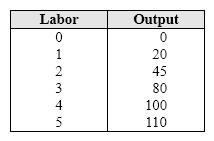
In Exhibit 11-2, if product price is fixed at $5, the MRP of the third worker is equal to:
A) $35.
B) $125.
C) $80.
D) $175.
In Exhibit 11-2, if product price is fixed at $5, the MRP of the third worker is equal to:
A) $35.
B) $125.
C) $80.
D) $175.
Question
Exhibit 11-1 Use the information in the accompanying chart to answer the following question(s). The firm hires labor competitively and sells its product in a competitive price-taker market.
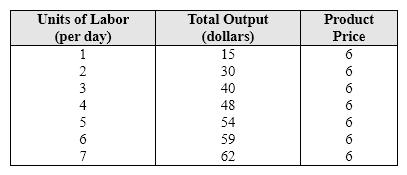
Refer to Exhibit 11-1. What is the marginal revenue product of the fifth unit of labor?
A) $6.
B) $36.
C) $54.
D) $324.
Refer to Exhibit 11-1. What is the marginal revenue product of the fifth unit of labor?
A) $6.
B) $36.
C) $54.
D) $324.
Question
Question
Question
Exhibit 11-4 Supply and demand curves for food servers
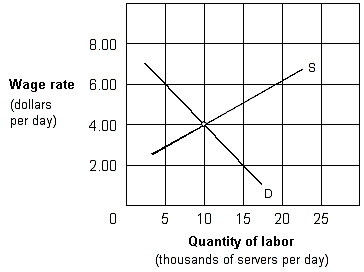
In Exhibit 11-4, the equilibrium wage and the number of food servers employed per day, respectively, are:
A) $2.00 and 5,000.
B) $4.00 and 10,000.
C) $6.00 and 15,000
D) $8.00 and 20,000.
In Exhibit 11-4, the equilibrium wage and the number of food servers employed per day, respectively, are:
A) $2.00 and 5,000.
B) $4.00 and 10,000.
C) $6.00 and 15,000
D) $8.00 and 20,000.
Question
Question
Question
Question
Question
Question
Question
Question
Question
Question
Question
Question
Question
Exhibit 11-5 A perfectly competitive labor market

In Exhibit 11-5, when the marginal revenue product is $20.00, firms should
A) continue hiring workers.
B) stop hiring workers.
C) start firing workers.
D) pay a wage above $15.00 to its workers
In Exhibit 11-5, when the marginal revenue product is $20.00, firms should
A) continue hiring workers.
B) stop hiring workers.
C) start firing workers.
D) pay a wage above $15.00 to its workers
Question
Exhibit 11-4 Supply and demand curves for food servers

In Exhibit 11-4, suppose that in the interest of boosting incomes of the working poor, Congress imposes a minimum wage of $6.00 per hour. This minimum wage rate creates a(n):
A) new labor market equilibrium.
B) excess demand for labor of 10 thousand food servers.
C) excess supply of labor of food servers.
D) situation of full employment for food servers.
In Exhibit 11-4, suppose that in the interest of boosting incomes of the working poor, Congress imposes a minimum wage of $6.00 per hour. This minimum wage rate creates a(n):
A) new labor market equilibrium.
B) excess demand for labor of 10 thousand food servers.
C) excess supply of labor of food servers.
D) situation of full employment for food servers.
Question
Question
Exhibit 11-1 Use the information in the accompanying chart to answer the following question(s). The firm hires labor competitively and sells its product in a competitive price-taker market.
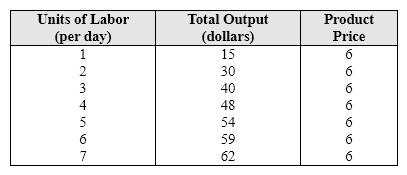
Refer to Exhibit 11-1. If the market wage rate is $25 per day, how many workers should the firm hire if it wants to maximize profits?
A) 4.
B) 5.
C) 6.
D) 7.
Refer to Exhibit 11-1. If the market wage rate is $25 per day, how many workers should the firm hire if it wants to maximize profits?
A) 4.
B) 5.
C) 6.
D) 7.
Question
Exhibit 11-4 Supply and demand curves for food servers
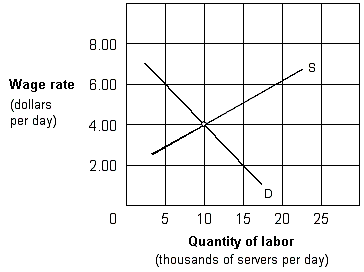
In Exhibit 11-4, assume that both input and output markets are perfectly competitive. If one additional server increases the number of meals sold by four per day and each meal sells for $10, each additional food server will be paid:
A) $16 per day.
B) $32 per day.
C) $36 per day.
D) $40 per day.
In Exhibit 11-4, assume that both input and output markets are perfectly competitive. If one additional server increases the number of meals sold by four per day and each meal sells for $10, each additional food server will be paid:
A) $16 per day.
B) $32 per day.
C) $36 per day.
D) $40 per day.
Question
Exhibit 11-4 Supply and demand curves for food servers
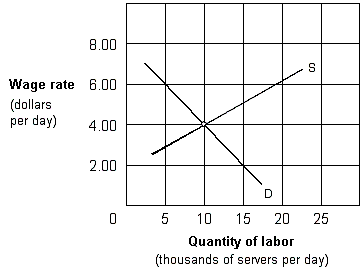
If the equilibrium wage rate in Exhibit 11-4 increased, the cause could be that:
A) the wage increased.
B) the marginal product of labor decreased.
C) either the demand for labor increased or the supply of labor decreased.
D) the price of the product produced by the labor decreased.
If the equilibrium wage rate in Exhibit 11-4 increased, the cause could be that:
A) the wage increased.
B) the marginal product of labor decreased.
C) either the demand for labor increased or the supply of labor decreased.
D) the price of the product produced by the labor decreased.
Question
The following chart indicates the reductions in total losses due to theft if a jewelry store hires additional security guards.
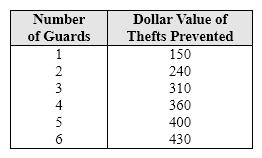
If the security guards can be hired for $45 per day, how many guards should the shop hire?
A) 2.
B) 3.
C) 4.
D) 5.
If the security guards can be hired for $45 per day, how many guards should the shop hire?
A) 2.
B) 3.
C) 4.
D) 5.
Question
Question
Question
Exhibit 11-3 Labor supply curve
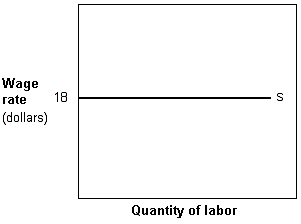
In Exhibit 11-3, the total wage cost of hiring 6 employees is:
A) $18 per hour.
B) $36 per hour.
C) $3 per hour.
D) $108 per hour.
In Exhibit 11-3, the total wage cost of hiring 6 employees is:
A) $18 per hour.
B) $36 per hour.
C) $3 per hour.
D) $108 per hour.
Question
Question
Question
Question
Question
Question
Question
Question
Question
Question
Question
Question
Question
Question
Question
Question
Question
Question
Question
Question
Question
Question
Exhibit 11-12 A monopsonist
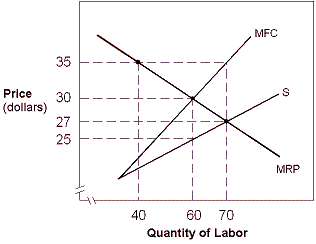
In Exhibit 11-12, suppose this labor market is unionized by a powerful union which forces a wage of $35 upon the industry. The firm would respond by hiring ____ workers and paying a wage of ____.
A) 40; $35
B) 60; $30
C) 70; $27
D) 60; $35
In Exhibit 11-12, suppose this labor market is unionized by a powerful union which forces a wage of $35 upon the industry. The firm would respond by hiring ____ workers and paying a wage of ____.
A) 40; $35
B) 60; $30
C) 70; $27
D) 60; $35
Question
Question
Question
Question
Question
Question
Question
Question
Question
Question
Exhibit 11- 7 Demand for labor curves
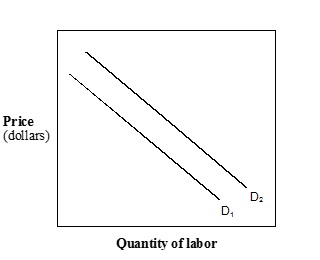
In Exhibit 11-7, which of the following could have caused the shift in labor demand from D 1 to D 2 ?
A) Increase in the demand for the product.
B) Decrease in wages.
C) Decrease in price of product.
D) Decrease in demand for the product.
In Exhibit 11-7, which of the following could have caused the shift in labor demand from D 1 to D 2 ?
A) Increase in the demand for the product.
B) Decrease in wages.
C) Decrease in price of product.
D) Decrease in demand for the product.
Question
Question
Exhibit 11-10 Labor and wage rate data
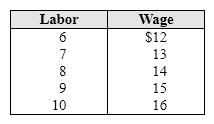
In Exhibit 11-10, the total wage cost of hiring 7 employees is:
A) $15.
B) $91.
C) $13.
D) $19.
E) $112.
In Exhibit 11-10, the total wage cost of hiring 7 employees is:
A) $15.
B) $91.
C) $13.
D) $19.
E) $112.
Question
Question
Question
Question
Question
Question
Exhibit 11-10 Labor and wage rate data

In Exhibit 11-10, the marginal factor cost of the 8th employee is:
A) $14.
B) $13.
C) $21.
D) $112.
In Exhibit 11-10, the marginal factor cost of the 8th employee is:
A) $14.
B) $13.
C) $21.
D) $112.
Question

Unlock Deck
Sign up to unlock the cards in this deck!
Unlock Deck
Unlock Deck
1/105

Play

Full screen (f)
Deck 11: Labor Markets
1
The marginal cost of labor for a perfectly competitive firm is given by:
A) the marginal product of labor.
B) the market wage rate.
C) its marginal revenue product curve.
D) the demand curve for labor.
A) the marginal product of labor.
B) the market wage rate.
C) its marginal revenue product curve.
D) the demand curve for labor.
B
2
The marginal revenue product of a resource is:
A) the marginal product of the resource divided by the price of the product it helps to produce.
B) the price of the product times the price of the resource.
C) larger when the product price is larger.
D) larger when the marginal product is smaller.
A) the marginal product of the resource divided by the price of the product it helps to produce.
B) the price of the product times the price of the resource.
C) larger when the product price is larger.
D) larger when the marginal product is smaller.
C
3
Which of the following is the best example of an investment in human capital?
A) on-the-job training received by an apprentice electrician
B) an increase in the number of hours worked per week by a worker in an unskilled laboring job
C) the purchase of company stock by a worker
D) payments into a retirement pension plan by a skilled laborer
A) on-the-job training received by an apprentice electrician
B) an increase in the number of hours worked per week by a worker in an unskilled laboring job
C) the purchase of company stock by a worker
D) payments into a retirement pension plan by a skilled laborer
A
4
The demand for labor curve is identical to the:
A) marginal revenue curve.
B) marginal resource curve.
C) total revenue curve.
D) marginal revenue product curve.
A) marginal revenue curve.
B) marginal resource curve.
C) total revenue curve.
D) marginal revenue product curve.
Unlock Deck
Unlock for access to all 105 flashcards in this deck.
Unlock Deck
k this deck
5
The optimal hiring rule is to employ labor up to the point where:
A) wage = MFC.
B) wage = MP.
C) wage = MR
D) wage = MRP
A) wage = MFC.
B) wage = MP.
C) wage = MR
D) wage = MRP
Unlock Deck
Unlock for access to all 105 flashcards in this deck.
Unlock Deck
k this deck
6
The labor supply curve facing an individual employer in a perfectly competitive labor market is:
A) upward sloping.
B) downward sloping.
C) horizontal.
D) the MRP curve.
A) upward sloping.
B) downward sloping.
C) horizontal.
D) the MRP curve.
Unlock Deck
Unlock for access to all 105 flashcards in this deck.
Unlock Deck
k this deck
7
Tucker Corporation sells its product for $5.00. Tucker's industrial engineers have informed management that hiring one additional worker will increase output by five units per hour. Tucker should hire the additional worker only if the wage rate is:
A) $5.00 or less per hour.
B) $1.00 or more per hour.
C) $25.00 or less per hour.
D) more than $25.00 per hour.
A) $5.00 or less per hour.
B) $1.00 or more per hour.
C) $25.00 or less per hour.
D) more than $25.00 per hour.
Unlock Deck
Unlock for access to all 105 flashcards in this deck.
Unlock Deck
k this deck
8
A firm's demand for labor depends on, in part, the demand for the firm's product. To summarize this idea, economists say that the demand for labor is:
A) derived demand.
B) marginal demand.
C) secondary demand.
D) monopsonistic demand.
A) derived demand.
B) marginal demand.
C) secondary demand.
D) monopsonistic demand.
Unlock Deck
Unlock for access to all 105 flashcards in this deck.
Unlock Deck
k this deck
9
Firms should hire additional units of a resource as long as the:
A) marginal product of the resource exceeds the price of the resource multiplied by the quantity of output produced.
B) marginal product of the resource is less than the price of the resource.
C) price of the output produced is positive.
D) marginal revenue product of the resource exceeds the cost of an additional unit of the resource.
A) marginal product of the resource exceeds the price of the resource multiplied by the quantity of output produced.
B) marginal product of the resource is less than the price of the resource.
C) price of the output produced is positive.
D) marginal revenue product of the resource exceeds the cost of an additional unit of the resource.
Unlock Deck
Unlock for access to all 105 flashcards in this deck.
Unlock Deck
k this deck
10
A firm's demand curve for labor coincides with the:
A) marginal cost curve.
B) average cost curve.
C) marginal revenue curve.
D) marginal revenue product curve.
A) marginal cost curve.
B) average cost curve.
C) marginal revenue curve.
D) marginal revenue product curve.
Unlock Deck
Unlock for access to all 105 flashcards in this deck.
Unlock Deck
k this deck
11
Which of the following is the most accurate definition of a worker's marginal revenue product?
A) The change in the firm's profits as the result of hiring an additional worker.
B) The change in the firm's total revenue as the result of hiring an additional worker.
C) The change in the firm's output as the result of hiring an additional worker.
D) The change in the firm's cost as the result of hiring an additional worker.
A) The change in the firm's profits as the result of hiring an additional worker.
B) The change in the firm's total revenue as the result of hiring an additional worker.
C) The change in the firm's output as the result of hiring an additional worker.
D) The change in the firm's cost as the result of hiring an additional worker.
Unlock Deck
Unlock for access to all 105 flashcards in this deck.
Unlock Deck
k this deck
12
Dividing the change in total revenue by the change in labor gives:
A) marginal product of labor.
B) marginal revenue product of labor.
C) the price of the output.
D) demand for the output.
A) marginal product of labor.
B) marginal revenue product of labor.
C) the price of the output.
D) demand for the output.
Unlock Deck
Unlock for access to all 105 flashcards in this deck.
Unlock Deck
k this deck
13
Exhibit 11-2 Labor and output data
In Exhibit 11-2, if product price is fixed at $5, the MRP of the third worker is equal to:
A) $35.
B) $125.
C) $80.
D) $175.
In Exhibit 11-2, if product price is fixed at $5, the MRP of the third worker is equal to:
A) $35.
B) $125.
C) $80.
D) $175.
Unlock Deck
Unlock for access to all 105 flashcards in this deck.
Unlock Deck
k this deck
14
Exhibit 11-1 Use the information in the accompanying chart to answer the following question(s). The firm hires labor competitively and sells its product in a competitive price-taker market.
Refer to Exhibit 11-1. What is the marginal revenue product of the fifth unit of labor?
A) $6.
B) $36.
C) $54.
D) $324.
Refer to Exhibit 11-1. What is the marginal revenue product of the fifth unit of labor?
A) $6.
B) $36.
C) $54.
D) $324.
Unlock Deck
Unlock for access to all 105 flashcards in this deck.
Unlock Deck
k this deck
15
The marginal revenue product of a resource:
A) is defined as the marginal product of the resource multiplied by the resource price.
B) simply means that a firm should add to its capital stock as long as competition requires it.
C) equals the extra output produced by an additional unit of the resource multiplied by the price of that output.
D) equals the average product of the resource multiplied by the cost of hiring an additional (marginal) unit of the resource.
A) is defined as the marginal product of the resource multiplied by the resource price.
B) simply means that a firm should add to its capital stock as long as competition requires it.
C) equals the extra output produced by an additional unit of the resource multiplied by the price of that output.
D) equals the average product of the resource multiplied by the cost of hiring an additional (marginal) unit of the resource.
Unlock Deck
Unlock for access to all 105 flashcards in this deck.
Unlock Deck
k this deck
16
If a product's price increases, then its:
A) MP will increase.
B) MFC will increase.
C) MRP will increase.
D) MP will decrease.
A) MP will increase.
B) MFC will increase.
C) MRP will increase.
D) MP will decrease.
Unlock Deck
Unlock for access to all 105 flashcards in this deck.
Unlock Deck
k this deck
17
Exhibit 11-4 Supply and demand curves for food servers
In Exhibit 11-4, the equilibrium wage and the number of food servers employed per day, respectively, are:
A) $2.00 and 5,000.
B) $4.00 and 10,000.
C) $6.00 and 15,000
D) $8.00 and 20,000.
In Exhibit 11-4, the equilibrium wage and the number of food servers employed per day, respectively, are:
A) $2.00 and 5,000.
B) $4.00 and 10,000.
C) $6.00 and 15,000
D) $8.00 and 20,000.
Unlock Deck
Unlock for access to all 105 flashcards in this deck.
Unlock Deck
k this deck
18
One reason the supply of carpenters is greater than the supply of physicians is because:
A) carpenters demand less income.
B) physicians do not belong to a union.
C) of differences in human capital.
D) carpenters belong to unions.
A) carpenters demand less income.
B) physicians do not belong to a union.
C) of differences in human capital.
D) carpenters belong to unions.
Unlock Deck
Unlock for access to all 105 flashcards in this deck.
Unlock Deck
k this deck
19
Which of the following most clearly illustrates the concept of derived demand?
A) An increase in the price of steak causes the demand for poultry to increase.
B) An increase in the demand for new houses leads to an increase in the demand for construction workers.
C) An increase in consumer income leads to an increase in the demand for services provided by the government.
D) An increase in the demand for new cars causes the demand for used automobiles to rise.
A) An increase in the price of steak causes the demand for poultry to increase.
B) An increase in the demand for new houses leads to an increase in the demand for construction workers.
C) An increase in consumer income leads to an increase in the demand for services provided by the government.
D) An increase in the demand for new cars causes the demand for used automobiles to rise.
Unlock Deck
Unlock for access to all 105 flashcards in this deck.
Unlock Deck
k this deck
20
A worker's accumulated investment in education, training, experience, and health is called:
A) derived labor demand.
B) collective entrepreneurship.
C) seniority.
D) human capital.
A) derived labor demand.
B) collective entrepreneurship.
C) seniority.
D) human capital.
Unlock Deck
Unlock for access to all 105 flashcards in this deck.
Unlock Deck
k this deck
21
A union may attempt to obtain stricter certification requirements or longer apprenticeships. These changes would raise workers' wages because they:
A) create unnecessary unemployment.
B) shift in labor supply curve leftward.
C) decrease the marginal product of labor.
D) reduce management's use of featherbedding.
A) create unnecessary unemployment.
B) shift in labor supply curve leftward.
C) decrease the marginal product of labor.
D) reduce management's use of featherbedding.
Unlock Deck
Unlock for access to all 105 flashcards in this deck.
Unlock Deck
k this deck
22
Harold Brown runs a company that sells encyclopedia sets for $250 each. When he employs 10 workers, they can sell 60 sets per week, while only 54 sets are sold when 9 workers are employed. What is the weekly marginal revenue product of the tenth worker?
A) $250.
B) $1,250.
C) $1,500.
D) $15,000.
A) $250.
B) $1,250.
C) $1,500.
D) $15,000.
Unlock Deck
Unlock for access to all 105 flashcards in this deck.
Unlock Deck
k this deck
23
Explain how the presence of a superstar basketball player can increase the marginal revenue product of the other players on the team.
Unlock Deck
Unlock for access to all 105 flashcards in this deck.
Unlock Deck
k this deck
24
Which of the following statements concerning the supply of labor is true ?
A) The wage rate has no effect on the supply of labor.
B) The labor supply curve is downward sloping.
C) The supply of labor is determined by the prevailing wage rate.
D) The typical labor supply curve is upward sloping.
A) The wage rate has no effect on the supply of labor.
B) The labor supply curve is downward sloping.
C) The supply of labor is determined by the prevailing wage rate.
D) The typical labor supply curve is upward sloping.
Unlock Deck
Unlock for access to all 105 flashcards in this deck.
Unlock Deck
k this deck
25
If the marginal product of labor is always positive, the total revenue will grow with each additional worker. Firms do not continuously hire new workers because:
A) there isn't enough room in the factory.
B) there isn't an infinite number of workers.
C) wages would have to increase.
D) they stop when MRP = wage
A) there isn't enough room in the factory.
B) there isn't an infinite number of workers.
C) wages would have to increase.
D) they stop when MRP = wage
Unlock Deck
Unlock for access to all 105 flashcards in this deck.
Unlock Deck
k this deck
26
A decrease in the marginal product of labor would be represented by a(n):
A) increase in labor demand.
B) decrease in labor demand.
C) increase in the quantity demanded of labor.
D) decrease in the quantity demanded of labor.
A) increase in labor demand.
B) decrease in labor demand.
C) increase in the quantity demanded of labor.
D) decrease in the quantity demanded of labor.
Unlock Deck
Unlock for access to all 105 flashcards in this deck.
Unlock Deck
k this deck
27
An increase in the demand for a product will shift the
A) supply of labor used to produce the product rightward.
B) supply of labor used to produce the product leftward.
C) demand for labor used to produce the product rightward.
D) demand for labor used to produce the product leftward.
A) supply of labor used to produce the product rightward.
B) supply of labor used to produce the product leftward.
C) demand for labor used to produce the product rightward.
D) demand for labor used to produce the product leftward.
Unlock Deck
Unlock for access to all 105 flashcards in this deck.
Unlock Deck
k this deck
28
The demand for a factor of production depends on the:
A) supply of the factor.
B) supply of other factors of production.
C) demand for other factors of production.
D) demand for the products that it helps to produce.
A) supply of the factor.
B) supply of other factors of production.
C) demand for other factors of production.
D) demand for the products that it helps to produce.
Unlock Deck
Unlock for access to all 105 flashcards in this deck.
Unlock Deck
k this deck
29
A technological advance that increases the productivity of teachers can be expected to have what effects on the equilibrium labor market for teachers?
A) Wages will rise, and quantity of labor will fall.
B) Wages will rise, and quantity of labor will rise.
C) Wages will fall, and quantity of labor will fall.
D) Wages will fall, and quantity of labor will rise.
A) Wages will rise, and quantity of labor will fall.
B) Wages will rise, and quantity of labor will rise.
C) Wages will fall, and quantity of labor will fall.
D) Wages will fall, and quantity of labor will rise.
Unlock Deck
Unlock for access to all 105 flashcards in this deck.
Unlock Deck
k this deck
30
Exhibit 11-5 A perfectly competitive labor market
In Exhibit 11-5, when the marginal revenue product is $20.00, firms should
A) continue hiring workers.
B) stop hiring workers.
C) start firing workers.
D) pay a wage above $15.00 to its workers
In Exhibit 11-5, when the marginal revenue product is $20.00, firms should
A) continue hiring workers.
B) stop hiring workers.
C) start firing workers.
D) pay a wage above $15.00 to its workers
Unlock Deck
Unlock for access to all 105 flashcards in this deck.
Unlock Deck
k this deck
31
Exhibit 11-4 Supply and demand curves for food servers
In Exhibit 11-4, suppose that in the interest of boosting incomes of the working poor, Congress imposes a minimum wage of $6.00 per hour. This minimum wage rate creates a(n):
A) new labor market equilibrium.
B) excess demand for labor of 10 thousand food servers.
C) excess supply of labor of food servers.
D) situation of full employment for food servers.
In Exhibit 11-4, suppose that in the interest of boosting incomes of the working poor, Congress imposes a minimum wage of $6.00 per hour. This minimum wage rate creates a(n):
A) new labor market equilibrium.
B) excess demand for labor of 10 thousand food servers.
C) excess supply of labor of food servers.
D) situation of full employment for food servers.
Unlock Deck
Unlock for access to all 105 flashcards in this deck.
Unlock Deck
k this deck
32
If the wage rate is fixed at a certain level, the:
A) labor supply curve is horizontal.
B) labor supply is a straight upward sloping line.
C) MP must be constant.
D) labor supply will increase at an increasing rate.
A) labor supply curve is horizontal.
B) labor supply is a straight upward sloping line.
C) MP must be constant.
D) labor supply will increase at an increasing rate.
Unlock Deck
Unlock for access to all 105 flashcards in this deck.
Unlock Deck
k this deck
33
Exhibit 11-1 Use the information in the accompanying chart to answer the following question(s). The firm hires labor competitively and sells its product in a competitive price-taker market.
Refer to Exhibit 11-1. If the market wage rate is $25 per day, how many workers should the firm hire if it wants to maximize profits?
A) 4.
B) 5.
C) 6.
D) 7.
Refer to Exhibit 11-1. If the market wage rate is $25 per day, how many workers should the firm hire if it wants to maximize profits?
A) 4.
B) 5.
C) 6.
D) 7.
Unlock Deck
Unlock for access to all 105 flashcards in this deck.
Unlock Deck
k this deck
34
Exhibit 11-4 Supply and demand curves for food servers
In Exhibit 11-4, assume that both input and output markets are perfectly competitive. If one additional server increases the number of meals sold by four per day and each meal sells for $10, each additional food server will be paid:
A) $16 per day.
B) $32 per day.
C) $36 per day.
D) $40 per day.
In Exhibit 11-4, assume that both input and output markets are perfectly competitive. If one additional server increases the number of meals sold by four per day and each meal sells for $10, each additional food server will be paid:
A) $16 per day.
B) $32 per day.
C) $36 per day.
D) $40 per day.
Unlock Deck
Unlock for access to all 105 flashcards in this deck.
Unlock Deck
k this deck
35
Exhibit 11-4 Supply and demand curves for food servers
If the equilibrium wage rate in Exhibit 11-4 increased, the cause could be that:
A) the wage increased.
B) the marginal product of labor decreased.
C) either the demand for labor increased or the supply of labor decreased.
D) the price of the product produced by the labor decreased.
If the equilibrium wage rate in Exhibit 11-4 increased, the cause could be that:
A) the wage increased.
B) the marginal product of labor decreased.
C) either the demand for labor increased or the supply of labor decreased.
D) the price of the product produced by the labor decreased.
Unlock Deck
Unlock for access to all 105 flashcards in this deck.
Unlock Deck
k this deck
36
The following chart indicates the reductions in total losses due to theft if a jewelry store hires additional security guards.
If the security guards can be hired for $45 per day, how many guards should the shop hire?
A) 2.
B) 3.
C) 4.
D) 5.
If the security guards can be hired for $45 per day, how many guards should the shop hire?
A) 2.
B) 3.
C) 4.
D) 5.
Unlock Deck
Unlock for access to all 105 flashcards in this deck.
Unlock Deck
k this deck
37
A competitive car wash currently hires 4 workers, who together can wash 80 cars per day. The market price of car washes is $5 per wash, and the price of workers is $60 per day. The car wash should hire a fifth worker if it would increase total production to at least:
A) 92 cars per day.
B) 100 cars per day.
C) 104 cars per day.
D) 110 cars per day.
A) 92 cars per day.
B) 100 cars per day.
C) 104 cars per day.
D) 110 cars per day.
Unlock Deck
Unlock for access to all 105 flashcards in this deck.
Unlock Deck
k this deck
38
Describe the decision for a perfectly competitive employer in determining the profit maximizing quantity of labor to employ.
Unlock Deck
Unlock for access to all 105 flashcards in this deck.
Unlock Deck
k this deck
39
Exhibit 11-3 Labor supply curve
In Exhibit 11-3, the total wage cost of hiring 6 employees is:
A) $18 per hour.
B) $36 per hour.
C) $3 per hour.
D) $108 per hour.
In Exhibit 11-3, the total wage cost of hiring 6 employees is:
A) $18 per hour.
B) $36 per hour.
C) $3 per hour.
D) $108 per hour.
Unlock Deck
Unlock for access to all 105 flashcards in this deck.
Unlock Deck
k this deck
40
In Exhibit 11-5, at what wage rate will the firms stop hiring these workers?
A) $25.00.
B) $20.00.
C) $15.00.
D) $10.00.
A) $25.00.
B) $20.00.
C) $15.00.
D) $10.00.
Unlock Deck
Unlock for access to all 105 flashcards in this deck.
Unlock Deck
k this deck
41
If cats become a more popular pet in the United States than they are now, what can we expect to happen to the market for cat food workers?
A) MP increases
B) MRP increases
C) wage decreases
D) MRP decreases
A) MP increases
B) MRP increases
C) wage decreases
D) MRP decreases
Unlock Deck
Unlock for access to all 105 flashcards in this deck.
Unlock Deck
k this deck
42
If the MRP of labor decreases, labor:
A) demand will decrease.
B) demand will increase.
C) supply will increase.
D) supply will decrease.
A) demand will decrease.
B) demand will increase.
C) supply will increase.
D) supply will decrease.
Unlock Deck
Unlock for access to all 105 flashcards in this deck.
Unlock Deck
k this deck
43
Which of the following will decrease the demand for fast-food burger workers' labor?
A) More people start working two jobs and eat more fast food.
B) The price of pizza, a substitute for burgers, decreases.
C) A new technology allows burgers to be produced faster.
D) Workers get additional training that increases productivity.
A) More people start working two jobs and eat more fast food.
B) The price of pizza, a substitute for burgers, decreases.
C) A new technology allows burgers to be produced faster.
D) Workers get additional training that increases productivity.
Unlock Deck
Unlock for access to all 105 flashcards in this deck.
Unlock Deck
k this deck
44
The process of negotiating labor contracts between the union and management concerning wages and working conditions is called
A) collective bargaining.
B) featherbedding.
C) lobbying.
D) an apprenticeship.
A) collective bargaining.
B) featherbedding.
C) lobbying.
D) an apprenticeship.
Unlock Deck
Unlock for access to all 105 flashcards in this deck.
Unlock Deck
k this deck
45
Suppose the price of HD televisions decreases. As a result, the
A) MP of the workers making HD televisions will increase.
B) MFC of the workers making HD televisions will increase.
C) MRP of the workers making HD televisions will increase.
D) MRP of the workers making HD televisions will decrease.
A) MP of the workers making HD televisions will increase.
B) MFC of the workers making HD televisions will increase.
C) MRP of the workers making HD televisions will increase.
D) MRP of the workers making HD televisions will decrease.
Unlock Deck
Unlock for access to all 105 flashcards in this deck.
Unlock Deck
k this deck
46
Featherbedding allows unions to increase wages by:
A) limiting the supply of labor.
B) increasing firms' demand for labor.
C) forcing firms to accept higher-than-equilibrium wages.
D) reducing labor share of payroll taxes.
A) limiting the supply of labor.
B) increasing firms' demand for labor.
C) forcing firms to accept higher-than-equilibrium wages.
D) reducing labor share of payroll taxes.
Unlock Deck
Unlock for access to all 105 flashcards in this deck.
Unlock Deck
k this deck
47
What happens to the marginal product of labor when the market price of the good produced increases?
A) Increases proportional to price.
B) Decreases proportional to price.
C) Stays the same.
D) Falls because quantity demanded falls.
A) Increases proportional to price.
B) Decreases proportional to price.
C) Stays the same.
D) Falls because quantity demanded falls.
Unlock Deck
Unlock for access to all 105 flashcards in this deck.
Unlock Deck
k this deck
48
An advance in technology which increases labor productivity will shift the:
A) labor demand curve to the left.
B) MFC curve to the left.
C) MP curve downward.
D) labor demand curve to the right.
A) labor demand curve to the left.
B) MFC curve to the left.
C) MP curve downward.
D) labor demand curve to the right.
Unlock Deck
Unlock for access to all 105 flashcards in this deck.
Unlock Deck
k this deck
49
Which of the following would cause the demand for labor to change?
A) a change in the price of the good produced
B) a change in the cost of living
C) changes in the wage rate
D) movements along the labor demand curve
A) a change in the price of the good produced
B) a change in the cost of living
C) changes in the wage rate
D) movements along the labor demand curve
Unlock Deck
Unlock for access to all 105 flashcards in this deck.
Unlock Deck
k this deck
50
If union-sponsored advertisements for a particular product succeed in increasing the demand for that product , the:
A) demand for the union-labor used to produce the product will increase.
B) demand for the union-labor used to produce the product will decrease.
C) marginal factor cost of union-labor will increase.
D) marginal factor cost of union-labor will decrease.
A) demand for the union-labor used to produce the product will increase.
B) demand for the union-labor used to produce the product will decrease.
C) marginal factor cost of union-labor will increase.
D) marginal factor cost of union-labor will decrease.
Unlock Deck
Unlock for access to all 105 flashcards in this deck.
Unlock Deck
k this deck
51
If the price of labor falls, we can expect:
A) demand for labor will increase.
B) quantity demanded of labor will increase.
C) demand for labor will decrease.
D) quantity demanded of labor will decrease.
A) demand for labor will increase.
B) quantity demanded of labor will increase.
C) demand for labor will decrease.
D) quantity demanded of labor will decrease.
Unlock Deck
Unlock for access to all 105 flashcards in this deck.
Unlock Deck
k this deck
52
Describe the two basic strategies of unions in increasing wage rates for their members.
Unlock Deck
Unlock for access to all 105 flashcards in this deck.
Unlock Deck
k this deck
53
Which of the following can shift the labor demand curve to the right?
A) decrease in product price
B) increase in wages
C) increase in productivity
D) decrease in the marginal product
A) decrease in product price
B) increase in wages
C) increase in productivity
D) decrease in the marginal product
Unlock Deck
Unlock for access to all 105 flashcards in this deck.
Unlock Deck
k this deck
54
If product price increases, then:
A) MP will increase.
B) MFC will increase.
C) MRP will increase.
D) MP will decrease.
A) MP will increase.
B) MFC will increase.
C) MRP will increase.
D) MP will decrease.
Unlock Deck
Unlock for access to all 105 flashcards in this deck.
Unlock Deck
k this deck
55
A union can influence the demand for labor by:
A) requiring union fees.
B) raising union fees.
C) effective advertising that convinces customers to buy the "union label."
D) lobbying for legislation to reduce immigration.
A) requiring union fees.
B) raising union fees.
C) effective advertising that convinces customers to buy the "union label."
D) lobbying for legislation to reduce immigration.
Unlock Deck
Unlock for access to all 105 flashcards in this deck.
Unlock Deck
k this deck
56
Suppose a change in technology increases the marginal product of labor. The result is a(n):
A) downward movement along the demand for labor curve.
B) rightward shift in the demand for labor curve.
C) leftward shift in the demand for labor curve.
D) upward movement along the demand for labor curve.
A) downward movement along the demand for labor curve.
B) rightward shift in the demand for labor curve.
C) leftward shift in the demand for labor curve.
D) upward movement along the demand for labor curve.
Unlock Deck
Unlock for access to all 105 flashcards in this deck.
Unlock Deck
k this deck
57
Currently, union membership in the United States is about what percentage of civilian employees?
A) 10 percent.
B) 15 percent.
C) 20 percent.
D) 25 percent.
A) 10 percent.
B) 15 percent.
C) 20 percent.
D) 25 percent.
Unlock Deck
Unlock for access to all 105 flashcards in this deck.
Unlock Deck
k this deck
58
A union may negotiate limits on workload in order to increase the demand for labor and raise workers' salaries. This practice is known as:
A) featherbedding.
B) human capital formation.
C) monopsonistic bargaining.
D) artificial demand stimulus.
A) featherbedding.
B) human capital formation.
C) monopsonistic bargaining.
D) artificial demand stimulus.
Unlock Deck
Unlock for access to all 105 flashcards in this deck.
Unlock Deck
k this deck
59
Which part of the United States has the largest union membership measured as the percentage of civilian employees in unions?
A) south-western states
B) western states that do not border the Pacific Ocean
C) south-eastern states
D) mid-western states
A) south-western states
B) western states that do not border the Pacific Ocean
C) south-eastern states
D) mid-western states
Unlock Deck
Unlock for access to all 105 flashcards in this deck.
Unlock Deck
k this deck
60
A technological advance that increases labor productivity will:
A) decrease the demand for labor as MP falls.
B) decrease the demand for labor as fewer workers are needed.
C) decrease the supply of labor as fewer workers are needed.
D) increase the demand for labor as MP rises.
A) decrease the demand for labor as MP falls.
B) decrease the demand for labor as fewer workers are needed.
C) decrease the supply of labor as fewer workers are needed.
D) increase the demand for labor as MP rises.
Unlock Deck
Unlock for access to all 105 flashcards in this deck.
Unlock Deck
k this deck
61
Exhibit 11-12 A monopsonist
In Exhibit 11-12, suppose this labor market is unionized by a powerful union which forces a wage of $35 upon the industry. The firm would respond by hiring ____ workers and paying a wage of ____.
A) 40; $35
B) 60; $30
C) 70; $27
D) 60; $35
In Exhibit 11-12, suppose this labor market is unionized by a powerful union which forces a wage of $35 upon the industry. The firm would respond by hiring ____ workers and paying a wage of ____.
A) 40; $35
B) 60; $30
C) 70; $27
D) 60; $35
Unlock Deck
Unlock for access to all 105 flashcards in this deck.
Unlock Deck
k this deck
62
If an employer currently finds that the MRP of its labor resources equals $67, and the MFC equals $56, what would you advise the firm to do?
A) Stay at its current output level.
B) Hire additional workers.
C) Raise product prices.
D) Reduce employment.
A) Stay at its current output level.
B) Hire additional workers.
C) Raise product prices.
D) Reduce employment.
Unlock Deck
Unlock for access to all 105 flashcards in this deck.
Unlock Deck
k this deck
63
Which of the following statements is true ?
A) Derived demand for labor depends on the demand for the other inputs into production.
B) Unions can either increase demand or decrease the supply of labor.
C) Investment in human capital is expected to decrease the demand for those workers because there will be a greater number of qualified workers available.
D) Unions can effectively increase wages by lobbying for looser immigration laws.
A) Derived demand for labor depends on the demand for the other inputs into production.
B) Unions can either increase demand or decrease the supply of labor.
C) Investment in human capital is expected to decrease the demand for those workers because there will be a greater number of qualified workers available.
D) Unions can effectively increase wages by lobbying for looser immigration laws.
Unlock Deck
Unlock for access to all 105 flashcards in this deck.
Unlock Deck
k this deck
64
The demand curve for labor of Coca-Cola manufacturers will not shift to the right if:
A) Coca-Cola workers become unionized.
B) the price of Coca-Cola increases.
C) the firms innovate with new technology that raises labor productivity.
D) the price of Pepsi increases.
A) Coca-Cola workers become unionized.
B) the price of Coca-Cola increases.
C) the firms innovate with new technology that raises labor productivity.
D) the price of Pepsi increases.
Unlock Deck
Unlock for access to all 105 flashcards in this deck.
Unlock Deck
k this deck
65
An increase in demand for French fries will cause equilibrium wage rates:
A) and quantities of potato workers hired to rise.
B) and quantities of potato workers hired to fall.
C) to rise and quantities of potato workers hired to fall.
D) to fall and quantities of potato workers hired to rise.
A) and quantities of potato workers hired to rise.
B) and quantities of potato workers hired to fall.
C) to rise and quantities of potato workers hired to fall.
D) to fall and quantities of potato workers hired to rise.
Unlock Deck
Unlock for access to all 105 flashcards in this deck.
Unlock Deck
k this deck
66
Explain why wage rates might rise at Joe's Quik-Print Shop if Joe replaces his aging copy machines with state-of-the-art copy machines.
Unlock Deck
Unlock for access to all 105 flashcards in this deck.
Unlock Deck
k this deck
67
A monopsonist hires the amount of labor where the marginal revenue product of labor equals the:
A) price of the monopsonist's product.
B) wage rate.
C) marginal factor cost of labor.
D) marginal product of labor.
A) price of the monopsonist's product.
B) wage rate.
C) marginal factor cost of labor.
D) marginal product of labor.
Unlock Deck
Unlock for access to all 105 flashcards in this deck.
Unlock Deck
k this deck
68
Describe the factors that could cause an increase in the wage rate of workers.
Unlock Deck
Unlock for access to all 105 flashcards in this deck.
Unlock Deck
k this deck
69
In a labor market with one employer, the marginal factor cost is:
A) above the labor supply curve.
B) above the labor demand curve.
C) what determines the wage.
D) downward sloping.
A) above the labor supply curve.
B) above the labor demand curve.
C) what determines the wage.
D) downward sloping.
Unlock Deck
Unlock for access to all 105 flashcards in this deck.
Unlock Deck
k this deck
70
Suppose a monopsonist wants to hire more workers. If it has to pay the same wage to all of its workers, the:
A) marginal factor cost will fall while the wage will rise.
B) wage will fall while the marginal factor cost will rise.
C) difference between the wage and marginal factor cost will become smaller.
D) wage and the marginal factor cost will increase.
A) marginal factor cost will fall while the wage will rise.
B) wage will fall while the marginal factor cost will rise.
C) difference between the wage and marginal factor cost will become smaller.
D) wage and the marginal factor cost will increase.
Unlock Deck
Unlock for access to all 105 flashcards in this deck.
Unlock Deck
k this deck
71
Exhibit 11- 7 Demand for labor curves
In Exhibit 11-7, which of the following could have caused the shift in labor demand from D 1 to D 2 ?
A) Increase in the demand for the product.
B) Decrease in wages.
C) Decrease in price of product.
D) Decrease in demand for the product.
In Exhibit 11-7, which of the following could have caused the shift in labor demand from D 1 to D 2 ?
A) Increase in the demand for the product.
B) Decrease in wages.
C) Decrease in price of product.
D) Decrease in demand for the product.
Unlock Deck
Unlock for access to all 105 flashcards in this deck.
Unlock Deck
k this deck
72
If a town has a monopsony, this means:
A) there is only one employer.
B) price discrimination takes place.
C) goods are priced too high.
D) no unions can exist.
A) there is only one employer.
B) price discrimination takes place.
C) goods are priced too high.
D) no unions can exist.
Unlock Deck
Unlock for access to all 105 flashcards in this deck.
Unlock Deck
k this deck
73
Exhibit 11-10 Labor and wage rate data
In Exhibit 11-10, the total wage cost of hiring 7 employees is:
A) $15.
B) $91.
C) $13.
D) $19.
E) $112.
In Exhibit 11-10, the total wage cost of hiring 7 employees is:
A) $15.
B) $91.
C) $13.
D) $19.
E) $112.
Unlock Deck
Unlock for access to all 105 flashcards in this deck.
Unlock Deck
k this deck
74
If a monopsonist offers a wage of $6, he finds that 1,200 people are willing to work for him. This means that the:
A) marginal factor cost is $6.
B) marginal factor cost is $200.
C) total wage cost is $1,200.
D) total wage cost is $7,200.
A) marginal factor cost is $6.
B) marginal factor cost is $200.
C) total wage cost is $1,200.
D) total wage cost is $7,200.
Unlock Deck
Unlock for access to all 105 flashcards in this deck.
Unlock Deck
k this deck
75
If more and better technology is used for producing wheat in the United States than in a lesser-developed country, then the:
A) MRP of the U.S. workers will be higher than the MRP of the workers in the lesser-developed country.
B) MRP of the U.S. workers will be lower than the MRP of the workers in the lesser-developed country.
C) demand for the U.S. workers will be lower than the demand for the workers in the lesser developed country.
D) price of wheat will be higher in the United States than in the lesser-developed country.
A) MRP of the U.S. workers will be higher than the MRP of the workers in the lesser-developed country.
B) MRP of the U.S. workers will be lower than the MRP of the workers in the lesser-developed country.
C) demand for the U.S. workers will be lower than the demand for the workers in the lesser developed country.
D) price of wheat will be higher in the United States than in the lesser-developed country.
Unlock Deck
Unlock for access to all 105 flashcards in this deck.
Unlock Deck
k this deck
76
The best number of workers for any employer to hire is that quantity in which:
A) the marginal revenue product equals the marginal factor cost.
B) the marginal revenue product exceeds the marginal factor cost.
C) total costs are minimized.
D) total revenue is maximized.
A) the marginal revenue product equals the marginal factor cost.
B) the marginal revenue product exceeds the marginal factor cost.
C) total costs are minimized.
D) total revenue is maximized.
Unlock Deck
Unlock for access to all 105 flashcards in this deck.
Unlock Deck
k this deck
77
If a union is able to successfully lobby Congress to limit imports of rival products, and thus to raise the demand (and thus price) for the goods or services they make, then which of the following best describes the outcome?
A) The supply of labor will increase.
B) The demand for labor will increase.
C) The supply of labor will decrease.
D) The demand for labor will decrease.
A) The supply of labor will increase.
B) The demand for labor will increase.
C) The supply of labor will decrease.
D) The demand for labor will decrease.
Unlock Deck
Unlock for access to all 105 flashcards in this deck.
Unlock Deck
k this deck
78
According to the economic theory of labor markets, if unions are successful in raising wages, with no accompanying increase in labor productivity, then which of the following is true ?
A) The quantity of labor demanded by profit-maximizing firms will decline.
B) The quantity of labor demanded by profit-maximizing firms will increase.
C) The quantity of labor supplied by workers will decline.
D) There will be a shortage of labor in the unionized labor market.
A) The quantity of labor demanded by profit-maximizing firms will decline.
B) The quantity of labor demanded by profit-maximizing firms will increase.
C) The quantity of labor supplied by workers will decline.
D) There will be a shortage of labor in the unionized labor market.
Unlock Deck
Unlock for access to all 105 flashcards in this deck.
Unlock Deck
k this deck
79
Exhibit 11-10 Labor and wage rate data
In Exhibit 11-10, the marginal factor cost of the 8th employee is:
A) $14.
B) $13.
C) $21.
D) $112.
In Exhibit 11-10, the marginal factor cost of the 8th employee is:
A) $14.
B) $13.
C) $21.
D) $112.
Unlock Deck
Unlock for access to all 105 flashcards in this deck.
Unlock Deck
k this deck
80
A monopoly is a sole ____, and a monopsonist is a sole ____.
A) buyer in a product market; seller in a product market
B) seller in a product market; seller in a labor market
C) buyer in a product market; seller in a labor market
D) seller in a product market; buyer in a labor market
A) buyer in a product market; seller in a product market
B) seller in a product market; seller in a labor market
C) buyer in a product market; seller in a labor market
D) seller in a product market; buyer in a labor market
Unlock Deck
Unlock for access to all 105 flashcards in this deck.
Unlock Deck
k this deck
Unlock Deck
Unlock for access to all 105 flashcards in this deck.






