







 Chat with AI

Deck 9: Tooth Morphology
Full screen (f)

Question

Question
Question
Question
Question
Question
Question
Question
Question
Question
Question
Question
Question
Question
Question
Question
Question
Question
Question
Question
Question
Question
Question
Question
Question
Question
Question
Question
Question
Question
Question
Question
Question
Question
Question
Question
Question
Question
Question
Question
Question
Match between columns
Question
Question
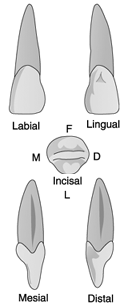 Identify the tooth in the illustration above.
A) Maxillary central
B) Maxillary lateral
C) Mandibular central
D) None of the above
Question
Question
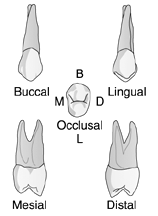 Identify the tooth in the illustration above.
A) Maxillary second premolar
B) Maxillary first molar
C) Maxillary first premolar
D) None of the above
Question
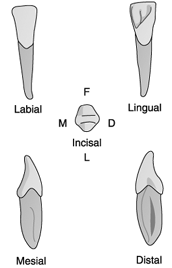 Identify the tooth in the illustration above.
A) Maxillary central
B) Mandibular lateral
C) Mandibular central
D) None of the above
Question
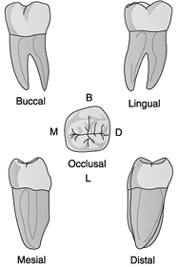 Identify the tooth in the illustration above.
A) Maxillary first molar
B) Maxillary second molar
C) Mandibular first molar
D) Mandibular second molar
Question
Question
Question
Question
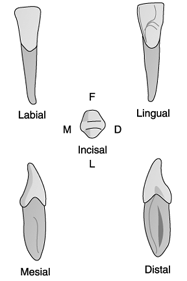 Identify the tooth in the illustration above.
A) Maxillary central
B) Maxillary lateral
C) Mandibular central
D) None of the above
Question
Question
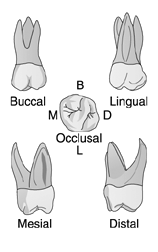 Identify the tooth in the illustration above.
A) Mandibular second molar
B) Maxillary second molar
C) Mandibular first molar
D) Maxillary first molar
Question
Question
Question
Question
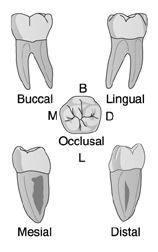 Identify the tooth in the illustration above.
A) Mandibular first molar
B) Mandibular second molar
C) Mandibular third molar
D) None of the above

Unlock Deck
Sign up to unlock the cards in this deck!
Unlock Deck
Unlock Deck
1/57

Play

Full screen (f)
Deck 9: Tooth Morphology
1
Place the teeth in the correct order from the midline backward.
1) Lateral
2) Molars
3) Centrals
4) Cuspids
5) Premolars
A) 1, 2, 3, 4, 5
B) 3, 1, 4, 5, 2
C) 2, 5, 4, 1, 3
D) 2, 4, 5, 3, 1
1) Lateral
2) Molars
3) Centrals
4) Cuspids
5) Premolars
A) 1, 2, 3, 4, 5
B) 3, 1, 4, 5, 2
C) 2, 5, 4, 1, 3
D) 2, 4, 5, 3, 1
3, 1, 4, 5, 2
2
All deciduous teeth are usually fully erupted by the age of ____________.
A) 1 year
B) 2 years
C) 3 years
D) 6 years
A) 1 year
B) 2 years
C) 3 years
D) 6 years
3 years
3
The period of mixed dentition is ______ years.
A) 2 to 3
B) 2 to 6
C) 6 to 12
D) 12 to 21
A) 2 to 3
B) 2 to 6
C) 6 to 12
D) 12 to 21
6 to 12
4
The first permanent tooth usually erupts at age ____________.
A) 6 months
B) 6 years
C) 12 years
D) 21 years
A) 6 months
B) 6 years
C) 12 years
D) 21 years
Unlock Deck
Unlock for access to all 57 flashcards in this deck.
Unlock Deck
k this deck
5
Usually by age ____, all the deciduous teeth have exfoliated.
A) 3
B) 6
C) 12
D) 21
A) 3
B) 6
C) 12
D) 21
Unlock Deck
Unlock for access to all 57 flashcards in this deck.
Unlock Deck
k this deck
6
The clinical crown is defined as the portion of the tooth ____________.
A) covered with enamel
B) covered with cementum
C) visible in the mouth
D) visible on a radiograph
A) covered with enamel
B) covered with cementum
C) visible in the mouth
D) visible on a radiograph
Unlock Deck
Unlock for access to all 57 flashcards in this deck.
Unlock Deck
k this deck
7
The root and the crown are divided by the cervical line.
Unlock Deck
Unlock for access to all 57 flashcards in this deck.
Unlock Deck
k this deck
8
A person's first tooth usually erupts at about age ____________.
A) 6 months
B) 12 months
C) 24 months
D) 6 years
A) 6 months
B) 12 months
C) 24 months
D) 6 years
Unlock Deck
Unlock for access to all 57 flashcards in this deck.
Unlock Deck
k this deck
9
The adult dentition has on average how many permanent teeth?
A) 5
B) 16
C) 32
D) 20
A) 5
B) 16
C) 32
D) 20
Unlock Deck
Unlock for access to all 57 flashcards in this deck.
Unlock Deck
k this deck
10
The first permanent teeth to erupt are the ____________.
A) mandibular centrals
B) mandibular first molars
C) maxillary cuspids
D) maxillary centrals
A) mandibular centrals
B) mandibular first molars
C) maxillary cuspids
D) maxillary centrals
Unlock Deck
Unlock for access to all 57 flashcards in this deck.
Unlock Deck
k this deck
11
Which permanent teeth are not succedaneous?
A) Centrals
B) Cuspids
C) Premolars
D) Molars
A) Centrals
B) Cuspids
C) Premolars
D) Molars
Unlock Deck
Unlock for access to all 57 flashcards in this deck.
Unlock Deck
k this deck
12
The first molars erupt before the cuspids.
Unlock Deck
Unlock for access to all 57 flashcards in this deck.
Unlock Deck
k this deck
13
On the mandibular cuspid, the mesial cusp slope is longer than the distal cusp slope.
Unlock Deck
Unlock for access to all 57 flashcards in this deck.
Unlock Deck
k this deck
14
The oral cavity contains how many quadrants?
A) One
B) Two
C) Three
D) Four
A) One
B) Two
C) Three
D) Four
Unlock Deck
Unlock for access to all 57 flashcards in this deck.
Unlock Deck
k this deck
15
The study of the structure and form of the teeth is ____________.
A) tooth morphology
B) embryology
C) histology
D) none of the above
A) tooth morphology
B) embryology
C) histology
D) none of the above
Unlock Deck
Unlock for access to all 57 flashcards in this deck.
Unlock Deck
k this deck
16
Deciduous teeth have large pulp chambers; greater care should be given during a coronal polish so as not to overheat the tooth.
Unlock Deck
Unlock for access to all 57 flashcards in this deck.
Unlock Deck
k this deck
17
All teeth have how may surfaces?
A) Two
B) Three
C) Four
D) Five
A) Two
B) Three
C) Four
D) Five
Unlock Deck
Unlock for access to all 57 flashcards in this deck.
Unlock Deck
k this deck
18
The anterior teeth are from ____________.
A) lateral to lateral
B) cuspid to cuspid
C) first premolar to first premolar
D) maxillary to mandibular
A) lateral to lateral
B) cuspid to cuspid
C) first premolar to first premolar
D) maxillary to mandibular
Unlock Deck
Unlock for access to all 57 flashcards in this deck.
Unlock Deck
k this deck
19
In the permanent dentition, the wisdom teeth can also be referred to as the third molar.
Unlock Deck
Unlock for access to all 57 flashcards in this deck.
Unlock Deck
k this deck
20
How many teeth are found in each arch in the deciduous dentition?
A) 5
B) 8
C) 10
D) 20
A) 5
B) 8
C) 10
D) 20
Unlock Deck
Unlock for access to all 57 flashcards in this deck.
Unlock Deck
k this deck
21
The elevated area of enamel that forms the mesial and distal borders of each tooth is the _______ ridge.
A) transverse
B) triangular
C) oblique
D) marginal
A) transverse
B) triangular
C) oblique
D) marginal
Unlock Deck
Unlock for access to all 57 flashcards in this deck.
Unlock Deck
k this deck
22
Which premolar is often considered for removal for orthodontic treatment?
A) Maxillary first
B) Maxillary second
C) Mandibular first
D) Mandibular second
A) Maxillary first
B) Maxillary second
C) Mandibular first
D) Mandibular second
Unlock Deck
Unlock for access to all 57 flashcards in this deck.
Unlock Deck
k this deck
23
Which tooth has the longest root in the maxillary arch?
A) Central
B) First molar
C) Cuspid
D) Lateral
A) Central
B) First molar
C) Cuspid
D) Lateral
Unlock Deck
Unlock for access to all 57 flashcards in this deck.
Unlock Deck
k this deck
24
Which teeth are sometimes congenitally missing?
A) Maxillary centrals
B) Mandibular centrals
C) Maxillary cuspids
D) Maxillary laterals
A) Maxillary centrals
B) Mandibular centrals
C) Maxillary cuspids
D) Maxillary laterals
Unlock Deck
Unlock for access to all 57 flashcards in this deck.
Unlock Deck
k this deck
25
Which teeth are often called the "cornerstone of the mouth"?
A) Centrals
B) First molars
C) Cuspids
D) Laterals
A) Centrals
B) First molars
C) Cuspids
D) Laterals
Unlock Deck
Unlock for access to all 57 flashcards in this deck.
Unlock Deck
k this deck
26
The tooth surface that is on the cheek side of the posterior teeth is ____________.
A) buccal
B) lingual
C) mesial
D) distal
A) buccal
B) lingual
C) mesial
D) distal
Unlock Deck
Unlock for access to all 57 flashcards in this deck.
Unlock Deck
k this deck
27
Which premolar has two roots?
A) Maxillary first
B) Maxillary second
C) Mandibular first
D) Mandibular second
A) Maxillary first
B) Maxillary second
C) Mandibular first
D) Mandibular second
Unlock Deck
Unlock for access to all 57 flashcards in this deck.
Unlock Deck
k this deck
28
The tooth that contains the cusp of Carabelli is the ____________.
A) maxillary third molar
B) maxillary first molar
C) mandibular first molar
D) none of the above
A) maxillary third molar
B) maxillary first molar
C) mandibular first molar
D) none of the above
Unlock Deck
Unlock for access to all 57 flashcards in this deck.
Unlock Deck
k this deck
29
Which teeth play an important role in speech?
A) Molars
B) Cuspids
C) Incisors
D) Premolars
A) Molars
B) Cuspids
C) Incisors
D) Premolars
Unlock Deck
Unlock for access to all 57 flashcards in this deck.
Unlock Deck
k this deck
30
An elevation of enamel that descends from the cusp into the middle area of the occlusal surface is the _________ ridge.
A) transverse
B) triangular
C) oblique
D) marginal
A) transverse
B) triangular
C) oblique
D) marginal
Unlock Deck
Unlock for access to all 57 flashcards in this deck.
Unlock Deck
k this deck
31
The union of two triangular ridges that produces one ridge across the occlusal surface is the ________ ridge.
A) transverse
B) occlusal
C) oblique
D) marginal
A) transverse
B) occlusal
C) oblique
D) marginal
Unlock Deck
Unlock for access to all 57 flashcards in this deck.
Unlock Deck
k this deck
32
The opening in the apical portion of each root is the ____________.
A) buccal groove
B) cingulum
C) apex
D) apical foramen
A) buccal groove
B) cingulum
C) apex
D) apical foramen
Unlock Deck
Unlock for access to all 57 flashcards in this deck.
Unlock Deck
k this deck
33
The smallest permanent tooth in the dentition is the ____________.
A) maxillary third molar
B) mandibular central
C) mandibular lateral
D) mandibular third molar
A) maxillary third molar
B) mandibular central
C) mandibular lateral
D) mandibular third molar
Unlock Deck
Unlock for access to all 57 flashcards in this deck.
Unlock Deck
k this deck
34
The dividing point of a multirooted tooth is the ____________.
A) grooves
B) furcation
C) fossa
D) cingulum
A) grooves
B) furcation
C) fossa
D) cingulum
Unlock Deck
Unlock for access to all 57 flashcards in this deck.
Unlock Deck
k this deck
35
Three bulges on the incisal edges of newly erupted centrals are the ____________.
A) mamelons
B) lingual grooves
C) fossae
D) cingula
A) mamelons
B) lingual grooves
C) fossae
D) cingula
Unlock Deck
Unlock for access to all 57 flashcards in this deck.
Unlock Deck
k this deck
36
The elevated area of enamel that extends obliquely across the tooth is the ________ ridge.
A) transverse
B) triangular
C) oblique
D) marginal
A) transverse
B) triangular
C) oblique
D) marginal
Unlock Deck
Unlock for access to all 57 flashcards in this deck.
Unlock Deck
k this deck
37
The shallow rounded or angular depression found on tooth surfaces is the ____________.
A) buccal groove
B) lingual groove
C) fossa
D) cingulum
A) buccal groove
B) lingual groove
C) fossa
D) cingulum
Unlock Deck
Unlock for access to all 57 flashcards in this deck.
Unlock Deck
k this deck
38
The tooth surface that is on the tongue side is the ____________.
A) facial
B) lingual
C) mesial
D) distal
A) facial
B) lingual
C) mesial
D) distal
Unlock Deck
Unlock for access to all 57 flashcards in this deck.
Unlock Deck
k this deck
39
The convex area on the lingual surfaces of the anterior teeth is the ____________.
A) buccal groove
B) lingual groove
C) lingual fossa
D) cingulum
A) buccal groove
B) lingual groove
C) lingual fossa
D) cingulum
Unlock Deck
Unlock for access to all 57 flashcards in this deck.
Unlock Deck
k this deck
40
If a tooth has two roots, it is considered ____________.
A) bifurcated
B) trifurcated
C) concave
D) none of the above
A) bifurcated
B) trifurcated
C) concave
D) none of the above
Unlock Deck
Unlock for access to all 57 flashcards in this deck.
Unlock Deck
k this deck
41
Match between columns
Unlock Deck
Unlock for access to all 57 flashcards in this deck.
Unlock Deck
k this deck
42
A tooth that has the characteristics of a buccal cusp and two lingual cusps is termed ____________.
A) bifurcate
B) bicanineate
C) tricanineate
D) trifurcate
A) bifurcate
B) bicanineate
C) tricanineate
D) trifurcate
Unlock Deck
Unlock for access to all 57 flashcards in this deck.
Unlock Deck
k this deck
43
Identify the tooth in the illustration above.A) Maxillary central
B) Maxillary lateral
C) Mandibular central
D) None of the above
Unlock Deck
Unlock for access to all 57 flashcards in this deck.
Unlock Deck
k this deck
44
On the tooth, the ____________ refers to where the proximal side of two teeth come together and touch (mesial of one and distal of the other).
A) incisal
B) furcation
C) contact
D) gingival-third
A) incisal
B) furcation
C) contact
D) gingival-third
Unlock Deck
Unlock for access to all 57 flashcards in this deck.
Unlock Deck
k this deck
45
Identify the tooth in the illustration above.A) Maxillary second premolar
B) Maxillary first molar
C) Maxillary first premolar
D) None of the above
Unlock Deck
Unlock for access to all 57 flashcards in this deck.
Unlock Deck
k this deck
46
Identify the tooth in the illustration above.A) Maxillary central
B) Mandibular lateral
C) Mandibular central
D) None of the above
Unlock Deck
Unlock for access to all 57 flashcards in this deck.
Unlock Deck
k this deck
47
Identify the tooth in the illustration above.A) Maxillary first molar
B) Maxillary second molar
C) Mandibular first molar
D) Mandibular second molar
Unlock Deck
Unlock for access to all 57 flashcards in this deck.
Unlock Deck
k this deck
48
Which tooth has a nonfunctioning lingual cusp?
A) Mandibular first premolar
B) Mandibular second premolar
C) Mandibular first molar
D) Mandibular second molar
A) Mandibular first premolar
B) Mandibular second premolar
C) Mandibular first molar
D) Mandibular second molar
Unlock Deck
Unlock for access to all 57 flashcards in this deck.
Unlock Deck
k this deck
49
A space or gap between the teeth is called a ____________.
A) fissure
B) diastoma
C) pit
D) bifurcation
A) fissure
B) diastoma
C) pit
D) bifurcation
Unlock Deck
Unlock for access to all 57 flashcards in this deck.
Unlock Deck
k this deck
50
____________ is a linear depression forming a groove that extends from the middle of the buccal surface to the occlusal surface of the tooth.
A) Incisal-third
B) Developmental groove
C) Buccal groove
D) Cingulum
A) Incisal-third
B) Developmental groove
C) Buccal groove
D) Cingulum
Unlock Deck
Unlock for access to all 57 flashcards in this deck.
Unlock Deck
k this deck
51
Identify the tooth in the illustration above.A) Maxillary central
B) Maxillary lateral
C) Mandibular central
D) None of the above
Unlock Deck
Unlock for access to all 57 flashcards in this deck.
Unlock Deck
k this deck
52
The teeth in the permanent dentition that are farthest from the midline are the ____________.
A) canines
B) first and second premolars
C) first and second molars
D) wisdom teeth
A) canines
B) first and second premolars
C) first and second molars
D) wisdom teeth
Unlock Deck
Unlock for access to all 57 flashcards in this deck.
Unlock Deck
k this deck
53
Identify the tooth in the illustration above.A) Mandibular second molar
B) Maxillary second molar
C) Mandibular first molar
D) Maxillary first molar
Unlock Deck
Unlock for access to all 57 flashcards in this deck.
Unlock Deck
k this deck
54
____________ is a developmental groove where decay often initiates this imperfect union.
A) Fossa
B) Cusp of Carabelli
C) Fissure
D) Embrasure
A) Fossa
B) Cusp of Carabelli
C) Fissure
D) Embrasure
Unlock Deck
Unlock for access to all 57 flashcards in this deck.
Unlock Deck
k this deck
55
The tooth that appears to have four equally sized cusps is the
A) Mandibular first premolar
B) Mandibular second premolar
C) Mandibular first molar
D) Mandibular second molar
A) Mandibular first premolar
B) Mandibular second premolar
C) Mandibular first molar
D) Mandibular second molar
Unlock Deck
Unlock for access to all 57 flashcards in this deck.
Unlock Deck
k this deck
56
Which tooth has two pulp canals in one of its roots?
A) Mandibular first premolar
B) Mandibular second premolar
C) Mandibular first molar
D) Mandibular second molar
A) Mandibular first premolar
B) Mandibular second premolar
C) Mandibular first molar
D) Mandibular second molar
Unlock Deck
Unlock for access to all 57 flashcards in this deck.
Unlock Deck
k this deck
57
Identify the tooth in the illustration above.A) Mandibular first molar
B) Mandibular second molar
C) Mandibular third molar
D) None of the above
Unlock Deck
Unlock for access to all 57 flashcards in this deck.
Unlock Deck
k this deck
Unlock Deck
Unlock for access to all 57 flashcards in this deck.






