







 Chat with AI

Deck 1: Anatomy
Full screen (f)

Question

Question
A 52-year-old man is being evaluated for nonspecific, chronic abdominal pain. As part of the workup, he undergoes an abdominal CT scan with intravenous contrast, which reveals no significant findings. An axial image from the scan is shown below. 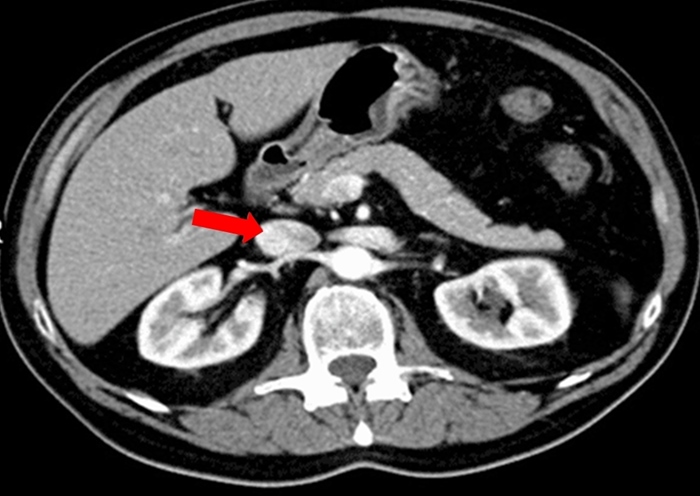 Which of the following statements best describes the structure indicated by the arrow?
A)It drains into the left subclavian vein in the thorax.
B)It drains through the cystic duct into the common bile duct.
C)It gives rise to the right and left renal arteries.
D)It is formed by the union of the common iliac veins.
E)It joins the splenic vein to form the portal vein.
Which of the following statements best describes the structure indicated by the arrow?A)It drains into the left subclavian vein in the thorax.
B)It drains through the cystic duct into the common bile duct.
C)It gives rise to the right and left renal arteries.
D)It is formed by the union of the common iliac veins.
E)It joins the splenic vein to form the portal vein.
Question
Question
Question
Question
Question
Question
Question
A 65-year-old man with a history of coronary artery disease comes to the physician complaining of progressive exertional shortness of breath, fatigue, and lower extremity swelling. His medical history is significant for a myocardial infarction 5 years ago and an electronic pacemaker implanted 2 years ago. His chest x-ray is shown below. A segment of one of the leads is highlighted (arrow). 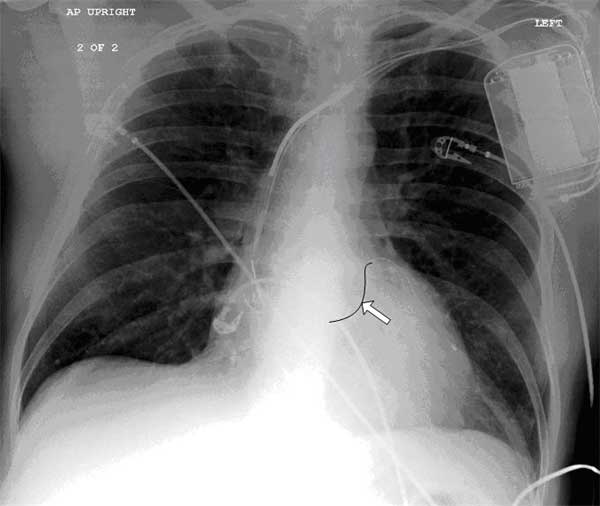 The highlighted segment most likely lies within which of the following structures?
A)Anterior interventricular sulcus
B)Atrioventricular groove
C)Pulmonary artery
D)Right atrium
E)Right ventricle
The highlighted segment most likely lies within which of the following structures?A)Anterior interventricular sulcus
B)Atrioventricular groove
C)Pulmonary artery
D)Right atrium
E)Right ventricle
Question
Question
Question
Question
Question
A 62-year-old man comes to the emergency department due to fever, productive cough, and dyspnea for the past several days. His symptoms are becoming progressively worse. The patient has underlying mild chronic obstructive pulmonary disease and has smoked a pack of cigarettes daily for the last 40 years. On examination, temperature is 38.3 C (100.9 F), pulse is 110/min, and respirations are 24/min. Auscultation of the right lung reveals bronchial breath sounds and crackles. Laboratory evaluation shows leukocytosis. Chest x-ray is shown below.  The mediastinal contour obscured by the lung consolidation on this patient's chest x-ray is primarily formed by which of the following structures?
A)Coronary sinus
B)Inferior vena cava
C)Pulmonary artery
D)Right atrium
E)Right ventricle
F)Superior vena cava
The mediastinal contour obscured by the lung consolidation on this patient's chest x-ray is primarily formed by which of the following structures?A)Coronary sinus
B)Inferior vena cava
C)Pulmonary artery
D)Right atrium
E)Right ventricle
F)Superior vena cava
Question
A 55-year-old man is brought to the emergency department due to shortness of breath, productive cough, and confusion. His wife mentions that last week he was diagnosed with the flu and his symptoms have progressively worsened. Temperature is 39.4 C (103 F), blood pressure is 80/50 mm Hg, pulse is 120/min, and respiratory rate is 22/min. Pulse oximetry shows 86% on room air. On physical examination, the patient is obtunded and in respiratory distress. He is intubated, given a 2-L bolus of normal saline, and started on broad spectrum antibiotics after blood cultures are obtained. A central line is placed to access a structure embryonically derived from the common cardinal veins. This structure is represented by which of the following labels shown in the chest CT scan below? 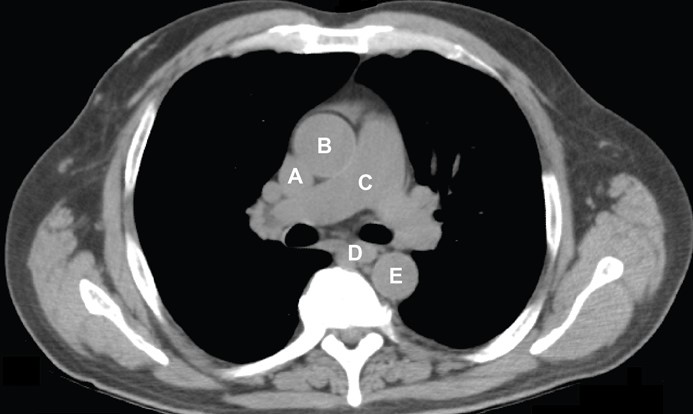
A)A
B)B
C)C
D)D
E)E
A)A
B)B
C)C
D)D
E)E
Question
Question
A 53-year-old man is hospitalized due to chest pain and palpitations. Cardiac catheterization is planned to evaluate for coronary artery disease. The femoral artery is palpated in the right groin, and a catheter is introduced into the common femoral artery. The associated vasculature is visualized after injecting a contrast agent into the catheter. 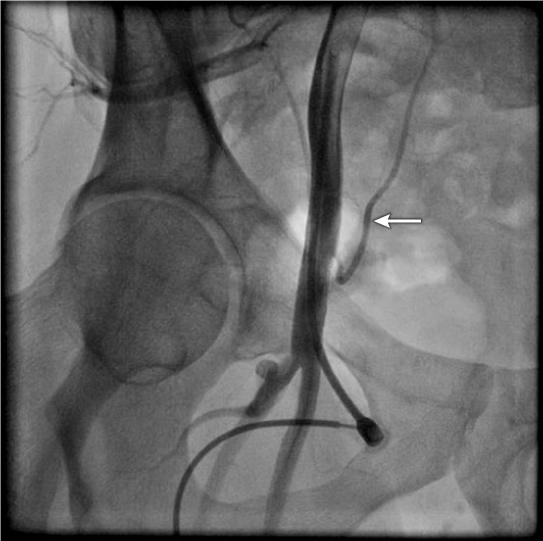 Which of the following is most likely the artery indicated by the arrow in the image above?
A)Inferior epigastric
B)Internal iliac
C)Medial circumflex femoral
D)Obturator
E)Superior gluteal
Which of the following is most likely the artery indicated by the arrow in the image above?A)Inferior epigastric
B)Internal iliac
C)Medial circumflex femoral
D)Obturator
E)Superior gluteal
Question
Question
Question
A 47-year-old man is brought to the emergency department after being involved in a high-speed motor vehicle collision. He was a restrained driver and rear-ended a slow-moving car on the highway. He complains of chest pain, abdominal pain, and difficulty breathing. The patient has a past medical history of hypertension, asthma, and type 2 diabetes mellitus. On arrival, his blood pressure is 98/54 mm Hg and pulse is 121/min. Thirty minutes later, he becomes unresponsive and his pulse is no longer detectable. Electrocardiogram demonstrates sinus tachycardia. Despite extensive resuscitation efforts, the patient dies. An autopsy would most likely show an injury involving which of the following areas of the thoracic aorta? 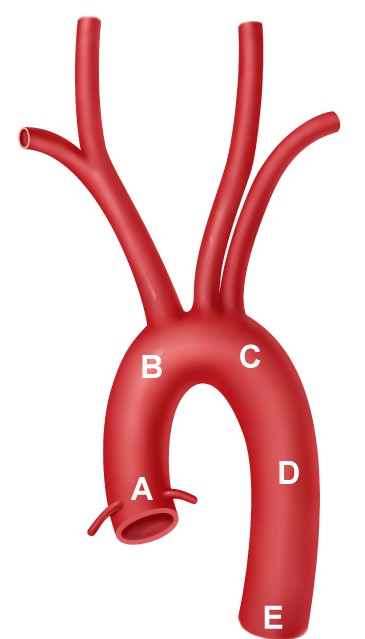
A)A
B)B
C)C
D)D
E)E
A)A
B)B
C)C
D)D
E)E
Question
Question
Question
Question
Question
A 56-year-old previously healthy man comes to the office due to decreased hearing in both ears. He reports difficulty understanding conversations in crowded rooms. His wife adds that they often argue about the volume of the television set. The patient cannot remember precisely when he first noticed hearing loss but says it has been present at least 6 months and is getting worse. For the past 12 years, he has worked in a factory where he has to shout to communicate with coworkers and has seldom worn hearing protection. An audiogram is obtained as shown in the image below.  Which of the following is most likely abnormal in this patient?
A)Auditory nerve
B)Cochlear cupula
C)Middle ear ossicles
D)Organ of Corti
E)Round window
F)Tympanic membrane
Which of the following is most likely abnormal in this patient?A)Auditory nerve
B)Cochlear cupula
C)Middle ear ossicles
D)Organ of Corti
E)Round window
F)Tympanic membrane
Question
Question
Question
Question
A 33-year-old man comes to the emergency department due to fever, chills, cough, and shortness of breath over the last week. He smokes a pack of cigarettes a day, consumes 2 or 3 alcoholic beverages daily, and uses intravenous heroin 2 or 3 times per week. He is febrile and tachycardic. Blood cultures grow Staphylococcus aureus. Chest x-ray shows bilateral nodular lesions with areas of cavitation. The valve most likely affected in this patient can be best evaluated by auscultation at which of the following sites? 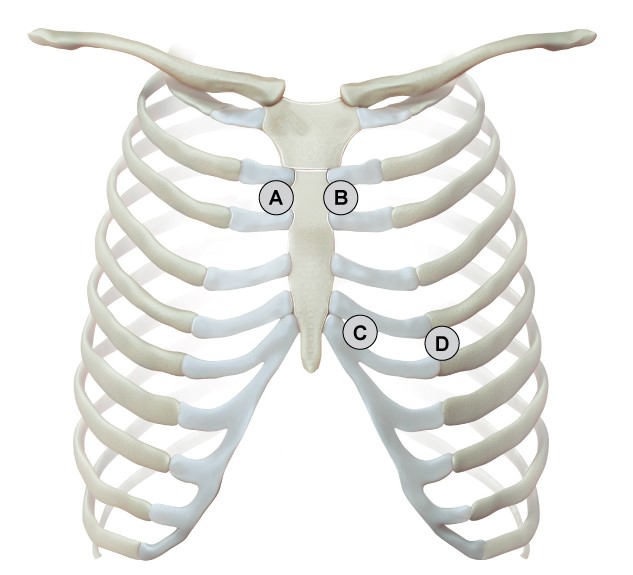
A)A
B)B
C)C
D)D
A)A
B)B
C)C
D)D
Question
Question
A 63-year-old man comes to the emergency department due to pain and swelling of the right calf. He has a history of recurrent gastrointestinal hemorrhage and was discharged from the hospital 4 days ago following a prolonged admission for diverticular bleeding requiring multiple blood transfusions. Temperature is 36.7 C (98 F), blood pressure is 110/60 mm Hg, pulse is 92/min, and respirations are 18/min. Compression ultrasonography with Doppler reveals deep venous thrombosis in the right popliteal vein. A filter placement is planned to prevent embolization. A section of the patient's abdominal CT at the level of L2 is shown in the image below. The filter will most likely be placed in which of the following structures? 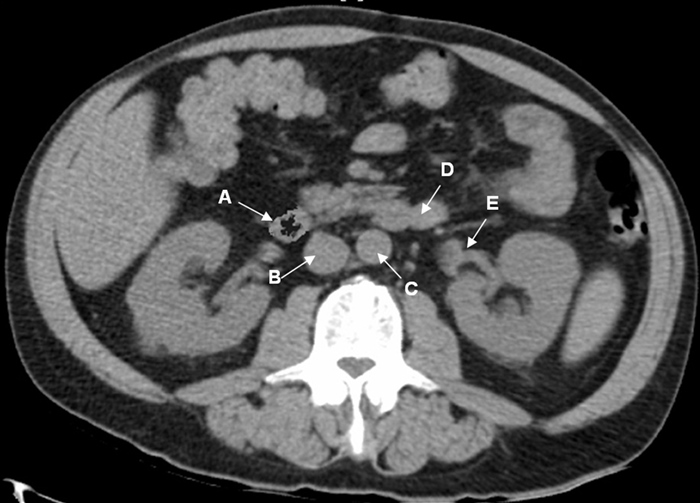
A)A
B)B
C)C
D)D
E)E
A)A
B)B
C)C
D)D
E)E
Question
Question
Question
Question
Question
Question
A 28-year-old man comes to the emergency department with a 3-day history of increasing chest tightness and intermittent sharp chest pains. He also reports mild dyspnea, especially on exertion. The patient has no prior chronic medical conditions but had an upper respiratory illness a week ago that resolved without treatment. ECG reveals sinus tachycardia and low voltage QRS complexes that vary in the amplitude from beat to beat. Which of the following is the most likely chest x-ray finding in this patient?
A)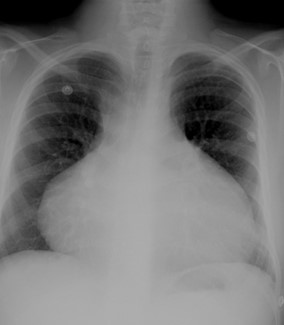
B)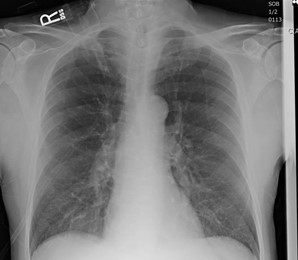
C)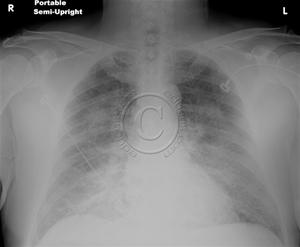
D)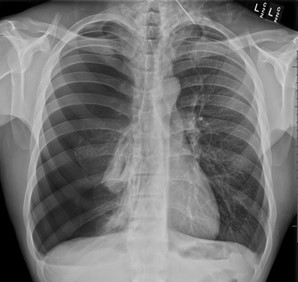
E)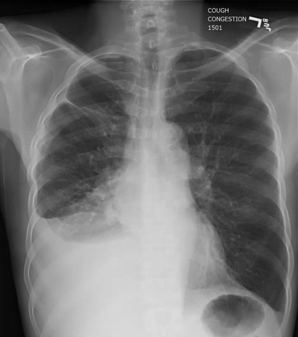
A)
B)
C)
D)
E)
Question
Question
Question
Question
Question
Question
Question
Question
Question
Question
Question
Question
Question
Question
Question
Question
Question
A 48-year-old woman comes to the office due to painful, heavy menses for the past 6 months. The patient has 4-5 days of heavy bleeding, often soaking through a tampon or sanitary napkin every few hours. Menstrual periods occur every 28-30 days. The patient is not on contraception and has no significant medical history. Vital signs are normal. Urine pregnancy test is negative. After an appropriate workup, a hysterectomy is performed, and the surgical specimen is shown below: 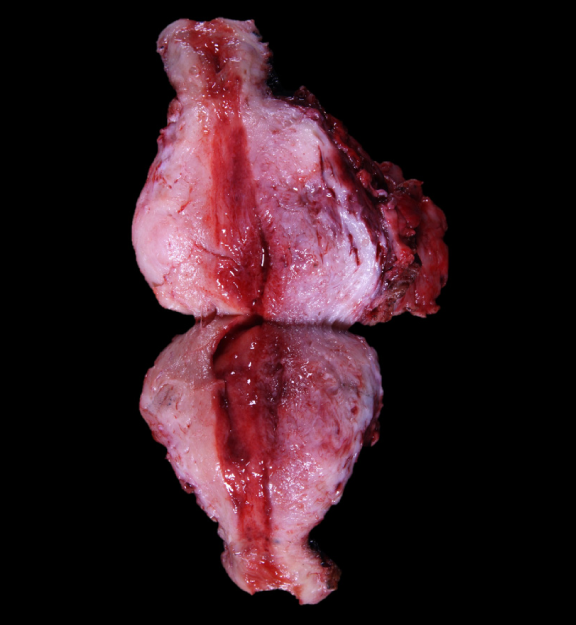 Which of the following is the most likely diagnosis?
A)Adenomyosis
B)Chronic endometritis
C)Complete hydatidiform mole
D)Endometriosis
E)Uterine leiomyoma
F)Uterine sarcoma
Which of the following is the most likely diagnosis?A)Adenomyosis
B)Chronic endometritis
C)Complete hydatidiform mole
D)Endometriosis
E)Uterine leiomyoma
F)Uterine sarcoma
Question
Question
Question
Question
A 30-year-old man comes to the emergency department due to left eye pain after being involved in a street fight. He received a fist blow to the left eye and has since had pain and diplopia. Past medical history is notable for 2 previous gunshot wounds. The patient does not smoke cigarettes but has a history of heavy alcohol intake and frequent marijuana use. On examination, there is significant soft tissue swelling around the left eye. Visual acuity is normal, but extraocular motility of the left eye is limited. Pupillary reflexes are normal. Coronal CT scan of the orbits is shown in the image below.  The orbital contents of this patient are most likely to herniate into which of the following sites?
A)Ethmoid cells
B)Frontal sinus
C)Inferior conchae
D)Maxillary sinus
E)Sphenoid sinus
The orbital contents of this patient are most likely to herniate into which of the following sites?A)Ethmoid cells
B)Frontal sinus
C)Inferior conchae
D)Maxillary sinus
E)Sphenoid sinus
Question
Question
A 20-month old girl is brought to the emergency department for difficulty breathing. The patient has had rhinorrhea and nasal congestion for the past 2 days. She developed a cough and noisy breathing this evening. Medical history is otherwise negative. She is growing well, meeting milestones, and up-to-date on immunizations. On examination, the patient has suprasternal and intercostal retractions, inspiratory stridor, and a barking cough. Inflammation and edema of which of the following sites is most likely causing this patient's stridor? 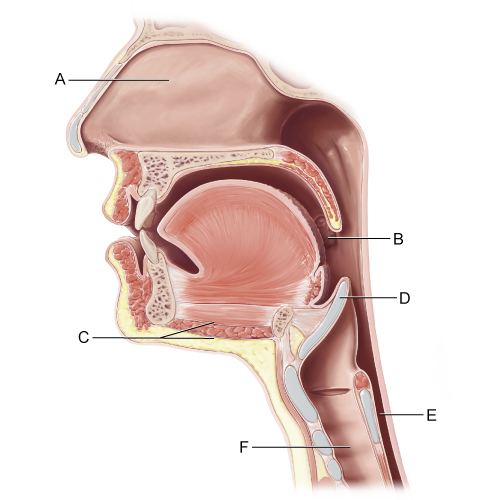
A)A
B)B
C)C
D)D
E)E
F)F
A)A
B)B
C)C
D)D
E)E
F)F
Question
Question
Question
Question
Question
Question
Question
Question
Question
Question
Question
Question
A 47-year-old man comes to the office due to dysphagia. The patient says that it feels like food has been getting stuck in his throat over the last month. He has changed his diet to accommodate his symptoms and now consumes only liquid foods. The patient has a long history of postprandial heartburn that sometimes awakens him from sleep. He has treated his heartburn with over-the-counter antacids but usually only has partial relief. A thoracic CT image near the level of the aortic arch is shown below. This patient's symptoms are most likely related to pathology involving which of the following structures? 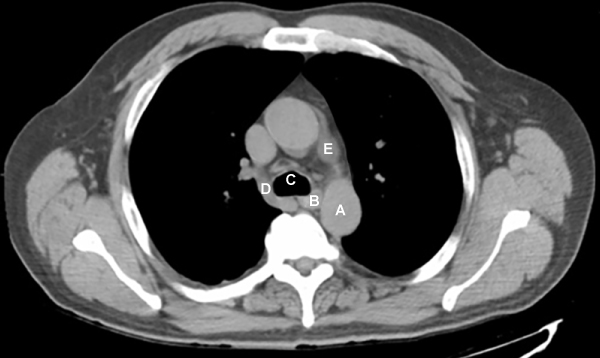
A)A
B)B
C)C
D)D
E)E
A)A
B)B
C)C
D)D
E)E
Question
Question
Question
Question
Question
A 48-year-old man is evaluated for abdominal pain and diarrhea. The patient characterizes his stool as voluminous and foul smelling. He has no significant past medical history. The patient drinks 6 cans of beer daily. On examination, he has normal bowel sounds and mild epigastric tenderness. A 72-hour stool collection shows excessive excretion of fecal fat. A CT scan of the abdomen is shown in the image below. Involvement of which of the following structures is most likely causing this patient's symptoms? 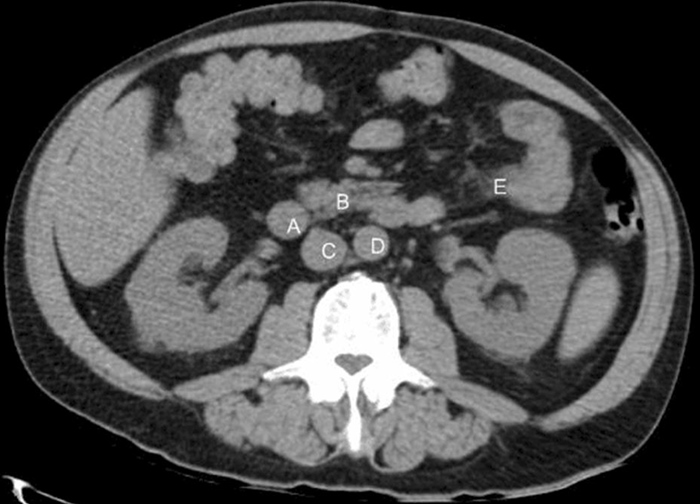
A)A
B)B
C)C
D)D
E)E
A)A
B)B
C)C
D)D
E)E
Question
Question
Question

Unlock Deck
Sign up to unlock the cards in this deck!
Unlock Deck
Unlock Deck
1/291

Play

Full screen (f)
Deck 1: Anatomy
1
A 54-year-old man comes to the office due to episodic burning substernal chest pain. His pain increases with activity and improves with rest. The patient has a history of hypertension and hyperlipidemia. He has smoked a pack of cigarettes daily for the past 30 years. His blood pressure is 140/85 mm Hg and pulse is 76/min. Cardiac auscultation reveals a S4 heart sound. Lung and abdominal examinations are unremarkable. An ECG at rest shows left ventricular hypertrophy. A myocardial perfusion scan reveals inducible ischemia of the inferior surface of the heart. Which of the following coronary arteries is most likely occluded in this patient?
A)Left anterior descending coronary artery
B)Left circumflex coronary artery
C)Left main coronary artery
D)Right coronary artery
E)Right marginal branch
A)Left anterior descending coronary artery
B)Left circumflex coronary artery
C)Left main coronary artery
D)Right coronary artery
E)Right marginal branch
D
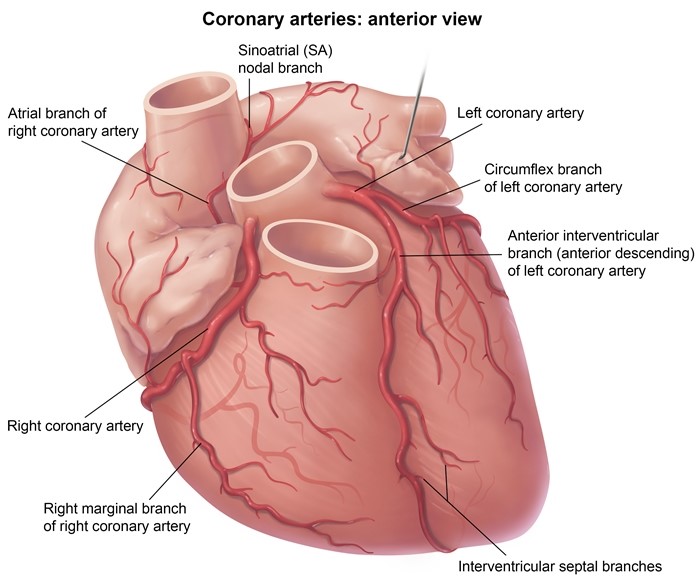
Click here for posterior view
The right and left main coronary arteries arise directly from the root of the aorta and provide the blood supply to the heart. The left main coronary artery divides into the left anterior descending (LAD) and circumflex coronary arteries, which supply most of the anterior and left lateral surfaces of the heart.
In 85%-90% of individuals, the right coronary artery gives rise to the posterior descending artery. Such patients are said to have right dominant coronary circulation. The posterior descending artery runs down the posterior interventricular groove and supplies the posterior one third of the interventricular septum and most of the inferior wall of the left ventricle.
The inferior (diaphragmatic) surface of the heart is formed by the left ventricle (two thirds) and right ventricle (one third), which are separated by the posterior interventricular groove. Because most individuals have right dominant circulation, occlusion of the right coronary artery is most likely to cause inducible ischemia of the inferior surface of the heart.
(Choice A) The LAD artery normally supplies the anterior two thirds of the interventricular septum (septal branches), the anterior wall of the left ventricle (diagonal branches), and part of the anterior papillary muscle.
(Choice B) The left circumflex coronary artery usually supplies the lateral and posterior superior walls of the left ventricle via obtuse marginal branches.
(Choice C) In approximately 10% of individuals, the posterior descending artery derives from the circumflex branch of the left main coronary artery (left dominant circulation); therefore, the left main coronary artery is not the artery most likely occluded in this patient.
(Choice E) The right marginal branch of the right coronary artery supplies the wall of the right ventricle and may provide collateral circulation in patients with LAD occlusion.
Educational objective:
The inferior wall of the left ventricle forms most of the inferior (diaphragmatic) surface of the heart and is supplied by the posterior descending artery. In 85%-90% of individuals, the posterior descending artery derives from the right coronary artery (right dominant coronary circulation).
__________
References:
Anatomy, histology, and pathology of coronary arteries: A review relevant to new interventional and imaging techniques--Part I.
(http://www.ncbi.nlm.nih.gov/pubmed/1617826)
Click here for posterior view
The right and left main coronary arteries arise directly from the root of the aorta and provide the blood supply to the heart. The left main coronary artery divides into the left anterior descending (LAD) and circumflex coronary arteries, which supply most of the anterior and left lateral surfaces of the heart.
In 85%-90% of individuals, the right coronary artery gives rise to the posterior descending artery. Such patients are said to have right dominant coronary circulation. The posterior descending artery runs down the posterior interventricular groove and supplies the posterior one third of the interventricular septum and most of the inferior wall of the left ventricle.
The inferior (diaphragmatic) surface of the heart is formed by the left ventricle (two thirds) and right ventricle (one third), which are separated by the posterior interventricular groove. Because most individuals have right dominant circulation, occlusion of the right coronary artery is most likely to cause inducible ischemia of the inferior surface of the heart.
(Choice A) The LAD artery normally supplies the anterior two thirds of the interventricular septum (septal branches), the anterior wall of the left ventricle (diagonal branches), and part of the anterior papillary muscle.
(Choice B) The left circumflex coronary artery usually supplies the lateral and posterior superior walls of the left ventricle via obtuse marginal branches.
(Choice C) In approximately 10% of individuals, the posterior descending artery derives from the circumflex branch of the left main coronary artery (left dominant circulation); therefore, the left main coronary artery is not the artery most likely occluded in this patient.
(Choice E) The right marginal branch of the right coronary artery supplies the wall of the right ventricle and may provide collateral circulation in patients with LAD occlusion.
Educational objective:
The inferior wall of the left ventricle forms most of the inferior (diaphragmatic) surface of the heart and is supplied by the posterior descending artery. In 85%-90% of individuals, the posterior descending artery derives from the right coronary artery (right dominant coronary circulation).
__________
References:
Anatomy, histology, and pathology of coronary arteries: A review relevant to new interventional and imaging techniques--Part I.
(http://www.ncbi.nlm.nih.gov/pubmed/1617826)
2
A 52-year-old man is being evaluated for nonspecific, chronic abdominal pain. As part of the workup, he undergoes an abdominal CT scan with intravenous contrast, which reveals no significant findings. An axial image from the scan is shown below. Which of the following statements best describes the structure indicated by the arrow?
A)It drains into the left subclavian vein in the thorax.
B)It drains through the cystic duct into the common bile duct.
C)It gives rise to the right and left renal arteries.
D)It is formed by the union of the common iliac veins.
E)It joins the splenic vein to form the portal vein.
Which of the following statements best describes the structure indicated by the arrow?A)It drains into the left subclavian vein in the thorax.
B)It drains through the cystic duct into the common bile duct.
C)It gives rise to the right and left renal arteries.
D)It is formed by the union of the common iliac veins.
E)It joins the splenic vein to form the portal vein.
D
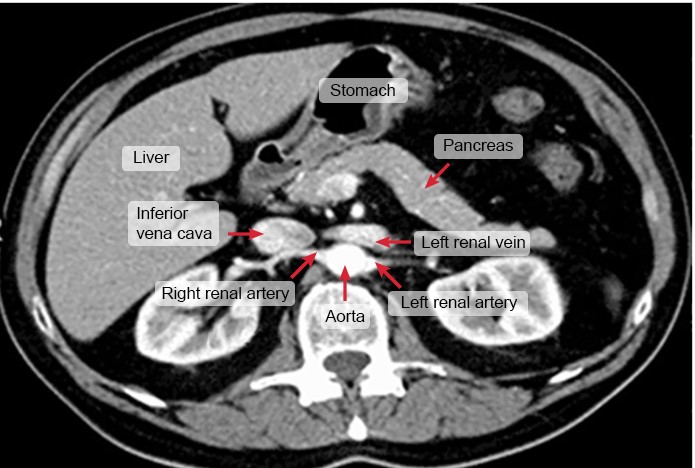
This axial CT image reveals the abdomen near the L1 vertebral level. At this level, the inferior vena cava (IVC) lies just anterior to the right renal artery and to the right of the aorta. The IVC is formed by the union of the right and left common iliac veins at the level of L4-L5 and drains into the right atrium just above the level of the diaphragm at T8. The IVC returns venous blood to the right atrium from the lower extremities, portal system, and abdominal and pelvic viscera.
(Choice A) The thoracic duct drains lymph from the entire left side of the body and all regions inferior to the umbilicus (including the entire gastrointestinal tract). It enters the thorax through the aortic hiatus and empties into the left subclavian vein near its junction with the internal jugular vein.
(Choice B) The cystic duct drains bile from the gallbladder into the common bile duct. The gallbladder is typically visualized just below the liver in the anterior right abdomen but is not well seen in this image.
(Choice C) The image reveals the abdominal aorta giving rise to the right and left renal arteries at the L1 vertebral level. The abdominal aorta lies posteromedial to the IVC within the abdomen.
(Choice E) The superior mesenteric vein joins the splenic vein to form the portal vein. The portal vein can be seen vaguely near the head of the pancreas in this cross-sectional image.
Educational objective:
The inferior vena cava is formed by the union of the right and left common iliac veins at the level of L4-L5. The renal arteries and veins lie at the level of L1. The inferior vena cava returns venous blood to the heart from the lower extremities, portal system, and abdominal and pelvic viscera.
This axial CT image reveals the abdomen near the L1 vertebral level. At this level, the inferior vena cava (IVC) lies just anterior to the right renal artery and to the right of the aorta. The IVC is formed by the union of the right and left common iliac veins at the level of L4-L5 and drains into the right atrium just above the level of the diaphragm at T8. The IVC returns venous blood to the right atrium from the lower extremities, portal system, and abdominal and pelvic viscera.
(Choice A) The thoracic duct drains lymph from the entire left side of the body and all regions inferior to the umbilicus (including the entire gastrointestinal tract). It enters the thorax through the aortic hiatus and empties into the left subclavian vein near its junction with the internal jugular vein.
(Choice B) The cystic duct drains bile from the gallbladder into the common bile duct. The gallbladder is typically visualized just below the liver in the anterior right abdomen but is not well seen in this image.
(Choice C) The image reveals the abdominal aorta giving rise to the right and left renal arteries at the L1 vertebral level. The abdominal aorta lies posteromedial to the IVC within the abdomen.
(Choice E) The superior mesenteric vein joins the splenic vein to form the portal vein. The portal vein can be seen vaguely near the head of the pancreas in this cross-sectional image.
Educational objective:
The inferior vena cava is formed by the union of the right and left common iliac veins at the level of L4-L5. The renal arteries and veins lie at the level of L1. The inferior vena cava returns venous blood to the heart from the lower extremities, portal system, and abdominal and pelvic viscera.
3
A 45-year-old man comes to clinic due to frequent episodes of palpitations accompanied by dizziness, fatigue, and shortness of breath. Prolonged ECG monitoring identifies episodes of atrial fibrillation associated with a rapid ventricular response rate. A radiofrequency ablation procedure is planned. The access site is the right femoral vein. The ablation catheter is advanced to the left atrium where radiofrequency energy is used to eliminate an ectopic focus of abnormal electrical activity. During the procedure, the catheter most likely passes through which of the following structures?
A)Aortic valve
B)Interatrial septum
C)Interventricular septum
D)Pulmonic valve
E)Tricuspid valve
A)Aortic valve
B)Interatrial septum
C)Interventricular septum
D)Pulmonic valve
E)Tricuspid valve
B
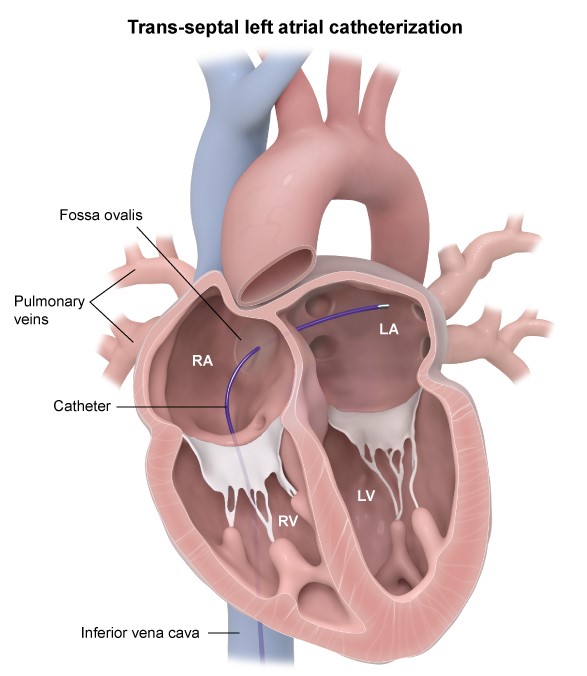
A venous catheter traveling from the femoral vein to the heart passes through the iliac vein and inferior vena cava to reach the right atrium. Once in the right atrium, structures within the right side of the heart and the pulmonary arteries are readily accessible. However, because the pulmonary capillaries are far too small to pass through, the left side of the heart must be accessed by traversing the interatrial septum. The interatrial septum is traversed at the site of the foramen ovale, which in adults is typically covered by a thin membrane of fibrous tissue that can be easily punctured.
Entry into the left atrium allows for direct measurement of left atrial pressure (rather than an estimate via pulmonary capillary wedge pressure) and for access to arrhythmogenic foci that may be located on the left atrial myocardium or the pulmonary veins. Following the procedure, the small atrial septal defect created by the catheter typically closes spontaneously.
(Choice A) Arterial catheterization of the left side of the heart typically starts in the femoral or radial artery and proceeds to the ascending aorta where pressure can be measured or dye can be placed into the coronary arteries to visualize atherosclerotic obstruction (ie, coronary angiography). In addition, the aortic valve may be crossed to measure left ventricular pressure. However, retrograde crossing of the structurally complex mitral valve is highly difficult, and the left atrium is not accessed via this route.
(Choice C) The interventricular septum is not traversed during heart catheterization because the myocardium is thick and difficult to puncture, and high left ventricular pressure would likely prevent spontaneous closure of the ventricular septal defect that is created.
(Choices D and E) The tricuspid valve is crossed during venous catherization to access the right ventricle, and the pulmonic valve is subsequently crossed to access the pulmonary arteries. However, because the catheter cannot pass through the pulmonary capillaries, the left atrium cannot be accessed via this route.
Educational objective:
To access the left side of the heart, cardiac venous catheters must cross the interatrial septum at the site of the foramen ovale. Entry into the left atrium allows for direct measurement of left atrial pressure and for access to arrhythmogenic foci on the left atrial myocardium or pulmonary veins.
__________
References:
Emerging applications for transseptal left heart catheterization old techniques for new procedures.
(http://www.ncbi.nlm.nih.gov/pubmed/18510957)
A venous catheter traveling from the femoral vein to the heart passes through the iliac vein and inferior vena cava to reach the right atrium. Once in the right atrium, structures within the right side of the heart and the pulmonary arteries are readily accessible. However, because the pulmonary capillaries are far too small to pass through, the left side of the heart must be accessed by traversing the interatrial septum. The interatrial septum is traversed at the site of the foramen ovale, which in adults is typically covered by a thin membrane of fibrous tissue that can be easily punctured.
Entry into the left atrium allows for direct measurement of left atrial pressure (rather than an estimate via pulmonary capillary wedge pressure) and for access to arrhythmogenic foci that may be located on the left atrial myocardium or the pulmonary veins. Following the procedure, the small atrial septal defect created by the catheter typically closes spontaneously.
(Choice A) Arterial catheterization of the left side of the heart typically starts in the femoral or radial artery and proceeds to the ascending aorta where pressure can be measured or dye can be placed into the coronary arteries to visualize atherosclerotic obstruction (ie, coronary angiography). In addition, the aortic valve may be crossed to measure left ventricular pressure. However, retrograde crossing of the structurally complex mitral valve is highly difficult, and the left atrium is not accessed via this route.
(Choice C) The interventricular septum is not traversed during heart catheterization because the myocardium is thick and difficult to puncture, and high left ventricular pressure would likely prevent spontaneous closure of the ventricular septal defect that is created.
(Choices D and E) The tricuspid valve is crossed during venous catherization to access the right ventricle, and the pulmonic valve is subsequently crossed to access the pulmonary arteries. However, because the catheter cannot pass through the pulmonary capillaries, the left atrium cannot be accessed via this route.
Educational objective:
To access the left side of the heart, cardiac venous catheters must cross the interatrial septum at the site of the foramen ovale. Entry into the left atrium allows for direct measurement of left atrial pressure and for access to arrhythmogenic foci on the left atrial myocardium or pulmonary veins.
__________
References:
Emerging applications for transseptal left heart catheterization old techniques for new procedures.
(http://www.ncbi.nlm.nih.gov/pubmed/18510957)
4
In the same midesophageal position, the probe is rotated so that it now faces posteriorly. Which of the following structures will be best visualized with the probe's new orientation? A)Descending aorta B)Pulmonary artery C)Pulmonary veins D)Superior vena cava E)Tricuspid valve
Unlock Deck
Unlock for access to all 291 flashcards in this deck.
Unlock Deck
k this deck
5
A 52-year-old man is brought to the emergency department for evaluation of fever, chills, and malaise. Cardiopulmonary examination reveals a new holosystolic heart murmur that radiates toward the axilla. Blood cultures are obtained, and the patient undergoes transesophageal echocardiography. The ultrasound probe is placed in the midesophagus facing anteriorly, and the cardiac chambers are interrogated. Which of the following chambers is closest to the probe? A)Left atrium B)Left ventricle C)Right atrium D)Right ventricle
Unlock Deck
Unlock for access to all 291 flashcards in this deck.
Unlock Deck
k this deck
6
A 68-year-old man with a history of permanent atrial fibrillation comes to the office for follow-up. He has been having symptoms due to ineffective ventricular rate control despite aggressive medical therapy. On examination, the patient's heart rate is 125/min and irregular. ECG shows atrial fibrillation with rapid ventricular response. A catheter-based radiofrequency ablation of the atrioventricular node with placement of a permanent ventricular pacemaker is planned. The ablation tip should be positioned at which of the following locations?
A)Between the tricuspid valve and the inferior vena cava opening
B)Interatrial septum near the opening of the coronary sinus
C)Left atrium near the opening of the pulmonary veins
D)The posterior border of the fossa ovalis
E)Upper part of crista terminalis near the superior vena cava opening
A)Between the tricuspid valve and the inferior vena cava opening
B)Interatrial septum near the opening of the coronary sinus
C)Left atrium near the opening of the pulmonary veins
D)The posterior border of the fossa ovalis
E)Upper part of crista terminalis near the superior vena cava opening
Unlock Deck
Unlock for access to all 291 flashcards in this deck.
Unlock Deck
k this deck
7
A 72-year-old man comes to the emergency department due to left-sided weakness and speech difficulty upon awakening this morning. Medical history includes hypertension and persistent atrial fibrillation. His anticoagulant medication was stopped 6 months ago after an episode of gastrointestinal bleeding. Blood pressure is 160/90 mm Hg and pulse is 88/min and irregular. Examination shows mild dysarthria, left lower facial weakness, and left hemiparesis. CT scan of the head shows no evidence of intracranial bleeding. Transthoracic echocardiogram shows left atrial enlargement, normal left ventricular systolic function, and mild mitral regurgitation. The patient's symptoms are determined to be caused by a thromboembolic event. Which of the following is the most likely source of the thrombus?
A)Crista terminalis
B)Left atrial appendage
C)Left ventricular apex
D)Mitral valve
E)Pulmonary veins
F)Right atrial appendage
G)Sinus of Valsalva
A)Crista terminalis
B)Left atrial appendage
C)Left ventricular apex
D)Mitral valve
E)Pulmonary veins
F)Right atrial appendage
G)Sinus of Valsalva
Unlock Deck
Unlock for access to all 291 flashcards in this deck.
Unlock Deck
k this deck
8
A 54-year-old man comes to the physician for evaluation of exertional chest pain. He first noticed the pain a couple months ago when he was shoveling snow off his driveway and has since experienced several episodes while doing other strenuous tasks. He describes the pain as a heavy, crushing sensation and says it is relieved with rest. The patient undergoes coronary angiography and is found to have severe stenosis of the right coronary artery and left anterior descending and circumflex arteries. He is referred to a surgeon for coronary artery bypass grafting. During the procedure, a portion of his great saphenous vein is removed and grafted to one of the diseased coronary arteries to bypass its atherosclerotic narrowing. The vein used as a graft during this patient's procedure can be accessed at which of the following sites?
A)At the midline of the popliteal fossa
B)Just inferior to the anterior superior iliac spine
C)Just inferolateral to the pubic tubercle
D)Just superior to the inguinal ligament
E)Over the lateral aspect of the foot
A)At the midline of the popliteal fossa
B)Just inferior to the anterior superior iliac spine
C)Just inferolateral to the pubic tubercle
D)Just superior to the inguinal ligament
E)Over the lateral aspect of the foot
Unlock Deck
Unlock for access to all 291 flashcards in this deck.
Unlock Deck
k this deck
9
A 65-year-old man with a history of coronary artery disease comes to the physician complaining of progressive exertional shortness of breath, fatigue, and lower extremity swelling. His medical history is significant for a myocardial infarction 5 years ago and an electronic pacemaker implanted 2 years ago. His chest x-ray is shown below. A segment of one of the leads is highlighted (arrow). The highlighted segment most likely lies within which of the following structures?
A)Anterior interventricular sulcus
B)Atrioventricular groove
C)Pulmonary artery
D)Right atrium
E)Right ventricle
The highlighted segment most likely lies within which of the following structures?A)Anterior interventricular sulcus
B)Atrioventricular groove
C)Pulmonary artery
D)Right atrium
E)Right ventricle
Unlock Deck
Unlock for access to all 291 flashcards in this deck.
Unlock Deck
k this deck
10
A 78-year-old woman is hospitalized due to acute myocardial infarction. The patient had been having intermittent chest pain for 3 days and came to the hospital when the pain became unremitting. She has type 2 diabetes mellitus, but her medical follow-up has been poor. On the third day of hospitalization, the patient has sudden-onset shortness of breath due to pulmonary edema. Echocardiography confirms severe mitral regurgitation. She is taken immediately to surgery, which reveals rupture of the posteromedial papillary muscle. This patient's finding typically suggests compromised blood flow through which of the following coronary arteries?
A)Conus branch
B)Diagonal branch
C)Left anterior descending
D)Obtuse marginal
E)Posterior descending
A)Conus branch
B)Diagonal branch
C)Left anterior descending
D)Obtuse marginal
E)Posterior descending
Unlock Deck
Unlock for access to all 291 flashcards in this deck.
Unlock Deck
k this deck
11
A 66-year-old man comes to the hospital due to sudden-onset chest pain and dyspnea. The patient has a history of asthma and gastroesophageal reflux disease but says his current symptoms feel different than what he usually experiences. An ECG is consistent with ST-elevation myocardial infarction, and an emergent cardiac catheterization is performed. Evaluation of the left and right coronary arteries reveals left-dominant circulation. A stenotic region is identified in one of the coronary vessels just before the origin of the artery supplying the atrioventricular node. Which of the following arteries is most likely affected?
A)Anterior interventricular artery
B)Left circumflex artery
C)Left diagonal artery
D)Right coronary artery
E)Right marginal artery
A)Anterior interventricular artery
B)Left circumflex artery
C)Left diagonal artery
D)Right coronary artery
E)Right marginal artery
Unlock Deck
Unlock for access to all 291 flashcards in this deck.
Unlock Deck
k this deck
12
A 51-year-old man is brought to the emergency department due to chest tightness that started 30 minutes prior to arrival. His chest discomfort is associated with shortness of breath and nausea. The patient was shoveling snow off his driveway when his symptoms began. He has a history of hypertension and type 2 diabetes mellitus. Initial ECG shows ST elevation in leads I and aVL. Cardiac enzymes are elevated. Emergent cardiac catheterization in this patient will most likely show occlusion of which of the following arteries?
A)Distal left anterior descending artery
B)Left circumflex artery
C)Left main coronary artery
D)Proximal left anterior descending artery
E)Right coronary artery
A)Distal left anterior descending artery
B)Left circumflex artery
C)Left main coronary artery
D)Proximal left anterior descending artery
E)Right coronary artery
Unlock Deck
Unlock for access to all 291 flashcards in this deck.
Unlock Deck
k this deck
13
An 82-year-old woman is sent to the hospital from a nursing home after 2 days of fever, confusion, and lethargy. The patient has a history of mild dementia, hypertension, and osteoarthritis. Her temperature is 38.8 C (102 F), blood pressure is 90/60 mm Hg, and pulse is 116/min. She has mild suprapubic and right costovertebral angle tenderness. Her leukocyte count is 18,000/mm3, and urinalysis is consistent with acute cystitis. A femoral venous access is planned for administration of intravenous fluids and antibiotics. The femoral artery pulsation is palpable immediately below the inguinal ligament. Which of the following describes the optimal cannulation site for the femoral vein?
A)Immediately lateral to the femoral artery
B)Immediately medial to the femoral artery
C)Midway between the iliac crest and the femoral artery
D)Superior and medial to the pubic tubercle
E)Superior to the inguinal ligament
A)Immediately lateral to the femoral artery
B)Immediately medial to the femoral artery
C)Midway between the iliac crest and the femoral artery
D)Superior and medial to the pubic tubercle
E)Superior to the inguinal ligament
Unlock Deck
Unlock for access to all 291 flashcards in this deck.
Unlock Deck
k this deck
14
A 62-year-old man comes to the emergency department due to fever, productive cough, and dyspnea for the past several days. His symptoms are becoming progressively worse. The patient has underlying mild chronic obstructive pulmonary disease and has smoked a pack of cigarettes daily for the last 40 years. On examination, temperature is 38.3 C (100.9 F), pulse is 110/min, and respirations are 24/min. Auscultation of the right lung reveals bronchial breath sounds and crackles. Laboratory evaluation shows leukocytosis. Chest x-ray is shown below. The mediastinal contour obscured by the lung consolidation on this patient's chest x-ray is primarily formed by which of the following structures?
A)Coronary sinus
B)Inferior vena cava
C)Pulmonary artery
D)Right atrium
E)Right ventricle
F)Superior vena cava
The mediastinal contour obscured by the lung consolidation on this patient's chest x-ray is primarily formed by which of the following structures?A)Coronary sinus
B)Inferior vena cava
C)Pulmonary artery
D)Right atrium
E)Right ventricle
F)Superior vena cava
Unlock Deck
Unlock for access to all 291 flashcards in this deck.
Unlock Deck
k this deck
15
A 55-year-old man is brought to the emergency department due to shortness of breath, productive cough, and confusion. His wife mentions that last week he was diagnosed with the flu and his symptoms have progressively worsened. Temperature is 39.4 C (103 F), blood pressure is 80/50 mm Hg, pulse is 120/min, and respiratory rate is 22/min. Pulse oximetry shows 86% on room air. On physical examination, the patient is obtunded and in respiratory distress. He is intubated, given a 2-L bolus of normal saline, and started on broad spectrum antibiotics after blood cultures are obtained. A central line is placed to access a structure embryonically derived from the common cardinal veins. This structure is represented by which of the following labels shown in the chest CT scan below?
A)A
B)B
C)C
D)D
E)E
A)A
B)B
C)C
D)D
E)E
Unlock Deck
Unlock for access to all 291 flashcards in this deck.
Unlock Deck
k this deck
16
A 70-year-old man comes to the emergency department due to severe midback pain that started several hours ago. He describes the pain as excruciating and wants immediate relief. The patient also has nausea, diaphoresis, and lightheadedness. He has a history of hypertension and chronic kidney disease. His medication compliance has been poor. He is an active smoker with a 40-pack-year history. His blood pressure on the right arm is 220/105 mm Hg. ECG shows sinus tachycardia and voltage criteria for left ventricular hypertrophy with secondary ST-segment and T wave changes. After initial evaluation, a transesophageal echocardiogram shows a dissection flap in the descending aorta but no evidence of dissection in the ascending aorta. The dissection flap in this patient most likely originates near which of the following points?
A)Brachiocephalic trunk
B)Celiac trunk
C)Intercostal arteries
D)Left subclavian artery
E)Renal arteries
A)Brachiocephalic trunk
B)Celiac trunk
C)Intercostal arteries
D)Left subclavian artery
E)Renal arteries
Unlock Deck
Unlock for access to all 291 flashcards in this deck.
Unlock Deck
k this deck
17
A 53-year-old man is hospitalized due to chest pain and palpitations. Cardiac catheterization is planned to evaluate for coronary artery disease. The femoral artery is palpated in the right groin, and a catheter is introduced into the common femoral artery. The associated vasculature is visualized after injecting a contrast agent into the catheter. Which of the following is most likely the artery indicated by the arrow in the image above?
A)Inferior epigastric
B)Internal iliac
C)Medial circumflex femoral
D)Obturator
E)Superior gluteal
Which of the following is most likely the artery indicated by the arrow in the image above?A)Inferior epigastric
B)Internal iliac
C)Medial circumflex femoral
D)Obturator
E)Superior gluteal
Unlock Deck
Unlock for access to all 291 flashcards in this deck.
Unlock Deck
k this deck
18
A 35-year-old woman comes to the office due to solid food dysphagia for the past several months. The patient has a sensation of food getting stuck in the mid-thorax, but has no pain or reflux. She also has palpitations and dyspnea on exertion. The patient immigrated to the United States from India 1 year ago, and was treated in her home country for rheumatic heart disease. Barium esophagram demonstrates extrinsic compression on the mid-esophagus. Enlargement of which of the following is most likely causing this patient's dysphagia?
A)Left atrium
B)Left ventricle
C)Pulmonary artery
D)Right atrium
E)Right ventricle
A)Left atrium
B)Left ventricle
C)Pulmonary artery
D)Right atrium
E)Right ventricle
Unlock Deck
Unlock for access to all 291 flashcards in this deck.
Unlock Deck
k this deck
19
A 71-year-old man comes to the hospital due to 3 hours of persistent retrosternal chest pain and dyspnea. After prompt evaluation, he is diagnosed with acute myocardial infarction and undergoes cardiac catheterization. During cannulation of the right common femoral artery, the arterial wall is penetrated superior to the right inguinal ligament. Percutaneous coronary intervention is then performed, after which firm pressure is applied to achieve hemostasis. Soon after the procedure, the patient becomes cold, clammy, and hypotensive. Physical examination shows a 5cm region of ecchymosis surrounding the femoral puncture site. Internal bleeding is suspected. Which of the following is the most likely location of the blood collection?
A)Pelvic cavity
B)Retroperitoneal space
C)Right paracolic gutter
D)Subcutaneous tissue
E)Thigh muscles
A)Pelvic cavity
B)Retroperitoneal space
C)Right paracolic gutter
D)Subcutaneous tissue
E)Thigh muscles
Unlock Deck
Unlock for access to all 291 flashcards in this deck.
Unlock Deck
k this deck
20
A 47-year-old man is brought to the emergency department after being involved in a high-speed motor vehicle collision. He was a restrained driver and rear-ended a slow-moving car on the highway. He complains of chest pain, abdominal pain, and difficulty breathing. The patient has a past medical history of hypertension, asthma, and type 2 diabetes mellitus. On arrival, his blood pressure is 98/54 mm Hg and pulse is 121/min. Thirty minutes later, he becomes unresponsive and his pulse is no longer detectable. Electrocardiogram demonstrates sinus tachycardia. Despite extensive resuscitation efforts, the patient dies. An autopsy would most likely show an injury involving which of the following areas of the thoracic aorta?
A)A
B)B
C)C
D)D
E)E
A)A
B)B
C)C
D)D
E)E
Unlock Deck
Unlock for access to all 291 flashcards in this deck.
Unlock Deck
k this deck
21
A 3-month-old boy is brought to the office for follow-up due to a unilateral cleft lip and palate. The patient has been doing well feeding with specialized bottle nipples and is gaining weight. As part of his multidisciplinary care, the parents are told that he will need to be monitored for ear infections and hearing loss. This is because the patient most likely has dysfunction of which of the following muscles?
A)Lateral pterygoid
B)Levator veli palatini
C)Orbicularis oris
D)Stapedius
E)Superior pharyngeal constrictor
A)Lateral pterygoid
B)Levator veli palatini
C)Orbicularis oris
D)Stapedius
E)Superior pharyngeal constrictor
Unlock Deck
Unlock for access to all 291 flashcards in this deck.
Unlock Deck
k this deck
22
A 65-year-old man comes to the office with a 4-month history of persistent left ear pain that is slowly worsening. He is also having some difficulty swallowing. The patient has no chronic medical conditions but has smoked 1 pack of cigarettes per day for the last 46 years. On examination, the external auditory canal is patent and the tympanic membrane is clear with no middle ear effusion. There is an enlarged lymph node in the left anterior neck. Flexible fiberoptic laryngoscopy reveals an ulcerative mass on the posterior pharyngeal wall of the hypopharynx. Involvement of which of the following nerves is most likely responsible for this patient's ear pain?
A)Trigeminal nerve
B)Facial nerve
C)Vestibulocochlear nerve
D)Vagus nerve
E)Hypoglossal nerve
F)Great auricular nerve
A)Trigeminal nerve
B)Facial nerve
C)Vestibulocochlear nerve
D)Vagus nerve
E)Hypoglossal nerve
F)Great auricular nerve
Unlock Deck
Unlock for access to all 291 flashcards in this deck.
Unlock Deck
k this deck
23
A 4-year-old boy is being evaluated for failure to thrive, shortness of breath, and exercise intolerance. The parents first became aware of his symptoms after the patient started preschool a few weeks ago. His teacher mentioned that the patient seemed to tire faster than the other children when playing outside. Cardiac examination shows bounding peripheral pulses and a palpable thrill below the clavicle near the left upper sternal border. On auscultation, a continuous murmur is best heard over the same region. After discussion with the parents, a thoracotomy is scheduled to correct the patient's condition. During the procedure, the surgeon should plan on ligating a derivative of which of the following embryologic structures?
A)Bulbus cordis
B)Fourth aortic arch
C)Primitive atria
D)Sinus venosus
E)Sixth aortic arch
A)Bulbus cordis
B)Fourth aortic arch
C)Primitive atria
D)Sinus venosus
E)Sixth aortic arch
Unlock Deck
Unlock for access to all 291 flashcards in this deck.
Unlock Deck
k this deck
24
A 71-year-old man comes to the emergency department due to sudden-onset vision loss in his left eye for one hour. He has a history of coronary artery disease, hypertension, and type 2 diabetes mellitus. Blood pressure is 145/80 mm Hg and pulse is 72/min. On examination, the patient can see only hand motions through the left eye. Funduscopic evaluation of the eye shows a cherry-red spot in the macula with surrounding retinal whitening. Cranial nerve examination is otherwise unremarkable. There is a left-sided neck bruit on cardiovascular examination. Which of the following is the most likely path of the embolus causing this patient's symptoms?
A)External carotid artery, facial artery, ophthalmic artery, retinal artery
B)External carotid artery, ophthalmic artery, retinal artery
C)External carotid artery, temporal artery, retinal artery
D)Internal carotid artery, anterior cerebral artery, retinal artery
E)Internal carotid artery, ophthalmic artery, retinal artery
A)External carotid artery, facial artery, ophthalmic artery, retinal artery
B)External carotid artery, ophthalmic artery, retinal artery
C)External carotid artery, temporal artery, retinal artery
D)Internal carotid artery, anterior cerebral artery, retinal artery
E)Internal carotid artery, ophthalmic artery, retinal artery
Unlock Deck
Unlock for access to all 291 flashcards in this deck.
Unlock Deck
k this deck
25
A 56-year-old previously healthy man comes to the office due to decreased hearing in both ears. He reports difficulty understanding conversations in crowded rooms. His wife adds that they often argue about the volume of the television set. The patient cannot remember precisely when he first noticed hearing loss but says it has been present at least 6 months and is getting worse. For the past 12 years, he has worked in a factory where he has to shout to communicate with coworkers and has seldom worn hearing protection. An audiogram is obtained as shown in the image below. Which of the following is most likely abnormal in this patient?
A)Auditory nerve
B)Cochlear cupula
C)Middle ear ossicles
D)Organ of Corti
E)Round window
F)Tympanic membrane
Which of the following is most likely abnormal in this patient?A)Auditory nerve
B)Cochlear cupula
C)Middle ear ossicles
D)Organ of Corti
E)Round window
F)Tympanic membrane
Unlock Deck
Unlock for access to all 291 flashcards in this deck.
Unlock Deck
k this deck
26
A 6-year-old boy is brought to the emergency department by his parents due to persistent nasal bleeding. The boy picks his nose frequently and has had several nosebleeds in the past, all of which stopped spontaneously after pinching the nose. The parents say that they have been pinching the nasal alae for over 30 minutes while the boy leans forward. Family history is negative for bleeding disorders. The patient takes no medications and has no allergies. Examination shows continuous blood trickle from his right nostril. Silver nitrate cautery is performed and the bleeding stops. Cautery was most likely applied to which of the following locations in this patient's nasal cavity?
A)Inferior turbinate
B)Middle meatus
C)Nasal septum
D)Posterior choanae
E)Posterolateral wall
A)Inferior turbinate
B)Middle meatus
C)Nasal septum
D)Posterior choanae
E)Posterolateral wall
Unlock Deck
Unlock for access to all 291 flashcards in this deck.
Unlock Deck
k this deck
27
A 52-year-old man comes to the office due to a chronic cough for the last 3 weeks. The patient says, "I haven't been coughing up phlegm, but sometimes I notice some blood on the tissue when I cough particularly hard." He has smoked 2 packs of cigarettes daily for the past 30 years and drinks 3 or 4 cans of beer on weekends. He works as a welder on an assembly line and says his father died of lung cancer at age 70. Physical examination shows right-sided face and arm swelling and engorgement of subcutaneous veins on the same side of the neck. Which of the following veins is most likely obstructed in this patient?
A)Axillary
B)Brachiocephalic
C)External jugular
D)Internal jugular
E)Subclavian
F)Superior vena cava
A)Axillary
B)Brachiocephalic
C)External jugular
D)Internal jugular
E)Subclavian
F)Superior vena cava
Unlock Deck
Unlock for access to all 291 flashcards in this deck.
Unlock Deck
k this deck
28
A 23-year-old man comes to the emergency department due to a sensation of food being stuck in his throat. His symptoms started 2 hours ago after eating fish at a local seafood restaurant. He has tried swallowing multiple times to clear the food with no relief. The patient has no difficulty with breathing. He does not appear to be in significant distress on physical examination. Laryngoscopy reveals a fish bone lodged in the left piriform recess. During retrieval of the fish bone, a nerve is injured deep to the mucosa overlying the recess. Which of the following is most likely to be impaired in this patient?
A)Cough reflex
B)Gag reflex
C)Mastication
D)Salivation
E)Taste sensation
A)Cough reflex
B)Gag reflex
C)Mastication
D)Salivation
E)Taste sensation
Unlock Deck
Unlock for access to all 291 flashcards in this deck.
Unlock Deck
k this deck
29
A 33-year-old man comes to the emergency department due to fever, chills, cough, and shortness of breath over the last week. He smokes a pack of cigarettes a day, consumes 2 or 3 alcoholic beverages daily, and uses intravenous heroin 2 or 3 times per week. He is febrile and tachycardic. Blood cultures grow Staphylococcus aureus. Chest x-ray shows bilateral nodular lesions with areas of cavitation. The valve most likely affected in this patient can be best evaluated by auscultation at which of the following sites?
A)A
B)B
C)C
D)D
A)A
B)B
C)C
D)D
Unlock Deck
Unlock for access to all 291 flashcards in this deck.
Unlock Deck
k this deck
30
A 36-year-old man is rushed to the emergency department after sudden onset of shortness of breath and difficulty swallowing. He has visited the emergency department several times before due to food and skin allergies. The patient is unconscious on arrival. Examination shows excessive accessory respiratory muscle use and edematous swelling of the face, lips, and tongue. There is also scattered urticaria over the upper body. Attempts at intubation are unsuccessful due to massive soft tissue edema involving the pharynx. A decision is made to perform an emergency cricothyrotomy. The incisions made during this procedure will most likely pass through which of the following structures?
A)Buccopharyngeal fascia and platysma
B)Platysma and thyroid isthmus
C)Pretracheal fascia and cricoid cartilage
D)Pretracheal fascia and prevertebral fascia
E)Superficial cervical fascia and cricothyroid membrane
A)Buccopharyngeal fascia and platysma
B)Platysma and thyroid isthmus
C)Pretracheal fascia and cricoid cartilage
D)Pretracheal fascia and prevertebral fascia
E)Superficial cervical fascia and cricothyroid membrane
Unlock Deck
Unlock for access to all 291 flashcards in this deck.
Unlock Deck
k this deck
31
A 63-year-old man comes to the emergency department due to pain and swelling of the right calf. He has a history of recurrent gastrointestinal hemorrhage and was discharged from the hospital 4 days ago following a prolonged admission for diverticular bleeding requiring multiple blood transfusions. Temperature is 36.7 C (98 F), blood pressure is 110/60 mm Hg, pulse is 92/min, and respirations are 18/min. Compression ultrasonography with Doppler reveals deep venous thrombosis in the right popliteal vein. A filter placement is planned to prevent embolization. A section of the patient's abdominal CT at the level of L2 is shown in the image below. The filter will most likely be placed in which of the following structures?
A)A
B)B
C)C
D)D
E)E
A)A
B)B
C)C
D)D
E)E
Unlock Deck
Unlock for access to all 291 flashcards in this deck.
Unlock Deck
k this deck
32
A 50-year-old man comes to the office due to a lump in his neck that has been present for 4 months and is enlarging. On examination, there is a firm, nontender, nonmobile mass in the right anterior neck. Otoscopic examination shows a clear right middle ear effusion. Needle biopsy of the neck mass is consistent with regional nodal spread of squamous cell carcinoma. Which of the following is the most likely site of the primary tumor?
A)Base of tongue
B)Nasopharynx
C)Parotid gland
D)Piriform sinus
E)Thyroid gland
F)Vocal cord
A)Base of tongue
B)Nasopharynx
C)Parotid gland
D)Piriform sinus
E)Thyroid gland
F)Vocal cord
Unlock Deck
Unlock for access to all 291 flashcards in this deck.
Unlock Deck
k this deck
33
A 35-year-old previously healthy man is evaluated for several episodes of syncope in the past 6 weeks. Physical examination is unremarkable. Echocardiogram shows no structural heart defect. An electrophysiologic study is performed during which catheters are passed into the patient's right and left atrium to record atrial electric potentials. Cardiac monitor currently shows normal sinus rhythm. Which of the following is the most likely earliest site of electric activation?
A)Junction of left atrium and atrial appendage
B)Left atrium near the opening of pulmonary veins
C)Right atrium near the opening of inferior vena cava
D)Right atrium near the opening of superior vena cava
E)Right atrium near the septal cusp of tricuspid valve
A)Junction of left atrium and atrial appendage
B)Left atrium near the opening of pulmonary veins
C)Right atrium near the opening of inferior vena cava
D)Right atrium near the opening of superior vena cava
E)Right atrium near the septal cusp of tricuspid valve
Unlock Deck
Unlock for access to all 291 flashcards in this deck.
Unlock Deck
k this deck
34
A 58-year-old man with a history of hypertension and hyperlipidemia comes to the emergency department due to substernal chest pain that began 6 hours ago and has gradually worsened. Blood pressure is 104/72 mm Hg and pulse is 88/min. ECG shows normal sinus rhythm with ST-segment depression and T-wave inversion, and troponin levels are elevated. The patient is diagnosed with non-ST-segment elevation myocardial infarction and admitted to the hospital for medical management, with coronary angiography scheduled the following morning. That evening, telemetry monitoring shows a new Mobitz type 1 second-degree atrioventricular block. Which of the following arteries was most likely obstructed during this patient's myocardial infarction?
A)Left anterior descending
B)Left circumflex
C)Left main coronary
D)Ramus intermedius
E)Right coronary
A)Left anterior descending
B)Left circumflex
C)Left main coronary
D)Ramus intermedius
E)Right coronary
Unlock Deck
Unlock for access to all 291 flashcards in this deck.
Unlock Deck
k this deck
35
A 23-year-old previously healthy man is brought to the emergency department after a stab injury. His friends report that they were "walking down the street minding our own business when a guy jumped out in front of us from behind a dumpster and stabbed him in the chest." They were able to disarm the man after this single attack, and the man then ran off into an alley. The patient is conscious but in distress. Physical examination shows a laterally directed anterior chest wall stab wound at the fifth intercostal space along the left midclavicular line. Which of the following structures is most likely to have been injured in this patient?
A)Azygos vein
B)Inferior vena cava
C)Left atrium
D)Left lung
E)Right ventricle
A)Azygos vein
B)Inferior vena cava
C)Left atrium
D)Left lung
E)Right ventricle
Unlock Deck
Unlock for access to all 291 flashcards in this deck.
Unlock Deck
k this deck
36
An 18-year-old man comes to the clinic due to hematuria and intermittent left flank pain of several months duration. He has no history of trauma or sexually transmitted diseases and no associated fever or dysuria. Examination reveals a soft abdomen with normal bowel sounds and no localized tenderness. Urinalysis confirms 3+ blood but no white blood cells, crystals, or organisms. Contrast-enhanced CT scan shows no abnormalities in the ureters or kidneys but does reveal compression of the left renal vein between the superior mesenteric artery and the aorta. Which of the following is most likely to develop due to the vascular abnormality seen in this patient?
A)Esophageal varices
B)Left-sided ankle swelling
C)Periumbilical venous distension
D)Rectal varices
E)Varicocele
A)Esophageal varices
B)Left-sided ankle swelling
C)Periumbilical venous distension
D)Rectal varices
E)Varicocele
Unlock Deck
Unlock for access to all 291 flashcards in this deck.
Unlock Deck
k this deck
37
A 28-year-old man comes to the emergency department with a 3-day history of increasing chest tightness and intermittent sharp chest pains. He also reports mild dyspnea, especially on exertion. The patient has no prior chronic medical conditions but had an upper respiratory illness a week ago that resolved without treatment. ECG reveals sinus tachycardia and low voltage QRS complexes that vary in the amplitude from beat to beat. Which of the following is the most likely chest x-ray finding in this patient?
A)
B)
C)
D)
E)
A)
B)
C)
D)
E)
Unlock Deck
Unlock for access to all 291 flashcards in this deck.
Unlock Deck
k this deck
38
A 23-year-old woman is brought to the emergency department with a chest wound. She was in her house during a severe thunderstorm when a large tree branch fell through a window. The window was shattered and large fragments of wood and glass struck the patient. She did not lose consciousness, but her family found her bleeding profusely and rushed her to the hospital. Blood pressure is 80/50 mm Hg and pulse is 130/min. The patient appears to be in severe distress. Physical examination shows a deep penetrating wound in the fourth intercostal space along the left sternal border. Smaller lacerations are noted across the face and forearms. Which of the following structures is most likely injured in this patient?
A)Inferior vena cava
B)Left atrium
C)Left ventricle
D)Pulmonary trunk
E)Right ventricle
A)Inferior vena cava
B)Left atrium
C)Left ventricle
D)Pulmonary trunk
E)Right ventricle
Unlock Deck
Unlock for access to all 291 flashcards in this deck.
Unlock Deck
k this deck
39
A 64-year-old man with type 2 diabetes mellitus is evaluated in the clinic due to occasional dizziness. His symptoms usually occur while playing table tennis. The patient has not had any falls or loss of consciousness. He has no known history of coronary artery disease or stroke. The patient has smoked a pack of cigarettes daily for the past 40 years and occasionally drinks alcohol. Orthostatic vital signs are normal. ECG shows normal sinus rhythm. Doppler ultrasound evaluation of the left vertebral artery reveals retrograde (caudal) flow instead of normal antegrade flow. Which of the following arteries is most likely to be occluded based on these ultrasound findings?
A)Innominate artery
B)Left internal carotid
C)Left internal mammary
D)Left subclavian
E)Right vertebral
A)Innominate artery
B)Left internal carotid
C)Left internal mammary
D)Left subclavian
E)Right vertebral
Unlock Deck
Unlock for access to all 291 flashcards in this deck.
Unlock Deck
k this deck
40
A 56-year-old woman is evaluated for fatigue and dyspnea on exertion. Past medical history includes hypertension and systemic sclerosis. Blood pressure is 135/80 mm Hg and pulse is 68/min. Cardiac examination reveals loud second heart sounds with no murmurs. Lungs are clear to auscultation. Further evaluation with a catheterization procedure is performed, during which a balloon-tipped catheter is advanced into the pulmonary artery. A branch of the pulmonary artery is occluded by the balloon, and the pressure beyond the point of occlusion is measured. The pressure reading from the procedure most likely corresponds to which of the following pressures?
A)Intrapleural pressure
B)Left atrial pressure
C)Mean airway pressure
D)Mean arterial pressure
E)Pulse pressure
F)Right atrial pressure
G)Right ventricular systolic pressure
A)Intrapleural pressure
B)Left atrial pressure
C)Mean airway pressure
D)Mean arterial pressure
E)Pulse pressure
F)Right atrial pressure
G)Right ventricular systolic pressure
Unlock Deck
Unlock for access to all 291 flashcards in this deck.
Unlock Deck
k this deck
41
A 64-year-old woman comes to the office for evaluation of a vulvar lesion. The patient has had a vulvar plaque for the past year that has slowly increased in size. She underwent menopause at age 52 and has a 30-year smoking history. Vital signs are normal. Physical examination shows a 1-cm nonfriable, white plaque on the right labia majora. The remainder of the physical examination is normal. A biopsy of the lesion is performed and shows squamous cell carcinoma. A sentinel lymph node biopsy is planned for cancer staging. This procedure should target which of the following lymph nodes?
A)Common iliac
B)External iliac
C)Inguinofemoral
D)Obturator
E)Paraaortic
F)Presacral
A)Common iliac
B)External iliac
C)Inguinofemoral
D)Obturator
E)Paraaortic
F)Presacral
Unlock Deck
Unlock for access to all 291 flashcards in this deck.
Unlock Deck
k this deck
42
A 28-year-old woman, gravida 1 para 0, at 38 weeks gestation undergoes spontaneous vaginal delivery. After an uncomplicated delivery of the fetus and placenta, a maternal laceration is noted at the posterior vaginal opening through the vaginal mucosa and submucosa. Which of the following structures is most likely damaged in this patient?
A)Internal anal sphincter
B)Ischiocavernosus muscle
C)Levator ani muscle
D)Perineal body
E)Sacrotuberous ligament
A)Internal anal sphincter
B)Ischiocavernosus muscle
C)Levator ani muscle
D)Perineal body
E)Sacrotuberous ligament
Unlock Deck
Unlock for access to all 291 flashcards in this deck.
Unlock Deck
k this deck
43
A 61-year-old woman comes to the office due to skin dimpling on the right breast. She first noticed the skin changes 3 months ago while on vacation and is concerned that they have not resolved. The patient does not use tobacco, alcohol, or illicit drugs. She exercises regularly and takes a daily multivitamin. Her last menstrual period was 8 years ago. Physical examination shows a prominent, nontender skin retraction without discoloration or swelling of the right breast. There is also a 6-cm irregular, immobile, firm mass in the right upper outer quadrant of the breast. The left breast appears normal. This patient's skin findings are likely due to malignant infiltration of which of the following structures?
A)Axillary lymph nodes
B)Lactiferous ducts
C)Mammary vein
D)Nipple
E)Suspensory ligaments
A)Axillary lymph nodes
B)Lactiferous ducts
C)Mammary vein
D)Nipple
E)Suspensory ligaments
Unlock Deck
Unlock for access to all 291 flashcards in this deck.
Unlock Deck
k this deck
44
A 54-year-old woman is evaluated for a painless thyroid nodule. She has had no weight changes, heat or cold intolerance, hoarseness, or dyspnea. Medical history is notable for mild hypertension, for which she takes appropriate medications. The patient does not use tobacco or alcohol. Physical examination shows a 3-cm, firm nodule in the right thyroid lobe and enlarged, right cervical lymph nodes. TSH is normal, and fine-needle aspiration of the nodule shows papillary structures with nuclear atypia. Total thyroidectomy is planned. During the surgery, a nearby nerve is injured while ligating an artery entering the superior pole of the thyroid lobe. Which of the following muscles is most likely to be denervated as a result of this injury?
A)Aryepiglotticus
B)Cricothyroid
C)Lateral cricoarytenoid
D)Posterior cricoarytenoid
E)Thyroarytenoid
A)Aryepiglotticus
B)Cricothyroid
C)Lateral cricoarytenoid
D)Posterior cricoarytenoid
E)Thyroarytenoid
Unlock Deck
Unlock for access to all 291 flashcards in this deck.
Unlock Deck
k this deck
45
A 30-year-old woman comes to the emergency department after a seizure. The patient reports pain on the left side of her face and is unable to fully open or close her mouth. She is drooling. On examination, the jaw deviates to the right and the left mandibular condyle is very prominent with a palpable depression posterior to it. The patient is diagnosed with an anterior dislocation of the left temporomandibular joint. The jaw is most likely maintained in a dislocated position due to continued spasm of which of the following muscles?
A)Buccinator
B)Genioglossus
C)Lateral pterygoid
D)Sternocleidomastoid
E)Superior pharyngeal constrictor
F)Zygomaticus major
A)Buccinator
B)Genioglossus
C)Lateral pterygoid
D)Sternocleidomastoid
E)Superior pharyngeal constrictor
F)Zygomaticus major
Unlock Deck
Unlock for access to all 291 flashcards in this deck.
Unlock Deck
k this deck
46
A 29-year-old woman, gravida 2 para 2, comes to the emergency department with fever, crampy abdominal pain, and right flank pain 8 days after an uncomplicated vaginal delivery. Temperature is 38.3 C (101 F) and blood pressure is 110/60 mm Hg. Physical examination shows tenderness in the right lower quadrant and flank. The patient is hospitalized and started on intravenous antibiotics for presumed postpartum endometritis, but her fever persists. Urine and blood cultures show no bacterial growth. CT scan of the abdomen and pelvis reveals right ovarian vein thrombosis. If this patient remains untreated, she is at risk for extension of the thrombus into which of the following vessels?
A)Inferior vena cava
B)Right common iliac vein
C)Right internal iliac vein
D)Right renal vein
E)Right uterine vein
A)Inferior vena cava
B)Right common iliac vein
C)Right internal iliac vein
D)Right renal vein
E)Right uterine vein
Unlock Deck
Unlock for access to all 291 flashcards in this deck.
Unlock Deck
k this deck
47
A 25-year-old woman comes to the office due to right ear pain that has worsened over the past 2 months. The pain is dull and constant and waxes and wanes. It is worse when she chews hard foods such as steak or almonds. In addition to ear pain, her ear feels stuffy and has some ringing. The patient grinds her teeth at night and previously wore a dental guard, but it broke several months ago. Ear examination is normal. Which of the following nerves is most likely responsible for this patient's ear pain?
A)Glossopharyngeal
B)Hypoglossal
C)Trigeminal
D)Vagus
E)Vestibulocochlear
A)Glossopharyngeal
B)Hypoglossal
C)Trigeminal
D)Vagus
E)Vestibulocochlear
Unlock Deck
Unlock for access to all 291 flashcards in this deck.
Unlock Deck
k this deck
48
A 29-year-old nulliparous woman comes to the emergency department due to right-sided pelvic pain. The pain is sharp and began suddenly while she was shoveling snow this morning. It is accompanied by nausea and is worse with movement. The patient's last menstrual period was 2 weeks ago. Temperature is 37.8 C (100 F), blood pressure is 100/60 mm Hg, and pulse is 92/min. Pelvic ultrasound reveals a normal-sized uterus and left ovary; there is a right adnexal mass measuring 6 cm with absent blood flow to the right ovary. Urine β-hCG is negative. The patient's condition most likely arises from obstructed blood flow through which of the following ligaments?
A)Cardinal ligament
B)Infundibulopelvic ligament
C)Mesosalpinx
D)Round ligament
E)Uterosacral ligament
A)Cardinal ligament
B)Infundibulopelvic ligament
C)Mesosalpinx
D)Round ligament
E)Uterosacral ligament
Unlock Deck
Unlock for access to all 291 flashcards in this deck.
Unlock Deck
k this deck
49
A 33-year-old man comes to the office due to trouble swallowing and a chronic sore throat. He has no chronic medical conditions and does not use tobacco or alcohol. Physical examination shows an enlarged, ulcerated right tonsil. Biopsy of the ulcerated lesion reveals infiltrating nests of moderately differentiated squamous cells. Immunohistochemistry is positive for p16, suggesting that the tumor is likely due to human papilloma virus. Further imaging studies for cancer staging are planned. This patient's tumor is most likely to spread first to which of the following locations?
A)Adenoid tissue
B)Adrenal glands
C)Gray-white matter junction
D)Jugular lymph nodes
E)Lung parenchyma
F)Vertebral bodies
A)Adenoid tissue
B)Adrenal glands
C)Gray-white matter junction
D)Jugular lymph nodes
E)Lung parenchyma
F)Vertebral bodies
Unlock Deck
Unlock for access to all 291 flashcards in this deck.
Unlock Deck
k this deck
50
A 34-year-old man develops excessive thirst and frequent urination while being hospitalized for multiple injuries following a motorcycle collision. His urinary osmolality after 4 hours of water restriction is 250 mOsm/L and increases to 700 mOsm/L after administration of antidiuretic hormone. The patient is started on an appropriate medication, and his symptoms promptly resolve. Over the next 2 years, multiple attempts are made to wean the patient off the medication, but his symptoms would always return, necessitating the resumption of treatment. The permanence of this patient's condition is best explained by traumatic damage to which of the following structures?
A)Anterior pituitary
B)Hypothalamic nuclei
C)Kidneys
D)Posterior pituitary
E)Thalamic nuclei
A)Anterior pituitary
B)Hypothalamic nuclei
C)Kidneys
D)Posterior pituitary
E)Thalamic nuclei
Unlock Deck
Unlock for access to all 291 flashcards in this deck.
Unlock Deck
k this deck
51
A 24-year-old primigravid patient at 38 weeks gestation undergoes vaginal delivery of healthy twins after a prolonged labor course. Shortly after the placenta is delivered, profuse vaginal bleeding and a boggy uterus are noted on examination. Uterine massage and uterotonic medications fail to stop the bleeding. The patient is taken to the operating room for a laparotomy. Control of this patient's bleeding can best be achieved through bilateral ligation of which of the following arteries?
A)Common iliac
B)External iliac
C)Internal iliac
D)Internal pudendal
E)Ovarian
A)Common iliac
B)External iliac
C)Internal iliac
D)Internal pudendal
E)Ovarian
Unlock Deck
Unlock for access to all 291 flashcards in this deck.
Unlock Deck
k this deck
52
A 44-year-old man comes to the office for evaluation of a neck lump. The patient first noticed the lump 6 months ago while he was shaving and says that it seems to be growing in size. He has no pain, shortness of breath, cough, hoarseness, or difficulty swallowing. The patient had Hodgkin lymphoma 20 years ago, which was successfully treated with radiation therapy to his chest and neck. Physical examination shows a firm mass in the left thyroid lobe. There is no lymphadenopathy. Serum TSH level is normal. Fine-needle aspiration biopsy reveals papillary thyroid cancer. A total thyroidectomy is performed. During an attempt to ligate the inferior thyroid artery, a nervous structure in close proximity is inadvertently damaged. Which of the following was most likely injured during the surgery?
A)Accessory nerve
B)Ansa cervicalis
C)Hypoglossal nerve
D)Phrenic nerve
E)Recurrent laryngeal nerve
F)Superior cervical ganglion
G)Superior laryngeal nerve
A)Accessory nerve
B)Ansa cervicalis
C)Hypoglossal nerve
D)Phrenic nerve
E)Recurrent laryngeal nerve
F)Superior cervical ganglion
G)Superior laryngeal nerve
Unlock Deck
Unlock for access to all 291 flashcards in this deck.
Unlock Deck
k this deck
53
A 15-year-old girl comes to the office due to pelvic and crampy lower abdominal pain that seems to recur at the beginning of each month and resolves after a day or two. The pain began approximately 6 months ago and has significantly worsened each month. The patient has never had a menstrual period. She has never had sexual intercourse. Weight, height, and BMI are average for age and sex. Breast and pubic hair development are at sexual maturity rating (Tanner stage) 5. Digital rectal examination reveals a palpable mass anterior to the rectum. A pregnancy test is negative. Which of the following is the most likely diagnosis?
A)Androgen insensitivity syndrome
B)Asherman syndrome
C)Endometriosis
D)Imperforate hymen
E)Kallmann syndrome
A)Androgen insensitivity syndrome
B)Asherman syndrome
C)Endometriosis
D)Imperforate hymen
E)Kallmann syndrome
Unlock Deck
Unlock for access to all 291 flashcards in this deck.
Unlock Deck
k this deck
54
A 48-year-old woman comes to the office due to painful, heavy menses for the past 6 months. The patient has 4-5 days of heavy bleeding, often soaking through a tampon or sanitary napkin every few hours. Menstrual periods occur every 28-30 days. The patient is not on contraception and has no significant medical history. Vital signs are normal. Urine pregnancy test is negative. After an appropriate workup, a hysterectomy is performed, and the surgical specimen is shown below: Which of the following is the most likely diagnosis?
A)Adenomyosis
B)Chronic endometritis
C)Complete hydatidiform mole
D)Endometriosis
E)Uterine leiomyoma
F)Uterine sarcoma
Which of the following is the most likely diagnosis?A)Adenomyosis
B)Chronic endometritis
C)Complete hydatidiform mole
D)Endometriosis
E)Uterine leiomyoma
F)Uterine sarcoma
Unlock Deck
Unlock for access to all 291 flashcards in this deck.
Unlock Deck
k this deck
55
A 63-year-old postmenopausal woman comes to the office due to right-sided lower abdominal pain for the last 5 months. The patient has had no changes in bowel or bladder habits, no increase in abdominal girth or bloating, and no early satiety. Physical examination shows a soft abdomen with slight tenderness to palpation over the right lower quadrant. On pelvic examination, the uterus is small and the right adnexa is enlarged. Transvaginal ultrasound shows a normal uterus; a unilateral, 3.5-cm, complex ovarian mass with cystic and solid components; and no free fluid in the pelvis. Surgery is planned to remove the right ovary, including the mass. To avoid excessive bleeding, which of the following structures should be ligated during the oophorectomy?
A)Mesosalpinx
B)Round ligament of the uterus
C)Suspensory ligament of the ovary
D)Transverse cervical ligament
E)Uteroovarian ligament
A)Mesosalpinx
B)Round ligament of the uterus
C)Suspensory ligament of the ovary
D)Transverse cervical ligament
E)Uteroovarian ligament
Unlock Deck
Unlock for access to all 291 flashcards in this deck.
Unlock Deck
k this deck
56
A 23-year-old primigravida woman has a vaginal delivery of a 3600-g (7 lb 15 oz) infant after a protracted labor. The patient has had no pain medications or epidural analgesia during delivery. She sustains a second-degree perineal laceration, and repair is planned. Prior to administering local anesthesia, the physician palpates for distinct bony protrusions located on the posterolateral vaginal sidewalls; a firm band can be felt running medially and posteriorly from each of the bilateral bony protrusions. The anesthetic agent is injected around the bony prominence. Which of the following nerves is most likely blocked by this injection?
A)Genitofemoral
B)Iliohypogastric
C)Inferior gluteal
D)Obturator
E)Posterior femoral cutaneous
F)Pudendal
A)Genitofemoral
B)Iliohypogastric
C)Inferior gluteal
D)Obturator
E)Posterior femoral cutaneous
F)Pudendal
Unlock Deck
Unlock for access to all 291 flashcards in this deck.
Unlock Deck
k this deck
57
A 15-year-old boy comes to the office due to right ear itching and discomfort for the past several days. He has no fever or hearing loss but has noted scant drainage of thin, whitish fluid. The patient has been taking swimming lessons at a local gym. On examination, there is no redness around the ear, but gentle traction of the pinna elicits pain. During inspection of the external auditory canal, a speculum is inserted into the meatus in close contact with its posterior wall, causing the patient to suddenly become lightheaded and faint. He recovers spontaneously within a few minutes with no residual confusion. Which of the following nerves was most likely irritated during the procedure?
A)Accessory
B)Facial
C)Trigeminal
D)Vagus
E)Vestibulocochlear
A)Accessory
B)Facial
C)Trigeminal
D)Vagus
E)Vestibulocochlear
Unlock Deck
Unlock for access to all 291 flashcards in this deck.
Unlock Deck
k this deck
58
A 30-year-old man comes to the emergency department due to left eye pain after being involved in a street fight. He received a fist blow to the left eye and has since had pain and diplopia. Past medical history is notable for 2 previous gunshot wounds. The patient does not smoke cigarettes but has a history of heavy alcohol intake and frequent marijuana use. On examination, there is significant soft tissue swelling around the left eye. Visual acuity is normal, but extraocular motility of the left eye is limited. Pupillary reflexes are normal. Coronal CT scan of the orbits is shown in the image below. The orbital contents of this patient are most likely to herniate into which of the following sites?
A)Ethmoid cells
B)Frontal sinus
C)Inferior conchae
D)Maxillary sinus
E)Sphenoid sinus
The orbital contents of this patient are most likely to herniate into which of the following sites?A)Ethmoid cells
B)Frontal sinus
C)Inferior conchae
D)Maxillary sinus
E)Sphenoid sinus
Unlock Deck
Unlock for access to all 291 flashcards in this deck.
Unlock Deck
k this deck
59
A 63-year-old woman comes to the office for evaluation of chronic constipation. For the past 8 months, the patient has had increased straining with bowel movements but no abdominal pain or rectal bleeding. She has 2 children, both delivered via forceps-assisted vaginal delivery. BMI is 31 kg/m2. On digital rectal examination, there are no masses and rectal tone is normal; pelvic examination shows a visible bulge into the vagina with straining. Sensation around the perineum is intact. Fecal occult blood testing is negative. Which of the following is the most likely cause of this patient's symptoms?
A)Absence of colonic intramural ganglion cells
B)Colonic sensitivity with chronic irregular contractions
C)Damage to the levator ani muscle complex
D)Defect in the external anal sphincter
E)Increased internal anal sphincter parasympathetic tone
A)Absence of colonic intramural ganglion cells
B)Colonic sensitivity with chronic irregular contractions
C)Damage to the levator ani muscle complex
D)Defect in the external anal sphincter
E)Increased internal anal sphincter parasympathetic tone
Unlock Deck
Unlock for access to all 291 flashcards in this deck.
Unlock Deck
k this deck
60
A 20-month old girl is brought to the emergency department for difficulty breathing. The patient has had rhinorrhea and nasal congestion for the past 2 days. She developed a cough and noisy breathing this evening. Medical history is otherwise negative. She is growing well, meeting milestones, and up-to-date on immunizations. On examination, the patient has suprasternal and intercostal retractions, inspiratory stridor, and a barking cough. Inflammation and edema of which of the following sites is most likely causing this patient's stridor?
A)A
B)B
C)C
D)D
E)E
F)F
A)A
B)B
C)C
D)D
E)E
F)F
Unlock Deck
Unlock for access to all 291 flashcards in this deck.
Unlock Deck
k this deck
61
A 24-year-old, previously healthy woman comes to the emergency department due to hematemesis. The patient was binge drinking when she became very nauseated and began vomiting repeatedly. She reports vomiting approximately a cupful of bright red blood during the most recent episode. Blood pressure is 136/78 mm Hg and pulse is 96/min. Physical examination shows mild epigastric tenderness. Endoscopy reveals a longitudinal mucosal laceration in the distal esophagus with active bleeding. Endoscopic treatment is performed, but the bleeding recurs. Angiography with transarterial embolization of the bleeding vessel is planned. A distal branch of which of the following blood vessels is most likely to be embolized during this patient's procedure?
A)Internal thoracic artery
B)Left gastric artery
C)Splenic artery
D)Superior mesenteric artery
E)Thoracic aorta
A)Internal thoracic artery
B)Left gastric artery
C)Splenic artery
D)Superior mesenteric artery
E)Thoracic aorta
Unlock Deck
Unlock for access to all 291 flashcards in this deck.
Unlock Deck
k this deck
62
A 65-year-old man is evaluated in the clinic due to several months of abdominal pain and vomiting. The pain starts 2 to 3 hours after meals, is characterized as crampy, and is often associated with bilious vomiting. Lately, the patient has been tolerating only liquids and has consequently lost 12 lbs in the past 4 months. On physical examination, he has mild epigastric tenderness on deep palpation. Contrast-enhanced CT scan of the abdomen shows an irregular mass in the third portion of the duodenum that is infiltrating beyond the gut wall. If this mass continues to enlarge, which of the following structures is most likely to be compromised in this patient?
A)Common bile duct
B)Gastroduodenal artery
C)Portal vein
D)Superior mesenteric artery
E)Ureter
A)Common bile duct
B)Gastroduodenal artery
C)Portal vein
D)Superior mesenteric artery
E)Ureter
Unlock Deck
Unlock for access to all 291 flashcards in this deck.
Unlock Deck
k this deck
63
A 65-year-old woman comes to the emergency department due to nausea, vomiting, and abdominal pain that began about 6 hours ago. She has also had vague pelvic pain over the last few months but says her pain has never been this severe. Temperature is 38.4 C (101 F), blood pressure is 141/90 mm Hg, pulse is 92/min, and respirations are 18/min. Physical examination shows a moderately distended abdomen. There is a tender bulge below the inguinal ligament, lateral to the pubic tubercle. The overlying skin is erythematous. Which of the following structures is most likely immediately lateral to the bulge?
A)Femoral vein
B)Inferior epigastric vessels
C)Pectineal ligament
D)Rectus muscle sheath
E)Round ligament
F)Transversalis fascia
A)Femoral vein
B)Inferior epigastric vessels
C)Pectineal ligament
D)Rectus muscle sheath
E)Round ligament
F)Transversalis fascia
Unlock Deck
Unlock for access to all 291 flashcards in this deck.
Unlock Deck
k this deck
64
A 62-year-old man comes to the emergency department due to acute-onset constipation. His last bowel movement was 4 days ago; before that time, his stools were always regular. Review of systems is positive for dry cough, increasing low back pain, a 9-kg (20-lb) weight loss in the past month, and increasing difficulty with urination. He has smoked 2 packs of cigarettes daily for 30 years. Vital signs are within normal limits. Point tenderness is elicited with palpation over the lower spine. Bilateral lower extremity weakness is present, and sensation is impaired in the perineal region. Chest x-ray reveals a right lung mass. Dysfunction of which of the following nerves best explains this patient's constipation?
A)Greater splanchnic nerve
B)Ilioinguinal nerve
C)Lesser splanchnic nerve
D)Pelvic splanchnic nerves
E)Vagus nerve
A)Greater splanchnic nerve
B)Ilioinguinal nerve
C)Lesser splanchnic nerve
D)Pelvic splanchnic nerves
E)Vagus nerve
Unlock Deck
Unlock for access to all 291 flashcards in this deck.
Unlock Deck
k this deck
65
A 21-year-old man comes to the emergency department due to abdominal pain, nausea, and vomiting. The patient started having vague periumbilical pain in the morning. Over the next several hours, the pain became more severe, sharper, and localized to the right lower abdominal quadrant. Temperature is 38.3 C (100.9 F), blood pressure is 132/84 mm Hg, pulse is 102/min, and respirations are 12/min. Physical examination shows maximal tenderness in the right lower abdomen two-thirds of the distance from the umbilicus to the anterior superior iliac spine. Bowel sounds are decreased. Laboratory studies reveal a leukocyte count of 16,000/mm3. The change in this patient's pain characteristics is most likely explained by which of the following?
A)Involvement of the obturator internus muscle
B)Inflammation of the psoas major muscle
C)Stimulation of the cecal nerve endings
D)Irritation of the parietal peritoneum
E)Retrocecal orientation of the appendix
A)Involvement of the obturator internus muscle
B)Inflammation of the psoas major muscle
C)Stimulation of the cecal nerve endings
D)Irritation of the parietal peritoneum
E)Retrocecal orientation of the appendix
Unlock Deck
Unlock for access to all 291 flashcards in this deck.
Unlock Deck
k this deck
66
A 27-year-old woman, gravida 1 para 0, with gestational diabetes mellitus comes to the hospital at 38 weeks gestation for evaluation of abdominal pain. The patient is scheduled for an elective cesarean section at 39 weeks as a recent ultrasound revealed that the estimated fetal weight is 5200 g (11 lb 4 oz). Examination reveals that the patient is in active labor and the fetus is in breech presentation; an urgent cesarean section is performed. During the surgery, the rectus abdominus muscle is split vertically, but space appears to be limited. In anticipation of a large-for-gestational-age baby, a decision is made to transect the rectus abdominis muscle. If the rectus abdominis muscle is incised laterally, which of the following structures is at greatest risk of injury?
A)Deep circumflex iliac artery
B)Deep inguinal ring
C)Femoral sheath
D)Inferior epigastric artery
E)Lateral femoral cutaneous nerve
F)Superior epigastric artery
A)Deep circumflex iliac artery
B)Deep inguinal ring
C)Femoral sheath
D)Inferior epigastric artery
E)Lateral femoral cutaneous nerve
F)Superior epigastric artery
Unlock Deck
Unlock for access to all 291 flashcards in this deck.
Unlock Deck
k this deck
67
A 65-year-old man with a history of hypertension, type 2 diabetes mellitus, and tobacco smoking comes to the office reporting mild back pain. Abdominal examination reveals a bruit, but no pulsatile mass is palpated. Femoral and pedal pulses are symmetric. The patient is sent for ultrasound and is found to have a large infrarenal abdominal aortic aneurysm. Open aneurysm repair is performed. During the procedure, the inferior mesenteric artery is ligated, the diseased portion of the aorta is dissected, and a graft is placed from below the renal arteries to the bifurcation of the aorta. Collateral circulation from which of the following vessels is most likely responsible for preventing ischemia of the descending colon?
A)Celiac trunk
B)External iliac artery
C)Inferior vena cava
D)Internal iliac artery
E)Portal vein
F)Renal artery
G)Superior mesenteric artery
A)Celiac trunk
B)External iliac artery
C)Inferior vena cava
D)Internal iliac artery
E)Portal vein
F)Renal artery
G)Superior mesenteric artery
Unlock Deck
Unlock for access to all 291 flashcards in this deck.
Unlock Deck
k this deck
68
A 39-year-old, nulliparous woman comes to the office due to pelvic pressure and constipation that have worsened over the past year. She frequently has an uncomfortable sensation of incomplete evacuation following defecation. Menses occur every 28 days without heavy bleeding or severe pain. The patient has no pain with intercourse and routinely uses condoms for contraception. BMI is 24 kg/m2. Examination shows an irregularly enlarged uterus and normal rectal tone. Which of the following is the most likely etiology of the patient's constipation?
A)Adenomyosis
B)Cervical carcinoma
C)Posterior subserosal uterine leiomyoma
D)Posterior vaginal wall prolapse
E)Rectovaginal endometriosis
A)Adenomyosis
B)Cervical carcinoma
C)Posterior subserosal uterine leiomyoma
D)Posterior vaginal wall prolapse
E)Rectovaginal endometriosis
Unlock Deck
Unlock for access to all 291 flashcards in this deck.
Unlock Deck
k this deck
69
A 39-year-old woman is admitted to the hospital for a total abdominal hysterectomy for symptomatic uterine fibroids. The largest fibroid, measuring 8 cm, is located in the lower aspect of the uterus at the level of the cardinal ligament, compressing the bladder anteriorly. The patient has no other medical conditions and no prior surgeries. After the surgery, she develops right-sided back pain. The patient has been able to urinate without difficulty. Injury to which of the following structures is the most likely explanation for this patient's postoperative symptoms?
A)Bladder
B)External iliac artery
C)Ovarian artery
D)Ureter
E)Uterine artery
A)Bladder
B)External iliac artery
C)Ovarian artery
D)Ureter
E)Uterine artery
Unlock Deck
Unlock for access to all 291 flashcards in this deck.
Unlock Deck
k this deck
70
A 17-year-old girl is brought to the hospital due to abdominal pain, nausea, and vomiting. She began having periumbilical pain and nausea several hours ago and initially attributed her symptoms to some "bad food" she ate at a potluck lunch earlier in the day. However, her pain progressively worsened and became localized to the right lower quadrant. Temperature is 101 F (38.3 C), blood pressure is 124/78 mm Hg, pulse is 92/min, and respirations are 14/min. On examination, the patient has right lower quadrant tenderness with guarding. Laboratory evaluation shows leukocytosis. Surgical intervention is planned. During surgery, which of the following landmarks is most helpful in identifying the diseased organ?
A)Greater omentum
B)Haustra of the colon
C)Lesser omentum
D)Psoas major muscle
E)Teniae coli
A)Greater omentum
B)Haustra of the colon
C)Lesser omentum
D)Psoas major muscle
E)Teniae coli
Unlock Deck
Unlock for access to all 291 flashcards in this deck.
Unlock Deck
k this deck
71
A 71-year-old man comes to the emergency department due to several episodes of bright red blood per rectum. His recent colonoscopy revealed numerous colonic diverticula. Laboratory studies on admission are notable for a hemoglobin of 8.2 g/dL with an unremarkable coagulation profile. An abdominal angiogram shows active bleeding from the sigmoid colon. Catheter embolization is planned via the femoral artery. During the procedure, the arterial catheter is most likely to proceed in which of the following orders?
A)External iliac, common iliac, abdominal aorta, celiac
B)External iliac, common iliac, abdominal aorta, inferior mesenteric
C)External iliac, common iliac, abdominal aorta, superior mesenteric
D)External iliac, internal iliac, internal pudendal
E)External iliac, internal iliac, middle rectal
A)External iliac, common iliac, abdominal aorta, celiac
B)External iliac, common iliac, abdominal aorta, inferior mesenteric
C)External iliac, common iliac, abdominal aorta, superior mesenteric
D)External iliac, internal iliac, internal pudendal
E)External iliac, internal iliac, middle rectal
Unlock Deck
Unlock for access to all 291 flashcards in this deck.
Unlock Deck
k this deck
72
A 47-year-old man comes to the office due to dysphagia. The patient says that it feels like food has been getting stuck in his throat over the last month. He has changed his diet to accommodate his symptoms and now consumes only liquid foods. The patient has a long history of postprandial heartburn that sometimes awakens him from sleep. He has treated his heartburn with over-the-counter antacids but usually only has partial relief. A thoracic CT image near the level of the aortic arch is shown below. This patient's symptoms are most likely related to pathology involving which of the following structures?
A)A
B)B
C)C
D)D
E)E
A)A
B)B
C)C
D)D
E)E
Unlock Deck
Unlock for access to all 291 flashcards in this deck.
Unlock Deck
k this deck
73
A 52-year-old man is brought to the emergency department for hematemesis that began an hour earlier. He has regularly consumed large amounts of alcohol for the last 20 years and has been hospitalized numerous times due to ethanol intoxication. Temperature is 36.7 C (98 F), blood pressure is 90/60 mm Hg, pulse is 106/min, and respirations are 22/min. Physical examination shows jaundice and scleral icterus. Examination of the abdomen reveals a palpable spleen and moderate ascites. Endoscopy reveals bleeding esophageal varices. This patient's current condition most likely resulted from chronic shunting of blood through which of the following veins?
A)Left gastric
B)Middle colic
C)Paraumbilical
D)Right gastroepiploic
E)Splenic
F)Superficial epigastric
A)Left gastric
B)Middle colic
C)Paraumbilical
D)Right gastroepiploic
E)Splenic
F)Superficial epigastric
Unlock Deck
Unlock for access to all 291 flashcards in this deck.
Unlock Deck
k this deck
74
A 74-year-old man comes to the office due to chronic constipation. Bowel movements occur once every 3 days and are hard and pellet-like. The patient frequently strains when he tries to defecate and never feels completely evacuated. The constipation is occasionally so severe that he uses his fingers to remove stool from the anorectal vault. Medical history is significant for Parkinson disease, for which he takes carbidopa-levodopa. Vital signs are unremarkable. A resting tremor is present on physical examination. The abdomen is distended but nontender to palpation. This patient's condition is most likely due to inadequate relaxation of which of the following muscles during defecation?
A)Bulbospongiosus
B)Obturator
C)Piriformis
D)Puborectalis
E)Rectus abdominis
A)Bulbospongiosus
B)Obturator
C)Piriformis
D)Puborectalis
E)Rectus abdominis
Unlock Deck
Unlock for access to all 291 flashcards in this deck.
Unlock Deck
k this deck
75
A 64-year-old man comes to the emergency department after an episode of hematemesis. He also reports dark stools and abdominal pain for the past several days. The patient has a history of chronic pancreatitis. Abdominal examination shows epigastric tenderness to palpation. Rectal examination is notable for black, guaiac-positive feces. Upper gastrointestinal endoscopy reveals a bleeding spot within a cluster of enlarged tortuous veins in the gastric fundus. The rest of the stomach and esophagus appears normal. Increased pressure in which of the following vascular structures is the most likely cause of this patient's condition?
A)Azygos vein
B)Left gastric vein
C)Pancreaticoduodenal vein
D)Splenic vein
E)Superior mesenteric vein
A)Azygos vein
B)Left gastric vein
C)Pancreaticoduodenal vein
D)Splenic vein
E)Superior mesenteric vein
Unlock Deck
Unlock for access to all 291 flashcards in this deck.
Unlock Deck
k this deck
76
A 56-year-old man comes to the physician complaining of early satiety, nausea, and vague epigastric pain for the past 4 months. He has a 36-pack-year smoking history and admits to drinking alcohol daily for the past 15 years. On physical examination, the patient appears thin and cachectic. Palpation of his abdomen reveals splenomegaly. Abdominal CT scan shows a large irregular mass extending posteriorly from the greater curvature of the stomach, impinging on the splenic artery and vein as they pass below. Tissues supplied by which of the following arteries would most likely be affected by compression of the splenic artery?
A)Gastroduodenal
B)Left gastroepiploic
C)Right gastric
D)Right gastroepiploic
E)Short gastric
A)Gastroduodenal
B)Left gastroepiploic
C)Right gastric
D)Right gastroepiploic
E)Short gastric
Unlock Deck
Unlock for access to all 291 flashcards in this deck.
Unlock Deck
k this deck
77
A 48-year-old man is evaluated for abdominal pain and diarrhea. The patient characterizes his stool as voluminous and foul smelling. He has no significant past medical history. The patient drinks 6 cans of beer daily. On examination, he has normal bowel sounds and mild epigastric tenderness. A 72-hour stool collection shows excessive excretion of fecal fat. A CT scan of the abdomen is shown in the image below. Involvement of which of the following structures is most likely causing this patient's symptoms?
A)A
B)B
C)C
D)D
E)E
A)A
B)B
C)C
D)D
E)E
Unlock Deck
Unlock for access to all 291 flashcards in this deck.
Unlock Deck
k this deck
78
A 68-year-old woman comes to the emergency department due to a 2-day history of crampy abdominal pain and vomiting. The patient has had no hematemesis, melena, or hematochezia. She has a history of hypertension, type 2 diabetes mellitus, and coronary artery disease. Several months ago, the patient had an episode of acute calculous cholecystitis that was managed non-operatively. Physical examination shows a distended, tympanic abdomen with high-pitched bowel sounds. Abdominal x-ray reveals air in the gallbladder and biliary tree. This patient's gallstone has most likely lodged in which of the following sites?
A)Common bile duct
B)Cystic duct
C)Duodenum
D)Ileum
E)Jejunum
A)Common bile duct
B)Cystic duct
C)Duodenum
D)Ileum
E)Jejunum
Unlock Deck
Unlock for access to all 291 flashcards in this deck.
Unlock Deck
k this deck
79
A 32-year-old female presents to your office with severe nausea and recurrent bilious vomiting. Her symptoms initially began as postprandial epigastric pain and early satiety, but have progressed over the last two weeks. She works as an actress, and tells you that her symptoms only started when she "landed a role in a soap opera" and was inspired to lose 25 lbs. on a "crash diet". On physical exam, her abdomen is tender and slightly distended with high-pitched bowel sounds. Concerned about a small bowel obstruction, you admit the patient to the hospital. A laparotomy is performed, and it is observed that the angle between her superior mesenteric artery and her aorta is significantly decreased. Which of the following structures is most likely to be obstructed by the artery?
A)Ascending portion of the duodenum
B)Descending portion of the duodenum
C)Duodenal bulb
D)Duodenojejunal flexure
E)Gastric antrum
F)Transverse portion of the duodenum
A)Ascending portion of the duodenum
B)Descending portion of the duodenum
C)Duodenal bulb
D)Duodenojejunal flexure
E)Gastric antrum
F)Transverse portion of the duodenum
Unlock Deck
Unlock for access to all 291 flashcards in this deck.
Unlock Deck
k this deck
80
A 58-year-old man comes to the office with upper abdominal pain, fatigue, and anorexia. He says his symptoms began about a month ago and seem to be getting worse. The patient has a history of cirrhosis due to chronic hepatitis C. Physical examination shows cachexia and worsening ascites. Imaging studies reveal a large mass in the right hepatic lobe consistent with unresectable hepatocellular cancer. The patient is scheduled to undergo percutaneous embolization of the artery supplying the tumor. Contrast material administration into which of the following structures is most likely to visually enhance the artery prior to embolization?
A)Celiac trunk
B)Gastroduodenal artery
C)Inferior mesenteric artery
D)Inferior vena cava
E)Splenic artery
F)Superior mesenteric artery
A)Celiac trunk
B)Gastroduodenal artery
C)Inferior mesenteric artery
D)Inferior vena cava
E)Splenic artery
F)Superior mesenteric artery
Unlock Deck
Unlock for access to all 291 flashcards in this deck.
Unlock Deck
k this deck
Unlock Deck
Unlock for access to all 291 flashcards in this deck.






