







 Chat with AI

Deck 7: Energy Metabolism
Full screen (f)

Question

Question
Question
Question
Question
Question
Question
Question
Question
Question
Question
Question
Question
Question
Question
Question
Question
Question
Question
Question
Question
Question
Question
Question
Question
Question
Question
Question
Question
Question
Question
Question
Question
Question
Question
Question
Question
Question
Question
Question
Question
Question
Question
Question
Question
Question
Question
Question
Refer to the figure.
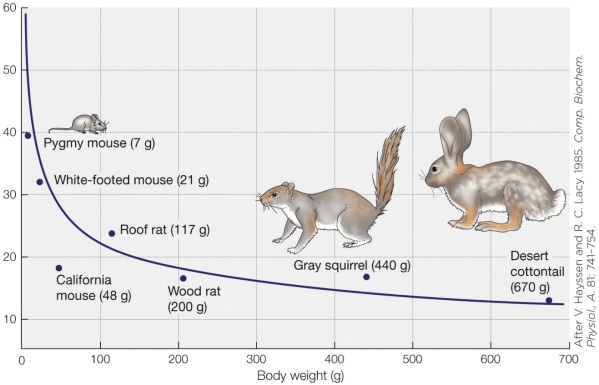 Which animal consumes the most oxygen per unit time?
A) Pygmy mouse
B) Wood rat
C) Gray squirrel
D) Desert cottontail
Which animal consumes the most oxygen per unit time?A) Pygmy mouse
B) Wood rat
C) Gray squirrel
D) Desert cottontail
Question
Refer to the figure.
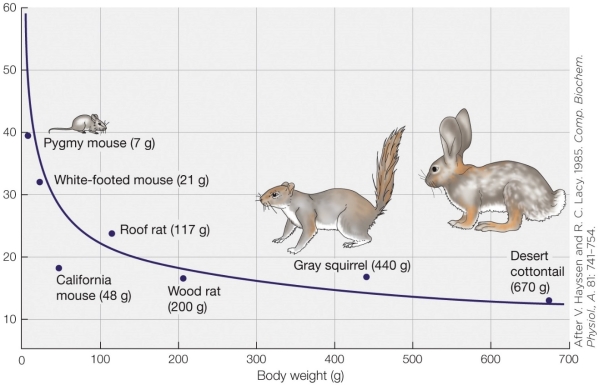 Where on the graph would you plot a wood frog?
A) About half way down directly below the pygmy mouse data point
B) Close to the x axis in the 0- to 100-gram weight range
C) Very close to the wood rat data point
D) About twice as high as the white-footed mouse data point
Where on the graph would you plot a wood frog?A) About half way down directly below the pygmy mouse data point
B) Close to the x axis in the 0- to 100-gram weight range
C) Very close to the wood rat data point
D) About twice as high as the white-footed mouse data point
Question
Refer to the figure.
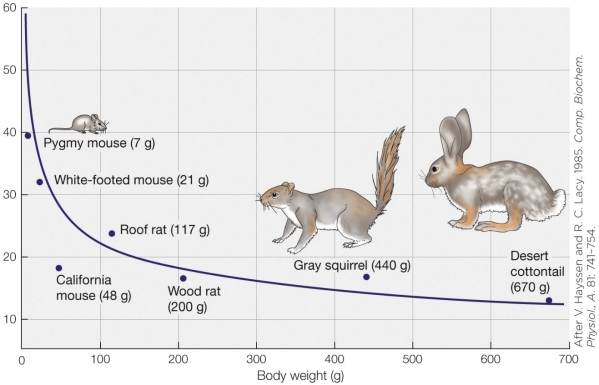 What would be the best label for the y axis?
A) Rate of oxygen consumption (ml O2/h)
B) Weight-specific metabolic rate (J/g•h)
C) Rate of oxygen consumption (ml O2/g•h)
D) Weight-specific metabolic rate (J/h)
What would be the best label for the y axis?A) Rate of oxygen consumption (ml O2/h)
B) Weight-specific metabolic rate (J/g•h)
C) Rate of oxygen consumption (ml O2/g•h)
D) Weight-specific metabolic rate (J/h)
Question
Refer to the figure.
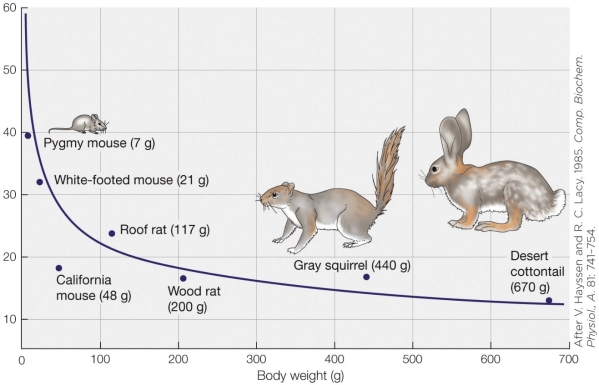 Based on the graph, change the scale of both axes and change the y axis units to be non-mass-specific. What is the best description of the line that fits the replotted data?
A) A straight line that begins low on the y axis and increases moving along the x axis
B) A straight line that begins high on the y axis and decreases moving along the x axis
C) Very similar shape to the plot above with different units on the y axis
D) An exponential curve that begins low on the y axis and increases moving along the x axis
Based on the graph, change the scale of both axes and change the y axis units to be non-mass-specific. What is the best description of the line that fits the replotted data?A) A straight line that begins low on the y axis and increases moving along the x axis
B) A straight line that begins high on the y axis and decreases moving along the x axis
C) Very similar shape to the plot above with different units on the y axis
D) An exponential curve that begins low on the y axis and increases moving along the x axis
Question
Question
Question
Question
Question
Question
Question
Question
Question
Question
Question
Question
Question
Question
Question
Question
Question

Unlock Deck
Sign up to unlock the cards in this deck!
Unlock Deck
Unlock Deck
1/68

Play

Full screen (f)
Deck 7: Energy Metabolism
1
During the reenactment of the Peary Arctic expedition, a dog sled was loaded with 630 kg of supplies to carefully meet the needs of the entire trip. What is the consequence of adding 25 kg of extra supplies?
A) No consequence
B) It increases the efficiency of the pulling effort.
C) It decreases the energy required of the humans to navigate the sled.
D) It increases the energetic requirements of the dogs to pull the sled.
A) No consequence
B) It increases the efficiency of the pulling effort.
C) It decreases the energy required of the humans to navigate the sled.
D) It increases the energetic requirements of the dogs to pull the sled.
D
2
During the reenactment of the Peary Arctic expedition, a dog sled team was loaded with supplies. What is the most important question to answer in order to calculate the weight of the most significant part of the supply mass?
A) What is the basal metabolic rate of the humans?
B) What is the basal metabolic rate of the dogs?
C) What is metabolic rate of the dogs pulling a sled at cruising speed?
D) What is the maximum speed a sledding dog can run?
A) What is the basal metabolic rate of the humans?
B) What is the basal metabolic rate of the dogs?
C) What is metabolic rate of the dogs pulling a sled at cruising speed?
D) What is the maximum speed a sledding dog can run?
C
3
Animals need _______ to create and maintain internal organization.
A) entropy
B) heat
C) an open system
D) energy
A) entropy
B) heat
C) an open system
D) energy
D
4
The statement "If an isolated system undergoes internal change, the direction of change is always toward greater disorder" is a description of
A) energy metabolism.
B) molecular kinetic energy.
C) physiological work.
D) the second law of thermodynamics.
A) energy metabolism.
B) molecular kinetic energy.
C) physiological work.
D) the second law of thermodynamics.
Unlock Deck
Unlock for access to all 68 flashcards in this deck.
Unlock Deck
k this deck
5
Which of the following is an example of an isolated system?
A) An electrically powered pump circulating hot water through an apartment building
B) A lone astronaut in the international space station
C) An individual bacterium in an animal's gastrointestinal tract
D) A hypothetical construct in which neither energy nor matter can pass
A) An electrically powered pump circulating hot water through an apartment building
B) A lone astronaut in the international space station
C) An individual bacterium in an animal's gastrointestinal tract
D) A hypothetical construct in which neither energy nor matter can pass
Unlock Deck
Unlock for access to all 68 flashcards in this deck.
Unlock Deck
k this deck
6
Which type of energy cannot be used by animals to do physiological work?
A) Chemical energy
B) Electrical energy
C) Heat (molecular kinetic energy)
D) Mechanical energy
A) Chemical energy
B) Electrical energy
C) Heat (molecular kinetic energy)
D) Mechanical energy
Unlock Deck
Unlock for access to all 68 flashcards in this deck.
Unlock Deck
k this deck
7
What is different between the heat resulting from a fire and the heat produced by animals?
A) There is no difference.
B) Heat from animals results from internal work and heat from a fire comes from external work.
C) The heat that animals obtain from food is always less than heat obtained from burning food in a fire.
D) Energy from fires always produces heat, but energy use by animals does not always generate heat.
A) There is no difference.
B) Heat from animals results from internal work and heat from a fire comes from external work.
C) The heat that animals obtain from food is always less than heat obtained from burning food in a fire.
D) Energy from fires always produces heat, but energy use by animals does not always generate heat.
Unlock Deck
Unlock for access to all 68 flashcards in this deck.
Unlock Deck
k this deck
8
"High-grade" energy refers to
A) chemical and mechanical energy.
B) chemical, electrical, and mechanical energy.
C) chemical, electrical, and mechanical energy + heat.
D) electrical and mechanical energy plus heat.
A) chemical and mechanical energy.
B) chemical, electrical, and mechanical energy.
C) chemical, electrical, and mechanical energy + heat.
D) electrical and mechanical energy plus heat.
Unlock Deck
Unlock for access to all 68 flashcards in this deck.
Unlock Deck
k this deck
9
Which form of energy is totipotent for animals?
A) Electrical energy
B) Chemical energy
C) Heat (molecular kinetic energy)
D) Mechanical energy
A) Electrical energy
B) Chemical energy
C) Heat (molecular kinetic energy)
D) Mechanical energy
Unlock Deck
Unlock for access to all 68 flashcards in this deck.
Unlock Deck
k this deck
10
In a fully-grown animal (i.e., one that is not still growing), ingested energy becomes
A) fecal chemical energy + absorbed chemical energy.
B) heat + chemical energy accumulated in body tissues.
C) exported chemical energy + mechanical energy of external work.
D) heat + absorbed chemical energy.
A) fecal chemical energy + absorbed chemical energy.
B) heat + chemical energy accumulated in body tissues.
C) exported chemical energy + mechanical energy of external work.
D) heat + absorbed chemical energy.
Unlock Deck
Unlock for access to all 68 flashcards in this deck.
Unlock Deck
k this deck
11
Catabolic processes _______ and anabolic processes _______.
A) break down organic molecules to release energy; use energy to build molecules
B) use energy to build molecules; break down organic molecules to release energy
C) use energy to break down molecules; use energy to build molecules
D) use energy to break down all molecules; break down organic molecules
A) break down organic molecules to release energy; use energy to build molecules
B) use energy to build molecules; break down organic molecules to release energy
C) use energy to break down molecules; use energy to build molecules
D) use energy to break down all molecules; break down organic molecules
Unlock Deck
Unlock for access to all 68 flashcards in this deck.
Unlock Deck
k this deck
12
An alpine skier rides a ski lift to the top of a mountain and then skis down a ski run. A telemark skier skis up the same mountain and then down the same ski run. Assuming the skiers weigh the same amount, which statement best describes the amount of work they do?
A) Both skiers do the same amount of physiological work but the telemark skier does more external work.
B) Both skiers do the same amount of external work but the telemark skier does more physiological work.
C) Both skiers do the same amount of external work but the alpine skier does more physiological work.
D) The telemark skier does much more work going up the mountain but both skiers do about the same amount of work skiing down the mountain.
A) Both skiers do the same amount of physiological work but the telemark skier does more external work.
B) Both skiers do the same amount of external work but the telemark skier does more physiological work.
C) Both skiers do the same amount of external work but the alpine skier does more physiological work.
D) The telemark skier does much more work going up the mountain but both skiers do about the same amount of work skiing down the mountain.
Unlock Deck
Unlock for access to all 68 flashcards in this deck.
Unlock Deck
k this deck
13
Suppose you eat five cookies, each of which contains 100 calories. If the same amount of energy in the cookies was used to heat 50,000 g of water, the temperature of the water would increase by
A) 0.1°C.
B) 1.0°C.
C) 10°C.
D) 100°C.
A) 0.1°C.
B) 1.0°C.
C) 10°C.
D) 100°C.
Unlock Deck
Unlock for access to all 68 flashcards in this deck.
Unlock Deck
k this deck
14
A person's resting heat production is approximately equivalent to that of a _______ incandescent light bulb.
A) 15-W
B) 50-W
C) 100-W
D) 300-W
A) 15-W
B) 50-W
C) 100-W
D) 300-W
Unlock Deck
Unlock for access to all 68 flashcards in this deck.
Unlock Deck
k this deck
15
A direct calorimeter measures the rate of
A) oxygen consumption.
B) carbon dioxide production.
C) heat production.
D) oxygen consumption and carbon dioxide production.
A) oxygen consumption.
B) carbon dioxide production.
C) heat production.
D) oxygen consumption and carbon dioxide production.
Unlock Deck
Unlock for access to all 68 flashcards in this deck.
Unlock Deck
k this deck
16
Suppose that you use direct calorimetry to monitor a person enclosed in a small room. During the measurement the person lowers many heavy weights from a desk onto the floor. The heat production you measure will
A) slightly underestimate the person's metabolic rate.
B) slightly overestimate the person's metabolic rate.
C) precisely and directly measure the person's metabolic rate.
D) be unrelated to the person's metabolic rate.
A) slightly underestimate the person's metabolic rate.
B) slightly overestimate the person's metabolic rate.
C) precisely and directly measure the person's metabolic rate.
D) be unrelated to the person's metabolic rate.
Unlock Deck
Unlock for access to all 68 flashcards in this deck.
Unlock Deck
k this deck
17
Suppose an animal is oxidizing food according to the following reaction:
C6H12O6 + 6 O2 6 CO2 + 6 H2O + 2820 kJ/mol. What is the respiratory quotient?
A) 1
B) 6
C) 18
D) 2820
C6H12O6 + 6 O2 6 CO2 + 6 H2O + 2820 kJ/mol. What is the respiratory quotient?
A) 1
B) 6
C) 18
D) 2820
Unlock Deck
Unlock for access to all 68 flashcards in this deck.
Unlock Deck
k this deck
18
Suppose an animal is oxidizing food according to the following reaction:
C16H32O2 + 23 O2 SYMBOL 174 \f "Symbol" 16 CO2 + 6 H2O + 10,042 kJ/mol. What is the respiratory quotient?
A) 23/16
B) 16/23
C) 10,042/23
D) 10,042/16
C16H32O2 + 23 O2 SYMBOL 174 \f "Symbol" 16 CO2 + 6 H2O + 10,042 kJ/mol. What is the respiratory quotient?
A) 23/16
B) 16/23
C) 10,042/23
D) 10,042/16
Unlock Deck
Unlock for access to all 68 flashcards in this deck.
Unlock Deck
k this deck
19
For which macromolecule is the conversion factor for heat to amount of oxygen consumed furthest from the conversion factor for heat to amount of carbon dioxide produced?
A) Carbohydrates
B) Lipids
C) Proteins
D) Nucleic Acids
A) Carbohydrates
B) Lipids
C) Proteins
D) Nucleic Acids
Unlock Deck
Unlock for access to all 68 flashcards in this deck.
Unlock Deck
k this deck
20
If an animal's metabolic rate is measured in a respirometer that has a continuous stream of air flowing through it, the type of calorimetry is called _______ and the type of respirometry is called _______.
A) open; direct
B) open; indirect
C) indirect; open
D) direct; open
A) open; direct
B) open; indirect
C) indirect; open
D) direct; open
Unlock Deck
Unlock for access to all 68 flashcards in this deck.
Unlock Deck
k this deck
21
What is the respiratory quotient (RQ value) during the aerobic catabolism of a typical lipid?
A) 0.71
B) 0.83
C) 1.00
D) 21.1 J/mL O2
A) 0.71
B) 0.83
C) 1.00
D) 21.1 J/mL O2
Unlock Deck
Unlock for access to all 68 flashcards in this deck.
Unlock Deck
k this deck
22
Sprinting is an activity that relies heavily on anaerobic metabolism over short periods of time. From a conceptual perspective, what would be the most accurate way to measure metabolic rate during sprinting?
A) Material balance
B) O2 consumption
C) Direct calorimetry
D) Respiratory exchange ratio
A) Material balance
B) O2 consumption
C) Direct calorimetry
D) Respiratory exchange ratio
Unlock Deck
Unlock for access to all 68 flashcards in this deck.
Unlock Deck
k this deck
23
Which factor is not an advantage of measuring metabolic rate via oxygen consumption?
A) Technical ease of measurement
B) Small uncertainty of estimates under many conditions
C) Exclusion of the energy used in external work
D) Exclusion of metabolism by gut microbes
A) Technical ease of measurement
B) Small uncertainty of estimates under many conditions
C) Exclusion of the energy used in external work
D) Exclusion of metabolism by gut microbes
Unlock Deck
Unlock for access to all 68 flashcards in this deck.
Unlock Deck
k this deck
24
The increase in the metabolic rate of an animal that results from eating food is called
A) specific dynamic action.
B) aerobic metabolism.
C) material balance.
D) diet induced thermogenesis.
A) specific dynamic action.
B) aerobic metabolism.
C) material balance.
D) diet induced thermogenesis.
Unlock Deck
Unlock for access to all 68 flashcards in this deck.
Unlock Deck
k this deck
25
Which factor exerts a particularly large effect on metabolic rates?
A) Environmental O2 level
B) Time of day
C) Age
D) Environmental temperature
A) Environmental O2 level
B) Time of day
C) Age
D) Environmental temperature
Unlock Deck
Unlock for access to all 68 flashcards in this deck.
Unlock Deck
k this deck
26
The specific dynamic action (SDA) is measured for an animal that eats 100 g of protein. The measurement is repeated a few days later, after the animal has been fed 300 g of protein. According to the usual model of SDA, how will the magnitude of the second SDA compare with the first SDA measurement?
A) It will be about the same.
B) It will be about three times as much.
C) It will be more than three times as much.
D) It is not possible to estimate without the RQ.
A) It will be about the same.
B) It will be about three times as much.
C) It will be more than three times as much.
D) It is not possible to estimate without the RQ.
Unlock Deck
Unlock for access to all 68 flashcards in this deck.
Unlock Deck
k this deck
27
The specific dynamic action (SDA) for an animal is measured in an animal that consumes 100 g of carbohydrate. The measurement is repeated a few days later, after the animal has been fed 200 g of protein. How will the magnitude of the second SDA compare with the first SDA measurement?
A) It will be about the same.
B) It will be about twice as much.
C) It will be more than twice as much.
D) It is not possible to estimate without the RQ.
A) It will be about the same.
B) It will be about twice as much.
C) It will be more than twice as much.
D) It is not possible to estimate without the RQ.
Unlock Deck
Unlock for access to all 68 flashcards in this deck.
Unlock Deck
k this deck
28
In most animals, the largest contributions to SDA occur
A) during chewing.
B) during digestion.
C) during absorption.
D) after absorption.
A) during chewing.
B) during digestion.
C) during absorption.
D) after absorption.
Unlock Deck
Unlock for access to all 68 flashcards in this deck.
Unlock Deck
k this deck
29
A semipermanent increase in metabolic rate in response to repeatedly eating unusually large amounts food is called
A) diet-induced thermogenesis.
B) the heat increment of feeding.
C) fat-stimulated metabolism.
D) dietary scaling.
A) diet-induced thermogenesis.
B) the heat increment of feeding.
C) fat-stimulated metabolism.
D) dietary scaling.
Unlock Deck
Unlock for access to all 68 flashcards in this deck.
Unlock Deck
k this deck
30
Suppose an animal has been deprived of food so long that it is in a postabsorptive state and its physiology is abnormal. Which measure would provide physiologically valid results?
A) BMR
B) SMR
C) SDA
D) Rate of heat production
A) BMR
B) SMR
C) SDA
D) Rate of heat production
Unlock Deck
Unlock for access to all 68 flashcards in this deck.
Unlock Deck
k this deck
31
Specific conditions must apply when either basal or standard metabolic rate is being measured. The animals must be
A) measured at standard temperature and pressure.
B) fully grown.
C) fed a standard diet.
D) fasting.
A) measured at standard temperature and pressure.
B) fully grown.
C) fed a standard diet.
D) fasting.
Unlock Deck
Unlock for access to all 68 flashcards in this deck.
Unlock Deck
k this deck
32
Which situation best describes the appropriate use of routine metabolic rate (RMR)?
A) a sleeping lion
B) a sprinting dog
C) a migrating bird
D) a swimming fish
A) a sleeping lion
B) a sprinting dog
C) a migrating bird
D) a swimming fish
Unlock Deck
Unlock for access to all 68 flashcards in this deck.
Unlock Deck
k this deck
33
A 30-g vole eats 175 g of forage per week and a 1900-kg rhino eats 650 kg of forage per week. This demonstrates that
A) voles eat more than rhinos.
B) the energy needs of the two species are not proportional to body size.
C) the rhino has a higher SDA as a percentage of ingested energy.
D) the vole has a lower digestive efficiency than a rhino.
A) voles eat more than rhinos.
B) the energy needs of the two species are not proportional to body size.
C) the rhino has a higher SDA as a percentage of ingested energy.
D) the vole has a lower digestive efficiency than a rhino.
Unlock Deck
Unlock for access to all 68 flashcards in this deck.
Unlock Deck
k this deck
34
The term "weight-specific metabolic rate" refers to
A) whole-animal metabolic rate at a specific body weight.
B) whole-animal metabolic rate divided by body weight.
C) the change in metabolic rate with body weight.
D) whole-animal metabolic rate multiplied by mass.
A) whole-animal metabolic rate at a specific body weight.
B) whole-animal metabolic rate divided by body weight.
C) the change in metabolic rate with body weight.
D) whole-animal metabolic rate multiplied by mass.
Unlock Deck
Unlock for access to all 68 flashcards in this deck.
Unlock Deck
k this deck
35
Suppose that you compare the amount of food needed by four groups of lizards, each of which has an MR that is expected for its body size. There are 10 lizards weighing 10 g each, 5 lizards weighing 20 g each, 2 lizards weighing 50 g each, and a single 100-g lizard. Assuming equivalent digestions, similar food, and so on, which lizard group requires the most food?
A) The 10-g lizard group
B) The 20-g lizard group
D) The 100-g lizard
E) All lizard groups require the same amount of food.
A) The 10-g lizard group
B) The 20-g lizard group
D) The 100-g lizard
E) All lizard groups require the same amount of food.
Unlock Deck
Unlock for access to all 68 flashcards in this deck.
Unlock Deck
k this deck
36
In which case would the equation M =aWb not be considered allometric?
A) a = 1 and b < 1
B) a = 1 and b > 1
C) a = 1 and b equals any value
D) b = 1 and a equals any value
A) a = 1 and b < 1
B) a = 1 and b > 1
C) a = 1 and b equals any value
D) b = 1 and a equals any value
Unlock Deck
Unlock for access to all 68 flashcards in this deck.
Unlock Deck
k this deck
37
Suppose that a study reports the allometric equation relating whole-animal metabolic rate to body weight for a new group of organisms. Based on existing data for other groups, which value would you predict for b?
A) 0.5
B) 0.7
C) 1
D) 12
A) 0.5
B) 0.7
C) 1
D) 12
Unlock Deck
Unlock for access to all 68 flashcards in this deck.
Unlock Deck
k this deck
38
Suppose the value of b for the allometric equation for maximal metabolic rate (MMR) and body weight is 0.87. The exponent for the equation relating the mass-specific MMR to body weight would be
A) ‒0.87.
B) 0.13.
C) ‒0.13.
D) (0.87)2.
A) ‒0.87.
B) 0.13.
C) ‒0.13.
D) (0.87)2.
Unlock Deck
Unlock for access to all 68 flashcards in this deck.
Unlock Deck
k this deck
39
Suppose that W (weight) for groups of big and little eaters has been measured in grams. Daily food consumption of big eaters is described by the allometric equation: food (g/day) = 5 W0.67. Daily food consumption of little eaters is described by the allometric equation: food (g/day) = 0.75 W0.67. Each day, a 1-g big eater will need _______ more food than a 1-g little eater.
A) (4.25)-0.33 g
B) (4.25)0.67 g
C) 4.25 g
D) no
A) (4.25)-0.33 g
B) (4.25)0.67 g
C) 4.25 g
D) no
Unlock Deck
Unlock for access to all 68 flashcards in this deck.
Unlock Deck
k this deck
40
Assume that the standard allometric equation (M = aWb) applies to a given species. Weight-specific metabolic rate will not depend on weight when
A) b < 0.
B) b > 1.
C) b = 1.
D) a = 1.
A) b < 0.
B) b > 1.
C) b = 1.
D) a = 1.
Unlock Deck
Unlock for access to all 68 flashcards in this deck.
Unlock Deck
k this deck
41
Suppose that you want to plot metabolic data for animals ranging in weight from 2 g to 10,000,000 g. A log‒log plot would be useful because
A) data > 1,000,000 g or < 1 g cannot be plotted on other kinds of graphs.
B) a log‒log plot transforms an allometric equation into a curve.
C) a log‒log plot puts all animals (e.g., birds and frogs) on the same trend line.
D) with a log‒log plot, a wide range of body weights can easily be plotted on the same graph.
A) data > 1,000,000 g or < 1 g cannot be plotted on other kinds of graphs.
B) a log‒log plot transforms an allometric equation into a curve.
C) a log‒log plot puts all animals (e.g., birds and frogs) on the same trend line.
D) with a log‒log plot, a wide range of body weights can easily be plotted on the same graph.
Unlock Deck
Unlock for access to all 68 flashcards in this deck.
Unlock Deck
k this deck
42
You measure the metabolic rate of a group of poikilotherms that has never been studied before. Compared to the relationship between metabolic rate and weight for birds, the value of a for the new group is likely to be _______ and the value of b is likely to be _______.
A) about the same; lower
B) lower; higher
C) lower; lower
D) lower; about the same
A) about the same; lower
B) lower; higher
C) lower; lower
D) lower; about the same
Unlock Deck
Unlock for access to all 68 flashcards in this deck.
Unlock Deck
k this deck
43
In order to measure the maximal aerobic metabolic rate of an animal, researchers commonly induce it by exercise. In vertebrates, a useful rule of thumb is that the maximal aerobic metabolic rate is about _______ times the resting metabolic rate.
A) 2
B) 3
C) 10
D) 50
A) 2
B) 3
C) 10
D) 50
Unlock Deck
Unlock for access to all 68 flashcards in this deck.
Unlock Deck
k this deck
44
Suppose that the body‒surface area of mammals was proportional to weight5/6. Following the other lines of reasoning associated with Rubner's surface "law," what would be the predicted relationship between metabolic rate and weight?
A) M = aW0.5
B) M = aW2/3
C) M = aW5/6
D) M = aW(2/3*5/6) = aW(5/9)
A) M = aW0.5
B) M = aW2/3
C) M = aW5/6
D) M = aW(2/3*5/6) = aW(5/9)
Unlock Deck
Unlock for access to all 68 flashcards in this deck.
Unlock Deck
k this deck
45
Rubner's surface "law" cannot be applied to fish and crabs because
A) these animals do not elevate their body temperatures above those of the environment.
B) these animals are too small for it to be applicable.
C) these animals do not have four limbs.
D) it can be applied only to mammals.
A) these animals do not elevate their body temperatures above those of the environment.
B) these animals are too small for it to be applicable.
C) these animals do not have four limbs.
D) it can be applied only to mammals.
Unlock Deck
Unlock for access to all 68 flashcards in this deck.
Unlock Deck
k this deck
46
The exponent for the relationship between metabolic rate and weight
A) varies across different animals but is commonly around 0.5.
B) varies across different animals but is commonly around 0.7.
C) is two-thirds.
D) is three-fourths.
A) varies across different animals but is commonly around 0.5.
B) varies across different animals but is commonly around 0.7.
C) is two-thirds.
D) is three-fourths.
Unlock Deck
Unlock for access to all 68 flashcards in this deck.
Unlock Deck
k this deck
47
Attempts to explain the mechanistic basis for the allometric scaling of metabolic rate with size have focused mostly on the
A) skeletal muscles.
B) gastrointestinal tract.
C) lungs.
D) circulatory system.
A) skeletal muscles.
B) gastrointestinal tract.
C) lungs.
D) circulatory system.
Unlock Deck
Unlock for access to all 68 flashcards in this deck.
Unlock Deck
k this deck
48
Refer to the figure.
Which animal consumes the most oxygen per unit time?
A) Pygmy mouse
B) Wood rat
C) Gray squirrel
D) Desert cottontail
Which animal consumes the most oxygen per unit time?A) Pygmy mouse
B) Wood rat
C) Gray squirrel
D) Desert cottontail
Unlock Deck
Unlock for access to all 68 flashcards in this deck.
Unlock Deck
k this deck
49
Refer to the figure.
Where on the graph would you plot a wood frog?
A) About half way down directly below the pygmy mouse data point
B) Close to the x axis in the 0- to 100-gram weight range
C) Very close to the wood rat data point
D) About twice as high as the white-footed mouse data point
Where on the graph would you plot a wood frog?A) About half way down directly below the pygmy mouse data point
B) Close to the x axis in the 0- to 100-gram weight range
C) Very close to the wood rat data point
D) About twice as high as the white-footed mouse data point
Unlock Deck
Unlock for access to all 68 flashcards in this deck.
Unlock Deck
k this deck
50
Refer to the figure.
What would be the best label for the y axis?
A) Rate of oxygen consumption (ml O2/h)
B) Weight-specific metabolic rate (J/g•h)
C) Rate of oxygen consumption (ml O2/g•h)
D) Weight-specific metabolic rate (J/h)
What would be the best label for the y axis?A) Rate of oxygen consumption (ml O2/h)
B) Weight-specific metabolic rate (J/g•h)
C) Rate of oxygen consumption (ml O2/g•h)
D) Weight-specific metabolic rate (J/h)
Unlock Deck
Unlock for access to all 68 flashcards in this deck.
Unlock Deck
k this deck
51
Refer to the figure.
Based on the graph, change the scale of both axes and change the y axis units to be non-mass-specific. What is the best description of the line that fits the replotted data?
A) A straight line that begins low on the y axis and increases moving along the x axis
B) A straight line that begins high on the y axis and decreases moving along the x axis
C) Very similar shape to the plot above with different units on the y axis
D) An exponential curve that begins low on the y axis and increases moving along the x axis
Based on the graph, change the scale of both axes and change the y axis units to be non-mass-specific. What is the best description of the line that fits the replotted data?A) A straight line that begins low on the y axis and increases moving along the x axis
B) A straight line that begins high on the y axis and decreases moving along the x axis
C) Very similar shape to the plot above with different units on the y axis
D) An exponential curve that begins low on the y axis and increases moving along the x axis
Unlock Deck
Unlock for access to all 68 flashcards in this deck.
Unlock Deck
k this deck
52
Suppose the relationship between resting heart rate (RHR, in beats/min) and body weight (W, in grams) is: RHR = aW‒0.23. What can be deduced from this relationship?
A) There is no systematic relationship between heart rate and weight, but large animals have faster heart rates.
B) Heart rate tends to be faster for small animals.
C) Heart rate tends to be exponentially slower for animals weighing 23 g, 230 g, 2300 g, and so on.
D) Heart rate tends to be faster for larger animals.
A) There is no systematic relationship between heart rate and weight, but large animals have faster heart rates.
B) Heart rate tends to be faster for small animals.
C) Heart rate tends to be exponentially slower for animals weighing 23 g, 230 g, 2300 g, and so on.
D) Heart rate tends to be faster for larger animals.
Unlock Deck
Unlock for access to all 68 flashcards in this deck.
Unlock Deck
k this deck
53
Larger mammals need more oxygen than smaller mammals, but they need less oxygen per gram of body weight. Smaller mammals meet their need for more oxygen with a _______ mass-specific heart size and a _______ heart rate.
A) bigger; faster
B) smaller; faster
C) similar; faster
D) bigger; slower
A) bigger; faster
B) smaller; faster
C) similar; faster
D) bigger; slower
Unlock Deck
Unlock for access to all 68 flashcards in this deck.
Unlock Deck
k this deck
54
Small mammals need more O2 per gram of body weight than large mammals do. Compared to large mammals, small mammals have _______ lungs and breathe _______ times per minute.
A) bigger; more
B) smaller; more
C) similar-sized; more
D) smaller; fewer
A) bigger; more
B) smaller; more
C) similar-sized; more
D) smaller; fewer
Unlock Deck
Unlock for access to all 68 flashcards in this deck.
Unlock Deck
k this deck
55
Humans can digest and absorb approximately _______% of their energy in cellulose.
A) 0
B) 25
C) 50
D) 75
A) 0
B) 25
C) 50
D) 75
Unlock Deck
Unlock for access to all 68 flashcards in this deck.
Unlock Deck
k this deck
56
Compared to gross growth efficiency, energy absorption efficiency
A) must be lower.
B) must be higher.
C) can be lower but does not have to be.
D) can be higher but does not have to be.
A) must be lower.
B) must be higher.
C) can be lower but does not have to be.
D) can be higher but does not have to be.
Unlock Deck
Unlock for access to all 68 flashcards in this deck.
Unlock Deck
k this deck
57
Compared to net growth efficiency, gross growth efficiency
A) must be lower.
B) must be higher.
C) can be lower but does not have to be.
D) can be higher but does not have to be.
A) must be lower.
B) must be higher.
C) can be lower but does not have to be.
D) can be higher but does not have to be.
Unlock Deck
Unlock for access to all 68 flashcards in this deck.
Unlock Deck
k this deck
58
Your partner in your new aquaculture business tells you to feed your salmon for another year because they will be bigger upon selling and that garners more money. What is the potential problem here?
A) Your partner is correct and there is no problem because fish keep growing if you feed them.
B) Your partner is incorrect; fish stop growing when in captivity for too long.
C) Your partner is likely incorrect; while the fish may grow over the next year, it may much slower such that the cost to feed them overtakes the profit.
D) Your partner is correct; the longer you feed fish, the more absorbed energy they put into growth.
A) Your partner is correct and there is no problem because fish keep growing if you feed them.
B) Your partner is incorrect; fish stop growing when in captivity for too long.
C) Your partner is likely incorrect; while the fish may grow over the next year, it may much slower such that the cost to feed them overtakes the profit.
D) Your partner is correct; the longer you feed fish, the more absorbed energy they put into growth.
Unlock Deck
Unlock for access to all 68 flashcards in this deck.
Unlock Deck
k this deck
59
Do microorganisms produce heat?
Unlock Deck
Unlock for access to all 68 flashcards in this deck.
Unlock Deck
k this deck
60
As part of an exercise program, a person holds a heavy weight above the ground for 10 minutes without moving the weight. Is the person doing work?
Unlock Deck
Unlock for access to all 68 flashcards in this deck.
Unlock Deck
k this deck
61
Suppose you use direct calorimetry to measure heat production by a person picking s out of a box on the floor and stacking them onto a bookshelf. Is the measure of heat production an accurate indicator of the person's metabolic rate? Why or why not?
Unlock Deck
Unlock for access to all 68 flashcards in this deck.
Unlock Deck
k this deck
62
The doubly labeled water (DLW) procedure entails injecting animals with water that has labeled hydrogen and labeled oxygen atoms. In a complex way, the DLW method makes it possible to estimate the rate of CO2 production. What kind of calorimetry is this?
Unlock Deck
Unlock for access to all 68 flashcards in this deck.
Unlock Deck
k this deck
63
Suppose you use indirect calorimetry to estimate an animal's metabolic rate and you do not know what foodstuff the animal is oxidizing. Is it better to estimate energy use from O2 or CO2? Why?
Unlock Deck
Unlock for access to all 68 flashcards in this deck.
Unlock Deck
k this deck
64
Why is thinking hard not an effective way to lose weight?
Unlock Deck
Unlock for access to all 68 flashcards in this deck.
Unlock Deck
k this deck
65
In the equation M =aWb, a and b are constants. Why, then, do the values of a and b vary across different groups of animals or even with different samples from a related group of animals?
Unlock Deck
Unlock for access to all 68 flashcards in this deck.
Unlock Deck
k this deck
66
In English, the idiomatic expression "He eats like a horse" suggests that the person eats a lot. The plot of metabolic rate versus body weight for carnivorous mammals depicts the metabolic rate of the least weasel as higher than that of other carnivorous mammals of the same weight. What would the phrase "He eats like a least weasel" mean?
Unlock Deck
Unlock for access to all 68 flashcards in this deck.
Unlock Deck
k this deck
67
Suppose you are a livestock manager tasked with maintaining or increasing the growth efficiency of animals that normally have low levels of physical activity. What would be the likely result if all animals were put on a regimen of vigorous physical exercise?
Unlock Deck
Unlock for access to all 68 flashcards in this deck.
Unlock Deck
k this deck
68
Suppose you breed and market fish sold for food and your greatest expense is the cost of the food. Why would it make sense to harvest animals either as soon as they reach adult size or before?
Unlock Deck
Unlock for access to all 68 flashcards in this deck.
Unlock Deck
k this deck
Unlock Deck
Unlock for access to all 68 flashcards in this deck.






