







 Chat with AI

Deck 11: Health Disparities in Health Insurance Markets
Full screen (f)

Question

Question
Question
Question
Question
Relative to insured and uninsured status, which conclusions can be drawn from the data in Box. 11.1.

A) Approximately 89.3% of persons age 18 to 64 had access to public or private insurance
B) Approximately 96.9% of children younger than 18 had access to public or private health insurance
C) a and b are both correct
D) None of the above are correct
E) It is not possible to respond based upon the data in Box 11.1
A) Approximately 89.3% of persons age 18 to 64 had access to public or private insurance
B) Approximately 96.9% of children younger than 18 had access to public or private health insurance
C) a and b are both correct
D) None of the above are correct
E) It is not possible to respond based upon the data in Box 11.1
Question
Question
Question
Question
Question
Question
Question
Question
Question
Question
-When data are analyzed for 1984 and 2015 on changes in the percent of the population with private health insurance, it reveals that the total percent of the population with private health insurance:
A) Increased
B) Decreased
C) Remained constant
D) Remained equal
Question
-The change in the percent of the population with private insurance from 1984 to 2015 was greatest among:
A) Persons under 18 years with incomes below 100% to the poverty line
B) Persons living In the Southern part of the U.S.
C) Persons outside of metropolitan areas
D) Males vs. females
E) a and b
F) b and c
G) c and d
H) All of the above
I) None of the above
Question
-Schneider et al. (2002) found that in 1998, differential healthcare was provided to African American Medicare recipients in a number of areas: Which of the following statement or statements is/are true:
A) Trivedi et al. (2016) had similar findings
B) Lopez et al. (2015) had similar outcomes
C) Both of the above
D) None of the above
Question
-Relative to Medicare recipients, which research findings below are true:
A) Latinos, African Americans, and women who were Medicare beneficiaries had high rates of hypertension and diabetic retinopathy (Lopez et al, 2015)
B) White American women insured through Medicare were less likely than their Latino American counterparts to undergo colorectal cancer screenings
C) Fewer Asian and Latino Americans males were prescribed high-risk medications than their White American and African American counterparts
D) a, b and c are correct
E) None of the above are correct
Question
Question
Question
Question
Question
Question
Question

Unlock Deck
Sign up to unlock the cards in this deck!
Unlock Deck
Unlock Deck
1/25

Play

Full screen (f)
Deck 11: Health Disparities in Health Insurance Markets
1
Antonisse et al. (2014) found that while the ACA was associated with higher rates of insurance coverage, adverse side effects may occur.
False
2
One set of researchers using a case study of a unionized steel mill and food processing plant, found that:
A) Increased demand for health insurance may increase insurance costs including cost sharing
B) They also argued that greater cost sharing may reduce access to health care because lower income groups will be unable to afford co-pays and other costs
C) a and b
D) Neither a nor b
A) Increased demand for health insurance may increase insurance costs including cost sharing
B) They also argued that greater cost sharing may reduce access to health care because lower income groups will be unable to afford co-pays and other costs
C) a and b
D) Neither a nor b
C
3
According to one group of researchers:
A) Insurance status does relate to disparities
B) Greater rates of insurance coverage will reduce some disparities
C) Greater rates of insurance coverage will reduce most disparities
D) Greater levels of insurance coverage will most likely increase health disparities
E) a and b
F) b and c
G) c and d
H) a, b, c and d
I) None of the above
A) Insurance status does relate to disparities
B) Greater rates of insurance coverage will reduce some disparities
C) Greater rates of insurance coverage will reduce most disparities
D) Greater levels of insurance coverage will most likely increase health disparities
E) a and b
F) b and c
G) c and d
H) a, b, c and d
I) None of the above
E
4
The largest proportion of Americans receive health care insurance via:
A) The public market
B) The private market
C) Self-pay
D) Are uninsured
A) The public market
B) The private market
C) Self-pay
D) Are uninsured
Unlock Deck
Unlock for access to all 25 flashcards in this deck.
Unlock Deck
k this deck
5
Relative to insured and uninsured status, which conclusions can be drawn from the data in Box. 11.1.
A) Approximately 89.3% of persons age 18 to 64 had access to public or private insurance
B) Approximately 96.9% of children younger than 18 had access to public or private health insurance
C) a and b are both correct
D) None of the above are correct
E) It is not possible to respond based upon the data in Box 11.1
A) Approximately 89.3% of persons age 18 to 64 had access to public or private insurance
B) Approximately 96.9% of children younger than 18 had access to public or private health insurance
C) a and b are both correct
D) None of the above are correct
E) It is not possible to respond based upon the data in Box 11.1
Unlock Deck
Unlock for access to all 25 flashcards in this deck.
Unlock Deck
k this deck
6
The group least likely to be uninsured in 2016 was:
A) Children younger than 18 years
B) Adults age 18-64
C) Persons age 18-40
D) Persons 65 and older
A) Children younger than 18 years
B) Adults age 18-64
C) Persons age 18-40
D) Persons 65 and older
Unlock Deck
Unlock for access to all 25 flashcards in this deck.
Unlock Deck
k this deck
7
According to the text, there are more than 170 public insurance providers.
Unlock Deck
Unlock for access to all 25 flashcards in this deck.
Unlock Deck
k this deck
8
When 100% of self-insured vs. self-funded insurance plans are combined with those that are partially self-funded, one can accurately make which statement below:
A) Self-funded or partially self-funded plans are more than 50% of the private insurance market
B) Major private health insurance providers control more than 50% of the private health insurance market
C) Public health insurance providers are more than 50% of the health insurance market
D) None of the above
A) Self-funded or partially self-funded plans are more than 50% of the private insurance market
B) Major private health insurance providers control more than 50% of the private health insurance market
C) Public health insurance providers are more than 50% of the health insurance market
D) None of the above
Unlock Deck
Unlock for access to all 25 flashcards in this deck.
Unlock Deck
k this deck
9
Self-insurance is now:
A) A declining model in the private insurance marketplace
B) A dominant model
C) A model that is more dominant among firms with 100-199 employees
D) A model that is declining among companies with 5000 or more employees
A) A declining model in the private insurance marketplace
B) A dominant model
C) A model that is more dominant among firms with 100-199 employees
D) A model that is declining among companies with 5000 or more employees
Unlock Deck
Unlock for access to all 25 flashcards in this deck.
Unlock Deck
k this deck
10
Among small employers:
A) A larger % are not offering public insurance
B) A decrease is occurring in the percent of small employers who provide health insurance to their employees
C) An increase is occurring in the percent of small employers who provide health insurance to their employees
D) a and b
E) b and c
F) a, b, and c
G) None of the above
A) A larger % are not offering public insurance
B) A decrease is occurring in the percent of small employers who provide health insurance to their employees
C) An increase is occurring in the percent of small employers who provide health insurance to their employees
D) a and b
E) b and c
F) a, b, and c
G) None of the above
Unlock Deck
Unlock for access to all 25 flashcards in this deck.
Unlock Deck
k this deck
11
Based upon your reading of Chapter 11, which statement or statements below are true?
A) Racial/ethnic disparities are higher between populations with private insurance than amongst persons who are Medicaid insured
B) White Americans who are Medicaid enrollees may require the assistance of health care professionals so that they can reverse the habit of postponing much needed care
C) Latino Americans, like African Americans who are privately insurance also need support in choosing to access care when needed
D) a and b are true
E) b and c are true
F) a, b, and c are true
G) a, b, and c are false
A) Racial/ethnic disparities are higher between populations with private insurance than amongst persons who are Medicaid insured
B) White Americans who are Medicaid enrollees may require the assistance of health care professionals so that they can reverse the habit of postponing much needed care
C) Latino Americans, like African Americans who are privately insurance also need support in choosing to access care when needed
D) a and b are true
E) b and c are true
F) a, b, and c are true
G) a, b, and c are false
Unlock Deck
Unlock for access to all 25 flashcards in this deck.
Unlock Deck
k this deck
12
According to Barnett and Berchick (2017), the percent of uninsured Americans dropped from 28.6% in 1987 to 8.6% in 2016. Thus, one may say:
A) In 1987, the % of Americans who were uninsured was 332.56% higher than in 2016
B) In 1987, the % of Americans who were uninsured was 232.56% higher than in 2016
C) In 2016, the percent of person who were uninsured was 30.01% as high as in 1987
D) a and b
E) b and c
F) None of the above
G) All of the above
A) In 1987, the % of Americans who were uninsured was 332.56% higher than in 2016
B) In 1987, the % of Americans who were uninsured was 232.56% higher than in 2016
C) In 2016, the percent of person who were uninsured was 30.01% as high as in 1987
D) a and b
E) b and c
F) None of the above
G) All of the above
Unlock Deck
Unlock for access to all 25 flashcards in this deck.
Unlock Deck
k this deck
13
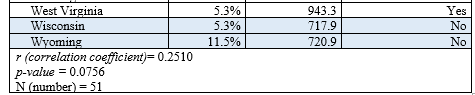
Both correlation coefficients that were calculated regarding the relationship between life expectancy by state and the % of persons who are uninsured in each state were:
A) positive and strong
B) negative and weak
C) negative and strong
D) positive and very weak
A) positive and strong
B) negative and weak
C) negative and strong
D) positive and very weak
Unlock Deck
Unlock for access to all 25 flashcards in this deck.
Unlock Deck
k this deck
14
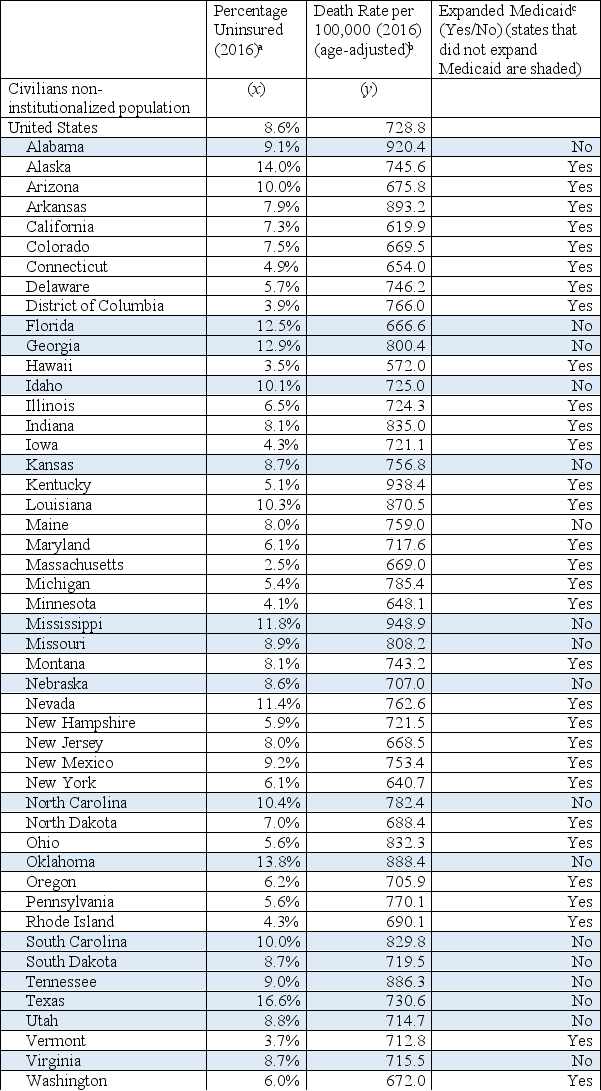
Based upon an analysis and review of data in Table 11.3:
A) The State with the highest uninsured rate in the country in 2016 was Texas
B) The State with the lowest uninsured rate was Hawaii
C) Hawaii did expand Medicare
D) Texas did not expand Medicare
E) a and b alone are true
F) b and c alone are true
G) c and d alone are true
H) a, b, c and d are true
I) None of the above are true
A) The State with the highest uninsured rate in the country in 2016 was Texas
B) The State with the lowest uninsured rate was Hawaii
C) Hawaii did expand Medicare
D) Texas did not expand Medicare
E) a and b alone are true
F) b and c alone are true
G) c and d alone are true
H) a, b, c and d are true
I) None of the above are true
Unlock Deck
Unlock for access to all 25 flashcards in this deck.
Unlock Deck
k this deck
15
-When data are analyzed for 1984 and 2015 on changes in the percent of the population with private health insurance, it reveals that the total percent of the population with private health insurance:
A) Increased
B) Decreased
C) Remained constant
D) Remained equal
Unlock Deck
Unlock for access to all 25 flashcards in this deck.
Unlock Deck
k this deck
16
-The change in the percent of the population with private insurance from 1984 to 2015 was greatest among:
A) Persons under 18 years with incomes below 100% to the poverty line
B) Persons living In the Southern part of the U.S.
C) Persons outside of metropolitan areas
D) Males vs. females
E) a and b
F) b and c
G) c and d
H) All of the above
I) None of the above
Unlock Deck
Unlock for access to all 25 flashcards in this deck.
Unlock Deck
k this deck
17
-Schneider et al. (2002) found that in 1998, differential healthcare was provided to African American Medicare recipients in a number of areas: Which of the following statement or statements is/are true:
A) Trivedi et al. (2016) had similar findings
B) Lopez et al. (2015) had similar outcomes
C) Both of the above
D) None of the above
Unlock Deck
Unlock for access to all 25 flashcards in this deck.
Unlock Deck
k this deck
18
-Relative to Medicare recipients, which research findings below are true:
A) Latinos, African Americans, and women who were Medicare beneficiaries had high rates of hypertension and diabetic retinopathy (Lopez et al, 2015)
B) White American women insured through Medicare were less likely than their Latino American counterparts to undergo colorectal cancer screenings
C) Fewer Asian and Latino Americans males were prescribed high-risk medications than their White American and African American counterparts
D) a, b and c are correct
E) None of the above are correct
Unlock Deck
Unlock for access to all 25 flashcards in this deck.
Unlock Deck
k this deck
19
White American Medicare enrollees were prescribed high-risk medications at a higher rate.
Unlock Deck
Unlock for access to all 25 flashcards in this deck.
Unlock Deck
k this deck
20
Brunner et al. (2000) found that Medicaid insured children with rheumatoid arthritis had poorer outcomes than privately insured children.
Unlock Deck
Unlock for access to all 25 flashcards in this deck.
Unlock Deck
k this deck
21
Several researchers found disparate barriers to health care among same-sex couples enrolled in private healthcare plans.
Unlock Deck
Unlock for access to all 25 flashcards in this deck.
Unlock Deck
k this deck
22
It is important for all health care professionals to know about disparities in health insurance marketplaces.
Unlock Deck
Unlock for access to all 25 flashcards in this deck.
Unlock Deck
k this deck
23
Significant differences in cancer characteristics and treatment exist.
Unlock Deck
Unlock for access to all 25 flashcards in this deck.
Unlock Deck
k this deck
24
Which treatment or treatments below would be billed to your insurance company for problems with the heart:
A) atrial fibrillation
B) adjuvant hormonal therapy
C) a and b
D) None of the above
A) atrial fibrillation
B) adjuvant hormonal therapy
C) a and b
D) None of the above
Unlock Deck
Unlock for access to all 25 flashcards in this deck.
Unlock Deck
k this deck
25
Cancer registries in the United States were established in:
A) 1945
B) 1965
C) 1992
D) 2010
A) 1945
B) 1965
C) 1992
D) 2010
Unlock Deck
Unlock for access to all 25 flashcards in this deck.
Unlock Deck
k this deck
Unlock Deck
Unlock for access to all 25 flashcards in this deck.






