







 Chat with AI

Deck 3: The Greek Golden Age, C 500-C 400 B.C.E
Full screen (f)

Question

Question
Question
Question
Question
Question
Question
Question
Question
Question
Question
Question
Question
Question
Question
Question
Question
Which of the following was allied against Persia during the Persian Wars?
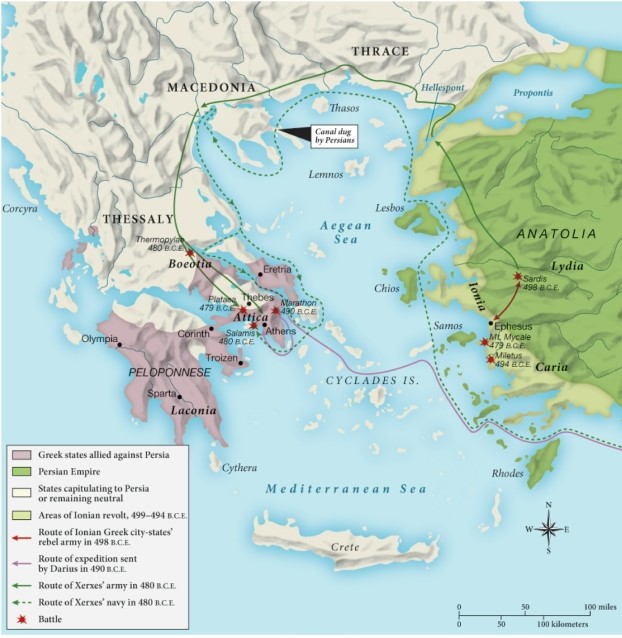
A) Anatolia
B) Laconia
C) Thessaly
D) Thrace
A) Anatolia
B) Laconia
C) Thessaly
D) Thrace
Question
How did the Persian Empire attack the Greek states that had allied against Persia during the Persian Wars of 499 through 479 B.C.E.?
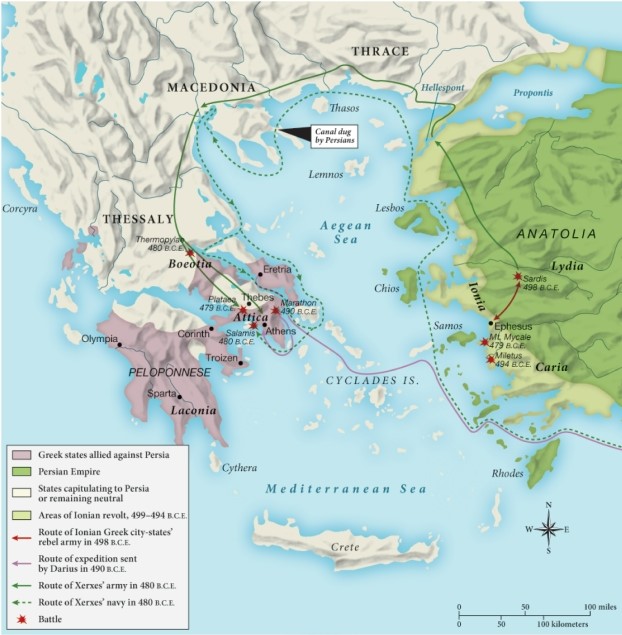
A) By sailing directly west into Athens to attack the coastal city-states.
B) By meeting Greek naval ships in the middle of the Aegean Sea.
C) By traveling north and west over land, then south through Macedonia and Thessaly into the Greek states.
D) By sailing south around Crete, then up into Peloponnese to attack.
A) By sailing directly west into Athens to attack the coastal city-states.
B) By meeting Greek naval ships in the middle of the Aegean Sea.
C) By traveling north and west over land, then south through Macedonia and Thessaly into the Greek states.
D) By sailing south around Crete, then up into Peloponnese to attack.
Question
Question
Question
Question
Question
Question
Question
Question
Question
Question
Question
Question
Question
In this portrayal of Athens, the long walls significantly provided

A) protection for the route between the urban center and the port.
B) a point of last refuge during a siege.
C) archers with protection while firing on invading armies.
D) defense during naval bombardments.
A) protection for the route between the urban center and the port.
B) a point of last refuge during a siege.
C) archers with protection while firing on invading armies.
D) defense during naval bombardments.
Question
Question
Question
Question
Question
Question
Question
Question
Question
Question
Question
Question
Question
Question
Question
Question
Question
Question
Question
Question
Question
Question
Question
Question
Question
Question
Question
Question
Question
Macedonia, Thebes, and the Persian Empire were all allied with
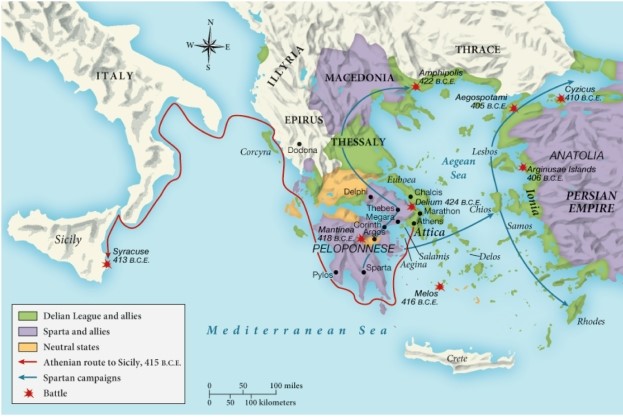
A) Thrace.
B) Athens.
C) Sparta.
D) Italy.
A) Thrace.
B) Athens.
C) Sparta.
D) Italy.
Question
Question
Question
Question
Question
Which of the following was part of Classical Greece around 400 B.C.E.?
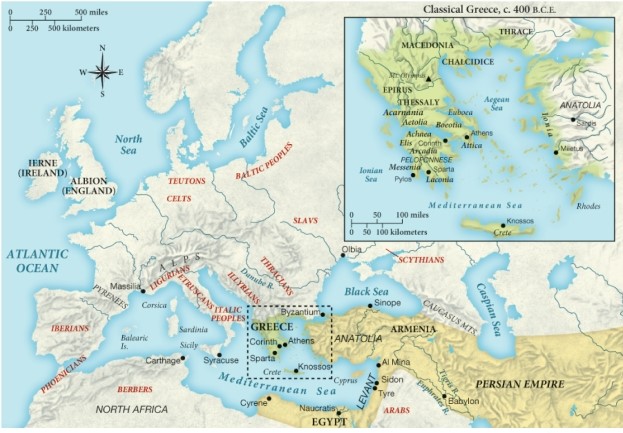
A) Sicily
B) Syracuse
C) Crete
D) Babylon
A) Sicily
B) Syracuse
C) Crete
D) Babylon

Unlock Deck
Sign up to unlock the cards in this deck!
Unlock Deck
Unlock Deck
1/65

Play

Full screen (f)
Deck 3: The Greek Golden Age, C 500-C 400 B.C.E
1
How were the comparatively small Greek forces able to defeat the numerically superior Persian invaders at Marathon and Salamis?
Answer would ideally include the following. The Greek forces were successful against the larger Persian forces because they had better and more farsighted commanders, better armor, and warships that were more effective in close combat, and also because they united against a common enemy. The commanders of the Greek forces at Marathon ordered an unexpected hoplite charge against the more numerous Persians. Themistocles wisely spent income from Athenian silver mines to increase the size of the Athenian navy, and then he tricked the Persian king into sending his ships into the narrow channel between the island of Salamis and the west coast of Athens; the heavier Greek ships were able to prevail against the lighter Persian craft in that tight space. The thirty-one Greek city-states that united to oppose the Persians chose Sparta, renowned for its military excellence, to lead their newly formed alliance.
2
How did Athens dominate the Delian League and create an empire?
Answer would ideally include the following. Having defeated the Persians, Athens created an alliance with city-states in northern Greece, on the islands of the Aegean Sea, and along the Ionian coast to combat further Persian threats. Athens then used the fully equipped triremes and funds contributed for defense to create the greatest naval force in the eastern Mediterranean. Having depleted the navies of alliance members, Athens proceeded to use the threat of force to prevent defection from the Delian League while prospering from its new prestige and increased income.
3
In 451 B.C.E., Pericles introduced new legislation on citizenship. How did this new law affect women?
Answer would ideally include the following. Pericles' citizenship law restricted Athenian citizenship to those whose parents were both born in Athens. Formerly, only an Athenian father had been needed to establish Athenian citizenship, and many wealthy Athenian men had married well-born women from other city-states. The change increased the status and desirability of Athenian women as wives while limiting the number of people eligible for the legal and financial benefits offered by Athens.
4
Why was Pericles' decision to pay people who served in public offices so important?
Unlock Deck
Unlock for access to all 65 flashcards in this deck.
Unlock Deck
k this deck
5
Public religious tradition was observed in public sacrifices and festivals. How was personal, private religious devotion demonstrated?
Unlock Deck
Unlock for access to all 65 flashcards in this deck.
Unlock Deck
k this deck
6
What role did families play in the lives of Athenian women?
Unlock Deck
Unlock for access to all 65 flashcards in this deck.
Unlock Deck
k this deck
7
Which classes of Athenian women were more independent, and how was that independence manifested?
Unlock Deck
Unlock for access to all 65 flashcards in this deck.
Unlock Deck
k this deck
8
How and why did education in Athens change during the mid-fifth century B.C.E.?
Unlock Deck
Unlock for access to all 65 flashcards in this deck.
Unlock Deck
k this deck
9
Explain how Socrates differed from the Sophists.
Unlock Deck
Unlock for access to all 65 flashcards in this deck.
Unlock Deck
k this deck
10
Compare and contrast Herodotus's and Thucydides' approaches to historical writing.
Unlock Deck
Unlock for access to all 65 flashcards in this deck.
Unlock Deck
k this deck
11
Please discuss the strategic and diplomatic miscalculations that helped lead to the Persian Wars.
Unlock Deck
Unlock for access to all 65 flashcards in this deck.
Unlock Deck
k this deck
12
Explain what radical democracy was in Athens. Who established that system? Provide an outline of the structure of Athens's radical democracy and describe the two primary goals of that system.
Unlock Deck
Unlock for access to all 65 flashcards in this deck.
Unlock Deck
k this deck
13
Why did the Sophists arouse controversy in fifth-century B.C.E. Athens? Who was most likely to embrace the ideas and teachings of the Sophists?
Unlock Deck
Unlock for access to all 65 flashcards in this deck.
Unlock Deck
k this deck
14
Discuss the basic structures and roles that Greek theater played in civic life. What functions did tragedies and comedies play, and what messages did playwrights seek to impart?
Unlock Deck
Unlock for access to all 65 flashcards in this deck.
Unlock Deck
k this deck
15
What factors led to the outbreak of the Peloponnesian War, the war's prolonged length, and its conclusion?
Unlock Deck
Unlock for access to all 65 flashcards in this deck.
Unlock Deck
k this deck
16
What did the Athenians do that so enraged the Persian king Darius I?
A) The Athenians refused to pay tribute to the Persian governors in Ionia.
B) The Athenians aided the Greek Ionian city-states in their uprising against their Persian overlords.
C) The Athenians humiliated the Persians by defeating the Persian king Darius's son Xerxes I at the battle of Thermopylae.
D) The Athenians launched a campaign against Persian allies in Ionia.
A) The Athenians refused to pay tribute to the Persian governors in Ionia.
B) The Athenians aided the Greek Ionian city-states in their uprising against their Persian overlords.
C) The Athenians humiliated the Persians by defeating the Persian king Darius's son Xerxes I at the battle of Thermopylae.
D) The Athenians launched a campaign against Persian allies in Ionia.
Unlock Deck
Unlock for access to all 65 flashcards in this deck.
Unlock Deck
k this deck
17
Which of the following was allied against Persia during the Persian Wars?
A) Anatolia
B) Laconia
C) Thessaly
D) Thrace
A) Anatolia
B) Laconia
C) Thessaly
D) Thrace
Unlock Deck
Unlock for access to all 65 flashcards in this deck.
Unlock Deck
k this deck
18
How did the Persian Empire attack the Greek states that had allied against Persia during the Persian Wars of 499 through 479 B.C.E.?
A) By sailing directly west into Athens to attack the coastal city-states.
B) By meeting Greek naval ships in the middle of the Aegean Sea.
C) By traveling north and west over land, then south through Macedonia and Thessaly into the Greek states.
D) By sailing south around Crete, then up into Peloponnese to attack.
A) By sailing directly west into Athens to attack the coastal city-states.
B) By meeting Greek naval ships in the middle of the Aegean Sea.
C) By traveling north and west over land, then south through Macedonia and Thessaly into the Greek states.
D) By sailing south around Crete, then up into Peloponnese to attack.
Unlock Deck
Unlock for access to all 65 flashcards in this deck.
Unlock Deck
k this deck
19
Why were the Greeks able to defeat the Persian fleet in the battle of Salamis in 480 B.C.E.?
A) The Persians had a larger number of ground troops, but the Athenians had more ships and could easily defeat the smaller Persian fleet.
B) The Greeks had intimate knowledge of the familiar waters and were able to attack at night.
C) The Greeks tricked the Persians into entering the narrow strait at Salamis, where smaller Athenian ships could outmaneuver the heavy Persian ships.
D) The Greeks forced the Persians to fight in a narrow strait between the island of Salamis and the coast, where their sturdier ships rammed the flimsier Persian ships.
A) The Persians had a larger number of ground troops, but the Athenians had more ships and could easily defeat the smaller Persian fleet.
B) The Greeks had intimate knowledge of the familiar waters and were able to attack at night.
C) The Greeks tricked the Persians into entering the narrow strait at Salamis, where smaller Athenian ships could outmaneuver the heavy Persian ships.
D) The Greeks forced the Persians to fight in a narrow strait between the island of Salamis and the coast, where their sturdier ships rammed the flimsier Persian ships.
Unlock Deck
Unlock for access to all 65 flashcards in this deck.
Unlock Deck
k this deck
20
Why do historians consider the Greek victory over the far more numerous Persians during the great Persian invasion of 480-479 B.C.E. to have been truly remarkable?
A) The Greeks so valued their political freedom that they joined forces to preserve it.
B) Spartan tactics overcame the Persians' superior numbers in every battle.
C) Athenian naval power proved more decisive than Spartan infantry battles.
D) The Greeks had never engaged a foreign invader, and their infantry was largely untrained and inexperienced.
A) The Greeks so valued their political freedom that they joined forces to preserve it.
B) Spartan tactics overcame the Persians' superior numbers in every battle.
C) Athenian naval power proved more decisive than Spartan infantry battles.
D) The Greeks had never engaged a foreign invader, and their infantry was largely untrained and inexperienced.
Unlock Deck
Unlock for access to all 65 flashcards in this deck.
Unlock Deck
k this deck
21
After the Persian Wars, a formal defensive alliance that included city-states in northern Greece, on the Aegean islands, and along the Ionian coast
A) spanned the Greek mainland as well, discouraging foreign powers from challenging Greek power and influence.
B) made all the city-states of the alliance wealthier than they had ever been before.
C) became the basis for the Athenian Empire, because Athens required the other member city-states to fund warships built and manned by Athenians.
D) adopted Athenian radical democracy, offering alliance members the benefit of Athenian law in addition to mutual protection.
A) spanned the Greek mainland as well, discouraging foreign powers from challenging Greek power and influence.
B) made all the city-states of the alliance wealthier than they had ever been before.
C) became the basis for the Athenian Empire, because Athens required the other member city-states to fund warships built and manned by Athenians.
D) adopted Athenian radical democracy, offering alliance members the benefit of Athenian law in addition to mutual protection.
Unlock Deck
Unlock for access to all 65 flashcards in this deck.
Unlock Deck
k this deck
22
The Delian League ensured that its members were protected from Persian attack but aroused the anger of many of its smaller members because Athens
A) refused to allow them the chance to construct their own triremes in lieu of paying dues.
B) used its control of the league fleet to coerce dues from weaker members.
C) roped them into launching aggressive wars against many nondemocratic states throughout the Greek world.
D) conscripted rowers from the weaker nations and refused to provide Athenian rowers.
A) refused to allow them the chance to construct their own triremes in lieu of paying dues.
B) used its control of the league fleet to coerce dues from weaker members.
C) roped them into launching aggressive wars against many nondemocratic states throughout the Greek world.
D) conscripted rowers from the weaker nations and refused to provide Athenian rowers.
Unlock Deck
Unlock for access to all 65 flashcards in this deck.
Unlock Deck
k this deck
23
Greek warships propelled by 170 rowers on three levels and equipped with a battering ram at the bow were known as
A) triremes.
B) Herakles.
C) metics.
D) hetaira.
A) triremes.
B) Herakles.
C) metics.
D) hetaira.
Unlock Deck
Unlock for access to all 65 flashcards in this deck.
Unlock Deck
k this deck
24
Why have historians described the democracy created in mid-fifth-century Athens under Pericles as "radical"?
A) Athens's Golden Age produced an unusual number of radical philosophers, who encouraged new ways of thinking about political power.
B) Pericles had seized control of the Athenian government by appealing to the most radical elements of the Athenian populace.
C) All male residents over the age of eighteen were allowed to vote and participate in assembly meetings.
D) All citizens, regardless of wealth, enjoyed equal protection under the law because the court system was removed from elite control.
A) Athens's Golden Age produced an unusual number of radical philosophers, who encouraged new ways of thinking about political power.
B) Pericles had seized control of the Athenian government by appealing to the most radical elements of the Athenian populace.
C) All male residents over the age of eighteen were allowed to vote and participate in assembly meetings.
D) All citizens, regardless of wealth, enjoyed equal protection under the law because the court system was removed from elite control.
Unlock Deck
Unlock for access to all 65 flashcards in this deck.
Unlock Deck
k this deck
25
How did ordinary male citizens contribute to the development of Athenian radical democracy?
A) They insisted on eligibility for public office.
B) They contributed toward new public buildings for elected officials.
C) They provided political support for their commanders in Athenian elections.
D) They pressed for judicial reform and equal treatment under the law.
A) They insisted on eligibility for public office.
B) They contributed toward new public buildings for elected officials.
C) They provided political support for their commanders in Athenian elections.
D) They pressed for judicial reform and equal treatment under the law.
Unlock Deck
Unlock for access to all 65 flashcards in this deck.
Unlock Deck
k this deck
26
The procedure known as ostracism in fifth-century B.C.E. Athens served as a safeguard against which of the following?
A) The dissipation of private property, because only males were thought suitable to inherit family wealth
B) The corruption of Greek culture resulting from the enthusiastic adoption of foreign customs and habits by Athenian youth
C) Mob rule in situations in which unscrupulous orators succeeded in swaying the assembly into adopting measures antithetical to community interests
D) Despotism by any individual who had become so popular that he might overthrow the democracy
A) The dissipation of private property, because only males were thought suitable to inherit family wealth
B) The corruption of Greek culture resulting from the enthusiastic adoption of foreign customs and habits by Athenian youth
C) Mob rule in situations in which unscrupulous orators succeeded in swaying the assembly into adopting measures antithetical to community interests
D) Despotism by any individual who had become so popular that he might overthrow the democracy
Unlock Deck
Unlock for access to all 65 flashcards in this deck.
Unlock Deck
k this deck
27
Why did some Athenians criticize democracy and argue in favor of an oligarchy?
A) They believed that democracies fostered the growth of political parties that corrupted the democratic system.
B) They insisted that democracies could not provide the continuity in leadership that a system of hereditary kingship could offer.
C) They worried that the poor, who lacked proper education and moral values, would exploit majority rule to pass laws against the wealthy.
D) They believed that democracies were more susceptible than oligarchies to the corrupting influence of foreign powers.
A) They believed that democracies fostered the growth of political parties that corrupted the democratic system.
B) They insisted that democracies could not provide the continuity in leadership that a system of hereditary kingship could offer.
C) They worried that the poor, who lacked proper education and moral values, would exploit majority rule to pass laws against the wealthy.
D) They believed that democracies were more susceptible than oligarchies to the corrupting influence of foreign powers.
Unlock Deck
Unlock for access to all 65 flashcards in this deck.
Unlock Deck
k this deck
28
How did Pericles make citizenship more exclusive?
A) By requiring that all male citizens marry
B) By granting citizenship only to the children of Athenian fathers
C) By granting citizenship only to those children whose mother and father were both Athenian by birth
D) By limiting citizenship for women to married women and mothers
A) By requiring that all male citizens marry
B) By granting citizenship only to the children of Athenian fathers
C) By granting citizenship only to those children whose mother and father were both Athenian by birth
D) By limiting citizenship for women to married women and mothers
Unlock Deck
Unlock for access to all 65 flashcards in this deck.
Unlock Deck
k this deck
29
What was one of Pericles' most important democratic innovations?
A) Allowing the children of long-term residents of Athens, who had contributed to the city-state's prosperity, to become citizens
B) Establishing a system whereby the five hundred ruling members of the council were chosen at random by lot and rotated annually
C) Establishing a free public education system open to the adolescent sons of all Athenian citizens
D) Providing a modest salary to any officeholder selected by lottery, thus enabling even poor men to serve as public officials
A) Allowing the children of long-term residents of Athens, who had contributed to the city-state's prosperity, to become citizens
B) Establishing a system whereby the five hundred ruling members of the council were chosen at random by lot and rotated annually
C) Establishing a free public education system open to the adolescent sons of all Athenian citizens
D) Providing a modest salary to any officeholder selected by lottery, thus enabling even poor men to serve as public officials
Unlock Deck
Unlock for access to all 65 flashcards in this deck.
Unlock Deck
k this deck
30
Pericles, a skilled orator and leading Athenian democrat, made a major blunder in the late 450s B.C.E. when he urged Athens to
A) use the Athenian fleet to support an uprising in Egypt against the Persians.
B) seek revenge against the Persians by launching an invasion into their territory.
C) impose heavy taxes on wealthy Athenians to finance major public building projects.
D) launch a war against the Spartans and their allies in the Peloponnesian League.
A) use the Athenian fleet to support an uprising in Egypt against the Persians.
B) seek revenge against the Persians by launching an invasion into their territory.
C) impose heavy taxes on wealthy Athenians to finance major public building projects.
D) launch a war against the Spartans and their allies in the Peloponnesian League.
Unlock Deck
Unlock for access to all 65 flashcards in this deck.
Unlock Deck
k this deck
31
In this portrayal of Athens, the long walls significantly provided
A) protection for the route between the urban center and the port.
B) a point of last refuge during a siege.
C) archers with protection while firing on invading armies.
D) defense during naval bombardments.
A) protection for the route between the urban center and the port.
B) a point of last refuge during a siege.
C) archers with protection while firing on invading armies.
D) defense during naval bombardments.
Unlock Deck
Unlock for access to all 65 flashcards in this deck.
Unlock Deck
k this deck
32
The Parthenon's frieze exemplifies Athenian confidence because it portrays
A) the Athenians in the presence of the gods.
B) the Athenians defeating the Persians.
C) the gods battling the Persians.
D) the Athenians receiving gifts and blessings from the gods.
A) the Athenians in the presence of the gods.
B) the Athenians defeating the Persians.
C) the gods battling the Persians.
D) the Athenians receiving gifts and blessings from the gods.
Unlock Deck
Unlock for access to all 65 flashcards in this deck.
Unlock Deck
k this deck
33
Golden Age sculptors shattered traditions from the Archaic Age not only by creating realistic and perfectly formed bodies, but also by
A) changing their focus to religious subjects.
B) depicting their subjects in a state of movement.
C) unveiling their works during major state festivals.
D) using bronze almost exclusively.
A) changing their focus to religious subjects.
B) depicting their subjects in a state of movement.
C) unveiling their works during major state festivals.
D) using bronze almost exclusively.
Unlock Deck
Unlock for access to all 65 flashcards in this deck.
Unlock Deck
k this deck
34
Historians refer to the period from around 500 to around 400 B.C.E. as the Golden Age of Greece because during this period
A) the Greeks succeeded in conquering much of the ancient world.
B) Greek city-states put aside their historic rivalries and jointly produced a tremendous outpouring of architecture, drama, and sculpture.
C) the Greeks discovered and exploited vast reserves of precious metals in the Eastern Mediterranean.
D) the Greeks put forward innovations in architecture, sculpture, drama, and philosophy.
A) the Greeks succeeded in conquering much of the ancient world.
B) Greek city-states put aside their historic rivalries and jointly produced a tremendous outpouring of architecture, drama, and sculpture.
C) the Greeks discovered and exploited vast reserves of precious metals in the Eastern Mediterranean.
D) the Greeks put forward innovations in architecture, sculpture, drama, and philosophy.
Unlock Deck
Unlock for access to all 65 flashcards in this deck.
Unlock Deck
k this deck
35
Greeks in search of a personal religion that addressed both life on earth and the afterlife joined
A) priests and priestesses at public festivals and rituals.
B) mystery cults such as the cult of Demeter.
C) hero cults such as the cult of Herakles.
D) divine cults that kept their rituals a strict secret.
A) priests and priestesses at public festivals and rituals.
B) mystery cults such as the cult of Demeter.
C) hero cults such as the cult of Herakles.
D) divine cults that kept their rituals a strict secret.
Unlock Deck
Unlock for access to all 65 flashcards in this deck.
Unlock Deck
k this deck
36
What did initiates into Greek mystery cults generally hope to obtain?
A) Entrance into heaven upon their death
B) Secret knowledge and divine protection
C) Improved social status and political advancement
D) Direct personal contact with Greek gods and goddesses
A) Entrance into heaven upon their death
B) Secret knowledge and divine protection
C) Improved social status and political advancement
D) Direct personal contact with Greek gods and goddesses
Unlock Deck
Unlock for access to all 65 flashcards in this deck.
Unlock Deck
k this deck
37
The majority of Athens's population consisted of
A) wealthy elites and revered soldiers.
B) individuals who lacked political rights.
C) male citizens who were active in the city-state's government.
D) women who held Athenian citizenship but were not eligible to vote.
A) wealthy elites and revered soldiers.
B) individuals who lacked political rights.
C) male citizens who were active in the city-state's government.
D) women who held Athenian citizenship but were not eligible to vote.
Unlock Deck
Unlock for access to all 65 flashcards in this deck.
Unlock Deck
k this deck
38
What was the term used for foreigners who received permanent residence status in exchange for paying taxes and serving in the military?
A) Hetairas
B) Miletus
C) Sophists
D) Metics
A) Hetairas
B) Miletus
C) Sophists
D) Metics
Unlock Deck
Unlock for access to all 65 flashcards in this deck.
Unlock Deck
k this deck
39
How did Athenians traditionally justify restricting women's freedom of movement?
A) They claimed that women needed to remain confined in order to control their sexual impulses.
B) They insisted that women needed to be protected from seducers and rapists.
C) They claimed that greater mobility would prevent women from carrying out religious rites in the temples.
D) They believed that women would seek to leave Athens for Sparta, where women enjoyed greater freedoms.
A) They claimed that women needed to remain confined in order to control their sexual impulses.
B) They insisted that women needed to be protected from seducers and rapists.
C) They claimed that greater mobility would prevent women from carrying out religious rites in the temples.
D) They believed that women would seek to leave Athens for Sparta, where women enjoyed greater freedoms.
Unlock Deck
Unlock for access to all 65 flashcards in this deck.
Unlock Deck
k this deck
40
Aspasia of Miletus exhibited so much knowledge and brilliance that which high-ranking Athenian politician wished to marry her?
A) Socrates
B) Themistocles
C) Pericles
D) Alcibiades
A) Socrates
B) Themistocles
C) Pericles
D) Alcibiades
Unlock Deck
Unlock for access to all 65 flashcards in this deck.
Unlock Deck
k this deck
41
Important discussions about politics, philosophy, and social matters often took place at a drinking party for upper-class Greek men called a(n)
A) symposium.
B) gymnasium.
C) miasma.
D) agora.
A) symposium.
B) gymnasium.
C) miasma.
D) agora.
Unlock Deck
Unlock for access to all 65 flashcards in this deck.
Unlock Deck
k this deck
42
Who were the Sophists?
A) Political leaders of Golden Age Athens who attempted to dazzle citizens with their rhetorical abilities and intellectual brilliance
B) Teenage boys who paid money to receive an education in rhetoric and mathematics from itinerant tutors
C) Professional teachers who-for a fee-taught students philosophy and rhetoric
D) Demagogues who urged Athenians to enter into what would become known as the Peloponnesian War
A) Political leaders of Golden Age Athens who attempted to dazzle citizens with their rhetorical abilities and intellectual brilliance
B) Teenage boys who paid money to receive an education in rhetoric and mathematics from itinerant tutors
C) Professional teachers who-for a fee-taught students philosophy and rhetoric
D) Demagogues who urged Athenians to enter into what would become known as the Peloponnesian War
Unlock Deck
Unlock for access to all 65 flashcards in this deck.
Unlock Deck
k this deck
43
Which of the following was one of the educational traditions of Golden Age Athens?
A) A mentor-protégé relationship whereby a male adolescent would learn from an older man by accompanying him in the course of his public functions, athletic exercises, and social interactions
B) The symposium, an intensive rhetoric course attended by the wealthy young men of Athens
C) The gymnasium, an exercise ground for boys to practice for military service
D) A system in which promising lower-class boys were housed and educated by wealthy benefactors
A) A mentor-protégé relationship whereby a male adolescent would learn from an older man by accompanying him in the course of his public functions, athletic exercises, and social interactions
B) The symposium, an intensive rhetoric course attended by the wealthy young men of Athens
C) The gymnasium, an exercise ground for boys to practice for military service
D) A system in which promising lower-class boys were housed and educated by wealthy benefactors
Unlock Deck
Unlock for access to all 65 flashcards in this deck.
Unlock Deck
k this deck
44
Why did Athens attract more Sophists than other similarly sized Greek city-states?
A) The demand was greater in Athens, since aspiring politicians needed the training in rhetoric that the Sophists offered to advance in Athens's democracy.
B) Other city-states, most notably Sparta and Corinth, banned Sophists from their territories, since the Sophists' teaching did not fit into the military education that those states emphasized.
C) The demand was greater in Athens, since the Athenian state preferred to hire Sophists to teach teenage boys rather than expanding its public school system to include boys in that age group.
D) The demand was greater in Athens, since Athenian women were denied a public education and had to rely on the services of tutors instead.
A) The demand was greater in Athens, since aspiring politicians needed the training in rhetoric that the Sophists offered to advance in Athens's democracy.
B) Other city-states, most notably Sparta and Corinth, banned Sophists from their territories, since the Sophists' teaching did not fit into the military education that those states emphasized.
C) The demand was greater in Athens, since the Athenian state preferred to hire Sophists to teach teenage boys rather than expanding its public school system to include boys in that age group.
D) The demand was greater in Athens, since Athenian women were denied a public education and had to rely on the services of tutors instead.
Unlock Deck
Unlock for access to all 65 flashcards in this deck.
Unlock Deck
k this deck
45
Which Athenian dramatist satirized the Sophists for making "the weaker argument the stronger"?
A) Euripides
B) Aeschylus
C) Sophocles
D) Aristophanes
A) Euripides
B) Aeschylus
C) Sophocles
D) Aristophanes
Unlock Deck
Unlock for access to all 65 flashcards in this deck.
Unlock Deck
k this deck
46
How did the fifth-century Sophist Protagoras offend many Athenians?
A) He insisted that absolute truth did not exist because every issue had two irreconcilable sides.
B) He promised powerful political positions to those whom he trained in rhetoric.
C) He recognized only certain gods as powerful and responsive to human needs.
D) He disputed the moral issues raised in many Athenian tragedies for philosophical reasons.
A) He insisted that absolute truth did not exist because every issue had two irreconcilable sides.
B) He promised powerful political positions to those whom he trained in rhetoric.
C) He recognized only certain gods as powerful and responsive to human needs.
D) He disputed the moral issues raised in many Athenian tragedies for philosophical reasons.
Unlock Deck
Unlock for access to all 65 flashcards in this deck.
Unlock Deck
k this deck
47
A philosopher friend of Pericles who argued that the sun was not a god, and another who believed that all matter consisted of tiny particles in constant motion,
A) angered traditional Athenians because both were prominent Sophists.
B) disturbed Athenians who feared that Athens would lose favor with the gods.
C) studied under Protagoras and defended his subjectivism.
D) influenced the philosophy of Socrates because they rejected traditional explanations of natural phenomena.
A) angered traditional Athenians because both were prominent Sophists.
B) disturbed Athenians who feared that Athens would lose favor with the gods.
C) studied under Protagoras and defended his subjectivism.
D) influenced the philosophy of Socrates because they rejected traditional explanations of natural phenomena.
Unlock Deck
Unlock for access to all 65 flashcards in this deck.
Unlock Deck
k this deck
48
What does "the Socratic method" refer to?
A) A skeptical attitude toward traditional religions
B) The teaching of rhetoric
C) A manner of teaching that features relentless questioning
D) The pursuit of excellence, or what the Greeks called aretê
A) A skeptical attitude toward traditional religions
B) The teaching of rhetoric
C) A manner of teaching that features relentless questioning
D) The pursuit of excellence, or what the Greeks called aretê
Unlock Deck
Unlock for access to all 65 flashcards in this deck.
Unlock Deck
k this deck
49
Socrates was the first philosopher in ancient Greece to
A) insist that the world was ruled not by gods but by natural laws.
B) urge Greeks to give up their study of Homer and Hesiod and replace it with a study of natural philosophy.
C) argue for the inclusion of women in political life.
D) make ethics and morality the main focus of his teachings.
A) insist that the world was ruled not by gods but by natural laws.
B) urge Greeks to give up their study of Homer and Hesiod and replace it with a study of natural philosophy.
C) argue for the inclusion of women in political life.
D) make ethics and morality the main focus of his teachings.
Unlock Deck
Unlock for access to all 65 flashcards in this deck.
Unlock Deck
k this deck
50
Who wrote The Histories, which depicted the Persian Wars as a clash between East and West?
A) Hippocrates of Cos
B) Thucydides of Athens
C) Herodotus of Halicarnassus
D) Themistocles of Athens
A) Hippocrates of Cos
B) Thucydides of Athens
C) Herodotus of Halicarnassus
D) Themistocles of Athens
Unlock Deck
Unlock for access to all 65 flashcards in this deck.
Unlock Deck
k this deck
51
In his History of the Peloponnesian War, the Greek historian Thucydides broke with tradition by
A) describing the moral failures and miscalculations of the Greeks.
B) ascribing the failure of the Athenians to their democratic system.
C) focusing on the role of the gods in the conflict.
D) underscoring the role of the Persians in bringing on the conflict.
A) describing the moral failures and miscalculations of the Greeks.
B) ascribing the failure of the Athenians to their democratic system.
C) focusing on the role of the gods in the conflict.
D) underscoring the role of the Persians in bringing on the conflict.
Unlock Deck
Unlock for access to all 65 flashcards in this deck.
Unlock Deck
k this deck
52
What Greek physician was regarded as a pioneer in using clinical observation to make medical diagnoses and may have been the author of the view that the human body consists of four humors, or fluids?
A) Herodotus
B) Protagoras
C) Hippocrates
D) Sophocles
A) Herodotus
B) Protagoras
C) Hippocrates
D) Sophocles
Unlock Deck
Unlock for access to all 65 flashcards in this deck.
Unlock Deck
k this deck
53
Greek tragedies played a significant role in Greek society by
A) hiring unemployed men as actors in the chorus, which made the tragedies popular with the poor.
B) reinforcing democracy and communal values.
C) illustrating conflicts and moral dilemmas that pertained to the society of citizens in a city-state.
D) presenting audience members with an idealized view of their society as a model to follow.
A) hiring unemployed men as actors in the chorus, which made the tragedies popular with the poor.
B) reinforcing democracy and communal values.
C) illustrating conflicts and moral dilemmas that pertained to the society of citizens in a city-state.
D) presenting audience members with an idealized view of their society as a model to follow.
Unlock Deck
Unlock for access to all 65 flashcards in this deck.
Unlock Deck
k this deck
54
In Greek tragedies, leading characters, usually the high and mighty, suffered a reversal of fortune because of hubris, a Greek term for
A) violent arrogance.
B) ignorance and superstition.
C) blasphemy and irreverence.
D) sexual excess.
A) violent arrogance.
B) ignorance and superstition.
C) blasphemy and irreverence.
D) sexual excess.
Unlock Deck
Unlock for access to all 65 flashcards in this deck.
Unlock Deck
k this deck
55
How did Golden Age comedies differ from tragedies?
A) Comedies were openly critical of contemporary people and policies.
B) Comedies were considered inferior to tragedies and were excluded from religious festivals.
C) Comedies were written in verse and enlivened by spectacular costumes and special effects.
D) Comedies were enormously popular, drawing large audiences rather than just an educated few.
A) Comedies were openly critical of contemporary people and policies.
B) Comedies were considered inferior to tragedies and were excluded from religious festivals.
C) Comedies were written in verse and enlivened by spectacular costumes and special effects.
D) Comedies were enormously popular, drawing large audiences rather than just an educated few.
Unlock Deck
Unlock for access to all 65 flashcards in this deck.
Unlock Deck
k this deck
56
Aristophanes, an Athenian playwright whose comedies made harsh references to prominent leaders,
A) also wrote a tragedy about a woman who defied the city-state to fulfill a family moral obligation.
B) ridiculed prominent Athenian women with both profanity and sexual innuendo.
C) won a lawsuit filed against him by a major Athenian political figure who disliked the way he was portrayed in one of Aristophanes' comedies.
D) ended his plays with appeals to the audience to honor the gods and observe tradition.
A) also wrote a tragedy about a woman who defied the city-state to fulfill a family moral obligation.
B) ridiculed prominent Athenian women with both profanity and sexual innuendo.
C) won a lawsuit filed against him by a major Athenian political figure who disliked the way he was portrayed in one of Aristophanes' comedies.
D) ended his plays with appeals to the audience to honor the gods and observe tradition.
Unlock Deck
Unlock for access to all 65 flashcards in this deck.
Unlock Deck
k this deck
57
Aristophanes' comedy Lysistrata (411 B.C.E.) portrayed women seizing the initiative and acting aggressively against men in order to
A) attain political equality and legal rights for women.
B) drive the Sophists and their students out of Athens.
C) end the Peloponnesian War and restore ordinary life.
D) poke fun at Pericles for giving in to so many radical demands.
A) attain political equality and legal rights for women.
B) drive the Sophists and their students out of Athens.
C) end the Peloponnesian War and restore ordinary life.
D) poke fun at Pericles for giving in to so many radical demands.
Unlock Deck
Unlock for access to all 65 flashcards in this deck.
Unlock Deck
k this deck
58
What finally convinced Sparta to send Athens an ultimatum demanding that it curtail its aggressive foreign policy?
A) Corinth, a Spartan ally, threatened to ally itself with Athens if Sparta did not intervene on its behalf to prevent future Athenian aggression.
B) Sparta feared that Athenian aggression abroad might antagonize the Persians into a renewed attack on the Greek mainland.
C) The Athenian general Alcibiades persuaded Corinth to break with Sparta and join Athens.
D) Corinth, an Athenian ally, attacked Megara, a Spartan ally, thus violating the terms of the Athenian-Spartan peace treaty.
A) Corinth, a Spartan ally, threatened to ally itself with Athens if Sparta did not intervene on its behalf to prevent future Athenian aggression.
B) Sparta feared that Athenian aggression abroad might antagonize the Persians into a renewed attack on the Greek mainland.
C) The Athenian general Alcibiades persuaded Corinth to break with Sparta and join Athens.
D) Corinth, an Athenian ally, attacked Megara, a Spartan ally, thus violating the terms of the Athenian-Spartan peace treaty.
Unlock Deck
Unlock for access to all 65 flashcards in this deck.
Unlock Deck
k this deck
59
According to Thucydides, what reason did Pericles offer for rejecting Sparta's ultimatum?
A) Pericles argued that Athens was completely innocent of Sparta's charges and that Sparta was simply trying to provoke Athens's allies into seceding from the Delian League.
B) Pericles insisted that Corinth, Sparta's ally, had attacked Athens first and had to be punished so that Athens would not lose face.
C) Pericles explained that giving in to Sparta would be taken as a sign of weakness and would encourage Athens's allies to withdraw their support.
D) Pericles argued that giving in to Sparta's demand would be a sign of weakness and would only encourage Sparta to take further advantage of Athens.
A) Pericles argued that Athens was completely innocent of Sparta's charges and that Sparta was simply trying to provoke Athens's allies into seceding from the Delian League.
B) Pericles insisted that Corinth, Sparta's ally, had attacked Athens first and had to be punished so that Athens would not lose face.
C) Pericles explained that giving in to Sparta would be taken as a sign of weakness and would encourage Athens's allies to withdraw their support.
D) Pericles argued that giving in to Sparta's demand would be a sign of weakness and would only encourage Sparta to take further advantage of Athens.
Unlock Deck
Unlock for access to all 65 flashcards in this deck.
Unlock Deck
k this deck
60
Macedonia, Thebes, and the Persian Empire were all allied with
A) Thrace.
B) Athens.
C) Sparta.
D) Italy.
A) Thrace.
B) Athens.
C) Sparta.
D) Italy.
Unlock Deck
Unlock for access to all 65 flashcards in this deck.
Unlock Deck
k this deck
61
What was Pericles' strategy for defeating the superior Spartan army?
A) To maneuver Spartan forces into a decisive land battle where he could make the most of existing Athenian forces
B) To avoid land battles whenever possible while attacking Sparta and its allies by sea
C) To delay all military action as long as possible
D) To secure the assistance of Persia in building a larger, more effective army
A) To maneuver Spartan forces into a decisive land battle where he could make the most of existing Athenian forces
B) To avoid land battles whenever possible while attacking Sparta and its allies by sea
C) To delay all military action as long as possible
D) To secure the assistance of Persia in building a larger, more effective army
Unlock Deck
Unlock for access to all 65 flashcards in this deck.
Unlock Deck
k this deck
62
Athens met with disaster when its generals attempted to conquer Sparta's allies in
A) Sicily.
B) Cyprus.
C) Melos.
D) Corinth.
A) Sicily.
B) Cyprus.
C) Melos.
D) Corinth.
Unlock Deck
Unlock for access to all 65 flashcards in this deck.
Unlock Deck
k this deck
63
What finally led to Athenian defeat and the conclusion of the Peloponnesian War?
A) Frustrated by more than two decades of nearly constant warfare and a devastating outbreak of the plague, the Athenian population revolted and installed a government that sued for peace.
B) The Spartans forged an alliance with a small number of the wealthiest Athenians, who embraced Spartan rule in order to realize their goal of destroying Athenian democracy.
C) The Spartans finally succeeded in conquering the overland routes to Athens and starving the city into submission.
D) The Spartans enlisted the help of the Persians to build a navy that could force the Athenians to surrender.
A) Frustrated by more than two decades of nearly constant warfare and a devastating outbreak of the plague, the Athenian population revolted and installed a government that sued for peace.
B) The Spartans forged an alliance with a small number of the wealthiest Athenians, who embraced Spartan rule in order to realize their goal of destroying Athenian democracy.
C) The Spartans finally succeeded in conquering the overland routes to Athens and starving the city into submission.
D) The Spartans enlisted the help of the Persians to build a navy that could force the Athenians to surrender.
Unlock Deck
Unlock for access to all 65 flashcards in this deck.
Unlock Deck
k this deck
64
When the Thirty Tyrants were overthrown in 403 B.C.E., the Athenians restored their democracy and
A) agreed to disband their navy to reduce the possibility of another war with Sparta.
B) banished the tyrants and their chief supporters for life.
C) proclaimed an amnesty to prevent further civil disorder.
D) ostracized the tyrants and seized their property for reparations.
A) agreed to disband their navy to reduce the possibility of another war with Sparta.
B) banished the tyrants and their chief supporters for life.
C) proclaimed an amnesty to prevent further civil disorder.
D) ostracized the tyrants and seized their property for reparations.
Unlock Deck
Unlock for access to all 65 flashcards in this deck.
Unlock Deck
k this deck
65
Which of the following was part of Classical Greece around 400 B.C.E.?
A) Sicily
B) Syracuse
C) Crete
D) Babylon
A) Sicily
B) Syracuse
C) Crete
D) Babylon
Unlock Deck
Unlock for access to all 65 flashcards in this deck.
Unlock Deck
k this deck
Unlock Deck
Unlock for access to all 65 flashcards in this deck.






