







 Chat with AI

Deck 19: The Cataclysm of Revolution, 1789-1799
Full screen (f)

Question

Question
Question
Question
Question
Question
Question
Question
Question
Question
Question
Question
Question
Question
Question
Question
Question
Question
Question
Question
Question
Question
Question
Question
Question
Question
Question
Question
Question
Question
Question
Question
Question
Question
Question
Question
The change that this map depicts to France's geography exemplifies the
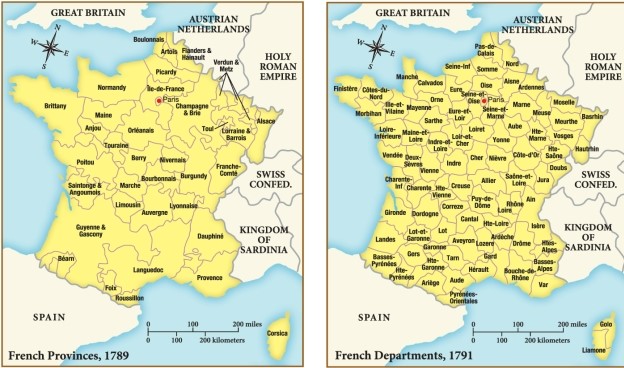
A) expansion that occurred as a result of the French revolutionary wars.
B) permanent administrative changes occasioned by the French Revolution.
C) King Louis XVI's reforms designed (unsuccessfully) to avert revolution.
D) massive irrigation projects carried out under Maximilien Robespierre.
A) expansion that occurred as a result of the French revolutionary wars.
B) permanent administrative changes occasioned by the French Revolution.
C) King Louis XVI's reforms designed (unsuccessfully) to avert revolution.
D) massive irrigation projects carried out under Maximilien Robespierre.
Question
Question
Question
Question
Question
Question
Question
Question
Question
Question
Question
Question
Question
Question
Question
Question
Question
Question
Question
Question
Question
Which of the following statements is supported by this map of France in the 1790s?
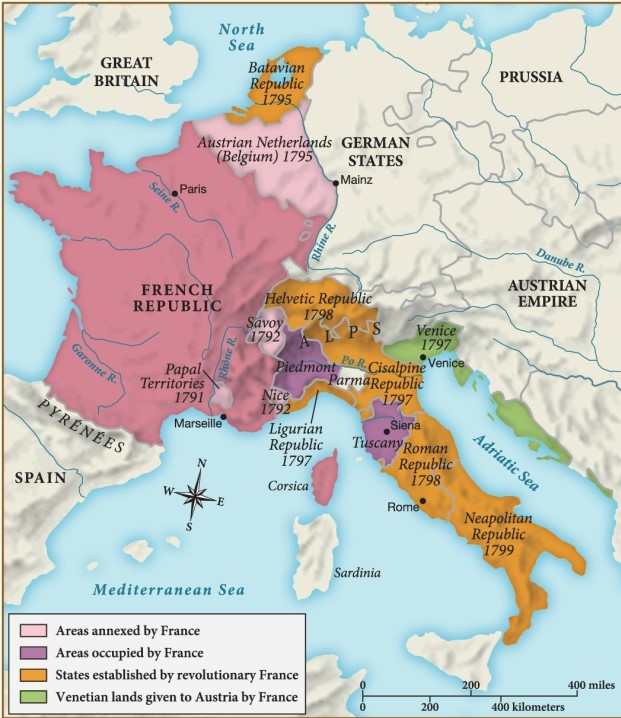
A) France lost a considerable amount of territory during this time.
B) France and Germany aligned with one another to form a Franco-German empire.
C) Many regions that were under French control were liberated during this time.
D) France expanded its territorial claims significantly during this time.
A) France lost a considerable amount of territory during this time.
B) France and Germany aligned with one another to form a Franco-German empire.
C) Many regions that were under French control were liberated during this time.
D) France expanded its territorial claims significantly during this time.
Question
Which of the following was the first region to be annexed by France during the 1790s?
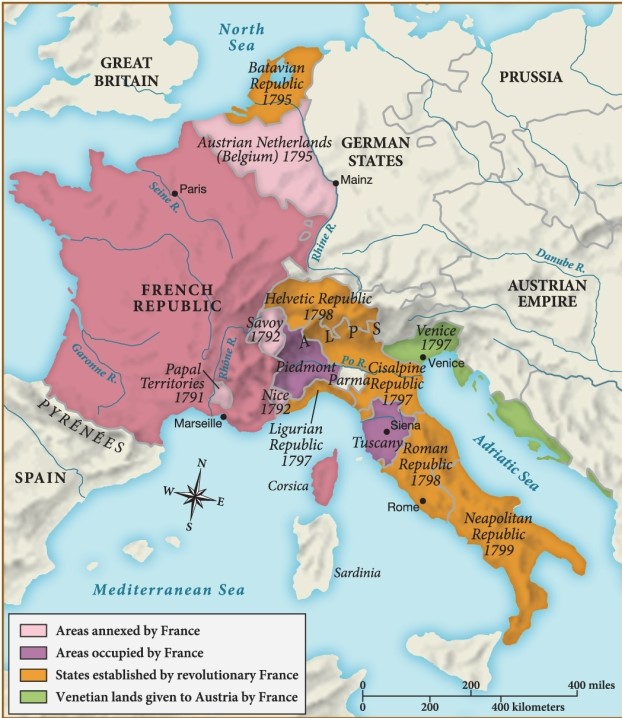
A) Savoy
B) The Papal Territories
C) Nice
D) The Austrian Netherlands
A) Savoy
B) The Papal Territories
C) Nice
D) The Austrian Netherlands
Question
Question
Which European nation had gained the most territory during the partitions of Poland by 1795?
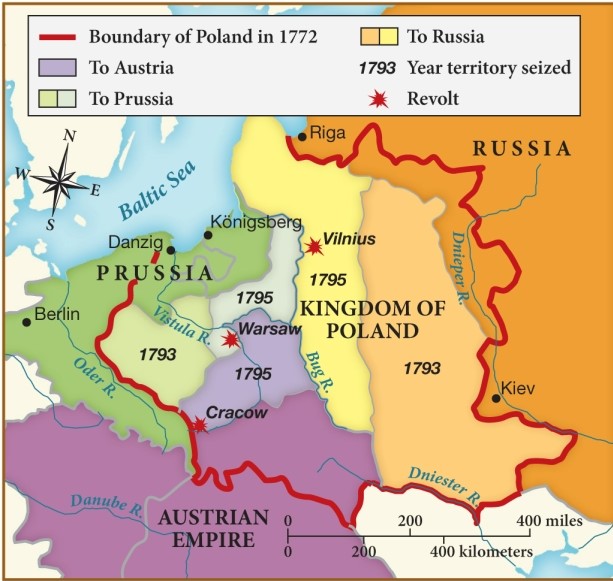
A) The Austrian Empire
B) Prussia
C) Russia
D) Berlin
A) The Austrian Empire
B) Prussia
C) Russia
D) Berlin
Question
Question
Question
Question
Question
According to this map, what did the Neapolitan, Roman, and Helvetic Republics all have in common?
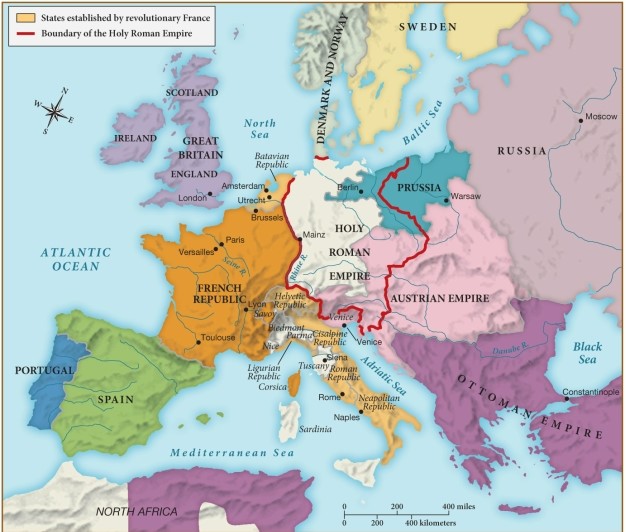
A) All of these republics were part of the Holy Roman Empire.
B) These republics served as the model for the United States government.
C) All of these republics were established by revolutionary France.
D) Each of these republics gained their freedom from Germany by 1799.
A) All of these republics were part of the Holy Roman Empire.
B) These republics served as the model for the United States government.
C) All of these republics were established by revolutionary France.
D) Each of these republics gained their freedom from Germany by 1799.

Unlock Deck
Sign up to unlock the cards in this deck!
Unlock Deck
Unlock Deck
1/65

Play

Full screen (f)
Deck 19: The Cataclysm of Revolution, 1789-1799
1
Describe the basic similarities and differences between the Dutch and Belgian revolts of the late 1780s.
Answer would ideally include the following. In each case, the revolt was intended to reduce the power of the country's leader, whose policies were unpopular. Members of the resistance in both countries portrayed themselves as true patriots, but the goals of the Dutch and Belgian rebels were almost diametrically opposite to each other. The Dutch wanted democratic reforms that took power away from traditional entrenched interests, while the Belgians were resisting the sweeping religious and political changes that Joseph II had introduced on the grounds that those reforms threatened their local privileges.
2
How was the reform movement in Poland-Lithuania aided by international politics in the 1780s?
Answer would ideally include the following. Poland-Lithuania had been dominated by Russia since the first partition of Poland in 1772, when a third of the country's territory was divided between Russia, Prussia, and Austria. International politics had its biggest impact on Poland-Lithuania in 1788, when Russia was deeply involved in a war with the Ottoman Turks and could not spare troops to block a reform-minded parliament called that year.
3
What issue deadlocked the Estates General in the spring of 1789, and why was this issue crucial to reform?
Answer would ideally include the following. The question that deadlocked the Estates General in May and June 1789 was voting rights-that is, whether the deputies would vote by order or by individual head. The last time the legislature had met, 175 years before, it had voted by orders-one vote for the clergy (the First Estate), one for the nobility (the Second Estate), and one for the representatives of everyone else (the Third Estate). The adoption of this same system in 1789 would likely mean that no substantive reforms would pass, since the conservative members of the First and Second Estates would probably unite to preserve their privileges. However, if each deputy were to vote individually, the Third Estate would almost certainly prevail because it had as many members as the other two orders combined.
4
What was the Civil Constitution of the Clergy of 1790, and what were its long-term effects?
Unlock Deck
Unlock for access to all 65 flashcards in this deck.
Unlock Deck
k this deck
5
What was the 1789 Declaration of the Rights of Man and Citizen? What did it purport to achieve and for whom? What groups found their situation ambiguous by its adoption.
Unlock Deck
Unlock for access to all 65 flashcards in this deck.
Unlock Deck
k this deck
6
Why was the royal family's 1791 flight to Varennes a turning point in the French Revolution?
Unlock Deck
Unlock for access to all 65 flashcards in this deck.
Unlock Deck
k this deck
7
Although the Committee of Public Safety is most frequently linked with the bloodshed of the Terror, its military reforms actually saved the Revolution. Explain why this was so.
Unlock Deck
Unlock for access to all 65 flashcards in this deck.
Unlock Deck
k this deck
8
Why was the Vendée region such a source of concern for the French government in 1793?
Unlock Deck
Unlock for access to all 65 flashcards in this deck.
Unlock Deck
k this deck
9
In what way did the French Revolution play a key role in the partitions of Poland in 1793 and 1795?
Unlock Deck
Unlock for access to all 65 flashcards in this deck.
Unlock Deck
k this deck
10
Why were French reformers initially unwilling to end slavery in the French Caribbean, and how did the situation on St. Domingue change after 1791?
Unlock Deck
Unlock for access to all 65 flashcards in this deck.
Unlock Deck
k this deck
11
Why did French revolutionaries attempt to "republicanize everything" within French society? How did they both succeed and fail in their efforts to "revolutionize" everyday life in France?
Unlock Deck
Unlock for access to all 65 flashcards in this deck.
Unlock Deck
k this deck
12
How did events in other European countries influence the outbreak of the French Revolution, and how did French wars with other European countries help determine the course of the Revolution?
Unlock Deck
Unlock for access to all 65 flashcards in this deck.
Unlock Deck
k this deck
13
One of the major problems of the eighteenth-century French Revolution was that not everyone agreed on the Revolution's goals or on which social group's interests best represented the interests of the nation as a whole. Explain this problem as it appeared and reappeared in the various stages of the French Revolution (government under the pre-1789 monarchy, the National Assembly, the Committee of Public Safety, and the Directory). Do you think such conflicts were inevitable?
Unlock Deck
Unlock for access to all 65 flashcards in this deck.
Unlock Deck
k this deck
14
Describe how and why the Terror developed as it did. What groups did it target, and how did this change over time? Was the Terror a natural outcome of revolutionary dynamics, or did it represent a betrayal of revolutionary principles?
Unlock Deck
Unlock for access to all 65 flashcards in this deck.
Unlock Deck
k this deck
15
What impact did the French Revolution of the late eighteenth century have on France's colonies in the Caribbean? How did France address those impacts? Did the enslaved persons in France's Caribbean colonies experience any benefits from the actions taken by France at this time? If so, explain how.
Unlock Deck
Unlock for access to all 65 flashcards in this deck.
Unlock Deck
k this deck
16
By the time France underwent revolution, it was the
A) richest, most powerful, and most populous state in Europe.
B) only state in Europe with an unstable government.
C) poorest and most economically depressed state in Europe.
D) most devout and powerful state in Europe.
A) richest, most powerful, and most populous state in Europe.
B) only state in Europe with an unstable government.
C) poorest and most economically depressed state in Europe.
D) most devout and powerful state in Europe.
Unlock Deck
Unlock for access to all 65 flashcards in this deck.
Unlock Deck
k this deck
17
How was the French revolution distinct from other Atlantic revolutions?
A) It focused on the principle of liberty.
B) It was more violent and lasted longer.
C) It mobilized large numbers of ordinary people.
D) It focused on the liberation of slaves, especially those in French colonies.
A) It focused on the principle of liberty.
B) It was more violent and lasted longer.
C) It mobilized large numbers of ordinary people.
D) It focused on the liberation of slaves, especially those in French colonies.
Unlock Deck
Unlock for access to all 65 flashcards in this deck.
Unlock Deck
k this deck
18
Which of the following was an important catalyst for the Dutch Patriot revolt in 1787?
A) Emperor Joseph II's attempt to institute anticlerical reforms as well as measures for administrative and judicial centralization
B) The decision of the Dutch stadholder to raise taxes on a wide range of commercial transactions
C) The example set in France when Louis XVI accepted the first French constitution
D) A rise in anti-British sentiment during the American War of Independence and opposition to the pro-British stadholder
A) Emperor Joseph II's attempt to institute anticlerical reforms as well as measures for administrative and judicial centralization
B) The decision of the Dutch stadholder to raise taxes on a wide range of commercial transactions
C) The example set in France when Louis XVI accepted the first French constitution
D) A rise in anti-British sentiment during the American War of Independence and opposition to the pro-British stadholder
Unlock Deck
Unlock for access to all 65 flashcards in this deck.
Unlock Deck
k this deck
19
How did Emperor Joseph II's Enlightenment-inspired reforms ignite the Belgian independence movement?
A) Belgians were so motivated by Joseph's Enlightenment ideals that they pushed for more direct participation in their own government, and eventually for independence.
B) Joseph's reorganization of the government eliminated offices belonging to nobles and lawyers, and his anti-Catholic measures offended the Catholic population, galvanizing resistance.
C) Since Joseph had little interest in governing Belgium, his reforms were designed to make the territory self-governing and stir up support for independence.
D) Belgium had a strongly Catholic population that had little interest in the Enlightenment and wanted to get rid of any regime that had anything to do with the movement.
A) Belgians were so motivated by Joseph's Enlightenment ideals that they pushed for more direct participation in their own government, and eventually for independence.
B) Joseph's reorganization of the government eliminated offices belonging to nobles and lawyers, and his anti-Catholic measures offended the Catholic population, galvanizing resistance.
C) Since Joseph had little interest in governing Belgium, his reforms were designed to make the territory self-governing and stir up support for independence.
D) Belgium had a strongly Catholic population that had little interest in the Enlightenment and wanted to get rid of any regime that had anything to do with the movement.
Unlock Deck
Unlock for access to all 65 flashcards in this deck.
Unlock Deck
k this deck
20
Between 1788 and 1791, how did the Polish Patriots attempt reform in Poland?
A) They took power away from King Stanislaw August Poniatowski and dispersed it among Polish nobles and aristocrats.
B) They granted King Stanislaw August Poniatowski much greater monarchical power in order to oppose Russia.
C) They enacted a new constitution that gave townspeople limited political rights and hinted at possible Jewish emancipation.
D) They abolished serfdom completely and instituted a sweeping measure of land reform to benefit newly freed peasants.
A) They took power away from King Stanislaw August Poniatowski and dispersed it among Polish nobles and aristocrats.
B) They granted King Stanislaw August Poniatowski much greater monarchical power in order to oppose Russia.
C) They enacted a new constitution that gave townspeople limited political rights and hinted at possible Jewish emancipation.
D) They abolished serfdom completely and instituted a sweeping measure of land reform to benefit newly freed peasants.
Unlock Deck
Unlock for access to all 65 flashcards in this deck.
Unlock Deck
k this deck
21
How was France seen internationally on the eve of the French Revolution?
A) Most believed that France was a weakening state.
B) Most believed that France was gradually maturing into a democracy.
C) Most believed that recent defeats made France likely to adopt the British constitutional system.
D) Most thought that France had restored her prestige by supporting the winning side in the American Revolution.
A) Most believed that France was a weakening state.
B) Most believed that France was gradually maturing into a democracy.
C) Most believed that recent defeats made France likely to adopt the British constitutional system.
D) Most thought that France had restored her prestige by supporting the winning side in the American Revolution.
Unlock Deck
Unlock for access to all 65 flashcards in this deck.
Unlock Deck
k this deck
22
What was the cause of France's fiscal crisis in the late 1780s?
A) Financial losses due to bad investments in international trade
B) Dwindling cash reserves due to several years of bad harvests and a rapidly growing population
C) Severe corruption at both the local and national levels, as aristocrats charged with tax collection skimmed funds from the coffers
D) A mounting deficit stemming from France's support of the colonies in the American War of Independence and compounded by its inadequate tax system
A) Financial losses due to bad investments in international trade
B) Dwindling cash reserves due to several years of bad harvests and a rapidly growing population
C) Severe corruption at both the local and national levels, as aristocrats charged with tax collection skimmed funds from the coffers
D) A mounting deficit stemming from France's support of the colonies in the American War of Independence and compounded by its inadequate tax system
Unlock Deck
Unlock for access to all 65 flashcards in this deck.
Unlock Deck
k this deck
23
Why were Louis XVI and Marie-Antoinette so unpopular, despite the king's seeming eagerness to promote reform?
A) They were extremely devout Catholics and seemed to be under the direct control of the papacy.
B) They meddled too much in government affairs, when people thought they should stay out of that which they did not understand.
C) They lived extravagantly and appeared indifferent to the misery of the people or the problems of the government.
D) They traveled abroad constantly and were never in France to deal with the problems the country faced.
A) They were extremely devout Catholics and seemed to be under the direct control of the papacy.
B) They meddled too much in government affairs, when people thought they should stay out of that which they did not understand.
C) They lived extravagantly and appeared indifferent to the misery of the people or the problems of the government.
D) They traveled abroad constantly and were never in France to deal with the problems the country faced.
Unlock Deck
Unlock for access to all 65 flashcards in this deck.
Unlock Deck
k this deck
24
What three events contributed to rising tensions in the months before elections to the Estates General were held?
A) Louis XVI moved the court from Versailles to Paris, proposed a new constitution, and offered to shrink the army.
B) The Queen closed Versailles, the clergy demanded an end to reforms, and the government subsidized grain prices.
C) The king refused to mandate voting by head rather than order, censorship broke down, and food shortages occurred.
D) The parlement of Paris agreed to support the king, the pope called for order, and the French aristocracy rallied to the monarchy.
A) Louis XVI moved the court from Versailles to Paris, proposed a new constitution, and offered to shrink the army.
B) The Queen closed Versailles, the clergy demanded an end to reforms, and the government subsidized grain prices.
C) The king refused to mandate voting by head rather than order, censorship broke down, and food shortages occurred.
D) The parlement of Paris agreed to support the king, the pope called for order, and the French aristocracy rallied to the monarchy.
Unlock Deck
Unlock for access to all 65 flashcards in this deck.
Unlock Deck
k this deck
25
The deputies of the Third Estate, one of the three estates that made up the Estates General, represented which segment of France's population?
A) The clergy
B) The nobility
C) The military
D) Peasants and the urban middle and lower classes
A) The clergy
B) The nobility
C) The military
D) Peasants and the urban middle and lower classes
Unlock Deck
Unlock for access to all 65 flashcards in this deck.
Unlock Deck
k this deck
26
When the Estates General met in 1789, what did their first decision concern?
A) The creation of a national bank of France
B) The role of the king in government
C) The crisis of the rising food shortage
D) The contentious issue of voting procedure
A) The creation of a national bank of France
B) The role of the king in government
C) The crisis of the rising food shortage
D) The contentious issue of voting procedure
Unlock Deck
Unlock for access to all 65 flashcards in this deck.
Unlock Deck
k this deck
27
Who were the sans-culottes?
A) Representatives of the nobility named for the style of knee breeches they wore to distinguish their social class
B) Members of the urban working classes who wore long trousers rather than the knee breeches of the upper classes
C) Members of a middle-class political club who organized meetings in support of the National Assembly
D) Counterrevolutionary militias that organized to support the French king with backing from the British government
A) Representatives of the nobility named for the style of knee breeches they wore to distinguish their social class
B) Members of the urban working classes who wore long trousers rather than the knee breeches of the upper classes
C) Members of a middle-class political club who organized meetings in support of the National Assembly
D) Counterrevolutionary militias that organized to support the French king with backing from the British government
Unlock Deck
Unlock for access to all 65 flashcards in this deck.
Unlock Deck
k this deck
28
What did the deputies to the National Assembly declare in the "tennis court oath" of June 20, 1789?
A) That the Third Estate represented the interests of the entire French nation
B) That the monarchy was no longer valid in France
C) That they would not disband until they had given France a binding constitution
D) That they would sweep away the last vestiges of feudal privilege
A) That the Third Estate represented the interests of the entire French nation
B) That the monarchy was no longer valid in France
C) That they would not disband until they had given France a binding constitution
D) That they would sweep away the last vestiges of feudal privilege
Unlock Deck
Unlock for access to all 65 flashcards in this deck.
Unlock Deck
k this deck
29
When Louis fired Jacques Necker, his finance minister, many people believed the king
A) would purge all corrupt officials so that reform could begin.
B) could not avoid national bankruptcy despite desperate financial retrenchment.
C) intended to dismiss the National Assembly and end all reforms.
D) was showing his commitment to reform by dismissing the universally hated Necker.
A) would purge all corrupt officials so that reform could begin.
B) could not avoid national bankruptcy despite desperate financial retrenchment.
C) intended to dismiss the National Assembly and end all reforms.
D) was showing his commitment to reform by dismissing the universally hated Necker.
Unlock Deck
Unlock for access to all 65 flashcards in this deck.
Unlock Deck
k this deck
30
What impact did the July 14, 1789 fall of the Bastille have on the political landscape of France?
A) It convinced Louis XVI that he had to retake control of the country, so he sent the military out to quell the uprising.
B) It demonstrated that the common people were willing to intervene violently, and it set off further revolts throughout France, which caused the king's government to crumble.
C) It frightened many of those in the city of Paris who had originally supported the revolution, shifting the momentum into the countryside.
D) It convinced the National Assembly that the working classes should not be allowed to vote or participate directly in politics, as they were too violent and unpredictable.
A) It convinced Louis XVI that he had to retake control of the country, so he sent the military out to quell the uprising.
B) It demonstrated that the common people were willing to intervene violently, and it set off further revolts throughout France, which caused the king's government to crumble.
C) It frightened many of those in the city of Paris who had originally supported the revolution, shifting the momentum into the countryside.
D) It convinced the National Assembly that the working classes should not be allowed to vote or participate directly in politics, as they were too violent and unpredictable.
Unlock Deck
Unlock for access to all 65 flashcards in this deck.
Unlock Deck
k this deck
31
The Great Fear is the term historians use to describe
A) the fear that gripped most of France when the Committee of Public Safety adopted a campaign of terror, especially the use of the guillotine, as a way of crushing opposition.
B) the panic of peasants who suspected an aristocratic conspiracy when unemployment and crop failures drove numerous beggars and vagrants to wander the countryside.
C) the dismay that spread among aristocrats when Louis XVI and Marie-Antoinette were apprehended during their flight to Varennes and returned to Paris.
D) the panic that drove the sans-culottes to ever more radical measures when they suspected that monarchists were plotting to repress the Revolution.
A) the fear that gripped most of France when the Committee of Public Safety adopted a campaign of terror, especially the use of the guillotine, as a way of crushing opposition.
B) the panic of peasants who suspected an aristocratic conspiracy when unemployment and crop failures drove numerous beggars and vagrants to wander the countryside.
C) the dismay that spread among aristocrats when Louis XVI and Marie-Antoinette were apprehended during their flight to Varennes and returned to Paris.
D) the panic that drove the sans-culottes to ever more radical measures when they suspected that monarchists were plotting to repress the Revolution.
Unlock Deck
Unlock for access to all 65 flashcards in this deck.
Unlock Deck
k this deck
32
How did the National Assembly respond to growing peasant unrest in the countryside in the summer of 1789?
A) Noble deputies offered to give up their traditional rights and privileges, which allowed the National Assembly to declare that the "feudal regime" had ended.
B) They organized National Guard units to suppress the peasant uprisings and restore order so that they could go back to the work of building a government.
C) They organized a system to send emergency supplies of food to regions hit by the massive food shortages in an attempt to appease peasant grievances.
D) They instituted a national draft to bring peasants under the control of the military and utilize their energy for the good of the nation.
A) Noble deputies offered to give up their traditional rights and privileges, which allowed the National Assembly to declare that the "feudal regime" had ended.
B) They organized National Guard units to suppress the peasant uprisings and restore order so that they could go back to the work of building a government.
C) They organized a system to send emergency supplies of food to regions hit by the massive food shortages in an attempt to appease peasant grievances.
D) They instituted a national draft to bring peasants under the control of the military and utilize their energy for the good of the nation.
Unlock Deck
Unlock for access to all 65 flashcards in this deck.
Unlock Deck
k this deck
33
In the Declaration of the Rights of Man and Citizen, the National Assembly
A) attempted to control rising female radicalism by declaring that women did not have equal rights with men.
B) solidified distinctions between the aristocracy and the Third Estate, although it extended citizenship to all.
C) sought to provide special privileges to those individuals who were actively involved in reforming the state.
D) pronounced all men free and equal and promised to recognize the essential political and civil rights of all men.
A) attempted to control rising female radicalism by declaring that women did not have equal rights with men.
B) solidified distinctions between the aristocracy and the Third Estate, although it extended citizenship to all.
C) sought to provide special privileges to those individuals who were actively involved in reforming the state.
D) pronounced all men free and equal and promised to recognize the essential political and civil rights of all men.
Unlock Deck
Unlock for access to all 65 flashcards in this deck.
Unlock Deck
k this deck
34
Which of the following rights was granted in the Declaration of the Rights of Man and Citizen?
A) The right to bear arms
B) Equality before the law
C) The pursuit of happiness
D) Universal suffrage
A) The right to bear arms
B) Equality before the law
C) The pursuit of happiness
D) Universal suffrage
Unlock Deck
Unlock for access to all 65 flashcards in this deck.
Unlock Deck
k this deck
35
Who was the author of the Declaration of the Rights of Women of 1791?
A) Jeanne Roland
B) Charlotte Corday
C) Marie-Antoinette
D) Olympe de Gouges
A) Jeanne Roland
B) Charlotte Corday
C) Marie-Antoinette
D) Olympe de Gouges
Unlock Deck
Unlock for access to all 65 flashcards in this deck.
Unlock Deck
k this deck
36
The change that this map depicts to France's geography exemplifies the
A) expansion that occurred as a result of the French revolutionary wars.
B) permanent administrative changes occasioned by the French Revolution.
C) King Louis XVI's reforms designed (unsuccessfully) to avert revolution.
D) massive irrigation projects carried out under Maximilien Robespierre.
A) expansion that occurred as a result of the French revolutionary wars.
B) permanent administrative changes occasioned by the French Revolution.
C) King Louis XVI's reforms designed (unsuccessfully) to avert revolution.
D) massive irrigation projects carried out under Maximilien Robespierre.
Unlock Deck
Unlock for access to all 65 flashcards in this deck.
Unlock Deck
k this deck
37
How did the National Assembly attempt to reform the Catholic church in France?
A) They taxed the tithes that were paid to the Catholic church as well as church properties and forced clergymen to report grievances aired in confession.
B) Fearing the foreign influence of the Vatican, the Assembly established a national Catholic church that was subject only to French Catholic authorities.
C) They outlawed monastic vows, confiscated all the church's property, and set up a system in which priests and bishops were elected locally and paid by the state.
D) They rewrote the Catholic liturgy to reflect the new republican values and took control of the Catholic school curriculum.
A) They taxed the tithes that were paid to the Catholic church as well as church properties and forced clergymen to report grievances aired in confession.
B) Fearing the foreign influence of the Vatican, the Assembly established a national Catholic church that was subject only to French Catholic authorities.
C) They outlawed monastic vows, confiscated all the church's property, and set up a system in which priests and bishops were elected locally and paid by the state.
D) They rewrote the Catholic liturgy to reflect the new republican values and took control of the Catholic school curriculum.
Unlock Deck
Unlock for access to all 65 flashcards in this deck.
Unlock Deck
k this deck
38
What was the significance of the event known as "the flight to Varennes"?
A) It showed the effectiveness of the National Assembly's crackdown on the Catholic church, as huge numbers fled into exile at Varennes.
B) It demonstrated to the French public that Louis XVI and Marie-Antoinette were traitors to the revolution, as the royal family had attempted to flee the country and gather resistance.
C) It revealed the weakness of the National Assembly, which could not keep the French nobility from fleeing the country in large numbers.
D) It enabled the National Assembly to create a standing army to crack down on peasant uprisings in the French countryside.
A) It showed the effectiveness of the National Assembly's crackdown on the Catholic church, as huge numbers fled into exile at Varennes.
B) It demonstrated to the French public that Louis XVI and Marie-Antoinette were traitors to the revolution, as the royal family had attempted to flee the country and gather resistance.
C) It revealed the weakness of the National Assembly, which could not keep the French nobility from fleeing the country in large numbers.
D) It enabled the National Assembly to create a standing army to crack down on peasant uprisings in the French countryside.
Unlock Deck
Unlock for access to all 65 flashcards in this deck.
Unlock Deck
k this deck
39
Why did France's entry into war with Austria in 1792 have an immediate radicalizing effect on the Revolution?
A) Most French citizens had no desire to go to war against their great ally, so massive protests sprang up throughout the countryside attacking revolutionary leaders.
B) Realizing they had Austria behind them, millions of French citizens joined a huge counterrevolutionary movement in support of the monarchy.
C) When the French armies proved dreadfully unprepared for battle, the authority of the Assembly was challenged, and angry crowds instigated more radical political change.
D) With the support of the Austrian army, Louis XVI made another unsuccessful escape attempt, leading revolutionaries to call for his execution.
A) Most French citizens had no desire to go to war against their great ally, so massive protests sprang up throughout the countryside attacking revolutionary leaders.
B) Realizing they had Austria behind them, millions of French citizens joined a huge counterrevolutionary movement in support of the monarchy.
C) When the French armies proved dreadfully unprepared for battle, the authority of the Assembly was challenged, and angry crowds instigated more radical political change.
D) With the support of the Austrian army, Louis XVI made another unsuccessful escape attempt, leading revolutionaries to call for his execution.
Unlock Deck
Unlock for access to all 65 flashcards in this deck.
Unlock Deck
k this deck
40
What new reforms resulted after the sans-culottes attacked the Tuileries in August, 1792?
A) The legislature ordered elections for a constitutional convention and instituted universal male suffrage; when the National Convention met, it abolished the monarchy and established a republic.
B) The National Assembly outlawed the Catholic church, instituted mandatory secular elementary education for all children, and ended peasant taxes to landlords.
C) The legislature instituted vast reforms of the economic system, including making the tax code more equitable and providing agricultural subsidies to farmers.
D) Confronted by the threat of an Austrian invasion, the legislature instituted a constitutional monarchy along the lines of Great Britain, with most power residing in the Assembly.
A) The legislature ordered elections for a constitutional convention and instituted universal male suffrage; when the National Convention met, it abolished the monarchy and established a republic.
B) The National Assembly outlawed the Catholic church, instituted mandatory secular elementary education for all children, and ended peasant taxes to landlords.
C) The legislature instituted vast reforms of the economic system, including making the tax code more equitable and providing agricultural subsidies to farmers.
D) Confronted by the threat of an Austrian invasion, the legislature instituted a constitutional monarchy along the lines of Great Britain, with most power residing in the Assembly.
Unlock Deck
Unlock for access to all 65 flashcards in this deck.
Unlock Deck
k this deck
41
What issue inspired the dispute in the French National Assembly between the Girondins and the Mountain?
A) The Mountain argued that the upper ranks of the aristocracy should be exiled along with King Louis XVI, while the Girondins believed that the king alone should be exiled.
B) The Mountain believed that the entire royal family should be exiled, while the Girondins argued for their execution.
C) The Girondins believed that the king, Louis XVI, was guilty of treason, while the Mountain believed that he was guilty simply of shirking his responsibilities.
D) The Mountain believed that the king, Louis XVI, should be executed for treason, while the Girondins argued that he should be given clemency or exile.
A) The Mountain argued that the upper ranks of the aristocracy should be exiled along with King Louis XVI, while the Girondins believed that the king alone should be exiled.
B) The Mountain believed that the entire royal family should be exiled, while the Girondins argued for their execution.
C) The Girondins believed that the king, Louis XVI, was guilty of treason, while the Mountain believed that he was guilty simply of shirking his responsibilities.
D) The Mountain believed that the king, Louis XVI, should be executed for treason, while the Girondins argued that he should be given clemency or exile.
Unlock Deck
Unlock for access to all 65 flashcards in this deck.
Unlock Deck
k this deck
42
Who was known as the "incorruptible" leader of the Committee of Public Safety?
A) Jacques-Louis David
B) Maximilien Robespierre
C) Georges-Jacques Danton
D) Jean-Paul Marat
A) Jacques-Louis David
B) Maximilien Robespierre
C) Georges-Jacques Danton
D) Jean-Paul Marat
Unlock Deck
Unlock for access to all 65 flashcards in this deck.
Unlock Deck
k this deck
43
What was the role of the twelve-member Committee of Public Safety, created in 1793?
A) To oversee the legislative affairs of the country while the Convention was in recess
B) To set the course for government and the war and coordinate the purge of unreliable officials
C) To run the new revolutionary tribunals that had been set up to purge all enemies of the Revolution
D) To oversee executions by guillotine and the confiscation of the property of traitors
A) To oversee the legislative affairs of the country while the Convention was in recess
B) To set the course for government and the war and coordinate the purge of unreliable officials
C) To run the new revolutionary tribunals that had been set up to purge all enemies of the Revolution
D) To oversee executions by guillotine and the confiscation of the property of traitors
Unlock Deck
Unlock for access to all 65 flashcards in this deck.
Unlock Deck
k this deck
44
Why did Robespierre believe terror was a necessary measure for the success of the Revolution?
A) He believed it instilled a stronger revolutionary character in the French people, who had lived for too long under a monarchy.
B) He thought that fear was an element that had to be provided by the government, since the Catholic church's authority had been curtailed.
C) He argued that the government should teach or force citizens to become virtuous republicans.
D) He believed that to be more powerful than a monarch, he needed to be more frightening, and so he instituted a regime of terror to maintain authority.
A) He believed it instilled a stronger revolutionary character in the French people, who had lived for too long under a monarchy.
B) He thought that fear was an element that had to be provided by the government, since the Catholic church's authority had been curtailed.
C) He argued that the government should teach or force citizens to become virtuous republicans.
D) He believed that to be more powerful than a monarch, he needed to be more frightening, and so he instituted a regime of terror to maintain authority.
Unlock Deck
Unlock for access to all 65 flashcards in this deck.
Unlock Deck
k this deck
45
Republican festivals sponsored by the Committee of Public Safety were designed to
A) raise funds for the war effort by inspiring people to give money to save the republic.
B) show other Europeans that stories about the Terror in France were greatly exaggerated.
C) destroy the mystique of the monarchy and make the republic sacred through symbolism.
D) gain the support of the army through the observance of holidays celebrating soldiers as "the heroes of the republic."
A) raise funds for the war effort by inspiring people to give money to save the republic.
B) show other Europeans that stories about the Terror in France were greatly exaggerated.
C) destroy the mystique of the monarchy and make the republic sacred through symbolism.
D) gain the support of the army through the observance of holidays celebrating soldiers as "the heroes of the republic."
Unlock Deck
Unlock for access to all 65 flashcards in this deck.
Unlock Deck
k this deck
46
Why did the revolutionaries' decision to take over the education of boys and girls ultimately fail?
A) They removed the Catholic clergy who had been teachers but did not have other teachers ready to take their place.
B) Political indoctrination took the place of subjects such as math, grammar, and history.
C) Only families able to pay school fees could send their children to state schools.
D) Education was restricted to the children of proven revolutionaries and veterans.
A) They removed the Catholic clergy who had been teachers but did not have other teachers ready to take their place.
B) Political indoctrination took the place of subjects such as math, grammar, and history.
C) Only families able to pay school fees could send their children to state schools.
D) Education was restricted to the children of proven revolutionaries and veterans.
Unlock Deck
Unlock for access to all 65 flashcards in this deck.
Unlock Deck
k this deck
47
In an attempt to appease the devout rural populace, how did the Committee of Public Safety institute an alternative to its campaign of de-Christianization?
A) It replaced the secular Cult of Reason with the deistic Cult of the Supreme Being.
B) It arrested the campaign's most radical leaders as a show of solidarity with devout Catholics.
C) It reinstated many of the clerics who had refused to take the oath of the Civil Constitution of the Clergy, declaring "silent acquiescence" an acceptable alternative.
D) It issued ordinances returning a good deal of church property to local parishes.
A) It replaced the secular Cult of Reason with the deistic Cult of the Supreme Being.
B) It arrested the campaign's most radical leaders as a show of solidarity with devout Catholics.
C) It reinstated many of the clerics who had refused to take the oath of the Civil Constitution of the Clergy, declaring "silent acquiescence" an acceptable alternative.
D) It issued ordinances returning a good deal of church property to local parishes.
Unlock Deck
Unlock for access to all 65 flashcards in this deck.
Unlock Deck
k this deck
48
How did the National Convention "revolutionize" space and time?
A) It outlawed church bells and clocks that were not emblazoned with the revolutionary motto.
B) It introduced a new calendar and metric system based on reason and revolutionary principles.
C) It renamed major cities in France after revolutionary figures and introduced more rational daily schedules for various professions such as farmers or lawyers.
D) It encouraged every French citizen to participate in daily rituals and revolutionary ceremonies that were designed to instill rational order and revolutionary fervor.
A) It outlawed church bells and clocks that were not emblazoned with the revolutionary motto.
B) It introduced a new calendar and metric system based on reason and revolutionary principles.
C) It renamed major cities in France after revolutionary figures and introduced more rational daily schedules for various professions such as farmers or lawyers.
D) It encouraged every French citizen to participate in daily rituals and revolutionary ceremonies that were designed to instill rational order and revolutionary fervor.
Unlock Deck
Unlock for access to all 65 flashcards in this deck.
Unlock Deck
k this deck
49
Why did Charlotte Corday assassinate Jean-Paul Marat in July 1793?
A) She believed that his death would rid the Revolution of an obstructionist who had opposed radical reform.
B) She believed that she was carrying out the will of God by punishing Marat for his plans to de-Christianize France.
C) She believed that she was avenging innocent Girondins who had been executed because Marat had called for their heads.
D) She believed that Marat had engineered the arrest and execution of Georges-Jacques Danton and his followers.
A) She believed that his death would rid the Revolution of an obstructionist who had opposed radical reform.
B) She believed that she was carrying out the will of God by punishing Marat for his plans to de-Christianize France.
C) She believed that she was avenging innocent Girondins who had been executed because Marat had called for their heads.
D) She believed that Marat had engineered the arrest and execution of Georges-Jacques Danton and his followers.
Unlock Deck
Unlock for access to all 65 flashcards in this deck.
Unlock Deck
k this deck
50
The most successful antirepublican and counterrevolutionary revolt took place in which French region?
A) The Vendée
B) The Basses-Pyrénées
C) Seine-et-Marne
D) The Gironde
A) The Vendée
B) The Basses-Pyrénées
C) Seine-et-Marne
D) The Gironde
Unlock Deck
Unlock for access to all 65 flashcards in this deck.
Unlock Deck
k this deck
51
The fall from grace of Robespierre and the Committee of Public Safety came about when Robespierre
A) ordered the execution of hundreds of Catholic priests in Lyon in 1794.
B) began to order the execution of members of the Convention itself.
C) was accused of enticing the British to stage an invasion of Brittany so as to whip up republican sentiment in exchange for French territory in the West Indies.
D) inaugurated the Cult of the Supreme Being, which many Catholics viewed as a brazen and blasphemous attempt to replace Christianity.
A) ordered the execution of hundreds of Catholic priests in Lyon in 1794.
B) began to order the execution of members of the Convention itself.
C) was accused of enticing the British to stage an invasion of Brittany so as to whip up republican sentiment in exchange for French territory in the West Indies.
D) inaugurated the Cult of the Supreme Being, which many Catholics viewed as a brazen and blasphemous attempt to replace Christianity.
Unlock Deck
Unlock for access to all 65 flashcards in this deck.
Unlock Deck
k this deck
52
According to historians, approximately how many people were imprisoned under the repression implemented by Robespierre?
A) 50,000
B) 300,000
C) 1 million
D) 5 million
A) 50,000
B) 300,000
C) 1 million
D) 5 million
Unlock Deck
Unlock for access to all 65 flashcards in this deck.
Unlock Deck
k this deck
53
The Thermidorian Reaction refers to
A) the return of France to a monarchy after 1794.
B) the successful efforts of Jacobins to prevent further reform after the death of Robespierre.
C) the successful efforts of anti-Jacobins in France to roll back the policies of Robespierre after his death.
D) the efforts of French women to end the violence of the revolutionary era through political action.
A) the return of France to a monarchy after 1794.
B) the successful efforts of Jacobins to prevent further reform after the death of Robespierre.
C) the successful efforts of anti-Jacobins in France to roll back the policies of Robespierre after his death.
D) the efforts of French women to end the violence of the revolutionary era through political action.
Unlock Deck
Unlock for access to all 65 flashcards in this deck.
Unlock Deck
k this deck
54
The Directory regime, which came to power in 1795 after the fall of Robespierre, was known for
A) its tenuous hold on power and the more relaxed atmosphere it supported within French society after the oppressive years of Robespierre's rule.
B) its attempts to resurrect the policies and memory of Robespierre through an even more oppressive crackdown on "subversive acts."
C) its complete indifference to revolutionary ideals and its return to an Old Regime atmosphere of luxury and extravagance.
D) its desire to end the continental war in Europe and renew diplomatic relations with Austria and Prussia.
A) its tenuous hold on power and the more relaxed atmosphere it supported within French society after the oppressive years of Robespierre's rule.
B) its attempts to resurrect the policies and memory of Robespierre through an even more oppressive crackdown on "subversive acts."
C) its complete indifference to revolutionary ideals and its return to an Old Regime atmosphere of luxury and extravagance.
D) its desire to end the continental war in Europe and renew diplomatic relations with Austria and Prussia.
Unlock Deck
Unlock for access to all 65 flashcards in this deck.
Unlock Deck
k this deck
55
As France's revolutionary armies won victories across the European continent, what was the French government's policy toward the newly "liberated" lands?
A) It set up a system of military occupation and forced the peoples in those lands to become subjects of the French state.
B) It created semi-independent "sister republics" that were modeled on the new French republic.
C) It set up French colonies in the annexed territories, sending large groups of French citizens to organize new settler communities there.
D) It left the old government structures largely in place but forced the occupied territories to pay the cost of the war.
A) It set up a system of military occupation and forced the peoples in those lands to become subjects of the French state.
B) It created semi-independent "sister republics" that were modeled on the new French republic.
C) It set up French colonies in the annexed territories, sending large groups of French citizens to organize new settler communities there.
D) It left the old government structures largely in place but forced the occupied territories to pay the cost of the war.
Unlock Deck
Unlock for access to all 65 flashcards in this deck.
Unlock Deck
k this deck
56
For Europe, what was one lasting consequence of France's military campaigns of the 1790s?
A) A new rivalry between Britain and Austria as each tried to seize French colonial holdings
B) The adoption of French language and culture by fervent reformers in Poland
C) A financial crisis caused by the collapse of the assignat paper currency
D) Massive casualties in wars inspired by the spread of revolutionary ideas
A) A new rivalry between Britain and Austria as each tried to seize French colonial holdings
B) The adoption of French language and culture by fervent reformers in Poland
C) A financial crisis caused by the collapse of the assignat paper currency
D) Massive casualties in wars inspired by the spread of revolutionary ideas
Unlock Deck
Unlock for access to all 65 flashcards in this deck.
Unlock Deck
k this deck
57
Which of the following statements is supported by this map of France in the 1790s?
A) France lost a considerable amount of territory during this time.
B) France and Germany aligned with one another to form a Franco-German empire.
C) Many regions that were under French control were liberated during this time.
D) France expanded its territorial claims significantly during this time.
A) France lost a considerable amount of territory during this time.
B) France and Germany aligned with one another to form a Franco-German empire.
C) Many regions that were under French control were liberated during this time.
D) France expanded its territorial claims significantly during this time.
Unlock Deck
Unlock for access to all 65 flashcards in this deck.
Unlock Deck
k this deck
58
Which of the following was the first region to be annexed by France during the 1790s?
A) Savoy
B) The Papal Territories
C) Nice
D) The Austrian Netherlands
A) Savoy
B) The Papal Territories
C) Nice
D) The Austrian Netherlands
Unlock Deck
Unlock for access to all 65 flashcards in this deck.
Unlock Deck
k this deck
59
What country disappeared from the map of Europe after Russia divided its territory with Austria and Prussia in 1795?
A) Poland
B) Sweden
C) Saxony
D) Hungary
A) Poland
B) Sweden
C) Saxony
D) Hungary
Unlock Deck
Unlock for access to all 65 flashcards in this deck.
Unlock Deck
k this deck
60
Which European nation had gained the most territory during the partitions of Poland by 1795?
A) The Austrian Empire
B) Prussia
C) Russia
D) Berlin
A) The Austrian Empire
B) Prussia
C) Russia
D) Berlin
Unlock Deck
Unlock for access to all 65 flashcards in this deck.
Unlock Deck
k this deck
61
How did French political leaders attempt to restore authority over slaves in St. Domingue in the wake of the slaves' 1791 revolt?
A) They gave white planters the authority to use any means necessary to capture the rebellion's leaders.
B) They sent a ship of National Guard units from France to quell the revolt and restore order.
C) They granted civil and political rights to the free blacks.
D) They abolished slavery in all French colonies.
A) They gave white planters the authority to use any means necessary to capture the rebellion's leaders.
B) They sent a ship of National Guard units from France to quell the revolt and restore order.
C) They granted civil and political rights to the free blacks.
D) They abolished slavery in all French colonies.
Unlock Deck
Unlock for access to all 65 flashcards in this deck.
Unlock Deck
k this deck
62
As a reward for his efforts in fighting off the Spanish armies, the French appointed Toussaint L'Ouverture, a former slave, governor of St. Domingue. Which of the following is also true of Toussaint L'Ouverture?
A) He later died in a French prison after his arrest by Napoleon's army.
B) He was later made an honorary deputy of the Convention.
C) He immediately turned on the French in an effort to win control of the western half of the island.
D) He had staged the initial revolt against the Spanish.
A) He later died in a French prison after his arrest by Napoleon's army.
B) He was later made an honorary deputy of the Convention.
C) He immediately turned on the French in an effort to win control of the western half of the island.
D) He had staged the initial revolt against the Spanish.
Unlock Deck
Unlock for access to all 65 flashcards in this deck.
Unlock Deck
k this deck
63
German states reacted to the French Revolution with an artistic and intellectual revival that was linked to
A) enthusiasm for the French Cult of the Supreme Being.
B) a flood of French pamphlets intended to bring the Germans over to the French side.
C) anti-French nationalism stirred by distrust of France's advancing armies.
D) reforms enacted by the Holy Roman Emperor to placate those who were attracted to the French revolutionary model.
A) enthusiasm for the French Cult of the Supreme Being.
B) a flood of French pamphlets intended to bring the Germans over to the French side.
C) anti-French nationalism stirred by distrust of France's advancing armies.
D) reforms enacted by the Holy Roman Emperor to placate those who were attracted to the French revolutionary model.
Unlock Deck
Unlock for access to all 65 flashcards in this deck.
Unlock Deck
k this deck
64
How did most European elites react to the French Revolution?
A) They saw the abolition of monarchy and the institution of a republic as the realization of Enlightenment principles and a model to be followed throughout Europe.
B) Although many were originally in favor of the Revolution's aims, especially the establishment of a republic, the events of the Terror made them wary of the revolutionary model.
C) They admired the Enlightenment ideals of the Revolution but distrusted the populist emphasis on universal suffrage and equality.
D) They were alarmed and even enraged by the abolition of monarchy and nobility and the encouragement of popular participation in politics.
A) They saw the abolition of monarchy and the institution of a republic as the realization of Enlightenment principles and a model to be followed throughout Europe.
B) Although many were originally in favor of the Revolution's aims, especially the establishment of a republic, the events of the Terror made them wary of the revolutionary model.
C) They admired the Enlightenment ideals of the Revolution but distrusted the populist emphasis on universal suffrage and equality.
D) They were alarmed and even enraged by the abolition of monarchy and nobility and the encouragement of popular participation in politics.
Unlock Deck
Unlock for access to all 65 flashcards in this deck.
Unlock Deck
k this deck
65
According to this map, what did the Neapolitan, Roman, and Helvetic Republics all have in common?
A) All of these republics were part of the Holy Roman Empire.
B) These republics served as the model for the United States government.
C) All of these republics were established by revolutionary France.
D) Each of these republics gained their freedom from Germany by 1799.
A) All of these republics were part of the Holy Roman Empire.
B) These republics served as the model for the United States government.
C) All of these republics were established by revolutionary France.
D) Each of these republics gained their freedom from Germany by 1799.
Unlock Deck
Unlock for access to all 65 flashcards in this deck.
Unlock Deck
k this deck
Unlock Deck
Unlock for access to all 65 flashcards in this deck.






