







 Chat with AI

Deck 15: Wars of Religion and the Clash of Worldviews, 1560-1648
Full screen (f)

Question

Question
Question
Question
Question
Question
Question
Question
Question
Question
Question
Question
Question
Question
Question
Question
Question
Question
Question
Question
Question
Question
Question
Which of the following statements is supported by this map?
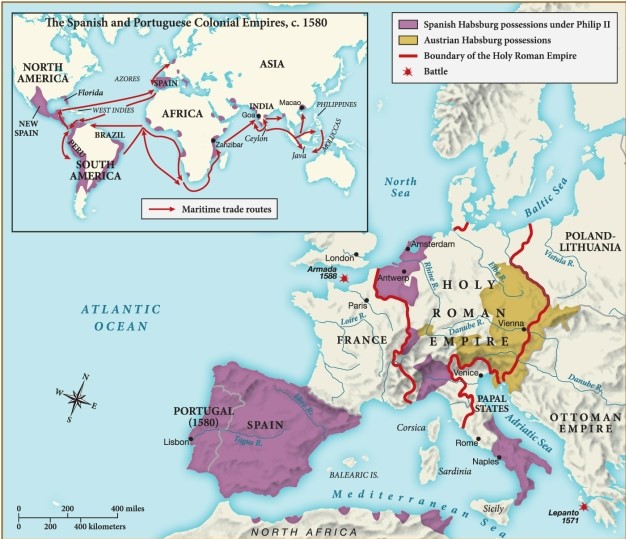
A) Philip II held territory on nearly every explored continent in the sixteenth century.
B) Philip II reigned over the entire Holy Roman Empire during the sixteenth century.
C) Austrian Habsburg territorial possessions in the sixteenth century outweighed those of Philip II.
D) The Austrian Habsburgs ruled over most of Asia by the sixteenth century.
A) Philip II held territory on nearly every explored continent in the sixteenth century.
B) Philip II reigned over the entire Holy Roman Empire during the sixteenth century.
C) Austrian Habsburg territorial possessions in the sixteenth century outweighed those of Philip II.
D) The Austrian Habsburgs ruled over most of Asia by the sixteenth century.
Question
Question
Question
Question
Question
Question
The events depicted in this map
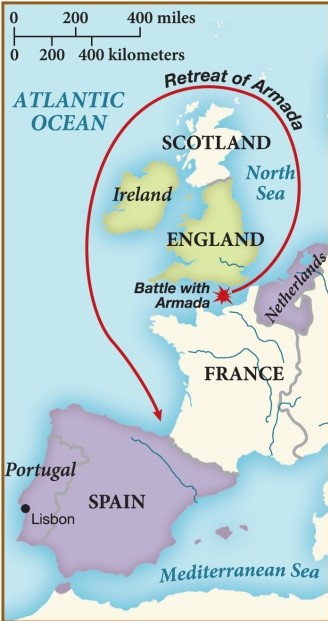
A) predated the Spanish victory at Lepanto.
B) were one of the greatest victories of Philipp II of Spain.
C) saved the English from a Spanish invasion.
D) brought the Catholic Church back to England under Mary.
A) predated the Spanish victory at Lepanto.
B) were one of the greatest victories of Philipp II of Spain.
C) saved the English from a Spanish invasion.
D) brought the Catholic Church back to England under Mary.
Question
Question
Question
Question
Question
Question
Question
Which of the following nations invaded the German states of the Holy Roman Empire during the Thirty Years' War?
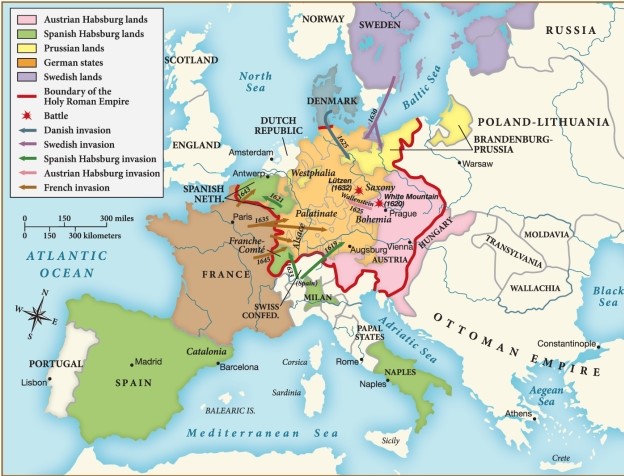
A) England
B) France
C) Poland-Lithuania
D) The Ottoman Empire
A) England
B) France
C) Poland-Lithuania
D) The Ottoman Empire
Question
Question
Question
Question
Question
Question
Question
Question
Question
Question
Question
Question
Question
Question
Question
According to this map, which European nation was the most successful at colonizing the Americas in the seventeenth century?
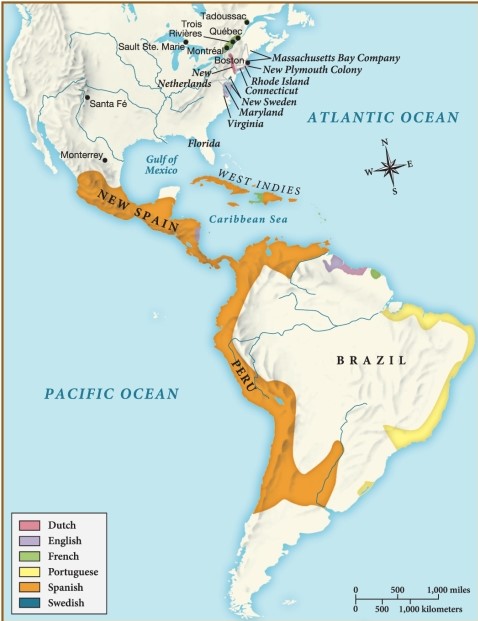
A) Denmark
B) France
C) Spain
D) Sweden
A) Denmark
B) France
C) Spain
D) Sweden
Question
Question
Question
Question
Question
Question
Question
Question
Question
Question
Question
Question
Question
Question
By about 1648, western and central Europe were primarily
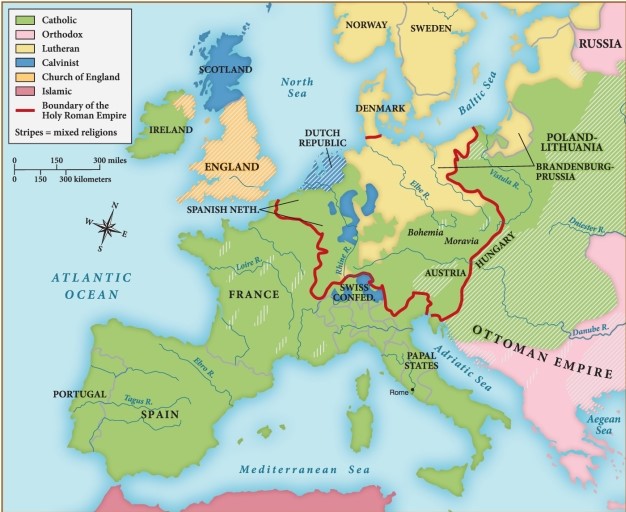
A) Calvinist.
B) Lutheran.
C) Orthodox.
D) Catholic.
A) Calvinist.
B) Lutheran.
C) Orthodox.
D) Catholic.

Unlock Deck
Sign up to unlock the cards in this deck!
Unlock Deck
Unlock Deck
1/65

Play

Full screen (f)
Deck 15: Wars of Religion and the Clash of Worldviews, 1560-1648
1
The massacre of thousands of French Huguenots by Catholic mobs in 1572 enraged Protestants, who argued that they now had a right to resist the government because a contract had been broken. What was this contract, and why did its political significance go beyond the religious conflicts of the period?
Answer would ideally include the following. Huguenot pamphleteers proclaimed that the king, by failing to support the true religion, had broken the unwritten contract he had with his people. This reflected the doctrine of constitutionalism, the belief that a government's legitimacy rested on its upholding a constitution or contract between ruler and ruled. As a result, Huguenots proclaimed that they had the right to resist a tyrant, who in their eyes was an idol worshipper.
2
How was the Edict of Nantes designed to restore peace and stability?
Answer would ideally include the following. Because more than a million Huguenots lived in France, the French monarch not only had to grant some form of toleration to pacify this large minority, but he also had to give them protection from Catholic hard-liners. The Edict of Nantes gave Huguenots the freedom to worship in specified towns, which they were also allowed to fortify and protect with their own military troops. This agreement effectively ended the French Wars of Religion.
3
Henry IV introduced the "nobility of the robe." Who were they, and why did he create them?
Answer would ideally include the following. The "nobility of the robe" was a new class of royal officials created by Henry IV to counterbalance the unruly nobility and strengthen the monarchy. In an effort to reestablish monarchical authority, Henry allowed rich merchants and lawyers to buy offices and to pass their positions on to their heirs in return for an annual payment. The income that the sale of offices raised helped reduce the state debt and strengthen the monarchy.
4
Why did the Dutch develop religious toleration in the course of the late sixteenth and seventeenth centuries?
Unlock Deck
Unlock for access to all 65 flashcards in this deck.
Unlock Deck
k this deck
5
While the almost constant fighting of the Thirty Years' War devastated central Europe, the situation was made worse by the new armies put into the field by the various rulers. What changes in the military made matters worse for ordinary civilians?
Unlock Deck
Unlock for access to all 65 flashcards in this deck.
Unlock Deck
k this deck
6
Explain how the decline in population growth during the early seventeenth century led to agricultural recession.
Unlock Deck
Unlock for access to all 65 flashcards in this deck.
Unlock Deck
k this deck
7
What effect did the economic recession of the early seventeenth century have on European women?
Unlock Deck
Unlock for access to all 65 flashcards in this deck.
Unlock Deck
k this deck
8
Explain how Nicolaus Copernicus, Johannes Kepler, and Galileo Galilei each challenged the view of the universe that was based on Ptolemy's work.
Unlock Deck
Unlock for access to all 65 flashcards in this deck.
Unlock Deck
k this deck
9
Sir Francis Bacon and René Descartes both helped to promote the prestige of the scientific method. Explain how their approaches to accumulating scientific knowledge differed.
Unlock Deck
Unlock for access to all 65 flashcards in this deck.
Unlock Deck
k this deck
10
What did Hugo Grotius use the term natural law to describe? What practice did his natural law condemn?
Unlock Deck
Unlock for access to all 65 flashcards in this deck.
Unlock Deck
k this deck
11
How did the basis for the prosperity of the Dutch and the English differ from that of the Spanish? What international political factors beyond their control worked in their favor?
Unlock Deck
Unlock for access to all 65 flashcards in this deck.
Unlock Deck
k this deck
12
Although the Thirty Years' War was the culmination of over a century of religious conflict in Europe, for several of the parties involved, state interests outweighed religious considerations. Discuss how the Thirty Years' War and its consequences represented a shift in European politics.
Unlock Deck
Unlock for access to all 65 flashcards in this deck.
Unlock Deck
k this deck
13
How did the pioneers and leaders of the scientific revolution help to secularize politics and society?
Unlock Deck
Unlock for access to all 65 flashcards in this deck.
Unlock Deck
k this deck
14
During this time of scientific revolution and challenges to religion, how did art evolve? Identify the new style of art that emerged during this time and its characteristics. How did that style fit with the tensions between the secular world and the church?
Unlock Deck
Unlock for access to all 65 flashcards in this deck.
Unlock Deck
k this deck
15
What political and social conditions between 1550 and 1650 explain the upsurge in allegations of witchcraft, especially against women? Do these conditions also account for educated people who could believe both in witches and in science?
Unlock Deck
Unlock for access to all 65 flashcards in this deck.
Unlock Deck
k this deck
16
What was the significance of the Peace of Augsburg (1555)?
A) It barred Protestant princes from participating in the election of the Holy Roman Emperor.
B) It stipulated that Lutherans pay their tithe to the Catholic church.
C) It made Lutheranism a legal religion in the predominantly Catholic Holy Roman Empire, but it did not extend recognition to Calvinism.
D) It required Lutherans in the Holy Roman Empire to live in principalities headed by Protestant princes.
A) It barred Protestant princes from participating in the election of the Holy Roman Emperor.
B) It stipulated that Lutherans pay their tithe to the Catholic church.
C) It made Lutheranism a legal religion in the predominantly Catholic Holy Roman Empire, but it did not extend recognition to Calvinism.
D) It required Lutherans in the Holy Roman Empire to live in principalities headed by Protestant princes.
Unlock Deck
Unlock for access to all 65 flashcards in this deck.
Unlock Deck
k this deck
17
Which French Catholic ruler ushered in the French Wars of Religion after a disastrous attempt to play rival factions against one another?
A) Charles IX
B) Catherine de Médicis
C) Henry of Navarre
D) Henri de Guise
A) Charles IX
B) Catherine de Médicis
C) Henry of Navarre
D) Henri de Guise
Unlock Deck
Unlock for access to all 65 flashcards in this deck.
Unlock Deck
k this deck
18
What occurred in Paris on August 24-26, 1572?
A) A French Protestant mob smashed Catholic church windows and statues.
B) Catholic mobs murdered some three thousand Huguenots in the St. Bartholomew's Day Massacre.
C) Huguenots rioted after King Henry II was assassinated during a jousting tournament.
D) Marguerite de Valois, the sister of the French king, married Henry of Navarre in a lavish three-day ceremony.
A) A French Protestant mob smashed Catholic church windows and statues.
B) Catholic mobs murdered some three thousand Huguenots in the St. Bartholomew's Day Massacre.
C) Huguenots rioted after King Henry II was assassinated during a jousting tournament.
D) Marguerite de Valois, the sister of the French king, married Henry of Navarre in a lavish three-day ceremony.
Unlock Deck
Unlock for access to all 65 flashcards in this deck.
Unlock Deck
k this deck
19
Why did King Henry IV declare "Paris is worth a Mass"?
A) He was a Huguenot but agreed to a Catholic wedding to please his Catholic fiancée and his Catholic subjects.
B) He converted to Catholicism to ensure his control over France, believing that he needed to place the interests of the state ahead of his Protestant faith.
C) Despite his personal skepticism, he ordered masses and prayers of protection for Paris.
D) As a southern French Protestant, he detested Paris and mocked its cathedrals and Catholic traditions.
A) He was a Huguenot but agreed to a Catholic wedding to please his Catholic fiancée and his Catholic subjects.
B) He converted to Catholicism to ensure his control over France, believing that he needed to place the interests of the state ahead of his Protestant faith.
C) Despite his personal skepticism, he ordered masses and prayers of protection for Paris.
D) As a southern French Protestant, he detested Paris and mocked its cathedrals and Catholic traditions.
Unlock Deck
Unlock for access to all 65 flashcards in this deck.
Unlock Deck
k this deck
20
How did the Edict of Nantes, issued by Henry IV in 1598, end the French Wars of Religion?
A) It legalized Protestantism and granted Protestants the same rights and freedoms as Catholics throughout the realm.
B) It granted Protestants a large measure of toleration, such as freedom to worship in specified towns and the right to retain their own troops, courts, and fortresses.
C) It established the Bourbons as heirs to the Valois throne, thus nullifying any Guise family counterclaims.
D) It declared Catholicism the official religion of France, thereby undermining popular support for the Guises and their Spanish allies.
A) It legalized Protestantism and granted Protestants the same rights and freedoms as Catholics throughout the realm.
B) It granted Protestants a large measure of toleration, such as freedom to worship in specified towns and the right to retain their own troops, courts, and fortresses.
C) It established the Bourbons as heirs to the Valois throne, thus nullifying any Guise family counterclaims.
D) It declared Catholicism the official religion of France, thereby undermining popular support for the Guises and their Spanish allies.
Unlock Deck
Unlock for access to all 65 flashcards in this deck.
Unlock Deck
k this deck
21
French Catholic writer Michel de Montaigne (1533-1592) broke with staunch Protestants and Catholics by endorsing what controversial belief?
A) The ancient doctrine of skepticism, which held that total certainty is never possible
B) The divine right of kings to rule over their subjects with total authority
C) Heliocentrism, or the belief that the planets revolve around the sun
D) The belief that international law should govern the use of torture and the treatment of prisoners of war
A) The ancient doctrine of skepticism, which held that total certainty is never possible
B) The divine right of kings to rule over their subjects with total authority
C) Heliocentrism, or the belief that the planets revolve around the sun
D) The belief that international law should govern the use of torture and the treatment of prisoners of war
Unlock Deck
Unlock for access to all 65 flashcards in this deck.
Unlock Deck
k this deck
22
What 1571 event ended Turkish dominance of the Mediterranean Sea?
A) Philip II's conquest of the Ottoman-controlled Balkan states
B) The revolt of the Moriscos at Tunis
C) Philip II's naval victory at Lepanto off the Greek coast
D) Emperor Ferdinand II's victory over the Turks at White Mountain in Hungary
A) Philip II's conquest of the Ottoman-controlled Balkan states
B) The revolt of the Moriscos at Tunis
C) Philip II's naval victory at Lepanto off the Greek coast
D) Emperor Ferdinand II's victory over the Turks at White Mountain in Hungary
Unlock Deck
Unlock for access to all 65 flashcards in this deck.
Unlock Deck
k this deck
23
Which of the following statements is supported by this map?
A) Philip II held territory on nearly every explored continent in the sixteenth century.
B) Philip II reigned over the entire Holy Roman Empire during the sixteenth century.
C) Austrian Habsburg territorial possessions in the sixteenth century outweighed those of Philip II.
D) The Austrian Habsburgs ruled over most of Asia by the sixteenth century.
A) Philip II held territory on nearly every explored continent in the sixteenth century.
B) Philip II reigned over the entire Holy Roman Empire during the sixteenth century.
C) Austrian Habsburg territorial possessions in the sixteenth century outweighed those of Philip II.
D) The Austrian Habsburgs ruled over most of Asia by the sixteenth century.
Unlock Deck
Unlock for access to all 65 flashcards in this deck.
Unlock Deck
k this deck
24
What caused the mass exodus of Moriscos from Spanish territory to North Africa between 1609 and 1614?
A) An outbreak of the plague forced them to flee to the deserts of the Sahara.
B) King Philip III expelled them in retaliation for their revolt forty years earlier in which some fifteen hundred Christians were killed.
C) They were chased from Spain after accusations were made that they practiced witchcraft and sorcery against the Spanish people.
D) They were defeated in a battle against the Spanish army after siding with Turkish forces that had invaded the territory.
A) An outbreak of the plague forced them to flee to the deserts of the Sahara.
B) King Philip III expelled them in retaliation for their revolt forty years earlier in which some fifteen hundred Christians were killed.
C) They were chased from Spain after accusations were made that they practiced witchcraft and sorcery against the Spanish people.
D) They were defeated in a battle against the Spanish army after siding with Turkish forces that had invaded the territory.
Unlock Deck
Unlock for access to all 65 flashcards in this deck.
Unlock Deck
k this deck
25
What divided the northern and southern provinces of the Netherlands even after they drove out the Spaniards in 1576?
A) The two provinces could not agree on which form of government to institute after they gained their independence from Spain.
B) The northern provinces built their wealth from slave trading, while the more religious southern provinces were morally opposed to the practice.
C) The southern provinces remained largely Catholic, while the northern Protestants were predominantly Protestant.
D) The Spanish government paid the southern provinces to revolt against the north in order to destabilize the rebellious Protestant territories.
A) The two provinces could not agree on which form of government to institute after they gained their independence from Spain.
B) The northern provinces built their wealth from slave trading, while the more religious southern provinces were morally opposed to the practice.
C) The southern provinces remained largely Catholic, while the northern Protestants were predominantly Protestant.
D) The Spanish government paid the southern provinces to revolt against the north in order to destabilize the rebellious Protestant territories.
Unlock Deck
Unlock for access to all 65 flashcards in this deck.
Unlock Deck
k this deck
26
What was the significance of the Church of England's Thirty-Nine Articles of Religion, which were issued in 1563 under the authority of Queen Elizabeth I?
A) They left Catholic ritual and doctrines virtually untouched but led to a breach between the Church of England and the papacy.
B) They combined elements of Catholic ritual with Calvinist doctrines.
C) They guaranteed an end to discrimination against Catholics.
D) They took the power to appoint bishops away from the monarch and gave it to the synod of bishops.
A) They left Catholic ritual and doctrines virtually untouched but led to a breach between the Church of England and the papacy.
B) They combined elements of Catholic ritual with Calvinist doctrines.
C) They guaranteed an end to discrimination against Catholics.
D) They took the power to appoint bishops away from the monarch and gave it to the synod of bishops.
Unlock Deck
Unlock for access to all 65 flashcards in this deck.
Unlock Deck
k this deck
27
What prompted Philip II to send his Spanish Armada against England and Elizabeth I in 1588?
A) Elizabeth's alliance with the House of Orange and her support for the Dutch rebellion against Spain
B) Elizabeth's public remark that the pope had the faith of a pirate, the courage of a nun, and the soul of a Turk
C) Elizabeth's rejection of an offer of marriage from Philip
D) Elizabeth's execution of her Catholic cousin Mary, queen of Scots
A) Elizabeth's alliance with the House of Orange and her support for the Dutch rebellion against Spain
B) Elizabeth's public remark that the pope had the faith of a pirate, the courage of a nun, and the soul of a Turk
C) Elizabeth's rejection of an offer of marriage from Philip
D) Elizabeth's execution of her Catholic cousin Mary, queen of Scots
Unlock Deck
Unlock for access to all 65 flashcards in this deck.
Unlock Deck
k this deck
28
Why did Philip II's Spanish Armada carry religious as well as political significance?
A) It carried large numbers of Jesuits on a mission to reconvert the English to Catholicism.
B) It attracted large numbers of Catholics from all over Europe to fight the English Protestants.
C) It was sent by a Catholic king to defeat the Protestant queen who had beheaded her Catholic cousin.
D) It was sent by Philip after his wife Mary, queen of Scots, was forced to convert to Protestantism.
A) It carried large numbers of Jesuits on a mission to reconvert the English to Catholicism.
B) It attracted large numbers of Catholics from all over Europe to fight the English Protestants.
C) It was sent by a Catholic king to defeat the Protestant queen who had beheaded her Catholic cousin.
D) It was sent by Philip after his wife Mary, queen of Scots, was forced to convert to Protestantism.
Unlock Deck
Unlock for access to all 65 flashcards in this deck.
Unlock Deck
k this deck
29
The events depicted in this map
A) predated the Spanish victory at Lepanto.
B) were one of the greatest victories of Philipp II of Spain.
C) saved the English from a Spanish invasion.
D) brought the Catholic Church back to England under Mary.
A) predated the Spanish victory at Lepanto.
B) were one of the greatest victories of Philipp II of Spain.
C) saved the English from a Spanish invasion.
D) brought the Catholic Church back to England under Mary.
Unlock Deck
Unlock for access to all 65 flashcards in this deck.
Unlock Deck
k this deck
30
What was one of the chief goals of Ivan the Terrible and his successors?
A) To weaken the Holy Roman Emperors enough to take Hungary away from them
B) To expand and make Muscovy the heart of a mighty Russian Empire
C) To convert western nobles to Orthodox Christianity and absorb the newly converted territories
D) To tightly restrict economic, social, and intellectual contact with the "ungodly" West
A) To weaken the Holy Roman Emperors enough to take Hungary away from them
B) To expand and make Muscovy the heart of a mighty Russian Empire
C) To convert western nobles to Orthodox Christianity and absorb the newly converted territories
D) To tightly restrict economic, social, and intellectual contact with the "ungodly" West
Unlock Deck
Unlock for access to all 65 flashcards in this deck.
Unlock Deck
k this deck
31
By the end of the Thirty Years' War, the balance of power in Europe
A) remained in the hands of the Habsburg rulers of Spain and Austria despite challenges from Protestant powers such as France and England.
B) had shifted away from the Habsburg powers toward France, England, and the Dutch Republic.
C) was moving away from secular monarchs and into the hands of religious organizations such as the Roman Catholic church.
D) had completely collapsed, leaving nearly every European country in political and economic turmoil.
A) remained in the hands of the Habsburg rulers of Spain and Austria despite challenges from Protestant powers such as France and England.
B) had shifted away from the Habsburg powers toward France, England, and the Dutch Republic.
C) was moving away from secular monarchs and into the hands of religious organizations such as the Roman Catholic church.
D) had completely collapsed, leaving nearly every European country in political and economic turmoil.
Unlock Deck
Unlock for access to all 65 flashcards in this deck.
Unlock Deck
k this deck
32
Which of the following best describes the origins of the Thirty Years' War (1618-1648)?
A) A long-standing dispute over the borders of France and the Holy Roman Empire that drew in nearly all the countries of Europe
B) A conflict over succession to the French throne following the assassination of Henry IV in 1610
C) The defeat of the Spanish Armada at the hands of Queen Elizabeth I's navy, and Spain's desire for revenge on England
D) A combination of religious disputes, ethnic competition, and political weakness in central Europe
A) A long-standing dispute over the borders of France and the Holy Roman Empire that drew in nearly all the countries of Europe
B) A conflict over succession to the French throne following the assassination of Henry IV in 1610
C) The defeat of the Spanish Armada at the hands of Queen Elizabeth I's navy, and Spain's desire for revenge on England
D) A combination of religious disputes, ethnic competition, and political weakness in central Europe
Unlock Deck
Unlock for access to all 65 flashcards in this deck.
Unlock Deck
k this deck
33
What was the significance of Cardinal Richelieu's decision to aid the Lutheran king Gustavus Adolphus's invasion of the Holy Roman Empire during the Thirty Years' War?
A) It demonstrated that political interests had come to outweigh religious concerns.
B) It showed that the French were so desperate to defeat the Germans that they would give money to Sweden, their long-standing enemy.
C) It illustrated the extent to which Protestants had taken over France, as they had sided with the Lutherans in the religious conflict.
D) It betrayed France's military weaknesses and left the country open to an invasion by the Spanish military.
A) It demonstrated that political interests had come to outweigh religious concerns.
B) It showed that the French were so desperate to defeat the Germans that they would give money to Sweden, their long-standing enemy.
C) It illustrated the extent to which Protestants had taken over France, as they had sided with the Lutherans in the religious conflict.
D) It betrayed France's military weaknesses and left the country open to an invasion by the Spanish military.
Unlock Deck
Unlock for access to all 65 flashcards in this deck.
Unlock Deck
k this deck
34
Why did France join in the Thirty Years' War in 1635, more than twenty years after the war began?
A) Spain, its Catholic neighbor, needed financial and military assistance to defeat Protestant forces in northern Europe.
B) The French king Louis XIII hoped to profit from Spain's troubles in the Netherlands and from the Austrian emperor's conflicts with Protestants in his empire.
C) Louis XIII was secretly a Protestant and hoped to overthrow the Habsburg monarchy in favor of Calvinist governments.
D) The French king and his ministers hoped to quell domestic unrest by focusing attention on the war abroad.
A) Spain, its Catholic neighbor, needed financial and military assistance to defeat Protestant forces in northern Europe.
B) The French king Louis XIII hoped to profit from Spain's troubles in the Netherlands and from the Austrian emperor's conflicts with Protestants in his empire.
C) Louis XIII was secretly a Protestant and hoped to overthrow the Habsburg monarchy in favor of Calvinist governments.
D) The French king and his ministers hoped to quell domestic unrest by focusing attention on the war abroad.
Unlock Deck
Unlock for access to all 65 flashcards in this deck.
Unlock Deck
k this deck
35
The Thirty Years' War ended in 1648 after the signing of which of the following documents?
A) The Edict of Restitution
B) The Thirty-Nine Articles
C) The Peace of Westphalia
D) The Edict of Nantes
A) The Edict of Restitution
B) The Thirty-Nine Articles
C) The Peace of Westphalia
D) The Edict of Nantes
Unlock Deck
Unlock for access to all 65 flashcards in this deck.
Unlock Deck
k this deck
36
Which of the following nations invaded the German states of the Holy Roman Empire during the Thirty Years' War?
A) England
B) France
C) Poland-Lithuania
D) The Ottoman Empire
A) England
B) France
C) Poland-Lithuania
D) The Ottoman Empire
Unlock Deck
Unlock for access to all 65 flashcards in this deck.
Unlock Deck
k this deck
37
After the conclusion of the Thirty Years' War in 1648, what largely disappeared as a major cause of war among European states?
A) Economic conditions
B) Dynastic transitions
C) Religious differences
D) Territorial disputes
A) Economic conditions
B) Dynastic transitions
C) Religious differences
D) Territorial disputes
Unlock Deck
Unlock for access to all 65 flashcards in this deck.
Unlock Deck
k this deck
38
How did the Thirty Years' War affect European civilians?
A) It solved the problem of overpopulation, leading to higher wages and better diets for both the rural peasantry and urban populations.
B) It left most civilians materially better off but ambivalent toward their governments, which had pushed them into the war.
C) It impoverished those in battle zones but greatly enriched merchants and privateers who profited from the prolonged warfare.
D) It resulted in widespread suffering and devastation and led to peasant revolts and even outbreaks of plague.
A) It solved the problem of overpopulation, leading to higher wages and better diets for both the rural peasantry and urban populations.
B) It left most civilians materially better off but ambivalent toward their governments, which had pushed them into the war.
C) It impoverished those in battle zones but greatly enriched merchants and privateers who profited from the prolonged warfare.
D) It resulted in widespread suffering and devastation and led to peasant revolts and even outbreaks of plague.
Unlock Deck
Unlock for access to all 65 flashcards in this deck.
Unlock Deck
k this deck
39
How did the Peace of Westphalia influence future European disputes?
A) It served as a diplomatic model for resolving disputes between warring nations, as it brought all parties together to design a settlement.
B) It forced the losing parties to take all blame and punishment for the conflict, creating a model that would last well into the twentieth century.
C) It forced European monarchs to appeal to a committee of European leaders for all major financial and political decisions.
D) It laid out the terms for naval warfare, particularly regarding the burgeoning Atlantic trade and the rise in privateering.
A) It served as a diplomatic model for resolving disputes between warring nations, as it brought all parties together to design a settlement.
B) It forced the losing parties to take all blame and punishment for the conflict, creating a model that would last well into the twentieth century.
C) It forced European monarchs to appeal to a committee of European leaders for all major financial and political decisions.
D) It laid out the terms for naval warfare, particularly regarding the burgeoning Atlantic trade and the rise in privateering.
Unlock Deck
Unlock for access to all 65 flashcards in this deck.
Unlock Deck
k this deck
40
Which European ruling family had lost a significant amount of political and economic power by the end of the seventeenth century?
A) The Bourbons
B) The House of Orange
C) The Valois
D) The Habsburgs
A) The Bourbons
B) The House of Orange
C) The Valois
D) The Habsburgs
Unlock Deck
Unlock for access to all 65 flashcards in this deck.
Unlock Deck
k this deck
41
The career of Cardinal Richelieu (1585-1642) as chief minister of France
A) epitomized a new preference for administrative brilliance over religious conviction.
B) reflected a new belief in raison d'état, or the primacy of the state's interest above all else.
C) exposed the complete dependence of French kings on the support of the papacy.
D) transformed European diplomacy as a result of his creation of the Catholic League.
A) epitomized a new preference for administrative brilliance over religious conviction.
B) reflected a new belief in raison d'état, or the primacy of the state's interest above all else.
C) exposed the complete dependence of French kings on the support of the papacy.
D) transformed European diplomacy as a result of his creation of the Catholic League.
Unlock Deck
Unlock for access to all 65 flashcards in this deck.
Unlock Deck
k this deck
42
How did European rulers justify the growth of state authority and the expansion of government bureaucracies in the wake of the Thirty Years' War?
A) They claimed that it was necessary to build a larger civilian authority in order to prevent a military coup.
B) They argued that the state was the only means through which order and prosperity could return to Europe.
C) They carefully cultivated their royal images in order to outwardly demonstrate their authority.
D) They built up large military reserves of returning soldiers to quell civilian unrest and support their policies.
A) They claimed that it was necessary to build a larger civilian authority in order to prevent a military coup.
B) They argued that the state was the only means through which order and prosperity could return to Europe.
C) They carefully cultivated their royal images in order to outwardly demonstrate their authority.
D) They built up large military reserves of returning soldiers to quell civilian unrest and support their policies.
Unlock Deck
Unlock for access to all 65 flashcards in this deck.
Unlock Deck
k this deck
43
Which of the following was a result of the flood of precious metals from the Americas and the tremendous growth in population that took place during the sixteenth century?
A) A drastic inflation of food prices that reached up to 400 percent
B) Increasing wealth for urban workers, whose wages skyrocketed
C) Building programs to create new roads and canals to transport people and goods
D) The expansion of Spain's wealth to its highest level ever by the end of the sixteenth century
A) A drastic inflation of food prices that reached up to 400 percent
B) Increasing wealth for urban workers, whose wages skyrocketed
C) Building programs to create new roads and canals to transport people and goods
D) The expansion of Spain's wealth to its highest level ever by the end of the sixteenth century
Unlock Deck
Unlock for access to all 65 flashcards in this deck.
Unlock Deck
k this deck
44
Which of the following was the only European state to emerge unscathed from the economic downturn of the early seventeenth century, thanks to its growing population and a tradition of agricultural innovation?
A) England
B) France
C) The Dutch Republic
D) The Holy Roman Empire
A) England
B) France
C) The Dutch Republic
D) The Holy Roman Empire
Unlock Deck
Unlock for access to all 65 flashcards in this deck.
Unlock Deck
k this deck
45
What was the staple food of European peasants in the sixteenth, seventeenth, and eighteenth centuries?
A) Meat
B) Cheese
C) Vegetables
D) Grain
A) Meat
B) Cheese
C) Vegetables
D) Grain
Unlock Deck
Unlock for access to all 65 flashcards in this deck.
Unlock Deck
k this deck
46
What was the general response of the European population to the famine that arose in Europe in the late sixteenth century?
A) Europeans engaged in massive, widespread revolts that brought down both local and national governments.
B) Although revolts did occur, most people simply took to the road in search of food and charity.
C) Europeans turned to religion and superstition as a means of explaining their bad fortune, and churches subsequently became very wealthy.
D) Europeans began turning on each other, and civil wars broke out across Europe as small disputes became cause for violence.
A) Europeans engaged in massive, widespread revolts that brought down both local and national governments.
B) Although revolts did occur, most people simply took to the road in search of food and charity.
C) Europeans turned to religion and superstition as a means of explaining their bad fortune, and churches subsequently became very wealthy.
D) Europeans began turning on each other, and civil wars broke out across Europe as small disputes became cause for violence.
Unlock Deck
Unlock for access to all 65 flashcards in this deck.
Unlock Deck
k this deck
47
Demographic historians who have studied the sixteenth and seventeenth centuries confirm that in times of economic crisis Europeans tended to
A) coalesce into extended households of some ten to fifteen people in an effort to pool resources.
B) practice infanticide of girls, who were deemed less able to withstand the heavy labor required in subsistence farming.
C) postpone marriage, often until their late twenties, and have fewer children.
D) marry young and have more children in the hope that their children would contribute to the family income.
A) coalesce into extended households of some ten to fifteen people in an effort to pool resources.
B) practice infanticide of girls, who were deemed less able to withstand the heavy labor required in subsistence farming.
C) postpone marriage, often until their late twenties, and have fewer children.
D) marry young and have more children in the hope that their children would contribute to the family income.
Unlock Deck
Unlock for access to all 65 flashcards in this deck.
Unlock Deck
k this deck
48
Although serfdom had virtually disappeared in western Europe by the seventeenth century, where did it intensify?
A) Southern Europe
B) Eastern Europe
C) The Ottoman Empire
D) The Spanish Empire
A) Southern Europe
B) Eastern Europe
C) The Ottoman Empire
D) The Spanish Empire
Unlock Deck
Unlock for access to all 65 flashcards in this deck.
Unlock Deck
k this deck
49
Why did the balance of economic power shift to northern Europe in the seventeenth century?
A) Northern Europeans began industrializing with factories and heavy industry, while southern Europeans maintained an agricultural economy.
B) Southern Europe experienced a heavy population migration to the New World after the discovery of gold and silver, which left few workers to plow the fields.
C) Northern Europeans invested in new agricultural techniques and the robust Atlantic trade, eclipsing southern Europe's Mediterranean trade and population decline.
D) Northern European privateers plundered the ships filled with gold from Spain and Portugal's New World colonies, leaving those Iberian countries bankrupt.
A) Northern Europeans began industrializing with factories and heavy industry, while southern Europeans maintained an agricultural economy.
B) Southern Europe experienced a heavy population migration to the New World after the discovery of gold and silver, which left few workers to plow the fields.
C) Northern Europeans invested in new agricultural techniques and the robust Atlantic trade, eclipsing southern Europe's Mediterranean trade and population decline.
D) Northern European privateers plundered the ships filled with gold from Spain and Portugal's New World colonies, leaving those Iberian countries bankrupt.
Unlock Deck
Unlock for access to all 65 flashcards in this deck.
Unlock Deck
k this deck
50
In what ways did European states engage in economic and political competition in the New World?
A) They began organizing mass emigration to the New World in order to gain a foothold in the newly discovered territories.
B) They chartered private joint-stock companies to import new goods and natural resources, and they invested in the burgeoning slave trade and plantation economies in the New World.
C) They organized special shipping routes that provided a means of tourism for wealthy European elites in addition to bringing goods and raw materials back from the New World.
D) They began to colonize the African coastline and interior in order to set up stronger bases for slave and commercial trade with the New World.
A) They began organizing mass emigration to the New World in order to gain a foothold in the newly discovered territories.
B) They chartered private joint-stock companies to import new goods and natural resources, and they invested in the burgeoning slave trade and plantation economies in the New World.
C) They organized special shipping routes that provided a means of tourism for wealthy European elites in addition to bringing goods and raw materials back from the New World.
D) They began to colonize the African coastline and interior in order to set up stronger bases for slave and commercial trade with the New World.
Unlock Deck
Unlock for access to all 65 flashcards in this deck.
Unlock Deck
k this deck
51
According to this map, which European nation was the most successful at colonizing the Americas in the seventeenth century?
A) Denmark
B) France
C) Spain
D) Sweden
A) Denmark
B) France
C) Spain
D) Sweden
Unlock Deck
Unlock for access to all 65 flashcards in this deck.
Unlock Deck
k this deck
52
Why did Britain and France turn their attention to occupation of the Caribbean islands in the 1620s and 1630s?
A) Because of ocean currents, it was easier to navigate to these islands than to sail the northern Atlantic to colonies like Plymouth or Canada.
B) The natives on these islands provided a ready labor source for mining and agriculture, industries that provided raw materials for European goods.
C) The islands were ideal for the new plantation economies of tobacco and sugarcane that were developing with labor from African slaves.
D) They provided a base for further inland exploration of both North and South America for the legendary gold and silver mines.
A) Because of ocean currents, it was easier to navigate to these islands than to sail the northern Atlantic to colonies like Plymouth or Canada.
B) The natives on these islands provided a ready labor source for mining and agriculture, industries that provided raw materials for European goods.
C) The islands were ideal for the new plantation economies of tobacco and sugarcane that were developing with labor from African slaves.
D) They provided a base for further inland exploration of both North and South America for the legendary gold and silver mines.
Unlock Deck
Unlock for access to all 65 flashcards in this deck.
Unlock Deck
k this deck
53
How did the long-term process known as secularization affect the study of science and the natural world?
A) The various branches of science (astronomy, biology, medicine, etc.) were able to develop fully and become discrete disciplines.
B) Scientific progress was hindered, as scholars whose scientific findings seemed to contradict biblical teachings were labeled as heretics by religious officials.
C) Religion became a matter of private conscience rather than public policy, thus allowing people to seek nonreligious explanations for natural phenomena.
D) It created a new class of scientific elites who were supported and endorsed by religious elites for their experimental proof of Christian doctrine.
A) The various branches of science (astronomy, biology, medicine, etc.) were able to develop fully and become discrete disciplines.
B) Scientific progress was hindered, as scholars whose scientific findings seemed to contradict biblical teachings were labeled as heretics by religious officials.
C) Religion became a matter of private conscience rather than public policy, thus allowing people to seek nonreligious explanations for natural phenomena.
D) It created a new class of scientific elites who were supported and endorsed by religious elites for their experimental proof of Christian doctrine.
Unlock Deck
Unlock for access to all 65 flashcards in this deck.
Unlock Deck
k this deck
54
Why was Galileo Galilei (1564-1642) put on trial before the inquisition in 1633?
A) He was accused of disobeying the Catholic church's order that he not teach that the earth revolves around the sun.
B) He openly stated that his new invention, the telescope, would allow believers to see the angels in heaven.
C) Although he had taken money from the Catholic church for his scientific experiments, he was discovered to be a Calvinist who disavowed the authority of the pope.
D) He refused to acknowledge the existence of hell since it could not be observed through his scientific devices.
A) He was accused of disobeying the Catholic church's order that he not teach that the earth revolves around the sun.
B) He openly stated that his new invention, the telescope, would allow believers to see the angels in heaven.
C) Although he had taken money from the Catholic church for his scientific experiments, he was discovered to be a Calvinist who disavowed the authority of the pope.
D) He refused to acknowledge the existence of hell since it could not be observed through his scientific devices.
Unlock Deck
Unlock for access to all 65 flashcards in this deck.
Unlock Deck
k this deck
55
Which of the following astronomers provided mathematical backing for heliocentrism and was the first to assert that planetary orbits are elliptical?
A) Galileo Galilei
B) Johannes Kepler
C) Tycho Brahe
D) Nicolaus Copernicus
A) Galileo Galilei
B) Johannes Kepler
C) Tycho Brahe
D) Nicolaus Copernicus
Unlock Deck
Unlock for access to all 65 flashcards in this deck.
Unlock Deck
k this deck
56
Which of the following was argued by the French scholar René Descartes (1596-1650)?
A) The only thing that is certain is that nothing in life is certain; therefore, man should lead a life of pleasure.
B) Scientific learning might very well undermine religious faith, which would lead to the downfall of the Catholic church.
C) Alchemy and astronomy are part of natural magic and are valid subjects for scientific exploration.
D) A scientific approach to knowledge could lead to a secure understanding of nature and human behavior.
A) The only thing that is certain is that nothing in life is certain; therefore, man should lead a life of pleasure.
B) Scientific learning might very well undermine religious faith, which would lead to the downfall of the Catholic church.
C) Alchemy and astronomy are part of natural magic and are valid subjects for scientific exploration.
D) A scientific approach to knowledge could lead to a secure understanding of nature and human behavior.
Unlock Deck
Unlock for access to all 65 flashcards in this deck.
Unlock Deck
k this deck
57
Principia Mathematica (1687), which synthesized the laws of movement and universal gravitation, was the work of what great scholar?
A) Sir Francis Bacon
B) Johannes Kepler
C) Marie Curie
D) Isaac Newton
A) Sir Francis Bacon
B) Johannes Kepler
C) Marie Curie
D) Isaac Newton
Unlock Deck
Unlock for access to all 65 flashcards in this deck.
Unlock Deck
k this deck
58
The French Catholic lawyer Jean Bodin (1530-1596) is perhaps best known for his defense of what doctrine?
A) Mercantilism
B) Monarchical absolutism
C) Religious toleration
D) Heliocentrism
A) Mercantilism
B) Monarchical absolutism
C) Religious toleration
D) Heliocentrism
Unlock Deck
Unlock for access to all 65 flashcards in this deck.
Unlock Deck
k this deck
59
Why did seventeenth-century Protestants and Catholics condemn Dutch scholar Hugo Grotius's conception of "natural law"?
A) They rejected his argument that natural law scientifically disproved the Ptolemaic, God-centered universe that the church endorsed.
B) They were threatened by Grotius's belief that humans did not need an official church structure to achieve salvation.
C) They were outraged by his claims that humans were soulless and that they reverted to a state of natural law where religion had no bearing.
D) They disapproved of his belief that natural law was beyond divine authority and that natural law, as opposed to scripture or religious authority, should govern politics.
A) They rejected his argument that natural law scientifically disproved the Ptolemaic, God-centered universe that the church endorsed.
B) They were threatened by Grotius's belief that humans did not need an official church structure to achieve salvation.
C) They were outraged by his claims that humans were soulless and that they reverted to a state of natural law where religion had no bearing.
D) They disapproved of his belief that natural law was beyond divine authority and that natural law, as opposed to scripture or religious authority, should govern politics.
Unlock Deck
Unlock for access to all 65 flashcards in this deck.
Unlock Deck
k this deck
60
Although William Shakespeare did not set plays like Hamlet (1601) in his own era, they nevertheless reflect what primary concern of his age?
A) The nature of power and the crisis of authority
B) The reassertion of masculinity among elites after women such as Elizabeth I took authority
C) The conviction that great wealth or power leads to moral corruption or even madness
D) The problem of uncertainty as the scientific revolution led to skepticism
A) The nature of power and the crisis of authority
B) The reassertion of masculinity among elites after women such as Elizabeth I took authority
C) The conviction that great wealth or power leads to moral corruption or even madness
D) The problem of uncertainty as the scientific revolution led to skepticism
Unlock Deck
Unlock for access to all 65 flashcards in this deck.
Unlock Deck
k this deck
61
The artistic style known as the baroque was most closely tied to which religious movement?
A) The Protestant Reformation
B) The Catholic resurgence after the Reformation
C) The Puritans
D) The Renaissance
A) The Protestant Reformation
B) The Catholic resurgence after the Reformation
C) The Puritans
D) The Renaissance
Unlock Deck
Unlock for access to all 65 flashcards in this deck.
Unlock Deck
k this deck
62
Which of the following elements were featured in the typical seventeenth-century opera?
A) Dance, drama, and spectacular scenery
B) An orchestra of sixty instruments and a chorus of forty voices
C) Original characters and complex, suspenseful stories
D) Themes designed to appeal to the largely Lutheran audiences
A) Dance, drama, and spectacular scenery
B) An orchestra of sixty instruments and a chorus of forty voices
C) Original characters and complex, suspenseful stories
D) Themes designed to appeal to the largely Lutheran audiences
Unlock Deck
Unlock for access to all 65 flashcards in this deck.
Unlock Deck
k this deck
63
What explains the predominance of women among those accused of witchcraft in Europe and North America in the sixteenth and seventeenth centuries?
A) The rising number of women's social groups formed to pursue political rights led to a fear of covens.
B) A series of plague-like illnesses swept through Europe and North America, afflicting mainly men, which led people to believe that witches were causing them.
C) Accusers tended to single out the poorest and most socially marginal people in their community (i.e., elderly spinsters and widows), who were thought to be seeking revenge on the wealthy.
D) The rise in infant and child mortality due to the severe famines of the era was blamed on jealous childless women.
A) The rising number of women's social groups formed to pursue political rights led to a fear of covens.
B) A series of plague-like illnesses swept through Europe and North America, afflicting mainly men, which led people to believe that witches were causing them.
C) Accusers tended to single out the poorest and most socially marginal people in their community (i.e., elderly spinsters and widows), who were thought to be seeking revenge on the wealthy.
D) The rise in infant and child mortality due to the severe famines of the era was blamed on jealous childless women.
Unlock Deck
Unlock for access to all 65 flashcards in this deck.
Unlock Deck
k this deck
64
Why did witchcraft trials begin to decline in the mid-seventeenth century?
A) Scientists, physicians, lawyers, and clergy came to believe that the accusations were based on superstition.
B) Science had proved that belief in the devil was not logical.
C) Enlightened rulers saw the trials as a threat to order and stability.
D) Protestant leaders ridiculed witch trials as one of the errors of Catholicism.
A) Scientists, physicians, lawyers, and clergy came to believe that the accusations were based on superstition.
B) Science had proved that belief in the devil was not logical.
C) Enlightened rulers saw the trials as a threat to order and stability.
D) Protestant leaders ridiculed witch trials as one of the errors of Catholicism.
Unlock Deck
Unlock for access to all 65 flashcards in this deck.
Unlock Deck
k this deck
65
By about 1648, western and central Europe were primarily
A) Calvinist.
B) Lutheran.
C) Orthodox.
D) Catholic.
A) Calvinist.
B) Lutheran.
C) Orthodox.
D) Catholic.
Unlock Deck
Unlock for access to all 65 flashcards in this deck.
Unlock Deck
k this deck
Unlock Deck
Unlock for access to all 65 flashcards in this deck.






