







 Chat with AI

Deck 10: Urban Geography: A World of Cities
Full screen (f)

Question

Question
Question
Question
Question
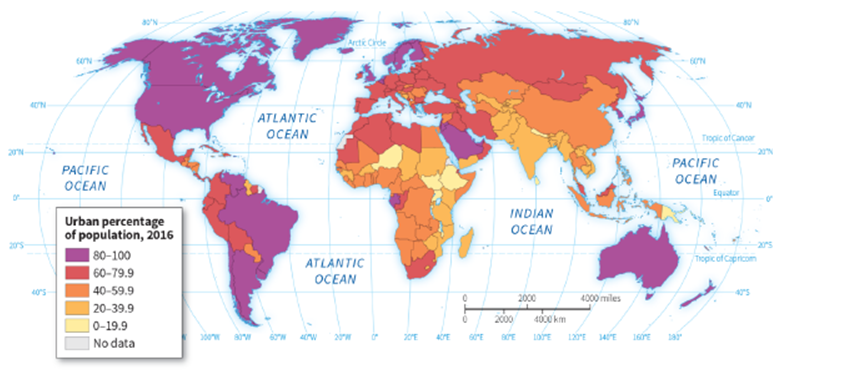
-The map shows "urban percentage of population," which shows all of the following EXCEPT:
A) lowest levels of urbanization being in Asia and Africa
B) urban and rural countries
C) varying rates of urbanization
D) the majority of the world's population living in rural regions
Question
-According to the map, which African country has the mostly highly urbanized population?
A) Uganda
B) South Africa
C) Gabon
D) Madagascar
Question
-Which region on the map is the LEAST urbanized?
A) North America
B) Europe
C) South America
D) East Asia
Question
-The U.S. Census Bureau defines a city as a densely populated area with a minimum of _____ inhabitants.
A) 1000
B) 2500
C) 50,000
D) 100,000
Question
-In South Africa, any settlement with a minimum of _____ people is considered a city.
A) 500
B) 5000
C) 50,000
D) 500,000
Question
Question
Question
Question
Question
Question
Question
Question
Question
Question
Question
Question
Question
Question
Question
Question
Question
Question
Question
Question
Question
Question
Question
Question

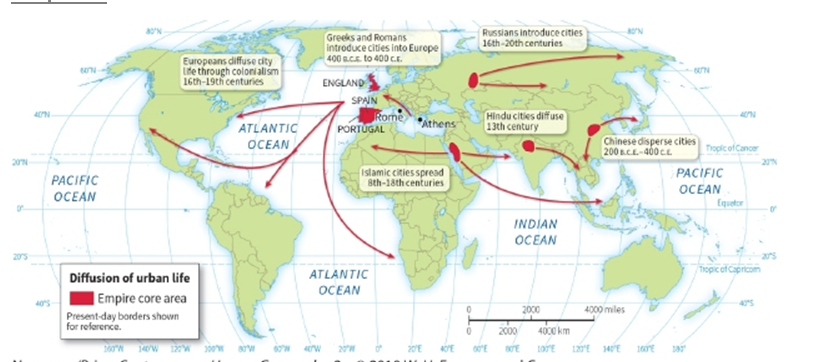
-According to the map, the world's first cities rose on all of the following continents EXCEPT:
A) South America
B) Australia
C) Africa
D) Asia
Question
-The map shows that the Nile Valley hearth is located in modern-day _____, while the Huang Ho hearth is located in modern-day _____.
A) Libya; Japan
B) Tunisia; Iraq
C) Mexico; Peru
D) Egypt; China
Question
Question
Question
Question
Question
Question
Question
Question
Question
Question
Question
Question
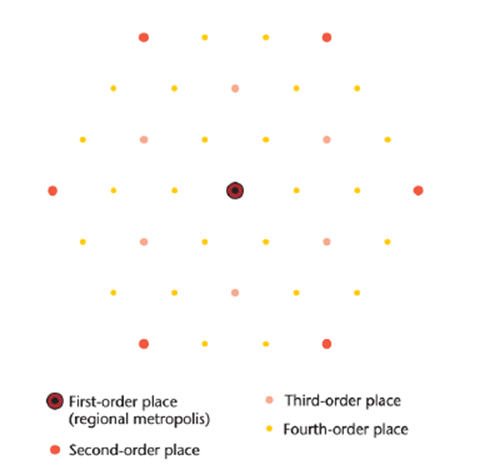
-The geographer who developed central-place theory, as depicted in the figure, was:
A) Christaller
B) von Thünen
C) Meinig
D) Olds
Question
-Which conclusion is NOT justified by the model shown here?
A) The primary geometric pattern of central-place theory is the hexagon.
B) The primary, or largest, city within the region drives the location of secondary and smaller cities.
C) Transportation routes between second-order places often travel through the largest regional metropolis.
D) Third- and fourth-order places are found farther out from the regional metropolis than second-order places.
Question
Question
Question
Question
Question
Question
Question
Question
Question
Question
Question
Question
Question
Question
Question
Question
Question
Question
Question
Question
Question
Question
Question
Question
Question
Question
Question
Question
Question
Question
Question
Question
Question

Unlock Deck
Sign up to unlock the cards in this deck!
Unlock Deck
Unlock Deck
1/150

Play

Full screen (f)
Deck 10: Urban Geography: A World of Cities
1
Assume that the 2 million years that humankind has spent on Earth is a 24-hour day. At approximately what time did settlements of more than a few hundred people come into being?
A) 9:00
B) 1:00 P.M.
C) 6:30 P.M.
D) 11:30 P.M.
A) 9:00
B) 1:00 P.M.
C) 6:30 P.M.
D) 11:30 P.M.
D
2
Assume that the 2 million years that humankind has spent on Earth is a 24-hour day. At approximately what time did towns and cities come into being?
A) 9:00
B) 1:00 P.M.
C) 11:30 P.M.
D) 11:57 P.M.
A) 9:00
B) 1:00 P.M.
C) 11:30 P.M.
D) 11:57 P.M.
D
3
Earth's population today is predominantly:
A) Rural
B) Suburban
C) Urban
D) found in the Southern Hemisphere
A) Rural
B) Suburban
C) Urban
D) found in the Southern Hemisphere
C
4
In which region do less than 40 percent of the people live in the urban regions of several countries?
A) Africa
B) North America
C) Latin America
D) Europe
A) Africa
B) North America
C) Latin America
D) Europe
Unlock Deck
Unlock for access to all 150 flashcards in this deck.
Unlock Deck
k this deck
5
-The map shows "urban percentage of population," which shows all of the following EXCEPT:
A) lowest levels of urbanization being in Asia and Africa
B) urban and rural countries
C) varying rates of urbanization
D) the majority of the world's population living in rural regions
Unlock Deck
Unlock for access to all 150 flashcards in this deck.
Unlock Deck
k this deck
6
-According to the map, which African country has the mostly highly urbanized population?
A) Uganda
B) South Africa
C) Gabon
D) Madagascar
Unlock Deck
Unlock for access to all 150 flashcards in this deck.
Unlock Deck
k this deck
7
-Which region on the map is the LEAST urbanized?
A) North America
B) Europe
C) South America
D) East Asia
Unlock Deck
Unlock for access to all 150 flashcards in this deck.
Unlock Deck
k this deck
8
-The U.S. Census Bureau defines a city as a densely populated area with a minimum of _____ inhabitants.
A) 1000
B) 2500
C) 50,000
D) 100,000
Unlock Deck
Unlock for access to all 150 flashcards in this deck.
Unlock Deck
k this deck
9
-In South Africa, any settlement with a minimum of _____ people is considered a city.
A) 500
B) 5000
C) 50,000
D) 500,000
Unlock Deck
Unlock for access to all 150 flashcards in this deck.
Unlock Deck
k this deck
10
Which statement is NOT correct concerning world urbanization and culture regions?
A) Regional comparisons are facilitated by readily available and comparable data.
B) Highly industrialized countries are more urbanized.
C) Less-developed countries are experiencing an urban explosion.
D) In the developing world, cities are affected by rural-to-urban migration.
A) Regional comparisons are facilitated by readily available and comparable data.
B) Highly industrialized countries are more urbanized.
C) Less-developed countries are experiencing an urban explosion.
D) In the developing world, cities are affected by rural-to-urban migration.
Unlock Deck
Unlock for access to all 150 flashcards in this deck.
Unlock Deck
k this deck
11
Newly urbanizing cities tend to undergo the demographic transition when:
A) multinational corporations set up headquarters in them
B) the flow of migrants from the hinterland increases by a minimum of 35 percent
C) women enter the workforce
D) foreign aid to the city decreases
A) multinational corporations set up headquarters in them
B) the flow of migrants from the hinterland increases by a minimum of 35 percent
C) women enter the workforce
D) foreign aid to the city decreases
Unlock Deck
Unlock for access to all 150 flashcards in this deck.
Unlock Deck
k this deck
12
Which of these generalizations about current urbanization is correct?
A) Highly industrialized countries have lower rates of urbanization than do less-developed countries.
B) Population growth in the next 30 years will continue to be greatest in the cities of more-developed countries.
C) Urban growth in less-developed countries is driven by rural-to-urban migration and higher-than-average fertility rates of recent migrants.
D) Urbanization around the world is driven by the growth of manufacturing in suburban areas.
A) Highly industrialized countries have lower rates of urbanization than do less-developed countries.
B) Population growth in the next 30 years will continue to be greatest in the cities of more-developed countries.
C) Urban growth in less-developed countries is driven by rural-to-urban migration and higher-than-average fertility rates of recent migrants.
D) Urbanization around the world is driven by the growth of manufacturing in suburban areas.
Unlock Deck
Unlock for access to all 150 flashcards in this deck.
Unlock Deck
k this deck
13
Which statement is true of urbanization?
A) Highly industrialized countries have lower rates of urbanization than less-developed countries.
B) Developing countries are rapidly urbanizing.
C) With prosperity and development comes the tendency for people to leave the city and move to the country.
D) In developing nations, the ratio of urban to rural population is decreasing dramatically.
A) Highly industrialized countries have lower rates of urbanization than less-developed countries.
B) Developing countries are rapidly urbanizing.
C) With prosperity and development comes the tendency for people to leave the city and move to the country.
D) In developing nations, the ratio of urban to rural population is decreasing dramatically.
Unlock Deck
Unlock for access to all 150 flashcards in this deck.
Unlock Deck
k this deck
14
In which region did the first cities appear?
A) Europe
B) Africa
C) the Middle East
D) South America
A) Europe
B) Africa
C) the Middle East
D) South America
Unlock Deck
Unlock for access to all 150 flashcards in this deck.
Unlock Deck
k this deck
15
In the earliest days of cities, what was the key distinction between city dwellers and rural dwellers?
A) City dwellers had lower birth and death rates.
B) All rural people were involved in agricultural production, but not all city people were.
C) Rural dwellers had better protection from the elements than did city dwellers.
D) City dwellers had better access to fresh water than did rural dwellers.
A) City dwellers had lower birth and death rates.
B) All rural people were involved in agricultural production, but not all city people were.
C) Rural dwellers had better protection from the elements than did city dwellers.
D) City dwellers had better access to fresh water than did rural dwellers.
Unlock Deck
Unlock for access to all 150 flashcards in this deck.
Unlock Deck
k this deck
16
Which is a necessary condition for the rise of cities?
A) socioeconomic stratification
B) lack of adequate food
C) burial of the dead
D) sewage systems
A) socioeconomic stratification
B) lack of adequate food
C) burial of the dead
D) sewage systems
Unlock Deck
Unlock for access to all 150 flashcards in this deck.
Unlock Deck
k this deck
17
The hydraulic civilization model is applicable to all of the following areas EXCEPT:
A) China
B) Egypt
C) Mesoamerica
D) Mesopotamia
A) China
B) Egypt
C) Mesoamerica
D) Mesopotamia
Unlock Deck
Unlock for access to all 150 flashcards in this deck.
Unlock Deck
k this deck
18
Wittfogel's hydraulic civilization model fits the development of urban civilizations in all of the following regions EXCEPT:
A) China
B) Egypt
C) Mesopotamia
D) the Ottoman Empire
A) China
B) Egypt
C) Mesopotamia
D) the Ottoman Empire
Unlock Deck
Unlock for access to all 150 flashcards in this deck.
Unlock Deck
k this deck
19
The hydraulic civilization model asserts that the development of _____ was the key reason for the rise of cities.
A) windmills
B) paper
C) irrigation systems
D) sanitary facilities
A) windmills
B) paper
C) irrigation systems
D) sanitary facilities
Unlock Deck
Unlock for access to all 150 flashcards in this deck.
Unlock Deck
k this deck
20
Two prerequisites for the support of nonfarmers in a city environment are:
A) a food surplus and a powerful army
B) a powerful army and a god-king
C) a god-king and control of a water supply
D) social stratification and a food surplus
A) a food surplus and a powerful army
B) a powerful army and a god-king
C) a god-king and control of a water supply
D) social stratification and a food surplus
Unlock Deck
Unlock for access to all 150 flashcards in this deck.
Unlock Deck
k this deck
21
The hydraulic civilization model of urban development suggests that _____ were the first urban dwellers.
A) technical specialists
B) ex-agriculturalists
C) an intellectual elite
D) a religious elite
A) technical specialists
B) ex-agriculturalists
C) an intellectual elite
D) a religious elite
Unlock Deck
Unlock for access to all 150 flashcards in this deck.
Unlock Deck
k this deck
22
The earliest cities arose along all of the following major rivers EXCEPT the:
A) Indus
B) Yellow (Huang Ho)
C) Nile
D) Volga
A) Indus
B) Yellow (Huang Ho)
C) Nile
D) Volga
Unlock Deck
Unlock for access to all 150 flashcards in this deck.
Unlock Deck
k this deck
23
When agricultural villages first arose 10,000 years ago, they were primarily organized by:
A) language
B) religion
C) crop type
D) kinship
A) language
B) religion
C) crop type
D) kinship
Unlock Deck
Unlock for access to all 150 flashcards in this deck.
Unlock Deck
k this deck
24
Which was NOT an urban hearth area?
A) coastal Peru
B) central North America
C) Mesopotamia
D) the Indus River valley
A) coastal Peru
B) central North America
C) Mesopotamia
D) the Indus River valley
Unlock Deck
Unlock for access to all 150 flashcards in this deck.
Unlock Deck
k this deck
25
In China, cities first appeared in the:
A) northwest
B) valley of the Yellow River
C) valley of the Indus
D) mountains of the southwest
A) northwest
B) valley of the Yellow River
C) valley of the Indus
D) mountains of the southwest
Unlock Deck
Unlock for access to all 150 flashcards in this deck.
Unlock Deck
k this deck
26
Which of the following is considered by some archeologists the oldest real city, dating 9000
A) Giza
B) Çatalhöyük
C) Samara
D) Jericho
A) Giza
B) Çatalhöyük
C) Samara
D) Jericho
Unlock Deck
Unlock for access to all 150 flashcards in this deck.
Unlock Deck
k this deck
27
The oldest urban hearth area is:
A) Mesoamerica
B) the Nile Valley
C) Huang Ho
D) Mesopotamia
A) Mesoamerica
B) the Nile Valley
C) Huang Ho
D) Mesopotamia
Unlock Deck
Unlock for access to all 150 flashcards in this deck.
Unlock Deck
k this deck
28
Which is NOT an attribute of a cosmomagical city?
A) The city center is considered the center of the known world and therefore sacred.
B) It is oriented toward the four cardinal directions of north, south, east, and west.
C) It is ruled by a priestly class with full power to wage war.
D) It is shaped to resemble the universe.
A) The city center is considered the center of the known world and therefore sacred.
B) It is oriented toward the four cardinal directions of north, south, east, and west.
C) It is ruled by a priestly class with full power to wage war.
D) It is shaped to resemble the universe.
Unlock Deck
Unlock for access to all 150 flashcards in this deck.
Unlock Deck
k this deck
29
Located at the center of a cosmomagical city is the:
A) royal palace
B) observatory
C) water source
D) axis mundi
A) royal palace
B) observatory
C) water source
D) axis mundi
Unlock Deck
Unlock for access to all 150 flashcards in this deck.
Unlock Deck
k this deck
30
Which is NOT an example of a type of axis mundi?
A) ziggurat
B) pyramid
C) temple
D) waterfall
A) ziggurat
B) pyramid
C) temple
D) waterfall
Unlock Deck
Unlock for access to all 150 flashcards in this deck.
Unlock Deck
k this deck
31
Why were cosmomagical cities oriented in the four cardinal directions?
A) to express the dominance of the city
B) the alignment would ensure harmony with the universe
C) maintain harmony between human and spiritual worlds
D) to replicate the world of the gods
A) to express the dominance of the city
B) the alignment would ensure harmony with the universe
C) maintain harmony between human and spiritual worlds
D) to replicate the world of the gods
Unlock Deck
Unlock for access to all 150 flashcards in this deck.
Unlock Deck
k this deck
32
In ancient cities, the axis mundi was symbolized by an elevated structure. Which combination is NOT correct?
A) Mesopotamia/ziggurat
B) Mesoamerica/pyramid
C) China/temple-palace
D) Japan/Confucian shrine
A) Mesopotamia/ziggurat
B) Mesoamerica/pyramid
C) China/temple-palace
D) Japan/Confucian shrine
Unlock Deck
Unlock for access to all 150 flashcards in this deck.
Unlock Deck
k this deck
33
-According to the map, the world's first cities rose on all of the following continents EXCEPT:
A) South America
B) Australia
C) Africa
D) Asia
Unlock Deck
Unlock for access to all 150 flashcards in this deck.
Unlock Deck
k this deck
34
-The map shows that the Nile Valley hearth is located in modern-day _____, while the Huang Ho hearth is located in modern-day _____.
A) Libya; Japan
B) Tunisia; Iraq
C) Mexico; Peru
D) Egypt; China
Unlock Deck
Unlock for access to all 150 flashcards in this deck.
Unlock Deck
k this deck
35
The Angkor Thom is an example of:
A) early suburbanization
B) cosmomagical cities
C) edge cities
D) elitist landscapes
A) early suburbanization
B) cosmomagical cities
C) edge cities
D) elitist landscapes
Unlock Deck
Unlock for access to all 150 flashcards in this deck.
Unlock Deck
k this deck
36
The diffusion of cities and an urban mode of living were greatly advanced by:
A) the diffusion of Christianity
B) the clearing of land for large-scale farming
C) imperial expansion
D) the invention of the locomotive
A) the diffusion of Christianity
B) the clearing of land for large-scale farming
C) imperial expansion
D) the invention of the locomotive
Unlock Deck
Unlock for access to all 150 flashcards in this deck.
Unlock Deck
k this deck
37
Western civilization and Western cities both trace their roots back to ancient:
A) Rome
B) Greece
C) China
D) Turkey
A) Rome
B) Greece
C) China
D) Turkey
Unlock Deck
Unlock for access to all 150 flashcards in this deck.
Unlock Deck
k this deck
38
Which factor did the ancient Romans keep uppermost in their minds when choosing city sites?
A) Water
B) Transportation
C) Defense
D) language spoken by natives
A) Water
B) Transportation
C) Defense
D) language spoken by natives
Unlock Deck
Unlock for access to all 150 flashcards in this deck.
Unlock Deck
k this deck
39
The Aztec capital of Tenochtitlán is today known as:
A) Managua
B) Mexico City
C) Juarez
D) San Diego
A) Managua
B) Mexico City
C) Juarez
D) San Diego
Unlock Deck
Unlock for access to all 150 flashcards in this deck.
Unlock Deck
k this deck
40
Tenochtitlán was the _____ capital.
A) Cherokee
B) Mayan
C) Aztec
D) Incan
A) Cherokee
B) Mayan
C) Aztec
D) Incan
Unlock Deck
Unlock for access to all 150 flashcards in this deck.
Unlock Deck
k this deck
41
The connection between agricultural innovations and the rise of cities is referred to as:
A) the urban revolution
B) the green revolution
C) the industrial revolution
D) the second urban revolution
A) the urban revolution
B) the green revolution
C) the industrial revolution
D) the second urban revolution
Unlock Deck
Unlock for access to all 150 flashcards in this deck.
Unlock Deck
k this deck
42
The second urban revolution came about primarily as a result of:
A) the transfer of private lands into public hands
B) increased colonial efforts
C) political revolution in Europe
D) innovations in mining and manufacturing
A) the transfer of private lands into public hands
B) increased colonial efforts
C) political revolution in Europe
D) innovations in mining and manufacturing
Unlock Deck
Unlock for access to all 150 flashcards in this deck.
Unlock Deck
k this deck
43
In the developing capitalist city, which type of urban land would be considered to have the lowest value?
A) land in the city center
B) land along a major thoroughfare
C) land close to a river or harbor
D) land in the countryside
A) land in the city center
B) land along a major thoroughfare
C) land close to a river or harbor
D) land in the countryside
Unlock Deck
Unlock for access to all 150 flashcards in this deck.
Unlock Deck
k this deck
44
Gender roles that assign men to the public space and women to private/home space came about during which period?
A) Ancient
B) medieval
C) Renaissance
D) capitalist
A) Ancient
B) medieval
C) Renaissance
D) capitalist
Unlock Deck
Unlock for access to all 150 flashcards in this deck.
Unlock Deck
k this deck
45
What is at the center of the capitalist city?
A) town hall
B) cathedral
C) central park
D) buildings dedicated to business
A) town hall
B) cathedral
C) central park
D) buildings dedicated to business
Unlock Deck
Unlock for access to all 150 flashcards in this deck.
Unlock Deck
k this deck
46
-The geographer who developed central-place theory, as depicted in the figure, was:
A) Christaller
B) von Thünen
C) Meinig
D) Olds
Unlock Deck
Unlock for access to all 150 flashcards in this deck.
Unlock Deck
k this deck
47
-Which conclusion is NOT justified by the model shown here?
A) The primary geometric pattern of central-place theory is the hexagon.
B) The primary, or largest, city within the region drives the location of secondary and smaller cities.
C) Transportation routes between second-order places often travel through the largest regional metropolis.
D) Third- and fourth-order places are found farther out from the regional metropolis than second-order places.
Unlock Deck
Unlock for access to all 150 flashcards in this deck.
Unlock Deck
k this deck
48
Central-place theory attempts to understand:
A) the placement of the axis-mundi
B) the organization of cosmological cities
C) how city centers are used
D) why cities are located where they are
A) the placement of the axis-mundi
B) the organization of cosmological cities
C) how city centers are used
D) why cities are located where they are
Unlock Deck
Unlock for access to all 150 flashcards in this deck.
Unlock Deck
k this deck
49
According to central-place theory, which shape BEST predicts the location of cities?
A) Circle
B) Square
C) triangle
D) hexagon
A) Circle
B) Square
C) triangle
D) hexagon
Unlock Deck
Unlock for access to all 150 flashcards in this deck.
Unlock Deck
k this deck
50
The average person will travel 10 miles to buy a new pair of shoes. According to Christaller, 10 miles would be considered the:
A) threshold
B) Range
C) central place
D) maximin statistic
A) threshold
B) Range
C) central place
D) maximin statistic
Unlock Deck
Unlock for access to all 150 flashcards in this deck.
Unlock Deck
k this deck
51
The range of a good is the:
A) number of people required to make its provision economically feasible
B) average profit margin required to make production economically feasible
C) average maximum distance people are willing to travel to purchase it
D) average minimum distance people are willing to travel to purchase it
A) number of people required to make its provision economically feasible
B) average profit margin required to make production economically feasible
C) average maximum distance people are willing to travel to purchase it
D) average minimum distance people are willing to travel to purchase it
Unlock Deck
Unlock for access to all 150 flashcards in this deck.
Unlock Deck
k this deck
52
Which would have the greatest threshold?
A) gas station
B) law office
C) chiropractic office
D) university
A) gas station
B) law office
C) chiropractic office
D) university
Unlock Deck
Unlock for access to all 150 flashcards in this deck.
Unlock Deck
k this deck
53
Which of the following did Walter Christaller believe people would travel great distances for?
A) purchase household goods
B) visit a cardiologist
C) go to the grocery store
D) car repair
A) purchase household goods
B) visit a cardiologist
C) go to the grocery store
D) car repair
Unlock Deck
Unlock for access to all 150 flashcards in this deck.
Unlock Deck
k this deck
54
The California city that took over San Francisco's position as the leading port city of the region is:
A) San Bruno
B) Milpitas
C) Millbrae
D) Oakland
A) San Bruno
B) Milpitas
C) Millbrae
D) Oakland
Unlock Deck
Unlock for access to all 150 flashcards in this deck.
Unlock Deck
k this deck
55
What accounts for most of the recent growth in urban population?
A) rural-to-urban migration
B) natural population increase
C) reverse migration
D) channelization
A) rural-to-urban migration
B) natural population increase
C) reverse migration
D) channelization
Unlock Deck
Unlock for access to all 150 flashcards in this deck.
Unlock Deck
k this deck
56
Which factor accounts for most of the historic growth of cities?
A) rural-to-urban migration
B) natural population increase
C) reverse migration
D) urban-to-urban migration
A) rural-to-urban migration
B) natural population increase
C) reverse migration
D) urban-to-urban migration
Unlock Deck
Unlock for access to all 150 flashcards in this deck.
Unlock Deck
k this deck
57
Future urban growth in Africa and Asia will likely come from:
A) rural-to-urban migration
B) natural population increase
C) reverse migration
D) channelization
A) rural-to-urban migration
B) natural population increase
C) reverse migration
D) channelization
Unlock Deck
Unlock for access to all 150 flashcards in this deck.
Unlock Deck
k this deck
58
The growth of cities is fueled by all of the following phenomena EXCEPT:
A) rural-to-urban migration
B) natural population increase
C) reverse migration
D) urban-to-urban migration
A) rural-to-urban migration
B) natural population increase
C) reverse migration
D) urban-to-urban migration
Unlock Deck
Unlock for access to all 150 flashcards in this deck.
Unlock Deck
k this deck
59
In which country did the Cultural Revolution force people out of cities and into the countryside?
A) England
B) India
C) the United States
D) China
A) England
B) India
C) the United States
D) China
Unlock Deck
Unlock for access to all 150 flashcards in this deck.
Unlock Deck
k this deck
60
The Carioca landscapes are located in:
A) Uruguay
B) Brazil
C) Argentina
D) Peru
A) Uruguay
B) Brazil
C) Argentina
D) Peru
Unlock Deck
Unlock for access to all 150 flashcards in this deck.
Unlock Deck
k this deck
61
In 1960 the capital of Brazil was relocated from _____ to _____.
A) Rio de Janeiro; Brasília
B) Brasilia; Rio de Janeiro
C) São Paulo; Fortaleza
D) Belo Horizonte; Porto Alegre
A) Rio de Janeiro; Brasília
B) Brasilia; Rio de Janeiro
C) São Paulo; Fortaleza
D) Belo Horizonte; Porto Alegre
Unlock Deck
Unlock for access to all 150 flashcards in this deck.
Unlock Deck
k this deck
62
Why did the Brazilian government relocate its capital from Rio de Janeiro to Brasilia in 1960?
A) to provide a more welcoming home for foreign laborers
B) to move the seat of government to the border with Bolivia
C) to increase its military power
D) to move the population away from the southeastern coast
A) to provide a more welcoming home for foreign laborers
B) to move the seat of government to the border with Bolivia
C) to increase its military power
D) to move the population away from the southeastern coast
Unlock Deck
Unlock for access to all 150 flashcards in this deck.
Unlock Deck
k this deck
63
Which is NOT an element of Carioca culture?
A) cultural homogeneity
B) cosmopolitanism
C) outdoor living
D) streets and parks
A) cultural homogeneity
B) cosmopolitanism
C) outdoor living
D) streets and parks
Unlock Deck
Unlock for access to all 150 flashcards in this deck.
Unlock Deck
k this deck
64
Which city is home to the world's largest urban forest?
A) New York
B) Rio de Janeiro
C) Paris
D) Moscow
A) New York
B) Rio de Janeiro
C) Paris
D) Moscow
Unlock Deck
Unlock for access to all 150 flashcards in this deck.
Unlock Deck
k this deck
65
Which is NOT a common problem in the urban centers of the developing world?
A) Unemployment rates are very high.
B) Migrants from rural areas are not reproducing at a rate that will be able to sustain the population.
C) Housing and infrastructure cannot be built fast enough to keep up with population increase.
D) Sewage systems are insufficient to handle the burgeoning population.
A) Unemployment rates are very high.
B) Migrants from rural areas are not reproducing at a rate that will be able to sustain the population.
C) Housing and infrastructure cannot be built fast enough to keep up with population increase.
D) Sewage systems are insufficient to handle the burgeoning population.
Unlock Deck
Unlock for access to all 150 flashcards in this deck.
Unlock Deck
k this deck
66
Which is NOT a problem faced by migrants to cities in developing nations?
A) Unemployment rates are often high.
B) Local governments strictly enforce one-child fertility policies.
C) Affordable housing is rare or nonexistent.
D) Water and sewage systems cannot handle the influx of migrants.
A) Unemployment rates are often high.
B) Local governments strictly enforce one-child fertility policies.
C) Affordable housing is rare or nonexistent.
D) Water and sewage systems cannot handle the influx of migrants.
Unlock Deck
Unlock for access to all 150 flashcards in this deck.
Unlock Deck
k this deck
67
A city such as London that dominates the economic, political, and cultural life of its country is categorized as this type of city:
A) Leading
B) Capital
C) primate
D) Prime
A) Leading
B) Capital
C) primate
D) Prime
Unlock Deck
Unlock for access to all 150 flashcards in this deck.
Unlock Deck
k this deck
68
According to the text, which is NOT an example of a primate city?
A) London
B) Paris
C) Munich
D) Buenos Aires
A) London
B) Paris
C) Munich
D) Buenos Aires
Unlock Deck
Unlock for access to all 150 flashcards in this deck.
Unlock Deck
k this deck
69
Which is NOT a "legacy city"?
A) Las Vegas
B) New York
C) Chicago
D) San Francisco
A) Las Vegas
B) New York
C) Chicago
D) San Francisco
Unlock Deck
Unlock for access to all 150 flashcards in this deck.
Unlock Deck
k this deck
70
Which is NOT an "aspirational city"?
A) Chicago
B) Phoenix
C) Houston
D) Raleigh
A) Chicago
B) Phoenix
C) Houston
D) Raleigh
Unlock Deck
Unlock for access to all 150 flashcards in this deck.
Unlock Deck
k this deck
71
Which is NOT considered an automobile city?
A) Miami
B) Atlanta
C) New York
D) Phoenix
A) Miami
B) Atlanta
C) New York
D) Phoenix
Unlock Deck
Unlock for access to all 150 flashcards in this deck.
Unlock Deck
k this deck
72
Which of the following is NOT a global city?:
A) Chicago
B) Hong Kong
C) Moscow
D) Seattle
A) Chicago
B) Hong Kong
C) Moscow
D) Seattle
Unlock Deck
Unlock for access to all 150 flashcards in this deck.
Unlock Deck
k this deck
73
According to Sassen, the world's three global cities were:
A) London, Paris, and Munich
B) New York, Los Angeles, and Beijing
C) Chicago, Geneva, and Moscow
D) Tokyo, London, and New York
A) London, Paris, and Munich
B) New York, Los Angeles, and Beijing
C) Chicago, Geneva, and Moscow
D) Tokyo, London, and New York
Unlock Deck
Unlock for access to all 150 flashcards in this deck.
Unlock Deck
k this deck
74
Contemporary definitions of a "global city" focus on all of the following characteristics EXCEPT:
A) economic might
B) political power
C) population
D) information exchange
A) economic might
B) political power
C) population
D) information exchange
Unlock Deck
Unlock for access to all 150 flashcards in this deck.
Unlock Deck
k this deck
75
The highest concentration of high-net-worth individuals in the world can be found in:
A) London
B) Hong Kong
C) Paris
D) New York
A) London
B) Hong Kong
C) Paris
D) New York
Unlock Deck
Unlock for access to all 150 flashcards in this deck.
Unlock Deck
k this deck
76
Which is an indicator that the urban wealthy have in some ways "opted out" of the global city?
A) a lack of public parks
B) the rise of gated communities
C) the tendency of the wealthy to flee to rural locations
D) the shrinking number of wealthy people in global cities
A) a lack of public parks
B) the rise of gated communities
C) the tendency of the wealthy to flee to rural locations
D) the shrinking number of wealthy people in global cities
Unlock Deck
Unlock for access to all 150 flashcards in this deck.
Unlock Deck
k this deck
77
All of the following are synonyms for squatter settlements EXCEPT:
A) favela
B) shantytown
C) barriada
D) ghetto
A) favela
B) shantytown
C) barriada
D) ghetto
Unlock Deck
Unlock for access to all 150 flashcards in this deck.
Unlock Deck
k this deck
78
All of the following are part of the UN definition of a slum household EXCEPT:
A) lack of an adequate physical structure to protect people from extreme climatic conditions
B) location on the outskirts of a major city
C) insufficient access to water
D) lack of access to sanitation
A) lack of an adequate physical structure to protect people from extreme climatic conditions
B) location on the outskirts of a major city
C) insufficient access to water
D) lack of access to sanitation
Unlock Deck
Unlock for access to all 150 flashcards in this deck.
Unlock Deck
k this deck
79
Which is NOT true of shantytowns?
A) They are also called favelas or squatter settlements.
B) They often begin as collections of crude shacks constructed from scrap materials.
C) They receive government subsidies for the provision of sanitation systems.
D) Electricity is often bootlegged into shantytowns.
A) They are also called favelas or squatter settlements.
B) They often begin as collections of crude shacks constructed from scrap materials.
C) They receive government subsidies for the provision of sanitation systems.
D) Electricity is often bootlegged into shantytowns.
Unlock Deck
Unlock for access to all 150 flashcards in this deck.
Unlock Deck
k this deck
80
Which is NOT true of cities in comparison to suburbs?
A) Cities are hotter.
B) Cities receive more rainfall.
C) Cities have lower pollution.
D) Cities have more fog and cloudiness.
A) Cities are hotter.
B) Cities receive more rainfall.
C) Cities have lower pollution.
D) Cities have more fog and cloudiness.
Unlock Deck
Unlock for access to all 150 flashcards in this deck.
Unlock Deck
k this deck
Unlock Deck
Unlock for access to all 150 flashcards in this deck.






