







 Chat with AI

Deck 5: Geographies of Race and Ethnicity: Melting Pot or Salad Bowl
Full screen (f)

Question

Question
Question
Question
Question
Question
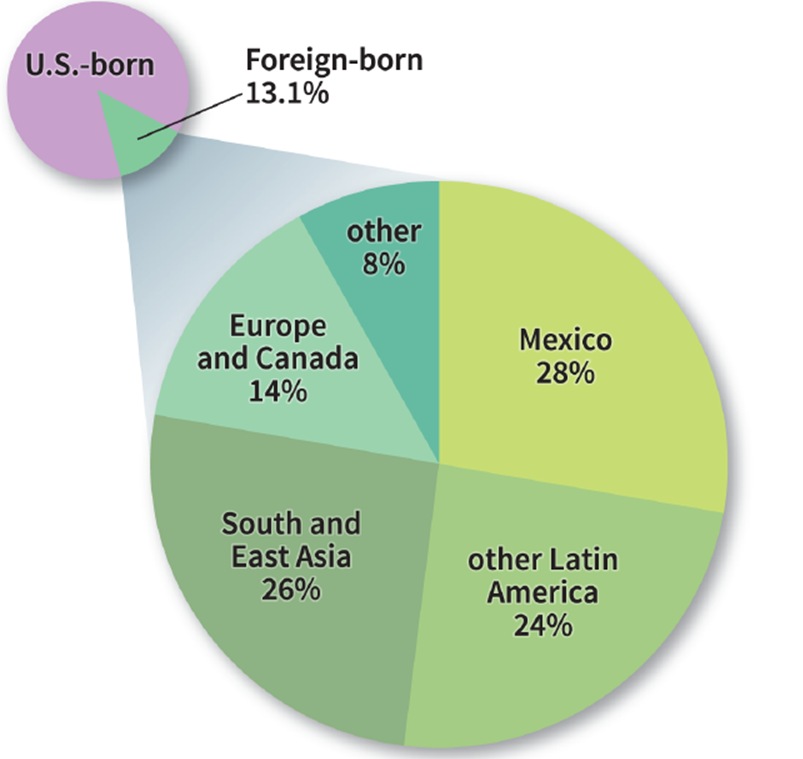
-Based on the figure shown here, which conclusion would NOT be correct?
A) Over 13 percent of the U.S. population is foreign-born.
B) More than half of the U.S. foreign-born population was born in Latin America.
C) Foreign-born U.S. residents from Mexico outnumber foreign-born residents from other Latin American countries.
D) If the total U.S. population in 2010 was 304.3 million, then approximately 82 million of those people were not born in the United States.
Question
-According to the chart, if the U.S. population in 2010 was 304.3 million, then approximately _____ million of those people were not born in the United States.
A) 18
B) 24
C) 39
D) 46
Question
-According to the chart, if the U.S. population in 2010 was 304.3 million, then approximately _____ million of those people were born in Latin American.
A) 9
B) 14
C) 17
D) 21
Question
-According to the chart, if the U.S. population in 2010 was 304.3 million, then approximately _____ million of those people were born in Asia.
A) 4
B) 10
C) 18
D) 23
Question
-The chart shows that the majority of the foreign-born population of the United States comes from:
A) Europe
B) Latin America and Mexico
C) Australia and Canada
D) South and East Asia
Question
Question
Question
Question
Question
Question
Question
Question
Question
Question
Question
Question
Question
Question
Question
Question
Question
Question
Question
Question
Question
Question
Question
Question
Question
Question
Question
Question
Question
Question
Question
Question
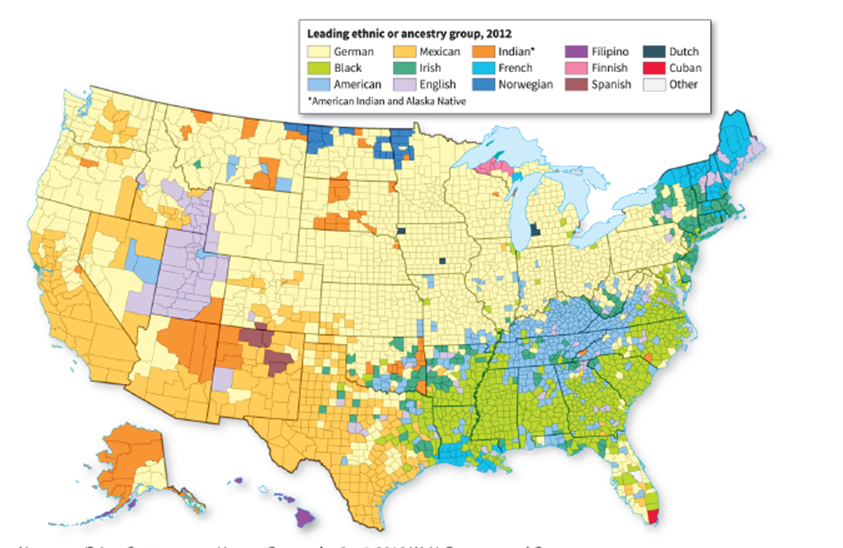
-What is the ethnic homeland in northeastern Arizona, southeastern Utah, and northwestern New Mexico?
A) German homeland
B) Black Belt
C) Native American homeland
D) French homeland
Question
-What is the most likely homeland for blacks in the United States?
A) the Southeast
B) the Northeast
C) the Midwest
D) California
Question
-Which of the following states has French ethnic islands?
A) Wisconsin
B) Utah
C) Louisianna
D) Iowa
Question
-Which of the following states is part of the Mexican homeland?
A) Florida
B) North Dakota
C) Oregon
D) Texas
Question
-What is the one state with a small Cuban homeland?
A) California
B) Florida
C) Nevada
D) Wyoming
Question
-According to the map, which state is NOT a part of the American Indian homeland?
A) Arizona
B) Nevada
C) Utah
D) New Mexico
Question
Question
Question
Question
Question
Question
Question
Question
Question
Question
Question
Question
Question
Question
Question
Question
Question
Question
Question
Question
Question
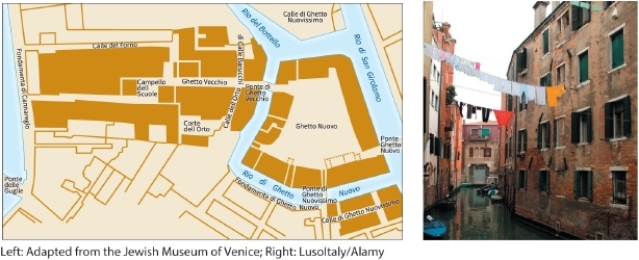
-In which city will you find the sixteenth-century ghetto mapped here?
A) Rome
B) Venice
C) Athens
D) Jerusalem
Question
Question
Question
Question
Question
Question
Question
Question
Question
Question
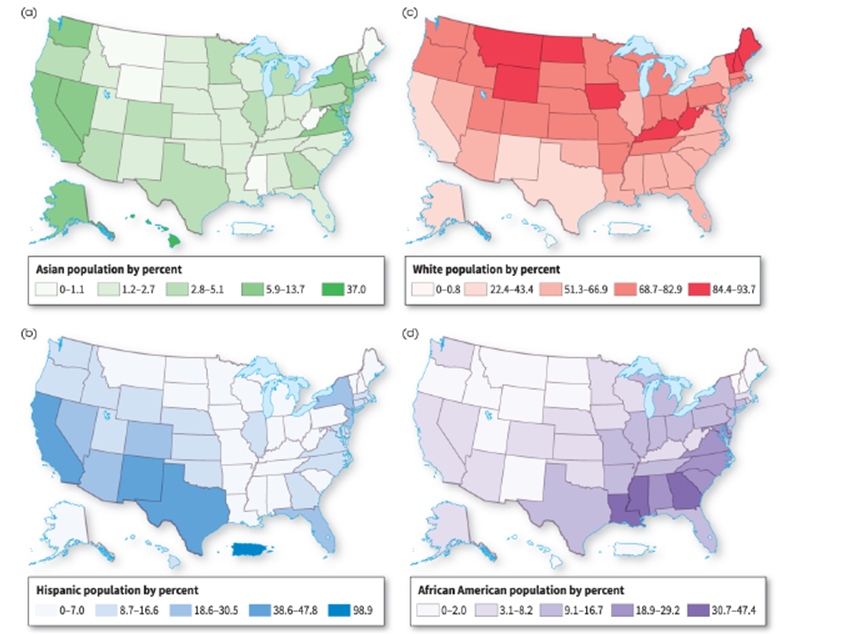
-According to the map, which part of the United States has the heaviest concentration of Hispanics?
A) the Southwest
B) the Midwest
C) the Middle Atlantic
D) New England
Question
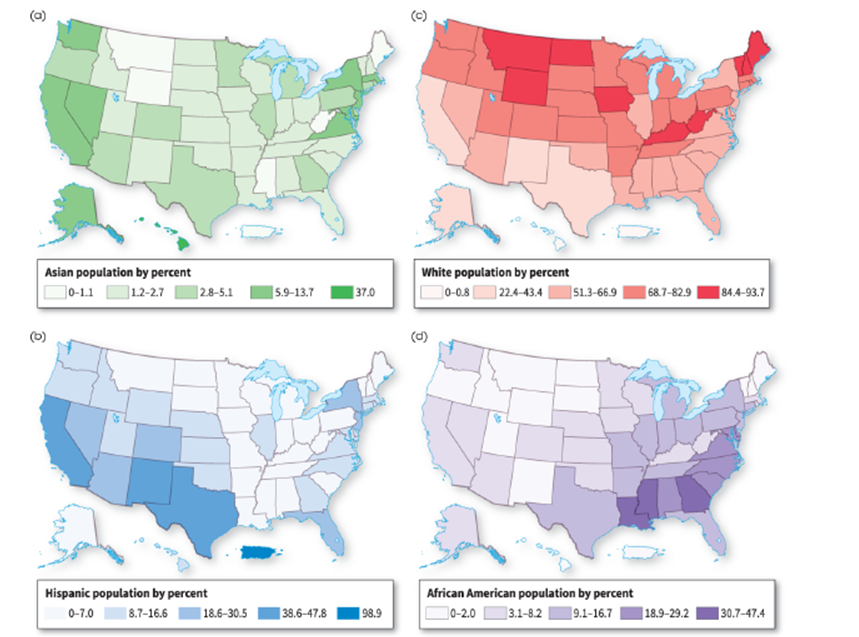
-According to the map, which part of the United States has the heaviest concentration of African Americans?
A) the South
B) the Midwest
C) the Middle Atlantic
D) New England
Question
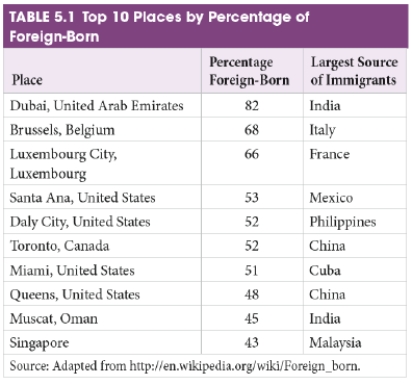
-Which European City has the highest percentage of foreign-born residents?
A) Luxembourg City
B) Dubai
C) Brussels
D) Toronto

Unlock Deck
Sign up to unlock the cards in this deck!
Unlock Deck
Unlock Deck
1/222

Play

Full screen (f)
Deck 5: Geographies of Race and Ethnicity: Melting Pot or Salad Bowl
1
In recent years, Nebraska has become an attractive migration prospect for people from:
A) Mexico
B) Colombia
C) China
D) Korea
A) Mexico
B) Colombia
C) China
D) Korea
A
2
Wilber, Nebraska, was settled by immigrants from which country?
A) Holland
B) Italy
C) Sweden
D) Czechoslovakia
A) Holland
B) Italy
C) Sweden
D) Czechoslovakia
D
3
The one-drop rule of the United States of the early twentieth century was used to identify people as:
A) Asian
B) Native American
C) African American
D) Hispanic/Latino
A) Asian
B) Native American
C) African American
D) Hispanic/Latino
C
4
The one-drop rule was designed to prevent:
A) migration
B) out-of-wedlock births
C) diplomatic difficulties with other rations
D) intermarriage between races
A) migration
B) out-of-wedlock births
C) diplomatic difficulties with other rations
D) intermarriage between races
Unlock Deck
Unlock for access to all 222 flashcards in this deck.
Unlock Deck
k this deck
5
Which statement BEST summarizes the current approach of the U.S. Census Bureau to self-definitions of race?
A) Each person recorded by the census must choose one race with which to identify.
B) The U.S. Census Bureau eliminated "race" as a category in the 2010 census.
C) The U.S. Census Bureau considers "race" and "ethnicity" as equivalent.
D) Individuals may choose to identify themselves with more than one racial group.
A) Each person recorded by the census must choose one race with which to identify.
B) The U.S. Census Bureau eliminated "race" as a category in the 2010 census.
C) The U.S. Census Bureau considers "race" and "ethnicity" as equivalent.
D) Individuals may choose to identify themselves with more than one racial group.
Unlock Deck
Unlock for access to all 222 flashcards in this deck.
Unlock Deck
k this deck
6
-Based on the figure shown here, which conclusion would NOT be correct?
A) Over 13 percent of the U.S. population is foreign-born.
B) More than half of the U.S. foreign-born population was born in Latin America.
C) Foreign-born U.S. residents from Mexico outnumber foreign-born residents from other Latin American countries.
D) If the total U.S. population in 2010 was 304.3 million, then approximately 82 million of those people were not born in the United States.
Unlock Deck
Unlock for access to all 222 flashcards in this deck.
Unlock Deck
k this deck
7
-According to the chart, if the U.S. population in 2010 was 304.3 million, then approximately _____ million of those people were not born in the United States.
A) 18
B) 24
C) 39
D) 46
Unlock Deck
Unlock for access to all 222 flashcards in this deck.
Unlock Deck
k this deck
8
-According to the chart, if the U.S. population in 2010 was 304.3 million, then approximately _____ million of those people were born in Latin American.
A) 9
B) 14
C) 17
D) 21
Unlock Deck
Unlock for access to all 222 flashcards in this deck.
Unlock Deck
k this deck
9
-According to the chart, if the U.S. population in 2010 was 304.3 million, then approximately _____ million of those people were born in Asia.
A) 4
B) 10
C) 18
D) 23
Unlock Deck
Unlock for access to all 222 flashcards in this deck.
Unlock Deck
k this deck
10
-The chart shows that the majority of the foreign-born population of the United States comes from:
A) Europe
B) Latin America and Mexico
C) Australia and Canada
D) South and East Asia
Unlock Deck
Unlock for access to all 222 flashcards in this deck.
Unlock Deck
k this deck
11
Which does NOT affect definitions of race and ethnicity?
A) biological genus and species definitions
B) your own self-definition
C) the way others see you
D) the way society and government treat you
A) biological genus and species definitions
B) your own self-definition
C) the way others see you
D) the way society and government treat you
Unlock Deck
Unlock for access to all 222 flashcards in this deck.
Unlock Deck
k this deck
12
Which factor does NOT play a role in a person's understanding of his or her race and ethnicity?
A) their self-definition
B) their racial classification by the United Nations
C) the way others see them
D) the way society treats them
A) their self-definition
B) their racial classification by the United Nations
C) the way others see them
D) the way society treats them
Unlock Deck
Unlock for access to all 222 flashcards in this deck.
Unlock Deck
k this deck
13
Which statement about race and ethnicity is CORRECT?
A) Race refers to skin color, while ethnicity refers to the country of origin of one's ancestors.
B) Race refers to genetically significant differences between populations while ethnicity refers to people of common ancestry and cultural traditions.
C) There is no significant difference between race and ethnicity, and the terms can be used interchangeably.
D) Race is a biological fact, while ethnicity disappears once an immigrant group assimilates.
A) Race refers to skin color, while ethnicity refers to the country of origin of one's ancestors.
B) Race refers to genetically significant differences between populations while ethnicity refers to people of common ancestry and cultural traditions.
C) There is no significant difference between race and ethnicity, and the terms can be used interchangeably.
D) Race is a biological fact, while ethnicity disappears once an immigrant group assimilates.
Unlock Deck
Unlock for access to all 222 flashcards in this deck.
Unlock Deck
k this deck
14
The last country in the Americas to ban slavery was:
A) the United States
B) Brazil
C) Honduras
D) Mexico
A) the United States
B) Brazil
C) Honduras
D) Mexico
Unlock Deck
Unlock for access to all 222 flashcards in this deck.
Unlock Deck
k this deck
15
The belief that human capabilities are determined by racial classification and that some races are superior to others is:
A) prejudice
B) cultural maladaptation
C) racism
D) acculturation
A) prejudice
B) cultural maladaptation
C) racism
D) acculturation
Unlock Deck
Unlock for access to all 222 flashcards in this deck.
Unlock Deck
k this deck
16
People who share a common ancestry and cultural tradition compose a(n):
A) race
B) tribunal
C) ethnic group
D) ethnoburb
A) race
B) tribunal
C) ethnic group
D) ethnoburb
Unlock Deck
Unlock for access to all 222 flashcards in this deck.
Unlock Deck
k this deck
17
Which is an example of racism?
A) Irish Americans show their pride by attending the St. Patrick's Day parade in New York City.
B) The Nazis believed that they were a superior race and that all other races were inferior to them.
C) Many people of Indian descent want their children to marry people of Indian descent.
D) Italian immigrants cluster together in particular neighborhoods of Boston.
A) Irish Americans show their pride by attending the St. Patrick's Day parade in New York City.
B) The Nazis believed that they were a superior race and that all other races were inferior to them.
C) Many people of Indian descent want their children to marry people of Indian descent.
D) Italian immigrants cluster together in particular neighborhoods of Boston.
Unlock Deck
Unlock for access to all 222 flashcards in this deck.
Unlock Deck
k this deck
18
Which is NOT a common method of joining an ethnic group?
A) birth
B) marriage
C) adoption
D) friendship
A) birth
B) marriage
C) adoption
D) friendship
Unlock Deck
Unlock for access to all 222 flashcards in this deck.
Unlock Deck
k this deck
19
According to
A) gang membership
B) poverty
C) Judaism
D) homelessness
A) gang membership
B) poverty
C) Judaism
D) homelessness
Unlock Deck
Unlock for access to all 222 flashcards in this deck.
Unlock Deck
k this deck
20
Which factor do most Jewish people use to define their ethnicity?
A) country of birth
B) country of residence
C) culture
D) Israeli citizenship
A) country of birth
B) country of residence
C) culture
D) Israeli citizenship
Unlock Deck
Unlock for access to all 222 flashcards in this deck.
Unlock Deck
k this deck
21
Which factor do most African Americans use to define their ethnicity?
A) country of ancestors' birth
B) religion
C) skin color
D) shared history stemming from slavery
A) country of ancestors' birth
B) religion
C) skin color
D) shared history stemming from slavery
Unlock Deck
Unlock for access to all 222 flashcards in this deck.
Unlock Deck
k this deck
22
Which factor do many German Americans use to define their ethnicity?
A) a history of persecution
B) religion (Protestantism)
C) ancestral language
D) skin color
A) a history of persecution
B) religion (Protestantism)
C) ancestral language
D) skin color
Unlock Deck
Unlock for access to all 222 flashcards in this deck.
Unlock Deck
k this deck
23
Members of majority groups often become ethnic minorities as a result of:
A) migration
B) intermarriage
C) religion
D) extinction of their language
A) migration
B) intermarriage
C) religion
D) extinction of their language
Unlock Deck
Unlock for access to all 222 flashcards in this deck.
Unlock Deck
k this deck
24
According to Hehman, which of the following is the most important factor in the disproportionate levels of police discrimination and violence experienced by blacks?
A) poverty
B) high levels of unemployment
C) violence in schools
D) racist community attitudes
A) poverty
B) high levels of unemployment
C) violence in schools
D) racist community attitudes
Unlock Deck
Unlock for access to all 222 flashcards in this deck.
Unlock Deck
k this deck
25
"We didn't jump the border; the border jumped us" refers to the change in ethnic status of some:
A) Bosnians
B) Palestinians
C) Mexican Americans
D) South Africans
A) Bosnians
B) Palestinians
C) Mexican Americans
D) South Africans
Unlock Deck
Unlock for access to all 222 flashcards in this deck.
Unlock Deck
k this deck
26
Suppose that members of a particular ethnic group move from the Middle East to London, England. They get jobs with English businesses and learn English, but they continue to speak Arabic in the home, choose not to become English citizens, do not vote in English elections, and send their children to Arabic schools. This ethnic group has engaged in:
A) assimilation
B) acculturation
C) racial profiling
D) cultural simplification
A) assimilation
B) acculturation
C) racial profiling
D) cultural simplification
Unlock Deck
Unlock for access to all 222 flashcards in this deck.
Unlock Deck
k this deck
27
What occurs when an ethnic minority completely blends with the host culture?
A) assimilation
B) acculturation
C) transculturation
D) racial profiling
A) assimilation
B) acculturation
C) transculturation
D) racial profiling
Unlock Deck
Unlock for access to all 222 flashcards in this deck.
Unlock Deck
k this deck
28
What occurs when an ethnic minority adopts enough of the ways of the host country to be able to function economically and socially?
A) assimilation
B) acculturation
C) cultural synthesis
D) transculturation
A) assimilation
B) acculturation
C) cultural synthesis
D) transculturation
Unlock Deck
Unlock for access to all 222 flashcards in this deck.
Unlock Deck
k this deck
29
When an ethnic group changes enough to be able to function within the host society, what has occurred?
A) assimilation
B) acculturation
C) cultural maladaptation
D) cultural preadaptation
A) assimilation
B) acculturation
C) cultural maladaptation
D) cultural preadaptation
Unlock Deck
Unlock for access to all 222 flashcards in this deck.
Unlock Deck
k this deck
30
The most effective device for assimilation is:
A) adaptaion
B) separation
C) relocation
D) intermarriage
A) adaptaion
B) separation
C) relocation
D) intermarriage
Unlock Deck
Unlock for access to all 222 flashcards in this deck.
Unlock Deck
k this deck
31
The BEST synonym for the traditional idea of the "melting pot" is:
A) assimilation
B) acculturation
C) cultural maladaptation
D) ethnic cleansing
A) assimilation
B) acculturation
C) cultural maladaptation
D) ethnic cleansing
Unlock Deck
Unlock for access to all 222 flashcards in this deck.
Unlock Deck
k this deck
32
Which factor is particularly effective in encouraging assimilation?
A) conversion to a new religion
B) maintenance of folkways
C) geographic isolation from the host culture
D) intermarriage
A) conversion to a new religion
B) maintenance of folkways
C) geographic isolation from the host culture
D) intermarriage
Unlock Deck
Unlock for access to all 222 flashcards in this deck.
Unlock Deck
k this deck
33
Consider a family that moves to the United States from Spain who learns English and quits speaking Spanish at home. This family is in the process of:
A) acculturation
B) assimilation
C) transculturation
D) ethnic island
A) acculturation
B) assimilation
C) transculturation
D) ethnic island
Unlock Deck
Unlock for access to all 222 flashcards in this deck.
Unlock Deck
k this deck
34
Which refers to the notion that people adopt elements of other cultures as well as contributing elements of their own culture?
A) acculturation
B) assimilation
C) transculturation
D) ethnic cleansing
A) acculturation
B) assimilation
C) transculturation
D) ethnic cleansing
Unlock Deck
Unlock for access to all 222 flashcards in this deck.
Unlock Deck
k this deck
35
Rather than a melting pot, which assumed that all cultures in the United States would eventually become the same, instead the analogy of ______ is often used to describe how racial and ethnic groups mix, but do not dissolve into each other.
A) soup
B) a taco
C) a salad bowl
D) bread
A) soup
B) a taco
C) a salad bowl
D) bread
Unlock Deck
Unlock for access to all 222 flashcards in this deck.
Unlock Deck
k this deck
36
Which is NOT a type of ethnic culture region?
A) ghetto
B) urban ethnic neighborhood
C) ethnic homeland
D) suburb
A) ghetto
B) urban ethnic neighborhood
C) ethnic homeland
D) suburb
Unlock Deck
Unlock for access to all 222 flashcards in this deck.
Unlock Deck
k this deck
37
Which of the following is the best example of an ethnic homeland?
A) a Native American reservation
B) New York City
C) Mexico
D) the United States
A) a Native American reservation
B) New York City
C) Mexico
D) the United States
Unlock Deck
Unlock for access to all 222 flashcards in this deck.
Unlock Deck
k this deck
38
Which association is NOT correct?
A) rural-ethnic homeland
B) urban-ethnic neighborhood
C) urban-ethnic ghetto
D) rural-ethnic ghetto
A) rural-ethnic homeland
B) urban-ethnic neighborhood
C) urban-ethnic ghetto
D) rural-ethnic ghetto
Unlock Deck
Unlock for access to all 222 flashcards in this deck.
Unlock Deck
k this deck
39
Which statement is NOT true of an ethnic homeland?
A) It is home to a sizable population.
B) It tends to cover a large area.
C) Its physical location makes its people more susceptible to assimilation over a relatively short period.
D) Its residents typically enjoy some measure of political autonomy or self-rule.
A) It is home to a sizable population.
B) It tends to cover a large area.
C) Its physical location makes its people more susceptible to assimilation over a relatively short period.
D) Its residents typically enjoy some measure of political autonomy or self-rule.
Unlock Deck
Unlock for access to all 222 flashcards in this deck.
Unlock Deck
k this deck
40
In its fully developed form, an ethnic homeland does NOT have:
A) a large geographic area
B) overlapping municipal borders
C) landscape evidence of its particular ethnic identity
D) a goal of complete cultural assimilation
A) a large geographic area
B) overlapping municipal borders
C) landscape evidence of its particular ethnic identity
D) a goal of complete cultural assimilation
Unlock Deck
Unlock for access to all 222 flashcards in this deck.
Unlock Deck
k this deck
41
Which is NOT true of ethnic islands?
A) They tend to be small dots on the countryside.
B) They tend to be isolated.
C) The size of an ethnic island makes it impervious to acculturation.
D) They are home to a maximum of a few thousand people.
A) They tend to be small dots on the countryside.
B) They tend to be isolated.
C) The size of an ethnic island makes it impervious to acculturation.
D) They are home to a maximum of a few thousand people.
Unlock Deck
Unlock for access to all 222 flashcards in this deck.
Unlock Deck
k this deck
42
-What is the ethnic homeland in northeastern Arizona, southeastern Utah, and northwestern New Mexico?
A) German homeland
B) Black Belt
C) Native American homeland
D) French homeland
Unlock Deck
Unlock for access to all 222 flashcards in this deck.
Unlock Deck
k this deck
43
-What is the most likely homeland for blacks in the United States?
A) the Southeast
B) the Northeast
C) the Midwest
D) California
Unlock Deck
Unlock for access to all 222 flashcards in this deck.
Unlock Deck
k this deck
44
-Which of the following states has French ethnic islands?
A) Wisconsin
B) Utah
C) Louisianna
D) Iowa
Unlock Deck
Unlock for access to all 222 flashcards in this deck.
Unlock Deck
k this deck
45
-Which of the following states is part of the Mexican homeland?
A) Florida
B) North Dakota
C) Oregon
D) Texas
Unlock Deck
Unlock for access to all 222 flashcards in this deck.
Unlock Deck
k this deck
46
-What is the one state with a small Cuban homeland?
A) California
B) Florida
C) Nevada
D) Wyoming
Unlock Deck
Unlock for access to all 222 flashcards in this deck.
Unlock Deck
k this deck
47
-According to the map, which state is NOT a part of the American Indian homeland?
A) Arizona
B) Nevada
C) Utah
D) New Mexico
Unlock Deck
Unlock for access to all 222 flashcards in this deck.
Unlock Deck
k this deck
48
"Acadiana" would be classified as an ethnic:
A) island
B) homeland
C) ethnic neighborhood
D) ghetto
A) island
B) homeland
C) ethnic neighborhood
D) ghetto
Unlock Deck
Unlock for access to all 222 flashcards in this deck.
Unlock Deck
k this deck
49
The Acadiana ethnic homeland is found in:
A) Texas
B) Washington
C) Maine
D) Louisiana
A) Texas
B) Washington
C) Maine
D) Louisiana
Unlock Deck
Unlock for access to all 222 flashcards in this deck.
Unlock Deck
k this deck
50
The Louisiana French homeland now identified with the Cajun people is:
A) Montreal
B) Syracuse
C) Acadiana
D) New Orleans
A) Montreal
B) Syracuse
C) Acadiana
D) New Orleans
Unlock Deck
Unlock for access to all 222 flashcards in this deck.
Unlock Deck
k this deck
51
The Tejano ethnic homeland is found in:
A) Arizona
B) New Mexico
C) Texas
D) California
A) Arizona
B) New Mexico
C) Texas
D) California
Unlock Deck
Unlock for access to all 222 flashcards in this deck.
Unlock Deck
k this deck
52
The French-Canadian homeland is centered in:
A) Québec
B) New Brunswick
C) Alberta
D) Ontario
A) Québec
B) New Brunswick
C) Alberta
D) Ontario
Unlock Deck
Unlock for access to all 222 flashcards in this deck.
Unlock Deck
k this deck
53
Which association of homelands and regions is NOT correct?
A) Acadiana-Louisiana
B) Tejano-South Texas
C) Hispano-Colorado and New Mexico
D) Deseret-North Carolina
A) Acadiana-Louisiana
B) Tejano-South Texas
C) Hispano-Colorado and New Mexico
D) Deseret-North Carolina
Unlock Deck
Unlock for access to all 222 flashcards in this deck.
Unlock Deck
k this deck
54
Which ethnic group has NOT experienced decay or increased absorption into the cultural mainstream in recent years?
A) French Canadians in Québec
B) Mormons in Utah
C) the Pennsylvania Dutch
D) African Americans in the southern Black Belt
A) French Canadians in Québec
B) Mormons in Utah
C) the Pennsylvania Dutch
D) African Americans in the southern Black Belt
Unlock Deck
Unlock for access to all 222 flashcards in this deck.
Unlock Deck
k this deck
55
If people living in an ethnic homeland assimilate, the region probably becomes a(n):
A) non-ethnic region
B) ethnic island
C) ethnic substrate
D) ethnic nation
A) non-ethnic region
B) ethnic island
C) ethnic substrate
D) ethnic nation
Unlock Deck
Unlock for access to all 222 flashcards in this deck.
Unlock Deck
k this deck
56
An ethnic substrate occurs as a result of:
A) language extinction
B) migration
C) assimilation
D) religious conversion
A) language extinction
B) migration
C) assimilation
D) religious conversion
Unlock Deck
Unlock for access to all 222 flashcards in this deck.
Unlock Deck
k this deck
57
The ethnic substrate in the midwestern United States is BEST described as:
A) Scandinavian
B) Russian
C) Italian
D) German
A) Scandinavian
B) Russian
C) Italian
D) German
Unlock Deck
Unlock for access to all 222 flashcards in this deck.
Unlock Deck
k this deck
58
An ethnic substrate from the Etruscan people is found in the Italian province of:
A) Calabria
B) Naples
C) Venice
D) Tuscany
A) Calabria
B) Naples
C) Venice
D) Tuscany
Unlock Deck
Unlock for access to all 222 flashcards in this deck.
Unlock Deck
k this deck
59
All of the following are characteristics of ethnic neighborhoods EXCEPT:
A) bans against competing houses of worship
B) presence of stores tailored to the tastes of a particular ethnic group
C) use of a common language
D) an ethnically based division of labor
A) bans against competing houses of worship
B) presence of stores tailored to the tastes of a particular ethnic group
C) use of a common language
D) an ethnically based division of labor
Unlock Deck
Unlock for access to all 222 flashcards in this deck.
Unlock Deck
k this deck
60
An ethnic neighborhood is what type of community?
A) ghetto
B) involuntary
C) voluntary
D) mixed
A) ghetto
B) involuntary
C) voluntary
D) mixed
Unlock Deck
Unlock for access to all 222 flashcards in this deck.
Unlock Deck
k this deck
61
Within a large U.S. city, the people who live in the low-lying area are mostly poor people from Peru. This area is BEST termed a(n):
A) ghetto
B) barrio
C) favela
D) ethnic substrate
A) ghetto
B) barrio
C) favela
D) ethnic substrate
Unlock Deck
Unlock for access to all 222 flashcards in this deck.
Unlock Deck
k this deck
62
In the United States, the term _____ is used to describe a poor African American neighborhood, while the term _____ is used to describe a poor Latino neighborhood.
A) favela; hood
B) hood; substrate
C) ghetto; barrio
D) barrio; colonia
A) favela; hood
B) hood; substrate
C) ghetto; barrio
D) barrio; colonia
Unlock Deck
Unlock for access to all 222 flashcards in this deck.
Unlock Deck
k this deck
63
Ethnic neighborhoods in the northern United States and Canada became common around:
A) 1840
B) 1885
C) 1920
D) 1940
A) 1840
B) 1885
C) 1920
D) 1940
Unlock Deck
Unlock for access to all 222 flashcards in this deck.
Unlock Deck
k this deck
64
The neighborhoods created by ethnic migrants tend to be:
A) permanent
B) transitory
C) racist
D) rural
A) permanent
B) transitory
C) racist
D) rural
Unlock Deck
Unlock for access to all 222 flashcards in this deck.
Unlock Deck
k this deck
65
During the urbanization and industrialization of North America, urban ethnic immigrants tended to:
A) cluster together in residential diaspora neighborhoods
B) disperse throughout the city to find employment
C) assimilate quickly
D) become criminals
A) cluster together in residential diaspora neighborhoods
B) disperse throughout the city to find employment
C) assimilate quickly
D) become criminals
Unlock Deck
Unlock for access to all 222 flashcards in this deck.
Unlock Deck
k this deck
66
In the mid-nineteenth century, all of the following immigrant groups in the United States tended to settle in cities EXCEPT:
A) German
B) Jewish
C) Italian
D) Polish
A) German
B) Jewish
C) Italian
D) Polish
Unlock Deck
Unlock for access to all 222 flashcards in this deck.
Unlock Deck
k this deck
67
In the mid-nineteenth century, which ethnic arrivals to the United States were the MOST likely to settle in rural areas?
A) Italian and Irish
B) Spanish and French
C) Jewish and Polish
D) Scandinavian and German
A) Italian and Irish
B) Spanish and French
C) Jewish and Polish
D) Scandinavian and German
Unlock Deck
Unlock for access to all 222 flashcards in this deck.
Unlock Deck
k this deck
68
-In which city will you find the sixteenth-century ghetto mapped here?
A) Rome
B) Venice
C) Athens
D) Jerusalem
Unlock Deck
Unlock for access to all 222 flashcards in this deck.
Unlock Deck
k this deck
69
The original residents of the ghetto mapped here were:
A) African
B) Greek
C) Jewish
D) Russian
A) African
B) Greek
C) Jewish
D) Russian
Unlock Deck
Unlock for access to all 222 flashcards in this deck.
Unlock Deck
k this deck
70
This map is written in Italian. Based on the geography of Ghetto Nuovo, it is safe to assume that the word "Ponte," used four times in the map, means:
A) canal
B) bridge
C) tunnel
D) street
A) canal
B) bridge
C) tunnel
D) street
Unlock Deck
Unlock for access to all 222 flashcards in this deck.
Unlock Deck
k this deck
71
Neighborhoods created by urban immigrants, regardless of their native origin, often tend to:
A) remain unchanged
B) disappear as inhabitants disappear into the host culture
C) remain in place although the ethnic background of the inhabitants may change
D) be identical to communities in the home country
A) remain unchanged
B) disappear as inhabitants disappear into the host culture
C) remain in place although the ethnic background of the inhabitants may change
D) be identical to communities in the home country
Unlock Deck
Unlock for access to all 222 flashcards in this deck.
Unlock Deck
k this deck
72
The neighborhood of affluent Chinese immigrants living in the San Gabriel Valley south of Los Angeles would be termed:
A) a Chinatown
B) an ethnoburb
C) an ethnic homeland
D) a ghetto
A) a Chinatown
B) an ethnoburb
C) an ethnic homeland
D) a ghetto
Unlock Deck
Unlock for access to all 222 flashcards in this deck.
Unlock Deck
k this deck
73
The principal source(s) of migrants to North America today is/are:
A) Africa and India
B) Latin America and Asia
C) the Philippines
D) Hong Kong and Timor-Leste
A) Africa and India
B) Latin America and Asia
C) the Philippines
D) Hong Kong and Timor-Leste
Unlock Deck
Unlock for access to all 222 flashcards in this deck.
Unlock Deck
k this deck
74
The fastest-growing ethnic group in the United States today comes from:
A) Ireland
B) Mexico
C) Colombia
D) Asia and Pacific Islands
A) Ireland
B) Mexico
C) Colombia
D) Asia and Pacific Islands
Unlock Deck
Unlock for access to all 222 flashcards in this deck.
Unlock Deck
k this deck
75
The largest national-origin group in Hawaii is composed of:
A) Japanese
B) Chinese
C) Filipinos
D) North Koreans
A) Japanese
B) Chinese
C) Filipinos
D) North Koreans
Unlock Deck
Unlock for access to all 222 flashcards in this deck.
Unlock Deck
k this deck
76
What is the primary ethnic group in Vancouver, Canada?
A) Americans from the United States
B) Punjabis from India
C) Chinese from China
D) Polynesians from New Zealand
A) Americans from the United States
B) Punjabis from India
C) Chinese from China
D) Polynesians from New Zealand
Unlock Deck
Unlock for access to all 222 flashcards in this deck.
Unlock Deck
k this deck
77
Which of the following groups is the LEAST segregated across the United States as a whole?
A) African Americans
B) Hispanics
C) Asians
D) Latinos of Caribbean heritage
A) African Americans
B) Hispanics
C) Asians
D) Latinos of Caribbean heritage
Unlock Deck
Unlock for access to all 222 flashcards in this deck.
Unlock Deck
k this deck
78
-According to the map, which part of the United States has the heaviest concentration of Hispanics?
A) the Southwest
B) the Midwest
C) the Middle Atlantic
D) New England
Unlock Deck
Unlock for access to all 222 flashcards in this deck.
Unlock Deck
k this deck
79
-According to the map, which part of the United States has the heaviest concentration of African Americans?
A) the South
B) the Midwest
C) the Middle Atlantic
D) New England
Unlock Deck
Unlock for access to all 222 flashcards in this deck.
Unlock Deck
k this deck
80
-Which European City has the highest percentage of foreign-born residents?
A) Luxembourg City
B) Dubai
C) Brussels
D) Toronto
Unlock Deck
Unlock for access to all 222 flashcards in this deck.
Unlock Deck
k this deck
Unlock Deck
Unlock for access to all 222 flashcards in this deck.






