







 Chat with AI

Deck 2: Frequency Distributions: Tabulating and Displaying Data
Full screen (f)

Question

Question
Question
Question
Question
Question
Question
Question
Question
Question
Question
Question
Question
The next eight questions pertain to the following table (Table 2):
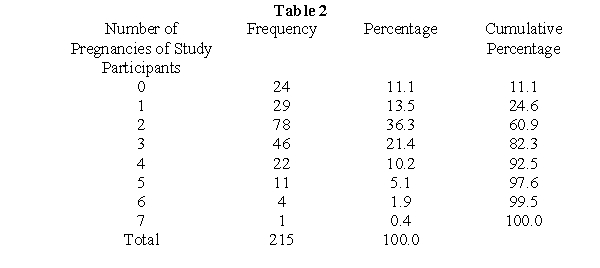
-In Table 2, the variable is _______ and the measurement level is _________.
A) Discrete, interval
B) Discrete, ratio
C) Continuous, interval
D) Continuous, ratio
-In Table 2, the variable is _______ and the measurement level is _________.
A) Discrete, interval
B) Discrete, ratio
C) Continuous, interval
D) Continuous, ratio
Question
The next eight questions pertain to the following table (Table 2):
-Table 2 is an example of a:
A) Frequency distribution
B) Grouped frequency distribution
C) Class interval
D) Data matrix
-Table 2 is an example of a:
A) Frequency distribution
B) Grouped frequency distribution
C) Class interval
D) Data matrix
Question
The next eight questions pertain to the following table (Table 2):
-In Table 2, the value of N is:
A) 24
B) 100.0
C) 215
D) 7
-In Table 2, the value of N is:
A) 24
B) 100.0
C) 215
D) 7
Question
The next eight questions pertain to the following table (Table 2):
-In Table 2, the cumulative relative frequency for five or fewer pregnancies is:
A) 210
B) 199
C) 92.5
D) 97.6
-In Table 2, the cumulative relative frequency for five or fewer pregnancies is:
A) 210
B) 199
C) 92.5
D) 97.6
Question
The next eight questions pertain to the following table (Table 2):
-The best way to graph information in Table 2 would be to construct:
A) A histogram
B) A pie chart
C) A bar graph
D) Either a pie chart or a bar graph
-The best way to graph information in Table 2 would be to construct:
A) A histogram
B) A pie chart
C) A bar graph
D) Either a pie chart or a bar graph
Question
The next eight questions pertain to the following table (Table 2):
-In Table 2, the distribution of data would be described as:
A) Symmetric
B) Positively skewed
C) Negatively skewed
D) It cannot be determined.
-In Table 2, the distribution of data would be described as:
A) Symmetric
B) Positively skewed
C) Negatively skewed
D) It cannot be determined.
Question
The next eight questions pertain to the following table (Table 2):
-In Table 2, the distribution of data would be described as:
A) Unimodal
B) Bimodal
C) Multimodal
D) It cannot be determined.
-In Table 2, the distribution of data would be described as:
A) Unimodal
B) Bimodal
C) Multimodal
D) It cannot be determined.
Question
The next eight questions pertain to the following table (Table 2):
-In Table 2, the most likely number to be an outlier is:
A) 0
B) 1
C) 7
D) 24
-In Table 2, the most likely number to be an outlier is:
A) 0
B) 1
C) 7
D) 24

Unlock Deck
Sign up to unlock the cards in this deck!
Unlock Deck
Unlock Deck
1/20

Play

Full screen (f)
Deck 2: Frequency Distributions: Tabulating and Displaying Data
1
A major purpose of constructing a frequency distribution with sample data is to:
A) Estimate a population parameter
B) Test a research hypothesis
C) Get an organized view of an entire set of scores
D) Get experience with statistical software
A) Estimate a population parameter
B) Test a research hypothesis
C) Get an organized view of an entire set of scores
D) Get experience with statistical software
C
2
In a frequency distribution, the two key informational components are:
A) Score values (X), frequencies (f)
B) A horizontal (X) axis, a vertical (Y) axis
C) Frequencies (f), percentages (%)
D) Participant ID number (id), score values (X)
A) Score values (X), frequencies (f)
B) A horizontal (X) axis, a vertical (Y) axis
C) Frequencies (f), percentages (%)
D) Participant ID number (id), score values (X)
A
3
In a frequency distribution, which of the following is true?
A) Σ N = %
B) Σ N = f
C) Σ f = %
D) Σ f = N
A) Σ N = %
B) Σ N = f
C) Σ f = %
D) Σ f = N
D
4
In the equation Σ % = 100.0, the symbol Σ signifies:
A) A percentage
B) The sum of
C) A data value
D) A frequency
A) A percentage
B) The sum of
C) A data value
D) A frequency
Unlock Deck
Unlock for access to all 20 flashcards in this deck.
Unlock Deck
k this deck
5
In a frequency distribution, percentages are sometimes called:
A) Proportions
B) Relative proportions
C) Relative frequencies
D) Cumulative proportions
A) Proportions
B) Relative proportions
C) Relative frequencies
D) Cumulative proportions
Unlock Deck
Unlock for access to all 20 flashcards in this deck.
Unlock Deck
k this deck
6
Data for which of the following variables is most likely to be presented in a grouped frequency distribution?
A) Nursing specialty area
B) Daily cholesterol intake
C) Number of abortions
D) Number of pets owned
A) Nursing specialty area
B) Daily cholesterol intake
C) Number of abortions
D) Number of pets owned
Unlock Deck
Unlock for access to all 20 flashcards in this deck.
Unlock Deck
k this deck
7
The level of measurement for data appropriately presented in a bar graph is:
A) Interval or ratio
B) Nominal only
C) Interval only
D) Nominal or ordinal
A) Interval or ratio
B) Nominal only
C) Interval only
D) Nominal or ordinal
Unlock Deck
Unlock for access to all 20 flashcards in this deck.
Unlock Deck
k this deck
8
In a frequency distribution graph, frequencies are typically presented on the ____ and data values are presented on the ____________.
A) Y axis, X axis
B) X axis, Y axis
C) f axis, N axis
D) N axis, f axis
A) Y axis, X axis
B) X axis, Y axis
C) f axis, N axis
D) N axis, f axis
Unlock Deck
Unlock for access to all 20 flashcards in this deck.
Unlock Deck
k this deck
9
Which of the following sets of data is not unimodal?
A) 1, 1, 1, 2, 2, 2, 2, 2, 2, 2, 2, 3, 3, 4, 5, 5, 5, 5, 5, 5, 5, 5
B) 0, 0, 0, 0, 0, 0, 0, 0, 1, 1, 1, 2, 2, 2, 2, 3, 3, 3, 4, 4, 4, 4
C) 0, 0, 1, 1, 1, 1, 1, 1, 1, 1, 1, 1, 1, 1, 1, 1, 2, 2, 3, 3, 4, 5
D) 1, 1, 2, 2, 3, 3, 4, 4, 5, 5, 5, 5, 5, 6, 6, 7, 7, 8, 8, 9, 9
A) 1, 1, 1, 2, 2, 2, 2, 2, 2, 2, 2, 3, 3, 4, 5, 5, 5, 5, 5, 5, 5, 5
B) 0, 0, 0, 0, 0, 0, 0, 0, 1, 1, 1, 2, 2, 2, 2, 3, 3, 3, 4, 4, 4, 4
C) 0, 0, 1, 1, 1, 1, 1, 1, 1, 1, 1, 1, 1, 1, 1, 1, 2, 2, 3, 3, 4, 5
D) 1, 1, 2, 2, 3, 3, 4, 4, 5, 5, 5, 5, 5, 6, 6, 7, 7, 8, 8, 9, 9
Unlock Deck
Unlock for access to all 20 flashcards in this deck.
Unlock Deck
k this deck
10
Which of the following variables is most likely to be negatively skewed in a general population?
A) Number of times arrested
B) Age at retirement
C) Number of times married
D) Age at birth
A) Number of times arrested
B) Age at retirement
C) Number of times married
D) Age at birth
Unlock Deck
Unlock for access to all 20 flashcards in this deck.
Unlock Deck
k this deck
11
A normal distribution is not:
A) Skewed
B) Leptokurtic
C) Platykurtic
D) All of the above
A) Skewed
B) Leptokurtic
C) Platykurtic
D) All of the above
Unlock Deck
Unlock for access to all 20 flashcards in this deck.
Unlock Deck
k this deck
12
A wild code is:
A) A value that is impossible given the coding scheme
B) An outlier or high value
C) A code for which there is a very low frequency
D) A code for which there is a very high frequency
A) A value that is impossible given the coding scheme
B) An outlier or high value
C) A code for which there is a very low frequency
D) A code for which there is a very high frequency
Unlock Deck
Unlock for access to all 20 flashcards in this deck.
Unlock Deck
k this deck
13
The next eight questions pertain to the following table (Table 2):
-In Table 2, the variable is _______ and the measurement level is _________.
A) Discrete, interval
B) Discrete, ratio
C) Continuous, interval
D) Continuous, ratio
-In Table 2, the variable is _______ and the measurement level is _________.
A) Discrete, interval
B) Discrete, ratio
C) Continuous, interval
D) Continuous, ratio
Unlock Deck
Unlock for access to all 20 flashcards in this deck.
Unlock Deck
k this deck
14
The next eight questions pertain to the following table (Table 2):
-Table 2 is an example of a:
A) Frequency distribution
B) Grouped frequency distribution
C) Class interval
D) Data matrix
-Table 2 is an example of a:
A) Frequency distribution
B) Grouped frequency distribution
C) Class interval
D) Data matrix
Unlock Deck
Unlock for access to all 20 flashcards in this deck.
Unlock Deck
k this deck
15
The next eight questions pertain to the following table (Table 2):
-In Table 2, the value of N is:
A) 24
B) 100.0
C) 215
D) 7
-In Table 2, the value of N is:
A) 24
B) 100.0
C) 215
D) 7
Unlock Deck
Unlock for access to all 20 flashcards in this deck.
Unlock Deck
k this deck
16
The next eight questions pertain to the following table (Table 2):
-In Table 2, the cumulative relative frequency for five or fewer pregnancies is:
A) 210
B) 199
C) 92.5
D) 97.6
-In Table 2, the cumulative relative frequency for five or fewer pregnancies is:
A) 210
B) 199
C) 92.5
D) 97.6
Unlock Deck
Unlock for access to all 20 flashcards in this deck.
Unlock Deck
k this deck
17
The next eight questions pertain to the following table (Table 2):
-The best way to graph information in Table 2 would be to construct:
A) A histogram
B) A pie chart
C) A bar graph
D) Either a pie chart or a bar graph
-The best way to graph information in Table 2 would be to construct:
A) A histogram
B) A pie chart
C) A bar graph
D) Either a pie chart or a bar graph
Unlock Deck
Unlock for access to all 20 flashcards in this deck.
Unlock Deck
k this deck
18
The next eight questions pertain to the following table (Table 2):
-In Table 2, the distribution of data would be described as:
A) Symmetric
B) Positively skewed
C) Negatively skewed
D) It cannot be determined.
-In Table 2, the distribution of data would be described as:
A) Symmetric
B) Positively skewed
C) Negatively skewed
D) It cannot be determined.
Unlock Deck
Unlock for access to all 20 flashcards in this deck.
Unlock Deck
k this deck
19
The next eight questions pertain to the following table (Table 2):
-In Table 2, the distribution of data would be described as:
A) Unimodal
B) Bimodal
C) Multimodal
D) It cannot be determined.
-In Table 2, the distribution of data would be described as:
A) Unimodal
B) Bimodal
C) Multimodal
D) It cannot be determined.
Unlock Deck
Unlock for access to all 20 flashcards in this deck.
Unlock Deck
k this deck
20
The next eight questions pertain to the following table (Table 2):
-In Table 2, the most likely number to be an outlier is:
A) 0
B) 1
C) 7
D) 24
-In Table 2, the most likely number to be an outlier is:
A) 0
B) 1
C) 7
D) 24
Unlock Deck
Unlock for access to all 20 flashcards in this deck.
Unlock Deck
k this deck
Unlock Deck
Unlock for access to all 20 flashcards in this deck.






