







 Chat with AI

Deck 6: T-Tests: Testing Two Mean Differences
Full screen (f)

Question

Question
Question
Question
Question
Question
Question
Question
Question
Question
Question
Question
Question
Question
Question
Question
Question
Questions pertain to the following table (Table 6), which presents fictitious results regarding the effects of guided imagery on pain outcomes among patients with cancer.
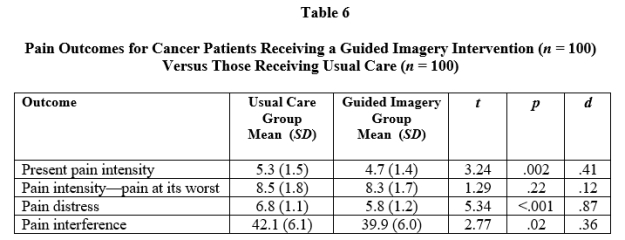
-Refer to Table 6. Which statistical test is most likely being reported in this table?
A) One-sample t-test
B) Independent groups t-test, pooled variance formula
C) Independent groups t-test, separate variance formula
D) Dependent groups t-test
-Refer to Table 6. Which statistical test is most likely being reported in this table?
A) One-sample t-test
B) Independent groups t-test, pooled variance formula
C) Independent groups t-test, separate variance formula
D) Dependent groups t-test
Question
Questions pertain to the following table (Table 6), which presents fictitious results regarding the effects of guided imagery on pain outcomes among patients with cancer.
-Refer to Table 6. For which outcome would the researcher need to accept the null hypothesis?
A) Present pain intensity
B) Pain intensity-pain at its worst
C) Pain distress
D) Pain interference
-Refer to Table 6. For which outcome would the researcher need to accept the null hypothesis?
A) Present pain intensity
B) Pain intensity-pain at its worst
C) Pain distress
D) Pain interference
Question
Questions pertain to the following table (Table 6), which presents fictitious results regarding the effects of guided imagery on pain outcomes among patients with cancer.
-Refer to Table 6. What were the degrees of freedom in these analyses?
A) 99
B) 100
C) 198
D) 199
-Refer to Table 6. What were the degrees of freedom in these analyses?
A) 99
B) 100
C) 198
D) 199
Question
Questions pertain to the following table (Table 6), which presents fictitious results regarding the effects of guided imagery on pain outcomes among patients with cancer.
-Refer to Table 6. Which of the following statements with regard to Table 6 is true?
A) All of the effect sizes were in the small-to-moderate range, using Cohen's guidelines.
B) Because α was the same in all four analyses, power was also the same.
C) Power was likely strongest for the outcome pain distress.
D) Power was inadequate for all four analyses.
-Refer to Table 6. Which of the following statements with regard to Table 6 is true?
A) All of the effect sizes were in the small-to-moderate range, using Cohen's guidelines.
B) Because α was the same in all four analyses, power was also the same.
C) Power was likely strongest for the outcome pain distress.
D) Power was inadequate for all four analyses.

Unlock Deck
Sign up to unlock the cards in this deck!
Unlock Deck
Unlock Deck
1/20

Play

Full screen (f)
Deck 6: T-Tests: Testing Two Mean Differences
1
A two-sample t-test would be appropriate for which of the following directional hypotheses?
A) H1: M1 ≠ M2
B) H1: µ1 ≠ µ2
C) H1: µ1 > µ2
D) H1: M1 > M2
A) H1: M1 ≠ M2
B) H1: µ1 ≠ µ2
C) H1: µ1 > µ2
D) H1: M1 > M2
C
2
Which of the following is not an assumption for the t-test?
A) Normally distributed variances in the populations
B) Normally distributed score values in the populations
C) Homogeneity of variances in the populations
D) Random sampling of cases from the populations
A) Normally distributed variances in the populations
B) Normally distributed score values in the populations
C) Homogeneity of variances in the populations
D) Random sampling of cases from the populations
A
3
Which of the following is true about t-tests?
A) They are used when both the independent and dependent variable are nominal-level variables.
B) They are used when the dependent variable is measured on an interval or ratio scale.
C) They are robust to the violation of all assumptions as long as N is at least 30.
D) They require measurements from people at least two points in time.
A) They are used when both the independent and dependent variable are nominal-level variables.
B) They are used when the dependent variable is measured on an interval or ratio scale.
C) They are robust to the violation of all assumptions as long as N is at least 30.
D) They require measurements from people at least two points in time.
B
4
If cholesterol levels in twins were being compared, one of whom in each pair was randomly assigned to a special dietary intervention, the appropriate statistical test would be the:
A) One-sample t-test
B) Independent groups t-test
C) Between-subjects t-test
D) Dependent groups t-test
A) One-sample t-test
B) Independent groups t-test
C) Between-subjects t-test
D) Dependent groups t-test
Unlock Deck
Unlock for access to all 20 flashcards in this deck.
Unlock Deck
k this deck
5
If smokers and nonsmokers were compared in terms of number of days absent from work annually, the appropriate statistical test would be the:
A) One-sample t-test
B) Independent groups t-test
C) Paired t-test
D) Dependent groups t-test
A) One-sample t-test
B) Independent groups t-test
C) Paired t-test
D) Dependent groups t-test
Unlock Deck
Unlock for access to all 20 flashcards in this deck.
Unlock Deck
k this deck
6
In a longitudinal study of 200 nursing school graduates, nurses who did not participate in the 3-year follow-up were compared to those who did. The appropriate statistical test would be the _____________ to assess for _____________ bias.
A) Independent groups t-test, selection
B) Independent groups t-test, attrition
C) Dependent groups t-test, cohort
D) Dependent groups t-test, nonresponse
A) Independent groups t-test, selection
B) Independent groups t-test, attrition
C) Dependent groups t-test, cohort
D) Dependent groups t-test, nonresponse
Unlock Deck
Unlock for access to all 20 flashcards in this deck.
Unlock Deck
k this deck
7
In the basic formula for the t-test, what is in the denominator?
A) The standard error of the difference
B) The variance of the difference
C) The standard error of the mean
D) The pooled standard deviation
A) The standard error of the difference
B) The variance of the difference
C) The standard error of the mean
D) The pooled standard deviation
Unlock Deck
Unlock for access to all 20 flashcards in this deck.
Unlock Deck
k this deck
8
A statistical test that can be used to test for the normality of a distribution is:
A) The one-sample t-test
B) The two-sample t-test
C) Levene's test
D) The Kolgomorov-Smirnov test
A) The one-sample t-test
B) The two-sample t-test
C) Levene's test
D) The Kolgomorov-Smirnov test
Unlock Deck
Unlock for access to all 20 flashcards in this deck.
Unlock Deck
k this deck
9
A statistical test that can be used to test for equality of variances in the distributions for two groups is:
A) The one-sample t-test
B) The two-sample t-test
C) Levene's test
D) The Kolgomorov-Smirnov test
A) The one-sample t-test
B) The two-sample t-test
C) Levene's test
D) The Kolgomorov-Smirnov test
Unlock Deck
Unlock for access to all 20 flashcards in this deck.
Unlock Deck
k this deck
10
A t was calculated to be -2.10 for a comparison of 50 men and 50 women with regard to attitude toward organ donation, measured on a 10-item scale. The tabled t for two-tailed α = .05 is 2.01. The researcher:
A) Can accept the null hypothesis that men and women have comparable attitudes
B) Can reject the null hypothesis that men and women have comparable attitudes
C) Can accept the alternative hypothesis that men have more favorable attitudes
D) Can accept the alternative hypothesis that women have more favorable attitudes
A) Can accept the null hypothesis that men and women have comparable attitudes
B) Can reject the null hypothesis that men and women have comparable attitudes
C) Can accept the alternative hypothesis that men have more favorable attitudes
D) Can accept the alternative hypothesis that women have more favorable attitudes
Unlock Deck
Unlock for access to all 20 flashcards in this deck.
Unlock Deck
k this deck
11
In a t-test situation, confidence intervals are constructed around:
A) The difference between two means
B) Each of the two means
C) The pooled variance
D) The two separate variances
A) The difference between two means
B) Each of the two means
C) The pooled variance
D) The two separate variances
Unlock Deck
Unlock for access to all 20 flashcards in this deck.
Unlock Deck
k this deck
12
In a t-test situation, magnitude of effects is often communicated through:
A) The absolute value of the t statistic
B) The p value
C) The magnitude of Levene's F
D) The magnitude of Cohen's d
A) The absolute value of the t statistic
B) The p value
C) The magnitude of Levene's F
D) The magnitude of Cohen's d
Unlock Deck
Unlock for access to all 20 flashcards in this deck.
Unlock Deck
k this deck
13
Effect size indexes play a role in:
A) Computing a confidence interval
B) Integrating findings in a meta-analysis
C) Testing the difference between two means
D) Evaluating assumptions for a statistical test
A) Computing a confidence interval
B) Integrating findings in a meta-analysis
C) Testing the difference between two means
D) Evaluating assumptions for a statistical test
Unlock Deck
Unlock for access to all 20 flashcards in this deck.
Unlock Deck
k this deck
14
With Cohen's d, values are in what type of units?
A) Probability values
B) Raw data values
C) Standard deviation units
D) Mean difference units
A) Probability values
B) Raw data values
C) Standard deviation units
D) Mean difference units
Unlock Deck
Unlock for access to all 20 flashcards in this deck.
Unlock Deck
k this deck
15
Which of the following is not a component in a power analysis?
A) The size of the sample
B) The size of the population
C) The effect size
D) The significance criterion
A) The size of the sample
B) The size of the population
C) The effect size
D) The significance criterion
Unlock Deck
Unlock for access to all 20 flashcards in this deck.
Unlock Deck
k this deck
16
In a post hoc power analysis, if the power estimate were .60 for a result that was nonsignificant, a researcher would be able to conclude that:
A) The risk of having committed a Type II error was about 40%
B) The risk of having committed a Type II error was about 60%
C) The nonsignificant result was not correct
D) The nonsignificant result was correct
A) The risk of having committed a Type II error was about 40%
B) The risk of having committed a Type II error was about 60%
C) The nonsignificant result was not correct
D) The nonsignificant result was correct
Unlock Deck
Unlock for access to all 20 flashcards in this deck.
Unlock Deck
k this deck
17
Questions pertain to the following table (Table 6), which presents fictitious results regarding the effects of guided imagery on pain outcomes among patients with cancer.
-Refer to Table 6. Which statistical test is most likely being reported in this table?
A) One-sample t-test
B) Independent groups t-test, pooled variance formula
C) Independent groups t-test, separate variance formula
D) Dependent groups t-test
-Refer to Table 6. Which statistical test is most likely being reported in this table?
A) One-sample t-test
B) Independent groups t-test, pooled variance formula
C) Independent groups t-test, separate variance formula
D) Dependent groups t-test
Unlock Deck
Unlock for access to all 20 flashcards in this deck.
Unlock Deck
k this deck
18
Questions pertain to the following table (Table 6), which presents fictitious results regarding the effects of guided imagery on pain outcomes among patients with cancer.
-Refer to Table 6. For which outcome would the researcher need to accept the null hypothesis?
A) Present pain intensity
B) Pain intensity-pain at its worst
C) Pain distress
D) Pain interference
-Refer to Table 6. For which outcome would the researcher need to accept the null hypothesis?
A) Present pain intensity
B) Pain intensity-pain at its worst
C) Pain distress
D) Pain interference
Unlock Deck
Unlock for access to all 20 flashcards in this deck.
Unlock Deck
k this deck
19
Questions pertain to the following table (Table 6), which presents fictitious results regarding the effects of guided imagery on pain outcomes among patients with cancer.
-Refer to Table 6. What were the degrees of freedom in these analyses?
A) 99
B) 100
C) 198
D) 199
-Refer to Table 6. What were the degrees of freedom in these analyses?
A) 99
B) 100
C) 198
D) 199
Unlock Deck
Unlock for access to all 20 flashcards in this deck.
Unlock Deck
k this deck
20
Questions pertain to the following table (Table 6), which presents fictitious results regarding the effects of guided imagery on pain outcomes among patients with cancer.
-Refer to Table 6. Which of the following statements with regard to Table 6 is true?
A) All of the effect sizes were in the small-to-moderate range, using Cohen's guidelines.
B) Because α was the same in all four analyses, power was also the same.
C) Power was likely strongest for the outcome pain distress.
D) Power was inadequate for all four analyses.
-Refer to Table 6. Which of the following statements with regard to Table 6 is true?
A) All of the effect sizes were in the small-to-moderate range, using Cohen's guidelines.
B) Because α was the same in all four analyses, power was also the same.
C) Power was likely strongest for the outcome pain distress.
D) Power was inadequate for all four analyses.
Unlock Deck
Unlock for access to all 20 flashcards in this deck.
Unlock Deck
k this deck
Unlock Deck
Unlock for access to all 20 flashcards in this deck.






