







 Chat with AI

Deck 7: Analysis of Variance
Full screen (f)

Question

Question
Question
Question
Question
Question
Question
Question
Question
Question
Question
Question
Question
Question
Question
Question
Question
Question
Question
Question
Question
Questions pertain to the following table (Table 7), which presents fictitious results regarding the effects of guided imagery on pain outcomes among patients with cancer.
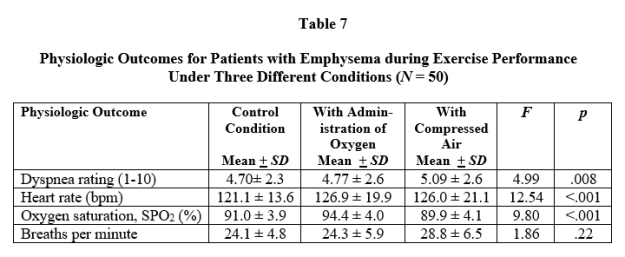
-Refer to Table 7. Which statistical test is most likely being reported in this table?
A) One-way ANOVA
B) Two-way ANOVA
C) RM-ANOVA
D) It cannot be determined.
-Refer to Table 7. Which statistical test is most likely being reported in this table?
A) One-way ANOVA
B) Two-way ANOVA
C) RM-ANOVA
D) It cannot be determined.
Question
Questions pertain to the following table (Table 7), which presents fictitious results regarding the effects of guided imagery on pain outcomes among patients with cancer.
-Refer to Table 7. For which outcome would the researcher need to accept the null hypothesis?
A) Dyspnea rating
B) Heart rate
C) Oxygen saturation
D) Breaths per minute
-Refer to Table 7. For which outcome would the researcher need to accept the null hypothesis?
A) Dyspnea rating
B) Heart rate
C) Oxygen saturation
D) Breaths per minute
Question
Questions pertain to the following table (Table 7), which presents fictitious results regarding the effects of guided imagery on pain outcomes among patients with cancer.
-Refer to Table 7. What were the degrees of freedom between (df treatment) in these analyses?
A) 2
B) 3
C) 47
D) 49
-Refer to Table 7. What were the degrees of freedom between (df treatment) in these analyses?
A) 2
B) 3
C) 47
D) 49
Question
Questions pertain to the following table (Table 7), which presents fictitious results regarding the effects of guided imagery on pain outcomes among patients with cancer.
-Refer to Table 7. Which of the following statements is true, based on information in Table 7?
A) Mean dyspnea ratings were significantly higher with compressed air than with O2.
B) Interaction effects were statistically significant.
C) Mean SPO2 values were significantly higher for the two intervention conditions than for the control condition.
D) One or more assumptions for the ANOVA for heart rate was likely violated.
-Refer to Table 7. Which of the following statements is true, based on information in Table 7?
A) Mean dyspnea ratings were significantly higher with compressed air than with O2.
B) Interaction effects were statistically significant.
C) Mean SPO2 values were significantly higher for the two intervention conditions than for the control condition.
D) One or more assumptions for the ANOVA for heart rate was likely violated.

Unlock Deck
Sign up to unlock the cards in this deck!
Unlock Deck
Unlock Deck
1/24

Play

Full screen (f)
Deck 7: Analysis of Variance
1
What distinguishes analysis of variance (ANOVA) from t-tests?
A) The null hypotheses regarding the equality of means
B) The underlying assumption of homogeneity of variances
C) The number of groups being compared
D) Applications for both within-subjects and between-subjects designs
A) The null hypotheses regarding the equality of means
B) The underlying assumption of homogeneity of variances
C) The number of groups being compared
D) Applications for both within-subjects and between-subjects designs
C
2
The basic alternative hypothesis in ANOVA is:
A) H1: µ1 = µ2 = µ3 = µ4
B) H1: µ1 ≠ µ2 ≠ µ3 ≠ µ4
C) H1: µ1 > µ2 > µ3 > µ4
D) H1: not H0
A) H1: µ1 = µ2 = µ3 = µ4
B) H1: µ1 ≠ µ2 ≠ µ3 ≠ µ4
C) H1: µ1 > µ2 > µ3 > µ4
D) H1: not H0
D
3
Which of the following is a basic concept underlying all ANOVAs?
A) Sphericity
B) Partitioning variance
C) Interaction effects
D) Repeated measurement
A) Sphericity
B) Partitioning variance
C) Interaction effects
D) Repeated measurement
B
4
In a basic one-way ANOVA, what components are being contrasted?
A) Between-group variance to within-group variance
B) Between-group variance to total variance
C) Between-group variance to treatment variance
D) Between-group variance to variance for interactions
A) Between-group variance to within-group variance
B) Between-group variance to total variance
C) Between-group variance to treatment variance
D) Between-group variance to variance for interactions
Unlock Deck
Unlock for access to all 24 flashcards in this deck.
Unlock Deck
k this deck
5
Between-group variation in ANOVA involves differences between _______ to the ________.
A) Individual scores, group means
B) Individual scores, grand mean
C) Means of one group, means of another group
D) Group means, grand mean
A) Individual scores, group means
B) Individual scores, grand mean
C) Means of one group, means of another group
D) Group means, grand mean
Unlock Deck
Unlock for access to all 24 flashcards in this deck.
Unlock Deck
k this deck
6
The formula for the F ratio involves dividing a _______ by a _______.
A) Sum of square, mean square
B) Mean square, sum of square
C) Mean square, mean square
D) Mean square, sum of squares
A) Sum of square, mean square
B) Mean square, sum of square
C) Mean square, mean square
D) Mean square, sum of squares
Unlock Deck
Unlock for access to all 24 flashcards in this deck.
Unlock Deck
k this deck
7
If the null hypothesis in an ANOVA situation were true, over the long run the value of F would be:
A) Zero
B) One
C) Depends on degrees of freedom
D) Depends on what type of ANOVA it is
A) Zero
B) One
C) Depends on degrees of freedom
D) Depends on what type of ANOVA it is
Unlock Deck
Unlock for access to all 24 flashcards in this deck.
Unlock Deck
k this deck
8
An independent groups t-test is to a dependent groups t-test as _______ is to _______.
A) One-way ANOVA, RM-ANOVA
B) One-way ANOVA, two-way ANOVA
C) Two-way ANOVA, three-way ANOVA
D) Two-way ANOVA, RM-ANOVA
A) One-way ANOVA, RM-ANOVA
B) One-way ANOVA, two-way ANOVA
C) Two-way ANOVA, three-way ANOVA
D) Two-way ANOVA, RM-ANOVA
Unlock Deck
Unlock for access to all 24 flashcards in this deck.
Unlock Deck
k this deck
9
Two-way ANOVA might be appropriate for which of the following experimental designs?
A) Crossover design
B) One-group pretest-posttest design
C) Two-group before-after design
D) Factorial design
A) Crossover design
B) One-group pretest-posttest design
C) Two-group before-after design
D) Factorial design
Unlock Deck
Unlock for access to all 24 flashcards in this deck.
Unlock Deck
k this deck
10
RM-ANOVA might be appropriate for which of the following experimental designs?
A) Crossover design
B) One-group pretest-posttest design
C) Two-group before-after design
D) Factorial design
A) Crossover design
B) One-group pretest-posttest design
C) Two-group before-after design
D) Factorial design
Unlock Deck
Unlock for access to all 24 flashcards in this deck.
Unlock Deck
k this deck
11
If a researcher found a significant interaction effect, it would mean that:
A) Both of the main effects were also significant
B) Neither of the main effects was significant
C) The means for different levels of one variable were not consistent across different levels of another
D) The means for one variable were different from the means for the second variable
A) Both of the main effects were also significant
B) Neither of the main effects was significant
C) The means for different levels of one variable were not consistent across different levels of another
D) The means for one variable were different from the means for the second variable
Unlock Deck
Unlock for access to all 24 flashcards in this deck.
Unlock Deck
k this deck
12
If means for a two-way ANOVA were plotted on a graph, an interaction effect might be indicated by:
A) Parallel lines
B) Curved lines
C) Crossed lines
D) None of the above
A) Parallel lines
B) Curved lines
C) Crossed lines
D) None of the above
Unlock Deck
Unlock for access to all 24 flashcards in this deck.
Unlock Deck
k this deck
13
To look up an F statistic in a table to assess its significant, how many different degrees of freedom would be needed to obtain a value?
A) 1 df
B) 2 dfs
C) It would depend on how many groups are in the analysis.
D) It would depend on how many factors are in the analysis.
A) 1 df
B) 2 dfs
C) It would depend on how many groups are in the analysis.
D) It would depend on how many factors are in the analysis.
Unlock Deck
Unlock for access to all 24 flashcards in this deck.
Unlock Deck
k this deck
14
In an RM-ANOVA, what is removed from the error term (within-subjects variation)?
A) Variation attributable to individual differences
B) Variation from interaction effects
C) Variation attributable to between-groups differences
D) Variation from time or between-treatment differences
A) Variation attributable to individual differences
B) Variation from interaction effects
C) Variation attributable to between-groups differences
D) Variation from time or between-treatment differences
Unlock Deck
Unlock for access to all 24 flashcards in this deck.
Unlock Deck
k this deck
15
Which of the following is true about RM-ANOVA?
A) It is not appropriate for nonexperimental designs.
B) It is a less sensitive test of the relationship between the independent and dependent variable than one-way ANOVA.
C) It has fewer assumptions than one-way ANOVA.
D) It assumes homogeneity of variances in differences scores between the populations being compared (sphericity).
A) It is not appropriate for nonexperimental designs.
B) It is a less sensitive test of the relationship between the independent and dependent variable than one-way ANOVA.
C) It has fewer assumptions than one-way ANOVA.
D) It assumes homogeneity of variances in differences scores between the populations being compared (sphericity).
Unlock Deck
Unlock for access to all 24 flashcards in this deck.
Unlock Deck
k this deck
16
The __________ can be used to adjust _________ when one of the assumptions for RM-ANOVA cannot be met.
A) Mauchly test, F statistic
B) Mauchly test, df
C) Huynh-Feldt epsilon, F statistic
D) Huynh-Feldt epsilon, df
A) Mauchly test, F statistic
B) Mauchly test, df
C) Huynh-Feldt epsilon, F statistic
D) Huynh-Feldt epsilon, df
Unlock Deck
Unlock for access to all 24 flashcards in this deck.
Unlock Deck
k this deck
17
Which of the following is a post hoc test?
A) Tukey's HSD test
B) Greenhouse-Geisser test
C) Planned comparisons test
D) Mauchly test
A) Tukey's HSD test
B) Greenhouse-Geisser test
C) Planned comparisons test
D) Mauchly test
Unlock Deck
Unlock for access to all 24 flashcards in this deck.
Unlock Deck
k this deck
18
Which of the following is also called a protected t-test?
A) Tukey's HSD test
B) Scheffé test
C) Fisher's LSD test
D) Duncan's multiple range test
A) Tukey's HSD test
B) Scheffé test
C) Fisher's LSD test
D) Duncan's multiple range test
Unlock Deck
Unlock for access to all 24 flashcards in this deck.
Unlock Deck
k this deck
19
Which of the following is true about the various multiple comparison tests?
A) They are appropriate only for one-way ANOVAs.
B) They can yield confidence intervals of different widths around mean differences.
C) They will all yield the same conclusions about differences between group means.
D) They are used primarily to minimize the risk of a Type II error.
A) They are appropriate only for one-way ANOVAs.
B) They can yield confidence intervals of different widths around mean differences.
C) They will all yield the same conclusions about differences between group means.
D) They are used primarily to minimize the risk of a Type II error.
Unlock Deck
Unlock for access to all 24 flashcards in this deck.
Unlock Deck
k this deck
20
Which of the following is not true?
A) The effect size index in ANOVA is η2.
B) The effect size index in ANOVA indicates the proportion of variance in the dependent variable accounted for by the independent variable.
C) An effect size of .15 in an ANOVA context would be considered small.
D) The effect size index in ANOVA is different than that used for a t-test.
A) The effect size index in ANOVA is η2.
B) The effect size index in ANOVA indicates the proportion of variance in the dependent variable accounted for by the independent variable.
C) An effect size of .15 in an ANOVA context would be considered small.
D) The effect size index in ANOVA is different than that used for a t-test.
Unlock Deck
Unlock for access to all 24 flashcards in this deck.
Unlock Deck
k this deck
21
Questions pertain to the following table (Table 7), which presents fictitious results regarding the effects of guided imagery on pain outcomes among patients with cancer.
-Refer to Table 7. Which statistical test is most likely being reported in this table?
A) One-way ANOVA
B) Two-way ANOVA
C) RM-ANOVA
D) It cannot be determined.
-Refer to Table 7. Which statistical test is most likely being reported in this table?
A) One-way ANOVA
B) Two-way ANOVA
C) RM-ANOVA
D) It cannot be determined.
Unlock Deck
Unlock for access to all 24 flashcards in this deck.
Unlock Deck
k this deck
22
Questions pertain to the following table (Table 7), which presents fictitious results regarding the effects of guided imagery on pain outcomes among patients with cancer.
-Refer to Table 7. For which outcome would the researcher need to accept the null hypothesis?
A) Dyspnea rating
B) Heart rate
C) Oxygen saturation
D) Breaths per minute
-Refer to Table 7. For which outcome would the researcher need to accept the null hypothesis?
A) Dyspnea rating
B) Heart rate
C) Oxygen saturation
D) Breaths per minute
Unlock Deck
Unlock for access to all 24 flashcards in this deck.
Unlock Deck
k this deck
23
Questions pertain to the following table (Table 7), which presents fictitious results regarding the effects of guided imagery on pain outcomes among patients with cancer.
-Refer to Table 7. What were the degrees of freedom between (df treatment) in these analyses?
A) 2
B) 3
C) 47
D) 49
-Refer to Table 7. What were the degrees of freedom between (df treatment) in these analyses?
A) 2
B) 3
C) 47
D) 49
Unlock Deck
Unlock for access to all 24 flashcards in this deck.
Unlock Deck
k this deck
24
Questions pertain to the following table (Table 7), which presents fictitious results regarding the effects of guided imagery on pain outcomes among patients with cancer.
-Refer to Table 7. Which of the following statements is true, based on information in Table 7?
A) Mean dyspnea ratings were significantly higher with compressed air than with O2.
B) Interaction effects were statistically significant.
C) Mean SPO2 values were significantly higher for the two intervention conditions than for the control condition.
D) One or more assumptions for the ANOVA for heart rate was likely violated.
-Refer to Table 7. Which of the following statements is true, based on information in Table 7?
A) Mean dyspnea ratings were significantly higher with compressed air than with O2.
B) Interaction effects were statistically significant.
C) Mean SPO2 values were significantly higher for the two intervention conditions than for the control condition.
D) One or more assumptions for the ANOVA for heart rate was likely violated.
Unlock Deck
Unlock for access to all 24 flashcards in this deck.
Unlock Deck
k this deck
Unlock Deck
Unlock for access to all 24 flashcards in this deck.






