







 Chat with AI

Deck 43: Smoking--Beyond Lung Cancer
Full screen (f)

Question

Question
Question
Question
Question
Question
Question
Question
Question
Question
Question
This figure shows a CT scan where the lung on the left is severely impacted by emphysema. 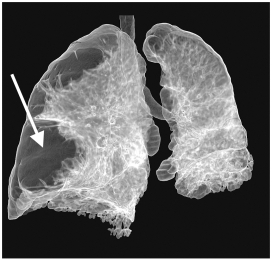
The region indicated by the arrow is clear because
A) a tumor has formed in this region.
B) tar from cigarette smoking is blocking the penetration of X-rays through the lung.
C) the alveoli in this region have all ruptured as a result of exposure to the irritants from cigarette smoke.
D) fluid has accumulated in this region of the lung as a result of edema.
The region indicated by the arrow is clear because
A) a tumor has formed in this region.
B) tar from cigarette smoking is blocking the penetration of X-rays through the lung.
C) the alveoli in this region have all ruptured as a result of exposure to the irritants from cigarette smoke.
D) fluid has accumulated in this region of the lung as a result of edema.
Question
Question
Question
Question
Question
Question
Question
Question
Question
Question
Question
Question
Question
Question
Question
Question
Question
Question
Question
Question
Question
Question
Question
Question
Question
Question
Examine the graph below.
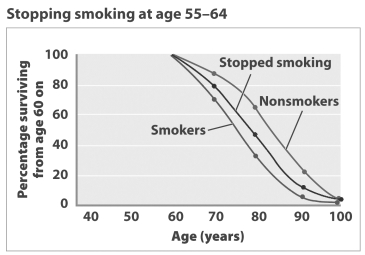
According to this graph, a person who quits smoking between the ages of 55 and 64 has a ____________ life expectancy than a person who has never smoked.
According to this graph, a person who quits smoking between the ages of 55 and 64 has a ____________ life expectancy than a person who has never smoked.
Question
Question
Question
Question
Question
Question
Question
Question
Question
Question
Question
Question
Question
Question
Question
Question
Question
Question
Question
Question
Question
Question
Question
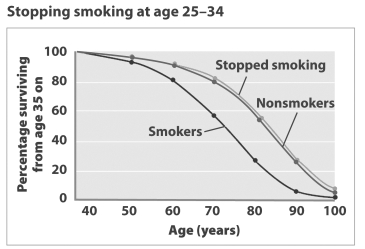
Based on the data in the graph below, a person who quits smoking between the ages of 25 and 35 has approximately the same life expectancy as a nonsmoker.
Question
Question
Question

Unlock Deck
Sign up to unlock the cards in this deck!
Unlock Deck
Unlock Deck
1/63

Play

Full screen (f)
Deck 43: Smoking--Beyond Lung Cancer
1
Smoking greatly increases the chances of arteriosclerosis by
A) damaging alveoli.
B) lowering HDLs.
C) impairing kidney function.
D) causing irregular heartbeats.
A) damaging alveoli.
B) lowering HDLs.
C) impairing kidney function.
D) causing irregular heartbeats.
B
2
Which of the following is false?
A) Tobacco plants belong to the same family as tomatoes and potatoes.
B) Tobacco cultivation dates back to 8,000 years ago.
C) The first people to use tobacco were native North Americans.
D) We have known that tobacco is linked to cancer since the late eighteenth century.
A) Tobacco plants belong to the same family as tomatoes and potatoes.
B) Tobacco cultivation dates back to 8,000 years ago.
C) The first people to use tobacco were native North Americans.
D) We have known that tobacco is linked to cancer since the late eighteenth century.
C
3
Smoking can reduce the ability to eliminate sodium and water from the body. In this case the ingredients in cigarette smoke would be affecting the
A) heart.
B) pancreas.
C) kidneys.
D) stomach.
A) heart.
B) pancreas.
C) kidneys.
D) stomach.
C
4
When a smoker inhales, the smoke first enters the pharynx. The next part of the respiratory tract the smoke moves into and damages is the
A) alveoli.
B) bronchi.
C) bronchioles.
D) tracheoles.
A) alveoli.
B) bronchi.
C) bronchioles.
D) tracheoles.
Unlock Deck
Unlock for access to all 63 flashcards in this deck.
Unlock Deck
k this deck
5
Which of the following describes why a light smoker may become a heavy smoker?
A) Nicotine is broken down more and more quickly by enzymes in the blood.
B) A smoker's brain becomes less sensitized to nicotine as a trigger for the release of dopamine.
C) Nicotine is broken down more and more quickly by dopamine.
D) More and more nicotine binds to dopamine, reducing its effects.
A) Nicotine is broken down more and more quickly by enzymes in the blood.
B) A smoker's brain becomes less sensitized to nicotine as a trigger for the release of dopamine.
C) Nicotine is broken down more and more quickly by dopamine.
D) More and more nicotine binds to dopamine, reducing its effects.
Unlock Deck
Unlock for access to all 63 flashcards in this deck.
Unlock Deck
k this deck
6
Recent research suggests that there may be a second chemical in tobacco smoke that
A) speeds up release of dopamine.
B) slows the breakdown of dopamine.
C) affects pleasure centers in the brain.
D) is twice as addictive as nicotine.
A) speeds up release of dopamine.
B) slows the breakdown of dopamine.
C) affects pleasure centers in the brain.
D) is twice as addictive as nicotine.
Unlock Deck
Unlock for access to all 63 flashcards in this deck.
Unlock Deck
k this deck
7
Which of the following is true?
A) Cilia in the lungs are paralyzed by tobacco smoke.
B) Bronchioles in the lungs prevent tobacco smoke from reaching alveoli.
C) Alveoli are the least vulnerable parts of the human respiratory system.
D) Tobacco smoke reaches the trachea after passing through the bronchi.
A) Cilia in the lungs are paralyzed by tobacco smoke.
B) Bronchioles in the lungs prevent tobacco smoke from reaching alveoli.
C) Alveoli are the least vulnerable parts of the human respiratory system.
D) Tobacco smoke reaches the trachea after passing through the bronchi.
Unlock Deck
Unlock for access to all 63 flashcards in this deck.
Unlock Deck
k this deck
8
Blood containing nicotine and other components of tobacco smoke would travel from your lungs and move first into the
A) left atrium.
B) left ventricle.
C) right atrium.
D) right ventricle.
A) left atrium.
B) left ventricle.
C) right atrium.
D) right ventricle.
Unlock Deck
Unlock for access to all 63 flashcards in this deck.
Unlock Deck
k this deck
9
Even though we understand perfectly well that tobacco is bad for us, people worldwide continue to smoke. Which of the following is most likely playing a role in this phenomenon?
A) Tobacco products are inexpensive.
B) Nicotine is addictive.
C) Nicotine causes the nucleus accumbens to shut down.
D) Smoking helps people lose weight.
A) Tobacco products are inexpensive.
B) Nicotine is addictive.
C) Nicotine causes the nucleus accumbens to shut down.
D) Smoking helps people lose weight.
Unlock Deck
Unlock for access to all 63 flashcards in this deck.
Unlock Deck
k this deck
10
Which of the following is true?
A) Secondhand smoke poses no threat to nonsmokers.
B) A nonsmoking spouse of a smoker has approximately the same health risk from smoking as a nonsmoker.
C) In the United States, secondhand smoke from mothers kills more babies than child abuse.
D) A young person who quits smoking has the same life expectancy as an older person who quits smoking
A) Secondhand smoke poses no threat to nonsmokers.
B) A nonsmoking spouse of a smoker has approximately the same health risk from smoking as a nonsmoker.
C) In the United States, secondhand smoke from mothers kills more babies than child abuse.
D) A young person who quits smoking has the same life expectancy as an older person who quits smoking
Unlock Deck
Unlock for access to all 63 flashcards in this deck.
Unlock Deck
k this deck
11
This figure shows a CT scan where the lung on the left is severely impacted by emphysema.
The region indicated by the arrow is clear because
A) a tumor has formed in this region.
B) tar from cigarette smoking is blocking the penetration of X-rays through the lung.
C) the alveoli in this region have all ruptured as a result of exposure to the irritants from cigarette smoke.
D) fluid has accumulated in this region of the lung as a result of edema.
The region indicated by the arrow is clear because
A) a tumor has formed in this region.
B) tar from cigarette smoking is blocking the penetration of X-rays through the lung.
C) the alveoli in this region have all ruptured as a result of exposure to the irritants from cigarette smoke.
D) fluid has accumulated in this region of the lung as a result of edema.
Unlock Deck
Unlock for access to all 63 flashcards in this deck.
Unlock Deck
k this deck
12
At the doctor's office a man complains of shortness of breath and a persistent cough. The man has been smoking for twenty years. These particular symptoms suggest that the man may have ___________ as a result of smoking.
A) peripheral artery disease
B) telomeres
C) chronic bronchitis
D) advanced lung cancer
A) peripheral artery disease
B) telomeres
C) chronic bronchitis
D) advanced lung cancer
Unlock Deck
Unlock for access to all 63 flashcards in this deck.
Unlock Deck
k this deck
13
During the first few years after you quit smoking,
A) the toxins that remain in your body can still affect your unborn child.
B) you are more likely to develop a tumor in your lungs than a smoker that has not quit smoking.
C) the lungs recover completely from the damage caused by emphysema.
D) your chance of having a heart attack decreases significantly.
A) the toxins that remain in your body can still affect your unborn child.
B) you are more likely to develop a tumor in your lungs than a smoker that has not quit smoking.
C) the lungs recover completely from the damage caused by emphysema.
D) your chance of having a heart attack decreases significantly.
Unlock Deck
Unlock for access to all 63 flashcards in this deck.
Unlock Deck
k this deck
14
Which of the following is an accurate statement?
A) By the time cigarette smoke gets to the bronchioles, it has already affected cells in the bronchi.
B) By the time cigarette smoke gets to the bronchioles, it has already affected alveoli.
C) By the time cigarette smoke gets to the pharynx, it has already passed through the alveoli.
D) By the time cigarette smoke gets to the trachea, it has already passed through the tracheoles.
A) By the time cigarette smoke gets to the bronchioles, it has already affected cells in the bronchi.
B) By the time cigarette smoke gets to the bronchioles, it has already affected alveoli.
C) By the time cigarette smoke gets to the pharynx, it has already passed through the alveoli.
D) By the time cigarette smoke gets to the trachea, it has already passed through the tracheoles.
Unlock Deck
Unlock for access to all 63 flashcards in this deck.
Unlock Deck
k this deck
15
Nicotine in your blood would be transferred to interstitial fluid and body cells from
A) arteries.
B) veins.
C) arterioles.
D) capillaries.
A) arteries.
B) veins.
C) arterioles.
D) capillaries.
Unlock Deck
Unlock for access to all 63 flashcards in this deck.
Unlock Deck
k this deck
16
Which of the following is most directly and intensely exposed to the dangerous agents in tobacco smoke?
A) the circulatory system
B) the nervous system
C) the respiratory system
D) the skeletal system
A) the circulatory system
B) the nervous system
C) the respiratory system
D) the skeletal system
Unlock Deck
Unlock for access to all 63 flashcards in this deck.
Unlock Deck
k this deck
17
A smoker can stand a better chance of quitting using some simple guidelines. Which of the following is not one of these guidelines?
A) Establish alternative behaviors to keep the craving to smoke at bay.
B) Recognize that it is hard to quit smoking and that you may not succeed on your first try.
C) Use alternative sources of nicotine to ease withdrawal.
D) Go on a strict diet to build your self- discipline.
A) Establish alternative behaviors to keep the craving to smoke at bay.
B) Recognize that it is hard to quit smoking and that you may not succeed on your first try.
C) Use alternative sources of nicotine to ease withdrawal.
D) Go on a strict diet to build your self- discipline.
Unlock Deck
Unlock for access to all 63 flashcards in this deck.
Unlock Deck
k this deck
18
Where in your blood would you expect nicotine to be carried?
A) in hemoglobin
B) in blood plasma
C) in killer T cells
D) in macrophages
A) in hemoglobin
B) in blood plasma
C) in killer T cells
D) in macrophages
Unlock Deck
Unlock for access to all 63 flashcards in this deck.
Unlock Deck
k this deck
19
Peripheral artery disease
A) involves the narrowing or blockage of blood vessels not found in heart tissues.
B) is equally common in smokers and nonsmokers.
C) causes heart attacks.
D) is the result of a sodium imbalance.
A) involves the narrowing or blockage of blood vessels not found in heart tissues.
B) is equally common in smokers and nonsmokers.
C) causes heart attacks.
D) is the result of a sodium imbalance.
Unlock Deck
Unlock for access to all 63 flashcards in this deck.
Unlock Deck
k this deck
20
Progressing from a "once in a while" smoker to a heavy smoker could be described as an example of
A) homeostasis.
B) negative feedback.
C) positive feedback.
D) a reflex loop.
A) homeostasis.
B) negative feedback.
C) positive feedback.
D) a reflex loop.
Unlock Deck
Unlock for access to all 63 flashcards in this deck.
Unlock Deck
k this deck
21
For nicotine to have an impact on the nervous system,
A) cells in the nervous system must have plasma membranes containing dopamine.
B) nicotine must act as an antigen on specific neurons.
C) some nerve cells must have receptors that can bind to nicotine.
D) nicotine must combine with preexisting antibodies in nerve cells.
A) cells in the nervous system must have plasma membranes containing dopamine.
B) nicotine must act as an antigen on specific neurons.
C) some nerve cells must have receptors that can bind to nicotine.
D) nicotine must combine with preexisting antibodies in nerve cells.
Unlock Deck
Unlock for access to all 63 flashcards in this deck.
Unlock Deck
k this deck
22
Edema results from the movement of ________ out of the blood vessels and into the surrounding tissues.
Unlock Deck
Unlock for access to all 63 flashcards in this deck.
Unlock Deck
k this deck
23
It's safe to smoke if you don't inhale.
Unlock Deck
Unlock for access to all 63 flashcards in this deck.
Unlock Deck
k this deck
24
People with emphysema have difficulty breathing because the walls of their alveoli break reducing the amount of _____________ available for gas exchange.
Unlock Deck
Unlock for access to all 63 flashcards in this deck.
Unlock Deck
k this deck
25
Smoking damages only the lungs.
Unlock Deck
Unlock for access to all 63 flashcards in this deck.
Unlock Deck
k this deck
26
Secondhand smoke is dangerous to nonsmokers because it contains the same __________ that cause cancer in smokers.
Unlock Deck
Unlock for access to all 63 flashcards in this deck.
Unlock Deck
k this deck
27
People with chronic bronchitis have difficulty catching their breath because the diameter of their bronchioles is _________ than normal
Unlock Deck
Unlock for access to all 63 flashcards in this deck.
Unlock Deck
k this deck
28
The addictive chemical in cigarette smoke is ________.
Unlock Deck
Unlock for access to all 63 flashcards in this deck.
Unlock Deck
k this deck
29
Cigarette smoke contains aldehydes, aromatic amines, and N-nitrosamines, which are all ___________ that cause mutations in DNA.
Unlock Deck
Unlock for access to all 63 flashcards in this deck.
Unlock Deck
k this deck
30
Like two other addictive drugs, cocaine and heroin, nicotine stimulates the release of ________ in the nucleus accumbens.
Unlock Deck
Unlock for access to all 63 flashcards in this deck.
Unlock Deck
k this deck
31
The components of cigarette smoke in your blood would move from your lungs to the chambers of your heart through the _________ circuit.
Unlock Deck
Unlock for access to all 63 flashcards in this deck.
Unlock Deck
k this deck
32
Where would you expect the effects of nicotine to occur at the level of a series of interconnected neurons?
A) on their myelin sheaths
B) at nodes of Ranvier
C) on the cell bodies of neurons
D) in synaptic clefts
A) on their myelin sheaths
B) at nodes of Ranvier
C) on the cell bodies of neurons
D) in synaptic clefts
Unlock Deck
Unlock for access to all 63 flashcards in this deck.
Unlock Deck
k this deck
33
Since nicotine is not normally found in your body, after smoking a cigarette it can easily _________ (a passive process) from the blood into your interstitial fluid and then to the cells of your nervous system.
Unlock Deck
Unlock for access to all 63 flashcards in this deck.
Unlock Deck
k this deck
34
Smokers who try to quit often become irritable and eat more, because
A) the pituitary gland is no longer suppressed from releasing the hormones that control appetite.
B) the body begins breaking down carcinogens and the resulting byproducts make it difficult to sleep.
C) the nervous system, which has been suppressed for so long by nicotine, becomes hypersensitive.
D) nicotine is no longer stimulating the release of dopamine from the nucleus accumbens.
A) the pituitary gland is no longer suppressed from releasing the hormones that control appetite.
B) the body begins breaking down carcinogens and the resulting byproducts make it difficult to sleep.
C) the nervous system, which has been suppressed for so long by nicotine, becomes hypersensitive.
D) nicotine is no longer stimulating the release of dopamine from the nucleus accumbens.
Unlock Deck
Unlock for access to all 63 flashcards in this deck.
Unlock Deck
k this deck
35
Tobacco smoke inhaled by nonsmoking people near a smoker is called __________ smoke.
Unlock Deck
Unlock for access to all 63 flashcards in this deck.
Unlock Deck
k this deck
36
Smoking paralyzes the cilia lining the respiratory system. This damages the lungs because
A) the cilia produce the mucus that covers the alveoli and without the mucus, gases cannot diffuse into the capillaries surrounding the alveoli.
B) when the cilia cannot move, bacteria and particles cannot be swept out of the respiratory system before damaging the walls of the alveoli.
C) when paralyzed, the cilia cannot prevent backflow from the heart into the lungs. The resulting flow of high-pressure blood into the lungs ruptures capillaries.
D) cilia are the gas exchange structures of the lungs and when they are paralyzed, air cannot move in and out of the lungs.
A) the cilia produce the mucus that covers the alveoli and without the mucus, gases cannot diffuse into the capillaries surrounding the alveoli.
B) when the cilia cannot move, bacteria and particles cannot be swept out of the respiratory system before damaging the walls of the alveoli.
C) when paralyzed, the cilia cannot prevent backflow from the heart into the lungs. The resulting flow of high-pressure blood into the lungs ruptures capillaries.
D) cilia are the gas exchange structures of the lungs and when they are paralyzed, air cannot move in and out of the lungs.
Unlock Deck
Unlock for access to all 63 flashcards in this deck.
Unlock Deck
k this deck
37
Examine the graph below.
According to this graph, a person who quits smoking between the ages of 55 and 64 has a ____________ life expectancy than a person who has never smoked.
According to this graph, a person who quits smoking between the ages of 55 and 64 has a ____________ life expectancy than a person who has never smoked.
Unlock Deck
Unlock for access to all 63 flashcards in this deck.
Unlock Deck
k this deck
38
When fluid collects in alveoli as a result of smoking, gas exchange is slower because
A) gases are unable to dissolve in fluids.
B) the fluid blocks the flow of blood through the capillaries in the lungs.
C) the fluid increases the amount of surface area available for diffusion.
D) gases diffuse more slowly over the longer distance created by the fluid.
A) gases are unable to dissolve in fluids.
B) the fluid blocks the flow of blood through the capillaries in the lungs.
C) the fluid increases the amount of surface area available for diffusion.
D) gases diffuse more slowly over the longer distance created by the fluid.
Unlock Deck
Unlock for access to all 63 flashcards in this deck.
Unlock Deck
k this deck
39
In order for nicotine to affect a neuron, it would have to
A) cross capillary walls.
B) diffuse into interstitial fluid.
C) reach a neuron's plasma membrane.
D) all of the above
A) cross capillary walls.
B) diffuse into interstitial fluid.
C) reach a neuron's plasma membrane.
D) all of the above
Unlock Deck
Unlock for access to all 63 flashcards in this deck.
Unlock Deck
k this deck
40
Tobacco kills most of its victims by causing diseases of the heart and circulatory system.
Unlock Deck
Unlock for access to all 63 flashcards in this deck.
Unlock Deck
k this deck
41
Carbon monoxide (CO) binds to hemoglobin more strongly than does oxygen (O₂).
Unlock Deck
Unlock for access to all 63 flashcards in this deck.
Unlock Deck
k this deck
42
A smoker endangers his or her own health as well as the health of anyone who is nearby.
Unlock Deck
Unlock for access to all 63 flashcards in this deck.
Unlock Deck
k this deck
43
Exposure to carbon monoxide (CO) from cigarette smoke is dangerous because it binds to the site where carbon dioxide (CO₂) binds to hemoglobin, preventing CO₂ from diffusing out of the blood.
Unlock Deck
Unlock for access to all 63 flashcards in this deck.
Unlock Deck
k this deck
44
Chewing tobacco is safe, because no smoke is produced.
Unlock Deck
Unlock for access to all 63 flashcards in this deck.
Unlock Deck
k this deck
45
The more a person smokes, the more sensitive that person's brain becomes to nicotine.
Unlock Deck
Unlock for access to all 63 flashcards in this deck.
Unlock Deck
k this deck
46
Carcinogens in tobacco smoke can get into the blood and cause cancer in areas other than the lungs.
Unlock Deck
Unlock for access to all 63 flashcards in this deck.
Unlock Deck
k this deck
47
Nicotine is more addictive for men than women.
Unlock Deck
Unlock for access to all 63 flashcards in this deck.
Unlock Deck
k this deck
48
If a person addicted to cigarette smoking cannot quit successfully on the first try, there is almost no hope of ever quitting.
Unlock Deck
Unlock for access to all 63 flashcards in this deck.
Unlock Deck
k this deck
49
Nicotine is toxic to the human body because it directly affects the function of the nervous system.
Unlock Deck
Unlock for access to all 63 flashcards in this deck.
Unlock Deck
k this deck
50
The earlier a smoker quits, the better chance he or she has of living a normal life span.
Unlock Deck
Unlock for access to all 63 flashcards in this deck.
Unlock Deck
k this deck
51
Dopamine is the addictive agent in tobacco smoke.
Unlock Deck
Unlock for access to all 63 flashcards in this deck.
Unlock Deck
k this deck
52
Smoking can increase levels of low density lipoproteins (LDLs) in the blood.
Unlock Deck
Unlock for access to all 63 flashcards in this deck.
Unlock Deck
k this deck
53
Smoking is implicated in gingivitis, also known as chronic gum disease.
Unlock Deck
Unlock for access to all 63 flashcards in this deck.
Unlock Deck
k this deck
54
The narrowing of blood vessels as a result of smoking decreases the amount of pressure needed to move blood through the body.
Unlock Deck
Unlock for access to all 63 flashcards in this deck.
Unlock Deck
k this deck
55
The reason you feel energized after smoking a cigarette is that nicotine stimulates the release of epinephrine from the adrenal glands.
Unlock Deck
Unlock for access to all 63 flashcards in this deck.
Unlock Deck
k this deck
56
Studies have shown that smoking cures wrinkles.
Unlock Deck
Unlock for access to all 63 flashcards in this deck.
Unlock Deck
k this deck
57
Lung infections are more common in smokers because their lungs contain large amounts mucus in which bacteria can reside.
Unlock Deck
Unlock for access to all 63 flashcards in this deck.
Unlock Deck
k this deck
58
Although a cigar-smoker may not inhale smoke, he or she is still subject to exposure to carcinogens in secondhand smoke.
Unlock Deck
Unlock for access to all 63 flashcards in this deck.
Unlock Deck
k this deck
59
Nicotine patches and gum work by providing some level of nicotine to reduce the impact of withdrawal symptoms.
Unlock Deck
Unlock for access to all 63 flashcards in this deck.
Unlock Deck
k this deck
60
Based on the data in the graph below, a person who quits smoking between the ages of 25 and 35 has approximately the same life expectancy as a nonsmoker.
Unlock Deck
Unlock for access to all 63 flashcards in this deck.
Unlock Deck
k this deck
61
The enzyme MAO B prolongs the feeling of pleasure by preventing the breakdown of dopamine.
Unlock Deck
Unlock for access to all 63 flashcards in this deck.
Unlock Deck
k this deck
62
The longer a person lives (even a nonsmoker), the shorter his or her chromosomes become.
Unlock Deck
Unlock for access to all 63 flashcards in this deck.
Unlock Deck
k this deck
63
Smoking a cigarette increases the amount of glucose in your blood stream.
Unlock Deck
Unlock for access to all 63 flashcards in this deck.
Unlock Deck
k this deck
Unlock Deck
Unlock for access to all 63 flashcards in this deck.






