







 Chat with AI

Deck 3: Major Groups of Living Organisms
Full screen (f)

Question

Question
Question
Question
Question
Question
Question
Question
Question
Question
Question
Question
Question
Question
Question
Question
Question
Question
Question
Question
Question
Question
Examine the evolutionary tree pictured below. 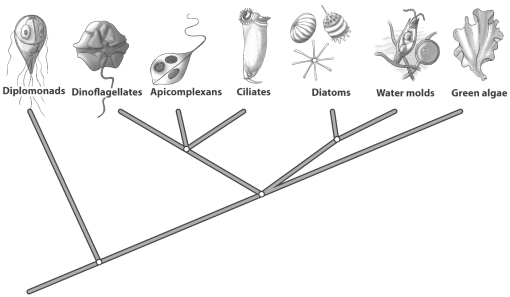
One prediction based on the arrangement of ciliates in the illustration is that the DNA of
A) the green algae would share more in common with the plants than with the diplomonads.
B) the diatoms and water molds would be more similar to one another than any other protist.
C) the diplomonads would constitute a large percentage of the DNA of all other protists.
D) All of the above predictions are reasonable.
One prediction based on the arrangement of ciliates in the illustration is that the DNA of
A) the green algae would share more in common with the plants than with the diplomonads.
B) the diatoms and water molds would be more similar to one another than any other protist.
C) the diplomonads would constitute a large percentage of the DNA of all other protists.
D) All of the above predictions are reasonable.
Question
Question
Question
Question
Question
Question
Question
Question
Question
Question
Question
Question
The inset in the figure below shows halobacterium, an archaean that lives in environments with very high salinities. 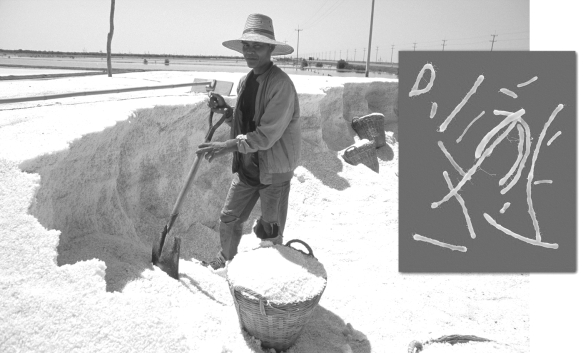
What hypothesis can explain the extreme habitats of the archaeans?
A) They came to earth from other planets, where harsher conditions prevail.
B) They would be more widespread, but are unable to successfully compete with bacteria and now occupy habitats where bacteria cannot live.
C) Archaeans evolved when Earth was much less hospitable, and are now relegated to those habitats most similar to early Earth.
D) Numerous food resources are available and unexploited in Earth's extreme habitats.
What hypothesis can explain the extreme habitats of the archaeans?
A) They came to earth from other planets, where harsher conditions prevail.
B) They would be more widespread, but are unable to successfully compete with bacteria and now occupy habitats where bacteria cannot live.
C) Archaeans evolved when Earth was much less hospitable, and are now relegated to those habitats most similar to early Earth.
D) Numerous food resources are available and unexploited in Earth's extreme habitats.
Question
Question
Question
Question
Question
Question
Question
The figure below shows the vertebrates and arthropods to be distantly related, yet each has features, like limbs and jaws, seen in no other groups. 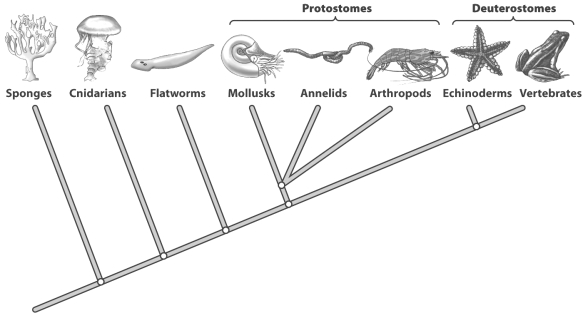
How can such an obvious similarity be discounted in favor of embryological development as a basis for classification?
A) The decision to overlook certain features reveals the arbitrary nature of classification and explains why there is so little agreement among taxonomists.
B) Limbs are not discounted by taxonomists; they were acquired from a common ancestor but later lost by the mollusks, annelids, and echinoderms.
C) Embryos are securely protected during development and have little need to evolve; shared inherited features indicate a common ancestor.
D) Examination of the embryos of all animals with body cavities reveals limbs, but they are unnecessary for some lifestyles and so they degenerate.
How can such an obvious similarity be discounted in favor of embryological development as a basis for classification?
A) The decision to overlook certain features reveals the arbitrary nature of classification and explains why there is so little agreement among taxonomists.
B) Limbs are not discounted by taxonomists; they were acquired from a common ancestor but later lost by the mollusks, annelids, and echinoderms.
C) Embryos are securely protected during development and have little need to evolve; shared inherited features indicate a common ancestor.
D) Examination of the embryos of all animals with body cavities reveals limbs, but they are unnecessary for some lifestyles and so they degenerate.
Question
Question
Question
Question
Question
Question
Question
Question
Question
Question
Question
Question
Question
Question
Question
Question
Question
Question
Question
Question
Question
Question
Question
Question
Question
Question
Question
Question
Question
Question
Question
Question
Question

Unlock Deck
Sign up to unlock the cards in this deck!
Unlock Deck
Unlock Deck
1/74

Play

Full screen (f)
Deck 3: Major Groups of Living Organisms
1
A distinguishing difference between bacteria and archaeans is
A) that bacteria are prokaryotic and archaeans are eukaryotic.
B) the molecules used to construct their cell walls.
C) the presence of membrane-bound organelles only in bacteria.
D) the greater size of the bacterial nucleus.
A) that bacteria are prokaryotic and archaeans are eukaryotic.
B) the molecules used to construct their cell walls.
C) the presence of membrane-bound organelles only in bacteria.
D) the greater size of the bacterial nucleus.
B
2
Bacterial cells can typically be represented by one of the following three shapes:
A) the sphere, rod, or cube.
B) the rod, sphere, or corkscrew.
C) the corkscrew, cube, or rod.
D) the cube, sphere, or comma.
A) the sphere, rod, or cube.
B) the rod, sphere, or corkscrew.
C) the corkscrew, cube, or rod.
D) the cube, sphere, or comma.
B
3
The vertebrates, which include organisms such as humans, birds, and frogs, illustrate that very different forms can evolve from one basic body plan. The observation that these diverse organisms share a general body plan supports the hypothesis that
A) they may simply be different variations of the same species.
B) evolution discovers and produces the most useful features for a given point in time.
C) they form a lineage that began with a common ancestor.
D) highly adaptive traits have a high probability of evolving independently within otherwise unrelated groups.
A) they may simply be different variations of the same species.
B) evolution discovers and produces the most useful features for a given point in time.
C) they form a lineage that began with a common ancestor.
D) highly adaptive traits have a high probability of evolving independently within otherwise unrelated groups.
C
4
Which of the following would you most likely find surviving in a boiling-hot spring?
A) an archaean
B) bacteria
C) a eukaryote
D) none of the above
A) an archaean
B) bacteria
C) a eukaryote
D) none of the above
Unlock Deck
Unlock for access to all 74 flashcards in this deck.
Unlock Deck
k this deck
5
The current classification system used by biologists is
A) complex and unchanging.
B) universally accepted by all biologists.
C) based on four generalized types of living organism: the Bacteria, the Archaea, the Eukarya, and the Protista.
D) updated and revised whenever new information becomes available.
A) complex and unchanging.
B) universally accepted by all biologists.
C) based on four generalized types of living organism: the Bacteria, the Archaea, the Eukarya, and the Protista.
D) updated and revised whenever new information becomes available.
Unlock Deck
Unlock for access to all 74 flashcards in this deck.
Unlock Deck
k this deck
6
Prokaryotes obtain their nutrition in a variety of ways; all of the following methods except ______ have been observed.
A) consuming other organisms
B) acquiring carbon from nonliving sources
C) using noncarbon-based nutritional systems
D) photosynthesis
A) consuming other organisms
B) acquiring carbon from nonliving sources
C) using noncarbon-based nutritional systems
D) photosynthesis
Unlock Deck
Unlock for access to all 74 flashcards in this deck.
Unlock Deck
k this deck
7
Which of the following statements about bacteria is false?
A) They help a variety of organisms digest their food.
B) They can provide the nitrate necessary for plant nutrition.
C) They can be used to clean up oil spills.
D) The membranes from their organelles can be used to produce medicines.
A) They help a variety of organisms digest their food.
B) They can provide the nitrate necessary for plant nutrition.
C) They can be used to clean up oil spills.
D) The membranes from their organelles can be used to produce medicines.
Unlock Deck
Unlock for access to all 74 flashcards in this deck.
Unlock Deck
k this deck
8
Prokaryotes differ in several ways from eukaryotes; one of the most distinctive is
A) the absence of a plasma membrane.
B) having hereditary material composed of DNA.
C) the presence of chromosomes.
D) a nucleus that encloses the cell's DNA.
A) the absence of a plasma membrane.
B) having hereditary material composed of DNA.
C) the presence of chromosomes.
D) a nucleus that encloses the cell's DNA.
Unlock Deck
Unlock for access to all 74 flashcards in this deck.
Unlock Deck
k this deck
9
When success is defined as the greatest number of living individuals, Earth's most successful inhabitants are the
A) vertebrates and birds.
B) fungi and animals.
C) bacteria and archaea.
D) plants and animals.
A) vertebrates and birds.
B) fungi and animals.
C) bacteria and archaea.
D) plants and animals.
Unlock Deck
Unlock for access to all 74 flashcards in this deck.
Unlock Deck
k this deck
10
Carbon and energy are among the most basic life resources and organisms have been classified with respect to how they are obtained. What term describes an organism that obtains these substances from rock?
A) chemoheterotroph
B) photoautotroph
C) photoheterotroph
D) chemoautotroph
A) chemoheterotroph
B) photoautotroph
C) photoheterotroph
D) chemoautotroph
Unlock Deck
Unlock for access to all 74 flashcards in this deck.
Unlock Deck
k this deck
11
The group with the greatest diversity in the ways it obtains carbon and energy is
A) the Fungi.
B) the Animalia.
C) the prokaryotes.
D) the Plantae.
A) the Fungi.
B) the Animalia.
C) the prokaryotes.
D) the Plantae.
Unlock Deck
Unlock for access to all 74 flashcards in this deck.
Unlock Deck
k this deck
12
Which of the following terms describes organisms that can survive in extremely salty environments?
A) thermophiles
B) halophiles
C) methanogens
D) none of the above
A) thermophiles
B) halophiles
C) methanogens
D) none of the above
Unlock Deck
Unlock for access to all 74 flashcards in this deck.
Unlock Deck
k this deck
13
Which of the following is not a testable hypothesis?
A) Bacteria have a nucleus.
B) Scientists who study bacteria are more satisfied with their careers.
C) Fungi obtain nutrients only from plants.
D) Animals can carry out photosynthesis.
A) Bacteria have a nucleus.
B) Scientists who study bacteria are more satisfied with their careers.
C) Fungi obtain nutrients only from plants.
D) Animals can carry out photosynthesis.
Unlock Deck
Unlock for access to all 74 flashcards in this deck.
Unlock Deck
k this deck
14
Bacteria can be distinguished from most other organisms because
A) bacterial cells have membrane-bound organelles.
B) bacterial DNA is not located within an organelle.
C) bacteria reproduce by splitting in two.
D) bacteria are generally single-celled.
A) bacterial cells have membrane-bound organelles.
B) bacterial DNA is not located within an organelle.
C) bacteria reproduce by splitting in two.
D) bacteria are generally single-celled.
Unlock Deck
Unlock for access to all 74 flashcards in this deck.
Unlock Deck
k this deck
15
Prokaryotic genomes
A) do not contain DNA.
B) are relatively small, containing only DNA that is actively used.
C) are relatively large, containing extra DNA that serves no known function.
D) contain about four times as much DNA as eukaryotic genomes.
A) do not contain DNA.
B) are relatively small, containing only DNA that is actively used.
C) are relatively large, containing extra DNA that serves no known function.
D) contain about four times as much DNA as eukaryotic genomes.
Unlock Deck
Unlock for access to all 74 flashcards in this deck.
Unlock Deck
k this deck
16
Because plants lack the ability to directly utilize the ______ present in the atmosphere, their abundance often depends on bacterial populations present within the soil.
A) nitrogen
B) oxygen
C) water
D) carbon dioxide
A) nitrogen
B) oxygen
C) water
D) carbon dioxide
Unlock Deck
Unlock for access to all 74 flashcards in this deck.
Unlock Deck
k this deck
17
Taxonomy is the subdiscipline in biology that classifies living organisms; at the present time
A) all living organisms have been discovered, named, and their relationships to other organisms described.
B) humans have just finished a complete count of the number of species on Earth.
C) the diversity of organisms on Earth is not completely known and estimates of the number of unknown species vary 10-fold.
D) there is no consensus regarding the proper classification system of currently known organisms.
A) all living organisms have been discovered, named, and their relationships to other organisms described.
B) humans have just finished a complete count of the number of species on Earth.
C) the diversity of organisms on Earth is not completely known and estimates of the number of unknown species vary 10-fold.
D) there is no consensus regarding the proper classification system of currently known organisms.
Unlock Deck
Unlock for access to all 74 flashcards in this deck.
Unlock Deck
k this deck
18
In addition to the Bacteria, which other kingdom is comprised exclusively of prokaryotic organisms?
A) Archaea
B) Fungi
C) Protista
D) Plantae
A) Archaea
B) Fungi
C) Protista
D) Plantae
Unlock Deck
Unlock for access to all 74 flashcards in this deck.
Unlock Deck
k this deck
19
Which of the following is not one of the three major ways of classifying organisms?
A) the Linnaean hierarchy
B) the Darwinian hierarchy
C) domains
D) an evolutionary tree
A) the Linnaean hierarchy
B) the Darwinian hierarchy
C) domains
D) an evolutionary tree
Unlock Deck
Unlock for access to all 74 flashcards in this deck.
Unlock Deck
k this deck
20
Microscopic examination can often resolve questions in taxonomy, for example, cells that possess a nucleus are never classified as
A) eukaryote.
B) fungi.
C) archaean.
D) protist.
A) eukaryote.
B) fungi.
C) archaean.
D) protist.
Unlock Deck
Unlock for access to all 74 flashcards in this deck.
Unlock Deck
k this deck
21
What capability did the development of a vascular system provide?
A) greater efficiency at capturing the energy from sunlight
B) greater efficiency for nutrient transport and structural support
C) permitted plant life to establish on land
D) allowed the developing embryo to remain protected until better growth conditions were available
A) greater efficiency at capturing the energy from sunlight
B) greater efficiency for nutrient transport and structural support
C) permitted plant life to establish on land
D) allowed the developing embryo to remain protected until better growth conditions were available
Unlock Deck
Unlock for access to all 74 flashcards in this deck.
Unlock Deck
k this deck
22
Examine the evolutionary tree pictured below.
One prediction based on the arrangement of ciliates in the illustration is that the DNA of
A) the green algae would share more in common with the plants than with the diplomonads.
B) the diatoms and water molds would be more similar to one another than any other protist.
C) the diplomonads would constitute a large percentage of the DNA of all other protists.
D) All of the above predictions are reasonable.
One prediction based on the arrangement of ciliates in the illustration is that the DNA of
A) the green algae would share more in common with the plants than with the diplomonads.
B) the diatoms and water molds would be more similar to one another than any other protist.
C) the diplomonads would constitute a large percentage of the DNA of all other protists.
D) All of the above predictions are reasonable.
Unlock Deck
Unlock for access to all 74 flashcards in this deck.
Unlock Deck
k this deck
23
What resources do plants use to produce the sugar molecules that their cells use for fuel?
A) carbon dioxide, water, and light energy
B) nitrogen and oxygen
C) water and pond scum
D) water, nitrogen, and iron
A) carbon dioxide, water, and light energy
B) nitrogen and oxygen
C) water and pond scum
D) water, nitrogen, and iron
Unlock Deck
Unlock for access to all 74 flashcards in this deck.
Unlock Deck
k this deck
24
The most ancient of the Eukarya are
A) Fungi.
B) Animalia.
C) Protista.
D) Plantae.
A) Fungi.
B) Animalia.
C) Protista.
D) Plantae.
Unlock Deck
Unlock for access to all 74 flashcards in this deck.
Unlock Deck
k this deck
25
Mitochondria, the energy-processing organelles in eukaryotic cells, have their own DNA, separate from that of the cell's nucleus. Which of the following choices best explains the presence of mitochondria in eukaryotic cells?
A) An ancestral prokaryote engulfed and retained a separate energy-processing prokaryotic cell.
B) Mitochondria are formed when a eukaryotic cell undergoes fission.
C) Mitochondria are separate organisms that fuse with eukaryotic cells in much the same fashion as algae and fungi form lichens.
D) A prokaryote and a eukaryote fuse to form mitochondria.
A) An ancestral prokaryote engulfed and retained a separate energy-processing prokaryotic cell.
B) Mitochondria are formed when a eukaryotic cell undergoes fission.
C) Mitochondria are separate organisms that fuse with eukaryotic cells in much the same fashion as algae and fungi form lichens.
D) A prokaryote and a eukaryote fuse to form mitochondria.
Unlock Deck
Unlock for access to all 74 flashcards in this deck.
Unlock Deck
k this deck
26
No single characteristic is sufficient to describe a kingdom, for example, plants and some bacteria share in common
A) the ability to photosynthesize.
B) the presence of a cell wall and the absence of a plasma membrane.
C) a heterotrophic lifestyle.
D) the ability to reproduce sexually.
A) the ability to photosynthesize.
B) the presence of a cell wall and the absence of a plasma membrane.
C) a heterotrophic lifestyle.
D) the ability to reproduce sexually.
Unlock Deck
Unlock for access to all 74 flashcards in this deck.
Unlock Deck
k this deck
27
Life on earth appears to have began in the water; the first organisms believed to colonize land were
A) bacteria.
B) fungi.
C) plants.
D) animals.
A) bacteria.
B) fungi.
C) plants.
D) animals.
Unlock Deck
Unlock for access to all 74 flashcards in this deck.
Unlock Deck
k this deck
28
What best explains why bacteria can reproduce so much more rapidly than an organism like a mushroom?
A) Mushrooms reproduce using spores that require a lengthy exposure to the environment before the outer coating can break open.
B) Bacteria live in extreme environments and can avoid having to wait for more favorable conditions to reproduce, like mushrooms and other plants.
C) Since most bacteria cause disease they are avoided by consumers, while organisms like mushrooms are quickly eaten, preventing rapid population growth.
D) Mushrooms reproduce sexually, so the proper mating types must contact one another before reproduction can proceed.
A) Mushrooms reproduce using spores that require a lengthy exposure to the environment before the outer coating can break open.
B) Bacteria live in extreme environments and can avoid having to wait for more favorable conditions to reproduce, like mushrooms and other plants.
C) Since most bacteria cause disease they are avoided by consumers, while organisms like mushrooms are quickly eaten, preventing rapid population growth.
D) Mushrooms reproduce sexually, so the proper mating types must contact one another before reproduction can proceed.
Unlock Deck
Unlock for access to all 74 flashcards in this deck.
Unlock Deck
k this deck
29
Protists display the earliest version of sexual reproduction, whereby
A) separate male and female protists within the same species mate.
B) females of one protist species mate with males of another protist species.
C) special cells called gametes fuse together to produce a new individual.
D) an individual splits into two individuals that then mate with one another.
A) separate male and female protists within the same species mate.
B) females of one protist species mate with males of another protist species.
C) special cells called gametes fuse together to produce a new individual.
D) an individual splits into two individuals that then mate with one another.
Unlock Deck
Unlock for access to all 74 flashcards in this deck.
Unlock Deck
k this deck
30
Cells carry out many chemical processes, some of which produce toxic by-products. If you were designing a cell from known components, which of the following would provide the best method of protecting the cell from its own toxic by-products while allowing it to complete the chemical reactions necessary for life?
A) modify the cell membrane so that the toxin could diffuse to the outside of the cell but not reenter
B) isolate the toxin-producing reactions within an organelle
C) improve the photosynthetic process to produce more energy
D) devise a noncarbon-based cellular chemistry
A) modify the cell membrane so that the toxin could diffuse to the outside of the cell but not reenter
B) isolate the toxin-producing reactions within an organelle
C) improve the photosynthetic process to produce more energy
D) devise a noncarbon-based cellular chemistry
Unlock Deck
Unlock for access to all 74 flashcards in this deck.
Unlock Deck
k this deck
31
Protists may superficially resemble organisms in the other kingdoms; one exception is the kingdom _____, whose members do not resemble protists in any way.
A) Bacteria
B) Fungi
C) Plantae
D) Animalia.
A) Bacteria
B) Fungi
C) Plantae
D) Animalia.
Unlock Deck
Unlock for access to all 74 flashcards in this deck.
Unlock Deck
k this deck
32
Resolving the relationship between the various kingdoms has been challenging because species often resemble one another; for example, the _______ contain some organisms that are animal-like and others that are plant-like.
A) bacteria
B) fungi
C) archaeans
D) protists
A) bacteria
B) fungi
C) archaeans
D) protists
Unlock Deck
Unlock for access to all 74 flashcards in this deck.
Unlock Deck
k this deck
33
The kingdom Protista is quite diverse and the relationship between its various members is unclear. The best method of clarifying those relationships will require that biologists
A) remove the kingdom from Eukarya and place it in its own domain.
B) match each of the protist traits with the corresponding animal trait of the common ancestor.
C) separate the eukaryotic protists from the prokaryotic protists.
D) create an evolutionary tree for the group using comparative DNA data.
A) remove the kingdom from Eukarya and place it in its own domain.
B) match each of the protist traits with the corresponding animal trait of the common ancestor.
C) separate the eukaryotic protists from the prokaryotic protists.
D) create an evolutionary tree for the group using comparative DNA data.
Unlock Deck
Unlock for access to all 74 flashcards in this deck.
Unlock Deck
k this deck
34
The inset in the figure below shows halobacterium, an archaean that lives in environments with very high salinities.
What hypothesis can explain the extreme habitats of the archaeans?
A) They came to earth from other planets, where harsher conditions prevail.
B) They would be more widespread, but are unable to successfully compete with bacteria and now occupy habitats where bacteria cannot live.
C) Archaeans evolved when Earth was much less hospitable, and are now relegated to those habitats most similar to early Earth.
D) Numerous food resources are available and unexploited in Earth's extreme habitats.
What hypothesis can explain the extreme habitats of the archaeans?
A) They came to earth from other planets, where harsher conditions prevail.
B) They would be more widespread, but are unable to successfully compete with bacteria and now occupy habitats where bacteria cannot live.
C) Archaeans evolved when Earth was much less hospitable, and are now relegated to those habitats most similar to early Earth.
D) Numerous food resources are available and unexploited in Earth's extreme habitats.
Unlock Deck
Unlock for access to all 74 flashcards in this deck.
Unlock Deck
k this deck
35
The main body of a fungus is known as the
A) mycelium.
B) mitochondrion.
C) gymnosperm.
D) septum.
A) mycelium.
B) mitochondrion.
C) gymnosperm.
D) septum.
Unlock Deck
Unlock for access to all 74 flashcards in this deck.
Unlock Deck
k this deck
36
Although exceptions exist, reproduction in most eukaryotes involves
A) two individuals combining DNA during the formation of a new organism.
B) one individual dividing to make two identical organisms.
C) two individuals fusing to form one organism.
D) the cells of an individual dividing.
A) two individuals combining DNA during the formation of a new organism.
B) one individual dividing to make two identical organisms.
C) two individuals fusing to form one organism.
D) the cells of an individual dividing.
Unlock Deck
Unlock for access to all 74 flashcards in this deck.
Unlock Deck
k this deck
37
The first plant group to develop seeds was the
A) mosses.
B) ferns.
C) gymnosperms.
D) angiosperms.
A) mosses.
B) ferns.
C) gymnosperms.
D) angiosperms.
Unlock Deck
Unlock for access to all 74 flashcards in this deck.
Unlock Deck
k this deck
38
Although costly to produce, the large number of plants producing fruit attest to its success as an adaptation; in what way is fruit production helpful?
A) Fruits attract pollinators like insects and birds to move pollen between different plants.
B) Fruit toxins can discourage potential consumers from eating the plant.
C) Plants can store energy in fruits during summer and then later recover the energy during winter, when the fruit decomposes.
D) Consumers eating fruits also eat seeds that when not digested can be deposited far from the parent plant.
A) Fruits attract pollinators like insects and birds to move pollen between different plants.
B) Fruit toxins can discourage potential consumers from eating the plant.
C) Plants can store energy in fruits during summer and then later recover the energy during winter, when the fruit decomposes.
D) Consumers eating fruits also eat seeds that when not digested can be deposited far from the parent plant.
Unlock Deck
Unlock for access to all 74 flashcards in this deck.
Unlock Deck
k this deck
39
The kingdom Plantae consists of four major groups; the _____ are believed to have been the first to appear.
A) angiosperms
B) gymnosperm
C) ferns
D) mosses
A) angiosperms
B) gymnosperm
C) ferns
D) mosses
Unlock Deck
Unlock for access to all 74 flashcards in this deck.
Unlock Deck
k this deck
40
Speculate on the diversity of life on Earth if plants had never evolved.
A) The existence of large multicellular consumers like animals would be unlikely.
B) Since protists evolved before plants and can derive their energy by consuming bacteria, they could be expected to be common.
C) Bacterial life would be less diverse than it is presently.
D) All of the above are reasonable hypotheses.
A) The existence of large multicellular consumers like animals would be unlikely.
B) Since protists evolved before plants and can derive their energy by consuming bacteria, they could be expected to be common.
C) Bacterial life would be less diverse than it is presently.
D) All of the above are reasonable hypotheses.
Unlock Deck
Unlock for access to all 74 flashcards in this deck.
Unlock Deck
k this deck
41
The figure below shows the vertebrates and arthropods to be distantly related, yet each has features, like limbs and jaws, seen in no other groups.
How can such an obvious similarity be discounted in favor of embryological development as a basis for classification?
A) The decision to overlook certain features reveals the arbitrary nature of classification and explains why there is so little agreement among taxonomists.
B) Limbs are not discounted by taxonomists; they were acquired from a common ancestor but later lost by the mollusks, annelids, and echinoderms.
C) Embryos are securely protected during development and have little need to evolve; shared inherited features indicate a common ancestor.
D) Examination of the embryos of all animals with body cavities reveals limbs, but they are unnecessary for some lifestyles and so they degenerate.
How can such an obvious similarity be discounted in favor of embryological development as a basis for classification?
A) The decision to overlook certain features reveals the arbitrary nature of classification and explains why there is so little agreement among taxonomists.
B) Limbs are not discounted by taxonomists; they were acquired from a common ancestor but later lost by the mollusks, annelids, and echinoderms.
C) Embryos are securely protected during development and have little need to evolve; shared inherited features indicate a common ancestor.
D) Examination of the embryos of all animals with body cavities reveals limbs, but they are unnecessary for some lifestyles and so they degenerate.
Unlock Deck
Unlock for access to all 74 flashcards in this deck.
Unlock Deck
k this deck
42
Relationships among the animals having body cavities can be easily determined by examination of embryonic development; vertebrates and echinoderms are grouped together because in each
A) the infolding that forms the body cavity eventually becomes the anus.
B) life starts as a single fertilized cell and then becomes multicellular.
C) the death of specific cells creates the internal hollow that eventually becomes the body cavity.
D) the infolding that forms the body cavity eventually becomes the mouth.
A) the infolding that forms the body cavity eventually becomes the anus.
B) life starts as a single fertilized cell and then becomes multicellular.
C) the death of specific cells creates the internal hollow that eventually becomes the body cavity.
D) the infolding that forms the body cavity eventually becomes the mouth.
Unlock Deck
Unlock for access to all 74 flashcards in this deck.
Unlock Deck
k this deck
43
Viral classification and biology has been challenging; presently most biologists agree that viruses
A) should be classified as members of the kingdom Protista.
B) are constructed from a protein wrapped around DNA or RNA.
C) use a photosynthetic process more similar to bacteria than plants.
D) should be classified as autochemotrophic.
A) should be classified as members of the kingdom Protista.
B) are constructed from a protein wrapped around DNA or RNA.
C) use a photosynthetic process more similar to bacteria than plants.
D) should be classified as autochemotrophic.
Unlock Deck
Unlock for access to all 74 flashcards in this deck.
Unlock Deck
k this deck
44
_______ is the most ancient group with the eukaryotic domain.
Unlock Deck
Unlock for access to all 74 flashcards in this deck.
Unlock Deck
k this deck
45
Lichens are formed by an association between
A) algae and plants.
B) fungi and plants.
C) algae and fungi.
D) protists and algae.
A) algae and plants.
B) fungi and plants.
C) algae and fungi.
D) protists and algae.
Unlock Deck
Unlock for access to all 74 flashcards in this deck.
Unlock Deck
k this deck
46
New features that allow a group to survive and reproduce successfully can be called ___________ innovations.
Unlock Deck
Unlock for access to all 74 flashcards in this deck.
Unlock Deck
k this deck
47
A waxy covering known as the _______ was an important adaptation for terrestrial life; it helps keep land plants from drying out when exposed to sun and wind.
Unlock Deck
Unlock for access to all 74 flashcards in this deck.
Unlock Deck
k this deck
48
The defining feature of the angiosperms is the _______.
Unlock Deck
Unlock for access to all 74 flashcards in this deck.
Unlock Deck
k this deck
49
Bacteria, Archaea, and Eukarya are three _______ under the most commonly used current classification system.
Unlock Deck
Unlock for access to all 74 flashcards in this deck.
Unlock Deck
k this deck
50
The two animal lineages that evolved complete body cavities with a mouth at one end and an anal opening at the other are the
A) protostomes and deuterostomes.
B) prokaryotes and eukaryotes.
C) protostomes and protists.
D) sponges and flatworms.
A) protostomes and deuterostomes.
B) prokaryotes and eukaryotes.
C) protostomes and protists.
D) sponges and flatworms.
Unlock Deck
Unlock for access to all 74 flashcards in this deck.
Unlock Deck
k this deck
51
Honeybees have declined dramatically within the United States in recent years, but it's important to note that the honeybee is not a native species; it is native to Asia. If the honeybee disappears entirely,
A) native pollinators will quickly replace it, both restoring the natural ecological order and maintaining normal plant pollination.
B) existing insects will quickly evolve to take advantage of the lack of competition for nectar and pollen in its absence.
C) plants will quickly evolve different methods of pollen dispersal, like wind pollination, to avoid extinction themselves.
D) farming will have to significantly change since most modern crops are horticulturally modified and poorly pollinated by native species.
A) native pollinators will quickly replace it, both restoring the natural ecological order and maintaining normal plant pollination.
B) existing insects will quickly evolve to take advantage of the lack of competition for nectar and pollen in its absence.
C) plants will quickly evolve different methods of pollen dispersal, like wind pollination, to avoid extinction themselves.
D) farming will have to significantly change since most modern crops are horticulturally modified and poorly pollinated by native species.
Unlock Deck
Unlock for access to all 74 flashcards in this deck.
Unlock Deck
k this deck
52
Imagine the discovery of an undescribed nonphotosynthetic multicellular organism. To determine whether it is a(n) _______, you need to examine it microscopically to determine if its _______
A) animal or fungi; cells have cell walls.
B) animal or plant; cells have nuclei.
C) plant or fungi; cells have cell walls
D) animal or fungi; cells contain DNA.
A) animal or fungi; cells have cell walls.
B) animal or plant; cells have nuclei.
C) plant or fungi; cells have cell walls
D) animal or fungi; cells contain DNA.
Unlock Deck
Unlock for access to all 74 flashcards in this deck.
Unlock Deck
k this deck
53
One reason plants can live on land is because they have developed the _______, which facilitates the distribution of water and nutrients obtained from the soil.
Unlock Deck
Unlock for access to all 74 flashcards in this deck.
Unlock Deck
k this deck
54
Although seeming quite distinct, cotton, morphine, and flour are all obtained from flowering plants, otherwise known as __________
Unlock Deck
Unlock for access to all 74 flashcards in this deck.
Unlock Deck
k this deck
55
Which of the following groups has been the most recent to evolve?
A) Bacteria
B) Fungi
C) Ciliates
D) Archaea
A) Bacteria
B) Fungi
C) Ciliates
D) Archaea
Unlock Deck
Unlock for access to all 74 flashcards in this deck.
Unlock Deck
k this deck
56
Which of the following investigations would be the least likely to provide useful information about the relationships within the kingdom Animalia?
A) which developmental sequences occur during embryonic growth
B) an examination of the construction of the cell membrane
C) a comparative examination of the proteins used in photosynthesis
D) in what way various organs and organ systems have become modified over time
A) which developmental sequences occur during embryonic growth
B) an examination of the construction of the cell membrane
C) a comparative examination of the proteins used in photosynthesis
D) in what way various organs and organ systems have become modified over time
Unlock Deck
Unlock for access to all 74 flashcards in this deck.
Unlock Deck
k this deck
57
_______, first seen in the gymnosperms, were a major evolutionary development; they both protect the embryo and provide an initial source of nutrients.
Unlock Deck
Unlock for access to all 74 flashcards in this deck.
Unlock Deck
k this deck
58
The ______ of a eukaryotic cell contains its DNA.
Unlock Deck
Unlock for access to all 74 flashcards in this deck.
Unlock Deck
k this deck
59
The ________ were the first plant group to evolve a vascular system.
Unlock Deck
Unlock for access to all 74 flashcards in this deck.
Unlock Deck
k this deck
60
The earliest lineage of organisms living today are the _______.
Unlock Deck
Unlock for access to all 74 flashcards in this deck.
Unlock Deck
k this deck
61
The vertebrates are grouped into a lineage because all of members possess an internal _______.
Unlock Deck
Unlock for access to all 74 flashcards in this deck.
Unlock Deck
k this deck
62
Most plants produce flowers, which greatly improve the probability of _______.
Unlock Deck
Unlock for access to all 74 flashcards in this deck.
Unlock Deck
k this deck
63
The most commonly used classification system includes 12 kingdoms.
Unlock Deck
Unlock for access to all 74 flashcards in this deck.
Unlock Deck
k this deck
64
The organisms found living inside boiling-hot geysers can be described as thermophiles.
Unlock Deck
Unlock for access to all 74 flashcards in this deck.
Unlock Deck
k this deck
65
Aerobic organisms can survive without oxygen.
Unlock Deck
Unlock for access to all 74 flashcards in this deck.
Unlock Deck
k this deck
66
Flowers are the organs of reproduction in angiosperms.
Unlock Deck
Unlock for access to all 74 flashcards in this deck.
Unlock Deck
k this deck
67
In nature, fungi function primarily as _______, getting their nutrition from dead and dying organisms.
Unlock Deck
Unlock for access to all 74 flashcards in this deck.
Unlock Deck
k this deck
68
The domain Eukarya is presently subdivided into four kingdoms, although new information concerning the protists could increase that number.
Unlock Deck
Unlock for access to all 74 flashcards in this deck.
Unlock Deck
k this deck
69
Seeds contain the embryos of plants and nutrients to assist with germination and initial growth.
Unlock Deck
Unlock for access to all 74 flashcards in this deck.
Unlock Deck
k this deck
70
Sponges are considered to be the most ancient of animals; although multicellular, sponges have not developed the _______ present in all other animals.
Unlock Deck
Unlock for access to all 74 flashcards in this deck.
Unlock Deck
k this deck
71
All bacteria have the same shape.
Unlock Deck
Unlock for access to all 74 flashcards in this deck.
Unlock Deck
k this deck
72
The flower is the basic reproductive structure of a plant; thus, all plants produce flowers.
Unlock Deck
Unlock for access to all 74 flashcards in this deck.
Unlock Deck
k this deck
73
Without angiosperms, mosses could not reproduce.
Unlock Deck
Unlock for access to all 74 flashcards in this deck.
Unlock Deck
k this deck
74
Mutualistic organisms are more commonly termed parasites.
Unlock Deck
Unlock for access to all 74 flashcards in this deck.
Unlock Deck
k this deck
Unlock Deck
Unlock for access to all 74 flashcards in this deck.






