







 Chat with AI

Deck 11: Parliamentary, Presidential, and Semi-Presidential Democracies
Full screen (f)

Question

Question
Question
Question
Question
Question
Question
Question
Question
Question
Question
Question
Question
Question
Question
Question
Question
Question
Question
Question
Question
Question
Question
Question
Question
Question
Question
Question
Question
Question
Question
Question
Question
Question
Question
Question
Question
Question
Question
In Table 1, below, we report the results from the Swedish parliamentary elections of 1982. Based on these results, answer the following questions.
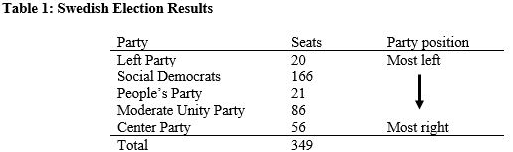
-If a government formed between the Social Democrats, the Center Party, and the Moderate Unity Party, then what type of government would it be?
A) minority coalition government
B) surplus majority government
C) connected minimal winning coalition
D) minimal winning coalition.
-If a government formed between the Social Democrats, the Center Party, and the Moderate Unity Party, then what type of government would it be?
A) minority coalition government
B) surplus majority government
C) connected minimal winning coalition
D) minimal winning coalition.
Question
In Table 1, below, we report the results from the Swedish parliamentary elections of 1982. Based on these results, answer the following questions.
-The formateur would most likely be the leader of which party?
A) Left Party
B) Social Democrats
C) People's Party
D) Moderate Unity Party
E) Center Party
-The formateur would most likely be the leader of which party?
A) Left Party
B) Social Democrats
C) People's Party
D) Moderate Unity Party
E) Center Party
Question
In Table 1, below, we report the results from the Swedish parliamentary elections of 1982. Based on these results, answer the following questions.
-A preelectoral coalition is a collection of parties that do not compete independently at election time.
-A preelectoral coalition is a collection of parties that do not compete independently at election time.
Question
Question
Question
Question
Question
Question
Question
Question
Use Table 2, below, to answer the following questions.
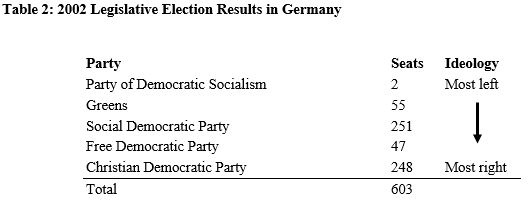
-Look at the election results from Germany in 2002 in Table 2. If a government formed between the Christian Democratic Party and the Free Democratic Party, then what type of government would it be? Pick the best answer from those shown below.
A) minority coalition government
B) surplus majority government
C) connected minimal winning coalition
D) minimal winning coalition
-Look at the election results from Germany in 2002 in Table 2. If a government formed between the Christian Democratic Party and the Free Democratic Party, then what type of government would it be? Pick the best answer from those shown below.
A) minority coalition government
B) surplus majority government
C) connected minimal winning coalition
D) minimal winning coalition
Question
Use Table 2, below, to answer the following questions.
-If a government had formed between the Social Democratic Party and the Greens, then what type of government would it be?
A) a minority coalition government
B) a minimal winning coalition government
C) a surplus majority government
-If a government had formed between the Social Democratic Party and the Greens, then what type of government would it be?
A) a minority coalition government
B) a minimal winning coalition government
C) a surplus majority government
Question
Use Table 2, below, to answer the following questions.
-If a government had formed between the Christian Democratic Party and the Free Democratic Party, then what type of government would it be?
A) a minority coalition government
B) a minimal winning coalition government
C) a surplus majority government
-If a government had formed between the Christian Democratic Party and the Free Democratic Party, then what type of government would it be?
A) a minority coalition government
B) a minimal winning coalition government
C) a surplus majority government
Question
Question
Question
Question
Question
Question
Question
Question
Question
Question

Unlock Deck
Sign up to unlock the cards in this deck!
Unlock Deck
Unlock Deck
1/61

Play

Full screen (f)
Deck 11: Parliamentary, Presidential, and Semi-Presidential Democracies
1
If a country has an independently elected president, then we necessarily consider it to be a presidential regime.
False
2
Is it possible to have a monarch as a head of state in a democracy?
A) Yes, this can occur in semi-presidential regimes.
B) Yes, this can occur in presidential regimes.
C) Yes, this can occur in parliamentary regimes.
D) No, it is impossible for a country to be considered a democracy if it still has a monarchy.
A) Yes, this can occur in semi-presidential regimes.
B) Yes, this can occur in presidential regimes.
C) Yes, this can occur in parliamentary regimes.
D) No, it is impossible for a country to be considered a democracy if it still has a monarchy.
C
3
When we talk about "the government" in terms of distinguishing parliamentary, presidential, and semi-presidential systems (e.g., when we say that the government depends on the legislative majority as well as the president in a mixed system) we mean:
A) the state.
B) all of the elected officials in a country.
C) the cabinet (made up of the prime minister and the other ministers).
A) the state.
B) all of the elected officials in a country.
C) the cabinet (made up of the prime minister and the other ministers).
C
4
If the opposition in the legislature proposes a vote on whether or not the current government should stay in power, then this is an example of:
A) an investiture vote.
B) a no confidence vote.
A) an investiture vote.
B) a no confidence vote.
Unlock Deck
Unlock for access to all 61 flashcards in this deck.
Unlock Deck
k this deck
5
If an incoming government must face a formal vote before it can officially take office, this is referred to as:
A) an investiture vote.
B) a no confidence vote.
A) an investiture vote.
B) a no confidence vote.
Unlock Deck
Unlock for access to all 61 flashcards in this deck.
Unlock Deck
k this deck
6
Which of the following statements best describes a vote of confidence?
A) A new government must pass a vote (on the cabinet's composition and proposed policies) in the legislature before it can take office.
B) A government declares that a vote on a particular piece of legislation is also a vote of support for the government itself; if the legislators do not support the legislation, then the government will resign (and new elections might result).
C) A group of legislators propose a vote on the support of the incumbent government. If the government passes the vote, then it stays in office. If it fails the vote, then it must resign (and new elections might result).
A) A new government must pass a vote (on the cabinet's composition and proposed policies) in the legislature before it can take office.
B) A government declares that a vote on a particular piece of legislation is also a vote of support for the government itself; if the legislators do not support the legislation, then the government will resign (and new elections might result).
C) A group of legislators propose a vote on the support of the incumbent government. If the government passes the vote, then it stays in office. If it fails the vote, then it must resign (and new elections might result).
Unlock Deck
Unlock for access to all 61 flashcards in this deck.
Unlock Deck
k this deck
7
When you classify countries in terms of presidential versus not presidential (i.e., either parliamentary or semi-presidential), whether or not a country has an investiture vote is more important than whether or not they have a no confidence vote procedure.
Unlock Deck
Unlock for access to all 61 flashcards in this deck.
Unlock Deck
k this deck
8
What is a constructive vote of no confidence?
A) When the legislature votes to approve an incoming cabinet.
B) When the members of the legislative majority propose a no confidence vote.
C) When the no confidence vote specifies an alternative government that will be installed if the no confidence vote is successful.
A) When the legislature votes to approve an incoming cabinet.
B) When the members of the legislative majority propose a no confidence vote.
C) When the no confidence vote specifies an alternative government that will be installed if the no confidence vote is successful.
Unlock Deck
Unlock for access to all 61 flashcards in this deck.
Unlock Deck
k this deck
9
To stay in power in a parliamentary democracy, the government must keep a majority of the members of the legislature happy.
Unlock Deck
Unlock for access to all 61 flashcards in this deck.
Unlock Deck
k this deck
10
In which system(s) is the government not responsible to the legislature?
A) in a parliamentary regime
B) in a presidential regime
C) in a semi-presidential regime
D) all of these
E) only (A) and (C)
F) only (B) and (C)
A) in a parliamentary regime
B) in a presidential regime
C) in a semi-presidential regime
D) all of these
E) only (A) and (C)
F) only (B) and (C)
Unlock Deck
Unlock for access to all 61 flashcards in this deck.
Unlock Deck
k this deck
11
In which system(s) is the government responsible to the legislature but not the president?
A) in a parliamentary regime
B) in a presidential regime
C) in a semi-presidential regime
D) all of these
E) only (A) and (C)
F) only (B) and (C)
A) in a parliamentary regime
B) in a presidential regime
C) in a semi-presidential regime
D) all of these
E) only (A) and (C)
F) only (B) and (C)
Unlock Deck
Unlock for access to all 61 flashcards in this deck.
Unlock Deck
k this deck
12
In which system(s) is the government responsible to the legislature and the president?
A) in a parliamentary regime
B) in a presidential regime
C) in a semi-presidential regime
D) all of these
E) only (A) and (C)
F) only (B) and (C)
A) in a parliamentary regime
B) in a presidential regime
C) in a semi-presidential regime
D) all of these
E) only (A) and (C)
F) only (B) and (C)
Unlock Deck
Unlock for access to all 61 flashcards in this deck.
Unlock Deck
k this deck
13
In which system(s) is the government responsible to the legislature?
A) in a parliamentary regime
B) in a presidential regime
C) in a semi-presidential regime
D) all of these
E) only (A) and (C)
F) only (B) and (C)
A) in a parliamentary regime
B) in a presidential regime
C) in a semi-presidential regime
D) all of these
E) only (A) and (C)
F) only (B) and (C)
Unlock Deck
Unlock for access to all 61 flashcards in this deck.
Unlock Deck
k this deck
14
In which system(s) is the government responsible to the president?
A) in a parliamentary regime
B) in a presidential regime
C) in a semi-presidential regime
D) all of these
E) only (A) and (C)
F) only (B) and (C)
A) in a parliamentary regime
B) in a presidential regime
C) in a semi-presidential regime
D) all of these
E) only (A) and (C)
F) only (B) and (C)
Unlock Deck
Unlock for access to all 61 flashcards in this deck.
Unlock Deck
k this deck
15
Which of the following defines a presidential regime?
A) Independently (directly or indirectly) elected president.
B) Government is responsible to the president but not to the legislature.
C) Both (A) and (B).
A) Independently (directly or indirectly) elected president.
B) Government is responsible to the president but not to the legislature.
C) Both (A) and (B).
Unlock Deck
Unlock for access to all 61 flashcards in this deck.
Unlock Deck
k this deck
16
In a semi-presidential regime, who is the primary political actor during periods of cohabitation?
A) the president
B) the prime minister
C) Both, depending on the issue-prime minister has more control over domestic politics, but president still has a role in foreign policy.
A) the president
B) the prime minister
C) Both, depending on the issue-prime minister has more control over domestic politics, but president still has a role in foreign policy.
Unlock Deck
Unlock for access to all 61 flashcards in this deck.
Unlock Deck
k this deck
17
Canada held an early general election on January 23, 2006, after the Liberal Party's minority government was toppled in a no-confidence vote on November 28, 2005. Canada does not have an independently elected president. Based on these two pieces of information, is Canada a presidential, parliamentary, or semi-presidential democracy?
A) presidential
B) parliamentary
C) semi-presidential
A) presidential
B) parliamentary
C) semi-presidential
Unlock Deck
Unlock for access to all 61 flashcards in this deck.
Unlock Deck
k this deck
18
The difference between premier-presidential regimes and president-parliamentary regimes is the following:
A) The former is responsible to the legislature while the latter is not.
B) The former is responsible to the president while the latter is not.
C) The former is not responsible to the legislature while the latter is.
D) The former is not responsible to the president while the latter is.
A) The former is responsible to the legislature while the latter is not.
B) The former is responsible to the president while the latter is not.
C) The former is not responsible to the legislature while the latter is.
D) The former is not responsible to the president while the latter is.
Unlock Deck
Unlock for access to all 61 flashcards in this deck.
Unlock Deck
k this deck
19
A good example of a premier-presidential regime is the following country:
A) China
B) Ireland
C) United Kingdom
D) Italy
A) China
B) Ireland
C) United Kingdom
D) Italy
Unlock Deck
Unlock for access to all 61 flashcards in this deck.
Unlock Deck
k this deck
20
A good example of a president-parliamentary regime is the following country:
A) China
B) Netherlands
C) Japan
D) France
A) China
B) Netherlands
C) Japan
D) France
Unlock Deck
Unlock for access to all 61 flashcards in this deck.
Unlock Deck
k this deck
21
Presidents have more influence on policy in president-parliamentary regimes than premier-presidential regimes:
Unlock Deck
Unlock for access to all 61 flashcards in this deck.
Unlock Deck
k this deck
22
Which of the following is an example of a presidential regime?
A) El Salvador
B) Bangladesh
C) France
A) El Salvador
B) Bangladesh
C) France
Unlock Deck
Unlock for access to all 61 flashcards in this deck.
Unlock Deck
k this deck
23
Based on the following information from the Irish constitution, is Ireland presidential, parliamentary, or semi-presidential?
Article 12: There shall be a President of Ireland (Uachtarán na hÉireann), hereinafter called the President, who shall take precedence over all other persons in the State and who shall exercise and perform the powers and functions conferred on the President by this Constitution and by law. The President shall be elected by direct vote of the people.
Article 13: The President shall, on the nomination of the Dáil Éireann, appoint the Taoiseach, that is, the head of the Government or Prime Minister. The president shall, on the nomination of the Taoiseach with the previous approval of Dáil Éireann, appoint the other members of the Government. The President shall, on the advice of the Taoiseach, accept the resignation or terminate the appointment of any member of the Government. Dáil Éireann shall be summoned and dissolved by the President on the advice of the Taoiseach. The President may in his absolute discretion refuse to dissolve Dáil Éireann on the advice of a Taoiseach who has ceased to retain the support of a majority in Dáil Éireann. . . . The President shall not be answerable to either House of the Oireachtas or to any court for the exercise and performance of the powers and functions of his office or for any act done or purporting to be done by him in the exercise and performance of these powers and functions.
Article 15: The National Parliament shall be called and known, and is in this Constitution generally referred to, as the Oireachtas. The Oireachtas shall consist of the President and two Houses, viz.: a House of Representatives to be called Dáil Éireann and a Senate to be called Seanad Éireann.
Article 28: The Government shall consist of not less than seven and not more than fifteen members who shall be appointed by the President in accordance with the provisions of this Constitution. . . . The Government shall be responsible to the Dáil Éireann. The head of the government, or Prime Minister, shall be called, and is in this Constitution referred to as, the Taoiseach.
A) parliamentary
B) presidential
C) semi-presidential
Article 12: There shall be a President of Ireland (Uachtarán na hÉireann), hereinafter called the President, who shall take precedence over all other persons in the State and who shall exercise and perform the powers and functions conferred on the President by this Constitution and by law. The President shall be elected by direct vote of the people.
Article 13: The President shall, on the nomination of the Dáil Éireann, appoint the Taoiseach, that is, the head of the Government or Prime Minister. The president shall, on the nomination of the Taoiseach with the previous approval of Dáil Éireann, appoint the other members of the Government. The President shall, on the advice of the Taoiseach, accept the resignation or terminate the appointment of any member of the Government. Dáil Éireann shall be summoned and dissolved by the President on the advice of the Taoiseach. The President may in his absolute discretion refuse to dissolve Dáil Éireann on the advice of a Taoiseach who has ceased to retain the support of a majority in Dáil Éireann. . . . The President shall not be answerable to either House of the Oireachtas or to any court for the exercise and performance of the powers and functions of his office or for any act done or purporting to be done by him in the exercise and performance of these powers and functions.
Article 15: The National Parliament shall be called and known, and is in this Constitution generally referred to, as the Oireachtas. The Oireachtas shall consist of the President and two Houses, viz.: a House of Representatives to be called Dáil Éireann and a Senate to be called Seanad Éireann.
Article 28: The Government shall consist of not less than seven and not more than fifteen members who shall be appointed by the President in accordance with the provisions of this Constitution. . . . The Government shall be responsible to the Dáil Éireann. The head of the government, or Prime Minister, shall be called, and is in this Constitution referred to as, the Taoiseach.
A) parliamentary
B) presidential
C) semi-presidential
Unlock Deck
Unlock for access to all 61 flashcards in this deck.
Unlock Deck
k this deck
24
Based on the following information from the Chilean constitution, is Chile presidential, parliamentary, or semi-presidential?
1980 Chilean Constitution:
Article 4: Chile is a democratic republic.
Article 24: The government and administration of the State are vested in the President of the Republic, who is the Chief of the State.
Article 25: The President of the Republic shall hold office for a term of eight years and may not be reelected for the consecutive period.
Article 26: The President shall be elected by direct ballot, with an absolute majority of the votes validly cast.
Article 32: The special powers vested in the President of the Republic are the following: . . . To appoint, and remove at will Ministers of State, Undersecretaries, Intendants, Governors and Mayors appointed by him.
Article 33: The Ministers of State are the direct and immediate collaborators of the President of the Republic in governing and administering the State.
A) parliamentary
B) presidential
C) semi-presidential
1980 Chilean Constitution:
Article 4: Chile is a democratic republic.
Article 24: The government and administration of the State are vested in the President of the Republic, who is the Chief of the State.
Article 25: The President of the Republic shall hold office for a term of eight years and may not be reelected for the consecutive period.
Article 26: The President shall be elected by direct ballot, with an absolute majority of the votes validly cast.
Article 32: The special powers vested in the President of the Republic are the following: . . . To appoint, and remove at will Ministers of State, Undersecretaries, Intendants, Governors and Mayors appointed by him.
Article 33: The Ministers of State are the direct and immediate collaborators of the President of the Republic in governing and administering the State.
A) parliamentary
B) presidential
C) semi-presidential
Unlock Deck
Unlock for access to all 61 flashcards in this deck.
Unlock Deck
k this deck
25
The March 2007 unity or grand coalition cabinet of the Palestinian Territories has 12 Hamas members and six Fatah members (the other seven members are nonpartisan or from much smaller parties). Of the legislative seats controlled by the government parties, Hamas controls around 59%. Hamas received 48% of the government positions. Is this a good example of Gamsons Law?
Unlock Deck
Unlock for access to all 61 flashcards in this deck.
Unlock Deck
k this deck
26
Legislative elections were held in Finland on March 18, 2007. Eight parties won seats in parliament. Look at Table 11.16 at the end of Chapter 11 (page 459). Based on what you learned in Chapter 11 and the information in Table 11.16, the leader of which party is likely to be appointed formateur?
A) Center Party
B) National Coalition Party
C) Social Democratic Party
D) Left Alliance
A) Center Party
B) National Coalition Party
C) Social Democratic Party
D) Left Alliance
Unlock Deck
Unlock for access to all 61 flashcards in this deck.
Unlock Deck
k this deck
27
Legislative elections were held in Sweden on September 17, 2006, and seven parties won seats. Although the left-wing Social Democratic Party won more seats than any other party, the leader of the largest right-wing party was appointed to be the first formateur. Which of the following statements might best explain this choice?
A) The choice of formateur is random. As a result, the leader of the largest right-wing party had the same chance of being chosen as did each of the other party leaders.
B) In this particular election, four right-wing parties ran as a preelectoral coalition and together won a majority of the seats. Because they had pledged to govern together if successful, it made sense to give the leader of the largest coalition party the position of formateur.
C) The position of formateur is always offered first to a party on the right; if the first attempt to form a government fails, the second formateur will be chosen from a left-wing party, and so on.
A) The choice of formateur is random. As a result, the leader of the largest right-wing party had the same chance of being chosen as did each of the other party leaders.
B) In this particular election, four right-wing parties ran as a preelectoral coalition and together won a majority of the seats. Because they had pledged to govern together if successful, it made sense to give the leader of the largest coalition party the position of formateur.
C) The position of formateur is always offered first to a party on the right; if the first attempt to form a government fails, the second formateur will be chosen from a left-wing party, and so on.
Unlock Deck
Unlock for access to all 61 flashcards in this deck.
Unlock Deck
k this deck
28
Look at Table 11.17 at the end of Chapter 11 (p. 460). This table shows the results from the 1996 legislative elections in Ecuador. Based on the results in Table 11.17, from which party would you expect the formateur to come if Ecuador were a parliamentary democracy?
A) Social Christian Party
B) Ecuadorian Roldosista Party
C) Popular Democracy
D) New Country Movement
A) Social Christian Party
B) Ecuadorian Roldosista Party
C) Popular Democracy
D) New Country Movement
Unlock Deck
Unlock for access to all 61 flashcards in this deck.
Unlock Deck
k this deck
29
Look at Table 11.17 at the end of Chapter 11. This table shows the results from the 1996 legislative elections in Ecuador. Ecuador is in fact a presidential democracy. In the 1996 presidential elections, Abdalá Bucaram Ortz of the Ecuadorian Roldosista Party (PRE) was elected president ahead of Jaime Nebot Saadi of the Social Christian Party (PSC). Based on this new information, from which party would you now expect the formateur to come?
A) Social Christian Party
B) Ecuadorian Roldosista Party
C) Popular Democracy
D) New Country Movement
A) Social Christian Party
B) Ecuadorian Roldosista Party
C) Popular Democracy
D) New Country Movement
Unlock Deck
Unlock for access to all 61 flashcards in this deck.
Unlock Deck
k this deck
30
What happens in a presidential democracy when a president does not command the support of a majority of the members of the legislature?
A) The legislature can pass a vote of no confidence and force the president to resign.
B) The president continues in office with a minority cabinet and the legislature has no power to make her leave office before her fixed term is up.
C) The president can dissolve the legislature and call new legislative elections.
A) The legislature can pass a vote of no confidence and force the president to resign.
B) The president continues in office with a minority cabinet and the legislature has no power to make her leave office before her fixed term is up.
C) The president can dissolve the legislature and call new legislative elections.
Unlock Deck
Unlock for access to all 61 flashcards in this deck.
Unlock Deck
k this deck
31
How are cabinet portfolios typically allocated in parliamentary regimes?
A) They are distributed among all of the parties who won seats in the legislature in proportion to each party's percentage of legislative seats.
B) They are distributed among government parties in proportion to each party's percentage of government coalition seats.
C) They are distributed randomly.
A) They are distributed among all of the parties who won seats in the legislature in proportion to each party's percentage of legislative seats.
B) They are distributed among government parties in proportion to each party's percentage of government coalition seats.
C) They are distributed randomly.
Unlock Deck
Unlock for access to all 61 flashcards in this deck.
Unlock Deck
k this deck
32
Empirically, cabinet portfolios are distributed among government parties in rough proportion to the number of seats that each party contributes to the government's legislative majority EXCEPT:
A) Smaller parties are underrepresented and larger parties are overrepresented.
B) Smaller parties are overrepresented and larger parties are underrepresented.
C) Medium parties are overrepresented at the expense of larger parties.
D) Medium parties are underrepresented at the expense of smaller parties.
A) Smaller parties are underrepresented and larger parties are overrepresented.
B) Smaller parties are overrepresented and larger parties are underrepresented.
C) Medium parties are overrepresented at the expense of larger parties.
D) Medium parties are underrepresented at the expense of smaller parties.
Unlock Deck
Unlock for access to all 61 flashcards in this deck.
Unlock Deck
k this deck
33
Why are smaller parties overrepresented in the allocation of cabinet portfolios in coalition governments?
A) Smaller parties are able to cobble together greater public support for their platform.
B) Smaller parties may receive more portfolios, but they are less powerful.
C) Larger parties want to encourage smaller parties from remaining in the coalition.
D) Both A and B
E) Both B and C
A) Smaller parties are able to cobble together greater public support for their platform.
B) Smaller parties may receive more portfolios, but they are less powerful.
C) Larger parties want to encourage smaller parties from remaining in the coalition.
D) Both A and B
E) Both B and C
Unlock Deck
Unlock for access to all 61 flashcards in this deck.
Unlock Deck
k this deck
34
The Ukraine was in a situation of cohabitation from 2006 until the fall of 2007. In the spring of 2007, the president and the prime minister had a heated political conflict. The directly elected president (Viktor Yushchenko), who himself enjoys a fixed term of office, announced that the parliament would be dissolved (that is, elections would be held at the end of May to elect new members of parliament, which also means a new government). The Prime Minister (Viktor Yanukovych) argued that this dissolution order was not legitimate. The entire matter was then referred to a constitutional court. Based on this information, can you say what type of democratic institutions the Ukraine had at the time?
A) presidential
B) parliamentary
C) semi-presidential
A) presidential
B) parliamentary
C) semi-presidential
Unlock Deck
Unlock for access to all 61 flashcards in this deck.
Unlock Deck
k this deck
35
Single-party majority governments survive in office longer than other types of government in parliamentary democracies.
Unlock Deck
Unlock for access to all 61 flashcards in this deck.
Unlock Deck
k this deck
36
What answer best describes the identity of the formateur in presidential regimes?
A) the leader of the largest party
B) the president
C) the prime minister
D) the president, but only if he is the leader of the largest party
A) the leader of the largest party
B) the president
C) the prime minister
D) the president, but only if he is the leader of the largest party
Unlock Deck
Unlock for access to all 61 flashcards in this deck.
Unlock Deck
k this deck
37
Minority governments are more common in parliamentary regimes than presidential ones.
Unlock Deck
Unlock for access to all 61 flashcards in this deck.
Unlock Deck
k this deck
38
If a government formed between the People's Party and the Left Party, then what type of government would it be?
A) minority coalition government
B) surplus majority government
C) connected minimal winning coalition
D) minimal winning coalition
A) minority coalition government
B) surplus majority government
C) connected minimal winning coalition
D) minimal winning coalition
Unlock Deck
Unlock for access to all 61 flashcards in this deck.
Unlock Deck
k this deck
39
In Table 1, below, we report the results from the Swedish parliamentary elections of 1982. Based on these results, answer the following questions.
-If a government formed between the Social Democrats, the Center Party, and the Moderate Unity Party, then what type of government would it be?
A) minority coalition government
B) surplus majority government
C) connected minimal winning coalition
D) minimal winning coalition.
-If a government formed between the Social Democrats, the Center Party, and the Moderate Unity Party, then what type of government would it be?
A) minority coalition government
B) surplus majority government
C) connected minimal winning coalition
D) minimal winning coalition.
Unlock Deck
Unlock for access to all 61 flashcards in this deck.
Unlock Deck
k this deck
40
In Table 1, below, we report the results from the Swedish parliamentary elections of 1982. Based on these results, answer the following questions.
-The formateur would most likely be the leader of which party?
A) Left Party
B) Social Democrats
C) People's Party
D) Moderate Unity Party
E) Center Party
-The formateur would most likely be the leader of which party?
A) Left Party
B) Social Democrats
C) People's Party
D) Moderate Unity Party
E) Center Party
Unlock Deck
Unlock for access to all 61 flashcards in this deck.
Unlock Deck
k this deck
41
In Table 1, below, we report the results from the Swedish parliamentary elections of 1982. Based on these results, answer the following questions.
-A preelectoral coalition is a collection of parties that do not compete independently at election time.
-A preelectoral coalition is a collection of parties that do not compete independently at election time.
Unlock Deck
Unlock for access to all 61 flashcards in this deck.
Unlock Deck
k this deck
42
Preelectoral coalitions provide voters with more democratic transparency in the government formation process than government coalitions whose members begin bargaining after elections.
Unlock Deck
Unlock for access to all 61 flashcards in this deck.
Unlock Deck
k this deck
43
Endogenous election timing occurs in countries where the timing of elections is fixed.
Unlock Deck
Unlock for access to all 61 flashcards in this deck.
Unlock Deck
k this deck
44
What do governments do according to the Political Surfing story of election timing?
A) They actively manipulate the economy and call elections when the economy is going well.
B) They do not actively manipulate the economy but wait to call elections until the economy is going well.
C) Call elections when the economy is about to get bad.
D) They call elections when their popularity is high.
A) They actively manipulate the economy and call elections when the economy is going well.
B) They do not actively manipulate the economy but wait to call elections until the economy is going well.
C) Call elections when the economy is about to get bad.
D) They call elections when their popularity is high.
Unlock Deck
Unlock for access to all 61 flashcards in this deck.
Unlock Deck
k this deck
45
The allocation of cabinet seats among parties is more proportional in presidential regimes than parliamentary regimes.
Unlock Deck
Unlock for access to all 61 flashcards in this deck.
Unlock Deck
k this deck
46
Coalition governments rarely occur in presidential regimes.
Unlock Deck
Unlock for access to all 61 flashcards in this deck.
Unlock Deck
k this deck
47
Nonpartisan ministers are more common in parliamentary regimes than presidential ones.
Unlock Deck
Unlock for access to all 61 flashcards in this deck.
Unlock Deck
k this deck
48
Votes of no confidence do not exist in presidential systems.
Unlock Deck
Unlock for access to all 61 flashcards in this deck.
Unlock Deck
k this deck
49
Use Table 2, below, to answer the following questions.
-Look at the election results from Germany in 2002 in Table 2. If a government formed between the Christian Democratic Party and the Free Democratic Party, then what type of government would it be? Pick the best answer from those shown below.
A) minority coalition government
B) surplus majority government
C) connected minimal winning coalition
D) minimal winning coalition
-Look at the election results from Germany in 2002 in Table 2. If a government formed between the Christian Democratic Party and the Free Democratic Party, then what type of government would it be? Pick the best answer from those shown below.
A) minority coalition government
B) surplus majority government
C) connected minimal winning coalition
D) minimal winning coalition
Unlock Deck
Unlock for access to all 61 flashcards in this deck.
Unlock Deck
k this deck
50
Use Table 2, below, to answer the following questions.
-If a government had formed between the Social Democratic Party and the Greens, then what type of government would it be?
A) a minority coalition government
B) a minimal winning coalition government
C) a surplus majority government
-If a government had formed between the Social Democratic Party and the Greens, then what type of government would it be?
A) a minority coalition government
B) a minimal winning coalition government
C) a surplus majority government
Unlock Deck
Unlock for access to all 61 flashcards in this deck.
Unlock Deck
k this deck
51
Use Table 2, below, to answer the following questions.
-If a government had formed between the Christian Democratic Party and the Free Democratic Party, then what type of government would it be?
A) a minority coalition government
B) a minimal winning coalition government
C) a surplus majority government
-If a government had formed between the Christian Democratic Party and the Free Democratic Party, then what type of government would it be?
A) a minority coalition government
B) a minimal winning coalition government
C) a surplus majority government
Unlock Deck
Unlock for access to all 61 flashcards in this deck.
Unlock Deck
k this deck
52
If politicians are purely office seeking, what type of government would they prefer to form?
A) connected coalition
B) surplus majority government
C) connected minimal winning coalition
D) minimal winning coalition
E) least minimal winning coalition
A) connected coalition
B) surplus majority government
C) connected minimal winning coalition
D) minimal winning coalition
E) least minimal winning coalition
Unlock Deck
Unlock for access to all 61 flashcards in this deck.
Unlock Deck
k this deck
53
All parliamentary systems have an investiture vote
Unlock Deck
Unlock for access to all 61 flashcards in this deck.
Unlock Deck
k this deck
54
Which of the following statements best describes a vote of confidence?
A) A new government must pass a vote (on the cabinet's composition and proposed policies) in the legislature before it can take office.
B) A government declares that a vote on a particular piece of legislation is also a vote on support for the government itself; if the legislators do not support the legislation, then the government will resign (and new elections might result).
C) A group of legislators propose a vote on support for the incumbent government. If the government passes the vote, then it stays in office. If it fails the vote, then it must resign (and new elections might result).
D) None of these.
A) A new government must pass a vote (on the cabinet's composition and proposed policies) in the legislature before it can take office.
B) A government declares that a vote on a particular piece of legislation is also a vote on support for the government itself; if the legislators do not support the legislation, then the government will resign (and new elections might result).
C) A group of legislators propose a vote on support for the incumbent government. If the government passes the vote, then it stays in office. If it fails the vote, then it must resign (and new elections might result).
D) None of these.
Unlock Deck
Unlock for access to all 61 flashcards in this deck.
Unlock Deck
k this deck
55
What is the role of the formateur?
A) to appoint someone to form the government
B) to manage the bargaining process of government formation
C) to appoint the informateur
D) to call for a vote of confidence
A) to appoint someone to form the government
B) to manage the bargaining process of government formation
C) to appoint the informateur
D) to call for a vote of confidence
Unlock Deck
Unlock for access to all 61 flashcards in this deck.
Unlock Deck
k this deck
56
The chapter contains a lengthy discussion of the government formation process in Germany in 1987 following legislative elections in that country. Did the distribution of seats in the German cabinet after the 1987 election demonstrate that party leaders were pure office seekers, pure policy seekers, or some combination? Explain.
Unlock Deck
Unlock for access to all 61 flashcards in this deck.
Unlock Deck
k this deck
57
In a representative democracy, ______ delegate authority to ______ in order to act on their behalf:
A) citizens; administrators
B) bureaucrats; citizens
C) principal; agents
D) principal; administrators
A) citizens; administrators
B) bureaucrats; citizens
C) principal; agents
D) principal; administrators
Unlock Deck
Unlock for access to all 61 flashcards in this deck.
Unlock Deck
k this deck
58
In a representative democracy, the series of problems related to delegation are called:
A) principal-agent problems
B) linkage problems
C) representative problems
A) principal-agent problems
B) linkage problems
C) representative problems
Unlock Deck
Unlock for access to all 61 flashcards in this deck.
Unlock Deck
k this deck
59
The agent is always able to implement his or her ideal preference under delegation:
Unlock Deck
Unlock for access to all 61 flashcards in this deck.
Unlock Deck
k this deck
60
The delegation problem where the principal cannot observe the agent's type (preferences, motivations, or skills) is known as:
A) moral hazard
B) linkage problem
C) adverse selection
A) moral hazard
B) linkage problem
C) adverse selection
Unlock Deck
Unlock for access to all 61 flashcards in this deck.
Unlock Deck
k this deck
61
The delegation problem where the principal doesn't have complete information about how the agent is performing is known as:
A) moral hazard
B) linkage problem
C) adverse selection
A) moral hazard
B) linkage problem
C) adverse selection
Unlock Deck
Unlock for access to all 61 flashcards in this deck.
Unlock Deck
k this deck
Unlock Deck
Unlock for access to all 61 flashcards in this deck.






