







 Chat with AI

Deck 6: Psychological Maltreatment
Full screen (f)

Question

Question
Question
Question
Question
Question
Question
Question
Question
Question
Question
Question
Question
Question
Question
Question
Question
Question
Question
Question
Question
Question
Question
Question
Question
Question
Question
Question
Question
Question
Question
Question
Question
Question
Question
Question
Question
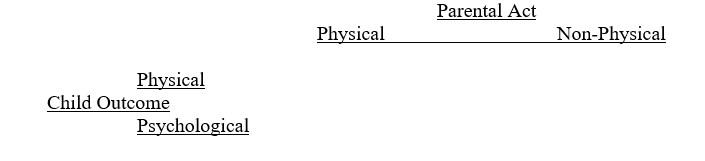
According to McGee and Wolfe, fill out the chart below with the following terms: physical abuse; psychological abuse, type of abuse depends on act (you may use the terms more than once)
Question
Question
Question
Question
Question

Unlock Deck
Sign up to unlock the cards in this deck!
Unlock Deck
Unlock Deck
1/42

Play

Full screen (f)
Deck 6: Psychological Maltreatment
1
A mother tells her son he is no good, lazy bum and she wishes he were never born. This mother is guilty of
A) Psychological neglect
B) Psychological abuse
C) Physical neglect
D) Physical abuse
A) Psychological neglect
B) Psychological abuse
C) Physical neglect
D) Physical abuse
Psychological abuse
2
A mother did not want to have a third child. When the baby is born, she feeds her and changes her as needed, but she does not give her any additional attention. This mother is guilty of
A) Psychological neglect
B) Psychological abuse
C) Physical neglect
D) Physical abuse
A) Psychological neglect
B) Psychological abuse
C) Physical neglect
D) Physical abuse
Psychological neglect
3
With regard to state statutes, which of the following statements is true?
A) Psychological maltreatment is not mentioned by most states.
B) Psychological maltreatment is addressed by all 50 states
C) Psychological abuse is more clearly addressed than is psychological neglect.
D) Psychological neglect is more clearly addressed than is psychological abuse.
A) Psychological maltreatment is not mentioned by most states.
B) Psychological maltreatment is addressed by all 50 states
C) Psychological abuse is more clearly addressed than is psychological neglect.
D) Psychological neglect is more clearly addressed than is psychological abuse.
Psychological abuse is more clearly addressed than is psychological neglect.
4
Which edition of the DSM first included psychological maltreatment?
A) DSM-II
B) DSM-III
C) DSM-IV
D) DSM-V
A) DSM-II
B) DSM-III
C) DSM-IV
D) DSM-V
Unlock Deck
Unlock for access to all 42 flashcards in this deck.
Unlock Deck
k this deck
5
A father continually belittles his son; calling him names and shaming him. Which subtype of psychological maltreatment is this?
A) Spurning
B) Terrorizing
C) Isolating
D) Exploiting/Corrupting
E) Denying Emotional Responsiveness
A) Spurning
B) Terrorizing
C) Isolating
D) Exploiting/Corrupting
E) Denying Emotional Responsiveness
Unlock Deck
Unlock for access to all 42 flashcards in this deck.
Unlock Deck
k this deck
6
Recently a father posted video of his 18 month old son smoking a joint on youtube. This could certainly be considered physically abusive. In addition, what subtype of psychological maltreatment would be an appropriate label?
A) Spurning
B) Terrorizing
C) Isolating
D) Exploiting/Corrupting
E) Denying Emotional Responsiveness
A) Spurning
B) Terrorizing
C) Isolating
D) Exploiting/Corrupting
E) Denying Emotional Responsiveness
Unlock Deck
Unlock for access to all 42 flashcards in this deck.
Unlock Deck
k this deck
7
A father tells his son that if he does not earn straight As on his report card, he will kill his dog. This represents which subtype of psychological maltreatment?
A) Spurning
B) Terrorizing
C) Isolating
D) Exploiting/Corrupting
E) Denying Emotional Responsiveness
A) Spurning
B) Terrorizing
C) Isolating
D) Exploiting/Corrupting
E) Denying Emotional Responsiveness
Unlock Deck
Unlock for access to all 42 flashcards in this deck.
Unlock Deck
k this deck
8
Because Bob fell in with a bad crowd when he was young, he does not let his son, Eric, interact with other children. He homeschools Eric and does not let him out of the house unsupervised even though Eric is 15 years old. This represents which subtype of psychological maltreatment?
A) Spurning
B) Terrorizing
C) Isolating
D) Exploiting/Corrupting
E) Denying Emotional Responsiveness
A) Spurning
B) Terrorizing
C) Isolating
D) Exploiting/Corrupting
E) Denying Emotional Responsiveness
Unlock Deck
Unlock for access to all 42 flashcards in this deck.
Unlock Deck
k this deck
9
According to Hamarman and Bernet, if there is no intent to harm and the child is not harmed by a psychologically abusive behavior than
A) there is no maltreatment
B) the maltreatment is mild
C) the maltreatment is moderate
D) the maltreatment is severe
A) there is no maltreatment
B) the maltreatment is mild
C) the maltreatment is moderate
D) the maltreatment is severe
Unlock Deck
Unlock for access to all 42 flashcards in this deck.
Unlock Deck
k this deck
10
According to research, among families who were guilty of physical abuse, what percentage were also guilty of psychological maltreatment?
A) 100%
B) Approximately 90%
C) Approximately 80%
D) Approximately 45%
A) 100%
B) Approximately 90%
C) Approximately 80%
D) Approximately 45%
Unlock Deck
Unlock for access to all 42 flashcards in this deck.
Unlock Deck
k this deck
11
According to research, among families who were guilty of psychological maltreatment, what percentage were also guilty of physical abuse?
A) 100%
B) 68-80%
C) 18-45%
D) 6-11%
A) 100%
B) 68-80%
C) 18-45%
D) 6-11%
Unlock Deck
Unlock for access to all 42 flashcards in this deck.
Unlock Deck
k this deck
12
According to Hamarman and Bernet, moderate psychological maltreatment means that
A) there was both intent to harm and harm
B) there was either intent to harm or harm, but not both
C) there was neither intent to harm nor harm
A) there was both intent to harm and harm
B) there was either intent to harm or harm, but not both
C) there was neither intent to harm nor harm
Unlock Deck
Unlock for access to all 42 flashcards in this deck.
Unlock Deck
k this deck
13
According to the NIS-IV Harm Standard, how many children were harmed by psychological abuse in 2005-2006?
A) 1 per 1,000
B) 2 per 1,000
C) 3 per 1,000
D) 4 per 1,000
A) 1 per 1,000
B) 2 per 1,000
C) 3 per 1,000
D) 4 per 1,000
Unlock Deck
Unlock for access to all 42 flashcards in this deck.
Unlock Deck
k this deck
14
According to the NIS-IV Harm Standard, how many children were harmed by psychological neglect in 2005-2006?
A) 1 per 1,000
B) 1.6 per 1,000
C) 2 per 1,000
D) 2.6 per 1,000
A) 1 per 1,000
B) 1.6 per 1,000
C) 2 per 1,000
D) 2.6 per 1,000
Unlock Deck
Unlock for access to all 42 flashcards in this deck.
Unlock Deck
k this deck
15
According to the NIS-IV Endangerment Standard, how many children were endangered by psychological abuse in 2005-2006?
A) 1.0 per 1,000
B) 2.3 per 1,000
C) 4.1 per 1,000
D) 5.6 per 1,000
A) 1.0 per 1,000
B) 2.3 per 1,000
C) 4.1 per 1,000
D) 5.6 per 1,000
Unlock Deck
Unlock for access to all 42 flashcards in this deck.
Unlock Deck
k this deck
16
According to the NIS-IV Endangerment Standard, how many children were endangered by psychological neglect in 2005-2006?
A) 5.0 per 1,000
B) 7.5 per 1,000
C) 10.2 per 1,000
D) 15.9 per 1,000
A) 5.0 per 1,000
B) 7.5 per 1,000
C) 10.2 per 1,000
D) 15.9 per 1,000
Unlock Deck
Unlock for access to all 42 flashcards in this deck.
Unlock Deck
k this deck
17
Which of the following is true about the NCANDS data on the incidence of psychological maltreatment?
A) Most states report no cases of psychological maltreatment
B) There is remarkable consistency across states in terms of the incidence of psychological maltreatment
C) The rates of reported psychological maltreatment vary widely among the states
A) Most states report no cases of psychological maltreatment
B) There is remarkable consistency across states in terms of the incidence of psychological maltreatment
C) The rates of reported psychological maltreatment vary widely among the states
Unlock Deck
Unlock for access to all 42 flashcards in this deck.
Unlock Deck
k this deck
18
When comparing the rates of psychological maltreatment according to retrospective data and according to the NIS-IV
A) the rates are nearly identical
B) the NIS rates are significantly higher
C) the rates from retrospective studies are much higher
A) the rates are nearly identical
B) the NIS rates are significantly higher
C) the rates from retrospective studies are much higher
Unlock Deck
Unlock for access to all 42 flashcards in this deck.
Unlock Deck
k this deck
19
Which theory would state that a child's basic needs and psychological needs must be met before they can reach their full potential?
A) Maslow - Human Needs Theory
B) Erikson - Psychosocial Theory
C) Attachment Theory
A) Maslow - Human Needs Theory
B) Erikson - Psychosocial Theory
C) Attachment Theory
Unlock Deck
Unlock for access to all 42 flashcards in this deck.
Unlock Deck
k this deck
20
Whose theory says that as children age they face a series of psychosocial crises that shape their development?
A) Maslow's
B) Erikson's
C) Bowlby's
D) Freud's
A) Maslow's
B) Erikson's
C) Bowlby's
D) Freud's
Unlock Deck
Unlock for access to all 42 flashcards in this deck.
Unlock Deck
k this deck
21
According the study by Haferkemp et al. (2015), the trauma symptom of dissociation is seen
A) Only in victims of physical abuse
B) Seen more commonly in victims of emotional abuse than in other maltreatment victims
C) Seen equally frequently across all types of maltreatment
D) Almost never seen in cases were death was not a realistic fear
A) Only in victims of physical abuse
B) Seen more commonly in victims of emotional abuse than in other maltreatment victims
C) Seen equally frequently across all types of maltreatment
D) Almost never seen in cases were death was not a realistic fear
Unlock Deck
Unlock for access to all 42 flashcards in this deck.
Unlock Deck
k this deck
22
Victims of psychological maltreatment are at an increased risk for anxiety and depression
A) Only during childhood
B) During childhood and persisting into adulthood
C) Only in adulthood
D) None of the above
A) Only during childhood
B) During childhood and persisting into adulthood
C) Only in adulthood
D) None of the above
Unlock Deck
Unlock for access to all 42 flashcards in this deck.
Unlock Deck
k this deck
23
According to the study by Cohen et al. (2019), which type of maltreatment was associated with an increase in anhedonia?
A) Emotional abuse
B) Emotional neglect
C) Both emotional abuse and neglect
D) Neither emotional abuse nor emotional neglect
A) Emotional abuse
B) Emotional neglect
C) Both emotional abuse and neglect
D) Neither emotional abuse nor emotional neglect
Unlock Deck
Unlock for access to all 42 flashcards in this deck.
Unlock Deck
k this deck
24
According to Rorty et al. (1994) the most common type of maltreatment history among women suffering from Bulimia was
A) Sexual
B) Physical
C) Psychological
D) Munchausen Syndrome by Proxy
A) Sexual
B) Physical
C) Psychological
D) Munchausen Syndrome by Proxy
Unlock Deck
Unlock for access to all 42 flashcards in this deck.
Unlock Deck
k this deck
25
According to the research reviewed by Maguire et al. (2015), learning problems in victims of children who have been emotionally abused may be related to elevated symptoms of
A) Schizophrenia
B) Depression
C) Conduct Disorder
D) Attention Deficit Hyperactivity Disorder
A) Schizophrenia
B) Depression
C) Conduct Disorder
D) Attention Deficit Hyperactivity Disorder
Unlock Deck
Unlock for access to all 42 flashcards in this deck.
Unlock Deck
k this deck
26
The United States has a uniform definition of psychological maltreatment that holds across all states and U.S. territories.
Unlock Deck
Unlock for access to all 42 flashcards in this deck.
Unlock Deck
k this deck
27
Reading the state statutes on child maltreatment make it clear what constitutes psychological maltreatment.
Unlock Deck
Unlock for access to all 42 flashcards in this deck.
Unlock Deck
k this deck
28
Psychological maltreatment can have a negative impact on a child's physical health.
Unlock Deck
Unlock for access to all 42 flashcards in this deck.
Unlock Deck
k this deck
29
A history of psychological maltreatment increases the likelihood that a child will engage in non-suicidal self-injurious behaviors.
Unlock Deck
Unlock for access to all 42 flashcards in this deck.
Unlock Deck
k this deck
30
Unlike other forms of maltreatment, psychological abuse is not associated with an increased risk for substance use during adolescence/young adulthood.
Unlock Deck
Unlock for access to all 42 flashcards in this deck.
Unlock Deck
k this deck
31
Matching
Which subtype of psychological maltreatment is most evident in the following scenarios?
---------Ms. Jenkins is extremely worried about Bobby getting hurt. Even though he is almost 8 years old, she does not like him to be out of her sight. She does not allow him to play unsupervised in the yard or even in his room.
A) Spurning
B) Terrorizing
C) Isolating
D) Exploiting/Corrupting
E) Denying Emotional Responsiveness
F) Mental Health, Medical, and Educational Neglect
Which subtype of psychological maltreatment is most evident in the following scenarios?
---------Ms. Jenkins is extremely worried about Bobby getting hurt. Even though he is almost 8 years old, she does not like him to be out of her sight. She does not allow him to play unsupervised in the yard or even in his room.
A) Spurning
B) Terrorizing
C) Isolating
D) Exploiting/Corrupting
E) Denying Emotional Responsiveness
F) Mental Health, Medical, and Educational Neglect
Unlock Deck
Unlock for access to all 42 flashcards in this deck.
Unlock Deck
k this deck
32
Matching
Which subtype of psychological maltreatment is most evident in the following scenarios?
---------One neighbor overheard another telling her son, "I wish you were never born. You can't do anything right. You are so stupid!"
A) Spurning
B) Terrorizing
C) Isolating
D) Exploiting/Corrupting
E) Denying Emotional Responsiveness
F) Mental Health, Medical, and Educational Neglect
Which subtype of psychological maltreatment is most evident in the following scenarios?
---------One neighbor overheard another telling her son, "I wish you were never born. You can't do anything right. You are so stupid!"
A) Spurning
B) Terrorizing
C) Isolating
D) Exploiting/Corrupting
E) Denying Emotional Responsiveness
F) Mental Health, Medical, and Educational Neglect
Unlock Deck
Unlock for access to all 42 flashcards in this deck.
Unlock Deck
k this deck
33
Matching
Which subtype of psychological maltreatment is most evident in the following scenarios?
---------Mr. James realizes that it is easier for children to pick pockets than it is for adults - they are smaller and less likely to arouse suspicion. So, Mr. James teaches his young son to pick pockets at a busy mall.
A) Spurning
B) Terrorizing
C) Isolating
D) Exploiting/Corrupting
E) Denying Emotional Responsiveness
F) Mental Health, Medical, and Educational Neglect
Which subtype of psychological maltreatment is most evident in the following scenarios?
---------Mr. James realizes that it is easier for children to pick pockets than it is for adults - they are smaller and less likely to arouse suspicion. So, Mr. James teaches his young son to pick pockets at a busy mall.
A) Spurning
B) Terrorizing
C) Isolating
D) Exploiting/Corrupting
E) Denying Emotional Responsiveness
F) Mental Health, Medical, and Educational Neglect
Unlock Deck
Unlock for access to all 42 flashcards in this deck.
Unlock Deck
k this deck
34
Matching
Which subtype of psychological maltreatment is most evident in the following scenarios?
---------Even though Ms. Smith knows her friend deals drugs and hangs out with a violent gang, she lets her daughter with this friend so she can go to a party.
A) Spurning
B) Terrorizing
C) Isolating
D) Exploiting/Corrupting
E) Denying Emotional Responsiveness
F) Mental Health, Medical, and Educational Neglect
Which subtype of psychological maltreatment is most evident in the following scenarios?
---------Even though Ms. Smith knows her friend deals drugs and hangs out with a violent gang, she lets her daughter with this friend so she can go to a party.
A) Spurning
B) Terrorizing
C) Isolating
D) Exploiting/Corrupting
E) Denying Emotional Responsiveness
F) Mental Health, Medical, and Educational Neglect
Unlock Deck
Unlock for access to all 42 flashcards in this deck.
Unlock Deck
k this deck
35
Compare and contrast the terms psychological and emotional.
Unlock Deck
Unlock for access to all 42 flashcards in this deck.
Unlock Deck
k this deck
36
Provide two reasons that Hamarman and Bernet (2000) give to argue that psychological maltreatment should be defined in terms of parental behavior rather than child outcome?
Unlock Deck
Unlock for access to all 42 flashcards in this deck.
Unlock Deck
k this deck
37
According to McGee and Wolfe, fill out the chart below with the following terms: physical abuse; psychological abuse, type of abuse depends on act (you may use the terms more than once)
Unlock Deck
Unlock for access to all 42 flashcards in this deck.
Unlock Deck
k this deck
38
Do you prefer the APSAC's or Glaser's definition of psychological maltreatment?
Unlock Deck
Unlock for access to all 42 flashcards in this deck.
Unlock Deck
k this deck
39
Explain the negative consequences of psychological maltreatment in terms of Maslow's theory.
Unlock Deck
Unlock for access to all 42 flashcards in this deck.
Unlock Deck
k this deck
40
What did Okado and Azar (2011) discover about the relationship between inappropriate emotional relationships with mothers and subsequent risk for child maltreatment?
Unlock Deck
Unlock for access to all 42 flashcards in this deck.
Unlock Deck
k this deck
41
List 5 possible problems in social functioning seen in victims of psychological maltreatment.
Unlock Deck
Unlock for access to all 42 flashcards in this deck.
Unlock Deck
k this deck
42
List one factor related to greater resiliency and one related to greater harm in the face of psychological maltreatment.
Unlock Deck
Unlock for access to all 42 flashcards in this deck.
Unlock Deck
k this deck
Unlock Deck
Unlock for access to all 42 flashcards in this deck.






