







 Chat with AI

Deck 9: Nontariff Distortions to Trade
Full screen (f)

Question

Question
Question
Question
Question
Question
Question
Question
Question
Question
Question
Question
Question
Question
The following figure illustrates the demand and supply curves for PCs in a small country.
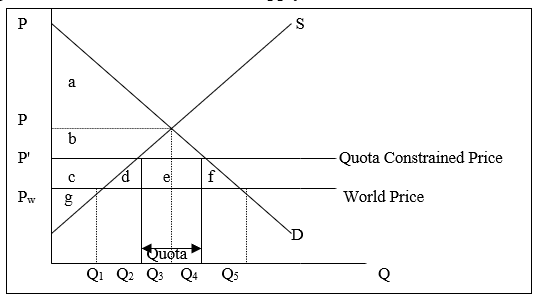
-Which of the following is true for the above quota?
A) Consumers lose area a.
B) The government would receive area e if it auctions the quota.
C) Domestic firms gain areas 'b + d.
D) There is no loss to the country's overall welfare.
E) There is a gain in the country's welfare.
-Which of the following is true for the above quota?
A) Consumers lose area a.
B) The government would receive area e if it auctions the quota.
C) Domestic firms gain areas 'b + d.
D) There is no loss to the country's overall welfare.
E) There is a gain in the country's welfare.
Question
The following figure illustrates the demand and supply curves for PCs in a small country.
-Suppose the government used a tariff to achieve the same level of protection as the quota illustrated above. Comparing the two outcomes (quota versus tariff) we can conclude:
A) consumers lose area a.
B) the government can collect the tariff or sell the quotas to receive area e.
C) domestic producers gain under both a tariff and a quota.
D) All of the above
E) None of the above
-Suppose the government used a tariff to achieve the same level of protection as the quota illustrated above. Comparing the two outcomes (quota versus tariff) we can conclude:
A) consumers lose area a.
B) the government can collect the tariff or sell the quotas to receive area e.
C) domestic producers gain under both a tariff and a quota.
D) All of the above
E) None of the above
Question
The following figure illustrates the demand and supply curves for PCs in a small country.
-With no trade the amount of domestically produced PCs is:
A) Q1.
B) Q2.
C) Q3.
D) Q1 to Q3.
E) zero.
-With no trade the amount of domestically produced PCs is:
A) Q1.
B) Q2.
C) Q3.
D) Q1 to Q3.
E) zero.
Question
The following figure illustrates the demand and supply curves for PCs in a small country.
-With no trade the amount of domestically produced PCs is:
A) Q1.
B) Q2.
C) Q3.
D) Q1 to Q3.
E) zero.
-With no trade the amount of domestically produced PCs is:
A) Q1.
B) Q2.
C) Q3.
D) Q1 to Q3.
E) zero.
Question
The following figure illustrates the demand and supply curves for PCs in a small country.
-With no trade the country's producer surplus is:
A) area a.
B) area b.
C) areas b + c.
D) areas b + c + g.
E) b + d
-With no trade the country's producer surplus is:
A) area a.
B) area b.
C) areas b + c.
D) areas b + c + g.
E) b + d
Question
The following figure illustrates the demand and supply curves for PCs in a small country.
-With no trade the country's consumer surplus is:
A) area a.
B) area a + b.
C) area b.
D) area a + b + c.
E) b + d.
-With no trade the country's consumer surplus is:
A) area a.
B) area a + b.
C) area b.
D) area a + b + c.
E) b + d.
Question
The following figure illustrates the demand and supply curves for PCs in a small country.
-With free trade the country imports:
A) Q1.
B) Q2.
C) Q3.
D) Q1 to Q5.
E) area c.
-With free trade the country imports:
A) Q1.
B) Q2.
C) Q3.
D) Q1 to Q5.
E) area c.
Question
The following figure illustrates the demand and supply curves for PCs in a small country.
-With free trade the country's producer's surplus is:
A) area a.
B) area b.
C) area c.
D) area d.
E) area g.
-With free trade the country's producer's surplus is:
A) area a.
B) area b.
C) area c.
D) area d.
E) area g.
Question
The following figure illustrates the demand and supply curves for PCs in a small country.
-With a quota imposed on PCs, the country imports:
A) Q1.
B) Q2.
C) Q3.
D) zero to Q1.
E) Q2 to Q4.
-With a quota imposed on PCs, the country imports:
A) Q1.
B) Q2.
C) Q3.
D) zero to Q1.
E) Q2 to Q4.
Question
The following figure illustrates the demand and supply curves for PCs in a small country.
-The loss of consumer surplus due to the quota is:
A) area c.
B) area b.
C) area c + d.
D) area c + d + e.
E) area c + d + e + f.
-The loss of consumer surplus due to the quota is:
A) area c.
B) area b.
C) area c + d.
D) area c + d + e.
E) area c + d + e + f.
Question
The following figure illustrates the demand and supply curves for PCs in a small country.
-When a quota is imposed in a domestic market:
A) domestic producers capture all of any future increase in demand.
B) foreign producers capture all of any future increase in demand.
C) the government captures all of any future increase in demand.
D) All of the above
E) None of the above
-When a quota is imposed in a domestic market:
A) domestic producers capture all of any future increase in demand.
B) foreign producers capture all of any future increase in demand.
C) the government captures all of any future increase in demand.
D) All of the above
E) None of the above
Question
Question
Question
Question
Question
Question
Question
Question
Question
Question
Question
Question
Question
Question
Question
Question
Question
Question
Question
Question
Question
Question
Question
Question
Question
Question
Question
Question
Question
Question
Question
Question
Question
Question
Question
Question
Question
Question
Question
Question
Question
Question
Question
Question
Question
Question
Question
Question
Question
Question
Question
Question
Question
Question
Question
Question

Unlock Deck
Sign up to unlock the cards in this deck!
Unlock Deck
Unlock Deck
1/97

Play

Full screen (f)
Deck 9: Nontariff Distortions to Trade
1
An example of a nontariff barrier (NTB) is:
A) a tax on imports.
B) a tax on exports.
C) a physical limit on imports.
D) a tax on trade in services only.
E) All of the above.
A) a tax on imports.
B) a tax on exports.
C) a physical limit on imports.
D) a tax on trade in services only.
E) All of the above.
a physical limit on imports.
2
Nontariff barriers (NTBs) include all of the following except:
A) quotas.
B) tariffs.
C) subsidies.
D) health standards.
E) VERs.
A) quotas.
B) tariffs.
C) subsidies.
D) health standards.
E) VERs.
tariffs.
3
Quotas:
A) are a form of protectionism.
B) restrict imports of a product to a certain quantitative level.
C) are banned under the WTO.
D) All of the above
E) None of the above
A) are a form of protectionism.
B) restrict imports of a product to a certain quantitative level.
C) are banned under the WTO.
D) All of the above
E) None of the above
All of the above
4
Once a country joins the WTO:
A) all quotas must by immediately be eliminated.
B) all quotas are allowed under the WTO.
C) quotas must be slowly eliminated over a given period of time.
D) all quotas are allowed since the WTO does not pay attention to this trade issue.
E) the organization ignores quotas.
A) all quotas must by immediately be eliminated.
B) all quotas are allowed under the WTO.
C) quotas must be slowly eliminated over a given period of time.
D) all quotas are allowed since the WTO does not pay attention to this trade issue.
E) the organization ignores quotas.
Unlock Deck
Unlock for access to all 97 flashcards in this deck.
Unlock Deck
k this deck
5
Quotas exist because:
A) not all countries are members of the WTO.
B) some countries that are members of the WTO are allowed to maintain quotas during a transition period.
C) many industrial countries implement quotas in defiance of WTO rules.
D) All of the above
E) None of the above
A) not all countries are members of the WTO.
B) some countries that are members of the WTO are allowed to maintain quotas during a transition period.
C) many industrial countries implement quotas in defiance of WTO rules.
D) All of the above
E) None of the above
Unlock Deck
Unlock for access to all 97 flashcards in this deck.
Unlock Deck
k this deck
6
Which of the following is not one of the reasons countries have quotas?
A) Non-WTO member
B) New WTO member
C) Protection of agricultural production
D) Membership in the UN
E) All of the above
A) Non-WTO member
B) New WTO member
C) Protection of agricultural production
D) Membership in the UN
E) All of the above
Unlock Deck
Unlock for access to all 97 flashcards in this deck.
Unlock Deck
k this deck
7
A VER is:
A) a tariff that is imposed by the exporting country.
B) a tariff that is imposed by an importing country.
C) a voluntary quota imposed by the importing country.
D) a voluntary quota imposed by the exporting country.
E) only used by developing countries.
A) a tariff that is imposed by the exporting country.
B) a tariff that is imposed by an importing country.
C) a voluntary quota imposed by the importing country.
D) a voluntary quota imposed by the exporting country.
E) only used by developing countries.
Unlock Deck
Unlock for access to all 97 flashcards in this deck.
Unlock Deck
k this deck
8
Which of the following is not an NTB?
A) A quota
B) A VER
C) A technical rule calculated to exclude imports
D) An MFN tariff
E) All of the above
A) A quota
B) A VER
C) A technical rule calculated to exclude imports
D) An MFN tariff
E) All of the above
Unlock Deck
Unlock for access to all 97 flashcards in this deck.
Unlock Deck
k this deck
9
Nontariff barriers include all of the following except:
A) buy domestic requirements.
B) tariffs.
C) technical standards.
D) labor standards.
E) None of the above
A) buy domestic requirements.
B) tariffs.
C) technical standards.
D) labor standards.
E) None of the above
Unlock Deck
Unlock for access to all 97 flashcards in this deck.
Unlock Deck
k this deck
10
Nontariff barriers include all of the following except:
A) buy domestic requirements.
B) technical standards.
C) environmental standards.
D) the corporate income tax.
E) None of the above
A) buy domestic requirements.
B) technical standards.
C) environmental standards.
D) the corporate income tax.
E) None of the above
Unlock Deck
Unlock for access to all 97 flashcards in this deck.
Unlock Deck
k this deck
11
Which of the following statements is true?
A) A VER is essentially the same thing as a quota.
B) A VER and a quota have nothing in common.
C) Quotas are legal under WTO rules.
D) VERs enhance consumer welfare whereas quotas do not.
E) The WTO does not cover quotas.
A) A VER is essentially the same thing as a quota.
B) A VER and a quota have nothing in common.
C) Quotas are legal under WTO rules.
D) VERs enhance consumer welfare whereas quotas do not.
E) The WTO does not cover quotas.
Unlock Deck
Unlock for access to all 97 flashcards in this deck.
Unlock Deck
k this deck
12
A VER is imposed by:
A) the domestic government.
B) the foreign government.
C) the domestic producers.
D) the domestic consumers.
E) the WTO.
A) the domestic government.
B) the foreign government.
C) the domestic producers.
D) the domestic consumers.
E) the WTO.
Unlock Deck
Unlock for access to all 97 flashcards in this deck.
Unlock Deck
k this deck
13
Which of the following countries has a quota on imports of sugar?
A) Germany
B) Mexico
C) The U.S.
D) The Dominican Republic
E) Mexico.
A) Germany
B) Mexico
C) The U.S.
D) The Dominican Republic
E) Mexico.
Unlock Deck
Unlock for access to all 97 flashcards in this deck.
Unlock Deck
k this deck
14
The following figure illustrates the demand and supply curves for PCs in a small country.
-Which of the following is true for the above quota?
A) Consumers lose area a.
B) The government would receive area e if it auctions the quota.
C) Domestic firms gain areas 'b + d.
D) There is no loss to the country's overall welfare.
E) There is a gain in the country's welfare.
-Which of the following is true for the above quota?
A) Consumers lose area a.
B) The government would receive area e if it auctions the quota.
C) Domestic firms gain areas 'b + d.
D) There is no loss to the country's overall welfare.
E) There is a gain in the country's welfare.
Unlock Deck
Unlock for access to all 97 flashcards in this deck.
Unlock Deck
k this deck
15
The following figure illustrates the demand and supply curves for PCs in a small country.
-Suppose the government used a tariff to achieve the same level of protection as the quota illustrated above. Comparing the two outcomes (quota versus tariff) we can conclude:
A) consumers lose area a.
B) the government can collect the tariff or sell the quotas to receive area e.
C) domestic producers gain under both a tariff and a quota.
D) All of the above
E) None of the above
-Suppose the government used a tariff to achieve the same level of protection as the quota illustrated above. Comparing the two outcomes (quota versus tariff) we can conclude:
A) consumers lose area a.
B) the government can collect the tariff or sell the quotas to receive area e.
C) domestic producers gain under both a tariff and a quota.
D) All of the above
E) None of the above
Unlock Deck
Unlock for access to all 97 flashcards in this deck.
Unlock Deck
k this deck
16
The following figure illustrates the demand and supply curves for PCs in a small country.
-With no trade the amount of domestically produced PCs is:
A) Q1.
B) Q2.
C) Q3.
D) Q1 to Q3.
E) zero.
-With no trade the amount of domestically produced PCs is:
A) Q1.
B) Q2.
C) Q3.
D) Q1 to Q3.
E) zero.
Unlock Deck
Unlock for access to all 97 flashcards in this deck.
Unlock Deck
k this deck
17
The following figure illustrates the demand and supply curves for PCs in a small country.
-With no trade the amount of domestically produced PCs is:
A) Q1.
B) Q2.
C) Q3.
D) Q1 to Q3.
E) zero.
-With no trade the amount of domestically produced PCs is:
A) Q1.
B) Q2.
C) Q3.
D) Q1 to Q3.
E) zero.
Unlock Deck
Unlock for access to all 97 flashcards in this deck.
Unlock Deck
k this deck
18
The following figure illustrates the demand and supply curves for PCs in a small country.
-With no trade the country's producer surplus is:
A) area a.
B) area b.
C) areas b + c.
D) areas b + c + g.
E) b + d
-With no trade the country's producer surplus is:
A) area a.
B) area b.
C) areas b + c.
D) areas b + c + g.
E) b + d
Unlock Deck
Unlock for access to all 97 flashcards in this deck.
Unlock Deck
k this deck
19
The following figure illustrates the demand and supply curves for PCs in a small country.
-With no trade the country's consumer surplus is:
A) area a.
B) area a + b.
C) area b.
D) area a + b + c.
E) b + d.
-With no trade the country's consumer surplus is:
A) area a.
B) area a + b.
C) area b.
D) area a + b + c.
E) b + d.
Unlock Deck
Unlock for access to all 97 flashcards in this deck.
Unlock Deck
k this deck
20
The following figure illustrates the demand and supply curves for PCs in a small country.
-With free trade the country imports:
A) Q1.
B) Q2.
C) Q3.
D) Q1 to Q5.
E) area c.
-With free trade the country imports:
A) Q1.
B) Q2.
C) Q3.
D) Q1 to Q5.
E) area c.
Unlock Deck
Unlock for access to all 97 flashcards in this deck.
Unlock Deck
k this deck
21
The following figure illustrates the demand and supply curves for PCs in a small country.
-With free trade the country's producer's surplus is:
A) area a.
B) area b.
C) area c.
D) area d.
E) area g.
-With free trade the country's producer's surplus is:
A) area a.
B) area b.
C) area c.
D) area d.
E) area g.
Unlock Deck
Unlock for access to all 97 flashcards in this deck.
Unlock Deck
k this deck
22
The following figure illustrates the demand and supply curves for PCs in a small country.
-With a quota imposed on PCs, the country imports:
A) Q1.
B) Q2.
C) Q3.
D) zero to Q1.
E) Q2 to Q4.
-With a quota imposed on PCs, the country imports:
A) Q1.
B) Q2.
C) Q3.
D) zero to Q1.
E) Q2 to Q4.
Unlock Deck
Unlock for access to all 97 flashcards in this deck.
Unlock Deck
k this deck
23
The following figure illustrates the demand and supply curves for PCs in a small country.
-The loss of consumer surplus due to the quota is:
A) area c.
B) area b.
C) area c + d.
D) area c + d + e.
E) area c + d + e + f.
-The loss of consumer surplus due to the quota is:
A) area c.
B) area b.
C) area c + d.
D) area c + d + e.
E) area c + d + e + f.
Unlock Deck
Unlock for access to all 97 flashcards in this deck.
Unlock Deck
k this deck
24
The following figure illustrates the demand and supply curves for PCs in a small country.
-When a quota is imposed in a domestic market:
A) domestic producers capture all of any future increase in demand.
B) foreign producers capture all of any future increase in demand.
C) the government captures all of any future increase in demand.
D) All of the above
E) None of the above
-When a quota is imposed in a domestic market:
A) domestic producers capture all of any future increase in demand.
B) foreign producers capture all of any future increase in demand.
C) the government captures all of any future increase in demand.
D) All of the above
E) None of the above
Unlock Deck
Unlock for access to all 97 flashcards in this deck.
Unlock Deck
k this deck
25
For the government, a quota is worse than a tariff because part of the lost _____ surplus is not transferred to the government.
A) consumer
B) producer
C) dead-weight
D) tariff
E) exporter.
A) consumer
B) producer
C) dead-weight
D) tariff
E) exporter.
Unlock Deck
Unlock for access to all 97 flashcards in this deck.
Unlock Deck
k this deck
26
Like tariffs, quotas result in:
A) additional government revenue.
B) an increase in consumer surplus.
C) a higher imported price.
D) more imports.
E) a lower imported price.
A) additional government revenue.
B) an increase in consumer surplus.
C) a higher imported price.
D) more imports.
E) a lower imported price.
Unlock Deck
Unlock for access to all 97 flashcards in this deck.
Unlock Deck
k this deck
27
When a quota is imposed, the losers include:
A) consumers and domestic producers.
B) consumers and foreign producers.
C) consumers and the domestic government.
D) consumers.
E) domestic producers.
A) consumers and domestic producers.
B) consumers and foreign producers.
C) consumers and the domestic government.
D) consumers.
E) domestic producers.
Unlock Deck
Unlock for access to all 97 flashcards in this deck.
Unlock Deck
k this deck
28
Suppose a quota on foreign-produced cars is enforced by the U.S. government. Which of the following groups is most like to oppose this action?
A) American automobile manufacturers
B) Consumers
C) American Steel Workers
D) United Auto Workers
E) the U.S. government
A) American automobile manufacturers
B) Consumers
C) American Steel Workers
D) United Auto Workers
E) the U.S. government
Unlock Deck
Unlock for access to all 97 flashcards in this deck.
Unlock Deck
k this deck
29
When a quota is imposed:
A) foreign firms may gain by selling the imported product at a higher price.
B) foreign firms may lose by selling fewer imports.
C) domestic firms lose by selling fewer products.
D) both a and b
E) both b and c
A) foreign firms may gain by selling the imported product at a higher price.
B) foreign firms may lose by selling fewer imports.
C) domestic firms lose by selling fewer products.
D) both a and b
E) both b and c
Unlock Deck
Unlock for access to all 97 flashcards in this deck.
Unlock Deck
k this deck
30
Like tariffs, quotas generally lead to:
A) an increased amount of consumer surplus.
B) a reduced amount of producer surplus.
C) higher prices and fewer imports.
D) increased government revenue.
E) increase the amount of trade.
A) an increased amount of consumer surplus.
B) a reduced amount of producer surplus.
C) higher prices and fewer imports.
D) increased government revenue.
E) increase the amount of trade.
Unlock Deck
Unlock for access to all 97 flashcards in this deck.
Unlock Deck
k this deck
31
If a government auctions its quota:
A) domestic producers gain additional producer surplus.
B) consumers gain additional consumer surplus.
C) foreign firms pay an additional cost.
D) foreign firms gain additional revenue.
E) domestic producers lose additional producer surplus.
A) domestic producers gain additional producer surplus.
B) consumers gain additional consumer surplus.
C) foreign firms pay an additional cost.
D) foreign firms gain additional revenue.
E) domestic producers lose additional producer surplus.
Unlock Deck
Unlock for access to all 97 flashcards in this deck.
Unlock Deck
k this deck
32
To calculate a tariff equivalent for a quota one must:
A) take the difference between the world market price and the quota constrained domestic price and divide by the world market price.
B) take the difference between the world market price and the quota constrained domestic price and divide by the quota-constrained price.
C) take the difference between the tariff and domestic market cost divided by the domestic market costs.
D) take the sum of all quotas and divide by the number of units imported.
E) None of the above
A) take the difference between the world market price and the quota constrained domestic price and divide by the world market price.
B) take the difference between the world market price and the quota constrained domestic price and divide by the quota-constrained price.
C) take the difference between the tariff and domestic market cost divided by the domestic market costs.
D) take the sum of all quotas and divide by the number of units imported.
E) None of the above
Unlock Deck
Unlock for access to all 97 flashcards in this deck.
Unlock Deck
k this deck
33
When demand increases for a good subject to a quota:
A) imports would stay the same but the price would rise.
B) the price would stay the same but imports would increase.
C) the supply curve shifts outward at the world price.
D) the price wouldn't change since imports ensure consumption.
E) All of the above
A) imports would stay the same but the price would rise.
B) the price would stay the same but imports would increase.
C) the supply curve shifts outward at the world price.
D) the price wouldn't change since imports ensure consumption.
E) All of the above
Unlock Deck
Unlock for access to all 97 flashcards in this deck.
Unlock Deck
k this deck
34
If imports are constrained by a quota and demand increases then:
A) prices will rise.
B) prices will fall.
C) the quantity imported will increase.
D) the quantity imported will fall
E) neither price nor quantity will change.
A) prices will rise.
B) prices will fall.
C) the quantity imported will increase.
D) the quantity imported will fall
E) neither price nor quantity will change.
Unlock Deck
Unlock for access to all 97 flashcards in this deck.
Unlock Deck
k this deck
35
Which of the following statements is true?
A) If demand increases in the presence of a tariff, then prices will not increase because the amount of imports will increase.
B) Businesses always prefer tariff protection to quota protection.
C) Exporters never engage in FDI because of quota protection.
D) Quotas have no discernible effect on imports or domestic production.
E) Domestic consumers are unaffected by quotas.
A) If demand increases in the presence of a tariff, then prices will not increase because the amount of imports will increase.
B) Businesses always prefer tariff protection to quota protection.
C) Exporters never engage in FDI because of quota protection.
D) Quotas have no discernible effect on imports or domestic production.
E) Domestic consumers are unaffected by quotas.
Unlock Deck
Unlock for access to all 97 flashcards in this deck.
Unlock Deck
k this deck
36
With a quota, as the domestic demand for a product rises:
A) losses for domestic firms increase.
B) losses for domestic consumers decrease.
C) losses for the domestic government decrease.
D) losses to society increase.
E) losses to society decrease.
A) losses for domestic firms increase.
B) losses for domestic consumers decrease.
C) losses for the domestic government decrease.
D) losses to society increase.
E) losses to society decrease.
Unlock Deck
Unlock for access to all 97 flashcards in this deck.
Unlock Deck
k this deck
37
After a quota has been imposed in a market, suppose that the demand for the product increases, this would cause the quota price to _____ and the amount imported to _____ .
A) remain the same, remain the same
B) fall, fall
C) rise, rise
D) rise, remain the same
E) fall, remain the same
A) remain the same, remain the same
B) fall, fall
C) rise, rise
D) rise, remain the same
E) fall, remain the same
Unlock Deck
Unlock for access to all 97 flashcards in this deck.
Unlock Deck
k this deck
38
Which of the following statements is false?
A) If demand increases in the presence of a tariff, then imports will increase.
B) If demand increases in the presence of a quota, then the price will rise.
C) The government always receives the same revenue with either a tariff or a quota.
D) If the government auctioned off quotas they would get the same revenue they would get if there were a tariff.
E) Quotas raise producer surplus.
A) If demand increases in the presence of a tariff, then imports will increase.
B) If demand increases in the presence of a quota, then the price will rise.
C) The government always receives the same revenue with either a tariff or a quota.
D) If the government auctioned off quotas they would get the same revenue they would get if there were a tariff.
E) Quotas raise producer surplus.
Unlock Deck
Unlock for access to all 97 flashcards in this deck.
Unlock Deck
k this deck
39
In moving from free trade to a quota, _____ is likely to occur.
A) an increase in the volume of trade
B) transshipping from the importing country to the exporting country
C) a quality upgrading of the traded good
D) an increase in imports
E) an increase in exports
A) an increase in the volume of trade
B) transshipping from the importing country to the exporting country
C) a quality upgrading of the traded good
D) an increase in imports
E) an increase in exports
Unlock Deck
Unlock for access to all 97 flashcards in this deck.
Unlock Deck
k this deck
40
Which of the following describes the use of government policy to enhance exports in specific industries?
A) VER
B) AVE
C) Strategic trade policy
D) NTB
E) quota policy
A) VER
B) AVE
C) Strategic trade policy
D) NTB
E) quota policy
Unlock Deck
Unlock for access to all 97 flashcards in this deck.
Unlock Deck
k this deck
41
The U.S. policy that requires the government to buy from a domestic supplier unless the domestic supplier's price is more than 6% higher than the foreign price is called:
A) the Buy American Act of 1933.
B) the Discriminatory Policy Act of 1988.
C) the Protection of Domestic Industries Act of 1994.
D) the Foreign Policy Act of 2001.
E) None of the above
A) the Buy American Act of 1933.
B) the Discriminatory Policy Act of 1988.
C) the Protection of Domestic Industries Act of 1994.
D) the Foreign Policy Act of 2001.
E) None of the above
Unlock Deck
Unlock for access to all 97 flashcards in this deck.
Unlock Deck
k this deck
42
The Buy American Act of 1933 gives American suppliers a _____ percent margin of preference over foreign suppliers and a _____ percent margin of preference for military or defense related goods.
A) 6; 10
B) 5; 20
C) 6; 50
D) 10; 20
E) 20; 20
A) 6; 10
B) 5; 20
C) 6; 50
D) 10; 20
E) 20; 20
Unlock Deck
Unlock for access to all 97 flashcards in this deck.
Unlock Deck
k this deck
43
Using various government policies to increase exports is frequently called:
A) labor standards.
B) environmental policy.
C) MITI.
D) strategic trade policy.
E) manufacturing policy.
A) labor standards.
B) environmental policy.
C) MITI.
D) strategic trade policy.
E) manufacturing policy.
Unlock Deck
Unlock for access to all 97 flashcards in this deck.
Unlock Deck
k this deck
44
Which of the following is a source of government regulation related to international trade?
A) Administrative regulations
B) Technical regulations
C) Industrial policy
D) All of the above
E) None of the above
A) Administrative regulations
B) Technical regulations
C) Industrial policy
D) All of the above
E) None of the above
Unlock Deck
Unlock for access to all 97 flashcards in this deck.
Unlock Deck
k this deck
45
The impact of transportation costs on international trade causes:
A) import prices to rise
B) export prices to rise.
C) imports to increase.
D) import prices to fall.
E) no change in import prices.
A) import prices to rise
B) export prices to rise.
C) imports to increase.
D) import prices to fall.
E) no change in import prices.
Unlock Deck
Unlock for access to all 97 flashcards in this deck.
Unlock Deck
k this deck
46
The impact of transportation costs on international trade causes:
A) imports to increase
B) imports to decrease
C) export price to increase
D) import prices to decrease.
E) imports to cease.
A) imports to increase
B) imports to decrease
C) export price to increase
D) import prices to decrease.
E) imports to cease.
Unlock Deck
Unlock for access to all 97 flashcards in this deck.
Unlock Deck
k this deck
47
The gravity equation relates the volume of trade to:
A) distance.
B) the GDP of the importing country.
C) the GDP of the exporting country.
D) All of the above.
E) None of the above
A) distance.
B) the GDP of the importing country.
C) the GDP of the exporting country.
D) All of the above.
E) None of the above
Unlock Deck
Unlock for access to all 97 flashcards in this deck.
Unlock Deck
k this deck
48
Which of the following predicts the volume of trade?
A) absolute advantage
B) comparative advantage
C) factor proportions
D) the gravity equation
E) all of the above
A) absolute advantage
B) comparative advantage
C) factor proportions
D) the gravity equation
E) all of the above
Unlock Deck
Unlock for access to all 97 flashcards in this deck.
Unlock Deck
k this deck
49
NTBs could be associated with:
A) quotas.
B) VERs.
C) the MFA (Multi Fibre Agreement)
D) all of the above
E) none of the above
A) quotas.
B) VERs.
C) the MFA (Multi Fibre Agreement)
D) all of the above
E) none of the above
Unlock Deck
Unlock for access to all 97 flashcards in this deck.
Unlock Deck
k this deck
50
Transportation costs:
A) raises the price of imported goods.
B) lowers the volume of imports.
C) are CIF - FAS.
D) all of the above .
E) none of the above.
A) raises the price of imported goods.
B) lowers the volume of imports.
C) are CIF - FAS.
D) all of the above .
E) none of the above.
Unlock Deck
Unlock for access to all 97 flashcards in this deck.
Unlock Deck
k this deck
51
Both labor and environmental standards are applied to:
A) carpets.
B) lumber.
C) U.S. free-trade agreements.
D) all of the above
E) none of the above
A) carpets.
B) lumber.
C) U.S. free-trade agreements.
D) all of the above
E) none of the above
Unlock Deck
Unlock for access to all 97 flashcards in this deck.
Unlock Deck
k this deck
52
A quota restricts the imports of a product to a certain quantitative level.
Unlock Deck
Unlock for access to all 97 flashcards in this deck.
Unlock Deck
k this deck
53
Between 10 and 20% of the tariffs lines of the EU, Japan, and the U.S. are affected by nontariff barriers to trade.
Unlock Deck
Unlock for access to all 97 flashcards in this deck.
Unlock Deck
k this deck
54
Tariffs over the last two decades have increased as foreign competition has increased.
Unlock Deck
Unlock for access to all 97 flashcards in this deck.
Unlock Deck
k this deck
55
The U.S. currently has no quotas on imported products.
Unlock Deck
Unlock for access to all 97 flashcards in this deck.
Unlock Deck
k this deck
56
Quotas are not a legal method of restricting imports under GATT and the WTO.
Unlock Deck
Unlock for access to all 97 flashcards in this deck.
Unlock Deck
k this deck
57
The net loss to a country as a result of a quota is smaller than the net loss of an equivalent tariff.
Unlock Deck
Unlock for access to all 97 flashcards in this deck.
Unlock Deck
k this deck
58
A quota or a VER is usually applied so that a specific number of units can be imported without regard to the price of the product.
Unlock Deck
Unlock for access to all 97 flashcards in this deck.
Unlock Deck
k this deck
59
A country that is a member of the WTO by definition does not use quotas as a form of protection.
Unlock Deck
Unlock for access to all 97 flashcards in this deck.
Unlock Deck
k this deck
60
Some countries, such as the U.S., maintain quotas in defiance of WTO rules.
Unlock Deck
Unlock for access to all 97 flashcards in this deck.
Unlock Deck
k this deck
61
The Multifibre Arrangement (MFA) is a fair system and minimizes welfare losses by allocating quotas based on traditional market shares.
Unlock Deck
Unlock for access to all 97 flashcards in this deck.
Unlock Deck
k this deck
62
The EU and the U.S. severely limit the exports of apparel from developed countries through the use of quotas.
Unlock Deck
Unlock for access to all 97 flashcards in this deck.
Unlock Deck
k this deck
63
The practical difference between a quota and a VER is the name.
Unlock Deck
Unlock for access to all 97 flashcards in this deck.
Unlock Deck
k this deck
64
When a country voluntary agrees to limit its exports to another country, it is called a voluntary export restraint.
Unlock Deck
Unlock for access to all 97 flashcards in this deck.
Unlock Deck
k this deck
65
Quotas redistribute consumer surplus to domestic and foreign firms.
Unlock Deck
Unlock for access to all 97 flashcards in this deck.
Unlock Deck
k this deck
66
Like tariffs, quotas tend to increase the government's tax revenue.
Unlock Deck
Unlock for access to all 97 flashcards in this deck.
Unlock Deck
k this deck
67
A quota is a form of commercial policy.
Unlock Deck
Unlock for access to all 97 flashcards in this deck.
Unlock Deck
k this deck
68
Quotas tend to increase producers surplus.
Unlock Deck
Unlock for access to all 97 flashcards in this deck.
Unlock Deck
k this deck
69
Converting a quota into a tariff is easily accomplished by calculating what the ad valorem equivalent tariff (AVE) needs to be to achieve the same level of protection.
Unlock Deck
Unlock for access to all 97 flashcards in this deck.
Unlock Deck
k this deck
70
If the demand for a product increases, then a quota will lead to an increase in the price of the product because the amount imported cannot increase.
Unlock Deck
Unlock for access to all 97 flashcards in this deck.
Unlock Deck
k this deck
71
A quota will sometimes encourage exporters to lower the quality of their product in order to export less.
Unlock Deck
Unlock for access to all 97 flashcards in this deck.
Unlock Deck
k this deck
72
A quota will encourage exporters to increase the quality of the goods that they are exporting.
Unlock Deck
Unlock for access to all 97 flashcards in this deck.
Unlock Deck
k this deck
73
A quota will encourage exporters to increase the quality of the goods that they are exporting in order to reduce the revenue they receive from exports.
Unlock Deck
Unlock for access to all 97 flashcards in this deck.
Unlock Deck
k this deck
74
As tariffs have declined, national differences in the regulation of business have less of a chance to alter the pattern of world production and trade.
Unlock Deck
Unlock for access to all 97 flashcards in this deck.
Unlock Deck
k this deck
75
Trade restrictions can occur when a country imposes additional technical requirements that are written in a manner so that foreign firms cannot comply.
Unlock Deck
Unlock for access to all 97 flashcards in this deck.
Unlock Deck
k this deck
76
Business regulations within a country do not impact international trade flows when there is a free-trade agreement between the two countries.
Unlock Deck
Unlock for access to all 97 flashcards in this deck.
Unlock Deck
k this deck
77
Since governments buy just like private consumers and businesses, government procurement has no noticeable impact of world trade.
Unlock Deck
Unlock for access to all 97 flashcards in this deck.
Unlock Deck
k this deck
78
Government procurement practices normally create a level playing field for foreign and domestic firms.
Unlock Deck
Unlock for access to all 97 flashcards in this deck.
Unlock Deck
k this deck
79
Most countries have some form of policy to favor domestic producers in the area of government procurement.
Unlock Deck
Unlock for access to all 97 flashcards in this deck.
Unlock Deck
k this deck
80
The WTO has been very successful in negotiations concerning government procurement.
Unlock Deck
Unlock for access to all 97 flashcards in this deck.
Unlock Deck
k this deck
Unlock Deck
Unlock for access to all 97 flashcards in this deck.






