







 Chat with AI

Deck 5: When Firms Act As Pricemakers: Competition Versus Monopoly
Full screen (f)

Question

Question
Question
Question
Question
Question
Question
Question
Question
Question
Question
Question
Question
Question
Question
Question
Question
Question
Question
Question
Question
Question
Question
Question
Question
Question
Question
Question
Question
Question
Question
Question
Question
Question
Question
Question
Question
Question
Answer the next five questions in terms of the following graph of a firm operating in competition:
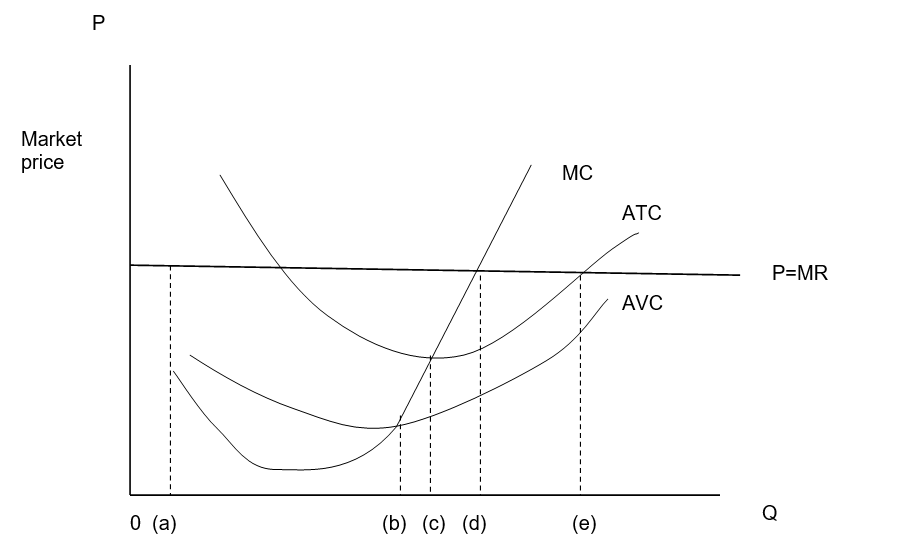
-Average total costs are lowest at output level___.
-Average total costs are lowest at output level___.
Question
Answer the next five questions in terms of the following graph of a firm operating in competition:
-Profit will be greatest at output level___.
-Profit will be greatest at output level___.
Question
Answer the next five questions in terms of the following graph of a firm operating in competition:
-Maximum efficiency is obtained at output level___.
-Maximum efficiency is obtained at output level___.
Question
Answer the next five questions in terms of the following graph of a firm operating in competition:
-Beyond output ___ the firm would break even, earning no profit in the short run.
-Beyond output ___ the firm would break even, earning no profit in the short run.
Question
Answer the next five questions in terms of the following graph of a firm operating in competition:
-The shutdown point is output level ___.
-The shutdown point is output level ___.
Question
Question
Question
Answer the next three questions based upon the following diagram.
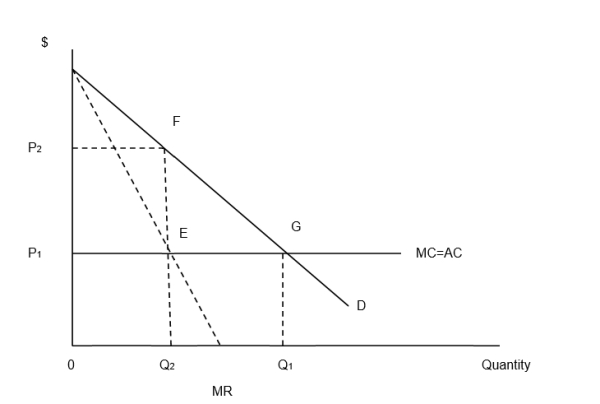
-If monopoly prevails, profits will be:
A) EFG
B) normal
C) P1 P2FE
D) Q2EGQ1
E) elusive
-If monopoly prevails, profits will be:
A) EFG
B) normal
C) P1 P2FE
D) Q2EGQ1
E) elusive
Question
Question
Question
Question
Question
Question
Question
Question
Answer the next three questions based upon the following diagram.
-The monopoly output is:
A) Q2
B) Q1
C) not shown in the diagram
D) P1
E) 0
-The monopoly output is:
A) Q2
B) Q1
C) not shown in the diagram
D) P1
E) 0
Question
Answer the next three questions based upon the following diagram.
-The price that coincides with allocative efficiency is:
A) Q2
B) P1
C) not shown in the diagram
D) P2
E) 0
-The price that coincides with allocative efficiency is:
A) Q2
B) P1
C) not shown in the diagram
D) P2
E) 0

Unlock Deck
Sign up to unlock the cards in this deck!
Unlock Deck
Unlock Deck
1/54

Play

Full screen (f)
Deck 5: When Firms Act As Pricemakers: Competition Versus Monopoly
1
Define the following market structures:
Competition
Monopolistic competition
Oligopoly
Monopoly
Competition
Monopolistic competition
Oligopoly
Monopoly
Competition: In a competitive market structure, there are many buyers and sellers, and no single entity has control over the market. Prices are determined by supply and demand, and there is free entry and exit for businesses.
Monopolistic competition: Monopolistic competition is a market structure in which many companies offer similar but not identical products. There is some degree of market power for each firm, as they can differentiate their products through branding, marketing, or other means.
Oligopoly: An oligopoly is a market structure in which a small number of firms dominate the market. These firms have significant market power and can influence prices and output. There are barriers to entry, and the actions of one firm can have a significant impact on the others.
Monopoly: A monopoly exists when a single company or entity controls the entire market for a particular product or service. This gives the monopolist significant market power, allowing them to set prices and output levels without competition. Monopolies often arise due to barriers to entry, such as high start-up costs or exclusive access to resources.
Monopolistic competition: Monopolistic competition is a market structure in which many companies offer similar but not identical products. There is some degree of market power for each firm, as they can differentiate their products through branding, marketing, or other means.
Oligopoly: An oligopoly is a market structure in which a small number of firms dominate the market. These firms have significant market power and can influence prices and output. There are barriers to entry, and the actions of one firm can have a significant impact on the others.
Monopoly: A monopoly exists when a single company or entity controls the entire market for a particular product or service. This gives the monopolist significant market power, allowing them to set prices and output levels without competition. Monopolies often arise due to barriers to entry, such as high start-up costs or exclusive access to resources.
2
"A monopolist may exercise price making power." Explain.
A monopolist may exercise price-making power due to the unique position it holds in the market. Unlike in a competitive market where many firms sell identical or similar products, a monopolist is the sole provider of a particular good or service, which means it faces no direct competition. This lack of competition grants the monopolist several advantages that allow it to exert control over the price of its product.
Here are several reasons explaining how a monopolist can exercise price-making power:
1. **Control Over Supply**: Since the monopolist is the only supplier of the good or service, it can control the quantity available in the market. By adjusting the supply, the monopolist can influence the market price. If it reduces the supply, the scarcity of the product can lead to higher prices.
2. **Price Discrimination**: A monopolist can engage in price discrimination, which means charging different prices to different consumers for the same product, based on their willingness to pay. This is only possible when the monopolist has control over the market and can segment the market effectively.
3. **No Close Substitutes**: In a monopoly, the product or service offered typically has no close substitutes, meaning consumers cannot easily switch to a different product if the price of the monopolized product increases. This inelastic demand gives the monopolist more freedom to set higher prices without losing all of its customers.
4. **Barriers to Entry**: Monopolies often exist because there are high barriers to entry that prevent other firms from entering the market and competing. These barriers can be legal (patents, licenses), technological (control of a key technology), natural (control of a resource), or economic (high startup costs). With these barriers in place, the monopolist can set prices without concern for potential competitors undercutting them.
5. **Market Power**: The monopolist's market power is the ability to influence the price of a good or service while considering the market demand. The monopolist can set a price above marginal cost (the cost of producing one more unit of a good) without fear of being undercut by competitors, which would be impossible in a perfectly competitive market.
6. **Profit Maximization**: A monopolist will seek to maximize profits by producing the quantity of goods where marginal cost equals marginal revenue (the additional revenue from selling one more unit of a good). At this point, the monopolist can set the price at the highest level that the market will bear for that quantity, which is typically above the competitive price level.
In summary, a monopolist's price-making power arises from its control over the market supply, lack of competition, ability to price discriminate, barriers to entry that protect its market position, and the inelastic nature of demand for its product. This power enables the monopolist to set prices to maximize profits in a way that would not be possible in a more competitive market environment.
Here are several reasons explaining how a monopolist can exercise price-making power:
1. **Control Over Supply**: Since the monopolist is the only supplier of the good or service, it can control the quantity available in the market. By adjusting the supply, the monopolist can influence the market price. If it reduces the supply, the scarcity of the product can lead to higher prices.
2. **Price Discrimination**: A monopolist can engage in price discrimination, which means charging different prices to different consumers for the same product, based on their willingness to pay. This is only possible when the monopolist has control over the market and can segment the market effectively.
3. **No Close Substitutes**: In a monopoly, the product or service offered typically has no close substitutes, meaning consumers cannot easily switch to a different product if the price of the monopolized product increases. This inelastic demand gives the monopolist more freedom to set higher prices without losing all of its customers.
4. **Barriers to Entry**: Monopolies often exist because there are high barriers to entry that prevent other firms from entering the market and competing. These barriers can be legal (patents, licenses), technological (control of a key technology), natural (control of a resource), or economic (high startup costs). With these barriers in place, the monopolist can set prices without concern for potential competitors undercutting them.
5. **Market Power**: The monopolist's market power is the ability to influence the price of a good or service while considering the market demand. The monopolist can set a price above marginal cost (the cost of producing one more unit of a good) without fear of being undercut by competitors, which would be impossible in a perfectly competitive market.
6. **Profit Maximization**: A monopolist will seek to maximize profits by producing the quantity of goods where marginal cost equals marginal revenue (the additional revenue from selling one more unit of a good). At this point, the monopolist can set the price at the highest level that the market will bear for that quantity, which is typically above the competitive price level.
In summary, a monopolist's price-making power arises from its control over the market supply, lack of competition, ability to price discriminate, barriers to entry that protect its market position, and the inelastic nature of demand for its product. This power enables the monopolist to set prices to maximize profits in a way that would not be possible in a more competitive market environment.
3
Explain the difference between an accountant's and an economist's understanding of costs and profit.
An accountant's understanding of costs and profit is focused on the financial records and transactions of a business. They are primarily concerned with tracking and reporting the actual expenses incurred and the revenue generated by the business. Accountants use this information to prepare financial statements, such as income statements and balance sheets, which provide a historical record of the company's financial performance.
On the other hand, an economist's understanding of costs and profit is more focused on the broader economic implications of business decisions. Economists consider not only the explicit costs (such as wages, rent, and materials) but also the implicit costs (such as the opportunity cost of using resources in a particular way). They also analyze the relationship between costs and production levels to determine the most efficient allocation of resources. Additionally, economists consider the concept of economic profit, which takes into account both explicit and implicit costs, as well as the cost of capital.
In summary, while accountants focus on the financial recording and reporting of costs and profit, economists take a more holistic approach, considering the broader economic implications and opportunity costs associated with business decisions.
On the other hand, an economist's understanding of costs and profit is more focused on the broader economic implications of business decisions. Economists consider not only the explicit costs (such as wages, rent, and materials) but also the implicit costs (such as the opportunity cost of using resources in a particular way). They also analyze the relationship between costs and production levels to determine the most efficient allocation of resources. Additionally, economists consider the concept of economic profit, which takes into account both explicit and implicit costs, as well as the cost of capital.
In summary, while accountants focus on the financial recording and reporting of costs and profit, economists take a more holistic approach, considering the broader economic implications and opportunity costs associated with business decisions.
4
Competitive markets deliver allocative and productive efficiency in the long run. How does this contrast with the results found with a monopoly market structure?
Unlock Deck
Unlock for access to all 54 flashcards in this deck.
Unlock Deck
k this deck
5
Fair-return pricing is common to public utility regulation. What is it? Explain pricing and output levels and dilemmas associated with it.
Unlock Deck
Unlock for access to all 54 flashcards in this deck.
Unlock Deck
k this deck
6
Explain the differences between "economic regulation" and "social regulation" of business.
Unlock Deck
Unlock for access to all 54 flashcards in this deck.
Unlock Deck
k this deck
7
Show the computation of the Herfindahl-Hirschman Index. How is it used?
Unlock Deck
Unlock for access to all 54 flashcards in this deck.
Unlock Deck
k this deck
8
Define and explain the following types of anti-competitive behavior.
Price fixing
Price discrimination
Tying agreements and exclusive dealing
Mergers and acquisitions
Interlocking directorates
Price fixing
Price discrimination
Tying agreements and exclusive dealing
Mergers and acquisitions
Interlocking directorates
Unlock Deck
Unlock for access to all 54 flashcards in this deck.
Unlock Deck
k this deck
9
Generally a firm's price-making ability is greater the greater the number of similar sized firms operating in the market.
Unlock Deck
Unlock for access to all 54 flashcards in this deck.
Unlock Deck
k this deck
10
From an accountant's view, profit is what is left over after all opportunity costs of production and operations are paid.
Unlock Deck
Unlock for access to all 54 flashcards in this deck.
Unlock Deck
k this deck
11
Ease of entry of other firms into the market is one of the ways in which competition acts as a restraint on excessive profits and a stimulus for firms to be efficient.
Unlock Deck
Unlock for access to all 54 flashcards in this deck.
Unlock Deck
k this deck
12
In long-run equilibrium, firms operating in competitive markets will all earn normal profits.
Unlock Deck
Unlock for access to all 54 flashcards in this deck.
Unlock Deck
k this deck
13
Maximum efficiency for any firm exists at the level of output where P = MC.
Unlock Deck
Unlock for access to all 54 flashcards in this deck.
Unlock Deck
k this deck
14
The MC = MR rule of determining the socially optimal output level for a firm applies in the case of monopoly but not in the case of pure competition.
Unlock Deck
Unlock for access to all 54 flashcards in this deck.
Unlock Deck
k this deck
15
Fair-return pricing as applied to a public utility is undertaken to ensure
that the utility earns normal profits.
that the utility earns normal profits.
Unlock Deck
Unlock for access to all 54 flashcards in this deck.
Unlock Deck
k this deck
16
The "contestable market" argument holds that inter-industry competition between giant firms in related, but not identical markets, does not limit the price-making power of large firms.
Unlock Deck
Unlock for access to all 54 flashcards in this deck.
Unlock Deck
k this deck
17
For a monopoly firm, the firm's demand curve is downward sloping to the right because its demand curve and the industry demand curve coincide.
Unlock Deck
Unlock for access to all 54 flashcards in this deck.
Unlock Deck
k this deck
18
The Clayton Act of 1914 prohibits mergers and acquisitions that significantly lessen competition.
Unlock Deck
Unlock for access to all 54 flashcards in this deck.
Unlock Deck
k this deck
19
Interlocking directorates are an antitrust concern when directors serve on the boards of competing firms.
Unlock Deck
Unlock for access to all 54 flashcards in this deck.
Unlock Deck
k this deck
20
"Deregulation" as an approach toward the various regulatory agencies was particularly popular in the 1980s and was in fact a central part of Ronald Reagan's supply-side strategy.
Unlock Deck
Unlock for access to all 54 flashcards in this deck.
Unlock Deck
k this deck
21
A firm's profits are maximized at the output level where average revenue equals average cost.
Unlock Deck
Unlock for access to all 54 flashcards in this deck.
Unlock Deck
k this deck
22
Economic theory maintains that an unregulated monopolist can exert considerable control over prices.
Unlock Deck
Unlock for access to all 54 flashcards in this deck.
Unlock Deck
k this deck
23
A monopolist is a single seller of a unique product.
Unlock Deck
Unlock for access to all 54 flashcards in this deck.
Unlock Deck
k this deck
24
A monopolist is a single buyer of a differentiated product.
Unlock Deck
Unlock for access to all 54 flashcards in this deck.
Unlock Deck
k this deck
25
Economists view economic profit as the amount remaining after all implicit and explicit costs have been subtracted from total revenue.
Unlock Deck
Unlock for access to all 54 flashcards in this deck.
Unlock Deck
k this deck
26
If a firm sells more of product in a perfectly competitive market, its total revenue must rise.
Unlock Deck
Unlock for access to all 54 flashcards in this deck.
Unlock Deck
k this deck
27
Losses tend to prompt firms to leave a market.
Unlock Deck
Unlock for access to all 54 flashcards in this deck.
Unlock Deck
k this deck
28
Antitrust laws are designed to prevent the formation of monopolies, curtail activities that restrain competition, and prohibit anti-competitive practices.
Unlock Deck
Unlock for access to all 54 flashcards in this deck.
Unlock Deck
k this deck
29
Accounting profits and economic profits are identical concepts.
Unlock Deck
Unlock for access to all 54 flashcards in this deck.
Unlock Deck
k this deck
30
Economic profits entice new firms to enter an industry.
Unlock Deck
Unlock for access to all 54 flashcards in this deck.
Unlock Deck
k this deck
31
Economic profits encourage new industries to enter a firm.
Unlock Deck
Unlock for access to all 54 flashcards in this deck.
Unlock Deck
k this deck
32
X-inefficiency can arise because of the difficulties in managing a large, complex organization.
Unlock Deck
Unlock for access to all 54 flashcards in this deck.
Unlock Deck
k this deck
33
A firm in a market with many sellers, unrestricted entry, and selling a homogeneous product is an example of:
A) a purely competitive firm
B) a monopolistic firm
C) an oligopolistic firm
D) a monopolistically competitive firm
E) a public utility
A) a purely competitive firm
B) a monopolistic firm
C) an oligopolistic firm
D) a monopolistically competitive firm
E) a public utility
Unlock Deck
Unlock for access to all 54 flashcards in this deck.
Unlock Deck
k this deck
34
A market structure of only one seller is best described as:
A) competitive
B) monopolistic
C) oligopolistic
D) monopolistically competitive
A) competitive
B) monopolistic
C) oligopolistic
D) monopolistically competitive
Unlock Deck
Unlock for access to all 54 flashcards in this deck.
Unlock Deck
k this deck
35
In the short-run economic operation of a firm:
A) total costs at first fall and then rise as production output is increased
B) average total costs fall throughout the short-run period
C) total fixed costs are unchanged
D) all costs are variable costs
A) total costs at first fall and then rise as production output is increased
B) average total costs fall throughout the short-run period
C) total fixed costs are unchanged
D) all costs are variable costs
Unlock Deck
Unlock for access to all 54 flashcards in this deck.
Unlock Deck
k this deck
36
In the long-run economic operation of a firm:
A) total costs at first fall and then rise as production output is increased
B) average total costs fall throughout the entire range of output
C) total fixed costs are unchanged
D) all costs are variable costs
A) total costs at first fall and then rise as production output is increased
B) average total costs fall throughout the entire range of output
C) total fixed costs are unchanged
D) all costs are variable costs
Unlock Deck
Unlock for access to all 54 flashcards in this deck.
Unlock Deck
k this deck
37
The marginal cost of any particular good is:
A) under competition, always falling
B) the total cost of production divided by the number of goods produced
C) under monopoly conditions, always greater than its price
D) the additional cost of producing an additional unit of the good
A) under competition, always falling
B) the total cost of production divided by the number of goods produced
C) under monopoly conditions, always greater than its price
D) the additional cost of producing an additional unit of the good
Unlock Deck
Unlock for access to all 54 flashcards in this deck.
Unlock Deck
k this deck
38
Answer the next five questions in terms of the following graph of a firm operating in competition:
-Average total costs are lowest at output level___.
-Average total costs are lowest at output level___.
Unlock Deck
Unlock for access to all 54 flashcards in this deck.
Unlock Deck
k this deck
39
Answer the next five questions in terms of the following graph of a firm operating in competition:
-Profit will be greatest at output level___.
-Profit will be greatest at output level___.
Unlock Deck
Unlock for access to all 54 flashcards in this deck.
Unlock Deck
k this deck
40
Answer the next five questions in terms of the following graph of a firm operating in competition:
-Maximum efficiency is obtained at output level___.
-Maximum efficiency is obtained at output level___.
Unlock Deck
Unlock for access to all 54 flashcards in this deck.
Unlock Deck
k this deck
41
Answer the next five questions in terms of the following graph of a firm operating in competition:
-Beyond output ___ the firm would break even, earning no profit in the short run.
-Beyond output ___ the firm would break even, earning no profit in the short run.
Unlock Deck
Unlock for access to all 54 flashcards in this deck.
Unlock Deck
k this deck
42
Answer the next five questions in terms of the following graph of a firm operating in competition:
-The shutdown point is output level ___.
-The shutdown point is output level ___.
Unlock Deck
Unlock for access to all 54 flashcards in this deck.
Unlock Deck
k this deck
43
In setting a price for a public utility according to the doctrine of fair-return pricing, regulatory authorities should set the price and output:
A) where MC = MR
B) where MC is lowest
C) where MC = ATC
D) where ATC = P
E) where ATC is lowest
A) where MC = MR
B) where MC is lowest
C) where MC = ATC
D) where ATC = P
E) where ATC is lowest
Unlock Deck
Unlock for access to all 54 flashcards in this deck.
Unlock Deck
k this deck
44
A public utility regulated by an independent regulatory commission according to the policy of "fair-return pricing":
A) has little individual incentive to act to lower unit costs
B) must provide service to all who are willing to purchase its service at the regulated price
C) is assured, legally, of never going bankrupt
D) all of the above
E) none of the above
A) has little individual incentive to act to lower unit costs
B) must provide service to all who are willing to purchase its service at the regulated price
C) is assured, legally, of never going bankrupt
D) all of the above
E) none of the above
Unlock Deck
Unlock for access to all 54 flashcards in this deck.
Unlock Deck
k this deck
45
Answer the next three questions based upon the following diagram.
-If monopoly prevails, profits will be:
A) EFG
B) normal
C) P1 P2FE
D) Q2EGQ1
E) elusive
-If monopoly prevails, profits will be:
A) EFG
B) normal
C) P1 P2FE
D) Q2EGQ1
E) elusive
Unlock Deck
Unlock for access to all 54 flashcards in this deck.
Unlock Deck
k this deck
46
The immediate effect of deregulation in the airlines industry was:
A) an increase in air fares
B) an increase in the number of airlines
C) an increase in government efforts to set air fares and assign air routes
D) a decline in air passengers
E) an increase in the number of new airports
A) an increase in air fares
B) an increase in the number of airlines
C) an increase in government efforts to set air fares and assign air routes
D) a decline in air passengers
E) an increase in the number of new airports
Unlock Deck
Unlock for access to all 54 flashcards in this deck.
Unlock Deck
k this deck
47
An example of social regulation is:
A) the Occupational Safety and Health Administration
B) the Interstate Commerce Commission
C) industrial policy
D) the Sherman Anti-Trust Act
E) all of the above
A) the Occupational Safety and Health Administration
B) the Interstate Commerce Commission
C) industrial policy
D) the Sherman Anti-Trust Act
E) all of the above
Unlock Deck
Unlock for access to all 54 flashcards in this deck.
Unlock Deck
k this deck
48
Which of the following statements is correct?
A) A normal profit occurs when total revenue minus total costs equals zero.
B) Total costs equal the sum of fixed costs and marginal costs.
C) Total fixed costs reside below total variable costs.
D) An economic profit occurs when total revenue minus explicit costs is greater than zero.
A) A normal profit occurs when total revenue minus total costs equals zero.
B) Total costs equal the sum of fixed costs and marginal costs.
C) Total fixed costs reside below total variable costs.
D) An economic profit occurs when total revenue minus explicit costs is greater than zero.
Unlock Deck
Unlock for access to all 54 flashcards in this deck.
Unlock Deck
k this deck
49
A perfectly competitive firm will face a demand curve that is:
A) vertical and anchored at the market quantity
B) horizontal and coinciding with the market price
C) down-sloping within a narrow range of prices
D) shifting rightward
E) a parabola
A) vertical and anchored at the market quantity
B) horizontal and coinciding with the market price
C) down-sloping within a narrow range of prices
D) shifting rightward
E) a parabola
Unlock Deck
Unlock for access to all 54 flashcards in this deck.
Unlock Deck
k this deck
50
The ideal purpose of antitrust laws is to:
A) maintain competitors
B) maintain monopoly
C) maintain competition
D) maintain the status quo
E) make lawyers and expert witnesses wealthy
A) maintain competitors
B) maintain monopoly
C) maintain competition
D) maintain the status quo
E) make lawyers and expert witnesses wealthy
Unlock Deck
Unlock for access to all 54 flashcards in this deck.
Unlock Deck
k this deck
51
Government regulation of business is economically justified when:
A) the government prefers intervention to laissez faire
B) property rights are poorly defined, economies of scale exist, or there is imperfect information
C) people have an anti-capitalist attitude
D) profits are being earned
E) all of the above
A) the government prefers intervention to laissez faire
B) property rights are poorly defined, economies of scale exist, or there is imperfect information
C) people have an anti-capitalist attitude
D) profits are being earned
E) all of the above
Unlock Deck
Unlock for access to all 54 flashcards in this deck.
Unlock Deck
k this deck
52
Environmental protection, occupational safety and health rules, and equal employment opportunity laws are examples of:
A) industry regulation
B) social regulation
C) government-run businesses
D) recently repealed regulations
A) industry regulation
B) social regulation
C) government-run businesses
D) recently repealed regulations
Unlock Deck
Unlock for access to all 54 flashcards in this deck.
Unlock Deck
k this deck
53
Answer the next three questions based upon the following diagram.
-The monopoly output is:
A) Q2
B) Q1
C) not shown in the diagram
D) P1
E) 0
-The monopoly output is:
A) Q2
B) Q1
C) not shown in the diagram
D) P1
E) 0
Unlock Deck
Unlock for access to all 54 flashcards in this deck.
Unlock Deck
k this deck
54
Answer the next three questions based upon the following diagram.
-The price that coincides with allocative efficiency is:
A) Q2
B) P1
C) not shown in the diagram
D) P2
E) 0
-The price that coincides with allocative efficiency is:
A) Q2
B) P1
C) not shown in the diagram
D) P2
E) 0
Unlock Deck
Unlock for access to all 54 flashcards in this deck.
Unlock Deck
k this deck
Unlock Deck
Unlock for access to all 54 flashcards in this deck.






