







 Chat with AI

Deck 1: Toward a Twenty-First Century Economic Agenda: Goals and Possibilities
Full screen (f)

Question

Question
Question
Question
Question
Question
Question
Question
Question
Question
Question
Question
Question
Answer the next five questions on the basis of the following diagram:
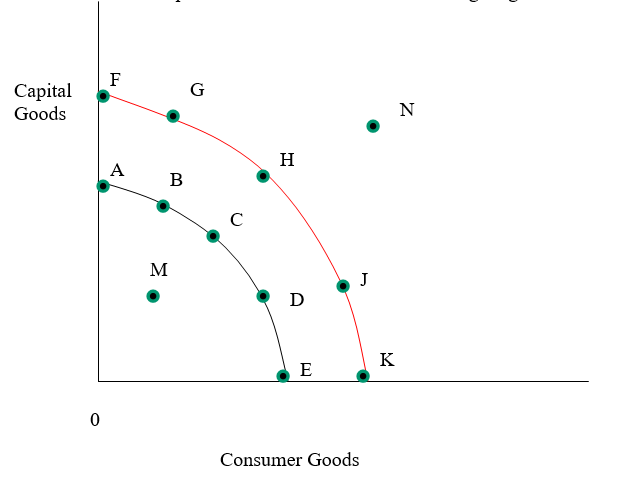
-Picking point G instead of point along curve FGHJK:
A) might cause a situation such as M to occur
B) will likely shift the curve to ABCDE
C) might make N more easily attainable by stimulating growth
D) will allow no prediction
-Picking point G instead of point along curve FGHJK:
A) might cause a situation such as M to occur
B) will likely shift the curve to ABCDE
C) might make N more easily attainable by stimulating growth
D) will allow no prediction
Question
Question
Question
Question
Question
Question
Question
Question
Question
Question
Question
Answer the next five questions on the basis of the following diagram:
-All of the following factors would shift the curve from ABCDE to FGHJK
Except:
A) technological progress
B) a larger capital stock
C) a larger labor force
D) a famine
-All of the following factors would shift the curve from ABCDE to FGHJK
Except:
A) technological progress
B) a larger capital stock
C) a larger labor force
D) a famine
Question
Question
Question
Question
Question
Question
Answer the next five questions on the basis of the following diagram:
-The movement of the curve from ABCDE to FGHJK shows:
A) economic growth
B) a loss of output
C) unemployment
D) smaller output combinations of capital and consumer goods
-The movement of the curve from ABCDE to FGHJK shows:
A) economic growth
B) a loss of output
C) unemployment
D) smaller output combinations of capital and consumer goods
Question
Answer the next five questions on the basis of the following diagram:
-Point N represents:
A) capital formation
B) unemployment
C) technological stagnation
D) an unattainable output combination
-Point N represents:
A) capital formation
B) unemployment
C) technological stagnation
D) an unattainable output combination
Question
Answer the next five questions on the basis of the following diagram:
-Given either curve ABCDE or FGHJK, point M must represent:
A) inflation
B) unemployment
C) an unattainable goal
D) conservative production policies
-Given either curve ABCDE or FGHJK, point M must represent:
A) inflation
B) unemployment
C) an unattainable goal
D) conservative production policies

Unlock Deck
Sign up to unlock the cards in this deck!
Unlock Deck
Unlock Deck
1/32

Play

Full screen (f)
Deck 1: Toward a Twenty-First Century Economic Agenda: Goals and Possibilities
1
Discuss and explain the positive economics-normative economics debate from the point of view of the economics profession. What issues are at stake in this debate?
The positive economics-normative economics debate is a fundamental discussion within the economics profession that revolves around the distinction between positive statements and normative statements. Positive economics refers to the objective analysis of economic phenomena, focusing on what is and what can be proven through empirical evidence. On the other hand, normative economics involves subjective value judgments and opinions about what should be or what is desirable.
From the point of view of the economics profession, this debate is crucial as it shapes the way economists approach and communicate their findings and recommendations. The issues at stake in this debate include the following:
1. Objectivity vs. Subjectivity: The distinction between positive and normative economics highlights the tension between objective analysis and subjective value judgments. Economists must navigate this tension when conducting research and providing policy recommendations.
2. Policy Implications: The debate has implications for the role of economists in policy-making. Positive economics focuses on providing factual analysis, while normative economics involves making value-based policy prescriptions. Economists must be transparent about the distinction between the two when advising policymakers.
3. Public Perception: The debate also affects how the public perceives economic analysis and recommendations. If economists are not clear about the difference between positive and normative statements, there is a risk of their work being misunderstood or misinterpreted by the public.
4. Ethical Considerations: Normative economics raises ethical questions about the values and priorities that underpin economic analysis and policy recommendations. Economists must consider the ethical implications of their normative statements and be mindful of potential biases.
Overall, the positive economics-normative economics debate is essential for the economics profession to maintain rigor and integrity in its research and policy advice. By acknowledging and addressing the distinction between positive and normative statements, economists can enhance the clarity and credibility of their work.
From the point of view of the economics profession, this debate is crucial as it shapes the way economists approach and communicate their findings and recommendations. The issues at stake in this debate include the following:
1. Objectivity vs. Subjectivity: The distinction between positive and normative economics highlights the tension between objective analysis and subjective value judgments. Economists must navigate this tension when conducting research and providing policy recommendations.
2. Policy Implications: The debate has implications for the role of economists in policy-making. Positive economics focuses on providing factual analysis, while normative economics involves making value-based policy prescriptions. Economists must be transparent about the distinction between the two when advising policymakers.
3. Public Perception: The debate also affects how the public perceives economic analysis and recommendations. If economists are not clear about the difference between positive and normative statements, there is a risk of their work being misunderstood or misinterpreted by the public.
4. Ethical Considerations: Normative economics raises ethical questions about the values and priorities that underpin economic analysis and policy recommendations. Economists must consider the ethical implications of their normative statements and be mindful of potential biases.
Overall, the positive economics-normative economics debate is essential for the economics profession to maintain rigor and integrity in its research and policy advice. By acknowledging and addressing the distinction between positive and normative statements, economists can enhance the clarity and credibility of their work.
2
What are the three basic economic questions? How would each of our three basic economic typologies-traditional economies, market economies, and command economies-answer these questions?
The three basic economic questions are: what to produce, how to produce, and for whom to produce.
In a traditional economy, these questions are answered based on customs, traditions, and cultural beliefs. What to produce is determined by what has always been produced in the past, how to produce is based on traditional methods and techniques, and for whom to produce is often based on social hierarchy or community needs.
In a market economy, these questions are answered through the forces of supply and demand. What to produce is determined by consumer preferences and purchasing power, how to produce is based on efficiency and cost-effectiveness, and for whom to produce is based on who can afford the goods and services being offered.
In a command economy, these questions are answered by the government or central authority. What to produce is determined by central planning and government priorities, how to produce is based on government directives and regulations, and for whom to produce is often based on social or political considerations.
Overall, each economic typology approaches the three basic economic questions in different ways, reflecting their unique values, priorities, and systems of organization.
In a traditional economy, these questions are answered based on customs, traditions, and cultural beliefs. What to produce is determined by what has always been produced in the past, how to produce is based on traditional methods and techniques, and for whom to produce is often based on social hierarchy or community needs.
In a market economy, these questions are answered through the forces of supply and demand. What to produce is determined by consumer preferences and purchasing power, how to produce is based on efficiency and cost-effectiveness, and for whom to produce is based on who can afford the goods and services being offered.
In a command economy, these questions are answered by the government or central authority. What to produce is determined by central planning and government priorities, how to produce is based on government directives and regulations, and for whom to produce is often based on social or political considerations.
Overall, each economic typology approaches the three basic economic questions in different ways, reflecting their unique values, priorities, and systems of organization.
3
"The production possibilities curve of a country illustrates both the absolute production limits and the opportunity costs confronting that nation as it chooses among output alternatives." Explain the meaning of this statement.
The production possibilities curve (PPC) of a country represents the maximum amount of two goods or services that can be produced given the available resources and technology. It shows the trade-offs a country faces when allocating its resources between different goods or services. The curve illustrates the absolute production limits by showing the maximum possible combinations of goods or services that can be produced at a given time.
Additionally, the PPC also demonstrates the concept of opportunity cost. As a country chooses to produce more of one good or service, it must give up the opportunity to produce some of the other good or service. This trade-off is represented by the slope of the PPC, which shows the rate at which one good or service can be exchanged for another. The opportunity cost of producing more of one good or service is the amount of the other good or service that must be sacrificed.
Therefore, the statement means that the PPC not only shows the absolute production limits of a country, but also highlights the opportunity costs that the country faces as it makes decisions about how to allocate its resources among different output alternatives. It serves as a visual representation of the trade-offs and choices that a country must make in order to efficiently utilize its resources and maximize its production.
Additionally, the PPC also demonstrates the concept of opportunity cost. As a country chooses to produce more of one good or service, it must give up the opportunity to produce some of the other good or service. This trade-off is represented by the slope of the PPC, which shows the rate at which one good or service can be exchanged for another. The opportunity cost of producing more of one good or service is the amount of the other good or service that must be sacrificed.
Therefore, the statement means that the PPC not only shows the absolute production limits of a country, but also highlights the opportunity costs that the country faces as it makes decisions about how to allocate its resources among different output alternatives. It serves as a visual representation of the trade-offs and choices that a country must make in order to efficiently utilize its resources and maximize its production.
4
It is generally agreed that a country undertaking a growth strategy would be well served to emphasize capital goods rather then consumer goods production. Why?
Unlock Deck
Unlock for access to all 32 flashcards in this deck.
Unlock Deck
k this deck
5
What are the underlying assumptions about an economy that we make when we use the production possibilities concept? Why are these assumptions so important?
Unlock Deck
Unlock for access to all 32 flashcards in this deck.
Unlock Deck
k this deck
6
In what sense is economics "a science of choice?"
Unlock Deck
Unlock for access to all 32 flashcards in this deck.
Unlock Deck
k this deck
7
Develop what you feel to be the ten most outstanding issues that should be included on an "American Economic Agenda" for the balance of the 2010s. What difficulties would you anticipate if you were trying to undertake a national effort to accomplish these goals?
Unlock Deck
Unlock for access to all 32 flashcards in this deck.
Unlock Deck
k this deck
8
Alfred Marshall stated that " . . . economics is the study of mankind in the
ordinary business of life."
ordinary business of life."
Unlock Deck
Unlock for access to all 32 flashcards in this deck.
Unlock Deck
k this deck
9
The deductive method begins with a hypothetical construct about economic
behavior and then seeks facts for verification
behavior and then seeks facts for verification
Unlock Deck
Unlock for access to all 32 flashcards in this deck.
Unlock Deck
k this deck
10
The micro-macro fallacy is committed when the properties of the part are
generalized as properties of the whole.
generalized as properties of the whole.
Unlock Deck
Unlock for access to all 32 flashcards in this deck.
Unlock Deck
k this deck
11
Macroeconomics focuses upon the performance of individual firms, consumer
behavior, resource pricing and allocation, and other narrowly focused economic
analyses.
behavior, resource pricing and allocation, and other narrowly focused economic
analyses.
Unlock Deck
Unlock for access to all 32 flashcards in this deck.
Unlock Deck
k this deck
12
Economics has set itself apart from other social sciences by becoming as precise
as the natural sciences in its theoretical formulations.
as the natural sciences in its theoretical formulations.
Unlock Deck
Unlock for access to all 32 flashcards in this deck.
Unlock Deck
k this deck
13
Answer the next five questions on the basis of the following diagram:
-Picking point G instead of point along curve FGHJK:
A) might cause a situation such as M to occur
B) will likely shift the curve to ABCDE
C) might make N more easily attainable by stimulating growth
D) will allow no prediction
-Picking point G instead of point along curve FGHJK:
A) might cause a situation such as M to occur
B) will likely shift the curve to ABCDE
C) might make N more easily attainable by stimulating growth
D) will allow no prediction
Unlock Deck
Unlock for access to all 32 flashcards in this deck.
Unlock Deck
k this deck
14
Rent is paid for the use of labor.
Unlock Deck
Unlock for access to all 32 flashcards in this deck.
Unlock Deck
k this deck
15
The feudal system was characterized by a reciprocal relationship between the
feudal lord and the serfs wherein the serfs received military protection and
economic security in exchange for sending tithes to the feudal lord.
feudal lord and the serfs wherein the serfs received military protection and
economic security in exchange for sending tithes to the feudal lord.
Unlock Deck
Unlock for access to all 32 flashcards in this deck.
Unlock Deck
k this deck
16
A command economy relies upon central direction of production and prices in
order to address the basic economic questions of what, how, and for whom.
order to address the basic economic questions of what, how, and for whom.
Unlock Deck
Unlock for access to all 32 flashcards in this deck.
Unlock Deck
k this deck
17
The opportunity cost principle states that it is ordinarily possible to increase the
production of one product without sacrifice of anything else as long as resources
and technology are fixed.
production of one product without sacrifice of anything else as long as resources
and technology are fixed.
Unlock Deck
Unlock for access to all 32 flashcards in this deck.
Unlock Deck
k this deck
18
Economic growth can be shown by a rightward shift of the production
possibilities curve.
possibilities curve.
Unlock Deck
Unlock for access to all 32 flashcards in this deck.
Unlock Deck
k this deck
19
A greater capital stock and a larger labor force could result in economic growth.
Unlock Deck
Unlock for access to all 32 flashcards in this deck.
Unlock Deck
k this deck
20
A point inside the production possibilities curve shows full employment
Unlock Deck
Unlock for access to all 32 flashcards in this deck.
Unlock Deck
k this deck
21
Productivity is a measure of an economy's capacity to produce outputs from
scarce resources.
scarce resources.
Unlock Deck
Unlock for access to all 32 flashcards in this deck.
Unlock Deck
k this deck
22
Economics demonstrates that society is relieved from the burden of making
choices about what to produce.
choices about what to produce.
Unlock Deck
Unlock for access to all 32 flashcards in this deck.
Unlock Deck
k this deck
23
A country that refrains from consumer goods production in order to increase its
output of capital goods may experience a more rapid rate of economic growth.
output of capital goods may experience a more rapid rate of economic growth.
Unlock Deck
Unlock for access to all 32 flashcards in this deck.
Unlock Deck
k this deck
24
Answer the next five questions on the basis of the following diagram:
-All of the following factors would shift the curve from ABCDE to FGHJK
Except:
A) technological progress
B) a larger capital stock
C) a larger labor force
D) a famine
-All of the following factors would shift the curve from ABCDE to FGHJK
Except:
A) technological progress
B) a larger capital stock
C) a larger labor force
D) a famine
Unlock Deck
Unlock for access to all 32 flashcards in this deck.
Unlock Deck
k this deck
25
When an economist moves from a hypothesis to real-world facts for verification, he or she is:
A) using the deductive method
B) committing the fallacy of false cause
C) using the inductive method
D) wasting time up in the "ivory tower"
A) using the deductive method
B) committing the fallacy of false cause
C) using the inductive method
D) wasting time up in the "ivory tower"
Unlock Deck
Unlock for access to all 32 flashcards in this deck.
Unlock Deck
k this deck
26
Normative economics:
A) deals with the establishment of goals based upon value judgments
B) deals only with facts and objective analysis
C) offers no policy prescriptions
D) refers to the normalization of trade relations among warring nations
A) deals with the establishment of goals based upon value judgments
B) deals only with facts and objective analysis
C) offers no policy prescriptions
D) refers to the normalization of trade relations among warring nations
Unlock Deck
Unlock for access to all 32 flashcards in this deck.
Unlock Deck
k this deck
27
The best alternative activity that is sacrificed when one pursues a particular
Activity is:
A) the accounting cost
B) the opportunity cost
C) the principle of comparative advantage
D) hindsight
E) insight
Activity is:
A) the accounting cost
B) the opportunity cost
C) the principle of comparative advantage
D) hindsight
E) insight
Unlock Deck
Unlock for access to all 32 flashcards in this deck.
Unlock Deck
k this deck
28
Which of the following is not capital?
A) a commercial airliner
B) an aluminum fabricating plant
C) a fast food outlet
D) a pair of pantyhose
A) a commercial airliner
B) an aluminum fabricating plant
C) a fast food outlet
D) a pair of pantyhose
Unlock Deck
Unlock for access to all 32 flashcards in this deck.
Unlock Deck
k this deck
29
Which of the following is not a fundamental economic question?
A) what should be produced
B) how should goods be produced
C) who should receive the goods produced
D) who's the boss?
A) what should be produced
B) how should goods be produced
C) who should receive the goods produced
D) who's the boss?
Unlock Deck
Unlock for access to all 32 flashcards in this deck.
Unlock Deck
k this deck
30
Answer the next five questions on the basis of the following diagram:
-The movement of the curve from ABCDE to FGHJK shows:
A) economic growth
B) a loss of output
C) unemployment
D) smaller output combinations of capital and consumer goods
-The movement of the curve from ABCDE to FGHJK shows:
A) economic growth
B) a loss of output
C) unemployment
D) smaller output combinations of capital and consumer goods
Unlock Deck
Unlock for access to all 32 flashcards in this deck.
Unlock Deck
k this deck
31
Answer the next five questions on the basis of the following diagram:
-Point N represents:
A) capital formation
B) unemployment
C) technological stagnation
D) an unattainable output combination
-Point N represents:
A) capital formation
B) unemployment
C) technological stagnation
D) an unattainable output combination
Unlock Deck
Unlock for access to all 32 flashcards in this deck.
Unlock Deck
k this deck
32
Answer the next five questions on the basis of the following diagram:
-Given either curve ABCDE or FGHJK, point M must represent:
A) inflation
B) unemployment
C) an unattainable goal
D) conservative production policies
-Given either curve ABCDE or FGHJK, point M must represent:
A) inflation
B) unemployment
C) an unattainable goal
D) conservative production policies
Unlock Deck
Unlock for access to all 32 flashcards in this deck.
Unlock Deck
k this deck
Unlock Deck
Unlock for access to all 32 flashcards in this deck.






