







 Chat with AI

Deck 29: Medical Mycolog
Full screen (f)

Question

Question
Question
Question
Question
Identify the structure the image provided.
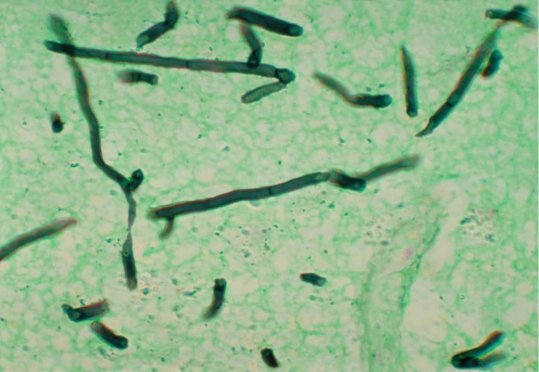
Source: CDC and Dr. Libero Ajello
A) Hyaline septate hyphae
B) Dematiaceous septate hyphae
C) Hyaline aseptate hyphae
D) Dematiaceous aseptate hyphae
Source: CDC and Dr. Libero Ajello
A) Hyaline septate hyphae
B) Dematiaceous septate hyphae
C) Hyaline aseptate hyphae
D) Dematiaceous aseptate hyphae
Question
What fungal structure is demonstrated in the image provided?
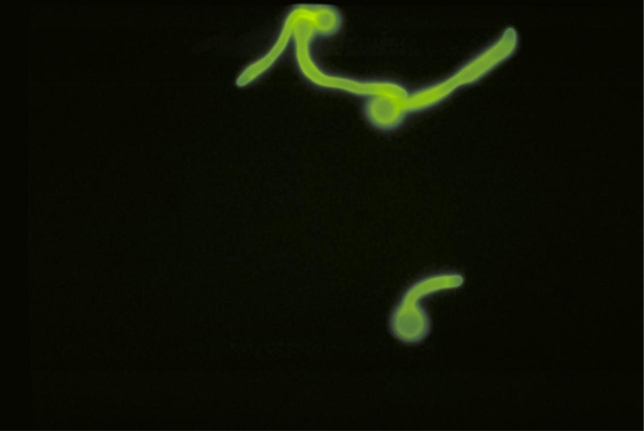 Source: CDC/Mercy Hospital, Toledo, OH; Dr. Brian Harrington
A) Blastoconidia
B) Pseudohyphae
C) Germ tube
D) True hyphae
Source: CDC/Mercy Hospital, Toledo, OH; Dr. Brian HarringtonA) Blastoconidia
B) Pseudohyphae
C) Germ tube
D) True hyphae
Question
Question
Question
Question
Question
Question
Question
A 34-year-old female presents to her physician with brown-colored, scaly, itching lesions on her chest. The physician recognizes the skin infection. He screens the lesions using a Wood's lamp and determines there is a yellow fluorescence present He performs scrapings of one of the lesions, stains them with PAS, and examines them microscopically. The image provided shows what the physician saw under the microscope.
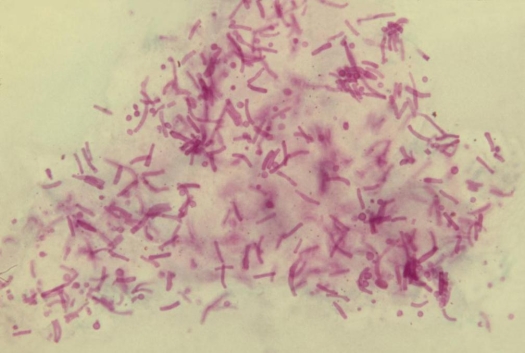
Source: CDC and Dr. Lucille K. Georg
Which of the following superficial mycoses does this woman possess?
A) Pityriasis versicolor
B) Superficial phaeohyphomycosis
C) White piedra
D) Black piedra
Source: CDC and Dr. Lucille K. Georg
Which of the following superficial mycoses does this woman possess?
A) Pityriasis versicolor
B) Superficial phaeohyphomycosis
C) White piedra
D) Black piedra
Question
A 17-year-old high school football player presents with burning, itching, and peeling skin between his toes. He visits his physician because home treatment is not working. The physician suspects one of three possible dermatophytes is the cause of the infection. The image provided is the microscopic examination of the colony that eventually grew on DTM medium.
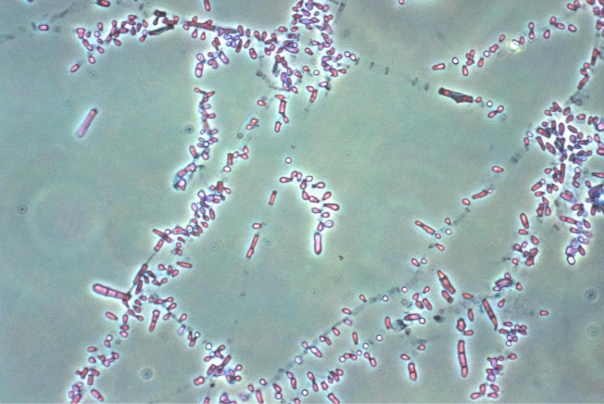 Source: CDC and Dr. Libero Ajello
This organism will be
A) urea positive.
B) positive for in-vitro hair perforation.
C) an olive or khaki colony.
D) able to produce a red pigment on CMA.
Source: CDC and Dr. Libero AjelloThis organism will be
A) urea positive.
B) positive for in-vitro hair perforation.
C) an olive or khaki colony.
D) able to produce a red pigment on CMA.
Question
Prior to returning to college for the fall, a 20-year-old male presents with numerous nodules and ulcers on this fingers. His history is significant because he worked for the summer on a farm bailing hay. The physician swabs the ulcers and sends the specimen to the microbiology department for routine and fungal culture. The routine culture showed no growth at 48 hours. Growth on the fungal agars incubated at 35°C and room temperature appear in the images provided.
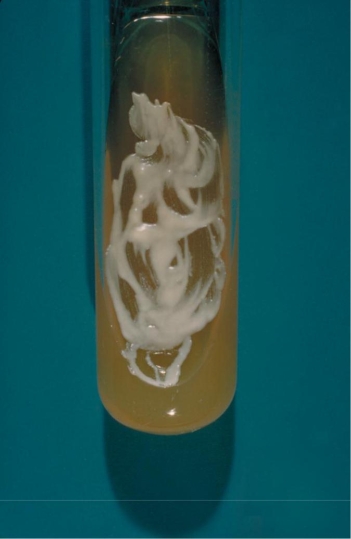 35°C incubation
Source: CDC and Dr. Lucille K. Georg
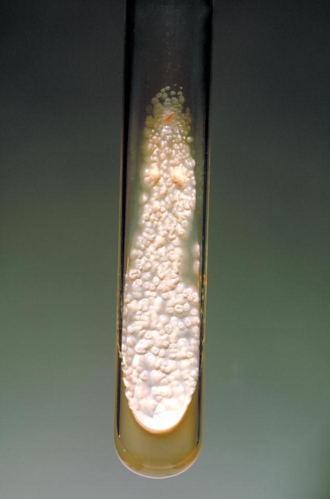 25°C incubation
Source: CDC and Dr. William Kaplan
On microscopic examination of the 35 degree isolate, you would expect to see.
A) Broad based budding yeast
B) Arthrospores
C) Yeast resembling cigar bodies
D) Spherules
35°C incubationSource: CDC and Dr. Lucille K. Georg
25°C incubationSource: CDC and Dr. William Kaplan
On microscopic examination of the 35 degree isolate, you would expect to see.
A) Broad based budding yeast
B) Arthrospores
C) Yeast resembling cigar bodies
D) Spherules
Question
A recent female immigrant from Vietnam presents to the emergency room with fever and numerous lesions on her skin. Her history is significant because she is HIV positive. The physician draws blood cultures and takes a bone marrow sample for routine and fungal culture. At 48 hours, the routine cultures demonstrate no growth. At three days, the room temperature fungal agar shows a velvety, red-white colony that exhibits a maroon pigment in the agar around the colony. The 35°C fungal agar shows small white moist colonies. The microscopic morphology of the 25°C colony is provided.
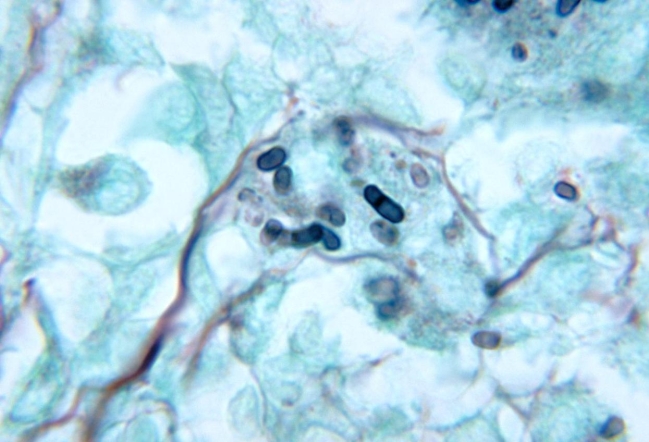 Source: CDC, Dr. Lucille K. George, and Dr. Arthur DiSalvo
Which of the following organisms is the possible etiologic agent?
A) Aspergillus fumigatus
B) Histoplasma capsulatum
C) Sporothrix schenckii
D) Penicillium marneffei
Source: CDC, Dr. Lucille K. George, and Dr. Arthur DiSalvoWhich of the following organisms is the possible etiologic agent?
A) Aspergillus fumigatus
B) Histoplasma capsulatum
C) Sporothrix schenckii
D) Penicillium marneffei
Question
A 21-year-old female leukemia patient receiving chemotherapy develops fever, cough, chest pain, and trouble breathing. A sputum culture is submitted for routine, fungal, and acid-fast cultures. At 48 hours, a black filamentous mould is growing on the sheep blood and chocolate agars. The fungal culture is growing the same organism. Microscopic examination of the organism is provided in the image below.
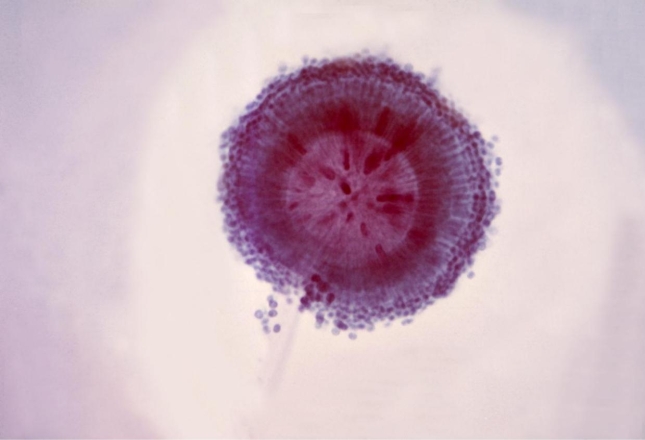 Source: CDC and Dr. Lucille K. Georg
Which organism is causing her infection?
A) Penicillium spp.
B) Aspergillus fumigatus
C) Aspergillus niger
D) Mucor spp.
Source: CDC and Dr. Lucille K. GeorgWhich organism is causing her infection?
A) Penicillium spp.
B) Aspergillus fumigatus
C) Aspergillus niger
D) Mucor spp.
Question
Question
A urine culture grows >100,000 colonies/mL of a pinpoint gray colony. Gram stain of the colony reveals blastoconidia. A RIOT agar is set up and read at 24 and 48 hours.
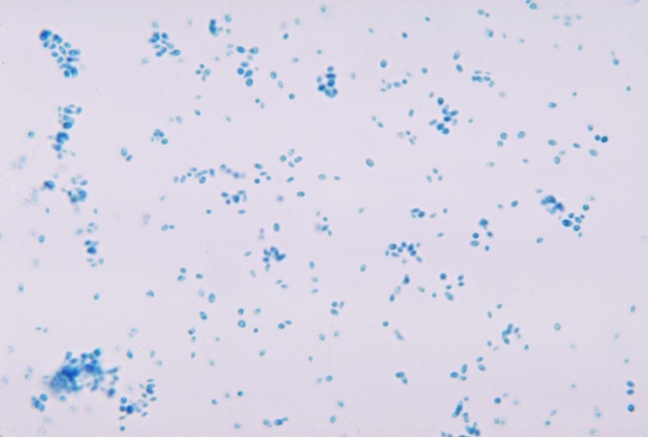 Source: CDC and Dr. Leanor Haley
What is the presumptive identification of this organism?
A) Candida dubliniensis
B) C. glabrata
C) C) albicans
D) C. tropicalis
Source: CDC and Dr. Leanor HaleyWhat is the presumptive identification of this organism?
A) Candida dubliniensis
B) C. glabrata
C) C) albicans
D) C. tropicalis
Question
Question

Unlock Deck
Sign up to unlock the cards in this deck!
Unlock Deck
Unlock Deck
1/21

Play

Full screen (f)
Deck 29: Medical Mycolog
1
Most fungal cultures are incubated at
A) 25°C.
B) 30°C.
C) 35°C.
D) 42°C.
A) 25°C.
B) 30°C.
C) 35°C.
D) 42°C.
30°C.
2
Which of the following individuals is prone to fungal infection?
A) 47-year-old male receiving vancomycin for systemic MRSA infection
B) 17-year-old female who received a kidney transplant three months ago
C) 38-year-old female with AIDS
D) All of the above
A) 47-year-old male receiving vancomycin for systemic MRSA infection
B) 17-year-old female who received a kidney transplant three months ago
C) 38-year-old female with AIDS
D) All of the above
All of the above
3
How does having type I diabetes predispose an individual to fungal infections?
A) High sugar levels can impair humoral immunity and the function of the white blood cells.
B) High sugar levels cause the body to break down protein and so the blood PH becomes acidic.
C) Diabetics often have trauma to their feet and hands due to neuropathy.
D) All of the above.
A) High sugar levels can impair humoral immunity and the function of the white blood cells.
B) High sugar levels cause the body to break down protein and so the blood PH becomes acidic.
C) Diabetics often have trauma to their feet and hands due to neuropathy.
D) All of the above.
All of the above.
4
Microbiologists can be exposed to moulds on routine bacterial cultures
A) inhalation of conidia.
B) traumatic implantation of hyphae..
C) direct contact with basidiospores.
D) colonization of the mucosal membranes by conidia.
A) inhalation of conidia.
B) traumatic implantation of hyphae..
C) direct contact with basidiospores.
D) colonization of the mucosal membranes by conidia.
Unlock Deck
Unlock for access to all 21 flashcards in this deck.
Unlock Deck
k this deck
5
Identify the structure the image provided.
Source: CDC and Dr. Libero Ajello
A) Hyaline septate hyphae
B) Dematiaceous septate hyphae
C) Hyaline aseptate hyphae
D) Dematiaceous aseptate hyphae
Source: CDC and Dr. Libero Ajello
A) Hyaline septate hyphae
B) Dematiaceous septate hyphae
C) Hyaline aseptate hyphae
D) Dematiaceous aseptate hyphae
Unlock Deck
Unlock for access to all 21 flashcards in this deck.
Unlock Deck
k this deck
6
What fungal structure is demonstrated in the image provided?
Source: CDC/Mercy Hospital, Toledo, OH; Dr. Brian Harrington
A) Blastoconidia
B) Pseudohyphae
C) Germ tube
D) True hyphae
Source: CDC/Mercy Hospital, Toledo, OH; Dr. Brian HarringtonA) Blastoconidia
B) Pseudohyphae
C) Germ tube
D) True hyphae
Unlock Deck
Unlock for access to all 21 flashcards in this deck.
Unlock Deck
k this deck
7
The result of asexual reproduction in filamentous moulds is
A) a spore.
B) an ascus.
C) basidiospores.
D) an ascospore.
A) a spore.
B) an ascus.
C) basidiospores.
D) an ascospore.
Unlock Deck
Unlock for access to all 21 flashcards in this deck.
Unlock Deck
k this deck
8
The sexual form of a fungus is called a/an _______________ while the asexual form is called a/an _____________.
A) anamorph, teleomorph
B) teleomorph, anamorph
C) spore, ascus
D) sporangium, zygospore
A) anamorph, teleomorph
B) teleomorph, anamorph
C) spore, ascus
D) sporangium, zygospore
Unlock Deck
Unlock for access to all 21 flashcards in this deck.
Unlock Deck
k this deck
9
What is the most common opportunistic filamentous mould capable of infecting
Weakened hosts?
A) Candida species
B) Aspergillus species
C) Mucor species
D) Cryptococcus neoformans
Weakened hosts?
A) Candida species
B) Aspergillus species
C) Mucor species
D) Cryptococcus neoformans
Unlock Deck
Unlock for access to all 21 flashcards in this deck.
Unlock Deck
k this deck
10
The isolation of Aspergillus spp. from lung tissue represents
A) a potential contaminant.
B) colonization.
C) a clinically significant isolate.
D) exposure to aflatoxins.
A) a potential contaminant.
B) colonization.
C) a clinically significant isolate.
D) exposure to aflatoxins.
Unlock Deck
Unlock for access to all 21 flashcards in this deck.
Unlock Deck
k this deck
11
Fungi, which invade tissues, can be observed microscopically using histological stains such as
A) methylene blue.
B) KOH.
C) periodic acid-Schiff.
D) rhodamine-auramine.
A) methylene blue.
B) KOH.
C) periodic acid-Schiff.
D) rhodamine-auramine.
Unlock Deck
Unlock for access to all 21 flashcards in this deck.
Unlock Deck
k this deck
12
A construction worker in Tucson, AZ, presents with flu-like symptoms and productive cough. A sputum specimen is submitted for fungal culture. The fungal culture reveals a white, cottony mould at both 25 and 35 degrees. On microscopic examination, arthrospores are noted. This isolate is probably a member of the _________ group of fungi.
A) superficial
B) subcutaneous
C) opportunistic
D) systemic
A) superficial
B) subcutaneous
C) opportunistic
D) systemic
Unlock Deck
Unlock for access to all 21 flashcards in this deck.
Unlock Deck
k this deck
13
A 34-year-old female presents to her physician with brown-colored, scaly, itching lesions on her chest. The physician recognizes the skin infection. He screens the lesions using a Wood's lamp and determines there is a yellow fluorescence present He performs scrapings of one of the lesions, stains them with PAS, and examines them microscopically. The image provided shows what the physician saw under the microscope.
Source: CDC and Dr. Lucille K. Georg
Which of the following superficial mycoses does this woman possess?
A) Pityriasis versicolor
B) Superficial phaeohyphomycosis
C) White piedra
D) Black piedra
Source: CDC and Dr. Lucille K. Georg
Which of the following superficial mycoses does this woman possess?
A) Pityriasis versicolor
B) Superficial phaeohyphomycosis
C) White piedra
D) Black piedra
Unlock Deck
Unlock for access to all 21 flashcards in this deck.
Unlock Deck
k this deck
14
A 17-year-old high school football player presents with burning, itching, and peeling skin between his toes. He visits his physician because home treatment is not working. The physician suspects one of three possible dermatophytes is the cause of the infection. The image provided is the microscopic examination of the colony that eventually grew on DTM medium.
Source: CDC and Dr. Libero Ajello
This organism will be
A) urea positive.
B) positive for in-vitro hair perforation.
C) an olive or khaki colony.
D) able to produce a red pigment on CMA.
Source: CDC and Dr. Libero AjelloThis organism will be
A) urea positive.
B) positive for in-vitro hair perforation.
C) an olive or khaki colony.
D) able to produce a red pigment on CMA.
Unlock Deck
Unlock for access to all 21 flashcards in this deck.
Unlock Deck
k this deck
15
Prior to returning to college for the fall, a 20-year-old male presents with numerous nodules and ulcers on this fingers. His history is significant because he worked for the summer on a farm bailing hay. The physician swabs the ulcers and sends the specimen to the microbiology department for routine and fungal culture. The routine culture showed no growth at 48 hours. Growth on the fungal agars incubated at 35°C and room temperature appear in the images provided.
35°C incubation
Source: CDC and Dr. Lucille K. Georg
25°C incubation
Source: CDC and Dr. William Kaplan
On microscopic examination of the 35 degree isolate, you would expect to see.
A) Broad based budding yeast
B) Arthrospores
C) Yeast resembling cigar bodies
D) Spherules
35°C incubationSource: CDC and Dr. Lucille K. Georg
25°C incubationSource: CDC and Dr. William Kaplan
On microscopic examination of the 35 degree isolate, you would expect to see.
A) Broad based budding yeast
B) Arthrospores
C) Yeast resembling cigar bodies
D) Spherules
Unlock Deck
Unlock for access to all 21 flashcards in this deck.
Unlock Deck
k this deck
16
A recent female immigrant from Vietnam presents to the emergency room with fever and numerous lesions on her skin. Her history is significant because she is HIV positive. The physician draws blood cultures and takes a bone marrow sample for routine and fungal culture. At 48 hours, the routine cultures demonstrate no growth. At three days, the room temperature fungal agar shows a velvety, red-white colony that exhibits a maroon pigment in the agar around the colony. The 35°C fungal agar shows small white moist colonies. The microscopic morphology of the 25°C colony is provided.
Source: CDC, Dr. Lucille K. George, and Dr. Arthur DiSalvo
Which of the following organisms is the possible etiologic agent?
A) Aspergillus fumigatus
B) Histoplasma capsulatum
C) Sporothrix schenckii
D) Penicillium marneffei
Source: CDC, Dr. Lucille K. George, and Dr. Arthur DiSalvoWhich of the following organisms is the possible etiologic agent?
A) Aspergillus fumigatus
B) Histoplasma capsulatum
C) Sporothrix schenckii
D) Penicillium marneffei
Unlock Deck
Unlock for access to all 21 flashcards in this deck.
Unlock Deck
k this deck
17
A 21-year-old female leukemia patient receiving chemotherapy develops fever, cough, chest pain, and trouble breathing. A sputum culture is submitted for routine, fungal, and acid-fast cultures. At 48 hours, a black filamentous mould is growing on the sheep blood and chocolate agars. The fungal culture is growing the same organism. Microscopic examination of the organism is provided in the image below.
Source: CDC and Dr. Lucille K. Georg
Which organism is causing her infection?
A) Penicillium spp.
B) Aspergillus fumigatus
C) Aspergillus niger
D) Mucor spp.
Source: CDC and Dr. Lucille K. GeorgWhich organism is causing her infection?
A) Penicillium spp.
B) Aspergillus fumigatus
C) Aspergillus niger
D) Mucor spp.
Unlock Deck
Unlock for access to all 21 flashcards in this deck.
Unlock Deck
k this deck
18
You have isolated a suspected Cryptococcus neoformans from the cerebrospinal fluid of an individual with AIDS. Which of the following tests is required for a rapid presumptive identification?
A) Urea hydrolysis
B) Caffeic acid production
C) Presence of a capsule
D) All of the above
A) Urea hydrolysis
B) Caffeic acid production
C) Presence of a capsule
D) All of the above
Unlock Deck
Unlock for access to all 21 flashcards in this deck.
Unlock Deck
k this deck
19
A urine culture grows >100,000 colonies/mL of a pinpoint gray colony. Gram stain of the colony reveals blastoconidia. A RIOT agar is set up and read at 24 and 48 hours.
Source: CDC and Dr. Leanor Haley
What is the presumptive identification of this organism?
A) Candida dubliniensis
B) C. glabrata
C) C) albicans
D) C. tropicalis
Source: CDC and Dr. Leanor HaleyWhat is the presumptive identification of this organism?
A) Candida dubliniensis
B) C. glabrata
C) C) albicans
D) C. tropicalis
Unlock Deck
Unlock for access to all 21 flashcards in this deck.
Unlock Deck
k this deck
20
Amphotericin B and the azole derivatives are potent fungal drugs because they cause changes in the organism's cell
A) pH.
B) nucleus.
C) membrane.
D) wall.
A) pH.
B) nucleus.
C) membrane.
D) wall.
Unlock Deck
Unlock for access to all 21 flashcards in this deck.
Unlock Deck
k this deck
21
Candida lusitaniae and C. krusei must be accurately differentiated from other Candida species due to their unique intrinsic resistance to fungal agents. What are their expected results?
A) C. lusitaniae is resistant to amphotericin B while C. krusei is resistant to fluconazole.
B) C. lusitaniae is resistant to fluconazole while C. krusei is resistant to amphotericin B.
C) C. lusitaniae and C. krusei are resistant to amphotericin B.
D) C. lusitaniae and C. krusei are resistant to fluconazole.
A) C. lusitaniae is resistant to amphotericin B while C. krusei is resistant to fluconazole.
B) C. lusitaniae is resistant to fluconazole while C. krusei is resistant to amphotericin B.
C) C. lusitaniae and C. krusei are resistant to amphotericin B.
D) C. lusitaniae and C. krusei are resistant to fluconazole.
Unlock Deck
Unlock for access to all 21 flashcards in this deck.
Unlock Deck
k this deck
Unlock Deck
Unlock for access to all 21 flashcards in this deck.






