







 Chat with AI

Deck 10: Public Goods and the Role of Government
Full screen (f)

Question

Question
Question
Question
Question
Question
Question
Question
Question
Question
Question
Question
Question
Question
Question
Question
Question
Question
Question
Question
Question
Question
Question
Question
Question
Question
Question
Figure 10.1: 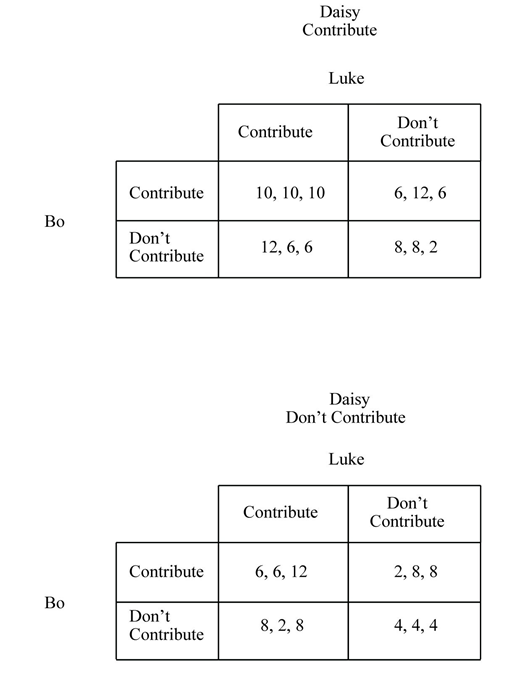 Three neighbors in a cul-de-sac, Bo, Luke, and Daisy, have an option of contributing or not contributing to paying for and installing outdoor security lighting to help make their cul-de-sac safer. For each person who contributes, one security light will be installed. The payoff matrix for this scenario is shown above.
-Refer to Figure 10.1. If only one light is installed, the person who is responsible for the light being installed receives a payoff of
A) 2.
B) 4.
C) 6.
D) 8.
Three neighbors in a cul-de-sac, Bo, Luke, and Daisy, have an option of contributing or not contributing to paying for and installing outdoor security lighting to help make their cul-de-sac safer. For each person who contributes, one security light will be installed. The payoff matrix for this scenario is shown above.-Refer to Figure 10.1. If only one light is installed, the person who is responsible for the light being installed receives a payoff of
A) 2.
B) 4.
C) 6.
D) 8.
Question
Figure 10.1: Three neighbors in a cul-de-sac, Bo, Luke, and Daisy, have an option of contributing or not contributing to paying for and installing outdoor security lighting to help make their cul-de-sac safer. For each person who contributes, one security light will be installed. The payoff matrix for this scenario is shown above.
-Refer to Figure 10.1. If only one light is installed, the people who were not responsible for the light being installed each receive a payoff of
A) 2.
B) 4.
C) 6.
D) 8.
Three neighbors in a cul-de-sac, Bo, Luke, and Daisy, have an option of contributing or not contributing to paying for and installing outdoor security lighting to help make their cul-de-sac safer. For each person who contributes, one security light will be installed. The payoff matrix for this scenario is shown above.-Refer to Figure 10.1. If only one light is installed, the people who were not responsible for the light being installed each receive a payoff of
A) 2.
B) 4.
C) 6.
D) 8.
Question
Figure 10.1: Three neighbors in a cul-de-sac, Bo, Luke, and Daisy, have an option of contributing or not contributing to paying for and installing outdoor security lighting to help make their cul-de-sac safer. For each person who contributes, one security light will be installed. The payoff matrix for this scenario is shown above.
-Refer to Figure 10.1. If two lights are installed, the people who were responsible for the light being installed each receive a payoff of
A) 2.
B) 4.
C) 6.
D) 8.
Three neighbors in a cul-de-sac, Bo, Luke, and Daisy, have an option of contributing or not contributing to paying for and installing outdoor security lighting to help make their cul-de-sac safer. For each person who contributes, one security light will be installed. The payoff matrix for this scenario is shown above.-Refer to Figure 10.1. If two lights are installed, the people who were responsible for the light being installed each receive a payoff of
A) 2.
B) 4.
C) 6.
D) 8.
Question
Figure 10.1: Three neighbors in a cul-de-sac, Bo, Luke, and Daisy, have an option of contributing or not contributing to paying for and installing outdoor security lighting to help make their cul-de-sac safer. For each person who contributes, one security light will be installed. The payoff matrix for this scenario is shown above.
-Refer to Figure 10.1. If two lights are installed, the person who was not responsible for the light being installed receives a payoff of
A) 4.
B) 6.
C) 8.
D) 12.
Three neighbors in a cul-de-sac, Bo, Luke, and Daisy, have an option of contributing or not contributing to paying for and installing outdoor security lighting to help make their cul-de-sac safer. For each person who contributes, one security light will be installed. The payoff matrix for this scenario is shown above.-Refer to Figure 10.1. If two lights are installed, the person who was not responsible for the light being installed receives a payoff of
A) 4.
B) 6.
C) 8.
D) 12.
Question
Figure 10.1: Three neighbors in a cul-de-sac, Bo, Luke, and Daisy, have an option of contributing or not contributing to paying for and installing outdoor security lighting to help make their cul-de-sac safer. For each person who contributes, one security light will be installed. The payoff matrix for this scenario is shown above.
-Refer to Figure 10.1. If three lights are installed, the people who were responsible for the light being installed each receive a payoff of
A) 4.
B) 6.
C) 8.
D) 10.
Three neighbors in a cul-de-sac, Bo, Luke, and Daisy, have an option of contributing or not contributing to paying for and installing outdoor security lighting to help make their cul-de-sac safer. For each person who contributes, one security light will be installed. The payoff matrix for this scenario is shown above.-Refer to Figure 10.1. If three lights are installed, the people who were responsible for the light being installed each receive a payoff of
A) 4.
B) 6.
C) 8.
D) 10.
Question
Figure 10.1: Three neighbors in a cul-de-sac, Bo, Luke, and Daisy, have an option of contributing or not contributing to paying for and installing outdoor security lighting to help make their cul-de-sac safer. For each person who contributes, one security light will be installed. The payoff matrix for this scenario is shown above.
-Refer to Figure 10.1. If Daisy contributes to the lighting, Luke should
A) contribute if Bo contributes.
B) not contribute only if Bo does not contribute.
C) contribute if Bo does not contribute.
D) not contribute regardless of what Bo decides to do.
Three neighbors in a cul-de-sac, Bo, Luke, and Daisy, have an option of contributing or not contributing to paying for and installing outdoor security lighting to help make their cul-de-sac safer. For each person who contributes, one security light will be installed. The payoff matrix for this scenario is shown above.-Refer to Figure 10.1. If Daisy contributes to the lighting, Luke should
A) contribute if Bo contributes.
B) not contribute only if Bo does not contribute.
C) contribute if Bo does not contribute.
D) not contribute regardless of what Bo decides to do.
Question
Figure 10.1: Three neighbors in a cul-de-sac, Bo, Luke, and Daisy, have an option of contributing or not contributing to paying for and installing outdoor security lighting to help make their cul-de-sac safer. For each person who contributes, one security light will be installed. The payoff matrix for this scenario is shown above.
-Refer to Figure 10.1. If Daisy contributes to the lighting, Bo should
A) contribute if Luke contributes.
B) not contribute only if Luke does not contribute.
C) not contribute regardless of what Luke decides to do.
D) contribute if Luke does not contribute.
Three neighbors in a cul-de-sac, Bo, Luke, and Daisy, have an option of contributing or not contributing to paying for and installing outdoor security lighting to help make their cul-de-sac safer. For each person who contributes, one security light will be installed. The payoff matrix for this scenario is shown above.-Refer to Figure 10.1. If Daisy contributes to the lighting, Bo should
A) contribute if Luke contributes.
B) not contribute only if Luke does not contribute.
C) not contribute regardless of what Luke decides to do.
D) contribute if Luke does not contribute.
Question
Figure 10.1: Three neighbors in a cul-de-sac, Bo, Luke, and Daisy, have an option of contributing or not contributing to paying for and installing outdoor security lighting to help make their cul-de-sac safer. For each person who contributes, one security light will be installed. The payoff matrix for this scenario is shown above.
-Refer to Figure 10.1. If Daisy does not contribute to the lighting, Luke should
A) contribute if Bo contributes.
B) not contribute only if Bo does not contribute.
C) not contribute regardless of what Bo decides to do.
D) contribute if Bo does not contribute.
Three neighbors in a cul-de-sac, Bo, Luke, and Daisy, have an option of contributing or not contributing to paying for and installing outdoor security lighting to help make their cul-de-sac safer. For each person who contributes, one security light will be installed. The payoff matrix for this scenario is shown above.-Refer to Figure 10.1. If Daisy does not contribute to the lighting, Luke should
A) contribute if Bo contributes.
B) not contribute only if Bo does not contribute.
C) not contribute regardless of what Bo decides to do.
D) contribute if Bo does not contribute.
Question
Figure 10.1: Three neighbors in a cul-de-sac, Bo, Luke, and Daisy, have an option of contributing or not contributing to paying for and installing outdoor security lighting to help make their cul-de-sac safer. For each person who contributes, one security light will be installed. The payoff matrix for this scenario is shown above.
-Refer to Figure 10.1. If Daisy does not contribute to the lighting, Bo should
A) contribute if Luke contributes.
B) not contribute only if Luke does not contribute.
C) not contribute regardless of what Luke decides to do.
D) contribute if Luke does not contribute.
Three neighbors in a cul-de-sac, Bo, Luke, and Daisy, have an option of contributing or not contributing to paying for and installing outdoor security lighting to help make their cul-de-sac safer. For each person who contributes, one security light will be installed. The payoff matrix for this scenario is shown above.-Refer to Figure 10.1. If Daisy does not contribute to the lighting, Bo should
A) contribute if Luke contributes.
B) not contribute only if Luke does not contribute.
C) not contribute regardless of what Luke decides to do.
D) contribute if Luke does not contribute.
Question
Figure 10.1: Three neighbors in a cul-de-sac, Bo, Luke, and Daisy, have an option of contributing or not contributing to paying for and installing outdoor security lighting to help make their cul-de-sac safer. For each person who contributes, one security light will be installed. The payoff matrix for this scenario is shown above.
-Refer to Figure 10.1. The dominant strategy for ________ is to not contribute.
A) Daisy
B) Bo
C) Luke
D) all of the above
Three neighbors in a cul-de-sac, Bo, Luke, and Daisy, have an option of contributing or not contributing to paying for and installing outdoor security lighting to help make their cul-de-sac safer. For each person who contributes, one security light will be installed. The payoff matrix for this scenario is shown above.-Refer to Figure 10.1. The dominant strategy for ________ is to not contribute.
A) Daisy
B) Bo
C) Luke
D) all of the above
Question
Figure 10.1: Three neighbors in a cul-de-sac, Bo, Luke, and Daisy, have an option of contributing or not contributing to paying for and installing outdoor security lighting to help make their cul-de-sac safer. For each person who contributes, one security light will be installed. The payoff matrix for this scenario is shown above.
-Refer to Figure 10.1. The dominant strategy for ________ is to contribute.
A) Daisy
B) Bo
C) Luke
D) none of the above
Three neighbors in a cul-de-sac, Bo, Luke, and Daisy, have an option of contributing or not contributing to paying for and installing outdoor security lighting to help make their cul-de-sac safer. For each person who contributes, one security light will be installed. The payoff matrix for this scenario is shown above.-Refer to Figure 10.1. The dominant strategy for ________ is to contribute.
A) Daisy
B) Bo
C) Luke
D) none of the above
Question
Figure 10.1: Three neighbors in a cul-de-sac, Bo, Luke, and Daisy, have an option of contributing or not contributing to paying for and installing outdoor security lighting to help make their cul-de-sac safer. For each person who contributes, one security light will be installed. The payoff matrix for this scenario is shown above.
-Refer to Figure 10.1. The Nash equilibrium occurs on the ________ page, in the ________ cell.
A) Contribute; upper-left
B) Contribute; lower-right
C) Don't Contribute; lower-right
D) Don't Contribute; upper-left
Three neighbors in a cul-de-sac, Bo, Luke, and Daisy, have an option of contributing or not contributing to paying for and installing outdoor security lighting to help make their cul-de-sac safer. For each person who contributes, one security light will be installed. The payoff matrix for this scenario is shown above.-Refer to Figure 10.1. The Nash equilibrium occurs on the ________ page, in the ________ cell.
A) Contribute; upper-left
B) Contribute; lower-right
C) Don't Contribute; lower-right
D) Don't Contribute; upper-left
Question
Figure 10.1: Three neighbors in a cul-de-sac, Bo, Luke, and Daisy, have an option of contributing or not contributing to paying for and installing outdoor security lighting to help make their cul-de-sac safer. For each person who contributes, one security light will be installed. The payoff matrix for this scenario is shown above.
-Refer to Figure 10.1. When each player plays his or her dominant strategy, society is poorer and the payoffs are smaller by ________ units than if each player had played the strategy with the ideal outcome for both the individual players and for the group as a whole.
A) 6
B) 12
C) 18
D) 30
Three neighbors in a cul-de-sac, Bo, Luke, and Daisy, have an option of contributing or not contributing to paying for and installing outdoor security lighting to help make their cul-de-sac safer. For each person who contributes, one security light will be installed. The payoff matrix for this scenario is shown above.-Refer to Figure 10.1. When each player plays his or her dominant strategy, society is poorer and the payoffs are smaller by ________ units than if each player had played the strategy with the ideal outcome for both the individual players and for the group as a whole.
A) 6
B) 12
C) 18
D) 30
Question
Figure 10.1: Three neighbors in a cul-de-sac, Bo, Luke, and Daisy, have an option of contributing or not contributing to paying for and installing outdoor security lighting to help make their cul-de-sac safer. For each person who contributes, one security light will be installed. The payoff matrix for this scenario is shown above.
-Refer to Figure 10.1. This scenario is representative of a(n)
A) prisoner's dilemma game.
B) battle of the sexes game.
C) pure coordination game.
D) assurance game.
Three neighbors in a cul-de-sac, Bo, Luke, and Daisy, have an option of contributing or not contributing to paying for and installing outdoor security lighting to help make their cul-de-sac safer. For each person who contributes, one security light will be installed. The payoff matrix for this scenario is shown above.-Refer to Figure 10.1. This scenario is representative of a(n)
A) prisoner's dilemma game.
B) battle of the sexes game.
C) pure coordination game.
D) assurance game.
Question
Question
Question
Question
Question
Question
Question
Question
Question
Question
Question
Question
Question
Question
Question
Question
Question
Question
Question

Unlock Deck
Sign up to unlock the cards in this deck!
Unlock Deck
Unlock Deck
1/59

Play

Full screen (f)
Deck 10: Public Goods and the Role of Government
1
Classifying a good as nonrival means
A) that there is a surplus of the good.
B) that the good is produced in a competitive market.
C) that the producer can prevent people from consuming it.
D) that many people can consume the good simultaneously.
A) that there is a surplus of the good.
B) that the good is produced in a competitive market.
C) that the producer can prevent people from consuming it.
D) that many people can consume the good simultaneously.
that many people can consume the good simultaneously.
2
A good is considered to be nonexcludable if
A) your consumption of the good reduces the quantity available for others to consume.
B) the producer can keep those who did not pay for the good from consuming the good.
C) the producer finds it difficult to keep those who did not pay for the good from consuming the good.
D) it is jointly owned by all members of a community.
A) your consumption of the good reduces the quantity available for others to consume.
B) the producer can keep those who did not pay for the good from consuming the good.
C) the producer finds it difficult to keep those who did not pay for the good from consuming the good.
D) it is jointly owned by all members of a community.
the producer finds it difficult to keep those who did not pay for the good from consuming the good.
3
Which of the following is an example of a product that is nonexcludable and rival?
A) a motorcycle
B) the court system
C) Western lowland gorillas
D) a NASCAR event
A) a motorcycle
B) the court system
C) Western lowland gorillas
D) a NASCAR event
Western lowland gorillas
4
Which of the following is an example of a product that is excludable and nonrival?
A) a motorcycle
B) the court system
C) Western lowland gorillas
D) a NASCAR event
A) a motorcycle
B) the court system
C) Western lowland gorillas
D) a NASCAR event
Unlock Deck
Unlock for access to all 59 flashcards in this deck.
Unlock Deck
k this deck
5
Which of the following is an example of a product that is excludable and rival?
A) a motorcycle
B) the court system
C) Western lowland gorillas
D) a NASCAR event
A) a motorcycle
B) the court system
C) Western lowland gorillas
D) a NASCAR event
Unlock Deck
Unlock for access to all 59 flashcards in this deck.
Unlock Deck
k this deck
6
Which of the following is an example of a product that is nonexcludable and nonrival?
A) a motorcycle
B) the court system
C) Western lowland gorillas
D) a NASCAR event
A) a motorcycle
B) the court system
C) Western lowland gorillas
D) a NASCAR event
Unlock Deck
Unlock for access to all 59 flashcards in this deck.
Unlock Deck
k this deck
7
Which of the following is an example of a common pool resource?
A) a lighthouse
B) burritos
C) a high school football game
D) redwood forests
A) a lighthouse
B) burritos
C) a high school football game
D) redwood forests
Unlock Deck
Unlock for access to all 59 flashcards in this deck.
Unlock Deck
k this deck
8
Which of the following is an example of a pure private good?
A) a lighthouse
B) burritos
C) a high school football game
D) redwood forests
A) a lighthouse
B) burritos
C) a high school football game
D) redwood forests
Unlock Deck
Unlock for access to all 59 flashcards in this deck.
Unlock Deck
k this deck
9
Which of the following is an example of a pure public good?
A) a lighthouse
B) burritos
C) a high school football game
D) redwood forests
A) a lighthouse
B) burritos
C) a high school football game
D) redwood forests
Unlock Deck
Unlock for access to all 59 flashcards in this deck.
Unlock Deck
k this deck
10
Which of the following is an example of a club good?
A) a lighthouse
B) burritos
C) a high school football game
D) redwood forests
A) a lighthouse
B) burritos
C) a high school football game
D) redwood forests
Unlock Deck
Unlock for access to all 59 flashcards in this deck.
Unlock Deck
k this deck
11
Club goods differ from pure private goods in that
A) club goods are nonexcludable while pure private goods are excludable
B) club goods are excludable while pure private goods are nonexcludable.
C) club goods are nonrival while pure private goods are rival.
D) club goods are nonexcludable while pure private goods are excludable.
A) club goods are nonexcludable while pure private goods are excludable
B) club goods are excludable while pure private goods are nonexcludable.
C) club goods are nonrival while pure private goods are rival.
D) club goods are nonexcludable while pure private goods are excludable.
Unlock Deck
Unlock for access to all 59 flashcards in this deck.
Unlock Deck
k this deck
12
A rival good is defined as a good for which there are substitutes.
Unlock Deck
Unlock for access to all 59 flashcards in this deck.
Unlock Deck
k this deck
13
An excludable good is a good that a producer can prevent people from consuming.
Unlock Deck
Unlock for access to all 59 flashcards in this deck.
Unlock Deck
k this deck
14
A common pool resource is nonrival and nonexcludable.
Unlock Deck
Unlock for access to all 59 flashcards in this deck.
Unlock Deck
k this deck
15
An amusement park is an example of a pure private good.
Unlock Deck
Unlock for access to all 59 flashcards in this deck.
Unlock Deck
k this deck
16
The San Diego Zoo is an example of a club good.
Unlock Deck
Unlock for access to all 59 flashcards in this deck.
Unlock Deck
k this deck
17
Determine if each of the goods below displays any of the following characteristics:
(i) rivalry
(ii) nonrivalry
(iii) excludability
(iv) nonexcludability
a. attending a Packers game at Lambeau Field
b. online encyclopedia Wikipedia
c. a shopping mall on Black Friday
d. an online defensive driving class
e. a Tesla Model S electric car
(i) rivalry
(ii) nonrivalry
(iii) excludability
(iv) nonexcludability
a. attending a Packers game at Lambeau Field
b. online encyclopedia Wikipedia
c. a shopping mall on Black Friday
d. an online defensive driving class
e. a Tesla Model S electric car
Unlock Deck
Unlock for access to all 59 flashcards in this deck.
Unlock Deck
k this deck
18
State whether each of the following goods is nonrival, nonexcludable, or both:
-a botanical garden
A) Nonrival
B)nonexcludable
C) A & B
-a botanical garden
A) Nonrival
B)nonexcludable
C) A & B
Unlock Deck
Unlock for access to all 59 flashcards in this deck.
Unlock Deck
k this deck
19
State whether each of the following goods is nonrival, nonexcludable, or both:
-a public beach
A) Nonrival
B)nonexcludable
C) A & B
-a public beach
A) Nonrival
B)nonexcludable
C) A & B
Unlock Deck
Unlock for access to all 59 flashcards in this deck.
Unlock Deck
k this deck
20
State whether each of the following goods is nonrival, nonexcludable, or both:
-a congested interstate highway
A) Nonrival
B)nonexcludable
C) A & B
-a congested interstate highway
A) Nonrival
B)nonexcludable
C) A & B
Unlock Deck
Unlock for access to all 59 flashcards in this deck.
Unlock Deck
k this deck
21
State whether each of the following goods is nonrival, nonexcludable, or both:
-a toll bridge
A) Nonrival
B)nonexcludable
C) A & B
-a toll bridge
A) Nonrival
B)nonexcludable
C) A & B
Unlock Deck
Unlock for access to all 59 flashcards in this deck.
Unlock Deck
k this deck
22
State whether each of the following goods is nonrival, nonexcludable, or both:
-street lights
A) Nonrival
B)nonexcludable
C) A & B
-street lights
A) Nonrival
B)nonexcludable
C) A & B
Unlock Deck
Unlock for access to all 59 flashcards in this deck.
Unlock Deck
k this deck
23
A good that is rival but nonexcludable is a ________.
Unlock Deck
Unlock for access to all 59 flashcards in this deck.
Unlock Deck
k this deck
24
Which of the following best illustrates the free rider problem?
A) For every purchase of a $100 season pass, you are entitled to free entry to an amusement park for the entire summer.
B) If your neighbors redo the landscapes in their yards, it is likely that the value of your house will increase.
C) Since no one owns rhinos and rhinos are valued for their horns, rhinos can be hunted to extinction.
D) Homeowners in a small neighborhood decide that security lighting is good for the neighborhood. One homeowner installs the lighting and asks you to contribute toward the cost, but you choose not to contribute.
A) For every purchase of a $100 season pass, you are entitled to free entry to an amusement park for the entire summer.
B) If your neighbors redo the landscapes in their yards, it is likely that the value of your house will increase.
C) Since no one owns rhinos and rhinos are valued for their horns, rhinos can be hunted to extinction.
D) Homeowners in a small neighborhood decide that security lighting is good for the neighborhood. One homeowner installs the lighting and asks you to contribute toward the cost, but you choose not to contribute.
Unlock Deck
Unlock for access to all 59 flashcards in this deck.
Unlock Deck
k this deck
25
Free riding is primarily a characteristic of which type of good?
A) a pure private good
B) a pure public good
C) a club good
D) a common pool resource
A) a pure private good
B) a pure public good
C) a club good
D) a common pool resource
Unlock Deck
Unlock for access to all 59 flashcards in this deck.
Unlock Deck
k this deck
26
People who live in apartment buildings across from a football stadium are able to watch football games from the balconies of their apartments instead of paying for tickets to sit inside the stadium. For these free riders, the football games are
A) rival and excludable.
B) rival and nonexcludable.
C) nonrival and excludable.
D) nonrival and nonexcludable.
A) rival and excludable.
B) rival and nonexcludable.
C) nonrival and excludable.
D) nonrival and nonexcludable.
Unlock Deck
Unlock for access to all 59 flashcards in this deck.
Unlock Deck
k this deck
27
Figure 10.1: Three neighbors in a cul-de-sac, Bo, Luke, and Daisy, have an option of contributing or not contributing to paying for and installing outdoor security lighting to help make their cul-de-sac safer. For each person who contributes, one security light will be installed. The payoff matrix for this scenario is shown above.
-Refer to Figure 10.1. If only one light is installed, the person who is responsible for the light being installed receives a payoff of
A) 2.
B) 4.
C) 6.
D) 8.
Three neighbors in a cul-de-sac, Bo, Luke, and Daisy, have an option of contributing or not contributing to paying for and installing outdoor security lighting to help make their cul-de-sac safer. For each person who contributes, one security light will be installed. The payoff matrix for this scenario is shown above.-Refer to Figure 10.1. If only one light is installed, the person who is responsible for the light being installed receives a payoff of
A) 2.
B) 4.
C) 6.
D) 8.
Unlock Deck
Unlock for access to all 59 flashcards in this deck.
Unlock Deck
k this deck
28
Figure 10.1: Three neighbors in a cul-de-sac, Bo, Luke, and Daisy, have an option of contributing or not contributing to paying for and installing outdoor security lighting to help make their cul-de-sac safer. For each person who contributes, one security light will be installed. The payoff matrix for this scenario is shown above.
-Refer to Figure 10.1. If only one light is installed, the people who were not responsible for the light being installed each receive a payoff of
A) 2.
B) 4.
C) 6.
D) 8.
Three neighbors in a cul-de-sac, Bo, Luke, and Daisy, have an option of contributing or not contributing to paying for and installing outdoor security lighting to help make their cul-de-sac safer. For each person who contributes, one security light will be installed. The payoff matrix for this scenario is shown above.-Refer to Figure 10.1. If only one light is installed, the people who were not responsible for the light being installed each receive a payoff of
A) 2.
B) 4.
C) 6.
D) 8.
Unlock Deck
Unlock for access to all 59 flashcards in this deck.
Unlock Deck
k this deck
29
Figure 10.1: Three neighbors in a cul-de-sac, Bo, Luke, and Daisy, have an option of contributing or not contributing to paying for and installing outdoor security lighting to help make their cul-de-sac safer. For each person who contributes, one security light will be installed. The payoff matrix for this scenario is shown above.
-Refer to Figure 10.1. If two lights are installed, the people who were responsible for the light being installed each receive a payoff of
A) 2.
B) 4.
C) 6.
D) 8.
Three neighbors in a cul-de-sac, Bo, Luke, and Daisy, have an option of contributing or not contributing to paying for and installing outdoor security lighting to help make their cul-de-sac safer. For each person who contributes, one security light will be installed. The payoff matrix for this scenario is shown above.-Refer to Figure 10.1. If two lights are installed, the people who were responsible for the light being installed each receive a payoff of
A) 2.
B) 4.
C) 6.
D) 8.
Unlock Deck
Unlock for access to all 59 flashcards in this deck.
Unlock Deck
k this deck
30
Figure 10.1: Three neighbors in a cul-de-sac, Bo, Luke, and Daisy, have an option of contributing or not contributing to paying for and installing outdoor security lighting to help make their cul-de-sac safer. For each person who contributes, one security light will be installed. The payoff matrix for this scenario is shown above.
-Refer to Figure 10.1. If two lights are installed, the person who was not responsible for the light being installed receives a payoff of
A) 4.
B) 6.
C) 8.
D) 12.
Three neighbors in a cul-de-sac, Bo, Luke, and Daisy, have an option of contributing or not contributing to paying for and installing outdoor security lighting to help make their cul-de-sac safer. For each person who contributes, one security light will be installed. The payoff matrix for this scenario is shown above.-Refer to Figure 10.1. If two lights are installed, the person who was not responsible for the light being installed receives a payoff of
A) 4.
B) 6.
C) 8.
D) 12.
Unlock Deck
Unlock for access to all 59 flashcards in this deck.
Unlock Deck
k this deck
31
Figure 10.1: Three neighbors in a cul-de-sac, Bo, Luke, and Daisy, have an option of contributing or not contributing to paying for and installing outdoor security lighting to help make their cul-de-sac safer. For each person who contributes, one security light will be installed. The payoff matrix for this scenario is shown above.
-Refer to Figure 10.1. If three lights are installed, the people who were responsible for the light being installed each receive a payoff of
A) 4.
B) 6.
C) 8.
D) 10.
Three neighbors in a cul-de-sac, Bo, Luke, and Daisy, have an option of contributing or not contributing to paying for and installing outdoor security lighting to help make their cul-de-sac safer. For each person who contributes, one security light will be installed. The payoff matrix for this scenario is shown above.-Refer to Figure 10.1. If three lights are installed, the people who were responsible for the light being installed each receive a payoff of
A) 4.
B) 6.
C) 8.
D) 10.
Unlock Deck
Unlock for access to all 59 flashcards in this deck.
Unlock Deck
k this deck
32
Figure 10.1: Three neighbors in a cul-de-sac, Bo, Luke, and Daisy, have an option of contributing or not contributing to paying for and installing outdoor security lighting to help make their cul-de-sac safer. For each person who contributes, one security light will be installed. The payoff matrix for this scenario is shown above.
-Refer to Figure 10.1. If Daisy contributes to the lighting, Luke should
A) contribute if Bo contributes.
B) not contribute only if Bo does not contribute.
C) contribute if Bo does not contribute.
D) not contribute regardless of what Bo decides to do.
Three neighbors in a cul-de-sac, Bo, Luke, and Daisy, have an option of contributing or not contributing to paying for and installing outdoor security lighting to help make their cul-de-sac safer. For each person who contributes, one security light will be installed. The payoff matrix for this scenario is shown above.-Refer to Figure 10.1. If Daisy contributes to the lighting, Luke should
A) contribute if Bo contributes.
B) not contribute only if Bo does not contribute.
C) contribute if Bo does not contribute.
D) not contribute regardless of what Bo decides to do.
Unlock Deck
Unlock for access to all 59 flashcards in this deck.
Unlock Deck
k this deck
33
Figure 10.1: Three neighbors in a cul-de-sac, Bo, Luke, and Daisy, have an option of contributing or not contributing to paying for and installing outdoor security lighting to help make their cul-de-sac safer. For each person who contributes, one security light will be installed. The payoff matrix for this scenario is shown above.
-Refer to Figure 10.1. If Daisy contributes to the lighting, Bo should
A) contribute if Luke contributes.
B) not contribute only if Luke does not contribute.
C) not contribute regardless of what Luke decides to do.
D) contribute if Luke does not contribute.
Three neighbors in a cul-de-sac, Bo, Luke, and Daisy, have an option of contributing or not contributing to paying for and installing outdoor security lighting to help make their cul-de-sac safer. For each person who contributes, one security light will be installed. The payoff matrix for this scenario is shown above.-Refer to Figure 10.1. If Daisy contributes to the lighting, Bo should
A) contribute if Luke contributes.
B) not contribute only if Luke does not contribute.
C) not contribute regardless of what Luke decides to do.
D) contribute if Luke does not contribute.
Unlock Deck
Unlock for access to all 59 flashcards in this deck.
Unlock Deck
k this deck
34
Figure 10.1: Three neighbors in a cul-de-sac, Bo, Luke, and Daisy, have an option of contributing or not contributing to paying for and installing outdoor security lighting to help make their cul-de-sac safer. For each person who contributes, one security light will be installed. The payoff matrix for this scenario is shown above.
-Refer to Figure 10.1. If Daisy does not contribute to the lighting, Luke should
A) contribute if Bo contributes.
B) not contribute only if Bo does not contribute.
C) not contribute regardless of what Bo decides to do.
D) contribute if Bo does not contribute.
Three neighbors in a cul-de-sac, Bo, Luke, and Daisy, have an option of contributing or not contributing to paying for and installing outdoor security lighting to help make their cul-de-sac safer. For each person who contributes, one security light will be installed. The payoff matrix for this scenario is shown above.-Refer to Figure 10.1. If Daisy does not contribute to the lighting, Luke should
A) contribute if Bo contributes.
B) not contribute only if Bo does not contribute.
C) not contribute regardless of what Bo decides to do.
D) contribute if Bo does not contribute.
Unlock Deck
Unlock for access to all 59 flashcards in this deck.
Unlock Deck
k this deck
35
Figure 10.1: Three neighbors in a cul-de-sac, Bo, Luke, and Daisy, have an option of contributing or not contributing to paying for and installing outdoor security lighting to help make their cul-de-sac safer. For each person who contributes, one security light will be installed. The payoff matrix for this scenario is shown above.
-Refer to Figure 10.1. If Daisy does not contribute to the lighting, Bo should
A) contribute if Luke contributes.
B) not contribute only if Luke does not contribute.
C) not contribute regardless of what Luke decides to do.
D) contribute if Luke does not contribute.
Three neighbors in a cul-de-sac, Bo, Luke, and Daisy, have an option of contributing or not contributing to paying for and installing outdoor security lighting to help make their cul-de-sac safer. For each person who contributes, one security light will be installed. The payoff matrix for this scenario is shown above.-Refer to Figure 10.1. If Daisy does not contribute to the lighting, Bo should
A) contribute if Luke contributes.
B) not contribute only if Luke does not contribute.
C) not contribute regardless of what Luke decides to do.
D) contribute if Luke does not contribute.
Unlock Deck
Unlock for access to all 59 flashcards in this deck.
Unlock Deck
k this deck
36
Figure 10.1: Three neighbors in a cul-de-sac, Bo, Luke, and Daisy, have an option of contributing or not contributing to paying for and installing outdoor security lighting to help make their cul-de-sac safer. For each person who contributes, one security light will be installed. The payoff matrix for this scenario is shown above.
-Refer to Figure 10.1. The dominant strategy for ________ is to not contribute.
A) Daisy
B) Bo
C) Luke
D) all of the above
Three neighbors in a cul-de-sac, Bo, Luke, and Daisy, have an option of contributing or not contributing to paying for and installing outdoor security lighting to help make their cul-de-sac safer. For each person who contributes, one security light will be installed. The payoff matrix for this scenario is shown above.-Refer to Figure 10.1. The dominant strategy for ________ is to not contribute.
A) Daisy
B) Bo
C) Luke
D) all of the above
Unlock Deck
Unlock for access to all 59 flashcards in this deck.
Unlock Deck
k this deck
37
Figure 10.1: Three neighbors in a cul-de-sac, Bo, Luke, and Daisy, have an option of contributing or not contributing to paying for and installing outdoor security lighting to help make their cul-de-sac safer. For each person who contributes, one security light will be installed. The payoff matrix for this scenario is shown above.
-Refer to Figure 10.1. The dominant strategy for ________ is to contribute.
A) Daisy
B) Bo
C) Luke
D) none of the above
Three neighbors in a cul-de-sac, Bo, Luke, and Daisy, have an option of contributing or not contributing to paying for and installing outdoor security lighting to help make their cul-de-sac safer. For each person who contributes, one security light will be installed. The payoff matrix for this scenario is shown above.-Refer to Figure 10.1. The dominant strategy for ________ is to contribute.
A) Daisy
B) Bo
C) Luke
D) none of the above
Unlock Deck
Unlock for access to all 59 flashcards in this deck.
Unlock Deck
k this deck
38
Figure 10.1: Three neighbors in a cul-de-sac, Bo, Luke, and Daisy, have an option of contributing or not contributing to paying for and installing outdoor security lighting to help make their cul-de-sac safer. For each person who contributes, one security light will be installed. The payoff matrix for this scenario is shown above.
-Refer to Figure 10.1. The Nash equilibrium occurs on the ________ page, in the ________ cell.
A) Contribute; upper-left
B) Contribute; lower-right
C) Don't Contribute; lower-right
D) Don't Contribute; upper-left
Three neighbors in a cul-de-sac, Bo, Luke, and Daisy, have an option of contributing or not contributing to paying for and installing outdoor security lighting to help make their cul-de-sac safer. For each person who contributes, one security light will be installed. The payoff matrix for this scenario is shown above.-Refer to Figure 10.1. The Nash equilibrium occurs on the ________ page, in the ________ cell.
A) Contribute; upper-left
B) Contribute; lower-right
C) Don't Contribute; lower-right
D) Don't Contribute; upper-left
Unlock Deck
Unlock for access to all 59 flashcards in this deck.
Unlock Deck
k this deck
39
Figure 10.1: Three neighbors in a cul-de-sac, Bo, Luke, and Daisy, have an option of contributing or not contributing to paying for and installing outdoor security lighting to help make their cul-de-sac safer. For each person who contributes, one security light will be installed. The payoff matrix for this scenario is shown above.
-Refer to Figure 10.1. When each player plays his or her dominant strategy, society is poorer and the payoffs are smaller by ________ units than if each player had played the strategy with the ideal outcome for both the individual players and for the group as a whole.
A) 6
B) 12
C) 18
D) 30
Three neighbors in a cul-de-sac, Bo, Luke, and Daisy, have an option of contributing or not contributing to paying for and installing outdoor security lighting to help make their cul-de-sac safer. For each person who contributes, one security light will be installed. The payoff matrix for this scenario is shown above.-Refer to Figure 10.1. When each player plays his or her dominant strategy, society is poorer and the payoffs are smaller by ________ units than if each player had played the strategy with the ideal outcome for both the individual players and for the group as a whole.
A) 6
B) 12
C) 18
D) 30
Unlock Deck
Unlock for access to all 59 flashcards in this deck.
Unlock Deck
k this deck
40
Figure 10.1: Three neighbors in a cul-de-sac, Bo, Luke, and Daisy, have an option of contributing or not contributing to paying for and installing outdoor security lighting to help make their cul-de-sac safer. For each person who contributes, one security light will be installed. The payoff matrix for this scenario is shown above.
-Refer to Figure 10.1. This scenario is representative of a(n)
A) prisoner's dilemma game.
B) battle of the sexes game.
C) pure coordination game.
D) assurance game.
Three neighbors in a cul-de-sac, Bo, Luke, and Daisy, have an option of contributing or not contributing to paying for and installing outdoor security lighting to help make their cul-de-sac safer. For each person who contributes, one security light will be installed. The payoff matrix for this scenario is shown above.-Refer to Figure 10.1. This scenario is representative of a(n)
A) prisoner's dilemma game.
B) battle of the sexes game.
C) pure coordination game.
D) assurance game.
Unlock Deck
Unlock for access to all 59 flashcards in this deck.
Unlock Deck
k this deck
41
In economics, a free rider is someone who relies on others to pay his bills.
Unlock Deck
Unlock for access to all 59 flashcards in this deck.
Unlock Deck
k this deck
42
The free-rider problem arises because pure public goods are nonexcludable.
Unlock Deck
Unlock for access to all 59 flashcards in this deck.
Unlock Deck
k this deck
43
Free riding is primarily a characteristic of pure private goods.
Unlock Deck
Unlock for access to all 59 flashcards in this deck.
Unlock Deck
k this deck
44
Free riding often results than less than the optimal quantity of a good being produced.
Unlock Deck
Unlock for access to all 59 flashcards in this deck.
Unlock Deck
k this deck
45
The public goods problem refers to the tendency for private individuals to provide pure public goods in less-than-socially-ideal amounts because of free riding.
Unlock Deck
Unlock for access to all 59 flashcards in this deck.
Unlock Deck
k this deck
46
A student makes the following statement: "The real problem with pure public goods is that they are nonrival and nonexcludable."Explain whether you agree or disagree with the student's statement.
Unlock Deck
Unlock for access to all 59 flashcards in this deck.
Unlock Deck
k this deck
47
Timmy and Tommy are considering contributing to a project. If both contribute, each receives a payoff of 20. If neither contribute, each receives a payoff of 10. If only one person contributes, the person who contributes receives a payoff of 14 and the person who does not contribute receives a payoff of 18. Will the public goods problem prevent this project from being completed? Explain why or why not.
Unlock Deck
Unlock for access to all 59 flashcards in this deck.
Unlock Deck
k this deck
48
Five people want to have a lighted garden built at the entrance to their neighborhood. The difficulties they experience in getting one another to commit to paying for the garden are best described as
A) property rights.
B) transactions costs.
C) negative externalities.
D) rivalry.
A) property rights.
B) transactions costs.
C) negative externalities.
D) rivalry.
Unlock Deck
Unlock for access to all 59 flashcards in this deck.
Unlock Deck
k this deck
49
Property rights motivate people to work harder and produce more economic pie than they would if property rights were not well defined.
Unlock Deck
Unlock for access to all 59 flashcards in this deck.
Unlock Deck
k this deck
50
People have little incentive to contribute to a project if they will be able to enjoy the benefits of the finished project for free.
Unlock Deck
Unlock for access to all 59 flashcards in this deck.
Unlock Deck
k this deck
51
If the government implements a tax on the general public to pay for street lighting in one neighborhood,
A) the tax redistributes well-being and the benevolent social planner is not pleased.
B) the tax redistributes well-being, but the benevolent social planner is pleased.
C) the tax reduces well being and the benevolent social planner is not pleased.
D) the tax has no bearing on well-being and the benevolent social planner is indifferent.
A) the tax redistributes well-being and the benevolent social planner is not pleased.
B) the tax redistributes well-being, but the benevolent social planner is pleased.
C) the tax reduces well being and the benevolent social planner is not pleased.
D) the tax has no bearing on well-being and the benevolent social planner is indifferent.
Unlock Deck
Unlock for access to all 59 flashcards in this deck.
Unlock Deck
k this deck
52
Suppose the government of a town of 2,000 people implements a tax on each of 5 people in a small neighborhood to raise $1,000 for a sculpture that will be placed in the common area of that 5-person neighborhood. Each of the 5 people in the small neighborhood will receive $120 in benefits from the sculpture. This tax is likely to
A) generate a great deal of opposition from taxpayers.
B) generate a great deal of opposition from the 5 people in the affected neighborhood.
C) generate little opposition from the 5 people in the affected neighborhood.
D) generate the desirable social outcome.
A) generate a great deal of opposition from taxpayers.
B) generate a great deal of opposition from the 5 people in the affected neighborhood.
C) generate little opposition from the 5 people in the affected neighborhood.
D) generate the desirable social outcome.
Unlock Deck
Unlock for access to all 59 flashcards in this deck.
Unlock Deck
k this deck
53
Suppose the government of a town of 2,000 people implements a tax on each of its 2,000 citizens to raise $1,000 for a sculpture that will be placed in the common area of a 5-person neighborhood. Each of the 5 people in the small neighborhood will receive $120 in benefits from the sculpture. This tax is likely to
A) generate a great deal of opposition from taxpayers.
B) generate a great deal of opposition from the 5 people in the affected neighborhood.
C) generate little opposition from a majority of its taxpayers.
D) generate the desirable social outcome.
A) generate a great deal of opposition from taxpayers.
B) generate a great deal of opposition from the 5 people in the affected neighborhood.
C) generate little opposition from a majority of its taxpayers.
D) generate the desirable social outcome.
Unlock Deck
Unlock for access to all 59 flashcards in this deck.
Unlock Deck
k this deck
54
Markets are generally more effective at providing ________ and governments are most effective at providing ________.
A) pure public goods; common pool resources
B) pure private goods; pure public goods
C) common pool resources; club goods
D) club goods; pure private goods
A) pure public goods; common pool resources
B) pure private goods; pure public goods
C) common pool resources; club goods
D) club goods; pure private goods
Unlock Deck
Unlock for access to all 59 flashcards in this deck.
Unlock Deck
k this deck
55
A pure public good will never be provided by individuals acting on their own initiative.
Unlock Deck
Unlock for access to all 59 flashcards in this deck.
Unlock Deck
k this deck
56
Governments are most effective at providing pure private goods.
Unlock Deck
Unlock for access to all 59 flashcards in this deck.
Unlock Deck
k this deck
57
Governments should provide nonrival, nonexcludable goods only if the social benefits of the goods outweigh the cost of producing those goods.
Unlock Deck
Unlock for access to all 59 flashcards in this deck.
Unlock Deck
k this deck
58
The $14.3 billion U.S. craft beer market is being subsidized at local, state, and even federal government levels, and the taxpayers pay for these subsidies. Economists know that these subsidies make Americans poorer on the whole. Why is it so difficult for U.S.taxpayers to end these subsidies for the craft beer market, a market which has been described as "booming"and "highly successful"?
Unlock Deck
Unlock for access to all 59 flashcards in this deck.
Unlock Deck
k this deck
59
Stadiums and arenas built for use by professional sports teams are often paid for by local governments using tax dollars. What kind of goods are these stadiums and arenas, and why would government use tax dollars to pay for them when the professional sports franchises that use them are generally quite successful, financially?
Unlock Deck
Unlock for access to all 59 flashcards in this deck.
Unlock Deck
k this deck
Unlock Deck
Unlock for access to all 59 flashcards in this deck.






