







 Chat with AI

Deck 15: International Trade
Full screen (f)

Question

Question
Question
Question
Question
Question
Question
Question
Question
Question
Question
Question
Question
Question
Question
Question
Question
Question
Question
Question
Question
Question
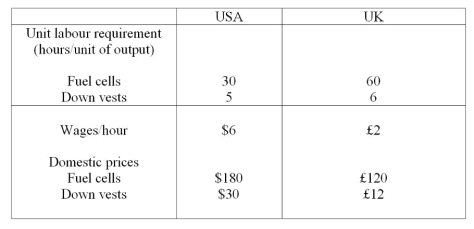
-Refer to Table 15.1. The data in the table show that:
A) the US has a comparative advantage in down vests.
B) the UK has a comparative advantage in fuel cells.
C) the US has a comparative advantage in fuel cells.
D) the US has an comparative disadvantage in down vests.
Question
-Refer to Table 15.1. The data the table show:
A) neither country has an absolute advantage.
B) neither country has an absolute disadvantage.
C) the UK has an absolute advantage in both products.
D) the US has an absolute advantage in both products.
Question
Table 15.2 Costs, prices and exchange rates
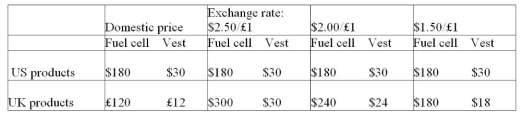
-Refer to Table 15.2. The international price data at different exchange rates show that at an exchange rate of $2.00/?1:
A) in the US one shirt is worth ten videos.
B) in the US one shirt is worth 1.25 videos.
C) in the US one shirt is worth 7.5 videos.
D) in the US one shirt is worth six videos.
-Refer to Table 15.2. The international price data at different exchange rates show that at an exchange rate of $2.00/?1:
A) in the US one shirt is worth ten videos.
B) in the US one shirt is worth 1.25 videos.
C) in the US one shirt is worth 7.5 videos.
D) in the US one shirt is worth six videos.
Question
Table 15.2 Costs, prices and exchange rates
-Refer to Table 15.2. The international price data at different exchange rates show that trade between the US and the UK would require an exchange rate of:
A) $1.25 = ?1.
B) $2.50 = ?1.
C) $2.00 = ?1.
D)$1.50 = ?1.
-Refer to Table 15.2. The international price data at different exchange rates show that trade between the US and the UK would require an exchange rate of:
A) $1.25 = ?1.
B) $2.50 = ?1.
C) $2.00 = ?1.
D)$1.50 = ?1.
Question
Table 15.3 Costs of producing wine and windmills for electricity generation
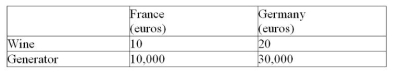
-Refer to Table 15.3. From this table we can conclude:
A) France has a comparative advantage in both goods.
B) France has a comparative advantage in wine and Germany has a comparative advantage in generators.
C) Germany has a comparative advantage in wine and France has a comparative advantage in generators.
D) Germany has a comparative advantage in both goods.
-Refer to Table 15.3. From this table we can conclude:
A) France has a comparative advantage in both goods.
B) France has a comparative advantage in wine and Germany has a comparative advantage in generators.
C) Germany has a comparative advantage in wine and France has a comparative advantage in generators.
D) Germany has a comparative advantage in both goods.
Question
Table 15.3 Costs of producing wine and windmills for electricity generation
-Refer to Table 15.3. From this table can conclude that if the two countries trade with each other, it is most likely that:
A) France exports both goods to Germany.
B) Germany exports both goods to France.
C) France exports wine to Germany and imports electric generators from Germany.
D) France exports electric generators to Germany and imports wine from Germany.
-Refer to Table 15.3. From this table can conclude that if the two countries trade with each other, it is most likely that:
A) France exports both goods to Germany.
B) Germany exports both goods to France.
C) France exports wine to Germany and imports electric generators from Germany.
D) France exports electric generators to Germany and imports wine from Germany.
Question
Question
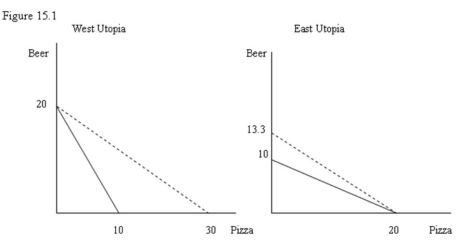
-Refer to Figure 15.1. The solid lines are production possibilities curves; the dashed lines are consumption possibilities curves. The data contained in the production possibilities curves are based on the assumption of:
A) imperfect shiftability of resources as between beer and pizza production.
B) constant costs.
C) decreasing costs.
D) increasing costs.
Question
-Refer to Figure 15.1. The solid lines are production possibilities curves; the dashed lines are trading possibilities curves. The opportunity cost of producing a:
A) pizza is 2 beers in both countries.
B) beer is 1/2 a pizza in both countries.
C) pizza in East Utopia is 1 beer.
D) beer in West Utopia is 1/2 a pizza.
Question
-Refer to Figure 15.1. If trade were opened between these two countries, West Utopia would specialize in the production of _____________ and try to sell each additional ___________ to East Utopia for
__________________ based on West Utopia's consumption possibilities curve.
A) pizza, pizza, 2/3 beer
B) pizza, beer, ½ beer
C) beer, beer, 2 pizza
D) beer, pizza, 1.5 beer
Question
Question
Question
Question
Question
Question
Question
Question
-Refer to Figure 15.2. We can conclude from the diagram that:
A) Southland has a comparative advantage in both goods.
B) Northland has an absolute advantage in both goods.
C) Northland has a comparative advantage in manufacturing and Southland has a comparative advantage in agriculture.
D) Northland has a comparative advantage in agriculture and Southland has a comparative advantage in manufacturing.
Question
-Refer to Figure 15.2. When the two countries trade with each other, we can expect:
A) Northland will export manufactured goods and Southland will export agricultural goods.
B) Northland will export agricultural goods and Southland will export manufactured goods.
C) Northland will export both goods to Southland, which will have a permanent trade deficit.
D) Southland will export both goods to Northland, which will have a permanent trade deficit.
Question
Question
Question
Question
Question
Question
Question
Question
Question
Question
Question
Question
Question
Question
Question
Question
Question
Question
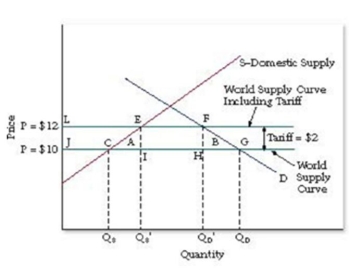
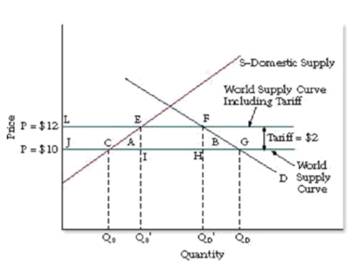
-Refer to Figure 15.2. The diagram shows that the imposition of a tariff:
A) raises the domestic price and reduces imports.
B) raises the domestic price and increases imports.
C) lowers the domestic price and raises imports.
D) lowers the domestic price and lowers imports.
Question
-Refer to Figure 15.2. The diagram shows that the imposition of a tariff on imports:
A) lowers prices to consumers and increases the quantity purchased.
B) raises prices to consumers and raises domestic output while reducing imports.
C) lowers prices to consumers and lowers imports.
D) raises prices to consumers and increases total quantity purchased.
Question
-Refer to Figure 15.2. The diagram shows that the effect of the tariff was:
A) to raise domestic production from QS to QS' with no effect on total purchases.
B) to lower domestic production from QS' to QS and raise imports from QS' to QD.
C) to raise prices, lower total consumption to QD' and raise domestic production to QS'.
D) to lower prices and increase total consumption to QD based on higher domestic production.
Question
-Refer to Figure 15.2. The diagram shows that:
A) DEJK is consumer benefit.
B) triangle FGH is deadweight loss.
C) triangle EIJ is a tariff revenue for the government.
D) EFGJ is producer cost.
Question
Question
Question
Question
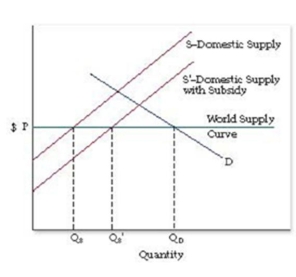
-Refer to Figure 15.3. The diagram shows that in the absence of a subsidy or tariff:
A) there would be no domestic production of the product, only imports equal to 0QD.
B) domestic consumers would only have 0QS of the product to buy.
C) domestic consumers could choose either domestic or imported quantities of the product.
D) domestic consumers would buy 0QD of the product with 0QS from domestic producers and QSQD from foreign producers.
Question
-Refer to Figure 15.3. The diagram shows how the provision of a subsidy for domestic producers:
A) increases domestic production and reduces imports.
B) allows consumers to buy as much of the product as they want to buy at the world price.
C) causes a misallocation of domestic resources by replacing lower cost imports with higher cost domestic output.
D) all of the above.
Question
-Refer to Figure 15.3. From the diagram we see that if government wanted to support the same level of domestic output produced under a subsidy by using a tariff instead, the result would be:
A) a higher price of the product to domestic consumers.
B) a lower level of imports and a lower level of total consumption.
C) tariff revenue for the government but a deadweight loss to society.
D) all of the above.
Question
Question
Question
Question
Question
Question
Question
Question
Question
Question
Question
Question
Question

Unlock Deck
Sign up to unlock the cards in this deck!
Unlock Deck
Unlock Deck
1/108

Play

Full screen (f)
Deck 15: International Trade
1
The volume of world trade:
A) has grown very slowly since 1950.
B) has resulted in nations becoming more independent.
C) has grown significantly in most industrialized countries in the last 30 years.
D) is composed primarily of trade among less-developed countries (LDCs).
A) has grown very slowly since 1950.
B) has resulted in nations becoming more independent.
C) has grown significantly in most industrialized countries in the last 30 years.
D) is composed primarily of trade among less-developed countries (LDCs).
has grown significantly in most industrialized countries in the last 30 years.
2
The composition of world trade:
A) is about 3/4 manufactured goods and 1/4 primary goods.
B) is dominated by Japanese commodities.
C) shifted toward fuel-related goods between the early 1970s and the early 1980s.
D) has shifted in favour of goods exported by the LDCs.
A) is about 3/4 manufactured goods and 1/4 primary goods.
B) is dominated by Japanese commodities.
C) shifted toward fuel-related goods between the early 1970s and the early 1980s.
D) has shifted in favour of goods exported by the LDCs.
shifted toward fuel-related goods between the early 1970s and the early 1980s.
3
The bulk of Canadian export and import trade is currently with:
A) Germany, Japan, and Mexico.
B) Japan, China, and Germany.
C) the United States, Western Europe, and Japan.
D) Japan, England, and France.
A) Germany, Japan, and Mexico.
B) Japan, China, and Germany.
C) the United States, Western Europe, and Japan.
D) Japan, England, and France.
the United States, Western Europe, and Japan.
4
Which products were the leading exports of Canada in 2005?
A) Steel.
B) Clothes.
C) Machinery/equipment including transport equipment.
D) Petroleum.
A) Steel.
B) Clothes.
C) Machinery/equipment including transport equipment.
D) Petroleum.
Unlock Deck
Unlock for access to all 108 flashcards in this deck.
Unlock Deck
k this deck
5
Measured in terms US dollars, world trade in 2004 was dominated by:
A) Japan and China.
B) the United States and England.
C) the European economies.
D) the Asian economies.
A) Japan and China.
B) the United States and England.
C) the European economies.
D) the Asian economies.
Unlock Deck
Unlock for access to all 108 flashcards in this deck.
Unlock Deck
k this deck
6
The country(ies) with the largest imports as a percentage of GDP is/are:
A) Canada.
B) the US.
C) Belgium and the Netherlands.
D) China and Japan.
A) Canada.
B) the US.
C) Belgium and the Netherlands.
D) China and Japan.
Unlock Deck
Unlock for access to all 108 flashcards in this deck.
Unlock Deck
k this deck
7
The area(s) in which the LDCs have grievances are:
A) world trade and international finance.
B) national agricultural policies.
C) resource development.
D) A and B but not C.
A) world trade and international finance.
B) national agricultural policies.
C) resource development.
D) A and B but not C.
Unlock Deck
Unlock for access to all 108 flashcards in this deck.
Unlock Deck
k this deck
8
In the world economy, LDCs were primarily exporters of ______ but have since changed the composition of their exports to favour____________.
A) manufactured goods; agricultural products
B) agricultural goods; raw materials
C) raw materials; manufactured goods
D) manufactured goods; raw materials
A) manufactured goods; agricultural products
B) agricultural goods; raw materials
C) raw materials; manufactured goods
D) manufactured goods; raw materials
Unlock Deck
Unlock for access to all 108 flashcards in this deck.
Unlock Deck
k this deck
9
For many years, the price of agricultural commodities has tended to be ____ and _____ relative to the price of manufactured goods.
A) volatile; declining
B) relatively stable; declining
C) volatile; rising
D) relatively stable; rising
A) volatile; declining
B) relatively stable; declining
C) volatile; rising
D) relatively stable; rising
Unlock Deck
Unlock for access to all 108 flashcards in this deck.
Unlock Deck
k this deck
10
Prices for primary products tend to be relatively volatile because the markets for these products tend to exhibit:
A) low supply elasticities and high demand elasticities.
B) high supply elasticities and low demand elasticities.
C) high supply elasticities and high demand elasticities.
D) low supply elasticities and low demand elasticities.
A) low supply elasticities and high demand elasticities.
B) high supply elasticities and low demand elasticities.
C) high supply elasticities and high demand elasticities.
D) low supply elasticities and low demand elasticities.
Unlock Deck
Unlock for access to all 108 flashcards in this deck.
Unlock Deck
k this deck
11
It is difficult for LDCs to pursue development through the export of primary products because of
_______________ and ________________.
A) the downward trend in commodity prices, the stability of primary products real prices
B) the upward trend in commodity prices, the stability of primary products real prices
C) the upward trend in commodity prices, the volatility of primary products real prices
D) the downward trend in commodity prices, the volatility of primary products real prices
_______________ and ________________.
A) the downward trend in commodity prices, the stability of primary products real prices
B) the upward trend in commodity prices, the stability of primary products real prices
C) the upward trend in commodity prices, the volatility of primary products real prices
D) the downward trend in commodity prices, the volatility of primary products real prices
Unlock Deck
Unlock for access to all 108 flashcards in this deck.
Unlock Deck
k this deck
12
Lower transport costs, improved information technology and reduced tariffs have raised concerns for LDCs because:
A) they have lowered their tariffs more than rich countries.
B) rich countries have been unwilling to reduce agricultural subsidies and protection.
C) LDCs' comparative advantages in manufactured exports are offset by rich country tariffs.
D) rich countries act only in accordance with LDC interests.
A) they have lowered their tariffs more than rich countries.
B) rich countries have been unwilling to reduce agricultural subsidies and protection.
C) LDCs' comparative advantages in manufactured exports are offset by rich country tariffs.
D) rich countries act only in accordance with LDC interests.
Unlock Deck
Unlock for access to all 108 flashcards in this deck.
Unlock Deck
k this deck
13
The NAFTA was intended to:
A) protect Canada and the US from cheap Mexican exports.
B) increase traded flows among Canada, the US and Mexico.
C) protect the Mexican oil industry from cheap Canadian oil exports.
D) limit import competition among the Canada, the US and Mexico.
A) protect Canada and the US from cheap Mexican exports.
B) increase traded flows among Canada, the US and Mexico.
C) protect the Mexican oil industry from cheap Canadian oil exports.
D) limit import competition among the Canada, the US and Mexico.
Unlock Deck
Unlock for access to all 108 flashcards in this deck.
Unlock Deck
k this deck
14
Which of the following statements is false?
A) Removal of trade barriers in rich countries will increase exports of the LDCs.
B) Trade, rather than foreign aid, will help LDCs in a lasting manner.
C) The LDCs are forced to dismantle their own tariffs and allow foreign investors.
D) The LDCs have strong voices in the WTO.
A) Removal of trade barriers in rich countries will increase exports of the LDCs.
B) Trade, rather than foreign aid, will help LDCs in a lasting manner.
C) The LDCs are forced to dismantle their own tariffs and allow foreign investors.
D) The LDCs have strong voices in the WTO.
Unlock Deck
Unlock for access to all 108 flashcards in this deck.
Unlock Deck
k this deck
15
The law of comparative advantage shows that if a country was absolutely more efficient in the production of all goods than other countries:
A) no gains from international trade were possible.
B) it should export only those goods it did not use.
C) it would still benefit from trade by exporting those goods in which it was relatively more efficient.
D) it should not import any goods.
A) no gains from international trade were possible.
B) it should export only those goods it did not use.
C) it would still benefit from trade by exporting those goods in which it was relatively more efficient.
D) it should not import any goods.
Unlock Deck
Unlock for access to all 108 flashcards in this deck.
Unlock Deck
k this deck
16
When it is said that country A has a comparative advantage in the production of a good, this means that:
A) country A must give up less of other goods than other countries to produce one more unit of that good.
B) the raw material cost to produce the good is less in country A than in other countries.
C) country A is not efficient in the production of the good.
D) country A cannot benefit from trade.
A) country A must give up less of other goods than other countries to produce one more unit of that good.
B) the raw material cost to produce the good is less in country A than in other countries.
C) country A is not efficient in the production of the good.
D) country A cannot benefit from trade.
Unlock Deck
Unlock for access to all 108 flashcards in this deck.
Unlock Deck
k this deck
17
Suppose that the opportunity costs of production differ between two countries. We can conclude that:
A) it will not be possible for either country to gain from trading with the other.
B) if each country specializes and trades with the other, there will be an increase in the production of all commodities.
C) each country should produce some of all goods to promote self-sufficiency.
D) each country must have a comparative advantage of some goods.
A) it will not be possible for either country to gain from trading with the other.
B) if each country specializes and trades with the other, there will be an increase in the production of all commodities.
C) each country should produce some of all goods to promote self-sufficiency.
D) each country must have a comparative advantage of some goods.
Unlock Deck
Unlock for access to all 108 flashcards in this deck.
Unlock Deck
k this deck
18
Suppose that no comparative advantage exists between the nations of Alpha and Beta. We can conclude that:
A) Alpha and Beta should still trade with each other.
B) by trading with each other, Alpha and Beta will experience significant gains from trade.
C) there will be no gains from specialization and trading with each other.
D) each country will produce only one good.
A) Alpha and Beta should still trade with each other.
B) by trading with each other, Alpha and Beta will experience significant gains from trade.
C) there will be no gains from specialization and trading with each other.
D) each country will produce only one good.
Unlock Deck
Unlock for access to all 108 flashcards in this deck.
Unlock Deck
k this deck
19
If the country of Zebland has a comparative advantage in the production of wheat over the country of Bluesky, then:
A) in Zebland, the opportunity cost of producing wheat is higher than in Bluesky.
B) in Zebland, the opportunity cost of producing wheat is lower than it is in Bluesky.
C) neither Bluesky nor Zebland should specialize only in the production of wheat.
D) Zebland will export all of its wheat.
A) in Zebland, the opportunity cost of producing wheat is higher than in Bluesky.
B) in Zebland, the opportunity cost of producing wheat is lower than it is in Bluesky.
C) neither Bluesky nor Zebland should specialize only in the production of wheat.
D) Zebland will export all of its wheat.
Unlock Deck
Unlock for access to all 108 flashcards in this deck.
Unlock Deck
k this deck
20
Consider two country countries, A and B, with two goods, X and Y. Find the false statement from the following statements:
A) If the country A has comparative advantage in X, it means the country A has lower opportunity costs of producing X than that in country B.
B) If the country B has comparative advantage in Y, it means the country B has lower opportunity costs of producing Y than that in country A.
C) Country A can have absolute advantage in both X and Y, but country A cannot have comparative advantage in both X and Y.
D) Country B cannot have absolute advantage in both X and Y
A) If the country A has comparative advantage in X, it means the country A has lower opportunity costs of producing X than that in country B.
B) If the country B has comparative advantage in Y, it means the country B has lower opportunity costs of producing Y than that in country A.
C) Country A can have absolute advantage in both X and Y, but country A cannot have comparative advantage in both X and Y.
D) Country B cannot have absolute advantage in both X and Y
Unlock Deck
Unlock for access to all 108 flashcards in this deck.
Unlock Deck
k this deck
21
In the US turbine fans for jet engines cost $900 and designer shirts cost $150. In the UK, designer shirts cost ?24 and turbine fans ?240, making turbine fans costs ____ relative to designer shirts in the US than in the UK. The opportunity cost of turbine fans is ______ in the US.
A) less, higher
B) more, lower
C) more, higher
D) less, lower
A) less, higher
B) more, lower
C) more, higher
D) less, lower
Unlock Deck
Unlock for access to all 108 flashcards in this deck.
Unlock Deck
k this deck
22
-Refer to Table 15.1. The data in the table show that:
A) the US has a comparative advantage in down vests.
B) the UK has a comparative advantage in fuel cells.
C) the US has a comparative advantage in fuel cells.
D) the US has an comparative disadvantage in down vests.
Unlock Deck
Unlock for access to all 108 flashcards in this deck.
Unlock Deck
k this deck
23
-Refer to Table 15.1. The data the table show:
A) neither country has an absolute advantage.
B) neither country has an absolute disadvantage.
C) the UK has an absolute advantage in both products.
D) the US has an absolute advantage in both products.
Unlock Deck
Unlock for access to all 108 flashcards in this deck.
Unlock Deck
k this deck
24
Table 15.2 Costs, prices and exchange rates
-Refer to Table 15.2. The international price data at different exchange rates show that at an exchange rate of $2.00/?1:
A) in the US one shirt is worth ten videos.
B) in the US one shirt is worth 1.25 videos.
C) in the US one shirt is worth 7.5 videos.
D) in the US one shirt is worth six videos.
-Refer to Table 15.2. The international price data at different exchange rates show that at an exchange rate of $2.00/?1:
A) in the US one shirt is worth ten videos.
B) in the US one shirt is worth 1.25 videos.
C) in the US one shirt is worth 7.5 videos.
D) in the US one shirt is worth six videos.
Unlock Deck
Unlock for access to all 108 flashcards in this deck.
Unlock Deck
k this deck
25
Table 15.2 Costs, prices and exchange rates
-Refer to Table 15.2. The international price data at different exchange rates show that trade between the US and the UK would require an exchange rate of:
A) $1.25 = ?1.
B) $2.50 = ?1.
C) $2.00 = ?1.
D)$1.50 = ?1.
-Refer to Table 15.2. The international price data at different exchange rates show that trade between the US and the UK would require an exchange rate of:
A) $1.25 = ?1.
B) $2.50 = ?1.
C) $2.00 = ?1.
D)$1.50 = ?1.
Unlock Deck
Unlock for access to all 108 flashcards in this deck.
Unlock Deck
k this deck
26
Table 15.3 Costs of producing wine and windmills for electricity generation
-Refer to Table 15.3. From this table we can conclude:
A) France has a comparative advantage in both goods.
B) France has a comparative advantage in wine and Germany has a comparative advantage in generators.
C) Germany has a comparative advantage in wine and France has a comparative advantage in generators.
D) Germany has a comparative advantage in both goods.
-Refer to Table 15.3. From this table we can conclude:
A) France has a comparative advantage in both goods.
B) France has a comparative advantage in wine and Germany has a comparative advantage in generators.
C) Germany has a comparative advantage in wine and France has a comparative advantage in generators.
D) Germany has a comparative advantage in both goods.
Unlock Deck
Unlock for access to all 108 flashcards in this deck.
Unlock Deck
k this deck
27
Table 15.3 Costs of producing wine and windmills for electricity generation
-Refer to Table 15.3. From this table can conclude that if the two countries trade with each other, it is most likely that:
A) France exports both goods to Germany.
B) Germany exports both goods to France.
C) France exports wine to Germany and imports electric generators from Germany.
D) France exports electric generators to Germany and imports wine from Germany.
-Refer to Table 15.3. From this table can conclude that if the two countries trade with each other, it is most likely that:
A) France exports both goods to Germany.
B) Germany exports both goods to France.
C) France exports wine to Germany and imports electric generators from Germany.
D) France exports electric generators to Germany and imports wine from Germany.
Unlock Deck
Unlock for access to all 108 flashcards in this deck.
Unlock Deck
k this deck
28
The level of the equilibrium exchange rate offsets international differences in: _________________.
A) comparative advantage
B) absolute trade
C) absolute advantage
D) comparative trade
A) comparative advantage
B) absolute trade
C) absolute advantage
D) comparative trade
Unlock Deck
Unlock for access to all 108 flashcards in this deck.
Unlock Deck
k this deck
29
-Refer to Figure 15.1. The solid lines are production possibilities curves; the dashed lines are consumption possibilities curves. The data contained in the production possibilities curves are based on the assumption of:
A) imperfect shiftability of resources as between beer and pizza production.
B) constant costs.
C) decreasing costs.
D) increasing costs.
Unlock Deck
Unlock for access to all 108 flashcards in this deck.
Unlock Deck
k this deck
30
-Refer to Figure 15.1. The solid lines are production possibilities curves; the dashed lines are trading possibilities curves. The opportunity cost of producing a:
A) pizza is 2 beers in both countries.
B) beer is 1/2 a pizza in both countries.
C) pizza in East Utopia is 1 beer.
D) beer in West Utopia is 1/2 a pizza.
Unlock Deck
Unlock for access to all 108 flashcards in this deck.
Unlock Deck
k this deck
31
-Refer to Figure 15.1. If trade were opened between these two countries, West Utopia would specialize in the production of _____________ and try to sell each additional ___________ to East Utopia for
__________________ based on West Utopia's consumption possibilities curve.
A) pizza, pizza, 2/3 beer
B) pizza, beer, ½ beer
C) beer, beer, 2 pizza
D) beer, pizza, 1.5 beer
Unlock Deck
Unlock for access to all 108 flashcards in this deck.
Unlock Deck
k this deck
32
The level of the __________________offsets international differences in absolute advantage.
A) interest rate
B) exchange rate
C) equilibrium interest rate
D) equilibrium exchange rate
A) interest rate
B) exchange rate
C) equilibrium interest rate
D) equilibrium exchange rate
Unlock Deck
Unlock for access to all 108 flashcards in this deck.
Unlock Deck
k this deck
33
International differences in opportunity costs lead to countries acquiring __________.
A) trade barriers
B) high exchange rates
C) comparative advantage
D) trade quotas
A) trade barriers
B) high exchange rates
C) comparative advantage
D) trade quotas
Unlock Deck
Unlock for access to all 108 flashcards in this deck.
Unlock Deck
k this deck
34
International differences in ___________________ lead to countries acquiring comparative advantage.
A) marginal costs
B) variable costs
C) fixed costs
D) opportunity costs
A) marginal costs
B) variable costs
C) fixed costs
D) opportunity costs
Unlock Deck
Unlock for access to all 108 flashcards in this deck.
Unlock Deck
k this deck
35
If a country does not have ________________________ in the production of any good, there is still
___________________.
A) an absolute cost advantage, an incentive to trade
B) a relative cost advantage, a disincentive to trade
C) a good technology, an incentive to trade
D) much experience, a disincentive to trade
___________________.
A) an absolute cost advantage, an incentive to trade
B) a relative cost advantage, a disincentive to trade
C) a good technology, an incentive to trade
D) much experience, a disincentive to trade
Unlock Deck
Unlock for access to all 108 flashcards in this deck.
Unlock Deck
k this deck
36
The main cause of different relative costs between countries is:
A) relative factor substitution.
B) relative factor endowments.
C) relative factor competition.
D) relative factor mobility.
A) relative factor substitution.
B) relative factor endowments.
C) relative factor competition.
D) relative factor mobility.
Unlock Deck
Unlock for access to all 108 flashcards in this deck.
Unlock Deck
k this deck
37
Relative factor endowments are the main reason for different _________________ between countries.
A) public holidays
B) working hours
C) opportunity costs
D) days lost through sickness
A) public holidays
B) working hours
C) opportunity costs
D) days lost through sickness
Unlock Deck
Unlock for access to all 108 flashcards in this deck.
Unlock Deck
k this deck
38
If the opportunity cost of producing computers is lower in Japan than in the U.S., then:
A) Japan should produce computers and sell them in the U.S.
B) Japan will consume more computers than the U.S.
C) the U.S. should produce computers and sell them in Japan.
D) the U.S. will consume more computers than Japan.
A) Japan should produce computers and sell them in the U.S.
B) Japan will consume more computers than the U.S.
C) the U.S. should produce computers and sell them in Japan.
D) the U.S. will consume more computers than Japan.
Unlock Deck
Unlock for access to all 108 flashcards in this deck.
Unlock Deck
k this deck
39
-Refer to Figure 15.2. We can conclude from the diagram that:
A) Southland has a comparative advantage in both goods.
B) Northland has an absolute advantage in both goods.
C) Northland has a comparative advantage in manufacturing and Southland has a comparative advantage in agriculture.
D) Northland has a comparative advantage in agriculture and Southland has a comparative advantage in manufacturing.
Unlock Deck
Unlock for access to all 108 flashcards in this deck.
Unlock Deck
k this deck
40
-Refer to Figure 15.2. When the two countries trade with each other, we can expect:
A) Northland will export manufactured goods and Southland will export agricultural goods.
B) Northland will export agricultural goods and Southland will export manufactured goods.
C) Northland will export both goods to Southland, which will have a permanent trade deficit.
D) Southland will export both goods to Northland, which will have a permanent trade deficit.
Unlock Deck
Unlock for access to all 108 flashcards in this deck.
Unlock Deck
k this deck
41
Which of the following statements is false?
A) Intra-industry trade in manufacturing as a percentage of total manufacturing trade in Canada is over 70% in last 20 years.
B) Increasing diseconomies of scale is the main reason for increasing inter-industry trade.
C) Paul Krugman's theory of trade in differentiated manufactured products is an important extension to traditional trade theories.
D) Paul Krugman developed a trade theory based on economies of scale, product diversity and imperfect competition.
A) Intra-industry trade in manufacturing as a percentage of total manufacturing trade in Canada is over 70% in last 20 years.
B) Increasing diseconomies of scale is the main reason for increasing inter-industry trade.
C) Paul Krugman's theory of trade in differentiated manufactured products is an important extension to traditional trade theories.
D) Paul Krugman developed a trade theory based on economies of scale, product diversity and imperfect competition.
Unlock Deck
Unlock for access to all 108 flashcards in this deck.
Unlock Deck
k this deck
42
All of the following statements are correct except:
A) International trade brings higher living standards by permitting greater specialization.
B) In the short run, all individuals benefit from international trade.
C) A country will always have a comparative advantage in something.
D) Self-sufficiency on the part of a nation will lower the real income levels of its inhabitants.
A) International trade brings higher living standards by permitting greater specialization.
B) In the short run, all individuals benefit from international trade.
C) A country will always have a comparative advantage in something.
D) Self-sufficiency on the part of a nation will lower the real income levels of its inhabitants.
Unlock Deck
Unlock for access to all 108 flashcards in this deck.
Unlock Deck
k this deck
43
If the nation of Alpha enjoys an increase in its standard of living as a result of specialization and trade, then Alpha has:
A) a comparative advantage in the production of at least one good.
B) a comparative advantage in the production of all goods.
C) only increased its standard of living at the expense of some other country.
D) experienced the gains from trade.
A) a comparative advantage in the production of at least one good.
B) a comparative advantage in the production of all goods.
C) only increased its standard of living at the expense of some other country.
D) experienced the gains from trade.
Unlock Deck
Unlock for access to all 108 flashcards in this deck.
Unlock Deck
k this deck
44
The simple model of comparative advantage emphasizes the mutual benefits of trade brought about by:
A) differences in tastes among countries.
B) differences in relative labour productivity among countries.
C) one country always gaining at the others' expense.
D) dividing up production to produce an even balance of trade.
A) differences in tastes among countries.
B) differences in relative labour productivity among countries.
C) one country always gaining at the others' expense.
D) dividing up production to produce an even balance of trade.
Unlock Deck
Unlock for access to all 108 flashcards in this deck.
Unlock Deck
k this deck
45
The law of comparative advantage states that countries _________ in producing and exporting the goods that they produce at a lower _______ cost than other countries.
A) diversify, absolute
B) specialize, relative
C) diversify, relative
D) specialize, absolute
A) diversify, absolute
B) specialize, relative
C) diversify, relative
D) specialize, absolute
Unlock Deck
Unlock for access to all 108 flashcards in this deck.
Unlock Deck
k this deck
46
When countries specialize in producing and exporting the goods that they produce at a lower relative cost than other countries, the distribution of the gains from trade:
A) depends on who produces and trades what products.
B) depends on the terms of trade, which lie between the countries' domestic opportunity cost.
C) provides equal benefits for all countries.
D) is unrelated to the pattern of trade.
A) depends on who produces and trades what products.
B) depends on the terms of trade, which lie between the countries' domestic opportunity cost.
C) provides equal benefits for all countries.
D) is unrelated to the pattern of trade.
Unlock Deck
Unlock for access to all 108 flashcards in this deck.
Unlock Deck
k this deck
47
International specialization and the gains that result from trade do not arise because of _________.
A) the location of multinationals
B) scale economies
C) differences in factor endowments
D) differences in technology
A) the location of multinationals
B) scale economies
C) differences in factor endowments
D) differences in technology
Unlock Deck
Unlock for access to all 108 flashcards in this deck.
Unlock Deck
k this deck
48
The gains from trade:
A) accrue primarily to traders when there are no barriers to entry.
B) tend to go to countries producing goods with diseconomies of scale rather than to countries producing goods with economies of scale.
C) tend to go to small countries rather than large countries.
D) accrue primarily to countries, not traders.
A) accrue primarily to traders when there are no barriers to entry.
B) tend to go to countries producing goods with diseconomies of scale rather than to countries producing goods with economies of scale.
C) tend to go to small countries rather than large countries.
D) accrue primarily to countries, not traders.
Unlock Deck
Unlock for access to all 108 flashcards in this deck.
Unlock Deck
k this deck
49
The analysis of international trade suggests that when there are no economies of scale:
A) large countries reap most of the gains from trade, and small countries are exploited.
B) small countries reap most of the gains from trade, and large countries are exploited.
C) all countries gain from trade, but smaller countries are likely to reap relatively bigger gains.
D) all countries gain from trade, but larger countries are likely to reap relatively bigger gains.
A) large countries reap most of the gains from trade, and small countries are exploited.
B) small countries reap most of the gains from trade, and large countries are exploited.
C) all countries gain from trade, but smaller countries are likely to reap relatively bigger gains.
D) all countries gain from trade, but larger countries are likely to reap relatively bigger gains.
Unlock Deck
Unlock for access to all 108 flashcards in this deck.
Unlock Deck
k this deck
50
Small countries enjoy a larger share of the gain from specialization and trade than large countries because:
A) they can trade at prices closer to their consumption possibilities curves than can large countries.
B) they are more nimble in reallocating their resources to export industries.
C) large countries are not interested in competing for trade with small countries.
D) large countries prefer to trade at their domestic opportunity costs rather than at small country opportunity costs.
A) they can trade at prices closer to their consumption possibilities curves than can large countries.
B) they are more nimble in reallocating their resources to export industries.
C) large countries are not interested in competing for trade with small countries.
D) large countries prefer to trade at their domestic opportunity costs rather than at small country opportunity costs.
Unlock Deck
Unlock for access to all 108 flashcards in this deck.
Unlock Deck
k this deck
51
The winners from trade are the ____ and the _____.
A) consumers of imported goods; producers of exported goods
B) consumers of imported goods; producers of imported goods
C) consumers of imported goods; consumers of exported goods
D) consumers of exported goods; producers of exported goods
A) consumers of imported goods; producers of exported goods
B) consumers of imported goods; producers of imported goods
C) consumers of imported goods; consumers of exported goods
D) consumers of exported goods; producers of exported goods
Unlock Deck
Unlock for access to all 108 flashcards in this deck.
Unlock Deck
k this deck
52
Non-tariff barriers are:
A) artificial differences in prices caused by import duties.
B) differences in national regulations which present free trade.
C) import duties.
D) none of the above.
A) artificial differences in prices caused by import duties.
B) differences in national regulations which present free trade.
C) import duties.
D) none of the above.
Unlock Deck
Unlock for access to all 108 flashcards in this deck.
Unlock Deck
k this deck
53
The introduction of a tariff on imported cars would raise the price of:
A) imported cars and reduce the quantity imported.
B) imported cars and increase the quantity imported.
C) exported cars and reduce the quantity exported.
D) exported cars and increase the quantity exported.
A) imported cars and reduce the quantity imported.
B) imported cars and increase the quantity imported.
C) exported cars and reduce the quantity exported.
D) exported cars and increase the quantity exported.
Unlock Deck
Unlock for access to all 108 flashcards in this deck.
Unlock Deck
k this deck
54
The imposition of a tariff will:
A) increase domestic production and reduce domestic prices.
B) increase domestic production and increase domestic prices.
C) decrease domestic production and reduce domestic prices.
D) decrease domestic production and increase domestic prices.
A) increase domestic production and reduce domestic prices.
B) increase domestic production and increase domestic prices.
C) decrease domestic production and reduce domestic prices.
D) decrease domestic production and increase domestic prices.
Unlock Deck
Unlock for access to all 108 flashcards in this deck.
Unlock Deck
k this deck
55
To protect the competitiveness of domestic industries, which of the following is the preferred device, on economic grounds:
A) subsidies.
B) quotas.
C) tariffs.
D) all the above.
A) subsidies.
B) quotas.
C) tariffs.
D) all the above.
Unlock Deck
Unlock for access to all 108 flashcards in this deck.
Unlock Deck
k this deck
56
Beginning with a free trade equilibrium and imposing an import tariff _________ the domestic price of imports leading to monetary transfers and to _______.
A) increases, deadweight loss
B) increases, benefits
C) decreases, deadweight
D) decreases, benefits
A) increases, deadweight loss
B) increases, benefits
C) decreases, deadweight
D) decreases, benefits
Unlock Deck
Unlock for access to all 108 flashcards in this deck.
Unlock Deck
k this deck
57
Suppose Canada eliminates tariffs on Chinese bicycles. As a result, we would expect:
A) the price of Chinese bicycles to decline in Canada.
B) employment to increase in the Chinese bicycle industry.
C) employment to decrease in the Canadian bicycle industry.
D) all of the above to occur.
A) the price of Chinese bicycles to decline in Canada.
B) employment to increase in the Chinese bicycle industry.
C) employment to decrease in the Canadian bicycle industry.
D) all of the above to occur.
Unlock Deck
Unlock for access to all 108 flashcards in this deck.
Unlock Deck
k this deck
58
-Refer to Figure 15.2. The diagram shows that the imposition of a tariff:
A) raises the domestic price and reduces imports.
B) raises the domestic price and increases imports.
C) lowers the domestic price and raises imports.
D) lowers the domestic price and lowers imports.
Unlock Deck
Unlock for access to all 108 flashcards in this deck.
Unlock Deck
k this deck
59
-Refer to Figure 15.2. The diagram shows that the imposition of a tariff on imports:
A) lowers prices to consumers and increases the quantity purchased.
B) raises prices to consumers and raises domestic output while reducing imports.
C) lowers prices to consumers and lowers imports.
D) raises prices to consumers and increases total quantity purchased.
Unlock Deck
Unlock for access to all 108 flashcards in this deck.
Unlock Deck
k this deck
60
-Refer to Figure 15.2. The diagram shows that the effect of the tariff was:
A) to raise domestic production from QS to QS' with no effect on total purchases.
B) to lower domestic production from QS' to QS and raise imports from QS' to QD.
C) to raise prices, lower total consumption to QD' and raise domestic production to QS'.
D) to lower prices and increase total consumption to QD based on higher domestic production.
Unlock Deck
Unlock for access to all 108 flashcards in this deck.
Unlock Deck
k this deck
61
-Refer to Figure 15.2. The diagram shows that:
A) DEJK is consumer benefit.
B) triangle FGH is deadweight loss.
C) triangle EIJ is a tariff revenue for the government.
D) EFGJ is producer cost.
Unlock Deck
Unlock for access to all 108 flashcards in this deck.
Unlock Deck
k this deck
62
The imposition of a tariff causes consumption to _________ and imports to ________.
A) rise, fall
B) rise, rise
C) fall, rise
D) fall, fall
A) rise, fall
B) rise, rise
C) fall, rise
D) fall, fall
Unlock Deck
Unlock for access to all 108 flashcards in this deck.
Unlock Deck
k this deck
63
A tariff causes domestic firms to __________ and consumers to __________.
A) overproduce, under consume
B) overproduce, overconsume
C) underproduce, underconsume
D) underproduce, overconsume
A) overproduce, under consume
B) overproduce, overconsume
C) underproduce, underconsume
D) underproduce, overconsume
Unlock Deck
Unlock for access to all 108 flashcards in this deck.
Unlock Deck
k this deck
64
If, as a result of trade policy, domestic firms overproduce and consumers underconsume it is likely that a
______ has been applied.
A) price floor
B) tariff
C) price ceiling
D) management consultant
______ has been applied.
A) price floor
B) tariff
C) price ceiling
D) management consultant
Unlock Deck
Unlock for access to all 108 flashcards in this deck.
Unlock Deck
k this deck
65
-Refer to Figure 15.3. The diagram shows that in the absence of a subsidy or tariff:
A) there would be no domestic production of the product, only imports equal to 0QD.
B) domestic consumers would only have 0QS of the product to buy.
C) domestic consumers could choose either domestic or imported quantities of the product.
D) domestic consumers would buy 0QD of the product with 0QS from domestic producers and QSQD from foreign producers.
Unlock Deck
Unlock for access to all 108 flashcards in this deck.
Unlock Deck
k this deck
66
-Refer to Figure 15.3. The diagram shows how the provision of a subsidy for domestic producers:
A) increases domestic production and reduces imports.
B) allows consumers to buy as much of the product as they want to buy at the world price.
C) causes a misallocation of domestic resources by replacing lower cost imports with higher cost domestic output.
D) all of the above.
Unlock Deck
Unlock for access to all 108 flashcards in this deck.
Unlock Deck
k this deck
67
-Refer to Figure 15.3. From the diagram we see that if government wanted to support the same level of domestic output produced under a subsidy by using a tariff instead, the result would be:
A) a higher price of the product to domestic consumers.
B) a lower level of imports and a lower level of total consumption.
C) tariff revenue for the government but a deadweight loss to society.
D) all of the above.
Unlock Deck
Unlock for access to all 108 flashcards in this deck.
Unlock Deck
k this deck
68
Suppose the domestic demand for turnips is P = 100 - Q. The domestic supply of turnips is P = 10 + Q. The world price is $30 per unit. The import will be:
A) 30 units.
B) 40 units.
C) 50 units.
D) 60 units.
A) 30 units.
B) 40 units.
C) 50 units.
D) 60 units.
Unlock Deck
Unlock for access to all 108 flashcards in this deck.
Unlock Deck
k this deck
69
Suppose the domestic demand for turnips is P = 100 - Q. The domestic supply of turnips is P = 10 + Q. The world price is $30 per unit. If the tax on import is $10 unit, the import will be:
A) 30 units.
B) 40 units.
C) 50 units.
D) 60 units.
A) 30 units.
B) 40 units.
C) 50 units.
D) 60 units.
Unlock Deck
Unlock for access to all 108 flashcards in this deck.
Unlock Deck
k this deck
70
Suppose the domestic demand for turnips is P = 100 - Q. The domestic supply of turnips is P = 10 + Q. The world price is $30 per unit. If the tax on import is $10 unit, the total tax-collections from imports will be:
A) $300.
B) $400.
C) $500.
D) $600.
A) $300.
B) $400.
C) $500.
D) $600.
Unlock Deck
Unlock for access to all 108 flashcards in this deck.
Unlock Deck
k this deck
71
Suppose the domestic demand for turnips is P = 100 - Q. The domestic supply of turnips is P = 10 + Q. The world price is $30 per unit. If the domestic suppliers get $10 per unit of subsidy, then the total import will be:
A) 30.
B) 40.
C) 50.
D) 60.
A) 30.
B) 40.
C) 50.
D) 60.
Unlock Deck
Unlock for access to all 108 flashcards in this deck.
Unlock Deck
k this deck
72
Suppose the domestic demand for turnips is P = 100 - Q. The domestic supply of turnips is P = 10 + Q. The world price is $30 per unit. If the domestic suppliers get $10 per unit of subsidy, then the total import subsidies will be:
A) $300.
B) $400.
C) $500.
D) $600.
A) $300.
B) $400.
C) $500.
D) $600.
Unlock Deck
Unlock for access to all 108 flashcards in this deck.
Unlock Deck
k this deck
73
The imposition of tariffs to counter foreign subsidies and dumping may be valid only when such foreign actions are:
A) legal.
B) temporary.
C) illegal.
D) permanent.
A) legal.
B) temporary.
C) illegal.
D) permanent.
Unlock Deck
Unlock for access to all 108 flashcards in this deck.
Unlock Deck
k this deck
74
The infant industry argument is often used to defend:
A) free trade.
B) tariffs.
C) laissez-faire.
D) declining industries.
A) free trade.
B) tariffs.
C) laissez-faire.
D) declining industries.
Unlock Deck
Unlock for access to all 108 flashcards in this deck.
Unlock Deck
k this deck
75
Dumping occurs when foreign producers sell at prices _____ their marginal production cost, either by making losses or with the assistance of _________________.
A) above, government subsidies
B) above, trade associations
C) below, government subsidies
D) below, trade associations
A) above, government subsidies
B) above, trade associations
C) below, government subsidies
D) below, trade associations
Unlock Deck
Unlock for access to all 108 flashcards in this deck.
Unlock Deck
k this deck
76
When foreign producers sell at prices below their marginal production cost, either by making losses or with the assistance of government subsidies, this is an example of:
A) the invisible hand.
B) optimal pricing.
C) gazumping.
D) dumping.
A) the invisible hand.
B) optimal pricing.
C) gazumping.
D) dumping.
Unlock Deck
Unlock for access to all 108 flashcards in this deck.
Unlock Deck
k this deck
77
One important reason that restrictions on international trade exist is that:
A)the small groups of producers who may be injured by trade often have more political influence than the large number of consumers who would benefit from freer trade.
B) the large groups of producers who may be injured by trade often have more political influence than the small number of consumers who would benefit from freer trade.
C)the large groups of consumers who may be injured by trade often have more political influence than the small number of producers who would benefit from freer trade.
D)the small groups of consumers who may be injured by trade often have more political influence than the large number of producers who would benefit from freer trade.
A)the small groups of producers who may be injured by trade often have more political influence than the large number of consumers who would benefit from freer trade.
B) the large groups of producers who may be injured by trade often have more political influence than the small number of consumers who would benefit from freer trade.
C)the large groups of consumers who may be injured by trade often have more political influence than the small number of producers who would benefit from freer trade.
D)the small groups of consumers who may be injured by trade often have more political influence than the large number of producers who would benefit from freer trade.
Unlock Deck
Unlock for access to all 108 flashcards in this deck.
Unlock Deck
k this deck
78
Infant industry protection may be justified in theory by:
A) both the "learning by doing" argument and the existence of economies of scale.
B) the "learning by doing" argument but not by the existence of economies of scale.
C) the existence of economies of scale but not by the "learning by doing" argument.
D) neither the "learning by doing" argument nor the existence of economies of scale.
A) both the "learning by doing" argument and the existence of economies of scale.
B) the "learning by doing" argument but not by the existence of economies of scale.
C) the existence of economies of scale but not by the "learning by doing" argument.
D) neither the "learning by doing" argument nor the existence of economies of scale.
Unlock Deck
Unlock for access to all 108 flashcards in this deck.
Unlock Deck
k this deck
79
The US coalition for fair lumber imports has lobbied the US government:
A) to impose duties on Canadian softwood lumber.
B) to prevent the importation of Canadian lumber to the US.
C) to abolish the duties on the Canadian softwood lumber.
D) to reduce the duties on the Canadian softwood lumber.
A) to impose duties on Canadian softwood lumber.
B) to prevent the importation of Canadian lumber to the US.
C) to abolish the duties on the Canadian softwood lumber.
D) to reduce the duties on the Canadian softwood lumber.
Unlock Deck
Unlock for access to all 108 flashcards in this deck.
Unlock Deck
k this deck
80
From the US producers' point of view, the ongoing dispute between Canada and the US over the Canadian exports of softwood lumber is based on the argument that:
A) the Canadian softwood lumber is much more expensive in US than in Canada.
B) the Canadian softwood lumber is subsidized by low provincial levies for tree harvesting.
C) the Canadian softwood lumber is heavily taxed in Canada.
D) the US government duty on the Canadian softwood lumber is totally unfair.
A) the Canadian softwood lumber is much more expensive in US than in Canada.
B) the Canadian softwood lumber is subsidized by low provincial levies for tree harvesting.
C) the Canadian softwood lumber is heavily taxed in Canada.
D) the US government duty on the Canadian softwood lumber is totally unfair.
Unlock Deck
Unlock for access to all 108 flashcards in this deck.
Unlock Deck
k this deck
Unlock Deck
Unlock for access to all 108 flashcards in this deck.






