







 Chat with AI

Deck 5: Civil Rights
Full screen (f)

Question

Question
Question
Question
Question
Question
Question
Question
According to the table below, which of the following states had the largest difference between African American and white eligible citizens registered to vote? 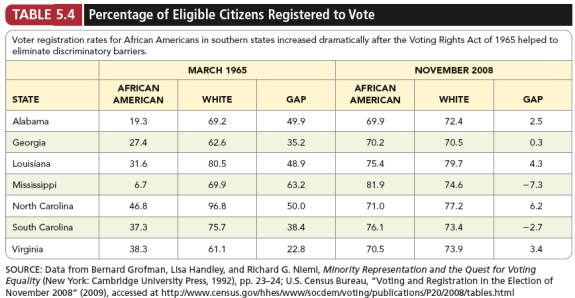
A) Georgia
B) Alabama
C) Mississippi
D) North Carolina
E) South Carolina
A) Georgia
B) Alabama
C) Mississippi
D) North Carolina
E) South Carolina
Question
Question
Question
Question
Question
Question
Question
Question
Question
Question
Question
Question
Question
According to data compiled by the U.S. Census Bureau in the table below, 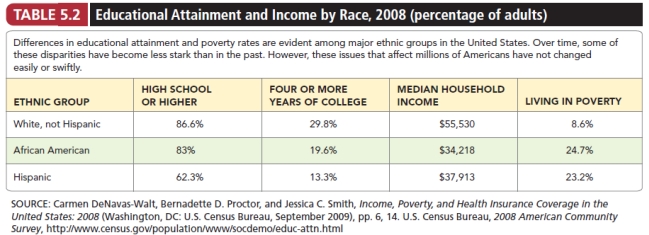
A) a connection cannot be made between education and poverty.
B) African Americans are paid a higher median household income than Hispanics.
C) Hispanics do better in obtaining a higher education than do African Americans.
D) a connection can be seen between education and poverty.
E) no connections can be made between races/ethnicity and education.
A) a connection cannot be made between education and poverty.
B) African Americans are paid a higher median household income than Hispanics.
C) Hispanics do better in obtaining a higher education than do African Americans.
D) a connection can be seen between education and poverty.
E) no connections can be made between races/ethnicity and education.
Question
Question
Question
Question
Question
Question
Question
Question
Question
Question
Question
Question
Question
Question
Question
Question
Question
Question
Question
Question
Question
Question
Question
Question
Question
Question
Question
Question
Question
Question
Question
Question
Question
Question
Question
Question
Question
Question
Question
Question
Question
Question
Question
Question
Question
Question
Question
Question
Question
Question
Question
Question
Question
Question
Question
Question
Question
Question
Question

Unlock Deck
Sign up to unlock the cards in this deck!
Unlock Deck
Unlock Deck
1/129

Play

Full screen (f)
Deck 5: Civil Rights
1
The statement that "all men are created equal" can be found in the
A) U.S. Constitution.
B) Declaration of Independence.
C) Bill of Rights.
D) Declaration of the Rights of Man.
E) Universal Declaration of Human Rights.
A) U.S. Constitution.
B) Declaration of Independence.
C) Bill of Rights.
D) Declaration of the Rights of Man.
E) Universal Declaration of Human Rights.
Declaration of Independence.
2
Policies that value equal economic status and attempt to provide such status through social provision of housing, health care, education, and governmental services are characterized by their emphasis on
A) political equality.
B) communism.
C) equality of condition.
D) equality of opportunity.
E) social equity.
A) political equality.
B) communism.
C) equality of condition.
D) equality of opportunity.
E) social equity.
equality of condition.
3
Policies that provide the foundation for equal participation in the social, economic, and political sphere but that also accept unequal results in income, political power, and property ownership are characterized by their emphasis on
A) political equality.
B) communism.
C) equality of condition.
D) equality of opportunity.
E) social equity.
A) political equality.
B) communism.
C) equality of condition.
D) equality of opportunity.
E) social equity.
equality of opportunity.
4
The NAACP lawyer who argued the Brown v. Board of Education of Topeka case before the U.S. Supreme Court was
A) Homer Plessy.
B) Fred Korematsu.
C) Warren Harding.
D) Clarence Thomas.
E) Thurgood Marshall.
A) Homer Plessy.
B) Fred Korematsu.
C) Warren Harding.
D) Clarence Thomas.
E) Thurgood Marshall.
Unlock Deck
Unlock for access to all 129 flashcards in this deck.
Unlock Deck
k this deck
5
In 1990 _________ initiated action in the court pathway stating that Virginia violated the constitutional rights of women seeking admission.
A) the NAACP
B) NOW (National Organization of Women)
C) Virginia Loving
D) the U.S. Justice Department
E) Virginia Military Institute (VMI)
A) the NAACP
B) NOW (National Organization of Women)
C) Virginia Loving
D) the U.S. Justice Department
E) Virginia Military Institute (VMI)
Unlock Deck
Unlock for access to all 129 flashcards in this deck.
Unlock Deck
k this deck
6
In Bush v. Gore, the U.S. Supreme Court terminated the Florida recount, asserting that recount procedures would violate the equal protection rights of individual voters. The Court did not, however, directly answer the question of where this case signaled the Court's willingness to look at voters as claimants deserving of higher levels of scrutiny. This is an example of the application of the _____ test.
A) strict scrutiny
B) intermediate scrutiny
C) low scrutiny
D) rational basis.
E) Lemon
A) strict scrutiny
B) intermediate scrutiny
C) low scrutiny
D) rational basis.
E) Lemon
Unlock Deck
Unlock for access to all 129 flashcards in this deck.
Unlock Deck
k this deck
7
When evaluating claims that a specific law or policy violates the equal protection clause, the Courts employ three levels of review. These are:
A) strict scrutiny, intermediate scrutiny, and rational basis test.
B) strict scrutiny, intermediate scrutiny, and low scrutiny.
C) strict scrutiny, rational basis test, and low scrutiny.
D) rational basis test, irrational basis test, and Lemon test.
E) equal protection test, rational basis test, and Lemon test.
A) strict scrutiny, intermediate scrutiny, and rational basis test.
B) strict scrutiny, intermediate scrutiny, and low scrutiny.
C) strict scrutiny, rational basis test, and low scrutiny.
D) rational basis test, irrational basis test, and Lemon test.
E) equal protection test, rational basis test, and Lemon test.
Unlock Deck
Unlock for access to all 129 flashcards in this deck.
Unlock Deck
k this deck
8
According to the table below, which of the following states had the largest difference between African American and white eligible citizens registered to vote?
A) Georgia
B) Alabama
C) Mississippi
D) North Carolina
E) South Carolina
A) Georgia
B) Alabama
C) Mississippi
D) North Carolina
E) South Carolina
Unlock Deck
Unlock for access to all 129 flashcards in this deck.
Unlock Deck
k this deck
9
The vote was extended to women in 1920 as a result of
A) presidential executive order.
B) passage of the Nineteenth Amendment.
C) congressional mandate.
D) a Supreme Court decision.
E) individual state decisions.
A) presidential executive order.
B) passage of the Nineteenth Amendment.
C) congressional mandate.
D) a Supreme Court decision.
E) individual state decisions.
Unlock Deck
Unlock for access to all 129 flashcards in this deck.
Unlock Deck
k this deck
10
In 1973, Congress prohibited discrimination against people with disabilities who work in government or who seek services from federally funded programs by passing the
A) American Disabilities Act.
B) Rehabilitation Act.
C) Equal Access to Facilities Act
D) Physically Challenged Assistance Act.
E) Disabilities Protection Act.
A) American Disabilities Act.
B) Rehabilitation Act.
C) Equal Access to Facilities Act
D) Physically Challenged Assistance Act.
E) Disabilities Protection Act.
Unlock Deck
Unlock for access to all 129 flashcards in this deck.
Unlock Deck
k this deck
11
Through which pathway have Native American activists succeeded in their attempts to recover some of the debt owned them by the United States government?
A) the court pathway
B) the elections pathway
C) the cultural change pathway
D) the grassroots mobilization pathway
E) the lobbying pathway.
A) the court pathway
B) the elections pathway
C) the cultural change pathway
D) the grassroots mobilization pathway
E) the lobbying pathway.
Unlock Deck
Unlock for access to all 129 flashcards in this deck.
Unlock Deck
k this deck
12
A governing system based on equality of condition would ensure that everyone had equal opportunity to participate in political and economic life, but would not interfere in the political and economic outcome of individual choices.
Unlock Deck
Unlock for access to all 129 flashcards in this deck.
Unlock Deck
k this deck
13
According to data compiled by the U.S. Census Bureau, African Americans are more likely than whites or Hispanics to complete college.
Unlock Deck
Unlock for access to all 129 flashcards in this deck.
Unlock Deck
k this deck
14
The Chief Justice of the U.S. Supreme Court during the Brown v. Board of Education of Topeka case was Earl Warren.
Unlock Deck
Unlock for access to all 129 flashcards in this deck.
Unlock Deck
k this deck
15
The Brown v. Board of Education of Topeka case validated the use of the court pathway of change by the NAACP.
Unlock Deck
Unlock for access to all 129 flashcards in this deck.
Unlock Deck
k this deck
16
In cases alleging discrimination because of race or national origin, the Supreme Court applies an intermediate scrutiny test.
Unlock Deck
Unlock for access to all 129 flashcards in this deck.
Unlock Deck
k this deck
17
Martin Luther King Jr.'s strategy of nonviolent resistance was demonstrated to be a failure in the Montgomery Bus Boycott.
Unlock Deck
Unlock for access to all 129 flashcards in this deck.
Unlock Deck
k this deck
18
César Chávez was a Latino civil rights leader who mainly used the court pathways to obtain protection for migrant farm workers.
Unlock Deck
Unlock for access to all 129 flashcards in this deck.
Unlock Deck
k this deck
19
In Romer v. Evans, the Court found that cities could not pass antidiscrimination laws to protect gays and lesbians.
Unlock Deck
Unlock for access to all 129 flashcards in this deck.
Unlock Deck
k this deck
20
The founders' intent behind the words "All men are created equal" was
A) equality of white men and women, excluding African Americans.
B) human equality, including women and African Americans.
C) equality of opportunity.
D) equality of condition.
E) political equality.
A) equality of white men and women, excluding African Americans.
B) human equality, including women and African Americans.
C) equality of opportunity.
D) equality of condition.
E) political equality.
Unlock Deck
Unlock for access to all 129 flashcards in this deck.
Unlock Deck
k this deck
21
According to data compiled by the U.S. Census Bureau in the table below,
A) a connection cannot be made between education and poverty.
B) African Americans are paid a higher median household income than Hispanics.
C) Hispanics do better in obtaining a higher education than do African Americans.
D) a connection can be seen between education and poverty.
E) no connections can be made between races/ethnicity and education.
A) a connection cannot be made between education and poverty.
B) African Americans are paid a higher median household income than Hispanics.
C) Hispanics do better in obtaining a higher education than do African Americans.
D) a connection can be seen between education and poverty.
E) no connections can be made between races/ethnicity and education.
Unlock Deck
Unlock for access to all 129 flashcards in this deck.
Unlock Deck
k this deck
22
After his assassination, President Abraham Lincoln was succeeded in office by
A) James Buchanan.
B) Ulysses Grant.
C) Andrew Johnson.
D) Rutherford Hayes.
E) Franklin Pierce.
A) James Buchanan.
B) Ulysses Grant.
C) Andrew Johnson.
D) Rutherford Hayes.
E) Franklin Pierce.
Unlock Deck
Unlock for access to all 129 flashcards in this deck.
Unlock Deck
k this deck
23
The Reconstruction Act of 1867 was most strongly supported by
A) wealthy southerners.
B) poor westerners.
C) wealthy northerners.
D) southerners in Congress.
E) northerners in Congress.
A) wealthy southerners.
B) poor westerners.
C) wealthy northerners.
D) southerners in Congress.
E) northerners in Congress.
Unlock Deck
Unlock for access to all 129 flashcards in this deck.
Unlock Deck
k this deck
24
After the disputed election of 1876 was awarded to Rutherford B. Hayes, federal occupation troops were removed from the South resulting in
A) a renewal of battles between the North and the South.
B) the terrorization of African Americans by secret societies, including the KKK.
C) a great sense of responsibility felt by southern legislatures to ensure African American voting rights.
D) a sense of relief felt by both white and black populations in the South.
E) an end to African Americans being terrorized by the troops.
A) a renewal of battles between the North and the South.
B) the terrorization of African Americans by secret societies, including the KKK.
C) a great sense of responsibility felt by southern legislatures to ensure African American voting rights.
D) a sense of relief felt by both white and black populations in the South.
E) an end to African Americans being terrorized by the troops.
Unlock Deck
Unlock for access to all 129 flashcards in this deck.
Unlock Deck
k this deck
25
The three Civil War Amendments, so named because they were passed in the period immediately after the Civil War, were the
A) Eleventh, Twelfth, and Thirteenth Amendments.
B) Twelfth, Thirteenth, and Fourteenth Amendments.
C) Thirteenth, Fourteenth, and Fifteenth Amendments.
D) Fourteenth, Fifteenth, and Sixteenth Amendments.
E) Fifteenth, Sixteenth, and Seventeenth Amendments.
A) Eleventh, Twelfth, and Thirteenth Amendments.
B) Twelfth, Thirteenth, and Fourteenth Amendments.
C) Thirteenth, Fourteenth, and Fifteenth Amendments.
D) Fourteenth, Fifteenth, and Sixteenth Amendments.
E) Fifteenth, Sixteenth, and Seventeenth Amendments.
Unlock Deck
Unlock for access to all 129 flashcards in this deck.
Unlock Deck
k this deck
26
Collectively, the Civil War Amendments were intended to
A) define the rights of freed slaves and give those rights constitutional protection.
B) punish the South for the Civil War.
C) reintegrate the United States into a single country.
D) dismantle the Southern military.
E) prevent states from attempting to leave the union again.
A) define the rights of freed slaves and give those rights constitutional protection.
B) punish the South for the Civil War.
C) reintegrate the United States into a single country.
D) dismantle the Southern military.
E) prevent states from attempting to leave the union again.
Unlock Deck
Unlock for access to all 129 flashcards in this deck.
Unlock Deck
k this deck
27
Laws enacted by southern state legislatures immediately after the Civil War that mandated rigid racial segregation were known as
A) black codes.
B) poll taxes.
C) literacy tests.
D) citizen's councils.
E) Jim Crow laws.
A) black codes.
B) poll taxes.
C) literacy tests.
D) citizen's councils.
E) Jim Crow laws.
Unlock Deck
Unlock for access to all 129 flashcards in this deck.
Unlock Deck
k this deck
28
The pathway that Homer Plessy took in order to be able to sit in any railroad car he desired, and which resulted in the Plessy v. Ferguson decision was the
A) court pathway.
B) grassroots mobilization pathway.
C) cultural change pathway.
D) lobbying pathway.
E) election pathway.
A) court pathway.
B) grassroots mobilization pathway.
C) cultural change pathway.
D) lobbying pathway.
E) election pathway.
Unlock Deck
Unlock for access to all 129 flashcards in this deck.
Unlock Deck
k this deck
29
The Supreme Court established the "separate but equal" standard in its ruling in the case of
A) Texas v. Johnson.
B) Marbury v. Madison.
C) Dred Scott v. Sanford.
D) Brown v. Board of Education.
E) Plessy v. Ferguson.
A) Texas v. Johnson.
B) Marbury v. Madison.
C) Dred Scott v. Sanford.
D) Brown v. Board of Education.
E) Plessy v. Ferguson.
Unlock Deck
Unlock for access to all 129 flashcards in this deck.
Unlock Deck
k this deck
30
Homer Plessy was arrested and charged with what crime?
A) refusing to give up his seat to a white passenger
B) sitting in a white-only train car
C) attempting to attend a white-only school
D) attending a white church
E) eating in a white-only restaurant
A) refusing to give up his seat to a white passenger
B) sitting in a white-only train car
C) attempting to attend a white-only school
D) attending a white church
E) eating in a white-only restaurant
Unlock Deck
Unlock for access to all 129 flashcards in this deck.
Unlock Deck
k this deck
31
The significance of the U.S. Supreme Court's decision in Brown v. Board of Education (1954) rests in the fact that it
A) brought an end to racial discrimination in the United States.
B) declared discrimination on the basis of race, class, or gender illegal.
C) precipitated a period of racial harmony in the United States.
D) guaranteed political and economic equality between whites and blacks in the United States.
E) signaled the court's importance as an avenue for effecting political change in the civil rights struggle.
A) brought an end to racial discrimination in the United States.
B) declared discrimination on the basis of race, class, or gender illegal.
C) precipitated a period of racial harmony in the United States.
D) guaranteed political and economic equality between whites and blacks in the United States.
E) signaled the court's importance as an avenue for effecting political change in the civil rights struggle.
Unlock Deck
Unlock for access to all 129 flashcards in this deck.
Unlock Deck
k this deck
32
How is the U.S. Supreme Court's decision in Brown v. Board of Education II
(1955) related to the first Brown ruling in 1954?
A) The newer ruling struck down the earlier decision.
B) The newer ruling ordered implementation of desegregation "with all deliberate speed."
C) The newer ruling extended the ruling to higher education.
D) The newer ruling extended the earlier decision to the states.
E) The two cases are not related in any way.
(1955) related to the first Brown ruling in 1954?
A) The newer ruling struck down the earlier decision.
B) The newer ruling ordered implementation of desegregation "with all deliberate speed."
C) The newer ruling extended the ruling to higher education.
D) The newer ruling extended the earlier decision to the states.
E) The two cases are not related in any way.
Unlock Deck
Unlock for access to all 129 flashcards in this deck.
Unlock Deck
k this deck
33
Laws prohibiting people from marrying individuals of a different race were declared unconstitutional by the U.S. Supreme Court's decision in
A) Tinker v. .Des Moines.
B) Texas v. Johnson.
C) Murray v. Maryland.
D) Loving v. Virginia.
E) Hamdi v. Rumsfeld.
A) Tinker v. .Des Moines.
B) Texas v. Johnson.
C) Murray v. Maryland.
D) Loving v. Virginia.
E) Hamdi v. Rumsfeld.
Unlock Deck
Unlock for access to all 129 flashcards in this deck.
Unlock Deck
k this deck
34
In evaluating claims that a specific law or policy violates the equal protection clause by discriminating against an individual on the basis of gender, the Courts employ
A) strict scrutiny
B) intermediate scrutiny
C) low scrutiny.
D) the rational basis test.
E) the Lemon test
A) strict scrutiny
B) intermediate scrutiny
C) low scrutiny.
D) the rational basis test.
E) the Lemon test
Unlock Deck
Unlock for access to all 129 flashcards in this deck.
Unlock Deck
k this deck
35
Under current practice, discrimination on the basis of age would fall under the level of
A) strict scrutiny
B) intermediate scrutiny
C) low scrutiny.
D) the rational basis test.
E) the Lemon test
A) strict scrutiny
B) intermediate scrutiny
C) low scrutiny.
D) the rational basis test.
E) the Lemon test
Unlock Deck
Unlock for access to all 129 flashcards in this deck.
Unlock Deck
k this deck
36
In Rostker v. Goldberg, the U.S. Supreme Court ruled that despite the service of and casualties suffered by female military personnel in the war zone of Iraq, the government is advancing an important interest in military preparation by limiting mandatory Selective Service registration to males. This is an example of the application of the _____ test.
A) strict scrutiny
B) intermediate scrutiny
C) low scrutiny
D) rational basis
E) Lemon
A) strict scrutiny
B) intermediate scrutiny
C) low scrutiny
D) rational basis
E) Lemon
Unlock Deck
Unlock for access to all 129 flashcards in this deck.
Unlock Deck
k this deck
37
In Grutter v. Bollinger, the U.S. Supreme Court approved race-conscious affirmative action programs in admission decisions at public universities, concluding that the advancement of diversity is a compelling government interest. This is an example of the application of the _____ test.
A) strict scrutiny
B) intermediate scrutiny
C) low scrutiny
D) rational basis.
E) Lemon
A) strict scrutiny
B) intermediate scrutiny
C) low scrutiny
D) rational basis.
E) Lemon
Unlock Deck
Unlock for access to all 129 flashcards in this deck.
Unlock Deck
k this deck
38
Whose refusal to give up her bus seat to a white passenger sparked a bus boycott and contributed to increasing participation in the civil rights movement?
A) Rosa Parks
B) Shirley Chisholm
C) Barbara Jordan
D) Mary Bethune
E) Susan Anthony
A) Rosa Parks
B) Shirley Chisholm
C) Barbara Jordan
D) Mary Bethune
E) Susan Anthony
Unlock Deck
Unlock for access to all 129 flashcards in this deck.
Unlock Deck
k this deck
39
All of the following occurred as a direct result of the Montgomery bus boycott, EXCEPT
A) the Montgomery bus system was nearly bankrupted.
B) national attention was focused on the status of blacks in the American South.
C) Martin Luther King Jr. gained national attention.
D) King's strategy of nonviolent civil disobedience was demonstrated to be a success.
E) Martin Luther King Jr. was assassinated.
A) the Montgomery bus system was nearly bankrupted.
B) national attention was focused on the status of blacks in the American South.
C) Martin Luther King Jr. gained national attention.
D) King's strategy of nonviolent civil disobedience was demonstrated to be a success.
E) Martin Luther King Jr. was assassinated.
Unlock Deck
Unlock for access to all 129 flashcards in this deck.
Unlock Deck
k this deck
40
Three people who sought to register new African American voters were abducted and murdered in 1964 in
A) Charleston, South Carolina.
B) Atlanta, Georgia.
C) Kansas City, Missouri.
D) Philadelphia, Mississippi.
E) Montgomery, Alabama.
A) Charleston, South Carolina.
B) Atlanta, Georgia.
C) Kansas City, Missouri.
D) Philadelphia, Mississippi.
E) Montgomery, Alabama.
Unlock Deck
Unlock for access to all 129 flashcards in this deck.
Unlock Deck
k this deck
41
James Meredith is most well known as
A) the first president of the NAACP.
B) the first African American to enroll in the University of Mississippi.
C) one of the Little Rock Nine.
D) the victim of a Klan campaign of terror.
E) the lawyer who argued the Brown decision before the U.S. Supreme Court.
A) the first president of the NAACP.
B) the first African American to enroll in the University of Mississippi.
C) one of the Little Rock Nine.
D) the victim of a Klan campaign of terror.
E) the lawyer who argued the Brown decision before the U.S. Supreme Court.
Unlock Deck
Unlock for access to all 129 flashcards in this deck.
Unlock Deck
k this deck
42
The "Little Rock Nine" was a(n)
A) group of African American lawyers and activists.
B) group of Arkansas policemen who blocked efforts at desegregation.
C) splinter group from the larger NAACP.
D) anti-war protest movement
E) group of African American students who attempted to enroll in an all-white high school.
A) group of African American lawyers and activists.
B) group of Arkansas policemen who blocked efforts at desegregation.
C) splinter group from the larger NAACP.
D) anti-war protest movement
E) group of African American students who attempted to enroll in an all-white high school.
Unlock Deck
Unlock for access to all 129 flashcards in this deck.
Unlock Deck
k this deck
43
The American president who sent troops to Arkansas to assist the "Little Rock Nine" in enrolling at the Little Rock Central High School was
A) Harry Truman.
B) Dwight Eisenhower.
C) Richard Nixon.
D) John Kennedy.
E) Lyndon Johnson.
A) Harry Truman.
B) Dwight Eisenhower.
C) Richard Nixon.
D) John Kennedy.
E) Lyndon Johnson.
Unlock Deck
Unlock for access to all 129 flashcards in this deck.
Unlock Deck
k this deck
44
The federal statute that effectively attacked literacy tests and other techniques used to prevent African Americans from voting was the
A) 1964 Civil Rights Act.
B) 1965 Voting Rights Act.
C) 1966 Enfranchisement Protection Act.
D) 1968 Just Voting Act.
E) 1969 Voter Protection Act.
A) 1964 Civil Rights Act.
B) 1965 Voting Rights Act.
C) 1966 Enfranchisement Protection Act.
D) 1968 Just Voting Act.
E) 1969 Voter Protection Act.
Unlock Deck
Unlock for access to all 129 flashcards in this deck.
Unlock Deck
k this deck
45
Which of the following most accurately describes the pathways taken that resulted in the passing of the Voting Rights Act of 1965?
A) Grassroots mobilization > cultural change > lobbying
B) Cultural change > courts
C) Grassroots mobilization > elections > cultural change
D) Lobbying > elections
E) Elections > lobbying > courts
A) Grassroots mobilization > cultural change > lobbying
B) Cultural change > courts
C) Grassroots mobilization > elections > cultural change
D) Lobbying > elections
E) Elections > lobbying > courts
Unlock Deck
Unlock for access to all 129 flashcards in this deck.
Unlock Deck
k this deck
46
Title II of the 1964 Civil Rights Act prohibits
A) discrimination in public accommodations.
B) discrimination in federal hiring practices.
C) all discrimination by private employers.
D) the use of literacy tests as a requirement for voter registration.
E) discrimination in all of these areas.
A) discrimination in public accommodations.
B) discrimination in federal hiring practices.
C) all discrimination by private employers.
D) the use of literacy tests as a requirement for voter registration.
E) discrimination in all of these areas.
Unlock Deck
Unlock for access to all 129 flashcards in this deck.
Unlock Deck
k this deck
47
The provision that requires officials in designated districts to obtain the permission of the U.S. attorney general before making any changes in elections and voting procedures is referred to as the _____ provision.
A) non-discrimination
B) prior restraint
C) good faith
D) preclearance
E) prioritization
A) non-discrimination
B) prior restraint
C) good faith
D) preclearance
E) prioritization
Unlock Deck
Unlock for access to all 129 flashcards in this deck.
Unlock Deck
k this deck
48
If a lobbying group wanted to present evidence to support additional policies that it thought should be put in place to negate discrimination in the workplace, which agency would the group contact?
A) The U.S. Equal Opportunity Agency
B) The U.S. Equal Employment Opportunity Commission
C) The U.S. Commission on Civil Rights
D) The U.S. Justice Department
E) The U.S. Anti-Discrimination Agency
A) The U.S. Equal Opportunity Agency
B) The U.S. Equal Employment Opportunity Commission
C) The U.S. Commission on Civil Rights
D) The U.S. Justice Department
E) The U.S. Anti-Discrimination Agency
Unlock Deck
Unlock for access to all 129 flashcards in this deck.
Unlock Deck
k this deck
49
Which agency within the U.S. government was created in 1964 to handle complaints about employment discrimination?
A) The U.S. Equal Opportunity Agency
B) The U.S. Equal Employment Opportunity Commission
C) The U.S. Commission on Civil Rights
D) The U.S. Justice Department
E) The U.S. Anti-Discrimination Agency
A) The U.S. Equal Opportunity Agency
B) The U.S. Equal Employment Opportunity Commission
C) The U.S. Commission on Civil Rights
D) The U.S. Justice Department
E) The U.S. Anti-Discrimination Agency
Unlock Deck
Unlock for access to all 129 flashcards in this deck.
Unlock Deck
k this deck
50
Susan B. Anthony and Elizabeth Cady Stanton founded and led the
A) National Organization for Women.
B) American Female Coalition.
C) Suffrage Organization of the United States.
D) National Woman Suffrage Association.
E) American Women's Association.
A) National Organization for Women.
B) American Female Coalition.
C) Suffrage Organization of the United States.
D) National Woman Suffrage Association.
E) American Women's Association.
Unlock Deck
Unlock for access to all 129 flashcards in this deck.
Unlock Deck
k this deck
51
Women won the right to vote after _______ of organized political action.
A) ten years
B) twenty years
C) fifty years
D) eighty years
E) a century
A) ten years
B) twenty years
C) fifty years
D) eighty years
E) a century
Unlock Deck
Unlock for access to all 129 flashcards in this deck.
Unlock Deck
k this deck
52
The right to vote was extended to women in the United States by the
A) Twelfth Amendment.
B) Fifteenth Amendment
C) Seventeenth Amendment.
D) Nineteenth Amendment.
E) Twenty-First Amendment.
A) Twelfth Amendment.
B) Fifteenth Amendment
C) Seventeenth Amendment.
D) Nineteenth Amendment.
E) Twenty-First Amendment.
Unlock Deck
Unlock for access to all 129 flashcards in this deck.
Unlock Deck
k this deck
53
Ratification of the Nineteenth Amendment occurred in
A) 1915.
B) 1918.
C) 1920.
D) 1924.
E) 1938.
A) 1915.
B) 1918.
C) 1920.
D) 1924.
E) 1938.
Unlock Deck
Unlock for access to all 129 flashcards in this deck.
Unlock Deck
k this deck
54
The famous Latino civil rights leader and the founder of the National Farm Workers Association was
A) César Chávez
B) Hector Garcia.
C) John Trasvina.
D) Baldemar Velasquez.
E) Ruben Martinez.
A) César Chávez
B) Hector Garcia.
C) John Trasvina.
D) Baldemar Velasquez.
E) Ruben Martinez.
Unlock Deck
Unlock for access to all 129 flashcards in this deck.
Unlock Deck
k this deck
55
Discrimination in the United States
A) is largely a thing of the past.
B) is primarily based on race.
C) continues to be perpetuated by social conditions that are a legacy of past discrimination.
D) has been overcome thanks to effective government action.
E) has been eliminated by the market.
A) is largely a thing of the past.
B) is primarily based on race.
C) continues to be perpetuated by social conditions that are a legacy of past discrimination.
D) has been overcome thanks to effective government action.
E) has been eliminated by the market.
Unlock Deck
Unlock for access to all 129 flashcards in this deck.
Unlock Deck
k this deck
56
In 1996, the Supreme Court blocked Colorado from
A) granting sex-same marriage.
B) passing ordinances that would prohibit gay or lesbian clubs in schools.
C) creating a law that would single out gays and lesbians for adverse treatment.
D) passing antidiscrimination laws to protect gays and lesbians.
E) allowing the Boy Scouts of America to accept gay troop leaders.
A) granting sex-same marriage.
B) passing ordinances that would prohibit gay or lesbian clubs in schools.
C) creating a law that would single out gays and lesbians for adverse treatment.
D) passing antidiscrimination laws to protect gays and lesbians.
E) allowing the Boy Scouts of America to accept gay troop leaders.
Unlock Deck
Unlock for access to all 129 flashcards in this deck.
Unlock Deck
k this deck
57
Because of their relatively small numbers and isolated locations, Native Americans have
A) relied extensively on the grassroots mobilization pathway.
B) not been able to effectively use the grassroots mobilization pathway.
C) been effective at pushing the cultural change pathway.
D) been ineffective at pushing the cultural change pathway.
E) relied exclusively on the electoral pathway.
A) relied extensively on the grassroots mobilization pathway.
B) not been able to effectively use the grassroots mobilization pathway.
C) been effective at pushing the cultural change pathway.
D) been ineffective at pushing the cultural change pathway.
E) relied exclusively on the electoral pathway.
Unlock Deck
Unlock for access to all 129 flashcards in this deck.
Unlock Deck
k this deck
58
Civil rights issues concern the freedoms and due process accorded to individuals.
Unlock Deck
Unlock for access to all 129 flashcards in this deck.
Unlock Deck
k this deck
59
According to data compiled by the U.S. Census Bureau, Hispanics are less likely than whites and African Americans to complete high school.
Unlock Deck
Unlock for access to all 129 flashcards in this deck.
Unlock Deck
k this deck
60
There were still small numbers of slaves in New York and Connecticut as late as 1827.
Unlock Deck
Unlock for access to all 129 flashcards in this deck.
Unlock Deck
k this deck
61
Before the American Revolution, slavery was limited to the colonies located in the American South.
Unlock Deck
Unlock for access to all 129 flashcards in this deck.
Unlock Deck
k this deck
62
Reconstruction refers to a period after the Civil War in which Union troops occupied the American South.
Unlock Deck
Unlock for access to all 129 flashcards in this deck.
Unlock Deck
k this deck
63
In the period of Reconstruction after the Civil War, African Americans were elected to state legislatures and the U.S. Congress.
Unlock Deck
Unlock for access to all 129 flashcards in this deck.
Unlock Deck
k this deck
64
The presidential election of 1876 effectively ended Reconstruction.
Unlock Deck
Unlock for access to all 129 flashcards in this deck.
Unlock Deck
k this deck
65
The number of African-American men who registered to vote in southern states increased between 1870 and 1890.
Unlock Deck
Unlock for access to all 129 flashcards in this deck.
Unlock Deck
k this deck
66
The Thirteenth, Fourteenth, and Fifteenth Amendments collectively are referred to as the "Civil War Amendments."
Unlock Deck
Unlock for access to all 129 flashcards in this deck.
Unlock Deck
k this deck
67
The U.S. Supreme Court's decision in Plessy v. Ferguson overturned the "separate but equal" doctrine.
Unlock Deck
Unlock for access to all 129 flashcards in this deck.
Unlock Deck
k this deck
68
The NAACP was founded to address racial discrimination.
Unlock Deck
Unlock for access to all 129 flashcards in this deck.
Unlock Deck
k this deck
69
As a result of the Supreme Court's decision in Brown and subsequent cases, inequality in education has been overcome in the United States.
Unlock Deck
Unlock for access to all 129 flashcards in this deck.
Unlock Deck
k this deck
70
The U.S. Supreme Court's ruling in the 1974 Milliken v. Bradley case limited the ability of lower courts to issue desegregation orders by requiring that all orders only affect students within the boundaries of a single school system.
Unlock Deck
Unlock for access to all 129 flashcards in this deck.
Unlock Deck
k this deck
71
Prohibitions against interracial marriage were struck down by the U.S. Supreme Court in the decision of Loving v. Virginia.
Unlock Deck
Unlock for access to all 129 flashcards in this deck.
Unlock Deck
k this deck
72
The Supreme Court affords the greatest protection to individuals in cases involving gender.
Unlock Deck
Unlock for access to all 129 flashcards in this deck.
Unlock Deck
k this deck
73
The Supreme Court has rejected all efforts to consider race as a factor in the college admission process.
Unlock Deck
Unlock for access to all 129 flashcards in this deck.
Unlock Deck
k this deck
74
The Supreme Court ruled in favor of Luther Lowe in his bid to register where he went to college, not where his parents lived.
Unlock Deck
Unlock for access to all 129 flashcards in this deck.
Unlock Deck
k this deck
75
The strict scrutiny test is reserved for situations involving discrimination on the basis of race, class, or gender.
Unlock Deck
Unlock for access to all 129 flashcards in this deck.
Unlock Deck
k this deck
76
The struggle for civil rights by African Americans relied primarily on the elections and lobbying pathways.
Unlock Deck
Unlock for access to all 129 flashcards in this deck.
Unlock Deck
k this deck
77
Grassroots mobilization, including marches, protests, and boycotts, played an important role in the struggle for civil rights.
Unlock Deck
Unlock for access to all 129 flashcards in this deck.
Unlock Deck
k this deck
78
President Richard Nixon sent the U.S. military to force desegregation of schools in Arkansas.
Unlock Deck
Unlock for access to all 129 flashcards in this deck.
Unlock Deck
k this deck
79
The 1965 Voting Rights Act prohibited discrimination on the basis of race or ethnicity in voter registration.
Unlock Deck
Unlock for access to all 129 flashcards in this deck.
Unlock Deck
k this deck
80
The Little Rock Nine were a group of black students who tried to enroll in an all-white school in Arkansas.
Unlock Deck
Unlock for access to all 129 flashcards in this deck.
Unlock Deck
k this deck
Unlock Deck
Unlock for access to all 129 flashcards in this deck.






