







 Chat with AI

Deck 5: Theoretical Foundations of Childrens Speech
Full screen (f)

Question

Question
Question
Question
Question
Question
Question
Question
Question
Question
Question
Question
Question
Question
Question
Question
Question
Question
Question
Question
Question
Question
Question
When an English-speaking adult says speak as [![<strong>When an English-speaking adult says speak as [ ] and [ ] the realizations of /k/ can be described as:</strong> A) allophones of the phoneme /k/. B) phonemes. C) disordered. D) exaggerated and quiet. <div style=padding-top: 35px>](https://d2lvgg3v3hfg70.cloudfront.net/TB9704/11ee98b5_f3eb_23ec_a6de_97719176c8d0_TB9704_11.jpg) ] and [
] and [![<strong>When an English-speaking adult says speak as [ ] and [ ] the realizations of /k/ can be described as:</strong> A) allophones of the phoneme /k/. B) phonemes. C) disordered. D) exaggerated and quiet. <div style=padding-top: 35px>](https://d2lvgg3v3hfg70.cloudfront.net/TB9704/11ee98b6_0033_d2fd_a6de_17a576139520_TB9704_11.jpg) ] the realizations of /k/ can be described as:
] the realizations of /k/ can be described as:
A) allophones of the phoneme /k/.
B) phonemes.
C) disordered.
D) exaggerated and quiet.
] and [] the realizations of /k/ can be described as:A) allophones of the phoneme /k/.
B) phonemes.
C) disordered.
D) exaggerated and quiet.
Question
Question
Question
Question
Which of the following consonants are strident but not sibilant?
A) [f, v]
B) [s, z,![<strong>Which of the following consonants are strident but not sibilant?</strong> A) [f, v] B) [s, z, , , , ] C) [ \theta , ð] D) [s, z, , , , , f, v] <div style=padding-top: 35px>](https://d2lvgg3v3hfg70.cloudfront.net/TB9704/11ee98b6_2ae9_d08e_a6de_4f01beca0766_TB9704_11.jpg) ,
, ![<strong>Which of the following consonants are strident but not sibilant?</strong> A) [f, v] B) [s, z, , , , ] C) [ \theta , ð] D) [s, z, , , , , f, v] <div style=padding-top: 35px>](https://d2lvgg3v3hfg70.cloudfront.net/TB9704/11ee98b6_3f7e_facf_a6de_1b608e826c50_TB9704_11.jpg) ,
, ![<strong>Which of the following consonants are strident but not sibilant?</strong> A) [f, v] B) [s, z, , , , ] C) [ \theta , ð] D) [s, z, , , , , f, v] <div style=padding-top: 35px>](https://d2lvgg3v3hfg70.cloudfront.net/TB9704/11ee98b6_507a_d1b0_a6de_cfad76d4646a_TB9704_11.jpg) ,
, ![<strong>Which of the following consonants are strident but not sibilant?</strong> A) [f, v] B) [s, z, , , , ] C) [ \theta , ð] D) [s, z, , , , , f, v] <div style=padding-top: 35px>](https://d2lvgg3v3hfg70.cloudfront.net/TB9704/11ee98b6_703e_6161_a6de_c9a1e33d996a_TB9704_11.jpg) ]
]
C) [ , ð]
D) [s, z, 11ee98b6_2ae9_d08e_a6de_4f01beca0766_TB9704_11, 11ee98b6_3f7e_facf_a6de_1b608e826c50_TB9704_11, 11ee98b6_507a_d1b0_a6de_cfad76d4646a_TB9704_11, 11ee98b6_703e_6161_a6de_c9a1e33d996a_TB9704_11, f, v]
A) [f, v]
B) [s, z,
, , , ]C) [ , ð]
D) [s, z, 11ee98b6_2ae9_d08e_a6de_4f01beca0766_TB9704_11, 11ee98b6_3f7e_facf_a6de_1b608e826c50_TB9704_11, 11ee98b6_507a_d1b0_a6de_cfad76d4646a_TB9704_11, 11ee98b6_703e_6161_a6de_c9a1e33d996a_TB9704_11, f, v]
Question
Question
Question
Oliver (4;6 years) is monolingual and speaks English. He has a moderate-severe phonological impairment. During an initial assessment he said the following
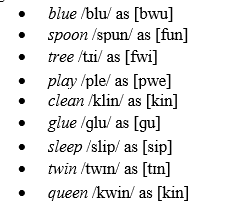
Oliver's attempts at producing consonant clusters reflect:
A) a sequence constraint.
B) an inventory constraint.
C) typical production of consonant clusters for his age.
D) a positional constraint for bilabials.
Oliver's attempts at producing consonant clusters reflect:
A) a sequence constraint.
B) an inventory constraint.
C) typical production of consonant clusters for his age.
D) a positional constraint for bilabials.
Question
Hamish (4;11 years) is monolingual and speaks English. He says shrink /![<strong>Hamish (4;11 years) is monolingual and speaks English. He says shrink / / as [ ]. The phonological processes on this word include:</strong> A) cluster reduction, velar fronting. B) cluster simplification, gliding of / /, palatal fronting, velar fronting. C) cluster reduction, gliding of / /, stopping of fricatives, velar fronting. D) cluster simplification, palatal fronting, backing, and gliding of / /. <div style=padding-top: 35px>](https://d2lvgg3v3hfg70.cloudfront.net/TB9704/11ee98b6_e70a_1003_a6de_af4babf517c1_TB9704_11.jpg) / as [
/ as [![<strong>Hamish (4;11 years) is monolingual and speaks English. He says shrink / / as [ ]. The phonological processes on this word include:</strong> A) cluster reduction, velar fronting. B) cluster simplification, gliding of / /, palatal fronting, velar fronting. C) cluster reduction, gliding of / /, stopping of fricatives, velar fronting. D) cluster simplification, palatal fronting, backing, and gliding of / /. <div style=padding-top: 35px>](https://d2lvgg3v3hfg70.cloudfront.net/TB9704/11ee98b6_fda8_0294_a6de_27fba73e7ed3_TB9704_11.jpg) ]. The phonological processes on this word include:
]. The phonological processes on this word include:
A) cluster reduction, velar fronting.
B) cluster simplification, gliding of /![<strong>Hamish (4;11 years) is monolingual and speaks English. He says shrink / / as [ ]. The phonological processes on this word include:</strong> A) cluster reduction, velar fronting. B) cluster simplification, gliding of / /, palatal fronting, velar fronting. C) cluster reduction, gliding of / /, stopping of fricatives, velar fronting. D) cluster simplification, palatal fronting, backing, and gliding of / /. <div style=padding-top: 35px>](https://d2lvgg3v3hfg70.cloudfront.net/TB9704/11ee98b7_0eae_fd05_a6de_0f39c41c208e_TB9704_11.jpg) /, palatal fronting, velar fronting.
/, palatal fronting, velar fronting.
C) cluster reduction, gliding of /11ee98b7_0eae_fd05_a6de_0f39c41c208e_TB9704_11/, stopping of fricatives, velar fronting.
D) cluster simplification, palatal fronting, backing, and gliding of /11ee98b7_0eae_fd05_a6de_0f39c41c208e_TB9704_11/.
/ as []. The phonological processes on this word include:A) cluster reduction, velar fronting.
B) cluster simplification, gliding of /
/, palatal fronting, velar fronting.C) cluster reduction, gliding of /11ee98b7_0eae_fd05_a6de_0f39c41c208e_TB9704_11/, stopping of fricatives, velar fronting.
D) cluster simplification, palatal fronting, backing, and gliding of /11ee98b7_0eae_fd05_a6de_0f39c41c208e_TB9704_11/.
Question
Gilbert (3;6 years) is multilingual-he speaks English and German. He says tree /ti/ as [di]. The phonological processes on this word include:
A) cluster reduction, gliding of /11ee98b7_0eae_fd05_a6de_0f39c41c208e_TB9704_11/.
B) cluster reduction, prevocalic voicing.
C) cluster simplification, gliding of /11ee98b7_0eae_fd05_a6de_0f39c41c208e_TB9704_11/ and prevocalic voicing.
D) sound preference substitution of [d].
i/ as [di]. The phonological processes on this word include:A) cluster reduction, gliding of /11ee98b7_0eae_fd05_a6de_0f39c41c208e_TB9704_11/.
B) cluster reduction, prevocalic voicing.
C) cluster simplification, gliding of /11ee98b7_0eae_fd05_a6de_0f39c41c208e_TB9704_11/ and prevocalic voicing.
D) sound preference substitution of [d].
Question
Ashton (2;2 years) is monolingual and speaks English. He says cup /![<strong>Ashton (2;2 years) is monolingual and speaks English. He says cup / / as / / and tea /ti/ as [ti]. The phonological process that describes Ashton's production of cup is:</strong> A) complete progressive velar assimilation. B) complete regressive labial assimilation. C) partial progressive velar assimilation. D) backing of fricatives. <div style=padding-top: 35px>](https://d2lvgg3v3hfg70.cloudfront.net/TB9704/11ee98b7_600c_c2e7_a6de_d5d34fcb3ab4_TB9704_11.jpg) / as /
/ as /![<strong>Ashton (2;2 years) is monolingual and speaks English. He says cup / / as / / and tea /ti/ as [ti]. The phonological process that describes Ashton's production of cup is:</strong> A) complete progressive velar assimilation. B) complete regressive labial assimilation. C) partial progressive velar assimilation. D) backing of fricatives. <div style=padding-top: 35px>](https://d2lvgg3v3hfg70.cloudfront.net/TB9704/11ee98b7_7041_a048_a6de_8fc15ef8160b_TB9704_11.jpg) / and tea /ti/ as [ti]. The phonological process that describes Ashton's production of cup is:
/ and tea /ti/ as [ti]. The phonological process that describes Ashton's production of cup is:
A) complete progressive velar assimilation.
B) complete regressive labial assimilation.
C) partial progressive velar assimilation.
D) backing of fricatives.
/ as // and tea /ti/ as [ti]. The phonological process that describes Ashton's production of cup is:A) complete progressive velar assimilation.
B) complete regressive labial assimilation.
C) partial progressive velar assimilation.
D) backing of fricatives.
Question
Lexie (3;1 years) is monolingual and speaks English. She says animal /![<strong>Lexie (3;1 years) is monolingual and speaks English. She says animal / / as [ ]. The phonological process that describes Lexie's production of animal is:</strong> A) epenthesis. B) coalescence. C) metathesis. D) migration. <div style=padding-top: 35px>](https://d2lvgg3v3hfg70.cloudfront.net/TB9704/11ee98b7_89f4_e929_a6de_e59790dd9f37_TB9704_11.jpg) / as [
/ as [![<strong>Lexie (3;1 years) is monolingual and speaks English. She says animal / / as [ ]. The phonological process that describes Lexie's production of animal is:</strong> A) epenthesis. B) coalescence. C) metathesis. D) migration. <div style=padding-top: 35px>](https://d2lvgg3v3hfg70.cloudfront.net/TB9704/11ee98b7_9bed_969a_a6de_b7e153ff3090_TB9704_11.jpg) ]. The phonological process that describes Lexie's production of animal is:
]. The phonological process that describes Lexie's production of animal is:
A) epenthesis.
B) coalescence.
C) metathesis.
D) migration.
/ as []. The phonological process that describes Lexie's production of animal is:A) epenthesis.
B) coalescence.
C) metathesis.
D) migration.
Question
Question
How many feet are in the word caterpillar / /?
/?
A) 2
B) 4
C) 1
D) 3
/?A) 2
B) 4
C) 1
D) 3
Question
How many mora ( ) are in the word shoe / /?
/?
A) 1
B) 2
C) 3
D) none
/?A) 1
B) 2
C) 3
D) none
Question
Question
Question

Unlock Deck
Sign up to unlock the cards in this deck!
Unlock Deck
Unlock Deck
1/40

Play

Full screen (f)
Deck 5: Theoretical Foundations of Childrens Speech
1
What is the difference between minimally opposing minimal pairs, maximally opposing minimal pairs, and near minimal pairs? Use example words to support your answer.
Minimally opposing minimal pairs, maximally opposing minimal pairs, and near minimal pairs are all types of word pairs used in phonology to demonstrate the contrast between two sounds.
Minimally opposing minimal pairs are word pairs that differ by only one sound, and changing that one sound changes the meaning of the word. For example, the words "bat" and "pat" are minimally opposing minimal pairs because they differ only in the initial consonant sound /b/ and /p/, and changing that sound changes the meaning of the word.
Maximally opposing minimal pairs, on the other hand, are word pairs that differ by every possible sound except for one. An example of maximally opposing minimal pairs is the words "pat" and "sat", where every sound differs except for the initial consonant sound /p/ and /s/.
Near minimal pairs are word pairs that are very similar in sound, but differ by more than one sound. An example of near minimal pairs is the words "ship" and "sheep", where the initial consonant sound /ʃ/ and the vowel sound /ɪ/ and /iː/ differ.
In summary, minimally opposing minimal pairs differ by only one sound, maximally opposing minimal pairs differ by every possible sound except for one, and near minimal pairs are very similar in sound but differ by more than one sound. These types of word pairs are used to demonstrate the contrast between sounds in phonology.
Minimally opposing minimal pairs are word pairs that differ by only one sound, and changing that one sound changes the meaning of the word. For example, the words "bat" and "pat" are minimally opposing minimal pairs because they differ only in the initial consonant sound /b/ and /p/, and changing that sound changes the meaning of the word.
Maximally opposing minimal pairs, on the other hand, are word pairs that differ by every possible sound except for one. An example of maximally opposing minimal pairs is the words "pat" and "sat", where every sound differs except for the initial consonant sound /p/ and /s/.
Near minimal pairs are word pairs that are very similar in sound, but differ by more than one sound. An example of near minimal pairs is the words "ship" and "sheep", where the initial consonant sound /ʃ/ and the vowel sound /ɪ/ and /iː/ differ.
In summary, minimally opposing minimal pairs differ by only one sound, maximally opposing minimal pairs differ by every possible sound except for one, and near minimal pairs are very similar in sound but differ by more than one sound. These types of word pairs are used to demonstrate the contrast between sounds in phonology.
2
Using your knowledge of distinctive features, define the term natural class.
A natural class in phonology is a group of sounds that share one or more phonetic or phonological features, making them a class or category that is relevant for the purposes of phonological analysis and rules. These features can be articulatory (how the sounds are produced), acoustic (the physical properties of the sounds), or auditory (how the sounds are perceived).
For example, the natural class of "voiceless stops" in English includes the sounds [p], [t], and [k], because they all share the features of being voiceless (no vibration of the vocal cords) and stops (complete closure in the vocal tract, followed by a release).
Natural classes are important in phonology because they allow linguists to formulate generalizations and rules that apply to all members of the class, rather than having to list each sound individually. This makes it easier to describe the patterns of sound changes and the structure of phonological systems in languages. For instance, a rule that devoices voiced stops at the end of a word in a certain language would apply to the natural class of voiced stops, without having to specify each sound ([b], [d], [g]) separately.
In summary, a natural class is a set of sounds in a language that share certain distinctive features, which makes them behave similarly in the phonological system of that language.
For example, the natural class of "voiceless stops" in English includes the sounds [p], [t], and [k], because they all share the features of being voiceless (no vibration of the vocal cords) and stops (complete closure in the vocal tract, followed by a release).
Natural classes are important in phonology because they allow linguists to formulate generalizations and rules that apply to all members of the class, rather than having to list each sound individually. This makes it easier to describe the patterns of sound changes and the structure of phonological systems in languages. For instance, a rule that devoices voiced stops at the end of a word in a certain language would apply to the natural class of voiced stops, without having to specify each sound ([b], [d], [g]) separately.
In summary, a natural class is a set of sounds in a language that share certain distinctive features, which makes them behave similarly in the phonological system of that language.
3
What are the three major class features?
The question "What are the three major class features?" is somewhat ambiguous as it does not specify the context or subject matter to which it refers. However, I will provide an answer based on a common interpretation within the realm of object-oriented programming (OOP), as classes are a fundamental concept in this area.
In object-oriented programming, a class is a blueprint for creating objects (a particular data structure), providing initial values for state (member variables or attributes), and implementations of behavior (member functions or methods). The three major class features in OOP are:
1. **Encapsulation**: Encapsulation is the mechanism of hiding the internal state of an object and requiring all interaction to be performed through an object's methods. It protects the integrity of the object by preventing external entities from directly manipulating its state. Instead, objects expose interfaces (methods) that allow controlled interaction with their internal state.
2. **Inheritance**: Inheritance is a way to form new classes using classes that have already been defined. The new classes, known as derived classes, inherit attributes and behavior from the existing classes, which are referred to as base classes. Inheritance allows for code reuse and can lead to a hierarchical relationship between classes.
3. **Polymorphism**: Polymorphism allows for the use of a single interface to represent different underlying forms (data types). In OOP, it means that a base class reference can point to a subclass object and that a method can perform different behaviors based on the object it is acting upon. This is often achieved through method overriding, where a method in a subclass has the same name and signature as a method in the parent class but implements different functionality.
These features work together to provide a robust framework for modeling complex systems and allow for code that is more modular, reusable, and easier to maintain.
In object-oriented programming, a class is a blueprint for creating objects (a particular data structure), providing initial values for state (member variables or attributes), and implementations of behavior (member functions or methods). The three major class features in OOP are:
1. **Encapsulation**: Encapsulation is the mechanism of hiding the internal state of an object and requiring all interaction to be performed through an object's methods. It protects the integrity of the object by preventing external entities from directly manipulating its state. Instead, objects expose interfaces (methods) that allow controlled interaction with their internal state.
2. **Inheritance**: Inheritance is a way to form new classes using classes that have already been defined. The new classes, known as derived classes, inherit attributes and behavior from the existing classes, which are referred to as base classes. Inheritance allows for code reuse and can lead to a hierarchical relationship between classes.
3. **Polymorphism**: Polymorphism allows for the use of a single interface to represent different underlying forms (data types). In OOP, it means that a base class reference can point to a subclass object and that a method can perform different behaviors based on the object it is acting upon. This is often achieved through method overriding, where a method in a subclass has the same name and signature as a method in the parent class but implements different functionality.
These features work together to provide a robust framework for modeling complex systems and allow for code that is more modular, reusable, and easier to maintain.
4
What is the difference between a strident and a sibilant?
Unlock Deck
Unlock for access to all 40 flashcards in this deck.
Unlock Deck
k this deck
5
Explain the concept of implicational relationships using the natural classes of plosives and fricatives.
Unlock Deck
Unlock for access to all 40 flashcards in this deck.
Unlock Deck
k this deck
6
What are the three types of constraints observed in phonological systems? Provide an example of each one using Luke's speech sample in Table 16-6 of McLeod and Baker (2017).
Unlock Deck
Unlock for access to all 40 flashcards in this deck.
Unlock Deck
k this deck
7
Using your knowledge of sonority, explain why the clusters /sp, st, sk/ are considered adjuncts rather than correct clusters.
Unlock Deck
Unlock for access to all 40 flashcards in this deck.
Unlock Deck
k this deck
8
Using Luke's speech sample in Table 16-6 of McLeod and Baker (2017), explain what is meant by least versus most productive phonological knowledge.
Unlock Deck
Unlock for access to all 40 flashcards in this deck.
Unlock Deck
k this deck
9
What is the difference between syllable structure processes, substitution processes, and assimilatory processes? Use the word swim to exemplify your answer.
Unlock Deck
Unlock for access to all 40 flashcards in this deck.
Unlock Deck
k this deck
10
How could a child's phonological processing ability be assessed?
Unlock Deck
Unlock for access to all 40 flashcards in this deck.
Unlock Deck
k this deck
11
Discuss the influence that generative phonology and natural phonology has had on SLPs' management of phonological impairment children.
Unlock Deck
Unlock for access to all 40 flashcards in this deck.
Unlock Deck
k this deck
12
Do children with phonological impairment have poor phonological working memory? Why or why not?
Unlock Deck
Unlock for access to all 40 flashcards in this deck.
Unlock Deck
k this deck
13
Why would a child say "no, not tea [ti] I meant sea [ti]"? Consider literature on single versus dual lexicon models of speech processing as part of your response.
Unlock Deck
Unlock for access to all 40 flashcards in this deck.
Unlock Deck
k this deck
14
Discuss the relationship between receptive vocabulary and phonological processing abilities in children with phonological impairment.
Unlock Deck
Unlock for access to all 40 flashcards in this deck.
Unlock Deck
k this deck
15
How could you assess motor planning/programming and motor execution in a child with a suspected motor speech disorder? What symptoms would you look for to try and separate motor planning/programming difficulties from motor execution difficulties? Use the background information and speech samples for Michael (4;2 years) in Tables 16-13, 16-14 and 16-15, and Lian (14;2 years) in Table16-17 and 16-18 of McLeod and Baker (2017), in addition to peer reviewed published literature to exemplify and support your answer.
Unlock Deck
Unlock for access to all 40 flashcards in this deck.
Unlock Deck
k this deck
16
Discuss the claim by Munson, Baylis, Krause, and Yim (2010) that phonological impairment is the consequence of less robust perceptual representations.
Unlock Deck
Unlock for access to all 40 flashcards in this deck.
Unlock Deck
k this deck
17
Discuss the role and possible clinical implications of speaker variance in the perception of speech.
Unlock Deck
Unlock for access to all 40 flashcards in this deck.
Unlock Deck
k this deck
18
What makes languages different from one another? Compare and contrast the phonological systems of two languages (e.g., English and Spanish; Arabic and Vietnamese) addressing the similarities and differences in their phonetic inventories, phonotactics rules, and typical (as opposed to atypical) phonological processes.
Unlock Deck
Unlock for access to all 40 flashcards in this deck.
Unlock Deck
k this deck
19
Using Stackhouse and Wells' (1997) psycholinguistic speech processing model, explain what is involved in the perception, storage and production of speech.
Unlock Deck
Unlock for access to all 40 flashcards in this deck.
Unlock Deck
k this deck
20
Discuss the clinical implications of the Nijmegen model (Levelt, Roelofs, & Meyer, 1999) with respect to the idea that we have a mental syllabary, and that we constructs plans for words using syllables.
Unlock Deck
Unlock for access to all 40 flashcards in this deck.
Unlock Deck
k this deck
21
In the words pea /pi/ and bee /bi/ we know that /p/ and /b/ are phonemes because:
A) one is aspirated and the other is not.
B) one is voiced and the other is voiceless.
C) they contrast the meaning between two words.
D) they are both bilabial.
A) one is aspirated and the other is not.
B) one is voiced and the other is voiceless.
C) they contrast the meaning between two words.
D) they are both bilabial.
Unlock Deck
Unlock for access to all 40 flashcards in this deck.
Unlock Deck
k this deck
22
The words key /ki/ and ski /ski/ are:
A) maximally opposing minimal pairs.
B) minimally opposing minimal pairs.
C) near minimal pair words.
D) not minimal pairs.
A) maximally opposing minimal pairs.
B) minimally opposing minimal pairs.
C) near minimal pair words.
D) not minimal pairs.
Unlock Deck
Unlock for access to all 40 flashcards in this deck.
Unlock Deck
k this deck
23
When an English-speaking adult says speak as [] and [] the realizations of /k/ can be described as:
A) allophones of the phoneme /k/.
B) phonemes.
C) disordered.
D) exaggerated and quiet.
] and [] the realizations of /k/ can be described as:A) allophones of the phoneme /k/.
B) phonemes.
C) disordered.
D) exaggerated and quiet.
Unlock Deck
Unlock for access to all 40 flashcards in this deck.
Unlock Deck
k this deck
24
A natural class is created when:
A) a group of phonemes share a distinctive feature.
B) children pronounce the phonemes naturally and early in development.
C) a group of phonemes sound the same.
D) a group of phonemes are used in most languages around the world.
A) a group of phonemes share a distinctive feature.
B) children pronounce the phonemes naturally and early in development.
C) a group of phonemes sound the same.
D) a group of phonemes are used in most languages around the world.
Unlock Deck
Unlock for access to all 40 flashcards in this deck.
Unlock Deck
k this deck
25
The three major class features are:
A) [± consonantal], [± vowel], and [± voice].
B) [± consonantal], [± sonorant], and [± obstruent].
C) [± consonantal], [± vowel], and [± nasal].
D) [± consonantal], [± sonorant], and [± approximant].
A) [± consonantal], [± vowel], and [± voice].
B) [± consonantal], [± sonorant], and [± obstruent].
C) [± consonantal], [± vowel], and [± nasal].
D) [± consonantal], [± sonorant], and [± approximant].
Unlock Deck
Unlock for access to all 40 flashcards in this deck.
Unlock Deck
k this deck
26
Continuants [± cont] include:
A) nasals, glides, liquids, and fricatives.
B) vowels, glides, liquids, and nasals.
C) vowels, glides, liquids, and fricatives.
D) vowels, nasals, liquids, and fricatives.
A) nasals, glides, liquids, and fricatives.
B) vowels, glides, liquids, and nasals.
C) vowels, glides, liquids, and fricatives.
D) vowels, nasals, liquids, and fricatives.
Unlock Deck
Unlock for access to all 40 flashcards in this deck.
Unlock Deck
k this deck
27
Which of the following consonants are strident but not sibilant?
A) [f, v]
B) [s, z,, , , ]
C) [ , ð]
D) [s, z, 11ee98b6_2ae9_d08e_a6de_4f01beca0766_TB9704_11, 11ee98b6_3f7e_facf_a6de_1b608e826c50_TB9704_11, 11ee98b6_507a_d1b0_a6de_cfad76d4646a_TB9704_11, 11ee98b6_703e_6161_a6de_c9a1e33d996a_TB9704_11, f, v]
A) [f, v]
B) [s, z,
, , , ]C) [ , ð]
D) [s, z, 11ee98b6_2ae9_d08e_a6de_4f01beca0766_TB9704_11, 11ee98b6_3f7e_facf_a6de_1b608e826c50_TB9704_11, 11ee98b6_507a_d1b0_a6de_cfad76d4646a_TB9704_11, 11ee98b6_703e_6161_a6de_c9a1e33d996a_TB9704_11, f, v]
Unlock Deck
Unlock for access to all 40 flashcards in this deck.
Unlock Deck
k this deck
28
Marked features are thought to be:
A) phonetically less complex, more common across languages, and earlier developing.
B) phonetically more complex, less common across languages, and later developing.
C) phonetically more complex, more common across languages, and earlier developing.
D) phonetically less complex, less common across languages, and later developing.
A) phonetically less complex, more common across languages, and earlier developing.
B) phonetically more complex, less common across languages, and later developing.
C) phonetically more complex, more common across languages, and earlier developing.
D) phonetically less complex, less common across languages, and later developing.
Unlock Deck
Unlock for access to all 40 flashcards in this deck.
Unlock Deck
k this deck
29
Of the following options, the correct implicational relationship is:
A) fricatives imply plosives.
B) plosives imply affricates.
C) fricatives imply affricates.
D) singletons imply consonant clusters.
A) fricatives imply plosives.
B) plosives imply affricates.
C) fricatives imply affricates.
D) singletons imply consonant clusters.
Unlock Deck
Unlock for access to all 40 flashcards in this deck.
Unlock Deck
k this deck
30
Oliver (4;6 years) is monolingual and speaks English. He has a moderate-severe phonological impairment. During an initial assessment he said the following
Oliver's attempts at producing consonant clusters reflect:
A) a sequence constraint.
B) an inventory constraint.
C) typical production of consonant clusters for his age.
D) a positional constraint for bilabials.
Oliver's attempts at producing consonant clusters reflect:
A) a sequence constraint.
B) an inventory constraint.
C) typical production of consonant clusters for his age.
D) a positional constraint for bilabials.
Unlock Deck
Unlock for access to all 40 flashcards in this deck.
Unlock Deck
k this deck
31
Hamish (4;11 years) is monolingual and speaks English. He says shrink // as []. The phonological processes on this word include:
A) cluster reduction, velar fronting.
B) cluster simplification, gliding of //, palatal fronting, velar fronting.
C) cluster reduction, gliding of /11ee98b7_0eae_fd05_a6de_0f39c41c208e_TB9704_11/, stopping of fricatives, velar fronting.
D) cluster simplification, palatal fronting, backing, and gliding of /11ee98b7_0eae_fd05_a6de_0f39c41c208e_TB9704_11/.
/ as []. The phonological processes on this word include:A) cluster reduction, velar fronting.
B) cluster simplification, gliding of /
/, palatal fronting, velar fronting.C) cluster reduction, gliding of /11ee98b7_0eae_fd05_a6de_0f39c41c208e_TB9704_11/, stopping of fricatives, velar fronting.
D) cluster simplification, palatal fronting, backing, and gliding of /11ee98b7_0eae_fd05_a6de_0f39c41c208e_TB9704_11/.
Unlock Deck
Unlock for access to all 40 flashcards in this deck.
Unlock Deck
k this deck
32
Gilbert (3;6 years) is multilingual-he speaks English and German. He says tree /ti/ as [di]. The phonological processes on this word include:
A) cluster reduction, gliding of /11ee98b7_0eae_fd05_a6de_0f39c41c208e_TB9704_11/.
B) cluster reduction, prevocalic voicing.
C) cluster simplification, gliding of /11ee98b7_0eae_fd05_a6de_0f39c41c208e_TB9704_11/ and prevocalic voicing.
D) sound preference substitution of [d].
i/ as [di]. The phonological processes on this word include:A) cluster reduction, gliding of /11ee98b7_0eae_fd05_a6de_0f39c41c208e_TB9704_11/.
B) cluster reduction, prevocalic voicing.
C) cluster simplification, gliding of /11ee98b7_0eae_fd05_a6de_0f39c41c208e_TB9704_11/ and prevocalic voicing.
D) sound preference substitution of [d].
Unlock Deck
Unlock for access to all 40 flashcards in this deck.
Unlock Deck
k this deck
33
Ashton (2;2 years) is monolingual and speaks English. He says cup // as // and tea /ti/ as [ti]. The phonological process that describes Ashton's production of cup is:
A) complete progressive velar assimilation.
B) complete regressive labial assimilation.
C) partial progressive velar assimilation.
D) backing of fricatives.
/ as // and tea /ti/ as [ti]. The phonological process that describes Ashton's production of cup is:A) complete progressive velar assimilation.
B) complete regressive labial assimilation.
C) partial progressive velar assimilation.
D) backing of fricatives.
Unlock Deck
Unlock for access to all 40 flashcards in this deck.
Unlock Deck
k this deck
34
Lexie (3;1 years) is monolingual and speaks English. She says animal // as []. The phonological process that describes Lexie's production of animal is:
A) epenthesis.
B) coalescence.
C) metathesis.
D) migration.
/ as []. The phonological process that describes Lexie's production of animal is:A) epenthesis.
B) coalescence.
C) metathesis.
D) migration.
Unlock Deck
Unlock for access to all 40 flashcards in this deck.
Unlock Deck
k this deck
35
The following phonological process considered atypical for children learning English is:
A) deaffrication.
B) epenthesis.
C) coalescence.
D) backing of velars.
A) deaffrication.
B) epenthesis.
C) coalescence.
D) backing of velars.
Unlock Deck
Unlock for access to all 40 flashcards in this deck.
Unlock Deck
k this deck
36
How many feet are in the word caterpillar //?
A) 2
B) 4
C) 1
D) 3
/?A) 2
B) 4
C) 1
D) 3
Unlock Deck
Unlock for access to all 40 flashcards in this deck.
Unlock Deck
k this deck
37
How many mora ( ) are in the word shoe //?
A) 1
B) 2
C) 3
D) none
/?A) 1
B) 2
C) 3
D) none
Unlock Deck
Unlock for access to all 40 flashcards in this deck.
Unlock Deck
k this deck
38
The task that does do not tap into a child's phonological processing ability is:
A) segmenting and blending phonemes in words.
B) repeating nonwords.
C) rapidly recalling the names of pictured items.
D) visually tracking a moving dot on a screen.
A) segmenting and blending phonemes in words.
B) repeating nonwords.
C) rapidly recalling the names of pictured items.
D) visually tracking a moving dot on a screen.
Unlock Deck
Unlock for access to all 40 flashcards in this deck.
Unlock Deck
k this deck
39
If you listen to the syllable [ba] but see the mouth produce the syllable [ga], then perceive [da], this is an example of the:
A) phoneme restoration effect.
B) Ganong effect.
C) statistical learning.
D) McGurk effect.
A) phoneme restoration effect.
B) Ganong effect.
C) statistical learning.
D) McGurk effect.
Unlock Deck
Unlock for access to all 40 flashcards in this deck.
Unlock Deck
k this deck
40
Children with childhood apraxia of speech, are thought to have a difficulty with:
A) phonological planning.
B) motor programming and motor execution.
C) motor planning and motor programming.
D) motor execution.
A) phonological planning.
B) motor programming and motor execution.
C) motor planning and motor programming.
D) motor execution.
Unlock Deck
Unlock for access to all 40 flashcards in this deck.
Unlock Deck
k this deck
Unlock Deck
Unlock for access to all 40 flashcards in this deck.






