







 Chat with AI

Deck 35: Chest Trauma
Full screen (f)

Question

Question
Question
Question
Question
Question
Question
Question
Question
Question
Question
Question
Question
In this image, the dark red tissue of the heart illustrates 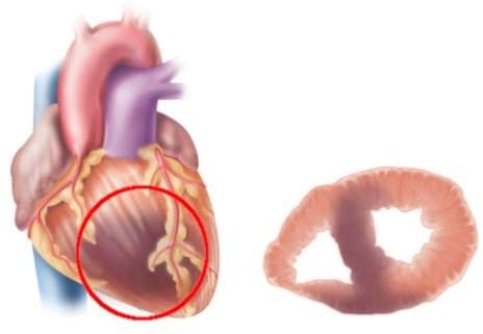
A) myocardial contusion.
B) pulmonary contusion.
C) cardiac laceration.
D) pericardial effusion.
A) myocardial contusion.
B) pulmonary contusion.
C) cardiac laceration.
D) pericardial effusion.
Question
Question
Question
Question
This displacement of the internal organs is called 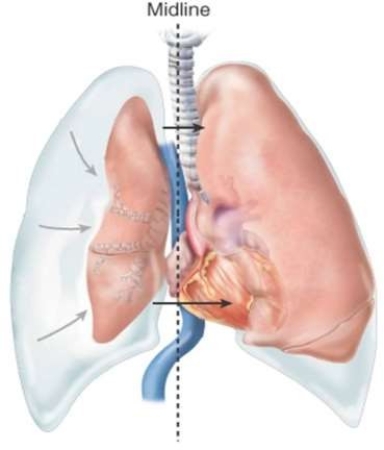
A) myocardial contusion.
B) tracheal deviation.
C) traumatic asphyxiation.
D) mediastinal shift.
A) myocardial contusion.
B) tracheal deviation.
C) traumatic asphyxiation.
D) mediastinal shift.
Question
Question
Question
Question
Question
Question
Question
Question
Question
Question
Question
Question
Question
Question
Question
Question
Question
Question
Question
Question
Question
Question
Question
This image shows 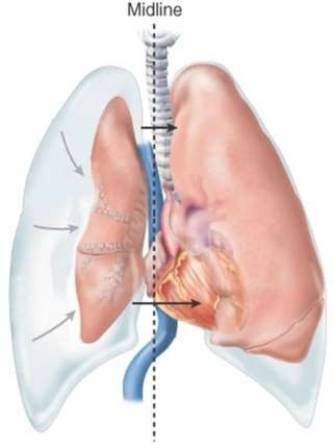
A) paradoxical movement.
B) mediastinal shift.
C) tracheal deviation.
D) pneumothorax.
A) paradoxical movement.
B) mediastinal shift.
C) tracheal deviation.
D) pneumothorax.
Question
Question
Question
Question
Question
Question
Question
Question
Question
What condition does this image depict? 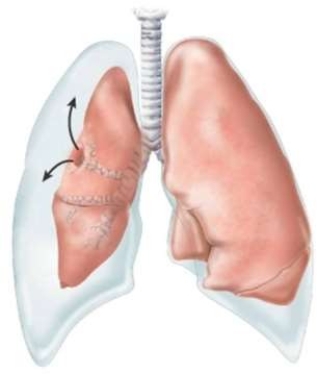
A) Complex pneumothorax
B) Basic pneumothorax
C) Simple pneumothorax
D) Open pneumothorax
A) Complex pneumothorax
B) Basic pneumothorax
C) Simple pneumothorax
D) Open pneumothorax
Question
Question
Question
Question
Question
Question
Question
Question
Question
This diagram of the rib cage shows that fractures to ribs 7, 8, or 9 can also damage 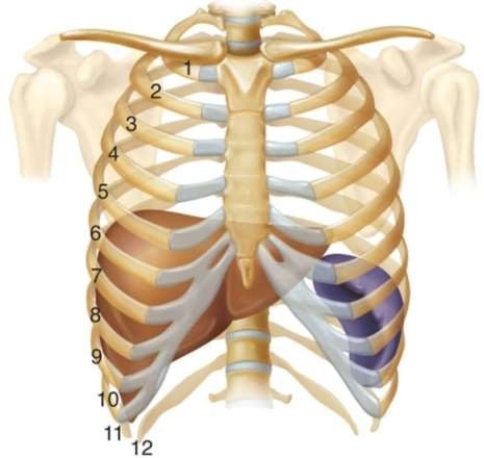 which organs?
A) Spleen and stomach
B) Liver and stomach
C) Liver and spleen
D) Diaphragm and stomach
which organs?A) Spleen and stomach
B) Liver and stomach
C) Liver and spleen
D) Diaphragm and stomach

Unlock Deck
Sign up to unlock the cards in this deck!
Unlock Deck
Unlock Deck
1/58

Play

Full screen (f)
Deck 35: Chest Trauma
1
The rib cage includes
A) the ribs, major blood vessels, lungs, and heart.
B) the ribs, thoracic vertebrae, lungs, and heart.
C) the ribs, lungs, heart, and sternum.
D) the ribs, thoracic vertebrae, and sternum.
A) the ribs, major blood vessels, lungs, and heart.
B) the ribs, thoracic vertebrae, lungs, and heart.
C) the ribs, lungs, heart, and sternum.
D) the ribs, thoracic vertebrae, and sternum.
the ribs, thoracic vertebrae, and sternum.
2
Which mechanism of injury will likely cause a closed chest injury?
A) A motor vehicle crash
B) A gunshot
C) Physical overexertion
D) Chronic coughing
A) A motor vehicle crash
B) A gunshot
C) Physical overexertion
D) Chronic coughing
A motor vehicle crash
3
Select the BEST response: A rib fracture is classified as
A) a pulmonary injury.
B) an open chest injury.
C) a pleural cavity injury.
D) a closed chest injury.
A) a pulmonary injury.
B) an open chest injury.
C) a pleural cavity injury.
D) a closed chest injury.
a closed chest injury.
4
Fractures of the 5-9 ribs on the right side are associated with injury to the
A) lungs.
B) spleen.
C) stomach.
D) liver.
A) lungs.
B) spleen.
C) stomach.
D) liver.
Unlock Deck
Unlock for access to all 58 flashcards in this deck.
Unlock Deck
k this deck
5
If you palpate the chest and hear a grating sound, you are hearing
A) pulmonary contusion.
B) pulmonary embolism.
C) subcutaneous emphysema.
D) crepitus.
A) pulmonary contusion.
B) pulmonary embolism.
C) subcutaneous emphysema.
D) crepitus.
Unlock Deck
Unlock for access to all 58 flashcards in this deck.
Unlock Deck
k this deck
6
What are the steps you should perform when caring for a rib fracture?
A) Put on PPE, maintain an airway, assess ventilation, give oxygen if necessary, and allow the patient to hold a pillow for comfort.
B) Put on PPE, assess ventilation, give oxygen if necessary, and transport to the nearest hospital.
C) Put on PPE, maintain an airway, assess ventilation, give oxygen if necessary, and then tape the affected ribs.
D) Put on PPE, maintain an airway, give oxygen if necessary, and place an occlusive bandage over the damaged area.
A) Put on PPE, maintain an airway, assess ventilation, give oxygen if necessary, and allow the patient to hold a pillow for comfort.
B) Put on PPE, assess ventilation, give oxygen if necessary, and transport to the nearest hospital.
C) Put on PPE, maintain an airway, assess ventilation, give oxygen if necessary, and then tape the affected ribs.
D) Put on PPE, maintain an airway, give oxygen if necessary, and place an occlusive bandage over the damaged area.
Unlock Deck
Unlock for access to all 58 flashcards in this deck.
Unlock Deck
k this deck
7
What is flail chest?
A) Bruising of the lung caused by blunt force trauma.
B) Multiple fractures to several adjacent ribs.
C) A broken rib that "flails" out and protrudes from the skin.
D) A laceration on the lung caused by a broken rib.
A) Bruising of the lung caused by blunt force trauma.
B) Multiple fractures to several adjacent ribs.
C) A broken rib that "flails" out and protrudes from the skin.
D) A laceration on the lung caused by a broken rib.
Unlock Deck
Unlock for access to all 58 flashcards in this deck.
Unlock Deck
k this deck
8
An older man says he was awoken by sharp pain on the right side of his chest, accompanied by rapid breathing and a cough. He was recently diagnosed with pneumonia. You should suspect
A) pulmonary contusion.
B) pulmonary edema.
C) a simple pneumothorax.
D) an asthma attack.
A) pulmonary contusion.
B) pulmonary edema.
C) a simple pneumothorax.
D) an asthma attack.
Unlock Deck
Unlock for access to all 58 flashcards in this deck.
Unlock Deck
k this deck
9
A massive hemothorax is
A) a bleed from the aorta into the abdominal cavity.
B) a blood loss of more than 1,500 mL into the pleural cavity.
C) the presence of blood in a tension pneumothorax.
D) a blood loss of 1,000 mL into the alveoli and bronchioles.
A) a bleed from the aorta into the abdominal cavity.
B) a blood loss of more than 1,500 mL into the pleural cavity.
C) the presence of blood in a tension pneumothorax.
D) a blood loss of 1,000 mL into the alveoli and bronchioles.
Unlock Deck
Unlock for access to all 58 flashcards in this deck.
Unlock Deck
k this deck
10
A cardiac tamponade is
A) the presence of blood within the pleural space.
B) a laceration of one of the major blood vessels.
C) the entrance of blood into the pericardial sac.
D) a contusion of the heart and the pulmonary wall.
A) the presence of blood within the pleural space.
B) a laceration of one of the major blood vessels.
C) the entrance of blood into the pericardial sac.
D) a contusion of the heart and the pulmonary wall.
Unlock Deck
Unlock for access to all 58 flashcards in this deck.
Unlock Deck
k this deck
11
A victim of a motor vehicle crash who exhibits deep red and purple colors on the head and neck likely has
A) cardiac tamponade.
B) jugular venous distension.
C) open pneumothorax.
D) traumatic asphyxia.
A) cardiac tamponade.
B) jugular venous distension.
C) open pneumothorax.
D) traumatic asphyxia.
Unlock Deck
Unlock for access to all 58 flashcards in this deck.
Unlock Deck
k this deck
12
What occurs in about 75% of patients with flail chest?
A) Simple pneumothorax
B) Tension pneumothorax
C) Pulmonary contusion
D) Myocardial contusion
A) Simple pneumothorax
B) Tension pneumothorax
C) Pulmonary contusion
D) Myocardial contusion
Unlock Deck
Unlock for access to all 58 flashcards in this deck.
Unlock Deck
k this deck
13
In this image, the dark red tissue of the heart illustrates
A) myocardial contusion.
B) pulmonary contusion.
C) cardiac laceration.
D) pericardial effusion.
A) myocardial contusion.
B) pulmonary contusion.
C) cardiac laceration.
D) pericardial effusion.
Unlock Deck
Unlock for access to all 58 flashcards in this deck.
Unlock Deck
k this deck
14
A young male was hit in the front of his chest with a baseball and fell over with no pulse. You should suspect
A) rib fracture.
B) commotio cordis.
C) pulmonary contusion.
D) myocardial contusion.
A) rib fracture.
B) commotio cordis.
C) pulmonary contusion.
D) myocardial contusion.
Unlock Deck
Unlock for access to all 58 flashcards in this deck.
Unlock Deck
k this deck
15
Your patient was stabbed in the chest and the knife was removed prior to your arrival. You notice blood and bubbles leaking from the wound. You should
A) pack the wound with sterile gauze and tape down two sides.
B) place an occlusive dressing over the wound and tape down three sides.
C) control bleeding before applying an occlusive dressing and administering high-flow oxygen.
D) apply a dry, sterile dressing and administer oxygen.
A) pack the wound with sterile gauze and tape down two sides.
B) place an occlusive dressing over the wound and tape down three sides.
C) control bleeding before applying an occlusive dressing and administering high-flow oxygen.
D) apply a dry, sterile dressing and administer oxygen.
Unlock Deck
Unlock for access to all 58 flashcards in this deck.
Unlock Deck
k this deck
16
A man attacked with a baseball bat is coughing up blood, exhibits bluish skin, and has trouble breathing. You should suspect
A) a tension pneumothorax.
B) commotio cordis.
C) a hemothorax.
D) a pulmonary contusion.
A) a tension pneumothorax.
B) commotio cordis.
C) a hemothorax.
D) a pulmonary contusion.
Unlock Deck
Unlock for access to all 58 flashcards in this deck.
Unlock Deck
k this deck
17
This displacement of the internal organs is called
A) myocardial contusion.
B) tracheal deviation.
C) traumatic asphyxiation.
D) mediastinal shift.
A) myocardial contusion.
B) tracheal deviation.
C) traumatic asphyxiation.
D) mediastinal shift.
Unlock Deck
Unlock for access to all 58 flashcards in this deck.
Unlock Deck
k this deck
18
What is a tension pneumothorax?
A) A compression of the chest that prevents blood flow and sometimes causes partial lung collapse.
B) A gradual accumulation of air in the pleural space, causing a partial to total lung collapse.
C) A non-increasing amount of air in the pleural space that causes a partial lung collapse.
D) Blood that collects in the pleural space and does not cause a lung collapse.
A) A compression of the chest that prevents blood flow and sometimes causes partial lung collapse.
B) A gradual accumulation of air in the pleural space, causing a partial to total lung collapse.
C) A non-increasing amount of air in the pleural space that causes a partial lung collapse.
D) Blood that collects in the pleural space and does not cause a lung collapse.
Unlock Deck
Unlock for access to all 58 flashcards in this deck.
Unlock Deck
k this deck
19
A patient presents with a closed chest injury, jugular vein distension, unequal breath sounds, and a chest with asymmetrical rise on inspiration. He likely has a(n)
A) tension pneumothorax.
B) simple pneumothorax.
C) open pneumothorax.
D) secondary pneumothorax.
A) tension pneumothorax.
B) simple pneumothorax.
C) open pneumothorax.
D) secondary pneumothorax.
Unlock Deck
Unlock for access to all 58 flashcards in this deck.
Unlock Deck
k this deck
20
Your patient has a penetrating chest injury. She is cyanotic and is sweating severely. She has normal breath sounds with equal rise and is tachycardic. You should suspect
A) a myocardial contusion.
B) a cardiac tamponade.
C) traumatic asphyxia.
D) None of these are correct.
A) a myocardial contusion.
B) a cardiac tamponade.
C) traumatic asphyxia.
D) None of these are correct.
Unlock Deck
Unlock for access to all 58 flashcards in this deck.
Unlock Deck
k this deck
21
In the late stage of a tension pneumothorax, blood backs up into the venous system, which causes
A) jugular venous distension.
B) subcutaneous emphysema.
C) crepitus.
D) All of these are correct.
A) jugular venous distension.
B) subcutaneous emphysema.
C) crepitus.
D) All of these are correct.
Unlock Deck
Unlock for access to all 58 flashcards in this deck.
Unlock Deck
k this deck
22
According to the text, because of the force involved in a flail chest injury, you should also suspect
A) pulmonary and myocardial contusions, commotio cordis, and cardiac tamponade.
B) pulmonary and myocardial contusions, hemothorax, and pneumothorax.
C) commotio cordis, myocardial contusions, and cardiac tamponade.
D) hemothorax, pneumothorax, and commotio cordis.
A) pulmonary and myocardial contusions, commotio cordis, and cardiac tamponade.
B) pulmonary and myocardial contusions, hemothorax, and pneumothorax.
C) commotio cordis, myocardial contusions, and cardiac tamponade.
D) hemothorax, pneumothorax, and commotio cordis.
Unlock Deck
Unlock for access to all 58 flashcards in this deck.
Unlock Deck
k this deck
23
Select the BEST response: After a vehicle rollover, the patient displays tachycardia and tachypnea and has immense pain caused by severe bruising across his chest. You should suspect
A) a broken rib.
B) a simple pneumothorax.
C) myocardial contusions.
D) flail chest.
A) a broken rib.
B) a simple pneumothorax.
C) myocardial contusions.
D) flail chest.
Unlock Deck
Unlock for access to all 58 flashcards in this deck.
Unlock Deck
k this deck
24
A 24 year old male called EMS to his home in the middle of the night. You notice him cough repeatedly. He says a pain courses through his chest as if he is being stabbed and complains of shortness of breath. He says that he has no known chest problems. You should suspect
A) traumatic asphyxia.
B) spontaneous pneumothorax.
C) pulmonary contusion.
D) chronic obstructive pulmonary disorder.
A) traumatic asphyxia.
B) spontaneous pneumothorax.
C) pulmonary contusion.
D) chronic obstructive pulmonary disorder.
Unlock Deck
Unlock for access to all 58 flashcards in this deck.
Unlock Deck
k this deck
25
What is a difference between a tension pneumothorax and a cardiac tamponade?
A) A tension pneumothorax has absent breath sounds on one side, while a cardiac tamponade has equal breath sounds on both sides.
B) A tension pneumothorax has the trachea in the midline position, while a cardiac tamponade has a deviated trachea.
C) A tension pneumothorax has a narrowing pulse pressure, while a cardiac tamponade has a normal pulse pressure.
D) A tension pneumothorax has tachycardia, while a cardiac tamponade has a normal heart rate.
A) A tension pneumothorax has absent breath sounds on one side, while a cardiac tamponade has equal breath sounds on both sides.
B) A tension pneumothorax has the trachea in the midline position, while a cardiac tamponade has a deviated trachea.
C) A tension pneumothorax has a narrowing pulse pressure, while a cardiac tamponade has a normal pulse pressure.
D) A tension pneumothorax has tachycardia, while a cardiac tamponade has a normal heart rate.
Unlock Deck
Unlock for access to all 58 flashcards in this deck.
Unlock Deck
k this deck
26
Hemoptysis is a sign of
A) tension pneumothorax.
B) myocardial contusion.
C) pulmonary contusion.
D) simple pneumothorax.
A) tension pneumothorax.
B) myocardial contusion.
C) pulmonary contusion.
D) simple pneumothorax.
Unlock Deck
Unlock for access to all 58 flashcards in this deck.
Unlock Deck
k this deck
27
You are coaching a high school hockey practice when a player is hit in the chest with a hockey stick. He falls immediately, has a seizure, and then lies motionless. In addition to contacting EMS dispatch, you should first
A) begin spinal stabilization and refrain from moving the patient until ALS arrives.
B) reposition the victim's airway and wait for him to catch his breath.
C) assess mental awareness with the Glasgow Coma Scale.
D) check breathing and pulse and begin CPR if necessary.
A) begin spinal stabilization and refrain from moving the patient until ALS arrives.
B) reposition the victim's airway and wait for him to catch his breath.
C) assess mental awareness with the Glasgow Coma Scale.
D) check breathing and pulse and begin CPR if necessary.
Unlock Deck
Unlock for access to all 58 flashcards in this deck.
Unlock Deck
k this deck
28
How many sets of ribs are there?
A) 11 in men, 12 in women
B) 12 for both sexes
C) 12 in men, 11 in women
D) 11 for both sexes
A) 11 in men, 12 in women
B) 12 for both sexes
C) 12 in men, 11 in women
D) 11 for both sexes
Unlock Deck
Unlock for access to all 58 flashcards in this deck.
Unlock Deck
k this deck
29
Which of the following rib fractures might injure the liver?
A) Fractures of ribs 5-9 on the left side
B) Fractures of ribs 5-9 on the right side
C) Fractures of ribs 11-12 on the left side
D) Fractures of ribs 11-12 on the right side
A) Fractures of ribs 5-9 on the left side
B) Fractures of ribs 5-9 on the right side
C) Fractures of ribs 11-12 on the left side
D) Fractures of ribs 11-12 on the right side
Unlock Deck
Unlock for access to all 58 flashcards in this deck.
Unlock Deck
k this deck
30
Your patient tells you that he was kicked in the chest by his horse. You notice that he is holding his arm tightly against his body and seems hesitant to move. You suspect
A) a dislocated shoulder.
B) a radius fracture.
C) a dislocated elbow.
D) a rib fracture.
A) a dislocated shoulder.
B) a radius fracture.
C) a dislocated elbow.
D) a rib fracture.
Unlock Deck
Unlock for access to all 58 flashcards in this deck.
Unlock Deck
k this deck
31
What is crepitus?
A) The grating, crackling, and popping sounds associated with joint erosion or bone fracture.
B) A popping sound, similar to crushing crisped rice, heard when palpating the skin.
C) A natural deformity of the long bones that often appears like swelling.
D) The "pins and needles" sensation felt when nerve damage begins.
A) The grating, crackling, and popping sounds associated with joint erosion or bone fracture.
B) A popping sound, similar to crushing crisped rice, heard when palpating the skin.
C) A natural deformity of the long bones that often appears like swelling.
D) The "pins and needles" sensation felt when nerve damage begins.
Unlock Deck
Unlock for access to all 58 flashcards in this deck.
Unlock Deck
k this deck
32
Which is likely a symptom of rib fracture?
A) Tenderness down the spinal column
B) A throbbing pain extending down the arms
C) Pain down the lower abdomen that worsens when palpated
D) Localized pain in the ribs that worsens upon deep breathing
A) Tenderness down the spinal column
B) A throbbing pain extending down the arms
C) Pain down the lower abdomen that worsens when palpated
D) Localized pain in the ribs that worsens upon deep breathing
Unlock Deck
Unlock for access to all 58 flashcards in this deck.
Unlock Deck
k this deck
33
You should encourage a patient with a rib fracture to
A) inhale slowly and exhale rapidly.
B) take rapid, shallow breaths.
C) cough and breathe deeply.
D) breathe through his nose rather than his mouth.
A) inhale slowly and exhale rapidly.
B) take rapid, shallow breaths.
C) cough and breathe deeply.
D) breathe through his nose rather than his mouth.
Unlock Deck
Unlock for access to all 58 flashcards in this deck.
Unlock Deck
k this deck
34
What is flail chest?
A) A broken floating rib that protrudes from the skin.
B) Multiple broken ribs that puncture internal organs or blood vessels.
C) A broken rib that punctures the lung.
D) Multiple adjacent ribs that are broken in multiple different places.
A) A broken floating rib that protrudes from the skin.
B) Multiple broken ribs that puncture internal organs or blood vessels.
C) A broken rib that punctures the lung.
D) Multiple adjacent ribs that are broken in multiple different places.
Unlock Deck
Unlock for access to all 58 flashcards in this deck.
Unlock Deck
k this deck
35
In a patient with flail chest, paradoxical movement occurs when the flail section
A) moves inward with inspiration, and outward with exhalation.
B) moves freely throughout the chest cavity.
C) disintegrates within the chest cavity.
D) damages lung tissue such that it cannot expand.
A) moves inward with inspiration, and outward with exhalation.
B) moves freely throughout the chest cavity.
C) disintegrates within the chest cavity.
D) damages lung tissue such that it cannot expand.
Unlock Deck
Unlock for access to all 58 flashcards in this deck.
Unlock Deck
k this deck
36
In chest trauma injuries, crepitus is a sign of
A) flail chest and open pneumothorax.
B) rib fracture and flail chest.
C) simple and open pneumothorax.
D) simple pneumothorax and rib fracture.
A) flail chest and open pneumothorax.
B) rib fracture and flail chest.
C) simple and open pneumothorax.
D) simple pneumothorax and rib fracture.
Unlock Deck
Unlock for access to all 58 flashcards in this deck.
Unlock Deck
k this deck
37
Which injury can be associated with flail chest?
A) Myocardial contusion
B) Myocarditis
C) Myocardial perfusion
D) Myocardial infarction
A) Myocardial contusion
B) Myocarditis
C) Myocardial perfusion
D) Myocardial infarction
Unlock Deck
Unlock for access to all 58 flashcards in this deck.
Unlock Deck
k this deck
38
What is the name of the condition in which air collects within the chest cavity and does NOT increase in volume with each breath?
A) Tension pneumothorax
B) Simple pneumothorax
C) Hemothorax
D) Hemopneumothorax
A) Tension pneumothorax
B) Simple pneumothorax
C) Hemothorax
D) Hemopneumothorax
Unlock Deck
Unlock for access to all 58 flashcards in this deck.
Unlock Deck
k this deck
39
What is a tension pneumothorax?
A) A condition in which air exists in the pleural cavity but does not progressively accumulate, causing only a partial lung collapse.
B) A condition in which blood and air collects in the pleural cavity and causes a pressure build-up and difficulty breathing.
C) A condition in which a tear in the lung tissue causes blood to collect in the pleural cavity and causes a partial lung collapse.
D) A condition in which air progressively accumulates in the pleural cavity, cannot escape, and causes a life threatening pressure build-up in the chest.
A) A condition in which air exists in the pleural cavity but does not progressively accumulate, causing only a partial lung collapse.
B) A condition in which blood and air collects in the pleural cavity and causes a pressure build-up and difficulty breathing.
C) A condition in which a tear in the lung tissue causes blood to collect in the pleural cavity and causes a partial lung collapse.
D) A condition in which air progressively accumulates in the pleural cavity, cannot escape, and causes a life threatening pressure build-up in the chest.
Unlock Deck
Unlock for access to all 58 flashcards in this deck.
Unlock Deck
k this deck
40
This image shows
A) paradoxical movement.
B) mediastinal shift.
C) tracheal deviation.
D) pneumothorax.
A) paradoxical movement.
B) mediastinal shift.
C) tracheal deviation.
D) pneumothorax.
Unlock Deck
Unlock for access to all 58 flashcards in this deck.
Unlock Deck
k this deck
41
An adult male is tachycardic, hypotenive, and has cool, clammy skin. You note that lung sounds are absent on the left side of his chest. You should suspect
A) hemothorax.
B) open pneumothorax.
C) simple pneumothorax.
D) tension pneumothorax.
A) hemothorax.
B) open pneumothorax.
C) simple pneumothorax.
D) tension pneumothorax.
Unlock Deck
Unlock for access to all 58 flashcards in this deck.
Unlock Deck
k this deck
42
Select the BEST response: Your patient was in a motorcycle crash. Before your arrival, a bystander covered a "nasty looking hole" in the patient's chest with a clean cloth. You should
A) remove the bandage, determine the extent of bleeding, and then dress appropriately.
B) place an occlusive dressing over the cloth and bandage tightly.
C) cover the cloth with dressing and bandage tightly.
D) remove the cloth, listen for sounds of escaping air, and then dress appropriately.
A) remove the bandage, determine the extent of bleeding, and then dress appropriately.
B) place an occlusive dressing over the cloth and bandage tightly.
C) cover the cloth with dressing and bandage tightly.
D) remove the cloth, listen for sounds of escaping air, and then dress appropriately.
Unlock Deck
Unlock for access to all 58 flashcards in this deck.
Unlock Deck
k this deck
43
A "sucking chest wound" is another name for a(n)
A) tension pneumothorax.
B) hemothorax.
C) simple pneumothorax.
D) open pneumothorax.
A) tension pneumothorax.
B) hemothorax.
C) simple pneumothorax.
D) open pneumothorax.
Unlock Deck
Unlock for access to all 58 flashcards in this deck.
Unlock Deck
k this deck
44
When a chest wound presents a sucking sound with each breath, it is a sign of
A) hypoxia.
B) subcutaneous emphysema.
C) crepitus.
D) open pneumothorax.
A) hypoxia.
B) subcutaneous emphysema.
C) crepitus.
D) open pneumothorax.
Unlock Deck
Unlock for access to all 58 flashcards in this deck.
Unlock Deck
k this deck
45
A 29 year old man was involved in a boating accident. You notice blood bubbling from an avulsion on his chest. You do not have any medical supplies with you. What should you use to dress the wound?
A) A t-shirt
B) A bathing suit
C) A plastic bag
D) A towel
A) A t-shirt
B) A bathing suit
C) A plastic bag
D) A towel
Unlock Deck
Unlock for access to all 58 flashcards in this deck.
Unlock Deck
k this deck
46
Why is it important to tape an occlusive dressing on 3-sides?
A) It allows for Easy removal of the bandage at the hospital.
B) The caregiver has room to clean blood from the wound.
C) It acts as a one-way valve, letting air out but not in.
D) It allows air to enter and escape as needed.
A) It allows for Easy removal of the bandage at the hospital.
B) The caregiver has room to clean blood from the wound.
C) It acts as a one-way valve, letting air out but not in.
D) It allows air to enter and escape as needed.
Unlock Deck
Unlock for access to all 58 flashcards in this deck.
Unlock Deck
k this deck
47
After applying an occlusive bandage to a sucking chest wound, the patient exhibits tachycardia, hypotension, and begins to feel extreme pain on the affected side. You should
A) warm the patient and recheck vital signs.
B) give oxygen by nonrebreather mask at 15L/min.
C) release the bandage and listen for escaping air.
D) begin treating the patient for shock.
A) warm the patient and recheck vital signs.
B) give oxygen by nonrebreather mask at 15L/min.
C) release the bandage and listen for escaping air.
D) begin treating the patient for shock.
Unlock Deck
Unlock for access to all 58 flashcards in this deck.
Unlock Deck
k this deck
48
How are chest wounds categorized?
A) Closed and open
B) Puncture and blunt force
C) Internal and external
D) Simple, tension, and open pneumothoraxes
A) Closed and open
B) Puncture and blunt force
C) Internal and external
D) Simple, tension, and open pneumothoraxes
Unlock Deck
Unlock for access to all 58 flashcards in this deck.
Unlock Deck
k this deck
49
What condition does this image depict?
A) Complex pneumothorax
B) Basic pneumothorax
C) Simple pneumothorax
D) Open pneumothorax
A) Complex pneumothorax
B) Basic pneumothorax
C) Simple pneumothorax
D) Open pneumothorax
Unlock Deck
Unlock for access to all 58 flashcards in this deck.
Unlock Deck
k this deck
50
What does JVD stand for?
A) Juvenile venous dysmorphia
B) Jugular venous distension
C) Jugular vein dysmorphia
D) Juvenile vascular diabetes
A) Juvenile venous dysmorphia
B) Jugular venous distension
C) Jugular vein dysmorphia
D) Juvenile vascular diabetes
Unlock Deck
Unlock for access to all 58 flashcards in this deck.
Unlock Deck
k this deck
51
Rib fractures most commonly occur in
A) older adults.
B) adults.
C) children.
D) babies.
A) older adults.
B) adults.
C) children.
D) babies.
Unlock Deck
Unlock for access to all 58 flashcards in this deck.
Unlock Deck
k this deck
52
According to the text, in treating a rib fracture, it is acceptable to
A) place an occlusive dressing on the injury.
B) apply tape to the affected ribs.
C) permit the patient shallow breathing.
D) allow the patient to hold a pillow to his chest.
A) place an occlusive dressing on the injury.
B) apply tape to the affected ribs.
C) permit the patient shallow breathing.
D) allow the patient to hold a pillow to his chest.
Unlock Deck
Unlock for access to all 58 flashcards in this deck.
Unlock Deck
k this deck
53
The twelfth floating rib is attached to which vertebra?
A) T11
B) T12
C) L1
D) L2
A) T11
B) T12
C) L1
D) L2
Unlock Deck
Unlock for access to all 58 flashcards in this deck.
Unlock Deck
k this deck
54
What motor vehicle safety accessory can occasionally cause rib fractures?
A) Tempered windows
B) Lap belt
C) Frontal airbag
D) 3-point seat belt
A) Tempered windows
B) Lap belt
C) Frontal airbag
D) 3-point seat belt
Unlock Deck
Unlock for access to all 58 flashcards in this deck.
Unlock Deck
k this deck
55
A patient has a chest injury. She exhibits extreme localized pain upon inspiration, shallow breathing, and you can hear breath sounds on each side of the chest. You suspect a
A) tension pneumothorax.
B) flail chest.
C) fractured rib.
D) None of these are correct.
A) tension pneumothorax.
B) flail chest.
C) fractured rib.
D) None of these are correct.
Unlock Deck
Unlock for access to all 58 flashcards in this deck.
Unlock Deck
k this deck
56
Which sign is associated with flail chest?
A) Mediastinal shift
B) Tracheal deviation
C) Paradoxical movement
D) Pulmonary contusion
A) Mediastinal shift
B) Tracheal deviation
C) Paradoxical movement
D) Pulmonary contusion
Unlock Deck
Unlock for access to all 58 flashcards in this deck.
Unlock Deck
k this deck
57
If you put on PPE, request advanced ALS, check for spinal injuries, maintain an open airway, and apply petroleum gauze to a wound, you are caring for
A) a flail chest.
B) a tension pneumothorax.
C) a rib fracture.
D) an open pneumothorax.
A) a flail chest.
B) a tension pneumothorax.
C) a rib fracture.
D) an open pneumothorax.
Unlock Deck
Unlock for access to all 58 flashcards in this deck.
Unlock Deck
k this deck
58
This diagram of the rib cage shows that fractures to ribs 7, 8, or 9 can also damage which organs?
A) Spleen and stomach
B) Liver and stomach
C) Liver and spleen
D) Diaphragm and stomach
which organs?A) Spleen and stomach
B) Liver and stomach
C) Liver and spleen
D) Diaphragm and stomach
Unlock Deck
Unlock for access to all 58 flashcards in this deck.
Unlock Deck
k this deck
Unlock Deck
Unlock for access to all 58 flashcards in this deck.






