







 Chat with AI

Deck 26: Nontraumatic Musculoskeletal Disorders
Full screen (f)

Question

Question
Question
In this image, which is the rectus femoris?
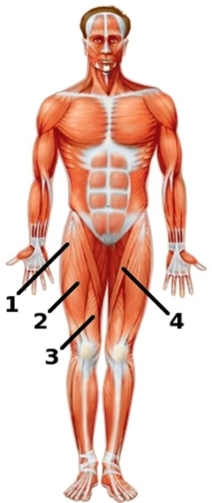
A) 4
B) 2
C) 3
D) 1
A) 4
B) 2
C) 3
D) 1
Question
Question
Question
Question
Question
Question
Question
Question
Question
Question
Question
Question

Unlock Deck
Sign up to unlock the cards in this deck!
Unlock Deck
Unlock Deck
1/15

Play

Full screen (f)
Deck 26: Nontraumatic Musculoskeletal Disorders
1
Bones are made mostly of
A) cartilage and collagen.
B) calcium and cartilage.
C) calcium and collagen.
D) collagen, calcium, and cartilage.
A) cartilage and collagen.
B) calcium and cartilage.
C) calcium and collagen.
D) collagen, calcium, and cartilage.
calcium and collagen.
2
Which are examples of synovial joints?
A) Rib, skull, and hip
B) Skull, elbow, and wrist
C) Hip, elbow, and ankle
D) Knee, hip, and spine
A) Rib, skull, and hip
B) Skull, elbow, and wrist
C) Hip, elbow, and ankle
D) Knee, hip, and spine
Hip, elbow, and ankle
3
In this image, which is the rectus femoris?
A) 4
B) 2
C) 3
D) 1
A) 4
B) 2
C) 3
D) 1
2
4
Which defines osteoarthritis?
A) A genetic disorder with general musculoskeletal pain
B) A disease of progressive bone loss
C) A condition with the breakdown of the joint's cartilage
D) A chronic inflammation of the joint lining
A) A genetic disorder with general musculoskeletal pain
B) A disease of progressive bone loss
C) A condition with the breakdown of the joint's cartilage
D) A chronic inflammation of the joint lining
Unlock Deck
Unlock for access to all 15 flashcards in this deck.
Unlock Deck
k this deck
5
Patients with osteoporosis most commonly fracture their
A) wrist, spine, and knee.
B) spine, hip, and wrist.
C) shoulder, ankle, and knee.
D) hip, wrist, and shoulder.
A) wrist, spine, and knee.
B) spine, hip, and wrist.
C) shoulder, ankle, and knee.
D) hip, wrist, and shoulder.
Unlock Deck
Unlock for access to all 15 flashcards in this deck.
Unlock Deck
k this deck
6
Tendonitis is an example of
A) an overuse pathology.
B) osteoarthritis.
C) an overuse disorder.
D) osteoporosis.
A) an overuse pathology.
B) osteoarthritis.
C) an overuse disorder.
D) osteoporosis.
Unlock Deck
Unlock for access to all 15 flashcards in this deck.
Unlock Deck
k this deck
7
What is bursitis?
A) When a bone spur hinders movement in a joint.
B) When an inflamed tendon bursts out of position.
C) When a joint's cushioning sac becomes inflamed.
D) When a joint continuously leaks synovial fluid.
A) When a bone spur hinders movement in a joint.
B) When an inflamed tendon bursts out of position.
C) When a joint's cushioning sac becomes inflamed.
D) When a joint continuously leaks synovial fluid.
Unlock Deck
Unlock for access to all 15 flashcards in this deck.
Unlock Deck
k this deck
8
A patient has chronic weakness and numbness in his hand and fingers that is aggravated by typing. You should suspect
A) collagen deficiency syndrome.
B) wrist tendonitis.
C) wrist bursitis.
D) carpal tunnel syndrome.
A) collagen deficiency syndrome.
B) wrist tendonitis.
C) wrist bursitis.
D) carpal tunnel syndrome.
Unlock Deck
Unlock for access to all 15 flashcards in this deck.
Unlock Deck
k this deck
9
In assessing OPQRST, which is an appropriate question for O?
A) What have you done to relive the pain or discomfort?
B) Have you ever had these symptoms before?
C) Does your discomfort stay in one area or does it move?
D) Did your symptoms begin suddenly or gradually?
A) What have you done to relive the pain or discomfort?
B) Have you ever had these symptoms before?
C) Does your discomfort stay in one area or does it move?
D) Did your symptoms begin suddenly or gradually?
Unlock Deck
Unlock for access to all 15 flashcards in this deck.
Unlock Deck
k this deck
10
Which is a standard part of patient assessment in a nontraumatic musculoskeletal disorder?
A) Assessment of the dorsalis pedis pulse
B) Performing a rapid medical assessment
C) Splinting a painful extremity
D) Assessing with the Glasgow Coma Scale
A) Assessment of the dorsalis pedis pulse
B) Performing a rapid medical assessment
C) Splinting a painful extremity
D) Assessing with the Glasgow Coma Scale
Unlock Deck
Unlock for access to all 15 flashcards in this deck.
Unlock Deck
k this deck
11
What is fibromyalgia?
A) An acute disorder characterized by weakening and loss of bone tissue.
B) An acute disorder characterized by general fatigue and musculoskeletal pain.
C) A chronic disorder characterized by weakening and loss of bone tissue.
D) A chronic disorder characterized by general fatigue and musculoskeletal pain.
A) An acute disorder characterized by weakening and loss of bone tissue.
B) An acute disorder characterized by general fatigue and musculoskeletal pain.
C) A chronic disorder characterized by weakening and loss of bone tissue.
D) A chronic disorder characterized by general fatigue and musculoskeletal pain.
Unlock Deck
Unlock for access to all 15 flashcards in this deck.
Unlock Deck
k this deck
12
Emergency care in nontraumatic musculoskeletal disorders is usually
A) urgent.
B) supportive.
C) precautionary.
D) intensive.
A) urgent.
B) supportive.
C) precautionary.
D) intensive.
Unlock Deck
Unlock for access to all 15 flashcards in this deck.
Unlock Deck
k this deck
13
A runner complains of swelling and pain in her upper thigh. You should suspect
A) housemaid's knee.
B) shin splints.
C) pelvic tendonitis.
D) hip bursitis.
A) housemaid's knee.
B) shin splints.
C) pelvic tendonitis.
D) hip bursitis.
Unlock Deck
Unlock for access to all 15 flashcards in this deck.
Unlock Deck
k this deck
14
Secondary osteoarthritis can be caused by
A) osteoporosis, fibromyalgia, and overuse.
B) diabetes, obesity, or injury to joints.
C) bursitis, tendonitis, and injury to joints.
D) overuse, diabetes, and tendonitis.
A) osteoporosis, fibromyalgia, and overuse.
B) diabetes, obesity, or injury to joints.
C) bursitis, tendonitis, and injury to joints.
D) overuse, diabetes, and tendonitis.
Unlock Deck
Unlock for access to all 15 flashcards in this deck.
Unlock Deck
k this deck
15
Which are signs or symptoms of fibromyalgia?
A) Osteoporosis and osteoarthritis
B) Depression and anxiety
C) Tachycardia and hypertension
D) Pulmonary congestion
A) Osteoporosis and osteoarthritis
B) Depression and anxiety
C) Tachycardia and hypertension
D) Pulmonary congestion
Unlock Deck
Unlock for access to all 15 flashcards in this deck.
Unlock Deck
k this deck
Unlock Deck
Unlock for access to all 15 flashcards in this deck.






