







 Chat with AI

Deck 8: The Government in the Economy: Taxation and Regulation, Credit Markets
Full screen (f)

Question

Question
Question
Question
Question
The table below shows the tax brackets for different income groups in a country:

-Refer to the table above. If Beth earns $60,000 per year, she has to pay a tax of ________.
A) $9,465.05
B) $1,600.50
C) $1,000.50
D) $24,000
-Refer to the table above. If Beth earns $60,000 per year, she has to pay a tax of ________.
A) $9,465.05
B) $1,600.50
C) $1,000.50
D) $24,000
Question
The table below shows the tax brackets for different income groups in a country:
-Refer to the table above. If Bob earns $105,000 per year, he has to pay a tax of approximately ________.
A) $6,400
B) $12,600
C) $18,675
D) $19,600
-Refer to the table above. If Bob earns $105,000 per year, he has to pay a tax of approximately ________.
A) $6,400
B) $12,600
C) $18,675
D) $19,600
Question
The table below shows the tax brackets for different income groups in a country:
-Refer to the table above. If Bob pays $20,000 in tax, approximately how much does he earn per year?
A) $60,760
B) $100,760
C) $110,760
D) $115,760
-Refer to the table above. If Bob pays $20,000 in tax, approximately how much does he earn per year?
A) $60,760
B) $100,760
C) $110,760
D) $115,760
Question
The following figure shows the supply and demand curves in a competitive market for a good. The government is considering a $1.50 tax on this good.

-Refer to the figure above. If the $1.50 tax is collected from the producers of this good, the deadweight loss of this taxation will be ________.
A) $0.25
B) $0.75
C) $1.50
D) $2
-Refer to the figure above. If the $1.50 tax is collected from the producers of this good, the deadweight loss of this taxation will be ________.
A) $0.25
B) $0.75
C) $1.50
D) $2
Question
The market for a particular video game title is shown below in demand and supply schedules, demand and supply equations, and a supply-demand figure
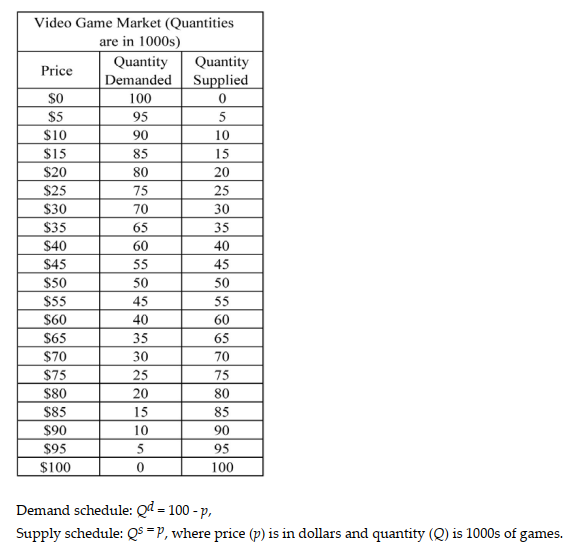
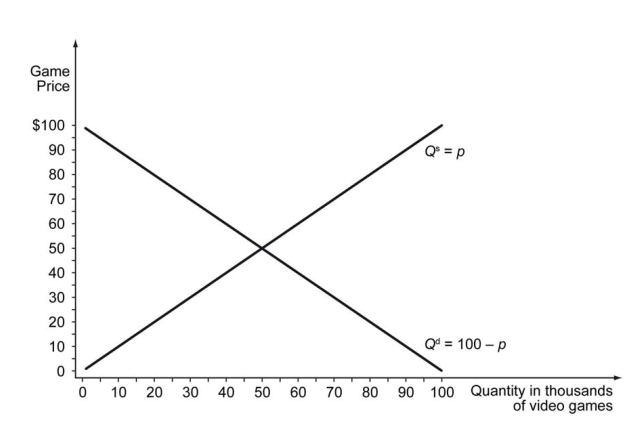
-Refer to the scenario above. After the imposition of the tax, the government collects ________ in tax revenue, and there is a deadweight loss of ________ in the market. Explain your answer with a graph.
A) $500,000; $50,000
B) $450,000; $50,000
C) $450,000; $25,000
D) $400,000; $0
-Refer to the scenario above. After the imposition of the tax, the government collects ________ in tax revenue, and there is a deadweight loss of ________ in the market. Explain your answer with a graph.
A) $500,000; $50,000
B) $450,000; $50,000
C) $450,000; $25,000
D) $400,000; $0
Question
The figure below shows the demand and the supply in a market before and after a tax is imposed. The demand and the supply curves are straight lines.
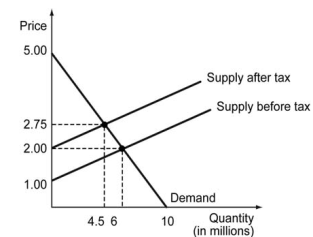
-Refer to the figure above. What is the deadweight loss due to this tax?
A) $500,000
B) $750,000
C) $1,000,000
D) Not enough information to compute the answer
-Refer to the figure above. What is the deadweight loss due to this tax?
A) $500,000
B) $750,000
C) $1,000,000
D) Not enough information to compute the answer
Question
The table below shows the reservation values of ten buyers and a seller for a loaf of bread. Each buyer would buy at most one loaf and the seller can make up to ten loaves. Initially trades happen under the market mechanism with each agent making a decision according to the market price and his or her own reservation value. Then the government imposes a price ceiling of $1.00 per unit.
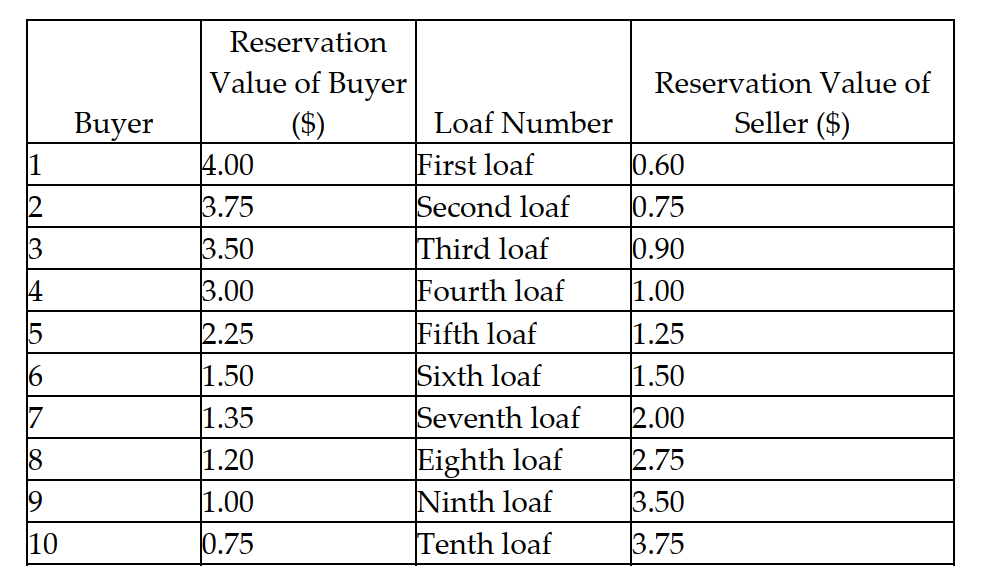
-Refer to the scenario above. What is the total surplus at the equilibrium before the price ceiling is imposed?
A) $13.60
B) $12.00
C) $11.40
D) $9.75
-Refer to the scenario above. What is the total surplus at the equilibrium before the price ceiling is imposed?
A) $13.60
B) $12.00
C) $11.40
D) $9.75
Question
The table below shows the reservation values of ten buyers and a seller for a loaf of bread. Each buyer would buy at most one loaf and the seller can make up to ten loaves. Initially trades happen under the market mechanism with each agent making a decision according to the market price and his or her own reservation value. Then the government imposes a price ceiling of $1.00 per unit.
-Refer to the scenario above. Suppose that, after the price ceiling is imposed, the seller serves customers on a first-come, first-served basis. In the hope of getting the good on the cheap, buyers flock to the store and form a line. Buyer 9 is at the top of the queue and is served immediately. Buyer 2 is next and is served after waiting for 15 minutes. Then Buyer 1 is served after waiting for 30 minutes, followed by Buyer 6 (who waited for an hour). Much to their dismay, other buyers were turned down, and the seller shuts the store. If each buyer has an opportunity cost of time equal to $6 per hour, what is the total net benefit to consumers?
A) $3.75
B) $1.50
C) $0.00
D) $1.25
-Refer to the scenario above. Suppose that, after the price ceiling is imposed, the seller serves customers on a first-come, first-served basis. In the hope of getting the good on the cheap, buyers flock to the store and form a line. Buyer 9 is at the top of the queue and is served immediately. Buyer 2 is next and is served after waiting for 15 minutes. Then Buyer 1 is served after waiting for 30 minutes, followed by Buyer 6 (who waited for an hour). Much to their dismay, other buyers were turned down, and the seller shuts the store. If each buyer has an opportunity cost of time equal to $6 per hour, what is the total net benefit to consumers?
A) $3.75
B) $1.50
C) $0.00
D) $1.25
Question
The table below shows the reservation values of ten buyers and a seller for a loaf of bread. Each buyer would buy at most one loaf and the seller can make up to ten loaves. Initially trades happen under the market mechanism with each agent making a decision according to the market price and his or her own reservation value. Then the government imposes a price ceiling of $1.00 per unit.
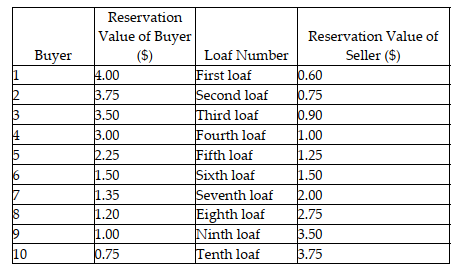
-Refer to the scenario above. Suppose that, after the price ceiling is imposed, the shortage forces buyers to offer bribes to the seller in order to secure a loaf. If each buyer offered as much as his or her reservation value, and the seller sells to the highest bidders, how many loaves will exchange hands' Is the outcome efficient?
A) 4 loaves; no the outcome is not efficient
B) 5 loaves; no the outcome is not efficient
C) 5 loaves; yes the outcome is efficient
D) 6 loaves; yes the outcome is efficient
-Refer to the scenario above. Suppose that, after the price ceiling is imposed, the shortage forces buyers to offer bribes to the seller in order to secure a loaf. If each buyer offered as much as his or her reservation value, and the seller sells to the highest bidders, how many loaves will exchange hands' Is the outcome efficient?
A) 4 loaves; no the outcome is not efficient
B) 5 loaves; no the outcome is not efficient
C) 5 loaves; yes the outcome is efficient
D) 6 loaves; yes the outcome is efficient
Question
The following figure depicts two industries, each facing an identical supply curve.
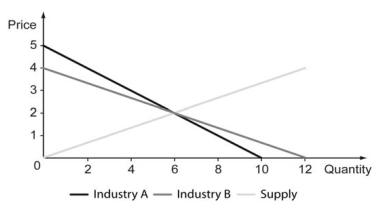
-Refer to the figure above. Which of the following is true?
A) Increasing equity by decreasing the price by $1 in both industries, using a price ceiling policy below the equilibrium price, requires a smaller loss in efficiency in industry A.
B) Increasing equity by decreasing the price by $1 in both industries, using a price ceiling policy below the equilibrium price, requires a smaller loss in efficiency in industry B.
C) Increasing equity by increasing the price by $1 in both industries, using a price floor policy above the equilibrium price, requires a greater loss in efficiency in industry A.
D) Increasing equity by increasing the price by $1 in both industries, using a price floor policy above the equilibrium price, requires a smaller loss in efficiency in industry B.
-Refer to the figure above. Which of the following is true?
A) Increasing equity by decreasing the price by $1 in both industries, using a price ceiling policy below the equilibrium price, requires a smaller loss in efficiency in industry A.
B) Increasing equity by decreasing the price by $1 in both industries, using a price ceiling policy below the equilibrium price, requires a smaller loss in efficiency in industry B.
C) Increasing equity by increasing the price by $1 in both industries, using a price floor policy above the equilibrium price, requires a greater loss in efficiency in industry A.
D) Increasing equity by increasing the price by $1 in both industries, using a price floor policy above the equilibrium price, requires a smaller loss in efficiency in industry B.
Question
Question
Question
The following figure shows credit demand and credit supply curves.
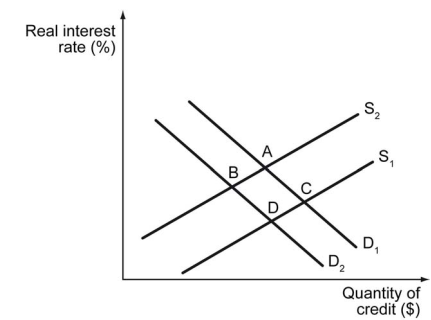
-Refer to the figure above. Assume that the loanable funds market initially is in equilibrium at point A. The media report that a new housing bubble may warrant precaution. Holding all else constant, how might the equilibrium change?
A) Demand will increase, so people can pay off their houses faster. The new equilibrium will be at point C.
B) Supply will increase, because potential buyers will choose to save instead of investing. The new equilibrium will be at point C.
C) Demand will decrease, because potential buyers may fear stricter requirements to qualify for loans and so choose to not buy a house yet. The new equilibrium will be at point B.
D) Supply will decrease, because banks are less likely to approve new loans. The new equilibrium will be at point B.
-Refer to the figure above. Assume that the loanable funds market initially is in equilibrium at point A. The media report that a new housing bubble may warrant precaution. Holding all else constant, how might the equilibrium change?
A) Demand will increase, so people can pay off their houses faster. The new equilibrium will be at point C.
B) Supply will increase, because potential buyers will choose to save instead of investing. The new equilibrium will be at point C.
C) Demand will decrease, because potential buyers may fear stricter requirements to qualify for loans and so choose to not buy a house yet. The new equilibrium will be at point B.
D) Supply will decrease, because banks are less likely to approve new loans. The new equilibrium will be at point B.
Question
The following table shows a T-account for Bank A in a new economy.

-Refer to the table above. What is the missing value for the amount of reserves that the bank has?
A) $1,850
B) $2,850
C) $14,050
D) $24,150
-Refer to the table above. What is the missing value for the amount of reserves that the bank has?
A) $1,850
B) $2,850
C) $14,050
D) $24,150
Question
The following table shows Free Donut Bank?s balance sheet. Free Donut Bank has a required reserve ratio of 20 percent and has $75 in excess reserves.
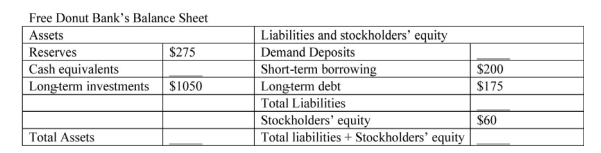
-Refer to the table above. What are Free Donut Bank's total liabilities?
A) $1,200
B) $1,375
C) $1,750
D) $2,000
-Refer to the table above. What are Free Donut Bank's total liabilities?
A) $1,200
B) $1,375
C) $1,750
D) $2,000
Question
The following table shows Free Donut Bank?s balance sheet. Free Donut Bank has a required reserve ratio of 20 percent and has $75 in excess reserves.
-Refer to the table above. What are Free Donut Bank's total assets?
A) $1,260
B) $1,335
C) $1,375
D) $1,435
-Refer to the table above. What are Free Donut Bank's total assets?
A) $1,260
B) $1,335
C) $1,375
D) $1,435
Question
The following table shows the assets and liabilities for Safeco Bank.
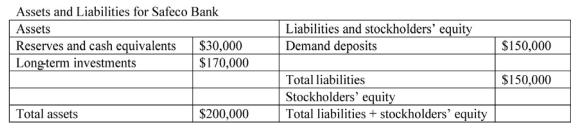
-Refer to the table above. What is Safeco Bank's Stockholder's equity?
A) $50,000
B) $75,000
C) $100,000
D) $150,000
-Refer to the table above. What is Safeco Bank's Stockholder's equity?
A) $50,000
B) $75,000
C) $100,000
D) $150,000
Question
Question
Question
Question

Unlock Deck
Sign up to unlock the cards in this deck!
Unlock Deck
Unlock Deck
1/25

Play

Full screen (f)
Deck 8: The Government in the Economy: Taxation and Regulation, Credit Markets
1
The government of Lithasia ran a budget deficit of $60,000 in 2014. If the tax revenue of the Lithasian government in 2014 was $320,000,000, how much did the government spend that year?
A) $319,940,000
B) $1,060,000
C) $320,060,000
D) $49,000,000
A) $319,940,000
B) $1,060,000
C) $320,060,000
D) $49,000,000
$320,060,000
2
The government of Putania spent $67,000,000 in a particular year, and the total tax receipts of the government in that year were $120,000. Calculate the budget deficit.
A) $600,000
B) $680,000
C) $67,120,000
D) $66,880,000
A) $600,000
B) $680,000
C) $67,120,000
D) $66,880,000
$66,880,000
3
What is the budget surplus if the total amount of taxes collected by a local government is $171,000 and the total amount spent is $90,000?
A) $81,000
B) $100,000
C) $70,000
D) $262,000
A) $81,000
B) $100,000
C) $70,000
D) $262,000
$81,000
4
If Kate pays an average tax rate of 12.5 percent and her total income is $34,000, she pays ________ in tax.
A) $5,500
B) $17,000
C) $4,250
D) $3,200
A) $5,500
B) $17,000
C) $4,250
D) $3,200
Unlock Deck
Unlock for access to all 25 flashcards in this deck.
Unlock Deck
k this deck
5
The table below shows the tax brackets for different income groups in a country:
-Refer to the table above. If Beth earns $60,000 per year, she has to pay a tax of ________.
A) $9,465.05
B) $1,600.50
C) $1,000.50
D) $24,000
-Refer to the table above. If Beth earns $60,000 per year, she has to pay a tax of ________.
A) $9,465.05
B) $1,600.50
C) $1,000.50
D) $24,000
Unlock Deck
Unlock for access to all 25 flashcards in this deck.
Unlock Deck
k this deck
6
The table below shows the tax brackets for different income groups in a country:
-Refer to the table above. If Bob earns $105,000 per year, he has to pay a tax of approximately ________.
A) $6,400
B) $12,600
C) $18,675
D) $19,600
-Refer to the table above. If Bob earns $105,000 per year, he has to pay a tax of approximately ________.
A) $6,400
B) $12,600
C) $18,675
D) $19,600
Unlock Deck
Unlock for access to all 25 flashcards in this deck.
Unlock Deck
k this deck
7
The table below shows the tax brackets for different income groups in a country:
-Refer to the table above. If Bob pays $20,000 in tax, approximately how much does he earn per year?
A) $60,760
B) $100,760
C) $110,760
D) $115,760
-Refer to the table above. If Bob pays $20,000 in tax, approximately how much does he earn per year?
A) $60,760
B) $100,760
C) $110,760
D) $115,760
Unlock Deck
Unlock for access to all 25 flashcards in this deck.
Unlock Deck
k this deck
8
The following figure shows the supply and demand curves in a competitive market for a good. The government is considering a $1.50 tax on this good.
-Refer to the figure above. If the $1.50 tax is collected from the producers of this good, the deadweight loss of this taxation will be ________.
A) $0.25
B) $0.75
C) $1.50
D) $2
-Refer to the figure above. If the $1.50 tax is collected from the producers of this good, the deadweight loss of this taxation will be ________.
A) $0.25
B) $0.75
C) $1.50
D) $2
Unlock Deck
Unlock for access to all 25 flashcards in this deck.
Unlock Deck
k this deck
9
The market for a particular video game title is shown below in demand and supply schedules, demand and supply equations, and a supply-demand figure
-Refer to the scenario above. After the imposition of the tax, the government collects ________ in tax revenue, and there is a deadweight loss of ________ in the market. Explain your answer with a graph.
A) $500,000; $50,000
B) $450,000; $50,000
C) $450,000; $25,000
D) $400,000; $0
-Refer to the scenario above. After the imposition of the tax, the government collects ________ in tax revenue, and there is a deadweight loss of ________ in the market. Explain your answer with a graph.
A) $500,000; $50,000
B) $450,000; $50,000
C) $450,000; $25,000
D) $400,000; $0
Unlock Deck
Unlock for access to all 25 flashcards in this deck.
Unlock Deck
k this deck
10
The figure below shows the demand and the supply in a market before and after a tax is imposed. The demand and the supply curves are straight lines.
-Refer to the figure above. What is the deadweight loss due to this tax?
A) $500,000
B) $750,000
C) $1,000,000
D) Not enough information to compute the answer
-Refer to the figure above. What is the deadweight loss due to this tax?
A) $500,000
B) $750,000
C) $1,000,000
D) Not enough information to compute the answer
Unlock Deck
Unlock for access to all 25 flashcards in this deck.
Unlock Deck
k this deck
11
The table below shows the reservation values of ten buyers and a seller for a loaf of bread. Each buyer would buy at most one loaf and the seller can make up to ten loaves. Initially trades happen under the market mechanism with each agent making a decision according to the market price and his or her own reservation value. Then the government imposes a price ceiling of $1.00 per unit.
-Refer to the scenario above. What is the total surplus at the equilibrium before the price ceiling is imposed?
A) $13.60
B) $12.00
C) $11.40
D) $9.75
-Refer to the scenario above. What is the total surplus at the equilibrium before the price ceiling is imposed?
A) $13.60
B) $12.00
C) $11.40
D) $9.75
Unlock Deck
Unlock for access to all 25 flashcards in this deck.
Unlock Deck
k this deck
12
The table below shows the reservation values of ten buyers and a seller for a loaf of bread. Each buyer would buy at most one loaf and the seller can make up to ten loaves. Initially trades happen under the market mechanism with each agent making a decision according to the market price and his or her own reservation value. Then the government imposes a price ceiling of $1.00 per unit.
-Refer to the scenario above. Suppose that, after the price ceiling is imposed, the seller serves customers on a first-come, first-served basis. In the hope of getting the good on the cheap, buyers flock to the store and form a line. Buyer 9 is at the top of the queue and is served immediately. Buyer 2 is next and is served after waiting for 15 minutes. Then Buyer 1 is served after waiting for 30 minutes, followed by Buyer 6 (who waited for an hour). Much to their dismay, other buyers were turned down, and the seller shuts the store. If each buyer has an opportunity cost of time equal to $6 per hour, what is the total net benefit to consumers?
A) $3.75
B) $1.50
C) $0.00
D) $1.25
-Refer to the scenario above. Suppose that, after the price ceiling is imposed, the seller serves customers on a first-come, first-served basis. In the hope of getting the good on the cheap, buyers flock to the store and form a line. Buyer 9 is at the top of the queue and is served immediately. Buyer 2 is next and is served after waiting for 15 minutes. Then Buyer 1 is served after waiting for 30 minutes, followed by Buyer 6 (who waited for an hour). Much to their dismay, other buyers were turned down, and the seller shuts the store. If each buyer has an opportunity cost of time equal to $6 per hour, what is the total net benefit to consumers?
A) $3.75
B) $1.50
C) $0.00
D) $1.25
Unlock Deck
Unlock for access to all 25 flashcards in this deck.
Unlock Deck
k this deck
13
The table below shows the reservation values of ten buyers and a seller for a loaf of bread. Each buyer would buy at most one loaf and the seller can make up to ten loaves. Initially trades happen under the market mechanism with each agent making a decision according to the market price and his or her own reservation value. Then the government imposes a price ceiling of $1.00 per unit.
-Refer to the scenario above. Suppose that, after the price ceiling is imposed, the shortage forces buyers to offer bribes to the seller in order to secure a loaf. If each buyer offered as much as his or her reservation value, and the seller sells to the highest bidders, how many loaves will exchange hands' Is the outcome efficient?
A) 4 loaves; no the outcome is not efficient
B) 5 loaves; no the outcome is not efficient
C) 5 loaves; yes the outcome is efficient
D) 6 loaves; yes the outcome is efficient
-Refer to the scenario above. Suppose that, after the price ceiling is imposed, the shortage forces buyers to offer bribes to the seller in order to secure a loaf. If each buyer offered as much as his or her reservation value, and the seller sells to the highest bidders, how many loaves will exchange hands' Is the outcome efficient?
A) 4 loaves; no the outcome is not efficient
B) 5 loaves; no the outcome is not efficient
C) 5 loaves; yes the outcome is efficient
D) 6 loaves; yes the outcome is efficient
Unlock Deck
Unlock for access to all 25 flashcards in this deck.
Unlock Deck
k this deck
14
The following figure depicts two industries, each facing an identical supply curve.
-Refer to the figure above. Which of the following is true?
A) Increasing equity by decreasing the price by $1 in both industries, using a price ceiling policy below the equilibrium price, requires a smaller loss in efficiency in industry A.
B) Increasing equity by decreasing the price by $1 in both industries, using a price ceiling policy below the equilibrium price, requires a smaller loss in efficiency in industry B.
C) Increasing equity by increasing the price by $1 in both industries, using a price floor policy above the equilibrium price, requires a greater loss in efficiency in industry A.
D) Increasing equity by increasing the price by $1 in both industries, using a price floor policy above the equilibrium price, requires a smaller loss in efficiency in industry B.
-Refer to the figure above. Which of the following is true?
A) Increasing equity by decreasing the price by $1 in both industries, using a price ceiling policy below the equilibrium price, requires a smaller loss in efficiency in industry A.
B) Increasing equity by decreasing the price by $1 in both industries, using a price ceiling policy below the equilibrium price, requires a smaller loss in efficiency in industry B.
C) Increasing equity by increasing the price by $1 in both industries, using a price floor policy above the equilibrium price, requires a greater loss in efficiency in industry A.
D) Increasing equity by increasing the price by $1 in both industries, using a price floor policy above the equilibrium price, requires a smaller loss in efficiency in industry B.
Unlock Deck
Unlock for access to all 25 flashcards in this deck.
Unlock Deck
k this deck
15
Approximately 80 percent of mothers of infants in the United States use infant formula. Infant formula has an extremely low price elasticity of demand. As a result, the government could raise substantial revenues by placing high excise taxes on infant formula, and these high taxes would generate relatively modest deadweight losses. What is the likely reason that the government does not increase the tax on infant formula? Explain your answer.
A) The government cares exclusively about efficiency.
B) The government cares exclusively about equity.
C) The deadweight loss would be too large.
D) The government trades off efficiency to promote equity.
A) The government cares exclusively about efficiency.
B) The government cares exclusively about equity.
C) The deadweight loss would be too large.
D) The government trades off efficiency to promote equity.
Unlock Deck
Unlock for access to all 25 flashcards in this deck.
Unlock Deck
k this deck
16
Historically, participation in employer-sponsored retirement saving programs has been characterized by "opt in;" eligible employees go to the company's Human Resources office and fill out a form so that they can start having deductions from their paycheck go into a retirement savings account. Recently, many companies have switched to an "opt out" model for their retirement plans: eligible workers are automatically enrolled in the plan and have to go to their Human Resources office and fill out a form if they do not want to participate in the plan. This change in how employees enroll in retirement savings programs at their employer is an example of ________.
A) command-and-control regulation
B) a nudge
C) deadweight loss
D) consumer sovereignty
A) command-and-control regulation
B) a nudge
C) deadweight loss
D) consumer sovereignty
Unlock Deck
Unlock for access to all 25 flashcards in this deck.
Unlock Deck
k this deck
17
The following figure shows credit demand and credit supply curves.
-Refer to the figure above. Assume that the loanable funds market initially is in equilibrium at point A. The media report that a new housing bubble may warrant precaution. Holding all else constant, how might the equilibrium change?
A) Demand will increase, so people can pay off their houses faster. The new equilibrium will be at point C.
B) Supply will increase, because potential buyers will choose to save instead of investing. The new equilibrium will be at point C.
C) Demand will decrease, because potential buyers may fear stricter requirements to qualify for loans and so choose to not buy a house yet. The new equilibrium will be at point B.
D) Supply will decrease, because banks are less likely to approve new loans. The new equilibrium will be at point B.
-Refer to the figure above. Assume that the loanable funds market initially is in equilibrium at point A. The media report that a new housing bubble may warrant precaution. Holding all else constant, how might the equilibrium change?
A) Demand will increase, so people can pay off their houses faster. The new equilibrium will be at point C.
B) Supply will increase, because potential buyers will choose to save instead of investing. The new equilibrium will be at point C.
C) Demand will decrease, because potential buyers may fear stricter requirements to qualify for loans and so choose to not buy a house yet. The new equilibrium will be at point B.
D) Supply will decrease, because banks are less likely to approve new loans. The new equilibrium will be at point B.
Unlock Deck
Unlock for access to all 25 flashcards in this deck.
Unlock Deck
k this deck
18
The following table shows a T-account for Bank A in a new economy.
-Refer to the table above. What is the missing value for the amount of reserves that the bank has?
A) $1,850
B) $2,850
C) $14,050
D) $24,150
-Refer to the table above. What is the missing value for the amount of reserves that the bank has?
A) $1,850
B) $2,850
C) $14,050
D) $24,150
Unlock Deck
Unlock for access to all 25 flashcards in this deck.
Unlock Deck
k this deck
19
The following table shows Free Donut Bank?s balance sheet. Free Donut Bank has a required reserve ratio of 20 percent and has $75 in excess reserves.
-Refer to the table above. What are Free Donut Bank's total liabilities?
A) $1,200
B) $1,375
C) $1,750
D) $2,000
-Refer to the table above. What are Free Donut Bank's total liabilities?
A) $1,200
B) $1,375
C) $1,750
D) $2,000
Unlock Deck
Unlock for access to all 25 flashcards in this deck.
Unlock Deck
k this deck
20
The following table shows Free Donut Bank?s balance sheet. Free Donut Bank has a required reserve ratio of 20 percent and has $75 in excess reserves.
-Refer to the table above. What are Free Donut Bank's total assets?
A) $1,260
B) $1,335
C) $1,375
D) $1,435
-Refer to the table above. What are Free Donut Bank's total assets?
A) $1,260
B) $1,335
C) $1,375
D) $1,435
Unlock Deck
Unlock for access to all 25 flashcards in this deck.
Unlock Deck
k this deck
21
The following table shows the assets and liabilities for Safeco Bank.
-Refer to the table above. What is Safeco Bank's Stockholder's equity?
A) $50,000
B) $75,000
C) $100,000
D) $150,000
-Refer to the table above. What is Safeco Bank's Stockholder's equity?
A) $50,000
B) $75,000
C) $100,000
D) $150,000
Unlock Deck
Unlock for access to all 25 flashcards in this deck.
Unlock Deck
k this deck
22
Alpha Bank has $100,000 in total assets and $45,000 in total liabilities. Beta Bank has $250,000 in total assets and $220,000 in total liabilities.
-Refer to the scenario above. What is Alpha Bank's Stockholders' equity?
A) $45,000
B) $55,000
C) $65,000
D) $145,000
-Refer to the scenario above. What is Alpha Bank's Stockholders' equity?
A) $45,000
B) $55,000
C) $65,000
D) $145,000
Unlock Deck
Unlock for access to all 25 flashcards in this deck.
Unlock Deck
k this deck
23
Alpha Bank has $100,000 in total assets and $45,000 in total liabilities. Beta Bank has $250,000 in total assets and $220,000 in total liabilities.
-Refer to the scenario above. What is Beta Bank's Stockholders'equity?
A) $15,000
B) $30,000
C) $220,000
D) $250,000
-Refer to the scenario above. What is Beta Bank's Stockholders'equity?
A) $15,000
B) $30,000
C) $220,000
D) $250,000
Unlock Deck
Unlock for access to all 25 flashcards in this deck.
Unlock Deck
k this deck
24
Amateur Bank is just starting out and has had the following transactions:
• Amateur Bank takes out a $3,000 loan from Pro Bank.
• Amateur bank has $2,500 invested in building and operations.
• Suzie deposits $1,200.
• Joe deposits $750.
• Robbie takes out a loan for $900.
• Jackie takes out a business loan for $625.
• Amateur Bank invests $1,000 in GoPro
-Refer to the scenario above. How much does Amateur Bank have in total assets?
A) $4,105
B) $4,950
C) $5,150
D) $5,450
• Amateur Bank takes out a $3,000 loan from Pro Bank.
• Amateur bank has $2,500 invested in building and operations.
• Suzie deposits $1,200.
• Joe deposits $750.
• Robbie takes out a loan for $900.
• Jackie takes out a business loan for $625.
• Amateur Bank invests $1,000 in GoPro
-Refer to the scenario above. How much does Amateur Bank have in total assets?
A) $4,105
B) $4,950
C) $5,150
D) $5,450
Unlock Deck
Unlock for access to all 25 flashcards in this deck.
Unlock Deck
k this deck
25
Amateur Bank is just starting out and has had the following transactions:
• Amateur Bank takes out a $3,000 loan from Pro Bank.
• Amateur bank has $2,500 invested in building and operations.
• Suzie deposits $1,200.
• Joe deposits $750.
• Robbie takes out a loan for $900.
• Jackie takes out a business loan for $625.
• Amateur Bank invests $1,000 in GoPro
-Refer to the scenario above. How much does Amateur Bank have in total liabilities?
A) $4,250
B) $4,950
C) $5,300
D) $5,500
• Amateur Bank takes out a $3,000 loan from Pro Bank.
• Amateur bank has $2,500 invested in building and operations.
• Suzie deposits $1,200.
• Joe deposits $750.
• Robbie takes out a loan for $900.
• Jackie takes out a business loan for $625.
• Amateur Bank invests $1,000 in GoPro
-Refer to the scenario above. How much does Amateur Bank have in total liabilities?
A) $4,250
B) $4,950
C) $5,300
D) $5,500
Unlock Deck
Unlock for access to all 25 flashcards in this deck.
Unlock Deck
k this deck
Unlock Deck
Unlock for access to all 25 flashcards in this deck.






