



Deck 2: Demand, Supply, and Market Equilibrium

Full screen (f)
exit full mode
Question
Use the following general linear demand relation to answer questions 9 through 13:

<strong>Use the following general linear demand relation to answer questions 9 through 13:   where M is income and   is the price of a related good, R.  -From this relation it is apparent that the good is:</strong> A) an inferior good B) a substitute for good R C) a normal good D) a complement for good R E) both c and d <div style=padding-top: 35px>
where M is income and <strong>Use the following general linear demand relation to answer questions 9 through 13:   where M is income and   is the price of a related good, R.  -From this relation it is apparent that the good is:</strong> A) an inferior good B) a substitute for good R C) a normal good D) a complement for good R E) both c and d <div style=padding-top: 35px> is the price of a related good, R.

-From this relation it is apparent that the good is:

A) an inferior good
B) a substitute for good R
C) a normal good
D) a complement for good R
E) both c and d
Use Space or
up arrow
down arrow
to flip the card.
Question
Use the following general linear demand relation to answer questions 9 through 13:
<strong>Use the following general linear demand relation to answer questions 9 through 13:   where M is income and   is the price of a related good, R.  -If M = $15,000 and   = $20, the demand function is</strong> A)   ) B)   . C)   D)   E)   <div style=padding-top: 35px>
where M is income and <strong>Use the following general linear demand relation to answer questions 9 through 13:   where M is income and   is the price of a related good, R.  -If M = $15,000 and   = $20, the demand function is</strong> A)   ) B)   . C)   D)   E)   <div style=padding-top: 35px> is the price of a related good, R.

-If M = $15,000 and
<strong>Use the following general linear demand relation to answer questions 9 through 13:   where M is income and   is the price of a related good, R.  -If M = $15,000 and   = $20, the demand function is</strong> A)   ) B)   . C)   D)   E)   <div style=padding-top: 35px>
= $20, the demand function is

A)
<strong>Use the following general linear demand relation to answer questions 9 through 13:   where M is income and   is the price of a related good, R.  -If M = $15,000 and   = $20, the demand function is</strong> A)   ) B)   . C)   D)   E)   <div style=padding-top: 35px>
)
B) <strong>Use the following general linear demand relation to answer questions 9 through 13:   where M is income and   is the price of a related good, R.  -If M = $15,000 and   = $20, the demand function is</strong> A)   ) B)   . C)   D)   E)   <div style=padding-top: 35px> .
C) <strong>Use the following general linear demand relation to answer questions 9 through 13:   where M is income and   is the price of a related good, R.  -If M = $15,000 and   = $20, the demand function is</strong> A)   ) B)   . C)   D)   E)   <div style=padding-top: 35px>
D) <strong>Use the following general linear demand relation to answer questions 9 through 13:   where M is income and   is the price of a related good, R.  -If M = $15,000 and   = $20, the demand function is</strong> A)   ) B)   . C)   D)   E)   <div style=padding-top: 35px>
E) <strong>Use the following general linear demand relation to answer questions 9 through 13:   where M is income and   is the price of a related good, R.  -If M = $15,000 and   = $20, the demand function is</strong> A)   ) B)   . C)   D)   E)   <div style=padding-top: 35px>
Question
Use the following general linear demand relation to answer questions 9 through 13:
<strong>Use the following general linear demand relation to answer questions 9 through 13:   where M is income and   is the price of a related good, R.  -If M = $15,000 and   = $20 and the supply function is   , equilibrium price and quantity are, respectively,</strong> A) P = $55 and Q = 195. B) P = $6 and Q = 38. C) P = $12 and Q = 200. D) P = $50 and Q = 170. E) P = $40 and Q = 250. <div style=padding-top: 35px>
where M is income and <strong>Use the following general linear demand relation to answer questions 9 through 13:   where M is income and   is the price of a related good, R.  -If M = $15,000 and   = $20 and the supply function is   , equilibrium price and quantity are, respectively,</strong> A) P = $55 and Q = 195. B) P = $6 and Q = 38. C) P = $12 and Q = 200. D) P = $50 and Q = 170. E) P = $40 and Q = 250. <div style=padding-top: 35px> is the price of a related good, R.

-If M = $15,000 and <strong>Use the following general linear demand relation to answer questions 9 through 13:   where M is income and   is the price of a related good, R.  -If M = $15,000 and   = $20 and the supply function is   , equilibrium price and quantity are, respectively,</strong> A) P = $55 and Q = 195. B) P = $6 and Q = 38. C) P = $12 and Q = 200. D) P = $50 and Q = 170. E) P = $40 and Q = 250. <div style=padding-top: 35px> = $20 and the supply function is <strong>Use the following general linear demand relation to answer questions 9 through 13:   where M is income and   is the price of a related good, R.  -If M = $15,000 and   = $20 and the supply function is   , equilibrium price and quantity are, respectively,</strong> A) P = $55 and Q = 195. B) P = $6 and Q = 38. C) P = $12 and Q = 200. D) P = $50 and Q = 170. E) P = $40 and Q = 250. <div style=padding-top: 35px> , equilibrium price and quantity are, respectively,

A) P = $55 and Q = 195.
B) P = $6 and Q = 38.
C) P = $12 and Q = 200.
D) P = $50 and Q = 170.
E) P = $40 and Q = 250.
Question
Use the following general linear demand relation to answer questions 9 through 13:
<strong>Use the following general linear demand relation to answer questions 9 through 13:   where M is income and   is the price of a related good, R.  -If M = $15,000 and P<sub>R</sub> = $20 and the supply function is Q= 30+3P, then, when the price of the good is $60,</strong> A) there is a shortage of 60 units of the good. B) there is equilibrium in the market. C) there is a surplus of 60 units of the good. D) the quantities demanded and supplied are indeterminate <div style=padding-top: 35px>
where M is income and <strong>Use the following general linear demand relation to answer questions 9 through 13:   where M is income and   is the price of a related good, R.  -If M = $15,000 and P<sub>R</sub> = $20 and the supply function is Q= 30+3P, then, when the price of the good is $60,</strong> A) there is a shortage of 60 units of the good. B) there is equilibrium in the market. C) there is a surplus of 60 units of the good. D) the quantities demanded and supplied are indeterminate <div style=padding-top: 35px> is the price of a related good, R.

-If M = $15,000 and PR = $20 and the supply function is Q= 30+3P, then, when the price of the good is $60,

A) there is a shortage of 60 units of the good.
B) there is equilibrium in the market.
C) there is a surplus of 60 units of the good.
D) the quantities demanded and supplied are indeterminate
Question
Use the following general linear demand relation to answer questions 9 through 13:
<strong>Use the following general linear demand relation to answer questions 9 through 13:   where M is income and   is the price of a related good, R.  -If M = $15,000 and   = $20 and the supply function is   , then, when the price of the good is $40,</strong> A) there is equilibrium in the market. B) there is a shortage of 180 units of the good. C) there is a surplus of 180 units of the good. D) there is a shortage of 80 units of the good. <div style=padding-top: 35px>
where M is income and <strong>Use the following general linear demand relation to answer questions 9 through 13:   where M is income and   is the price of a related good, R.  -If M = $15,000 and   = $20 and the supply function is   , then, when the price of the good is $40,</strong> A) there is equilibrium in the market. B) there is a shortage of 180 units of the good. C) there is a surplus of 180 units of the good. D) there is a shortage of 80 units of the good. <div style=padding-top: 35px> is the price of a related good, R.

-If M = $15,000 and
<strong>Use the following general linear demand relation to answer questions 9 through 13:   where M is income and   is the price of a related good, R.  -If M = $15,000 and   = $20 and the supply function is   , then, when the price of the good is $40,</strong> A) there is equilibrium in the market. B) there is a shortage of 180 units of the good. C) there is a surplus of 180 units of the good. D) there is a shortage of 80 units of the good. <div style=padding-top: 35px>
= $20 and the supply function is
<strong>Use the following general linear demand relation to answer questions 9 through 13:   where M is income and   is the price of a related good, R.  -If M = $15,000 and   = $20 and the supply function is   , then, when the price of the good is $40,</strong> A) there is equilibrium in the market. B) there is a shortage of 180 units of the good. C) there is a surplus of 180 units of the good. D) there is a shortage of 80 units of the good. <div style=padding-top: 35px>
, then, when the price of the good is $40,

A) there is equilibrium in the market.
B) there is a shortage of 180 units of the good.
C) there is a surplus of 180 units of the good.
D) there is a shortage of 80 units of the good.
Question
Use the following demand and supply functions
Demand: <strong>Use the following demand and supply functions Demand:   Supply:    -Equilibrium price and output are</strong> A) P = $5 and Q = 70. B) P = $11 and Q = 3.32. C) P = $12 and Q = 44. D) P = $15 and Q = 50. E) none of the above <div style=padding-top: 35px> Supply: <strong>Use the following demand and supply functions Demand:   Supply:    -Equilibrium price and output are</strong> A) P = $5 and Q = 70. B) P = $11 and Q = 3.32. C) P = $12 and Q = 44. D) P = $15 and Q = 50. E) none of the above <div style=padding-top: 35px>

-Equilibrium price and output are

A) P = $5 and Q = 70.
B) P = $11 and Q = 3.32.
C) P = $12 and Q = 44.
D) P = $15 and Q = 50.
E) none of the above
Question
Use the following demand and supply functions
Demand: <strong>Use the following demand and supply functions Demand:   Supply:    -If the price is $10, there is a</strong> A) surplus of 30 units. B) shortage of 30 units. C) surplus of 40 units. D) shortage of 10 units. E) none of the above <div style=padding-top: 35px> Supply: <strong>Use the following demand and supply functions Demand:   Supply:    -If the price is $10, there is a</strong> A) surplus of 30 units. B) shortage of 30 units. C) surplus of 40 units. D) shortage of 10 units. E) none of the above <div style=padding-top: 35px>

-If the price is $10, there is a

A) surplus of 30 units.
B) shortage of 30 units.
C) surplus of 40 units.
D) shortage of 10 units.
E) none of the above
Question
Use the following demand and supply functions
Demand: <strong>Use the following demand and supply functions Demand:   Supply:    -If the price is $2, there is a</strong> A) surplus of 10 units. B) shortage of 10 units. C) surplus of 30 units. D) shortage of 18 units. E) none of the above <div style=padding-top: 35px> Supply: <strong>Use the following demand and supply functions Demand:   Supply:    -If the price is $2, there is a</strong> A) surplus of 10 units. B) shortage of 10 units. C) surplus of 30 units. D) shortage of 18 units. E) none of the above <div style=padding-top: 35px>

-If the price is $2, there is a

A) surplus of 10 units.
B) shortage of 10 units.
C) surplus of 30 units.
D) shortage of 18 units.
E) none of the above
Question
Use the following general linear demand relation to answer questions 36 through 41:

<strong>Use the following general linear demand relation to answer questions 36 through 41:   where P is the price of good X, M is income, and   is the price of a related good, R.  -What is the demand function when M = $50,000 and  = $10?</strong> A)   B)   C)   D)   E) none of the above <div style=padding-top: 35px>
where P is the price of good X, M is income, and <strong>Use the following general linear demand relation to answer questions 36 through 41:   where P is the price of good X, M is income, and   is the price of a related good, R.  -What is the demand function when M = $50,000 and  = $10?</strong> A)   B)   C)   D)   E) none of the above <div style=padding-top: 35px> is the price of a related good, R.

-What is the demand function when M = $50,000 and
<strong>Use the following general linear demand relation to answer questions 36 through 41:   where P is the price of good X, M is income, and   is the price of a related good, R.  -What is the demand function when M = $50,000 and  = $10?</strong> A)   B)   C)   D)   E) none of the above <div style=padding-top: 35px> = $10?

A) <strong>Use the following general linear demand relation to answer questions 36 through 41:   where P is the price of good X, M is income, and   is the price of a related good, R.  -What is the demand function when M = $50,000 and  = $10?</strong> A)   B)   C)   D)   E) none of the above <div style=padding-top: 35px>
B) <strong>Use the following general linear demand relation to answer questions 36 through 41:   where P is the price of good X, M is income, and   is the price of a related good, R.  -What is the demand function when M = $50,000 and  = $10?</strong> A)   B)   C)   D)   E) none of the above <div style=padding-top: 35px>
C) <strong>Use the following general linear demand relation to answer questions 36 through 41:   where P is the price of good X, M is income, and   is the price of a related good, R.  -What is the demand function when M = $50,000 and  = $10?</strong> A)   B)   C)   D)   E) none of the above <div style=padding-top: 35px>
D) <strong>Use the following general linear demand relation to answer questions 36 through 41:   where P is the price of good X, M is income, and   is the price of a related good, R.  -What is the demand function when M = $50,000 and  = $10?</strong> A)   B)   C)   D)   E) none of the above <div style=padding-top: 35px>
E) none of the above
Question
Use the following general linear demand relation to answer questions 36 through 41:
<strong>Use the following general linear demand relation to answer questions 36 through 41:   where P is the price of good X, M is income, and   is the price of a related good, R.  -If M = $50,000 and   = $10 and the supply function is   , market price and output are, respectively,</strong> A) P = $12 and Q = 150. B) P = $10 and Q = 200. C) P = $12 and Q = 200. D) P = $15 and Q = 175. E) P = $15 and Q = 225. <div style=padding-top: 35px>
where P is the price of good X, M is income, and <strong>Use the following general linear demand relation to answer questions 36 through 41:   where P is the price of good X, M is income, and   is the price of a related good, R.  -If M = $50,000 and   = $10 and the supply function is   , market price and output are, respectively,</strong> A) P = $12 and Q = 150. B) P = $10 and Q = 200. C) P = $12 and Q = 200. D) P = $15 and Q = 175. E) P = $15 and Q = 225. <div style=padding-top: 35px> is the price of a related good, R.

-If M = $50,000 and
<strong>Use the following general linear demand relation to answer questions 36 through 41:   where P is the price of good X, M is income, and   is the price of a related good, R.  -If M = $50,000 and   = $10 and the supply function is   , market price and output are, respectively,</strong> A) P = $12 and Q = 150. B) P = $10 and Q = 200. C) P = $12 and Q = 200. D) P = $15 and Q = 175. E) P = $15 and Q = 225. <div style=padding-top: 35px>
= $10 and the supply function is
<strong>Use the following general linear demand relation to answer questions 36 through 41:   where P is the price of good X, M is income, and   is the price of a related good, R.  -If M = $50,000 and   = $10 and the supply function is   , market price and output are, respectively,</strong> A) P = $12 and Q = 150. B) P = $10 and Q = 200. C) P = $12 and Q = 200. D) P = $15 and Q = 175. E) P = $15 and Q = 225. <div style=padding-top: 35px>
, market price and output are, respectively,

A) P = $12 and Q = 150.
B) P = $10 and Q = 200.
C) P = $12 and Q = 200.
D) P = $15 and Q = 175.
E) P = $15 and Q = 225.
Question
Use the following general linear demand relation to answer questions 36 through 41:
<strong>Use the following general linear demand relation to answer questions 36 through 41:   where P is the price of good X, M is income, and   is the price of a related good, R.  -If income increases to $100,000 and the price of the related good is now $20, what is the demand function?</strong> A) Q<sub>d</sub>= 300-5P B) Q<sub>d</sub>= 400-10P C) Q<sub>d</sub>= 100-10P D) Q<sub>d</sub>= 400-5P <div style=padding-top: 35px>
where P is the price of good X, M is income, and <strong>Use the following general linear demand relation to answer questions 36 through 41:   where P is the price of good X, M is income, and   is the price of a related good, R.  -If income increases to $100,000 and the price of the related good is now $20, what is the demand function?</strong> A) Q<sub>d</sub>= 300-5P B) Q<sub>d</sub>= 400-10P C) Q<sub>d</sub>= 100-10P D) Q<sub>d</sub>= 400-5P <div style=padding-top: 35px> is the price of a related good, R.

-If income increases to $100,000 and the price of the related good is now $20, what is the demand function?

A) Qd= 300-5P
B) Qd= 400-10P
C) Qd= 100-10P
D) Qd= 400-5P
Question
If a demand curve goes through the point P = $6 and <strong>If a demand curve goes through the point P = $6 and   = 400, then</strong> A) $6 is the highest price consumers will pay for 400 units. B) $6 is the lowest price consumers can be charged to induce them to buy 400 units. C) 400 units are the most consumers will buy if price is $6. D) consumers will buy more than 400 if price is $6. E) both a and c <div style=padding-top: 35px> = 400, then

A) $6 is the highest price consumers will pay for 400 units.
B) $6 is the lowest price consumers can be charged to induce them to buy 400 units.
C) 400 units are the most consumers will buy if price is $6.
D) consumers will buy more than 400 if price is $6.
E) both a and c
Question
If a supply curve goes through the point P = $10 and
<strong>If a supply curve goes through the point P = $10 and   = 320, then</strong> A) $10 is the highest price that will induce firms to supply 320 units. B) $10 is the lowest price that will induce firms to supply 320 units. C) at a price higher than $10 there will be a surplus. D) at a price lower than $10 there will be a shortage. E) both c and d <div style=padding-top: 35px>
= 320, then

A) $10 is the highest price that will induce firms to supply 320 units.
B) $10 is the lowest price that will induce firms to supply 320 units.
C) at a price higher than $10 there will be a surplus.
D) at a price lower than $10 there will be a shortage.
E) both c and d
Question
Use the following general linear supply function to answer the next 6 questions:

<strong>Use the following general linear supply function to answer the next 6 questions:   where  is the quantity supplied of the good, P<sub>I</sub> is the price of the good, is the price of an input, and F is the number of firms producing the good.  -If   = $20 and F = 60 what is the equation of the supply function?</strong> A)   = 400 + 6 P B)   = 40 + 8 P C)   = 480 + 6   D)   = 480 + 6 P E) none of the above <div style=padding-top: 35px>
where<strong>Use the following general linear supply function to answer the next 6 questions:   where  is the quantity supplied of the good, P<sub>I</sub> is the price of the good, is the price of an input, and F is the number of firms producing the good.  -If   = $20 and F = 60 what is the equation of the supply function?</strong> A)   = 400 + 6 P B)   = 40 + 8 P C)   = 480 + 6   D)   = 480 + 6 P E) none of the above <div style=padding-top: 35px> is the quantity supplied of the good, PI is the price of the good, is the price of an input, and F is the number of firms producing the good.

-If
<strong>Use the following general linear supply function to answer the next 6 questions:   where  is the quantity supplied of the good, P<sub>I</sub> is the price of the good, is the price of an input, and F is the number of firms producing the good.  -If   = $20 and F = 60 what is the equation of the supply function?</strong> A)   = 400 + 6 P B)   = 40 + 8 P C)   = 480 + 6   D)   = 480 + 6 P E) none of the above <div style=padding-top: 35px>
= $20 and F = 60 what is the equation of the supply function?

A) <strong>Use the following general linear supply function to answer the next 6 questions:   where  is the quantity supplied of the good, P<sub>I</sub> is the price of the good, is the price of an input, and F is the number of firms producing the good.  -If   = $20 and F = 60 what is the equation of the supply function?</strong> A)   = 400 + 6 P B)   = 40 + 8 P C)   = 480 + 6   D)   = 480 + 6 P E) none of the above <div style=padding-top: 35px> = 400 + 6 P
B) <strong>Use the following general linear supply function to answer the next 6 questions:   where  is the quantity supplied of the good, P<sub>I</sub> is the price of the good, is the price of an input, and F is the number of firms producing the good.  -If   = $20 and F = 60 what is the equation of the supply function?</strong> A)   = 400 + 6 P B)   = 40 + 8 P C)   = 480 + 6   D)   = 480 + 6 P E) none of the above <div style=padding-top: 35px> = 40 + 8 P
C) <strong>Use the following general linear supply function to answer the next 6 questions:   where  is the quantity supplied of the good, P<sub>I</sub> is the price of the good, is the price of an input, and F is the number of firms producing the good.  -If   = $20 and F = 60 what is the equation of the supply function?</strong> A)   = 400 + 6 P B)   = 40 + 8 P C)   = 480 + 6   D)   = 480 + 6 P E) none of the above <div style=padding-top: 35px> = 480 + 6 <strong>Use the following general linear supply function to answer the next 6 questions:   where  is the quantity supplied of the good, P<sub>I</sub> is the price of the good, is the price of an input, and F is the number of firms producing the good.  -If   = $20 and F = 60 what is the equation of the supply function?</strong> A)   = 400 + 6 P B)   = 40 + 8 P C)   = 480 + 6   D)   = 480 + 6 P E) none of the above <div style=padding-top: 35px>
D) <strong>Use the following general linear supply function to answer the next 6 questions:   where  is the quantity supplied of the good, P<sub>I</sub> is the price of the good, is the price of an input, and F is the number of firms producing the good.  -If   = $20 and F = 60 what is the equation of the supply function?</strong> A)   = 400 + 6 P B)   = 40 + 8 P C)   = 480 + 6   D)   = 480 + 6 P E) none of the above <div style=padding-top: 35px> = 480 + 6 P
E) none of the above
Question
Use the following general linear supply function to answer the next 6 questions:
<strong>Use the following general linear supply function to answer the next 6 questions:   where  is the quantity supplied of the good, P<sub>I</sub> is the price of the good, is the price of an input, and F is the number of firms producing the good.  -If   = $20, F = 60, and the demand function is   The equilibrium price and quantity are, respectively,</strong> A) P = $10 and Q = 640. B) P = $8 and Q = 326. C) P = $10 and Q = 540. D) P = $8 and Q = 640. E) none of the above. <div style=padding-top: 35px>
where<strong>Use the following general linear supply function to answer the next 6 questions:   where  is the quantity supplied of the good, P<sub>I</sub> is the price of the good, is the price of an input, and F is the number of firms producing the good.  -If   = $20, F = 60, and the demand function is   The equilibrium price and quantity are, respectively,</strong> A) P = $10 and Q = 640. B) P = $8 and Q = 326. C) P = $10 and Q = 540. D) P = $8 and Q = 640. E) none of the above. <div style=padding-top: 35px> is the quantity supplied of the good, PI is the price of the good, is the price of an input, and F is the number of firms producing the good.

-If
<strong>Use the following general linear supply function to answer the next 6 questions:   where  is the quantity supplied of the good, P<sub>I</sub> is the price of the good, is the price of an input, and F is the number of firms producing the good.  -If   = $20, F = 60, and the demand function is   The equilibrium price and quantity are, respectively,</strong> A) P = $10 and Q = 640. B) P = $8 and Q = 326. C) P = $10 and Q = 540. D) P = $8 and Q = 640. E) none of the above. <div style=padding-top: 35px>
= $20, F = 60, and the demand function is
<strong>Use the following general linear supply function to answer the next 6 questions:   where  is the quantity supplied of the good, P<sub>I</sub> is the price of the good, is the price of an input, and F is the number of firms producing the good.  -If   = $20, F = 60, and the demand function is   The equilibrium price and quantity are, respectively,</strong> A) P = $10 and Q = 640. B) P = $8 and Q = 326. C) P = $10 and Q = 540. D) P = $8 and Q = 640. E) none of the above. <div style=padding-top: 35px>
The equilibrium price and quantity are, respectively,

A) P = $10 and Q = 640.
B) P = $8 and Q = 326.
C) P = $10 and Q = 540.
D) P = $8 and Q = 640.
E) none of the above.
Question
Use the following general linear supply function to answer the next 6 questions:
<strong>Use the following general linear supply function to answer the next 6 questions:   where  is the quantity supplied of the good, P<sub>I</sub> is the price of the good, is the price of an input, and F is the number of firms producing the good.  -Now suppose  = $40 and F = 50, what is the largest amount of the good that firms will supply when the price of the good is $20?</strong> A) 340 units B) 220 units C) 80 units D) 120 units <div style=padding-top: 35px>
where<strong>Use the following general linear supply function to answer the next 6 questions:   where  is the quantity supplied of the good, P<sub>I</sub> is the price of the good, is the price of an input, and F is the number of firms producing the good.  -Now suppose  = $40 and F = 50, what is the largest amount of the good that firms will supply when the price of the good is $20?</strong> A) 340 units B) 220 units C) 80 units D) 120 units <div style=padding-top: 35px> is the quantity supplied of the good, PI is the price of the good, is the price of an input, and F is the number of firms producing the good.

-Now suppose
<strong>Use the following general linear supply function to answer the next 6 questions:   where  is the quantity supplied of the good, P<sub>I</sub> is the price of the good, is the price of an input, and F is the number of firms producing the good.  -Now suppose  = $40 and F = 50, what is the largest amount of the good that firms will supply when the price of the good is $20?</strong> A) 340 units B) 220 units C) 80 units D) 120 units <div style=padding-top: 35px> = $40 and F = 50, what is the largest amount of the good that firms will supply when the price of the good is $20?

A) 340 units
B) 220 units
C) 80 units
D) 120 units
Question
Use the following general linear supply function to answer the next 6 questions:
<strong>Use the following general linear supply function to answer the next 6 questions:   where  is the quantity supplied of the good, P<sub>I</sub> is the price of the good, is the price of an input, and F is the number of firms producing the good.  -When   = $40 and F = 50, the INVERSE supply function is</strong> A) P = -36.667 + 0.1667Q<sub>s</sub>. B) P = -220 + 6Q<sub>s</sub>. C) P = 220 + 0.1667Q<sub>s</sub>. D) P = 220 + 6Q<sub>s</sub>. <div style=padding-top: 35px>
where<strong>Use the following general linear supply function to answer the next 6 questions:   where  is the quantity supplied of the good, P<sub>I</sub> is the price of the good, is the price of an input, and F is the number of firms producing the good.  -When   = $40 and F = 50, the INVERSE supply function is</strong> A) P = -36.667 + 0.1667Q<sub>s</sub>. B) P = -220 + 6Q<sub>s</sub>. C) P = 220 + 0.1667Q<sub>s</sub>. D) P = 220 + 6Q<sub>s</sub>. <div style=padding-top: 35px> is the quantity supplied of the good, PI is the price of the good, is the price of an input, and F is the number of firms producing the good.

-When <strong>Use the following general linear supply function to answer the next 6 questions:   where  is the quantity supplied of the good, P<sub>I</sub> is the price of the good, is the price of an input, and F is the number of firms producing the good.  -When   = $40 and F = 50, the INVERSE supply function is</strong> A) P = -36.667 + 0.1667Q<sub>s</sub>. B) P = -220 + 6Q<sub>s</sub>. C) P = 220 + 0.1667Q<sub>s</sub>. D) P = 220 + 6Q<sub>s</sub>. <div style=padding-top: 35px> = $40 and F = 50, the INVERSE supply function is

A) P = -36.667 + 0.1667Qs.
B) P = -220 + 6Qs.
C) P = 220 + 0.1667Qs.
D) P = 220 + 6Qs.
Question
Use the following general linear supply function to answer the next 6 questions:
<strong>Use the following general linear supply function to answer the next 6 questions:   where  is the quantity supplied of the good, P<sub>I</sub> is the price of the good, is the price of an input, and F is the number of firms producing the good.  -Again suppose   = $40 and F = 50, what is the lowest price that will induce firms to supply 400 units of output?</strong> A) $15 B) $20 C) $25 D) $30 E) $35 <div style=padding-top: 35px>
where<strong>Use the following general linear supply function to answer the next 6 questions:   where  is the quantity supplied of the good, P<sub>I</sub> is the price of the good, is the price of an input, and F is the number of firms producing the good.  -Again suppose   = $40 and F = 50, what is the lowest price that will induce firms to supply 400 units of output?</strong> A) $15 B) $20 C) $25 D) $30 E) $35 <div style=padding-top: 35px> is the quantity supplied of the good, PI is the price of the good, is the price of an input, and F is the number of firms producing the good.

-Again suppose <strong>Use the following general linear supply function to answer the next 6 questions:   where  is the quantity supplied of the good, P<sub>I</sub> is the price of the good, is the price of an input, and F is the number of firms producing the good.  -Again suppose   = $40 and F = 50, what is the lowest price that will induce firms to supply 400 units of output?</strong> A) $15 B) $20 C) $25 D) $30 E) $35 <div style=padding-top: 35px> = $40 and F = 50, what is the lowest price that will induce firms to supply 400 units of output?

A) $15
B) $20
C) $25
D) $30
E) $35
Question
Use the following general linear supply function to answer the next 6 questions:
<strong>Use the following general linear supply function to answer the next 6 questions:   where  is the quantity supplied of the good, P<sub>I</sub> is the price of the good, is the price of an input, and F is the number of firms producing the good.  -Suppose   = $40, F = 50, and the demand function is   , then if government sets a price of $50 what will be the result?</strong> A) a shortage of 120 B) a surplus of 120 C) a shortage of 160 D) a surplus of 160 <div style=padding-top: 35px>
where<strong>Use the following general linear supply function to answer the next 6 questions:   where  is the quantity supplied of the good, P<sub>I</sub> is the price of the good, is the price of an input, and F is the number of firms producing the good.  -Suppose   = $40, F = 50, and the demand function is   , then if government sets a price of $50 what will be the result?</strong> A) a shortage of 120 B) a surplus of 120 C) a shortage of 160 D) a surplus of 160 <div style=padding-top: 35px> is the quantity supplied of the good, PI is the price of the good, is the price of an input, and F is the number of firms producing the good.

-Suppose
<strong>Use the following general linear supply function to answer the next 6 questions:   where  is the quantity supplied of the good, P<sub>I</sub> is the price of the good, is the price of an input, and F is the number of firms producing the good.  -Suppose   = $40, F = 50, and the demand function is   , then if government sets a price of $50 what will be the result?</strong> A) a shortage of 120 B) a surplus of 120 C) a shortage of 160 D) a surplus of 160 <div style=padding-top: 35px>
= $40, F = 50, and the demand function is
<strong>Use the following general linear supply function to answer the next 6 questions:   where  is the quantity supplied of the good, P<sub>I</sub> is the price of the good, is the price of an input, and F is the number of firms producing the good.  -Suppose   = $40, F = 50, and the demand function is   , then if government sets a price of $50 what will be the result?</strong> A) a shortage of 120 B) a surplus of 120 C) a shortage of 160 D) a surplus of 160 <div style=padding-top: 35px>
, then if government sets a price of $50 what will be the result?

A) a shortage of 120
B) a surplus of 120
C) a shortage of 160
D) a surplus of 160
Question
Suppose <strong>Suppose   = $40, F = 50, and the demand function is   , then if government sets a price of $30 what will be the result?</strong> A) a shortage of 120 B) a surplus of 120 C) a shortage of 160 D) a surplus of 160 <div style=padding-top: 35px> = $40, F = 50, and the demand function is <strong>Suppose   = $40, F = 50, and the demand function is   , then if government sets a price of $30 what will be the result?</strong> A) a shortage of 120 B) a surplus of 120 C) a shortage of 160 D) a surplus of 160 <div style=padding-top: 35px> , then if government sets a price of $30 what will be the result?

A) a shortage of 120
B) a surplus of 120
C) a shortage of 160
D) a surplus of 160
Question
The general linear demand function below is used to answer the questions:

<strong>The general linear demand function below is used to answer the questions:   where Qd = quantity demanded, P = the price of the good, M = income,   = the price of a good related in consumption.   -If c = 15 and d = 20, the good is</strong> A) a normal good. B) an inferior good. C)A substitute for good R. D)A complement with good R. E)Both a and c <div style=padding-top: 35px>
where Qd = quantity demanded, P = the price of the good, M = income, = the price of a good related in consumption.


-If c = 15 and d = 20, the good is

A) a normal good.
B) an inferior good.
C)A substitute for good R.
D)A complement with good R.
E)Both a and c
Question
The general linear demand function below is used to answer the questions:
<strong>The general linear demand function below is used to answer the questions:   where Qd = quantity demanded, P = the price of the good, M = income,   = the price of a good related in consumption.   -For the general linear demand function given above</strong> A)   B) d is the effect on the quantity demanded of the good of a one-dollar change in the price of the related good, all other things constant. C) b is the effect on the quantity demanded of the good of a one-dollar change in the price of the good, all other things constant. D) all of the above <div style=padding-top: 35px>
where Qd = quantity demanded, P = the price of the good, M = income, = the price of a good related in consumption.


-For the general linear demand function given above

A) <strong>The general linear demand function below is used to answer the questions:   where Qd = quantity demanded, P = the price of the good, M = income,   = the price of a good related in consumption.   -For the general linear demand function given above</strong> A)   B) d is the effect on the quantity demanded of the good of a one-dollar change in the price of the related good, all other things constant. C) b is the effect on the quantity demanded of the good of a one-dollar change in the price of the good, all other things constant. D) all of the above <div style=padding-top: 35px>
B) d is the effect on the quantity demanded of the good of a one-dollar change in the price of the related good, all other things constant.
C) b is the effect on the quantity demanded of the good of a one-dollar change in the price of the good, all other things constant.
D) all of the above
Question
If the current price of a good is $10, market demand is
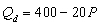
<strong>If the current price of a good is $10, market demand is   , and market supply is   , then</strong> A) more of the good is being produced than people want to buy. B) a lower price will increase the shortage. C) at the current price there is excess demand, or a shortage, of 150 units. D) Both b and c E) All of the above <div style=padding-top: 35px>
, and market supply is
<strong>If the current price of a good is $10, market demand is   , and market supply is   , then</strong> A) more of the good is being produced than people want to buy. B) a lower price will increase the shortage. C) at the current price there is excess demand, or a shortage, of 150 units. D) Both b and c E) All of the above <div style=padding-top: 35px>
, then

A) more of the good is being produced than people want to buy.
B) a lower price will increase the shortage.
C) at the current price there is excess demand, or a shortage, of 150 units.
D) Both b and c
E) All of the above
Question
The general demand function for good A is The general demand function for good A is   where   = quantity demanded of good A per month, P = the price of good A, M = average household income,   = price of related good B,   = a consumer taste index, P<sub>e</sub> = price consumers expect to pay next month for good A, and N = number of buyers in market for good. -Good A is a(n) ___________ good because the slope parameter on __________ is _________.<div style=padding-top: 35px> where The general demand function for good A is   where   = quantity demanded of good A per month, P = the price of good A, M = average household income,   = price of related good B,   = a consumer taste index, P<sub>e</sub> = price consumers expect to pay next month for good A, and N = number of buyers in market for good. -Good A is a(n) ___________ good because the slope parameter on __________ is _________.<div style=padding-top: 35px> = quantity demanded of good A per month, P = the price of good A, M = average household income, The general demand function for good A is   where   = quantity demanded of good A per month, P = the price of good A, M = average household income,   = price of related good B,   = a consumer taste index, P<sub>e</sub> = price consumers expect to pay next month for good A, and N = number of buyers in market for good. -Good A is a(n) ___________ good because the slope parameter on __________ is _________.<div style=padding-top: 35px> = price of related good B, The general demand function for good A is   where   = quantity demanded of good A per month, P = the price of good A, M = average household income,   = price of related good B,   = a consumer taste index, P<sub>e</sub> = price consumers expect to pay next month for good A, and N = number of buyers in market for good. -Good A is a(n) ___________ good because the slope parameter on __________ is _________.<div style=padding-top: 35px> = a consumer taste index, Pe = price consumers expect to pay next month for good A, and N = number of buyers in market for good.

-Good A is a(n) ___________ good because the slope parameter on __________ is _________.
Question
The general demand function for good A is The general demand function for good A is   where   = quantity demanded of good A per month, P = the price of good A, M = average household income,   = price of related good B,   = a consumer taste index, P<sub>e</sub> = price consumers expect to pay next month for good A, and N = number of buyers in market for good. -Goods A and B are ________________ because the slope parameter on ________ is _____________.<div style=padding-top: 35px> where The general demand function for good A is   where   = quantity demanded of good A per month, P = the price of good A, M = average household income,   = price of related good B,   = a consumer taste index, P<sub>e</sub> = price consumers expect to pay next month for good A, and N = number of buyers in market for good. -Goods A and B are ________________ because the slope parameter on ________ is _____________.<div style=padding-top: 35px> = quantity demanded of good A per month, P = the price of good A, M = average household income, The general demand function for good A is   where   = quantity demanded of good A per month, P = the price of good A, M = average household income,   = price of related good B,   = a consumer taste index, P<sub>e</sub> = price consumers expect to pay next month for good A, and N = number of buyers in market for good. -Goods A and B are ________________ because the slope parameter on ________ is _____________.<div style=padding-top: 35px> = price of related good B, The general demand function for good A is   where   = quantity demanded of good A per month, P = the price of good A, M = average household income,   = price of related good B,   = a consumer taste index, P<sub>e</sub> = price consumers expect to pay next month for good A, and N = number of buyers in market for good. -Goods A and B are ________________ because the slope parameter on ________ is _____________.<div style=padding-top: 35px> = a consumer taste index, Pe = price consumers expect to pay next month for good A, and N = number of buyers in market for good.
-Goods A and B are ________________ because the slope parameter on ________ is _____________.
Question
The general demand function for good A is The general demand function for good A is   where   = quantity demanded of good A per month, P = the price of good A, M = average household income,   = price of related good B,   = a consumer taste index, P<sub>e</sub> = price consumers expect to pay next month for good A, and N = number of buyers in market for good. -When   quantity demanded of good A is ____________ units per month.<div style=padding-top: 35px> where The general demand function for good A is   where   = quantity demanded of good A per month, P = the price of good A, M = average household income,   = price of related good B,   = a consumer taste index, P<sub>e</sub> = price consumers expect to pay next month for good A, and N = number of buyers in market for good. -When   quantity demanded of good A is ____________ units per month.<div style=padding-top: 35px> = quantity demanded of good A per month, P = the price of good A, M = average household income, The general demand function for good A is   where   = quantity demanded of good A per month, P = the price of good A, M = average household income,   = price of related good B,   = a consumer taste index, P<sub>e</sub> = price consumers expect to pay next month for good A, and N = number of buyers in market for good. -When   quantity demanded of good A is ____________ units per month.<div style=padding-top: 35px> = price of related good B, The general demand function for good A is   where   = quantity demanded of good A per month, P = the price of good A, M = average household income,   = price of related good B,   = a consumer taste index, P<sub>e</sub> = price consumers expect to pay next month for good A, and N = number of buyers in market for good. -When   quantity demanded of good A is ____________ units per month.<div style=padding-top: 35px> = a consumer taste index, Pe = price consumers expect to pay next month for good A, and N = number of buyers in market for good.
-When The general demand function for good A is   where   = quantity demanded of good A per month, P = the price of good A, M = average household income,   = price of related good B,   = a consumer taste index, P<sub>e</sub> = price consumers expect to pay next month for good A, and N = number of buyers in market for good. -When   quantity demanded of good A is ____________ units per month.<div style=padding-top: 35px> quantity demanded of good A is ____________ units per month.

Question
The general supply function is The general supply function is   , where   = quantity supplied per month, P = the price of the commodity,   = price of an input, and F = number of sellers. -The supply function when P<sub>I</sub> = $90 and F = 20 is ____________________. The supply function intersects the price axis at a price of $______.<div style=padding-top: 35px> , where The general supply function is   , where   = quantity supplied per month, P = the price of the commodity,   = price of an input, and F = number of sellers. -The supply function when P<sub>I</sub> = $90 and F = 20 is ____________________. The supply function intersects the price axis at a price of $______.<div style=padding-top: 35px> = quantity supplied per month, P = the price of the commodity, The general supply function is   , where   = quantity supplied per month, P = the price of the commodity,   = price of an input, and F = number of sellers. -The supply function when P<sub>I</sub> = $90 and F = 20 is ____________________. The supply function intersects the price axis at a price of $______.<div style=padding-top: 35px> = price of an input, and F = number of sellers.

-The supply function when PI = $90 and F = 20 is ____________________. The supply function intersects the price axis at a price of $______.
Question
The general supply function is The general supply function is   , where   = quantity supplied per month, P = the price of the commodity,   = price of an input, and F = number of sellers. -Using the supply function in part a, the quantity supplied when the price of the commodity is $300 is ________ units per month. When the price is $400, the quantity supplied is _______ units per month.<div style=padding-top: 35px> , where The general supply function is   , where   = quantity supplied per month, P = the price of the commodity,   = price of an input, and F = number of sellers. -Using the supply function in part a, the quantity supplied when the price of the commodity is $300 is ________ units per month. When the price is $400, the quantity supplied is _______ units per month.<div style=padding-top: 35px> = quantity supplied per month, P = the price of the commodity, The general supply function is   , where   = quantity supplied per month, P = the price of the commodity,   = price of an input, and F = number of sellers. -Using the supply function in part a, the quantity supplied when the price of the commodity is $300 is ________ units per month. When the price is $400, the quantity supplied is _______ units per month.<div style=padding-top: 35px> = price of an input, and F = number of sellers.
-Using the supply function in part a, the quantity supplied when the price of the commodity is $300 is ________ units per month. When the price is $400, the quantity supplied is _______ units per month.
Question
The general supply function is The general supply function is   , where   = quantity supplied per month, P = the price of the commodity,   = price of an input, and F = number of sellers. -The INVERSE supply equation (for part a) is ____________________. The supply price for 750 units per month is $_______.<div style=padding-top: 35px> , where The general supply function is   , where   = quantity supplied per month, P = the price of the commodity,   = price of an input, and F = number of sellers. -The INVERSE supply equation (for part a) is ____________________. The supply price for 750 units per month is $_______.<div style=padding-top: 35px> = quantity supplied per month, P = the price of the commodity, The general supply function is   , where   = quantity supplied per month, P = the price of the commodity,   = price of an input, and F = number of sellers. -The INVERSE supply equation (for part a) is ____________________. The supply price for 750 units per month is $_______.<div style=padding-top: 35px> = price of an input, and F = number of sellers.
-The INVERSE supply equation (for part a) is ____________________. The supply price for 750 units per month is $_______.
Question
Suppose that the demand and supply functions for good X are
Suppose that the demand and supply functions for good X are      -Equilibrium price is $__________ and equilibrium quantity is __________ units.<div style=padding-top: 35px> Suppose that the demand and supply functions for good X are      -Equilibrium price is $__________ and equilibrium quantity is __________ units.<div style=padding-top: 35px>
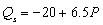
-Equilibrium price is $__________ and equilibrium quantity is __________ units.
Question
Suppose that the demand and supply functions for good X are
Suppose that the demand and supply functions for good X are      -If price is $8, then a ______________ of _______ units occurs. If price is $12, then a _____________ of _________ units occurs.<div style=padding-top: 35px> Suppose that the demand and supply functions for good X are      -If price is $8, then a ______________ of _______ units occurs. If price is $12, then a _____________ of _________ units occurs.<div style=padding-top: 35px>

-If price is $8, then a ______________ of _______ units occurs. If price is $12, then a _____________ of _________ units occurs.
Question
Suppose that the demand and supply functions for good X are
Suppose that the demand and supply functions for good X are      -Let the demand function change to Q<sub>d</sub> = 80-6P . Given the ORIGINAL supply function, the equilibrium price is $__________ and equilibrium quantity is __________ units.<div style=padding-top: 35px> Suppose that the demand and supply functions for good X are      -Let the demand function change to Q<sub>d</sub> = 80-6P . Given the ORIGINAL supply function, the equilibrium price is $__________ and equilibrium quantity is __________ units.<div style=padding-top: 35px>

-Let the demand function change to Qd = 80-6P . Given the ORIGINAL supply function, the equilibrium price is $__________ and equilibrium quantity is __________ units.
Question
Suppose that the demand and supply functions for good X are
Suppose that the demand and supply functions for good X are      -Let the supply function change to Q<sub>s</sub> = -40+12P . Given the ORIGINAL demand function, the equilibrium price is $__________ and equilibrium quantity is __________ units<div style=padding-top: 35px> Suppose that the demand and supply functions for good X are      -Let the supply function change to Q<sub>s</sub> = -40+12P . Given the ORIGINAL demand function, the equilibrium price is $__________ and equilibrium quantity is __________ units<div style=padding-top: 35px>

-Let the supply function change to Qs = -40+12P . Given the ORIGINAL demand function, the equilibrium price is $__________ and equilibrium quantity is __________ units
Question
The general demand and supply functions for good A are estimated to be, respectively: The general demand and supply functions for good A are estimated to be, respectively:   where   is quantity demanded per month,   is quantity supplied per month, P is price of good A, M is average household income, and   is the price of a related good R Assume the following values of the shift variables: M = $42,500, and   = $30. -The equation for INVERSE demand is _________________________.<div style=padding-top: 35px> where The general demand and supply functions for good A are estimated to be, respectively:   where   is quantity demanded per month,   is quantity supplied per month, P is price of good A, M is average household income, and   is the price of a related good R Assume the following values of the shift variables: M = $42,500, and   = $30. -The equation for INVERSE demand is _________________________.<div style=padding-top: 35px> is quantity demanded per month, The general demand and supply functions for good A are estimated to be, respectively:   where   is quantity demanded per month,   is quantity supplied per month, P is price of good A, M is average household income, and   is the price of a related good R Assume the following values of the shift variables: M = $42,500, and   = $30. -The equation for INVERSE demand is _________________________.<div style=padding-top: 35px> is quantity supplied per month, P is price of good A, M is average household income, and The general demand and supply functions for good A are estimated to be, respectively:   where   is quantity demanded per month,   is quantity supplied per month, P is price of good A, M is average household income, and   is the price of a related good R Assume the following values of the shift variables: M = $42,500, and   = $30. -The equation for INVERSE demand is _________________________.<div style=padding-top: 35px> is the price of a related good R Assume the following values of the shift variables: M = $42,500, and The general demand and supply functions for good A are estimated to be, respectively:   where   is quantity demanded per month,   is quantity supplied per month, P is price of good A, M is average household income, and   is the price of a related good R Assume the following values of the shift variables: M = $42,500, and   = $30. -The equation for INVERSE demand is _________________________.<div style=padding-top: 35px> = $30.
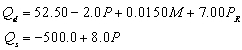
-The equation for INVERSE demand is _________________________.
Question
The general demand and supply functions for good A are estimated to be, respectively: The general demand and supply functions for good A are estimated to be, respectively:   where   is quantity demanded per month,   is quantity supplied per month, P is price of good A, M is average household income, and   is the price of a related good R Assume the following values of the shift variables: M = $42,500, and   = $30. -The maximum price at which 500 units of good A can be sold is ____________.<div style=padding-top: 35px> where The general demand and supply functions for good A are estimated to be, respectively:   where   is quantity demanded per month,   is quantity supplied per month, P is price of good A, M is average household income, and   is the price of a related good R Assume the following values of the shift variables: M = $42,500, and   = $30. -The maximum price at which 500 units of good A can be sold is ____________.<div style=padding-top: 35px> is quantity demanded per month, The general demand and supply functions for good A are estimated to be, respectively:   where   is quantity demanded per month,   is quantity supplied per month, P is price of good A, M is average household income, and   is the price of a related good R Assume the following values of the shift variables: M = $42,500, and   = $30. -The maximum price at which 500 units of good A can be sold is ____________.<div style=padding-top: 35px> is quantity supplied per month, P is price of good A, M is average household income, and The general demand and supply functions for good A are estimated to be, respectively:   where   is quantity demanded per month,   is quantity supplied per month, P is price of good A, M is average household income, and   is the price of a related good R Assume the following values of the shift variables: M = $42,500, and   = $30. -The maximum price at which 500 units of good A can be sold is ____________.<div style=padding-top: 35px> is the price of a related good R Assume the following values of the shift variables: M = $42,500, and The general demand and supply functions for good A are estimated to be, respectively:   where   is quantity demanded per month,   is quantity supplied per month, P is price of good A, M is average household income, and   is the price of a related good R Assume the following values of the shift variables: M = $42,500, and   = $30. -The maximum price at which 500 units of good A can be sold is ____________.<div style=padding-top: 35px> = $30.
-The maximum price at which 500 units of good A can be sold is ____________.
Question
The general demand and supply functions for good A are estimated to be, respectively: The general demand and supply functions for good A are estimated to be, respectively:   where   is quantity demanded per month,   is quantity supplied per month, P is price of good A, M is average household income, and   is the price of a related good R Assume the following values of the shift variables: M = $42,500, and   = $30. -The minimum price producers will accept to supply 500 units of good A is ________.<div style=padding-top: 35px> where The general demand and supply functions for good A are estimated to be, respectively:   where   is quantity demanded per month,   is quantity supplied per month, P is price of good A, M is average household income, and   is the price of a related good R Assume the following values of the shift variables: M = $42,500, and   = $30. -The minimum price producers will accept to supply 500 units of good A is ________.<div style=padding-top: 35px> is quantity demanded per month, The general demand and supply functions for good A are estimated to be, respectively:   where   is quantity demanded per month,   is quantity supplied per month, P is price of good A, M is average household income, and   is the price of a related good R Assume the following values of the shift variables: M = $42,500, and   = $30. -The minimum price producers will accept to supply 500 units of good A is ________.<div style=padding-top: 35px> is quantity supplied per month, P is price of good A, M is average household income, and The general demand and supply functions for good A are estimated to be, respectively:   where   is quantity demanded per month,   is quantity supplied per month, P is price of good A, M is average household income, and   is the price of a related good R Assume the following values of the shift variables: M = $42,500, and   = $30. -The minimum price producers will accept to supply 500 units of good A is ________.<div style=padding-top: 35px> is the price of a related good R Assume the following values of the shift variables: M = $42,500, and The general demand and supply functions for good A are estimated to be, respectively:   where   is quantity demanded per month,   is quantity supplied per month, P is price of good A, M is average household income, and   is the price of a related good R Assume the following values of the shift variables: M = $42,500, and   = $30. -The minimum price producers will accept to supply 500 units of good A is ________.<div style=padding-top: 35px> = $30.
-The minimum price producers will accept to supply 500 units of good A is ________.
Question
The general demand and supply functions for good A are estimated to be, respectively: The general demand and supply functions for good A are estimated to be, respectively:   where   is quantity demanded per month,   is quantity supplied per month, P is price of good A, M is average household income, and   is the price of a related good R Assume the following values of the shift variables: M = $42,500, and   = $30. -If price is $150, ______________ (a shortage, a surplus, equilibrium) occurs of ___________ units of good A.<div style=padding-top: 35px> where The general demand and supply functions for good A are estimated to be, respectively:   where   is quantity demanded per month,   is quantity supplied per month, P is price of good A, M is average household income, and   is the price of a related good R Assume the following values of the shift variables: M = $42,500, and   = $30. -If price is $150, ______________ (a shortage, a surplus, equilibrium) occurs of ___________ units of good A.<div style=padding-top: 35px> is quantity demanded per month, The general demand and supply functions for good A are estimated to be, respectively:   where   is quantity demanded per month,   is quantity supplied per month, P is price of good A, M is average household income, and   is the price of a related good R Assume the following values of the shift variables: M = $42,500, and   = $30. -If price is $150, ______________ (a shortage, a surplus, equilibrium) occurs of ___________ units of good A.<div style=padding-top: 35px> is quantity supplied per month, P is price of good A, M is average household income, and The general demand and supply functions for good A are estimated to be, respectively:   where   is quantity demanded per month,   is quantity supplied per month, P is price of good A, M is average household income, and   is the price of a related good R Assume the following values of the shift variables: M = $42,500, and   = $30. -If price is $150, ______________ (a shortage, a surplus, equilibrium) occurs of ___________ units of good A.<div style=padding-top: 35px> is the price of a related good R Assume the following values of the shift variables: M = $42,500, and The general demand and supply functions for good A are estimated to be, respectively:   where   is quantity demanded per month,   is quantity supplied per month, P is price of good A, M is average household income, and   is the price of a related good R Assume the following values of the shift variables: M = $42,500, and   = $30. -If price is $150, ______________ (a shortage, a surplus, equilibrium) occurs of ___________ units of good A.<div style=padding-top: 35px> = $30.
-If price is $150, ______________ (a shortage, a surplus, equilibrium) occurs of ___________ units of good A.
Question
The general demand and supply functions for good A are estimated to be, respectively: The general demand and supply functions for good A are estimated to be, respectively:   where   is quantity demanded per month,   is quantity supplied per month, P is price of good A, M is average household income, and   is the price of a related good R Assume the following values of the shift variables: M = $42,500, and   = $30. -The market clearing price of good A is $__________.<div style=padding-top: 35px> where The general demand and supply functions for good A are estimated to be, respectively:   where   is quantity demanded per month,   is quantity supplied per month, P is price of good A, M is average household income, and   is the price of a related good R Assume the following values of the shift variables: M = $42,500, and   = $30. -The market clearing price of good A is $__________.<div style=padding-top: 35px> is quantity demanded per month, The general demand and supply functions for good A are estimated to be, respectively:   where   is quantity demanded per month,   is quantity supplied per month, P is price of good A, M is average household income, and   is the price of a related good R Assume the following values of the shift variables: M = $42,500, and   = $30. -The market clearing price of good A is $__________.<div style=padding-top: 35px> is quantity supplied per month, P is price of good A, M is average household income, and The general demand and supply functions for good A are estimated to be, respectively:   where   is quantity demanded per month,   is quantity supplied per month, P is price of good A, M is average household income, and   is the price of a related good R Assume the following values of the shift variables: M = $42,500, and   = $30. -The market clearing price of good A is $__________.<div style=padding-top: 35px> is the price of a related good R Assume the following values of the shift variables: M = $42,500, and The general demand and supply functions for good A are estimated to be, respectively:   where   is quantity demanded per month,   is quantity supplied per month, P is price of good A, M is average household income, and   is the price of a related good R Assume the following values of the shift variables: M = $42,500, and   = $30. -The market clearing price of good A is $__________.<div style=padding-top: 35px> = $30.
-The market clearing price of good A is $__________.
Question
Consider the market for unleaded gasoline in the U.S.
-Event A: The Memorial Day holiday arrives in May and many motorists take to the road. As a result of Event A, ___________________ (demand, supply, both demand and supply) for gasoline will ____________ (increase, decrease). By itself, Event A will cause the price of unleaded gasoline in the U.S. to ___________(increase, decrease, stay the same) and quantity of gasoline bought and sold will ____________ (increase, decrease, stay the same).
Question
Consider the market for unleaded gasoline in the U.S.
-Event B: Refineries of gasoline in the U.S. increase their capacity to refine gasoline from crude oil by 20 percent. As a result of Event B, ___________________ (demand, supply, both demand and supply) for gasoline will ______________ (increase, decrease). By itself, Event B will cause the price of unleaded gasoline in the U.S. to _____________(increase, decrease, stay the same) and quantity of gasoline bought and sold will ______________ (increase, decrease, stay the same).
Question
Consider the market for unleaded gasoline in the U.S.
-If Events A and B occur together (i.e. simultaneously), the price of unleaded gasoline in the U.S. ___________________(is going to increase, is going to decrease, may rise or fall or stay the same) and quantity of gasoline bought and sold ______________________(is going to increase, is going to decrease, may rise or fall or stay the same).
Question
Consider the market for unleaded gasoline in the U.S.
-Explain carefully and concisely the conditions under which a shortage of gasoline can occur in the U.S
Question
The following events occur simultaneously:
The price of beef rises (beef and leather both come from cows).
The price of alligator hides increases.
Draw a demand-and-supply graph showing equilibrium in the market for leather before the two events described above. Label the axes and curves. Label the initial equilibrium - before events (i) and (ii)- as
 The following events occur simultaneously: The price of beef rises (beef and leather both come from cows). The price of alligator hides increases. Draw a demand-and-supply graph showing equilibrium in the market for leather before the two events described above. Label the axes and curves. Label the initial equilibrium - before events (i) and (ii)- as   and   on your graph. Now show on your graph how event (i) affects the demand or supply curves for leather. Briefly explain which of the demand or supply variables caused the effect you are showing on your graph. Now show on your graph how event (ii) affects the demand or supply curves for leather. Briefly explain which of the demand or supply variables caused the effect you are showing on your graph. Based on your graphic analysis, what do you predict will happen to the equilibrium price of leather? The equilibrium quantity of leather?<div style=padding-top: 35px>
and
 The following events occur simultaneously: The price of beef rises (beef and leather both come from cows). The price of alligator hides increases. Draw a demand-and-supply graph showing equilibrium in the market for leather before the two events described above. Label the axes and curves. Label the initial equilibrium - before events (i) and (ii)- as   and   on your graph. Now show on your graph how event (i) affects the demand or supply curves for leather. Briefly explain which of the demand or supply variables caused the effect you are showing on your graph. Now show on your graph how event (ii) affects the demand or supply curves for leather. Briefly explain which of the demand or supply variables caused the effect you are showing on your graph. Based on your graphic analysis, what do you predict will happen to the equilibrium price of leather? The equilibrium quantity of leather?<div style=padding-top: 35px>
on your graph.
Now show on your graph how event (i) affects the demand or supply curves for leather. Briefly explain which of the demand or supply variables caused the effect you are showing on your graph.
Now show on your graph how event (ii) affects the demand or supply curves for leather. Briefly explain which of the demand or supply variables caused the effect you are showing on your graph.
Based on your graphic analysis, what do you predict will happen to the equilibrium price of leather? The equilibrium quantity of leather?
Question
You are a financial analyst with a specialization in the motion picture industry. You have been hired to analyze the prices of movie theater tickets. The following two events are occurring (simultaneously) in the United States:
A new national chain opens new multi-screen movie theaters in most U.S. cities.
Movie theaters cut the price of popcorn and soft drinks in half.
Draw a demand-and-supply graph showing equilibrium in the market for movie tickets before the above two events take place. Label the axes and curves. Label the initial equilibrium - before events (i) and (ii)- as
  You are a financial analyst with a specialization in the motion picture industry. You have been hired to analyze the prices of movie theater tickets. The following two events are occurring (simultaneously) in the United States: A new national chain opens new multi-screen movie theaters in most U.S. cities. Movie theaters cut the price of popcorn and soft drinks in half. Draw a demand-and-supply graph showing equilibrium in the market for movie tickets before the above two events take place. Label the axes and curves. Label the initial equilibrium - before events (i) and (ii)- as   and   on your graph. Now show on your graph how event (i) affects the demand or supply curves for movie tickets. Briefly explain which of the demand or supply variables caused the effect you are showing on your graph. Now show on your graph how event (ii) affects the demand or supply curves for movie tickets. Briefly explain which of the demand or supply variables caused the effect you are showing on your graph. Based on your graphic analysis, what do you predict will happen to the equilibrium price of movie tickets? The equilibrium quantity of movie tickets?<div style=padding-top: 35px>
and
  You are a financial analyst with a specialization in the motion picture industry. You have been hired to analyze the prices of movie theater tickets. The following two events are occurring (simultaneously) in the United States: A new national chain opens new multi-screen movie theaters in most U.S. cities. Movie theaters cut the price of popcorn and soft drinks in half. Draw a demand-and-supply graph showing equilibrium in the market for movie tickets before the above two events take place. Label the axes and curves. Label the initial equilibrium - before events (i) and (ii)- as   and   on your graph. Now show on your graph how event (i) affects the demand or supply curves for movie tickets. Briefly explain which of the demand or supply variables caused the effect you are showing on your graph. Now show on your graph how event (ii) affects the demand or supply curves for movie tickets. Briefly explain which of the demand or supply variables caused the effect you are showing on your graph. Based on your graphic analysis, what do you predict will happen to the equilibrium price of movie tickets? The equilibrium quantity of movie tickets?<div style=padding-top: 35px>
on your graph.
Now show on your graph how event (i) affects the demand or supply curves for movie tickets. Briefly explain which of the demand or supply variables caused the effect you are showing on your graph.
Now show on your graph how event (ii) affects the demand or supply curves for movie tickets. Briefly explain which of the demand or supply variables caused the effect you are showing on your graph.
Based on your graphic analysis, what do you predict will happen to the equilibrium price of movie tickets? The equilibrium quantity of movie tickets?
Question
Use the linear demand and supply curves shown below to answer the following questions:
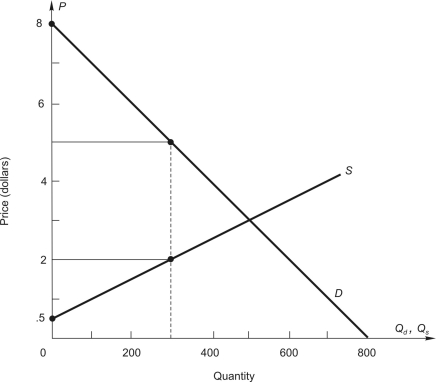
Use the linear demand and supply curves shown below to answer the following questions:   -The market or equilibrium price is $ ________.<div style=padding-top: 35px>
-The market or equilibrium price is $ ________.
Question
Use the linear demand and supply curves shown below to answer the following questions:
Use the linear demand and supply curves shown below to answer the following questions:   -The economic value of the 300th unit is $ ________ , and the minimum price producers will accept to produce this is unit is $ ________.<div style=padding-top: 35px>
-The economic value of the 300th unit is $ ________ , and the minimum price producers will accept to produce this is unit is $ ________.
Question
Use the linear demand and supply curves shown below to answer the following questions:
Use the linear demand and supply curves shown below to answer the following questions:   -For the 300th unit, consumer surplus is $ __________, and producer surplus is $ __________.<div style=padding-top: 35px>
-For the 300th unit, consumer surplus is $ __________, and producer surplus is $ __________.
Question
Use the linear demand and supply curves shown below to answer the following questions:
Use the linear demand and supply curves shown below to answer the following questions:   -At the market price in part a, the net gain to consumers when 300 units are purchased is $ __________.<div style=padding-top: 35px>
-At the market price in part a, the net gain to consumers when 300 units are purchased is $ __________.
Question
Use the linear demand and supply curves shown below to answer the following questions:
Use the linear demand and supply curves shown below to answer the following questions:   -At the market price in part a, the net gain to producers when they supply 300 units is $ __________.<div style=padding-top: 35px>
-At the market price in part a, the net gain to producers when they supply 300 units is $ __________.
Question
Use the linear demand and supply curves shown below to answer the following questions:
Use the linear demand and supply curves shown below to answer the following questions:   -The net gain to society when 300 units are produced and consumed at the market price is $ __________, which is called ____________.<div style=padding-top: 35px>
-The net gain to society when 300 units are produced and consumed at the market price is $ __________, which is called ____________.
Question
Use the linear demand and supply curves shown below to answer the following questions:
Use the linear demand and supply curves shown below to answer the following questions:   -n market equilibrium, total consumer surplus is $ __________, and the total producer surplus is $ __________.<div style=padding-top: 35px>
-n market equilibrium, total consumer surplus is $ __________, and the total producer surplus is $ __________.
Question
Use the linear demand and supply curves shown below to answer the following questions:
Use the linear demand and supply curves shown below to answer the following questions:   -The net gain to society created by this market is $ _________.<div style=padding-top: 35px>
-The net gain to society created by this market is $ _________.
Unlock Deck
Sign up to unlock the cards in this deck!
Unlock Deck
Unlock Deck
1/52
auto play flashcards
Play
simple tutorial
Full screen (f)
exit full mode
Deck 2: Demand, Supply, and Market Equilibrium
1
Use the following general linear demand relation to answer questions 9 through 13:
<strong>Use the following general linear demand relation to answer questions 9 through 13:   where M is income and   is the price of a related good, R.  -From this relation it is apparent that the good is:</strong> A) an inferior good B) a substitute for good R C) a normal good D) a complement for good R E) both c and d
where M is income and <strong>Use the following general linear demand relation to answer questions 9 through 13:   where M is income and   is the price of a related good, R.  -From this relation it is apparent that the good is:</strong> A) an inferior good B) a substitute for good R C) a normal good D) a complement for good R E) both c and d is the price of a related good, R.

-From this relation it is apparent that the good is:

A) an inferior good
B) a substitute for good R
C) a normal good
D) a complement for good R
E) both c and d
both c and d
2
Use the following general linear demand relation to answer questions 9 through 13:
<strong>Use the following general linear demand relation to answer questions 9 through 13:   where M is income and   is the price of a related good, R.  -If M = $15,000 and   = $20, the demand function is</strong> A)   ) B)   . C)   D)   E)
where M is income and <strong>Use the following general linear demand relation to answer questions 9 through 13:   where M is income and   is the price of a related good, R.  -If M = $15,000 and   = $20, the demand function is</strong> A)   ) B)   . C)   D)   E)   is the price of a related good, R.

-If M = $15,000 and
<strong>Use the following general linear demand relation to answer questions 9 through 13:   where M is income and   is the price of a related good, R.  -If M = $15,000 and   = $20, the demand function is</strong> A)   ) B)   . C)   D)   E)
= $20, the demand function is

A)
<strong>Use the following general linear demand relation to answer questions 9 through 13:   where M is income and   is the price of a related good, R.  -If M = $15,000 and   = $20, the demand function is</strong> A)   ) B)   . C)   D)   E)
)
B) <strong>Use the following general linear demand relation to answer questions 9 through 13:   where M is income and   is the price of a related good, R.  -If M = $15,000 and   = $20, the demand function is</strong> A)   ) B)   . C)   D)   E)   .
C) <strong>Use the following general linear demand relation to answer questions 9 through 13:   where M is income and   is the price of a related good, R.  -If M = $15,000 and   = $20, the demand function is</strong> A)   ) B)   . C)   D)   E)
D) <strong>Use the following general linear demand relation to answer questions 9 through 13:   where M is income and   is the price of a related good, R.  -If M = $15,000 and   = $20, the demand function is</strong> A)   ) B)   . C)   D)   E)
E) <strong>Use the following general linear demand relation to answer questions 9 through 13:   where M is income and   is the price of a related good, R.  -If M = $15,000 and   = $20, the demand function is</strong> A)   ) B)   . C)   D)   E)
  . .
3
Use the following general linear demand relation to answer questions 9 through 13:
<strong>Use the following general linear demand relation to answer questions 9 through 13:   where M is income and   is the price of a related good, R.  -If M = $15,000 and   = $20 and the supply function is   , equilibrium price and quantity are, respectively,</strong> A) P = $55 and Q = 195. B) P = $6 and Q = 38. C) P = $12 and Q = 200. D) P = $50 and Q = 170. E) P = $40 and Q = 250.
where M is income and <strong>Use the following general linear demand relation to answer questions 9 through 13:   where M is income and   is the price of a related good, R.  -If M = $15,000 and   = $20 and the supply function is   , equilibrium price and quantity are, respectively,</strong> A) P = $55 and Q = 195. B) P = $6 and Q = 38. C) P = $12 and Q = 200. D) P = $50 and Q = 170. E) P = $40 and Q = 250. is the price of a related good, R.

-If M = $15,000 and <strong>Use the following general linear demand relation to answer questions 9 through 13:   where M is income and   is the price of a related good, R.  -If M = $15,000 and   = $20 and the supply function is   , equilibrium price and quantity are, respectively,</strong> A) P = $55 and Q = 195. B) P = $6 and Q = 38. C) P = $12 and Q = 200. D) P = $50 and Q = 170. E) P = $40 and Q = 250. = $20 and the supply function is <strong>Use the following general linear demand relation to answer questions 9 through 13:   where M is income and   is the price of a related good, R.  -If M = $15,000 and   = $20 and the supply function is   , equilibrium price and quantity are, respectively,</strong> A) P = $55 and Q = 195. B) P = $6 and Q = 38. C) P = $12 and Q = 200. D) P = $50 and Q = 170. E) P = $40 and Q = 250. , equilibrium price and quantity are, respectively,

A) P = $55 and Q = 195.
B) P = $6 and Q = 38.
C) P = $12 and Q = 200.
D) P = $50 and Q = 170.
E) P = $40 and Q = 250.
P = $55 and Q = 195.
4
Use the following general linear demand relation to answer questions 9 through 13:
<strong>Use the following general linear demand relation to answer questions 9 through 13:   where M is income and   is the price of a related good, R.  -If M = $15,000 and P<sub>R</sub> = $20 and the supply function is Q= 30+3P, then, when the price of the good is $60,</strong> A) there is a shortage of 60 units of the good. B) there is equilibrium in the market. C) there is a surplus of 60 units of the good. D) the quantities demanded and supplied are indeterminate
where M is income and <strong>Use the following general linear demand relation to answer questions 9 through 13:   where M is income and   is the price of a related good, R.  -If M = $15,000 and P<sub>R</sub> = $20 and the supply function is Q= 30+3P, then, when the price of the good is $60,</strong> A) there is a shortage of 60 units of the good. B) there is equilibrium in the market. C) there is a surplus of 60 units of the good. D) the quantities demanded and supplied are indeterminate is the price of a related good, R.

-If M = $15,000 and PR = $20 and the supply function is Q= 30+3P, then, when the price of the good is $60,

A) there is a shortage of 60 units of the good.
B) there is equilibrium in the market.
C) there is a surplus of 60 units of the good.
D) the quantities demanded and supplied are indeterminate
Unlock Deck
Unlock for access to all 52 flashcards in this deck.
Unlock Deck
k this deck
5
Use the following general linear demand relation to answer questions 9 through 13:
<strong>Use the following general linear demand relation to answer questions 9 through 13:   where M is income and   is the price of a related good, R.  -If M = $15,000 and   = $20 and the supply function is   , then, when the price of the good is $40,</strong> A) there is equilibrium in the market. B) there is a shortage of 180 units of the good. C) there is a surplus of 180 units of the good. D) there is a shortage of 80 units of the good.
where M is income and <strong>Use the following general linear demand relation to answer questions 9 through 13:   where M is income and   is the price of a related good, R.  -If M = $15,000 and   = $20 and the supply function is   , then, when the price of the good is $40,</strong> A) there is equilibrium in the market. B) there is a shortage of 180 units of the good. C) there is a surplus of 180 units of the good. D) there is a shortage of 80 units of the good. is the price of a related good, R.

-If M = $15,000 and
<strong>Use the following general linear demand relation to answer questions 9 through 13:   where M is income and   is the price of a related good, R.  -If M = $15,000 and   = $20 and the supply function is   , then, when the price of the good is $40,</strong> A) there is equilibrium in the market. B) there is a shortage of 180 units of the good. C) there is a surplus of 180 units of the good. D) there is a shortage of 80 units of the good.
= $20 and the supply function is
<strong>Use the following general linear demand relation to answer questions 9 through 13:   where M is income and   is the price of a related good, R.  -If M = $15,000 and   = $20 and the supply function is   , then, when the price of the good is $40,</strong> A) there is equilibrium in the market. B) there is a shortage of 180 units of the good. C) there is a surplus of 180 units of the good. D) there is a shortage of 80 units of the good.
, then, when the price of the good is $40,

A) there is equilibrium in the market.
B) there is a shortage of 180 units of the good.
C) there is a surplus of 180 units of the good.
D) there is a shortage of 80 units of the good.
Unlock Deck
Unlock for access to all 52 flashcards in this deck.
Unlock Deck
k this deck
6
Use the following demand and supply functions
Demand: <strong>Use the following demand and supply functions Demand:   Supply:    -Equilibrium price and output are</strong> A) P = $5 and Q = 70. B) P = $11 and Q = 3.32. C) P = $12 and Q = 44. D) P = $15 and Q = 50. E) none of the above Supply: <strong>Use the following demand and supply functions Demand:   Supply:    -Equilibrium price and output are</strong> A) P = $5 and Q = 70. B) P = $11 and Q = 3.32. C) P = $12 and Q = 44. D) P = $15 and Q = 50. E) none of the above

-Equilibrium price and output are

A) P = $5 and Q = 70.
B) P = $11 and Q = 3.32.
C) P = $12 and Q = 44.
D) P = $15 and Q = 50.
E) none of the above
Unlock Deck
Unlock for access to all 52 flashcards in this deck.
Unlock Deck
k this deck
7
Use the following demand and supply functions
Demand: <strong>Use the following demand and supply functions Demand:   Supply:    -If the price is $10, there is a</strong> A) surplus of 30 units. B) shortage of 30 units. C) surplus of 40 units. D) shortage of 10 units. E) none of the above Supply: <strong>Use the following demand and supply functions Demand:   Supply:    -If the price is $10, there is a</strong> A) surplus of 30 units. B) shortage of 30 units. C) surplus of 40 units. D) shortage of 10 units. E) none of the above

-If the price is $10, there is a

A) surplus of 30 units.
B) shortage of 30 units.
C) surplus of 40 units.
D) shortage of 10 units.
E) none of the above
Unlock Deck
Unlock for access to all 52 flashcards in this deck.
Unlock Deck
k this deck
8
Use the following demand and supply functions
Demand: <strong>Use the following demand and supply functions Demand:   Supply:    -If the price is $2, there is a</strong> A) surplus of 10 units. B) shortage of 10 units. C) surplus of 30 units. D) shortage of 18 units. E) none of the above Supply: <strong>Use the following demand and supply functions Demand:   Supply:    -If the price is $2, there is a</strong> A) surplus of 10 units. B) shortage of 10 units. C) surplus of 30 units. D) shortage of 18 units. E) none of the above

-If the price is $2, there is a

A) surplus of 10 units.
B) shortage of 10 units.
C) surplus of 30 units.
D) shortage of 18 units.
E) none of the above
Unlock Deck
Unlock for access to all 52 flashcards in this deck.
Unlock Deck
k this deck
9
Use the following general linear demand relation to answer questions 36 through 41:
<strong>Use the following general linear demand relation to answer questions 36 through 41:   where P is the price of good X, M is income, and   is the price of a related good, R.  -What is the demand function when M = $50,000 and  = $10?</strong> A)   B)   C)   D)   E) none of the above
where P is the price of good X, M is income, and <strong>Use the following general linear demand relation to answer questions 36 through 41:   where P is the price of good X, M is income, and   is the price of a related good, R.  -What is the demand function when M = $50,000 and  = $10?</strong> A)   B)   C)   D)   E) none of the above is the price of a related good, R.

-What is the demand function when M = $50,000 and
<strong>Use the following general linear demand relation to answer questions 36 through 41:   where P is the price of good X, M is income, and   is the price of a related good, R.  -What is the demand function when M = $50,000 and  = $10?</strong> A)   B)   C)   D)   E) none of the above = $10?

A) <strong>Use the following general linear demand relation to answer questions 36 through 41:   where P is the price of good X, M is income, and   is the price of a related good, R.  -What is the demand function when M = $50,000 and  = $10?</strong> A)   B)   C)   D)   E) none of the above
B) <strong>Use the following general linear demand relation to answer questions 36 through 41:   where P is the price of good X, M is income, and   is the price of a related good, R.  -What is the demand function when M = $50,000 and  = $10?</strong> A)   B)   C)   D)   E) none of the above
C) <strong>Use the following general linear demand relation to answer questions 36 through 41:   where P is the price of good X, M is income, and   is the price of a related good, R.  -What is the demand function when M = $50,000 and  = $10?</strong> A)   B)   C)   D)   E) none of the above
D) <strong>Use the following general linear demand relation to answer questions 36 through 41:   where P is the price of good X, M is income, and   is the price of a related good, R.  -What is the demand function when M = $50,000 and  = $10?</strong> A)   B)   C)   D)   E) none of the above
E) none of the above
Unlock Deck
Unlock for access to all 52 flashcards in this deck.
Unlock Deck
k this deck
10
Use the following general linear demand relation to answer questions 36 through 41:
<strong>Use the following general linear demand relation to answer questions 36 through 41:   where P is the price of good X, M is income, and   is the price of a related good, R.  -If M = $50,000 and   = $10 and the supply function is   , market price and output are, respectively,</strong> A) P = $12 and Q = 150. B) P = $10 and Q = 200. C) P = $12 and Q = 200. D) P = $15 and Q = 175. E) P = $15 and Q = 225.
where P is the price of good X, M is income, and <strong>Use the following general linear demand relation to answer questions 36 through 41:   where P is the price of good X, M is income, and   is the price of a related good, R.  -If M = $50,000 and   = $10 and the supply function is   , market price and output are, respectively,</strong> A) P = $12 and Q = 150. B) P = $10 and Q = 200. C) P = $12 and Q = 200. D) P = $15 and Q = 175. E) P = $15 and Q = 225. is the price of a related good, R.

-If M = $50,000 and
<strong>Use the following general linear demand relation to answer questions 36 through 41:   where P is the price of good X, M is income, and   is the price of a related good, R.  -If M = $50,000 and   = $10 and the supply function is   , market price and output are, respectively,</strong> A) P = $12 and Q = 150. B) P = $10 and Q = 200. C) P = $12 and Q = 200. D) P = $15 and Q = 175. E) P = $15 and Q = 225.
= $10 and the supply function is
<strong>Use the following general linear demand relation to answer questions 36 through 41:   where P is the price of good X, M is income, and   is the price of a related good, R.  -If M = $50,000 and   = $10 and the supply function is   , market price and output are, respectively,</strong> A) P = $12 and Q = 150. B) P = $10 and Q = 200. C) P = $12 and Q = 200. D) P = $15 and Q = 175. E) P = $15 and Q = 225.
, market price and output are, respectively,

A) P = $12 and Q = 150.
B) P = $10 and Q = 200.
C) P = $12 and Q = 200.
D) P = $15 and Q = 175.
E) P = $15 and Q = 225.
Unlock Deck
Unlock for access to all 52 flashcards in this deck.
Unlock Deck
k this deck
11
Use the following general linear demand relation to answer questions 36 through 41:
<strong>Use the following general linear demand relation to answer questions 36 through 41:   where P is the price of good X, M is income, and   is the price of a related good, R.  -If income increases to $100,000 and the price of the related good is now $20, what is the demand function?</strong> A) Q<sub>d</sub>= 300-5P B) Q<sub>d</sub>= 400-10P C) Q<sub>d</sub>= 100-10P D) Q<sub>d</sub>= 400-5P
where P is the price of good X, M is income, and <strong>Use the following general linear demand relation to answer questions 36 through 41:   where P is the price of good X, M is income, and   is the price of a related good, R.  -If income increases to $100,000 and the price of the related good is now $20, what is the demand function?</strong> A) Q<sub>d</sub>= 300-5P B) Q<sub>d</sub>= 400-10P C) Q<sub>d</sub>= 100-10P D) Q<sub>d</sub>= 400-5P is the price of a related good, R.

-If income increases to $100,000 and the price of the related good is now $20, what is the demand function?

A) Qd= 300-5P
B) Qd= 400-10P
C) Qd= 100-10P
D) Qd= 400-5P
Unlock Deck
Unlock for access to all 52 flashcards in this deck.
Unlock Deck
k this deck
12
If a demand curve goes through the point P = $6 and <strong>If a demand curve goes through the point P = $6 and   = 400, then</strong> A) $6 is the highest price consumers will pay for 400 units. B) $6 is the lowest price consumers can be charged to induce them to buy 400 units. C) 400 units are the most consumers will buy if price is $6. D) consumers will buy more than 400 if price is $6. E) both a and c = 400, then

A) $6 is the highest price consumers will pay for 400 units.
B) $6 is the lowest price consumers can be charged to induce them to buy 400 units.
C) 400 units are the most consumers will buy if price is $6.
D) consumers will buy more than 400 if price is $6.
E) both a and c
Unlock Deck
Unlock for access to all 52 flashcards in this deck.
Unlock Deck
k this deck
13
If a supply curve goes through the point P = $10 and
<strong>If a supply curve goes through the point P = $10 and   = 320, then</strong> A) $10 is the highest price that will induce firms to supply 320 units. B) $10 is the lowest price that will induce firms to supply 320 units. C) at a price higher than $10 there will be a surplus. D) at a price lower than $10 there will be a shortage. E) both c and d
= 320, then

A) $10 is the highest price that will induce firms to supply 320 units.
B) $10 is the lowest price that will induce firms to supply 320 units.
C) at a price higher than $10 there will be a surplus.
D) at a price lower than $10 there will be a shortage.
E) both c and d
Unlock Deck
Unlock for access to all 52 flashcards in this deck.
Unlock Deck
k this deck
14
Use the following general linear supply function to answer the next 6 questions:
<strong>Use the following general linear supply function to answer the next 6 questions:   where  is the quantity supplied of the good, P<sub>I</sub> is the price of the good, is the price of an input, and F is the number of firms producing the good.  -If   = $20 and F = 60 what is the equation of the supply function?</strong> A)   = 400 + 6 P B)   = 40 + 8 P C)   = 480 + 6   D)   = 480 + 6 P E) none of the above
where<strong>Use the following general linear supply function to answer the next 6 questions:   where  is the quantity supplied of the good, P<sub>I</sub> is the price of the good, is the price of an input, and F is the number of firms producing the good.  -If   = $20 and F = 60 what is the equation of the supply function?</strong> A)   = 400 + 6 P B)   = 40 + 8 P C)   = 480 + 6   D)   = 480 + 6 P E) none of the above is the quantity supplied of the good, PI is the price of the good, is the price of an input, and F is the number of firms producing the good.

-If
<strong>Use the following general linear supply function to answer the next 6 questions:   where  is the quantity supplied of the good, P<sub>I</sub> is the price of the good, is the price of an input, and F is the number of firms producing the good.  -If   = $20 and F = 60 what is the equation of the supply function?</strong> A)   = 400 + 6 P B)   = 40 + 8 P C)   = 480 + 6   D)   = 480 + 6 P E) none of the above
= $20 and F = 60 what is the equation of the supply function?

A) <strong>Use the following general linear supply function to answer the next 6 questions:   where  is the quantity supplied of the good, P<sub>I</sub> is the price of the good, is the price of an input, and F is the number of firms producing the good.  -If   = $20 and F = 60 what is the equation of the supply function?</strong> A)   = 400 + 6 P B)   = 40 + 8 P C)   = 480 + 6   D)   = 480 + 6 P E) none of the above = 400 + 6 P
B) <strong>Use the following general linear supply function to answer the next 6 questions:   where  is the quantity supplied of the good, P<sub>I</sub> is the price of the good, is the price of an input, and F is the number of firms producing the good.  -If   = $20 and F = 60 what is the equation of the supply function?</strong> A)   = 400 + 6 P B)   = 40 + 8 P C)   = 480 + 6   D)   = 480 + 6 P E) none of the above = 40 + 8 P
C) <strong>Use the following general linear supply function to answer the next 6 questions:   where  is the quantity supplied of the good, P<sub>I</sub> is the price of the good, is the price of an input, and F is the number of firms producing the good.  -If   = $20 and F = 60 what is the equation of the supply function?</strong> A)   = 400 + 6 P B)   = 40 + 8 P C)   = 480 + 6   D)   = 480 + 6 P E) none of the above = 480 + 6 <strong>Use the following general linear supply function to answer the next 6 questions:   where  is the quantity supplied of the good, P<sub>I</sub> is the price of the good, is the price of an input, and F is the number of firms producing the good.  -If   = $20 and F = 60 what is the equation of the supply function?</strong> A)   = 400 + 6 P B)   = 40 + 8 P C)   = 480 + 6   D)   = 480 + 6 P E) none of the above
D) <strong>Use the following general linear supply function to answer the next 6 questions:   where  is the quantity supplied of the good, P<sub>I</sub> is the price of the good, is the price of an input, and F is the number of firms producing the good.  -If   = $20 and F = 60 what is the equation of the supply function?</strong> A)   = 400 + 6 P B)   = 40 + 8 P C)   = 480 + 6   D)   = 480 + 6 P E) none of the above = 480 + 6 P
E) none of the above
Unlock Deck
Unlock for access to all 52 flashcards in this deck.
Unlock Deck
k this deck
15
Use the following general linear supply function to answer the next 6 questions:
<strong>Use the following general linear supply function to answer the next 6 questions:   where  is the quantity supplied of the good, P<sub>I</sub> is the price of the good, is the price of an input, and F is the number of firms producing the good.  -If   = $20, F = 60, and the demand function is   The equilibrium price and quantity are, respectively,</strong> A) P = $10 and Q = 640. B) P = $8 and Q = 326. C) P = $10 and Q = 540. D) P = $8 and Q = 640. E) none of the above.
where<strong>Use the following general linear supply function to answer the next 6 questions:   where  is the quantity supplied of the good, P<sub>I</sub> is the price of the good, is the price of an input, and F is the number of firms producing the good.  -If   = $20, F = 60, and the demand function is   The equilibrium price and quantity are, respectively,</strong> A) P = $10 and Q = 640. B) P = $8 and Q = 326. C) P = $10 and Q = 540. D) P = $8 and Q = 640. E) none of the above. is the quantity supplied of the good, PI is the price of the good, is the price of an input, and F is the number of firms producing the good.

-If
<strong>Use the following general linear supply function to answer the next 6 questions:   where  is the quantity supplied of the good, P<sub>I</sub> is the price of the good, is the price of an input, and F is the number of firms producing the good.  -If   = $20, F = 60, and the demand function is   The equilibrium price and quantity are, respectively,</strong> A) P = $10 and Q = 640. B) P = $8 and Q = 326. C) P = $10 and Q = 540. D) P = $8 and Q = 640. E) none of the above.
= $20, F = 60, and the demand function is
<strong>Use the following general linear supply function to answer the next 6 questions:   where  is the quantity supplied of the good, P<sub>I</sub> is the price of the good, is the price of an input, and F is the number of firms producing the good.  -If   = $20, F = 60, and the demand function is   The equilibrium price and quantity are, respectively,</strong> A) P = $10 and Q = 640. B) P = $8 and Q = 326. C) P = $10 and Q = 540. D) P = $8 and Q = 640. E) none of the above.
The equilibrium price and quantity are, respectively,

A) P = $10 and Q = 640.
B) P = $8 and Q = 326.
C) P = $10 and Q = 540.
D) P = $8 and Q = 640.
E) none of the above.
Unlock Deck
Unlock for access to all 52 flashcards in this deck.
Unlock Deck
k this deck
16
Use the following general linear supply function to answer the next 6 questions:
<strong>Use the following general linear supply function to answer the next 6 questions:   where  is the quantity supplied of the good, P<sub>I</sub> is the price of the good, is the price of an input, and F is the number of firms producing the good.  -Now suppose  = $40 and F = 50, what is the largest amount of the good that firms will supply when the price of the good is $20?</strong> A) 340 units B) 220 units C) 80 units D) 120 units
where<strong>Use the following general linear supply function to answer the next 6 questions:   where  is the quantity supplied of the good, P<sub>I</sub> is the price of the good, is the price of an input, and F is the number of firms producing the good.  -Now suppose  = $40 and F = 50, what is the largest amount of the good that firms will supply when the price of the good is $20?</strong> A) 340 units B) 220 units C) 80 units D) 120 units is the quantity supplied of the good, PI is the price of the good, is the price of an input, and F is the number of firms producing the good.

-Now suppose
<strong>Use the following general linear supply function to answer the next 6 questions:   where  is the quantity supplied of the good, P<sub>I</sub> is the price of the good, is the price of an input, and F is the number of firms producing the good.  -Now suppose  = $40 and F = 50, what is the largest amount of the good that firms will supply when the price of the good is $20?</strong> A) 340 units B) 220 units C) 80 units D) 120 units = $40 and F = 50, what is the largest amount of the good that firms will supply when the price of the good is $20?

A) 340 units
B) 220 units
C) 80 units
D) 120 units
Unlock Deck
Unlock for access to all 52 flashcards in this deck.
Unlock Deck
k this deck
17
Use the following general linear supply function to answer the next 6 questions:
<strong>Use the following general linear supply function to answer the next 6 questions:   where  is the quantity supplied of the good, P<sub>I</sub> is the price of the good, is the price of an input, and F is the number of firms producing the good.  -When   = $40 and F = 50, the INVERSE supply function is</strong> A) P = -36.667 + 0.1667Q<sub>s</sub>. B) P = -220 + 6Q<sub>s</sub>. C) P = 220 + 0.1667Q<sub>s</sub>. D) P = 220 + 6Q<sub>s</sub>.
where<strong>Use the following general linear supply function to answer the next 6 questions:   where  is the quantity supplied of the good, P<sub>I</sub> is the price of the good, is the price of an input, and F is the number of firms producing the good.  -When   = $40 and F = 50, the INVERSE supply function is</strong> A) P = -36.667 + 0.1667Q<sub>s</sub>. B) P = -220 + 6Q<sub>s</sub>. C) P = 220 + 0.1667Q<sub>s</sub>. D) P = 220 + 6Q<sub>s</sub>. is the quantity supplied of the good, PI is the price of the good, is the price of an input, and F is the number of firms producing the good.

-When <strong>Use the following general linear supply function to answer the next 6 questions:   where  is the quantity supplied of the good, P<sub>I</sub> is the price of the good, is the price of an input, and F is the number of firms producing the good.  -When   = $40 and F = 50, the INVERSE supply function is</strong> A) P = -36.667 + 0.1667Q<sub>s</sub>. B) P = -220 + 6Q<sub>s</sub>. C) P = 220 + 0.1667Q<sub>s</sub>. D) P = 220 + 6Q<sub>s</sub>. = $40 and F = 50, the INVERSE supply function is

A) P = -36.667 + 0.1667Qs.
B) P = -220 + 6Qs.
C) P = 220 + 0.1667Qs.
D) P = 220 + 6Qs.
Unlock Deck
Unlock for access to all 52 flashcards in this deck.
Unlock Deck
k this deck
18
Use the following general linear supply function to answer the next 6 questions:
<strong>Use the following general linear supply function to answer the next 6 questions:   where  is the quantity supplied of the good, P<sub>I</sub> is the price of the good, is the price of an input, and F is the number of firms producing the good.  -Again suppose   = $40 and F = 50, what is the lowest price that will induce firms to supply 400 units of output?</strong> A) $15 B) $20 C) $25 D) $30 E) $35
where<strong>Use the following general linear supply function to answer the next 6 questions:   where  is the quantity supplied of the good, P<sub>I</sub> is the price of the good, is the price of an input, and F is the number of firms producing the good.  -Again suppose   = $40 and F = 50, what is the lowest price that will induce firms to supply 400 units of output?</strong> A) $15 B) $20 C) $25 D) $30 E) $35 is the quantity supplied of the good, PI is the price of the good, is the price of an input, and F is the number of firms producing the good.

-Again suppose <strong>Use the following general linear supply function to answer the next 6 questions:   where  is the quantity supplied of the good, P<sub>I</sub> is the price of the good, is the price of an input, and F is the number of firms producing the good.  -Again suppose   = $40 and F = 50, what is the lowest price that will induce firms to supply 400 units of output?</strong> A) $15 B) $20 C) $25 D) $30 E) $35 = $40 and F = 50, what is the lowest price that will induce firms to supply 400 units of output?

A) $15
B) $20
C) $25
D) $30
E) $35
Unlock Deck
Unlock for access to all 52 flashcards in this deck.
Unlock Deck
k this deck
19
Use the following general linear supply function to answer the next 6 questions:
<strong>Use the following general linear supply function to answer the next 6 questions:   where  is the quantity supplied of the good, P<sub>I</sub> is the price of the good, is the price of an input, and F is the number of firms producing the good.  -Suppose   = $40, F = 50, and the demand function is   , then if government sets a price of $50 what will be the result?</strong> A) a shortage of 120 B) a surplus of 120 C) a shortage of 160 D) a surplus of 160
where<strong>Use the following general linear supply function to answer the next 6 questions:   where  is the quantity supplied of the good, P<sub>I</sub> is the price of the good, is the price of an input, and F is the number of firms producing the good.  -Suppose   = $40, F = 50, and the demand function is   , then if government sets a price of $50 what will be the result?</strong> A) a shortage of 120 B) a surplus of 120 C) a shortage of 160 D) a surplus of 160 is the quantity supplied of the good, PI is the price of the good, is the price of an input, and F is the number of firms producing the good.

-Suppose
<strong>Use the following general linear supply function to answer the next 6 questions:   where  is the quantity supplied of the good, P<sub>I</sub> is the price of the good, is the price of an input, and F is the number of firms producing the good.  -Suppose   = $40, F = 50, and the demand function is   , then if government sets a price of $50 what will be the result?</strong> A) a shortage of 120 B) a surplus of 120 C) a shortage of 160 D) a surplus of 160
= $40, F = 50, and the demand function is
<strong>Use the following general linear supply function to answer the next 6 questions:   where  is the quantity supplied of the good, P<sub>I</sub> is the price of the good, is the price of an input, and F is the number of firms producing the good.  -Suppose   = $40, F = 50, and the demand function is   , then if government sets a price of $50 what will be the result?</strong> A) a shortage of 120 B) a surplus of 120 C) a shortage of 160 D) a surplus of 160
, then if government sets a price of $50 what will be the result?

A) a shortage of 120
B) a surplus of 120
C) a shortage of 160
D) a surplus of 160
Unlock Deck
Unlock for access to all 52 flashcards in this deck.
Unlock Deck
k this deck
20
Suppose <strong>Suppose   = $40, F = 50, and the demand function is   , then if government sets a price of $30 what will be the result?</strong> A) a shortage of 120 B) a surplus of 120 C) a shortage of 160 D) a surplus of 160 = $40, F = 50, and the demand function is <strong>Suppose   = $40, F = 50, and the demand function is   , then if government sets a price of $30 what will be the result?</strong> A) a shortage of 120 B) a surplus of 120 C) a shortage of 160 D) a surplus of 160 , then if government sets a price of $30 what will be the result?

A) a shortage of 120
B) a surplus of 120
C) a shortage of 160
D) a surplus of 160
Unlock Deck
Unlock for access to all 52 flashcards in this deck.
Unlock Deck
k this deck
21
The general linear demand function below is used to answer the questions:
<strong>The general linear demand function below is used to answer the questions:   where Qd = quantity demanded, P = the price of the good, M = income,   = the price of a good related in consumption.   -If c = 15 and d = 20, the good is</strong> A) a normal good. B) an inferior good. C)A substitute for good R. D)A complement with good R. E)Both a and c
where Qd = quantity demanded, P = the price of the good, M = income, = the price of a good related in consumption.


-If c = 15 and d = 20, the good is

A) a normal good.
B) an inferior good.
C)A substitute for good R.
D)A complement with good R.
E)Both a and c
Unlock Deck
Unlock for access to all 52 flashcards in this deck.
Unlock Deck
k this deck
22
The general linear demand function below is used to answer the questions:
<strong>The general linear demand function below is used to answer the questions:   where Qd = quantity demanded, P = the price of the good, M = income,   = the price of a good related in consumption.   -For the general linear demand function given above</strong> A)   B) d is the effect on the quantity demanded of the good of a one-dollar change in the price of the related good, all other things constant. C) b is the effect on the quantity demanded of the good of a one-dollar change in the price of the good, all other things constant. D) all of the above
where Qd = quantity demanded, P = the price of the good, M = income, = the price of a good related in consumption.


-For the general linear demand function given above

A) <strong>The general linear demand function below is used to answer the questions:   where Qd = quantity demanded, P = the price of the good, M = income,   = the price of a good related in consumption.   -For the general linear demand function given above</strong> A)   B) d is the effect on the quantity demanded of the good of a one-dollar change in the price of the related good, all other things constant. C) b is the effect on the quantity demanded of the good of a one-dollar change in the price of the good, all other things constant. D) all of the above
B) d is the effect on the quantity demanded of the good of a one-dollar change in the price of the related good, all other things constant.
C) b is the effect on the quantity demanded of the good of a one-dollar change in the price of the good, all other things constant.
D) all of the above
Unlock Deck
Unlock for access to all 52 flashcards in this deck.
Unlock Deck
k this deck
23
If the current price of a good is $10, market demand is
<strong>If the current price of a good is $10, market demand is   , and market supply is   , then</strong> A) more of the good is being produced than people want to buy. B) a lower price will increase the shortage. C) at the current price there is excess demand, or a shortage, of 150 units. D) Both b and c E) All of the above
, and market supply is
<strong>If the current price of a good is $10, market demand is   , and market supply is   , then</strong> A) more of the good is being produced than people want to buy. B) a lower price will increase the shortage. C) at the current price there is excess demand, or a shortage, of 150 units. D) Both b and c E) All of the above
, then

A) more of the good is being produced than people want to buy.
B) a lower price will increase the shortage.
C) at the current price there is excess demand, or a shortage, of 150 units.
D) Both b and c
E) All of the above
Unlock Deck
Unlock for access to all 52 flashcards in this deck.
Unlock Deck
k this deck
24
The general demand function for good A is The general demand function for good A is   where   = quantity demanded of good A per month, P = the price of good A, M = average household income,   = price of related good B,   = a consumer taste index, P<sub>e</sub> = price consumers expect to pay next month for good A, and N = number of buyers in market for good. -Good A is a(n) ___________ good because the slope parameter on __________ is _________. where The general demand function for good A is   where   = quantity demanded of good A per month, P = the price of good A, M = average household income,   = price of related good B,   = a consumer taste index, P<sub>e</sub> = price consumers expect to pay next month for good A, and N = number of buyers in market for good. -Good A is a(n) ___________ good because the slope parameter on __________ is _________. = quantity demanded of good A per month, P = the price of good A, M = average household income, The general demand function for good A is   where   = quantity demanded of good A per month, P = the price of good A, M = average household income,   = price of related good B,   = a consumer taste index, P<sub>e</sub> = price consumers expect to pay next month for good A, and N = number of buyers in market for good. -Good A is a(n) ___________ good because the slope parameter on __________ is _________. = price of related good B, The general demand function for good A is   where   = quantity demanded of good A per month, P = the price of good A, M = average household income,   = price of related good B,   = a consumer taste index, P<sub>e</sub> = price consumers expect to pay next month for good A, and N = number of buyers in market for good. -Good A is a(n) ___________ good because the slope parameter on __________ is _________. = a consumer taste index, Pe = price consumers expect to pay next month for good A, and N = number of buyers in market for good.
-Good A is a(n) ___________ good because the slope parameter on __________ is _________.
Unlock Deck
Unlock for access to all 52 flashcards in this deck.
Unlock Deck
k this deck
25
The general demand function for good A is The general demand function for good A is   where   = quantity demanded of good A per month, P = the price of good A, M = average household income,   = price of related good B,   = a consumer taste index, P<sub>e</sub> = price consumers expect to pay next month for good A, and N = number of buyers in market for good. -Goods A and B are ________________ because the slope parameter on ________ is _____________. where The general demand function for good A is   where   = quantity demanded of good A per month, P = the price of good A, M = average household income,   = price of related good B,   = a consumer taste index, P<sub>e</sub> = price consumers expect to pay next month for good A, and N = number of buyers in market for good. -Goods A and B are ________________ because the slope parameter on ________ is _____________. = quantity demanded of good A per month, P = the price of good A, M = average household income, The general demand function for good A is   where   = quantity demanded of good A per month, P = the price of good A, M = average household income,   = price of related good B,   = a consumer taste index, P<sub>e</sub> = price consumers expect to pay next month for good A, and N = number of buyers in market for good. -Goods A and B are ________________ because the slope parameter on ________ is _____________. = price of related good B, The general demand function for good A is   where   = quantity demanded of good A per month, P = the price of good A, M = average household income,   = price of related good B,   = a consumer taste index, P<sub>e</sub> = price consumers expect to pay next month for good A, and N = number of buyers in market for good. -Goods A and B are ________________ because the slope parameter on ________ is _____________. = a consumer taste index, Pe = price consumers expect to pay next month for good A, and N = number of buyers in market for good.
-Goods A and B are ________________ because the slope parameter on ________ is _____________.
Unlock Deck
Unlock for access to all 52 flashcards in this deck.
Unlock Deck
k this deck
26
The general demand function for good A is The general demand function for good A is   where   = quantity demanded of good A per month, P = the price of good A, M = average household income,   = price of related good B,   = a consumer taste index, P<sub>e</sub> = price consumers expect to pay next month for good A, and N = number of buyers in market for good. -When   quantity demanded of good A is ____________ units per month. where The general demand function for good A is   where   = quantity demanded of good A per month, P = the price of good A, M = average household income,   = price of related good B,   = a consumer taste index, P<sub>e</sub> = price consumers expect to pay next month for good A, and N = number of buyers in market for good. -When   quantity demanded of good A is ____________ units per month. = quantity demanded of good A per month, P = the price of good A, M = average household income, The general demand function for good A is   where   = quantity demanded of good A per month, P = the price of good A, M = average household income,   = price of related good B,   = a consumer taste index, P<sub>e</sub> = price consumers expect to pay next month for good A, and N = number of buyers in market for good. -When   quantity demanded of good A is ____________ units per month. = price of related good B, The general demand function for good A is   where   = quantity demanded of good A per month, P = the price of good A, M = average household income,   = price of related good B,   = a consumer taste index, P<sub>e</sub> = price consumers expect to pay next month for good A, and N = number of buyers in market for good. -When   quantity demanded of good A is ____________ units per month. = a consumer taste index, Pe = price consumers expect to pay next month for good A, and N = number of buyers in market for good.
-When The general demand function for good A is   where   = quantity demanded of good A per month, P = the price of good A, M = average household income,   = price of related good B,   = a consumer taste index, P<sub>e</sub> = price consumers expect to pay next month for good A, and N = number of buyers in market for good. -When   quantity demanded of good A is ____________ units per month. quantity demanded of good A is ____________ units per month.
Unlock Deck
Unlock for access to all 52 flashcards in this deck.
Unlock Deck
k this deck
27
The general supply function is The general supply function is   , where   = quantity supplied per month, P = the price of the commodity,   = price of an input, and F = number of sellers. -The supply function when P<sub>I</sub> = $90 and F = 20 is ____________________. The supply function intersects the price axis at a price of $______. , where The general supply function is   , where   = quantity supplied per month, P = the price of the commodity,   = price of an input, and F = number of sellers. -The supply function when P<sub>I</sub> = $90 and F = 20 is ____________________. The supply function intersects the price axis at a price of $______. = quantity supplied per month, P = the price of the commodity, The general supply function is   , where   = quantity supplied per month, P = the price of the commodity,   = price of an input, and F = number of sellers. -The supply function when P<sub>I</sub> = $90 and F = 20 is ____________________. The supply function intersects the price axis at a price of $______. = price of an input, and F = number of sellers.
-The supply function when PI = $90 and F = 20 is ____________________. The supply function intersects the price axis at a price of $______.
Unlock Deck
Unlock for access to all 52 flashcards in this deck.
Unlock Deck
k this deck
28
The general supply function is The general supply function is   , where   = quantity supplied per month, P = the price of the commodity,   = price of an input, and F = number of sellers. -Using the supply function in part a, the quantity supplied when the price of the commodity is $300 is ________ units per month. When the price is $400, the quantity supplied is _______ units per month. , where The general supply function is   , where   = quantity supplied per month, P = the price of the commodity,   = price of an input, and F = number of sellers. -Using the supply function in part a, the quantity supplied when the price of the commodity is $300 is ________ units per month. When the price is $400, the quantity supplied is _______ units per month. = quantity supplied per month, P = the price of the commodity, The general supply function is   , where   = quantity supplied per month, P = the price of the commodity,   = price of an input, and F = number of sellers. -Using the supply function in part a, the quantity supplied when the price of the commodity is $300 is ________ units per month. When the price is $400, the quantity supplied is _______ units per month. = price of an input, and F = number of sellers.
-Using the supply function in part a, the quantity supplied when the price of the commodity is $300 is ________ units per month. When the price is $400, the quantity supplied is _______ units per month.
Unlock Deck
Unlock for access to all 52 flashcards in this deck.
Unlock Deck
k this deck
29
The general supply function is The general supply function is   , where   = quantity supplied per month, P = the price of the commodity,   = price of an input, and F = number of sellers. -The INVERSE supply equation (for part a) is ____________________. The supply price for 750 units per month is $_______. , where The general supply function is   , where   = quantity supplied per month, P = the price of the commodity,   = price of an input, and F = number of sellers. -The INVERSE supply equation (for part a) is ____________________. The supply price for 750 units per month is $_______. = quantity supplied per month, P = the price of the commodity, The general supply function is   , where   = quantity supplied per month, P = the price of the commodity,   = price of an input, and F = number of sellers. -The INVERSE supply equation (for part a) is ____________________. The supply price for 750 units per month is $_______. = price of an input, and F = number of sellers.
-The INVERSE supply equation (for part a) is ____________________. The supply price for 750 units per month is $_______.
Unlock Deck
Unlock for access to all 52 flashcards in this deck.
Unlock Deck
k this deck
30
Suppose that the demand and supply functions for good X are
Suppose that the demand and supply functions for good X are      -Equilibrium price is $__________ and equilibrium quantity is __________ units. Suppose that the demand and supply functions for good X are      -Equilibrium price is $__________ and equilibrium quantity is __________ units.

-Equilibrium price is $__________ and equilibrium quantity is __________ units.
Unlock Deck
Unlock for access to all 52 flashcards in this deck.
Unlock Deck
k this deck
31
Suppose that the demand and supply functions for good X are
Suppose that the demand and supply functions for good X are      -If price is $8, then a ______________ of _______ units occurs. If price is $12, then a _____________ of _________ units occurs. Suppose that the demand and supply functions for good X are      -If price is $8, then a ______________ of _______ units occurs. If price is $12, then a _____________ of _________ units occurs.

-If price is $8, then a ______________ of _______ units occurs. If price is $12, then a _____________ of _________ units occurs.
Unlock Deck
Unlock for access to all 52 flashcards in this deck.
Unlock Deck
k this deck
32
Suppose that the demand and supply functions for good X are
Suppose that the demand and supply functions for good X are      -Let the demand function change to Q<sub>d</sub> = 80-6P . Given the ORIGINAL supply function, the equilibrium price is $__________ and equilibrium quantity is __________ units. Suppose that the demand and supply functions for good X are      -Let the demand function change to Q<sub>d</sub> = 80-6P . Given the ORIGINAL supply function, the equilibrium price is $__________ and equilibrium quantity is __________ units.

-Let the demand function change to Qd = 80-6P . Given the ORIGINAL supply function, the equilibrium price is $__________ and equilibrium quantity is __________ units.
Unlock Deck
Unlock for access to all 52 flashcards in this deck.
Unlock Deck
k this deck
33
Suppose that the demand and supply functions for good X are
Suppose that the demand and supply functions for good X are      -Let the supply function change to Q<sub>s</sub> = -40+12P . Given the ORIGINAL demand function, the equilibrium price is $__________ and equilibrium quantity is __________ units Suppose that the demand and supply functions for good X are      -Let the supply function change to Q<sub>s</sub> = -40+12P . Given the ORIGINAL demand function, the equilibrium price is $__________ and equilibrium quantity is __________ units

-Let the supply function change to Qs = -40+12P . Given the ORIGINAL demand function, the equilibrium price is $__________ and equilibrium quantity is __________ units
Unlock Deck
Unlock for access to all 52 flashcards in this deck.
Unlock Deck
k this deck
34
The general demand and supply functions for good A are estimated to be, respectively: The general demand and supply functions for good A are estimated to be, respectively:   where   is quantity demanded per month,   is quantity supplied per month, P is price of good A, M is average household income, and   is the price of a related good R Assume the following values of the shift variables: M = $42,500, and   = $30. -The equation for INVERSE demand is _________________________. where The general demand and supply functions for good A are estimated to be, respectively:   where   is quantity demanded per month,   is quantity supplied per month, P is price of good A, M is average household income, and   is the price of a related good R Assume the following values of the shift variables: M = $42,500, and   = $30. -The equation for INVERSE demand is _________________________. is quantity demanded per month, The general demand and supply functions for good A are estimated to be, respectively:   where   is quantity demanded per month,   is quantity supplied per month, P is price of good A, M is average household income, and   is the price of a related good R Assume the following values of the shift variables: M = $42,500, and   = $30. -The equation for INVERSE demand is _________________________. is quantity supplied per month, P is price of good A, M is average household income, and The general demand and supply functions for good A are estimated to be, respectively:   where   is quantity demanded per month,   is quantity supplied per month, P is price of good A, M is average household income, and   is the price of a related good R Assume the following values of the shift variables: M = $42,500, and   = $30. -The equation for INVERSE demand is _________________________. is the price of a related good R Assume the following values of the shift variables: M = $42,500, and The general demand and supply functions for good A are estimated to be, respectively:   where   is quantity demanded per month,   is quantity supplied per month, P is price of good A, M is average household income, and   is the price of a related good R Assume the following values of the shift variables: M = $42,500, and   = $30. -The equation for INVERSE demand is _________________________. = $30.
-The equation for INVERSE demand is _________________________.
Unlock Deck
Unlock for access to all 52 flashcards in this deck.
Unlock Deck
k this deck
35
The general demand and supply functions for good A are estimated to be, respectively: The general demand and supply functions for good A are estimated to be, respectively:   where   is quantity demanded per month,   is quantity supplied per month, P is price of good A, M is average household income, and   is the price of a related good R Assume the following values of the shift variables: M = $42,500, and   = $30. -The maximum price at which 500 units of good A can be sold is ____________. where The general demand and supply functions for good A are estimated to be, respectively:   where   is quantity demanded per month,   is quantity supplied per month, P is price of good A, M is average household income, and   is the price of a related good R Assume the following values of the shift variables: M = $42,500, and   = $30. -The maximum price at which 500 units of good A can be sold is ____________. is quantity demanded per month, The general demand and supply functions for good A are estimated to be, respectively:   where   is quantity demanded per month,   is quantity supplied per month, P is price of good A, M is average household income, and   is the price of a related good R Assume the following values of the shift variables: M = $42,500, and   = $30. -The maximum price at which 500 units of good A can be sold is ____________. is quantity supplied per month, P is price of good A, M is average household income, and The general demand and supply functions for good A are estimated to be, respectively:   where   is quantity demanded per month,   is quantity supplied per month, P is price of good A, M is average household income, and   is the price of a related good R Assume the following values of the shift variables: M = $42,500, and   = $30. -The maximum price at which 500 units of good A can be sold is ____________. is the price of a related good R Assume the following values of the shift variables: M = $42,500, and The general demand and supply functions for good A are estimated to be, respectively:   where   is quantity demanded per month,   is quantity supplied per month, P is price of good A, M is average household income, and   is the price of a related good R Assume the following values of the shift variables: M = $42,500, and   = $30. -The maximum price at which 500 units of good A can be sold is ____________. = $30.
-The maximum price at which 500 units of good A can be sold is ____________.
Unlock Deck
Unlock for access to all 52 flashcards in this deck.
Unlock Deck
k this deck
36
The general demand and supply functions for good A are estimated to be, respectively: The general demand and supply functions for good A are estimated to be, respectively:   where   is quantity demanded per month,   is quantity supplied per month, P is price of good A, M is average household income, and   is the price of a related good R Assume the following values of the shift variables: M = $42,500, and   = $30. -The minimum price producers will accept to supply 500 units of good A is ________. where The general demand and supply functions for good A are estimated to be, respectively:   where   is quantity demanded per month,   is quantity supplied per month, P is price of good A, M is average household income, and   is the price of a related good R Assume the following values of the shift variables: M = $42,500, and   = $30. -The minimum price producers will accept to supply 500 units of good A is ________. is quantity demanded per month, The general demand and supply functions for good A are estimated to be, respectively:   where   is quantity demanded per month,   is quantity supplied per month, P is price of good A, M is average household income, and   is the price of a related good R Assume the following values of the shift variables: M = $42,500, and   = $30. -The minimum price producers will accept to supply 500 units of good A is ________. is quantity supplied per month, P is price of good A, M is average household income, and The general demand and supply functions for good A are estimated to be, respectively:   where   is quantity demanded per month,   is quantity supplied per month, P is price of good A, M is average household income, and   is the price of a related good R Assume the following values of the shift variables: M = $42,500, and   = $30. -The minimum price producers will accept to supply 500 units of good A is ________. is the price of a related good R Assume the following values of the shift variables: M = $42,500, and The general demand and supply functions for good A are estimated to be, respectively:   where   is quantity demanded per month,   is quantity supplied per month, P is price of good A, M is average household income, and   is the price of a related good R Assume the following values of the shift variables: M = $42,500, and   = $30. -The minimum price producers will accept to supply 500 units of good A is ________. = $30.
-The minimum price producers will accept to supply 500 units of good A is ________.
Unlock Deck
Unlock for access to all 52 flashcards in this deck.
Unlock Deck
k this deck
37
The general demand and supply functions for good A are estimated to be, respectively: The general demand and supply functions for good A are estimated to be, respectively:   where   is quantity demanded per month,   is quantity supplied per month, P is price of good A, M is average household income, and   is the price of a related good R Assume the following values of the shift variables: M = $42,500, and   = $30. -If price is $150, ______________ (a shortage, a surplus, equilibrium) occurs of ___________ units of good A. where The general demand and supply functions for good A are estimated to be, respectively:   where   is quantity demanded per month,   is quantity supplied per month, P is price of good A, M is average household income, and   is the price of a related good R Assume the following values of the shift variables: M = $42,500, and   = $30. -If price is $150, ______________ (a shortage, a surplus, equilibrium) occurs of ___________ units of good A. is quantity demanded per month, The general demand and supply functions for good A are estimated to be, respectively:   where   is quantity demanded per month,   is quantity supplied per month, P is price of good A, M is average household income, and   is the price of a related good R Assume the following values of the shift variables: M = $42,500, and   = $30. -If price is $150, ______________ (a shortage, a surplus, equilibrium) occurs of ___________ units of good A. is quantity supplied per month, P is price of good A, M is average household income, and The general demand and supply functions for good A are estimated to be, respectively:   where   is quantity demanded per month,   is quantity supplied per month, P is price of good A, M is average household income, and   is the price of a related good R Assume the following values of the shift variables: M = $42,500, and   = $30. -If price is $150, ______________ (a shortage, a surplus, equilibrium) occurs of ___________ units of good A. is the price of a related good R Assume the following values of the shift variables: M = $42,500, and The general demand and supply functions for good A are estimated to be, respectively:   where   is quantity demanded per month,   is quantity supplied per month, P is price of good A, M is average household income, and   is the price of a related good R Assume the following values of the shift variables: M = $42,500, and   = $30. -If price is $150, ______________ (a shortage, a surplus, equilibrium) occurs of ___________ units of good A. = $30.
-If price is $150, ______________ (a shortage, a surplus, equilibrium) occurs of ___________ units of good A.
Unlock Deck
Unlock for access to all 52 flashcards in this deck.
Unlock Deck
k this deck
38
The general demand and supply functions for good A are estimated to be, respectively: The general demand and supply functions for good A are estimated to be, respectively:   where   is quantity demanded per month,   is quantity supplied per month, P is price of good A, M is average household income, and   is the price of a related good R Assume the following values of the shift variables: M = $42,500, and   = $30. -The market clearing price of good A is $__________. where The general demand and supply functions for good A are estimated to be, respectively:   where   is quantity demanded per month,   is quantity supplied per month, P is price of good A, M is average household income, and   is the price of a related good R Assume the following values of the shift variables: M = $42,500, and   = $30. -The market clearing price of good A is $__________. is quantity demanded per month, The general demand and supply functions for good A are estimated to be, respectively:   where   is quantity demanded per month,   is quantity supplied per month, P is price of good A, M is average household income, and   is the price of a related good R Assume the following values of the shift variables: M = $42,500, and   = $30. -The market clearing price of good A is $__________. is quantity supplied per month, P is price of good A, M is average household income, and The general demand and supply functions for good A are estimated to be, respectively:   where   is quantity demanded per month,   is quantity supplied per month, P is price of good A, M is average household income, and   is the price of a related good R Assume the following values of the shift variables: M = $42,500, and   = $30. -The market clearing price of good A is $__________. is the price of a related good R Assume the following values of the shift variables: M = $42,500, and The general demand and supply functions for good A are estimated to be, respectively:   where   is quantity demanded per month,   is quantity supplied per month, P is price of good A, M is average household income, and   is the price of a related good R Assume the following values of the shift variables: M = $42,500, and   = $30. -The market clearing price of good A is $__________. = $30.
-The market clearing price of good A is $__________.
Unlock Deck
Unlock for access to all 52 flashcards in this deck.
Unlock Deck
k this deck
39
Consider the market for unleaded gasoline in the U.S.
-Event A: The Memorial Day holiday arrives in May and many motorists take to the road. As a result of Event A, ___________________ (demand, supply, both demand and supply) for gasoline will ____________ (increase, decrease). By itself, Event A will cause the price of unleaded gasoline in the U.S. to ___________(increase, decrease, stay the same) and quantity of gasoline bought and sold will ____________ (increase, decrease, stay the same).
Unlock Deck
Unlock for access to all 52 flashcards in this deck.
Unlock Deck
k this deck
40
Consider the market for unleaded gasoline in the U.S.
-Event B: Refineries of gasoline in the U.S. increase their capacity to refine gasoline from crude oil by 20 percent. As a result of Event B, ___________________ (demand, supply, both demand and supply) for gasoline will ______________ (increase, decrease). By itself, Event B will cause the price of unleaded gasoline in the U.S. to _____________(increase, decrease, stay the same) and quantity of gasoline bought and sold will ______________ (increase, decrease, stay the same).
Unlock Deck
Unlock for access to all 52 flashcards in this deck.
Unlock Deck
k this deck
41
Consider the market for unleaded gasoline in the U.S.
-If Events A and B occur together (i.e. simultaneously), the price of unleaded gasoline in the U.S. ___________________(is going to increase, is going to decrease, may rise or fall or stay the same) and quantity of gasoline bought and sold ______________________(is going to increase, is going to decrease, may rise or fall or stay the same).
Unlock Deck
Unlock for access to all 52 flashcards in this deck.
Unlock Deck
k this deck
42
Consider the market for unleaded gasoline in the U.S.
-Explain carefully and concisely the conditions under which a shortage of gasoline can occur in the U.S
Unlock Deck
Unlock for access to all 52 flashcards in this deck.
Unlock Deck
k this deck
43
The following events occur simultaneously:
The price of beef rises (beef and leather both come from cows).
The price of alligator hides increases.
Draw a demand-and-supply graph showing equilibrium in the market for leather before the two events described above. Label the axes and curves. Label the initial equilibrium - before events (i) and (ii)- as
 The following events occur simultaneously: The price of beef rises (beef and leather both come from cows). The price of alligator hides increases. Draw a demand-and-supply graph showing equilibrium in the market for leather before the two events described above. Label the axes and curves. Label the initial equilibrium - before events (i) and (ii)- as   and   on your graph. Now show on your graph how event (i) affects the demand or supply curves for leather. Briefly explain which of the demand or supply variables caused the effect you are showing on your graph. Now show on your graph how event (ii) affects the demand or supply curves for leather. Briefly explain which of the demand or supply variables caused the effect you are showing on your graph. Based on your graphic analysis, what do you predict will happen to the equilibrium price of leather? The equilibrium quantity of leather?
and
 The following events occur simultaneously: The price of beef rises (beef and leather both come from cows). The price of alligator hides increases. Draw a demand-and-supply graph showing equilibrium in the market for leather before the two events described above. Label the axes and curves. Label the initial equilibrium - before events (i) and (ii)- as   and   on your graph. Now show on your graph how event (i) affects the demand or supply curves for leather. Briefly explain which of the demand or supply variables caused the effect you are showing on your graph. Now show on your graph how event (ii) affects the demand or supply curves for leather. Briefly explain which of the demand or supply variables caused the effect you are showing on your graph. Based on your graphic analysis, what do you predict will happen to the equilibrium price of leather? The equilibrium quantity of leather?
on your graph.
Now show on your graph how event (i) affects the demand or supply curves for leather. Briefly explain which of the demand or supply variables caused the effect you are showing on your graph.
Now show on your graph how event (ii) affects the demand or supply curves for leather. Briefly explain which of the demand or supply variables caused the effect you are showing on your graph.
Based on your graphic analysis, what do you predict will happen to the equilibrium price of leather? The equilibrium quantity of leather?
Unlock Deck
Unlock for access to all 52 flashcards in this deck.
Unlock Deck
k this deck
44
You are a financial analyst with a specialization in the motion picture industry. You have been hired to analyze the prices of movie theater tickets. The following two events are occurring (simultaneously) in the United States:
A new national chain opens new multi-screen movie theaters in most U.S. cities.
Movie theaters cut the price of popcorn and soft drinks in half.
Draw a demand-and-supply graph showing equilibrium in the market for movie tickets before the above two events take place. Label the axes and curves. Label the initial equilibrium - before events (i) and (ii)- as
  You are a financial analyst with a specialization in the motion picture industry. You have been hired to analyze the prices of movie theater tickets. The following two events are occurring (simultaneously) in the United States: A new national chain opens new multi-screen movie theaters in most U.S. cities. Movie theaters cut the price of popcorn and soft drinks in half. Draw a demand-and-supply graph showing equilibrium in the market for movie tickets before the above two events take place. Label the axes and curves. Label the initial equilibrium - before events (i) and (ii)- as   and   on your graph. Now show on your graph how event (i) affects the demand or supply curves for movie tickets. Briefly explain which of the demand or supply variables caused the effect you are showing on your graph. Now show on your graph how event (ii) affects the demand or supply curves for movie tickets. Briefly explain which of the demand or supply variables caused the effect you are showing on your graph. Based on your graphic analysis, what do you predict will happen to the equilibrium price of movie tickets? The equilibrium quantity of movie tickets?
and
  You are a financial analyst with a specialization in the motion picture industry. You have been hired to analyze the prices of movie theater tickets. The following two events are occurring (simultaneously) in the United States: A new national chain opens new multi-screen movie theaters in most U.S. cities. Movie theaters cut the price of popcorn and soft drinks in half. Draw a demand-and-supply graph showing equilibrium in the market for movie tickets before the above two events take place. Label the axes and curves. Label the initial equilibrium - before events (i) and (ii)- as   and   on your graph. Now show on your graph how event (i) affects the demand or supply curves for movie tickets. Briefly explain which of the demand or supply variables caused the effect you are showing on your graph. Now show on your graph how event (ii) affects the demand or supply curves for movie tickets. Briefly explain which of the demand or supply variables caused the effect you are showing on your graph. Based on your graphic analysis, what do you predict will happen to the equilibrium price of movie tickets? The equilibrium quantity of movie tickets?
on your graph.
Now show on your graph how event (i) affects the demand or supply curves for movie tickets. Briefly explain which of the demand or supply variables caused the effect you are showing on your graph.
Now show on your graph how event (ii) affects the demand or supply curves for movie tickets. Briefly explain which of the demand or supply variables caused the effect you are showing on your graph.
Based on your graphic analysis, what do you predict will happen to the equilibrium price of movie tickets? The equilibrium quantity of movie tickets?
Unlock Deck
Unlock for access to all 52 flashcards in this deck.
Unlock Deck
k this deck
45
Use the linear demand and supply curves shown below to answer the following questions:
Use the linear demand and supply curves shown below to answer the following questions:   -The market or equilibrium price is $ ________.
-The market or equilibrium price is $ ________.
Unlock Deck
Unlock for access to all 52 flashcards in this deck.
Unlock Deck
k this deck
46
Use the linear demand and supply curves shown below to answer the following questions:
Use the linear demand and supply curves shown below to answer the following questions:   -The economic value of the 300th unit is $ ________ , and the minimum price producers will accept to produce this is unit is $ ________.
-The economic value of the 300th unit is $ ________ , and the minimum price producers will accept to produce this is unit is $ ________.
Unlock Deck
Unlock for access to all 52 flashcards in this deck.
Unlock Deck
k this deck
47
Use the linear demand and supply curves shown below to answer the following questions:
Use the linear demand and supply curves shown below to answer the following questions:   -For the 300th unit, consumer surplus is $ __________, and producer surplus is $ __________.
-For the 300th unit, consumer surplus is $ __________, and producer surplus is $ __________.
Unlock Deck
Unlock for access to all 52 flashcards in this deck.
Unlock Deck
k this deck
48
Use the linear demand and supply curves shown below to answer the following questions:
Use the linear demand and supply curves shown below to answer the following questions:   -At the market price in part a, the net gain to consumers when 300 units are purchased is $ __________.
-At the market price in part a, the net gain to consumers when 300 units are purchased is $ __________.
Unlock Deck
Unlock for access to all 52 flashcards in this deck.
Unlock Deck
k this deck
49
Use the linear demand and supply curves shown below to answer the following questions:
Use the linear demand and supply curves shown below to answer the following questions:   -At the market price in part a, the net gain to producers when they supply 300 units is $ __________.
-At the market price in part a, the net gain to producers when they supply 300 units is $ __________.
Unlock Deck
Unlock for access to all 52 flashcards in this deck.
Unlock Deck
k this deck
50
Use the linear demand and supply curves shown below to answer the following questions:
Use the linear demand and supply curves shown below to answer the following questions:   -The net gain to society when 300 units are produced and consumed at the market price is $ __________, which is called ____________.
-The net gain to society when 300 units are produced and consumed at the market price is $ __________, which is called ____________.
Unlock Deck
Unlock for access to all 52 flashcards in this deck.
Unlock Deck
k this deck
51
Use the linear demand and supply curves shown below to answer the following questions:
Use the linear demand and supply curves shown below to answer the following questions:   -n market equilibrium, total consumer surplus is $ __________, and the total producer surplus is $ __________.
-n market equilibrium, total consumer surplus is $ __________, and the total producer surplus is $ __________.
Unlock Deck
Unlock for access to all 52 flashcards in this deck.
Unlock Deck
k this deck
52
Use the linear demand and supply curves shown below to answer the following questions:
Use the linear demand and supply curves shown below to answer the following questions:   -The net gain to society created by this market is $ _________.
-The net gain to society created by this market is $ _________.
Unlock Deck
Unlock for access to all 52 flashcards in this deck.
Unlock Deck
k this deck
locked card icon
Unlock Deck
Unlock for access to all 52 flashcards in this deck.

