







 Chat with AI

Deck 27: The Animal Biology and How It Moves
Full screen (f)

Question

Question
Question
Question
Question
Question
Question
The sliding filament model for muscle contraction can be studied using an isolated skeletal muscle that is fixed at each end, while a machine records the tension that is generated when the muscle is stimulated to contract. In one particular muscle tested, the length of the thick filaments was 1.6 m and the length of the thin filaments that project in from each Z line towards the center of the sarcomere was 1.0 0m. A summary of the results comparing sarcomere length to the degree of tension produced during contraction is shown below. What most likely explains the difference between segment II and segment III of the graph? 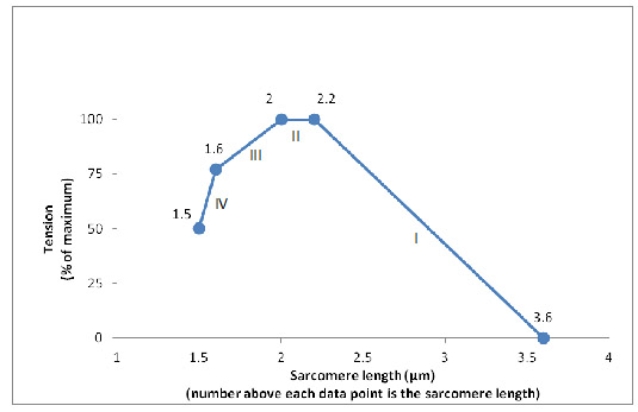
A) There is an increasing overlap of the free ends of the thin filaments in segment III but not in segment II.
B) Fewer myosin cross-bridges are forming in segment II than in segment III.
C) The length of the thick filaments is decreasing in segment III but not in segment II.
D) The distance between the Z lines is constant in segment II but rapidly increasing in segment III.
E) The muscle cells used up all the ATP by the end of segment II.
F) The length of the thin filaments is decreasing in segment III but not in segment II.
A) There is an increasing overlap of the free ends of the thin filaments in segment III but not in segment II.
B) Fewer myosin cross-bridges are forming in segment II than in segment III.
C) The length of the thick filaments is decreasing in segment III but not in segment II.
D) The distance between the Z lines is constant in segment II but rapidly increasing in segment III.
E) The muscle cells used up all the ATP by the end of segment II.
F) The length of the thin filaments is decreasing in segment III but not in segment II.
Question
Question
In the power stroke shown in panel c below, the thin filaments are pulled towards the center of the sarcomere. What is the specific sequence of events that occurs during a power stroke? 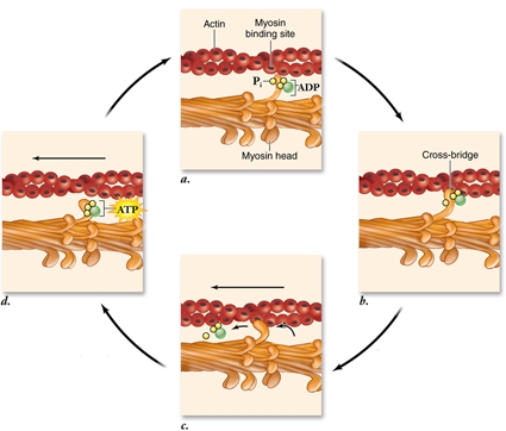
A) Release of ADP -> myosin head changes shape -> release of the phosphate group
B) Release of the phosphate group -> release of ADP -> myosin head changes shape
C) Release of the phosphate group -> myosin head changes shape -> release of ADP
D) Release of ADP-> release of the phosphate group -> myosin head changes shape
E) Myosin head changes shape -> release of the phosphate group -> release of ADP
A) Release of ADP -> myosin head changes shape -> release of the phosphate group
B) Release of the phosphate group -> release of ADP -> myosin head changes shape
C) Release of the phosphate group -> myosin head changes shape -> release of ADP
D) Release of ADP-> release of the phosphate group -> myosin head changes shape
E) Myosin head changes shape -> release of the phosphate group -> release of ADP
Question
Question
Question
The figure below represents a joint in the hind leg of a grasshopper. The exoskeleton of the leg is indicated by the two pairs of parallel black lines. A muscle that moves this leg is fixed to the skeleton at the end marked with a blue star. When the muscle contracts, it will pull on the tendon at its opposite end. Which configuration shows the most likely arrangement of the exoskeleton and a muscle that increases the flexion of this leg? 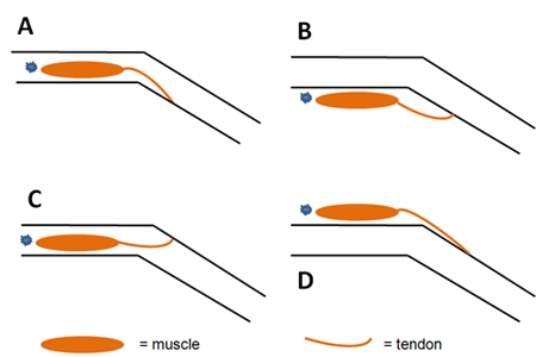
A) A
B) B
C) C
D) D
A) A
B) B
C) C
D) D
Question
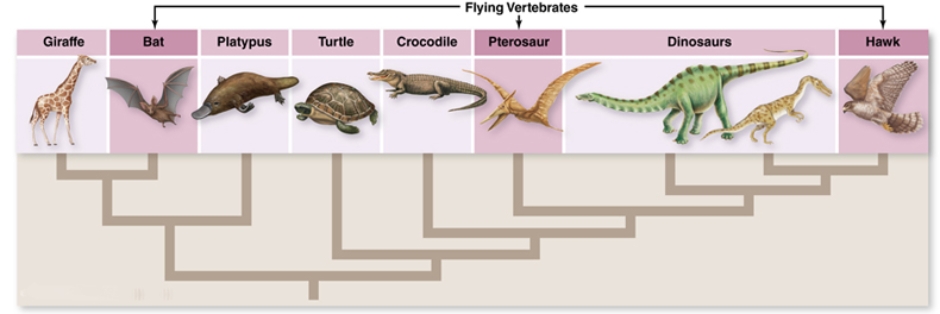 Based on the above diagram and other information from your text, what is the most likely (e.g., most parsimonious) explanation for the evolution of flight in vertebrates?
A) The common ancestor of all terrestrial vertebrates was wingless and wings evolved independently two different times: once in bats and once in the common ancestor of birds, pterosaurs and dinosaurs.
B) Wings evolved once in vertebrates (e.g., the common ancestor of all terrestrial vertebrates had wings) and wings were subsequently lost in all but three lineages: bats, pterosaurs and birds.
C) The common ancestor of all terrestrial vertebrates was wingless and wings evolved independently three different times: in bats, in pterosaurs and in the common ancestor of birds and dinosaurs.
D) The common ancestor of all terrestrial vertebrates was wingless and wings evolved independently three different times: in bats, in birds and in the common ancestor of pterosaurs and dinosaurs.
E) The common ancestor of all terrestrial vertebrates was wingless and wings evolved independently three different times: in bats, in pterosaurs and in birds.
Question
Question
Question
Question
Question

Unlock Deck
Sign up to unlock the cards in this deck!
Unlock Deck
Unlock Deck
1/18

Play

Full screen (f)
Deck 27: The Animal Biology and How It Moves
1
To diagnose and treat a disease, a doctor must evaluate the patient's body at multiple levels of organization. Identify the level of organization relevant to each stage of the process described below.
(1) As part of Fred's annual physical, the doctor examined his skin, fingernails and hair for signs of disease. Noticing an unusual lesion on his neck, the doctor referred Fred to a dermatologist.
(2) Upon observing the lesion, the dermatologist said, "Yes, this looks like it could be a squamous cell carcinoma, a tumor in the epidermis of the skin."
(3) The dermatologist carefully examined all of Fred's skin for signs of additional tumors, but did not find any.
(4) The dermatologist removed the lesion and sent it for a biopsy. Under the microscope, the pathologist saw some cells with abnormal morphology and confirmed a diagnosis of squamous cell carcinoma. However, he noted that the margins of the lesion were clear of abnormal cells, and the tumor had been successfully removed.
A) organism, cell, tissue, organ
B) organ system, tissue, organ, cell
C) organ system, organ, tissue, cell
D) organism, cell, organ system, tissue
(1) As part of Fred's annual physical, the doctor examined his skin, fingernails and hair for signs of disease. Noticing an unusual lesion on his neck, the doctor referred Fred to a dermatologist.
(2) Upon observing the lesion, the dermatologist said, "Yes, this looks like it could be a squamous cell carcinoma, a tumor in the epidermis of the skin."
(3) The dermatologist carefully examined all of Fred's skin for signs of additional tumors, but did not find any.
(4) The dermatologist removed the lesion and sent it for a biopsy. Under the microscope, the pathologist saw some cells with abnormal morphology and confirmed a diagnosis of squamous cell carcinoma. However, he noted that the margins of the lesion were clear of abnormal cells, and the tumor had been successfully removed.
A) organism, cell, tissue, organ
B) organ system, tissue, organ, cell
C) organ system, organ, tissue, cell
D) organism, cell, organ system, tissue
organ system, tissue, organ, cell
2
It's the ninth inning, and the bases are loaded. As the pitcher winds up to throw the ball, how does each tissue in his arm contribute to this critical pitch? The ___________ of his fingers grips the ball. His __________ sends instructions that trigger his ___________ to contract. His ______________ provides stability and transmits the force produced.
A) ectoderm; ectoderm; mesoderm; endoderm
B) connective tissue; nerve tissue; muscle tissue; epithelial tissue
C) epithelium; ectoderm; mesoderm; endoderm
D) epithelial tissue; nerve tissue; muscle tissue; connective tissue
A) ectoderm; ectoderm; mesoderm; endoderm
B) connective tissue; nerve tissue; muscle tissue; epithelial tissue
C) epithelium; ectoderm; mesoderm; endoderm
D) epithelial tissue; nerve tissue; muscle tissue; connective tissue
epithelial tissue; nerve tissue; muscle tissue; connective tissue
3
In 1822, the Canadian fur trader Alexis St. Martin was accidentally shot with a musket. The shot entered his left chest, fractured a rib, damaged the lungs, lacerated the diaphragm, perforated the stomach, and finally exited his body. Amazingly he survived, but the hole in his belly never completely healed. This allowed Dr. William Beaumont direct access to his stomach for experiments, and led to his discovery of the importance of stomach acid in digestion. Which body cavities did the musket shot pass through?
A) The shot entered the dorsal cavity and exited through the ventral cavity.
B) The shot entered the thoracic cavity and exited through the abdominopelvic cavity.
C) The shot entered the thoracic cavity and exited through the pleural cavity.
D) The shot entered the pericardial cavity and exited through the pleural cavity.
A) The shot entered the dorsal cavity and exited through the ventral cavity.
B) The shot entered the thoracic cavity and exited through the abdominopelvic cavity.
C) The shot entered the thoracic cavity and exited through the pleural cavity.
D) The shot entered the pericardial cavity and exited through the pleural cavity.
The shot entered the thoracic cavity and exited through the abdominopelvic cavity.
4
A friend asks you how exocrine glands differ from endocrine glands. She knows that both form from invaginated epithelium. How do you respond?
A) Exocrine and endocrine glands are essentially the same, both produce products that are secreted to the skin's surface.
B) Exocrine glands produce hormones which enter the blood stream, while endocrine glands secrete sweat and oil directly to the surface of the skin.
C) Endocrine glands produce hormones which enter the blood stream, while exocrine glands secrete sweat and oil directly to the surface of the skin.
D) Exocrine glands are found in the thoracic cavity while endocrine glands are located in the pleural cavity.
E) The liver is an endocrine gland that secretes directly into epithelial tissues. The pituitary gland is an exocrine gland that secretes into the blood stream.
A) Exocrine and endocrine glands are essentially the same, both produce products that are secreted to the skin's surface.
B) Exocrine glands produce hormones which enter the blood stream, while endocrine glands secrete sweat and oil directly to the surface of the skin.
C) Endocrine glands produce hormones which enter the blood stream, while exocrine glands secrete sweat and oil directly to the surface of the skin.
D) Exocrine glands are found in the thoracic cavity while endocrine glands are located in the pleural cavity.
E) The liver is an endocrine gland that secretes directly into epithelial tissues. The pituitary gland is an exocrine gland that secretes into the blood stream.
Unlock Deck
Unlock for access to all 18 flashcards in this deck.
Unlock Deck
k this deck
5
As the Baby Boomer generation ages, more and more joint replacement surgeries take place each year. Hip replacement surgery is the gold standard of all joint replacement surgeries, with many patients able to walk just a few hours after surgery and return home the very next day. In contrast, knee replacement surgery usually requires hospital stays of several days, followed by weeks to months of physical therapy. What best explains why the recovery after hip replacement surgery is so much faster than after knee replacement surgery?
A) The knee is a type of combination joint, which are difficult to replace.
B) The upper end of the thigh bone has less overall surface contact with the hip bone than its lower end has in the knee with bones of the lower leg.
C) The knee joint is stabilized by many more structures (many of which have to be cut) than the hip joint.
D) The hip joint is more superficial and more accessible to surgeons than the knee joint.
E) The hip only moves in one direction, and recovery of one motion is easier than recovering movement in many directions.
A) The knee is a type of combination joint, which are difficult to replace.
B) The upper end of the thigh bone has less overall surface contact with the hip bone than its lower end has in the knee with bones of the lower leg.
C) The knee joint is stabilized by many more structures (many of which have to be cut) than the hip joint.
D) The hip joint is more superficial and more accessible to surgeons than the knee joint.
E) The hip only moves in one direction, and recovery of one motion is easier than recovering movement in many directions.
Unlock Deck
Unlock for access to all 18 flashcards in this deck.
Unlock Deck
k this deck
6
You decide to do an experiment with isolated myofibrils to explore the effects of ATP hydrolysis on myofibril function. You do this by bathing the myofibrils in a solution that contains a modified form of ATP, which cannot be split into ADP and Pi. At what step will myofibril function be arrested by using this compound instead of unmodified ATP?
A) Myosin heads will bind to the actin filaments, but the power stroke will not occur and actin filaments will not slide over the myosin filaments.
B) Myosin molecules will be unable to assemble into thick filaments.
C) Myosin heads will be unable to bind to the actin filaments.
D) There will be no block in the cycle, since ATP hydrolysis is not required for this process.
E) The myosin heads will remain attached to the actin filaments after the power stroke.
A) Myosin heads will bind to the actin filaments, but the power stroke will not occur and actin filaments will not slide over the myosin filaments.
B) Myosin molecules will be unable to assemble into thick filaments.
C) Myosin heads will be unable to bind to the actin filaments.
D) There will be no block in the cycle, since ATP hydrolysis is not required for this process.
E) The myosin heads will remain attached to the actin filaments after the power stroke.
Unlock Deck
Unlock for access to all 18 flashcards in this deck.
Unlock Deck
k this deck
7
The sliding filament model for muscle contraction can be studied using an isolated skeletal muscle that is fixed at each end, while a machine records the tension that is generated when the muscle is stimulated to contract. In one particular muscle tested, the length of the thick filaments was 1.6 m and the length of the thin filaments that project in from each Z line towards the center of the sarcomere was 1.0 0m. A summary of the results comparing sarcomere length to the degree of tension produced during contraction is shown below. What most likely explains the difference between segment II and segment III of the graph?
A) There is an increasing overlap of the free ends of the thin filaments in segment III but not in segment II.
B) Fewer myosin cross-bridges are forming in segment II than in segment III.
C) The length of the thick filaments is decreasing in segment III but not in segment II.
D) The distance between the Z lines is constant in segment II but rapidly increasing in segment III.
E) The muscle cells used up all the ATP by the end of segment II.
F) The length of the thin filaments is decreasing in segment III but not in segment II.
A) There is an increasing overlap of the free ends of the thin filaments in segment III but not in segment II.
B) Fewer myosin cross-bridges are forming in segment II than in segment III.
C) The length of the thick filaments is decreasing in segment III but not in segment II.
D) The distance between the Z lines is constant in segment II but rapidly increasing in segment III.
E) The muscle cells used up all the ATP by the end of segment II.
F) The length of the thin filaments is decreasing in segment III but not in segment II.
Unlock Deck
Unlock for access to all 18 flashcards in this deck.
Unlock Deck
k this deck
8
Insects such as mosquitoes and beetles can beat their wings at tremendous speeds. This can be accomplished because
A) their wing muscle contractions causes another set of muscles to stretch which in turn produces another contraction without waiting for the arrival of a nerve impulse.
B) their wing muscle contractions cause another set of muscles to relax which in turn produces another wing movement.
C) their wing muscle contractions are stimulated by the continuous nerve signal impulses which produce a continuous contraction of their wing muscles.
D) their wing muscle contractions are capable of producing more ATP which allows these insects to have much faster and sustained wing movements.
E) their wing muscle contractions produce nerve impulses which lead to more contraction of the wing muscles which in turn permits faster motion of the wings.
A) their wing muscle contractions causes another set of muscles to stretch which in turn produces another contraction without waiting for the arrival of a nerve impulse.
B) their wing muscle contractions cause another set of muscles to relax which in turn produces another wing movement.
C) their wing muscle contractions are stimulated by the continuous nerve signal impulses which produce a continuous contraction of their wing muscles.
D) their wing muscle contractions are capable of producing more ATP which allows these insects to have much faster and sustained wing movements.
E) their wing muscle contractions produce nerve impulses which lead to more contraction of the wing muscles which in turn permits faster motion of the wings.
Unlock Deck
Unlock for access to all 18 flashcards in this deck.
Unlock Deck
k this deck
9
In the power stroke shown in panel c below, the thin filaments are pulled towards the center of the sarcomere. What is the specific sequence of events that occurs during a power stroke?
A) Release of ADP -> myosin head changes shape -> release of the phosphate group
B) Release of the phosphate group -> release of ADP -> myosin head changes shape
C) Release of the phosphate group -> myosin head changes shape -> release of ADP
D) Release of ADP-> release of the phosphate group -> myosin head changes shape
E) Myosin head changes shape -> release of the phosphate group -> release of ADP
A) Release of ADP -> myosin head changes shape -> release of the phosphate group
B) Release of the phosphate group -> release of ADP -> myosin head changes shape
C) Release of the phosphate group -> myosin head changes shape -> release of ADP
D) Release of ADP-> release of the phosphate group -> myosin head changes shape
E) Myosin head changes shape -> release of the phosphate group -> release of ADP
Unlock Deck
Unlock for access to all 18 flashcards in this deck.
Unlock Deck
k this deck
10
In order for an earthworm to lengthen several contiguous segments of its body, it must
A) contract its longitudinal muscles, which pulls up the chaetae and moves the body fluid perpendicular to the long axis of the worm.
B) contract its circular muscles, which extends the chaetae into the surrounding soil and moves the body fluid perpendicular to the long axis of the worm.
C) contract its circular muscles, which pulls up the chaetae and moves the body fluid parallel to the long axis of the worm.
D) contract its longitudinal muscles, which extends the chaetae into the surrounding soil and moves the body fluid parallel to the long axis of the worm.
E) contract its circular muscles, which extends the chaetae into the surrounding soil and moves the body fluid parallel to the long axis of the worm.
A) contract its longitudinal muscles, which pulls up the chaetae and moves the body fluid perpendicular to the long axis of the worm.
B) contract its circular muscles, which extends the chaetae into the surrounding soil and moves the body fluid perpendicular to the long axis of the worm.
C) contract its circular muscles, which pulls up the chaetae and moves the body fluid parallel to the long axis of the worm.
D) contract its longitudinal muscles, which extends the chaetae into the surrounding soil and moves the body fluid parallel to the long axis of the worm.
E) contract its circular muscles, which extends the chaetae into the surrounding soil and moves the body fluid parallel to the long axis of the worm.
Unlock Deck
Unlock for access to all 18 flashcards in this deck.
Unlock Deck
k this deck
11
Impressive was a champion Quarter Horse stallion with a magnificent muscular physique, a trait that he passed on to dozens of offspring. However, many of Impressive's offspring developed periodic muscular twitching that sometimes left the horses temporarily unable to move. Some horses even died. As it turns out, Impressive's award-winning physique was due to a mutation in a single, protein-encoding gene, resulting in hyperexcitable muscle (which contracts even in the absence of a stimulus from its motor neuron). Which is NOT a plausible explanation for the identity of the abnormal muscle protein in Impressive and his offspring?
A) tropomyosin that is unable to bind to actin
B) overactive Ca2+ pumps in the membrane of the sarcoplasmic reticulum
C) leaky Na+ channels
D) over-active troponin molecules
E) acetylcholine receptors that function in the absence of acetylcholine
A) tropomyosin that is unable to bind to actin
B) overactive Ca2+ pumps in the membrane of the sarcoplasmic reticulum
C) leaky Na+ channels
D) over-active troponin molecules
E) acetylcholine receptors that function in the absence of acetylcholine
Unlock Deck
Unlock for access to all 18 flashcards in this deck.
Unlock Deck
k this deck
12
The figure below represents a joint in the hind leg of a grasshopper. The exoskeleton of the leg is indicated by the two pairs of parallel black lines. A muscle that moves this leg is fixed to the skeleton at the end marked with a blue star. When the muscle contracts, it will pull on the tendon at its opposite end. Which configuration shows the most likely arrangement of the exoskeleton and a muscle that increases the flexion of this leg?
A) A
B) B
C) C
D) D
A) A
B) B
C) C
D) D
Unlock Deck
Unlock for access to all 18 flashcards in this deck.
Unlock Deck
k this deck
13
Based on the above diagram and other information from your text, what is the most likely (e.g., most parsimonious) explanation for the evolution of flight in vertebrates?A) The common ancestor of all terrestrial vertebrates was wingless and wings evolved independently two different times: once in bats and once in the common ancestor of birds, pterosaurs and dinosaurs.
B) Wings evolved once in vertebrates (e.g., the common ancestor of all terrestrial vertebrates had wings) and wings were subsequently lost in all but three lineages: bats, pterosaurs and birds.
C) The common ancestor of all terrestrial vertebrates was wingless and wings evolved independently three different times: in bats, in pterosaurs and in the common ancestor of birds and dinosaurs.
D) The common ancestor of all terrestrial vertebrates was wingless and wings evolved independently three different times: in bats, in birds and in the common ancestor of pterosaurs and dinosaurs.
E) The common ancestor of all terrestrial vertebrates was wingless and wings evolved independently three different times: in bats, in pterosaurs and in birds.
Unlock Deck
Unlock for access to all 18 flashcards in this deck.
Unlock Deck
k this deck
14
If the skin formed as a simple epithelium during development, what result would you expect?
A) This is the normal situation.
B) The skin would have increased transfer and improved water and gas homeostasis.
C) This would make the skin very fragile and impair its protective function.
D) This would mildly decrease its protective function.
A) This is the normal situation.
B) The skin would have increased transfer and improved water and gas homeostasis.
C) This would make the skin very fragile and impair its protective function.
D) This would mildly decrease its protective function.
Unlock Deck
Unlock for access to all 18 flashcards in this deck.
Unlock Deck
k this deck
15
How would you expect a disease of cartilage formation affect bone development?
A) Cartilage is used for other tissues, not bone, so it will not affect bone development.
B) Cartilage defects will affect bone only via the effect on tendons and ligaments.
C) It would greatly disrupt bone development, since bones are originally formed of cartilage which becomes replaced.
D) The epiphysis is formed of cartilage so that will be disrupted, but otherwise the bone will be normal.
A) Cartilage is used for other tissues, not bone, so it will not affect bone development.
B) Cartilage defects will affect bone only via the effect on tendons and ligaments.
C) It would greatly disrupt bone development, since bones are originally formed of cartilage which becomes replaced.
D) The epiphysis is formed of cartilage so that will be disrupted, but otherwise the bone will be normal.
Unlock Deck
Unlock for access to all 18 flashcards in this deck.
Unlock Deck
k this deck
16
Why does the sarcomere get narrower during muscle contraction?
A) The actin fiber shrinks.
B) The myosin fiber shrinks.
C) The myosin and actin fibers overlap more.
D) The edges of the muscle push the cells closer together.
E) The sarcoplasmic reticulum empties.
A) The actin fiber shrinks.
B) The myosin fiber shrinks.
C) The myosin and actin fibers overlap more.
D) The edges of the muscle push the cells closer together.
E) The sarcoplasmic reticulum empties.
Unlock Deck
Unlock for access to all 18 flashcards in this deck.
Unlock Deck
k this deck
17
At the emergency room, the doctor tell you "Your friend has high levels of troponin in the blood." What is this likely to indicate?
A) a broken bone
B) a high level of fitness
C) muscle damage
D) an unhealthy diet
A) a broken bone
B) a high level of fitness
C) muscle damage
D) an unhealthy diet
Unlock Deck
Unlock for access to all 18 flashcards in this deck.
Unlock Deck
k this deck
18
You just got a good look at the Loch Ness Monster! It's tail was waving from side to side. What can you conclude?
A) It is likely a type of fish.
B) It is likely a type of sea lion.
C) It is likely a type of whale.
D) Cannot draw any conclusion.
A) It is likely a type of fish.
B) It is likely a type of sea lion.
C) It is likely a type of whale.
D) Cannot draw any conclusion.
Unlock Deck
Unlock for access to all 18 flashcards in this deck.
Unlock Deck
k this deck
Unlock Deck
Unlock for access to all 18 flashcards in this deck.






