







 Chat with AI

Deck 41: Molecular Biology Tools
Full screen (f)

Question

Question
Question
Question
Question
Question
Question
Question
Question
Question
Question
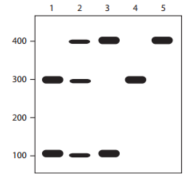
In an assay for the presence of a specific disease gene allele in several individuals, you isolate genomic DNA from each and perform polymerase chain reaction (PCR) using gene-specific primers. The PCR product is expected to have a recognition site for the restriction endonuclease BamHI. Following PCR and BamHI digestion, the products are separated by gel electrophoresis and the results are shown in the figure below. Which lane corresponds to the individual demonstrating heterozygosity for the BamHI site?
A) 1
B) 2
C) 3
D) 4
E) 5
A) 1
B) 2
C) 3
D) 4
E) 5
Question
Question
Question
Question
Question
Question
Question
Question
Question
Question
Question
Question
Question
Question

Unlock Deck
Sign up to unlock the cards in this deck!
Unlock Deck
Unlock Deck
1/25

Play

Full screen (f)
Deck 41: Molecular Biology Tools
1
You are carrying out experiments designed to utilize DNA encoding a wild-type gene to treat a disease resulting from inheritance of a defective gene. Which of the following techniques would be the most useful in pursuit of the goal of these studies?
A) gene therapy
B) polymerase chain reaction, PCR
C) restriction fragment length polymorphism, RFLP
D) RNAi
E) transgenesis
A) gene therapy
B) polymerase chain reaction, PCR
C) restriction fragment length polymorphism, RFLP
D) RNAi
E) transgenesis
gene therapy
2
You wish to analyze the pattern of genes expressed in a breast cancer in order to identify potential differences to normal breast tissue cells. Which of the following enzymes is most useful to you in your anticipated studies?
A) DNA ligase
B) DNase I
C) polynucleotide kinase
D) reverse transcriptase
E) restriction endonucleases
A) DNA ligase
B) DNase I
C) polynucleotide kinase
D) reverse transcriptase
E) restriction endonucleases
reverse transcriptase
3
You wish to incorporate radioactive phosphate onto the 5′-ends of a fragment of DNA so that it can be used as a probe on a Southern blot of genomic DNA. Which of the following enzymes is required in order for you to carry out the labeling of the DNA with radioactive phosphate?
A) DNA ligase
B) DNA polymerase
C) polynucleotide kinase
D) reverse transcriptase
E) terminal transferase
A) DNA ligase
B) DNA polymerase
C) polynucleotide kinase
D) reverse transcriptase
E) terminal transferase
polynucleotide kinase
4
You are testing the activity of an enzyme you have isolated from bovine pancreas. You find that when this enzyme is added to nuclei isolated from adipocytes and the products are subsequently analyzed by gel electrophoresis that the DNA in the nuclei is degraded into relatively discrete sizes approximately 150 bp in length. Which of the following most likely represents the enzyme activity in your pancreatic preparation?
A) a restriction endonuclease
B) DNA ligase
C) DNA polymerase
D) DNase I
E) reverse transcriptase
A) a restriction endonuclease
B) DNA ligase
C) DNA polymerase
D) DNase I
E) reverse transcriptase
Unlock Deck
Unlock for access to all 25 flashcards in this deck.
Unlock Deck
k this deck
5
Which of the following is a means to identify all of the genes that are active in any given cell under any given set of conditions?
A) cDNA cloning
B) genomic cloning
C) polymerase chain reaction, PCR
D) Southern blotting
E) restriction fragment length polymorphism, RFLP
A) cDNA cloning
B) genomic cloning
C) polymerase chain reaction, PCR
D) Southern blotting
E) restriction fragment length polymorphism, RFLP
Unlock Deck
Unlock for access to all 25 flashcards in this deck.
Unlock Deck
k this deck
6
You are examining a 7-year-old female who suffers from recurrent vasculo-occlusive episodes. Her parents report that she complains often of severe bone pain. You suspect the patient is suffering from sickle cell anemia. Which of the following tests would be appropriate to the confirmation of this diagnosis?
A) cDNA cloning
B) genomic cloning
C) polymerase chain reaction, PCR
D) Southern blotting
E) restriction fragment length polymorphism, RFLP
A) cDNA cloning
B) genomic cloning
C) polymerase chain reaction, PCR
D) Southern blotting
E) restriction fragment length polymorphism, RFLP
Unlock Deck
Unlock for access to all 25 flashcards in this deck.
Unlock Deck
k this deck
7
Which of the following enzymes is required in order to acquire templates for the process of quantitative PCR?
A) DNA I
B) DNA ligase
C) restriction endonuclease
D) reverse transcriptase
E) RNase H
A) DNA I
B) DNA ligase
C) restriction endonuclease
D) reverse transcriptase
E) RNase H
Unlock Deck
Unlock for access to all 25 flashcards in this deck.
Unlock Deck
k this deck
8
In the technique of cDNA cloning, an enzyme is often used that recognizes duplexes formed between DNA and RNA. Which of the following is the enzyme in question?
A) DNA polymerase
B) polynucleotide kinase
C) reverse transcriptase
D) RNase H
E) terminal transferase
A) DNA polymerase
B) polynucleotide kinase
C) reverse transcriptase
D) RNase H
E) terminal transferase
Unlock Deck
Unlock for access to all 25 flashcards in this deck.
Unlock Deck
k this deck
9
A 47-year-old man is being examined by his personal physician because of a progressive dementia, evolving involuntary movements, and changes to his affect. History indicates that he noticed frequent uncontrolled spasmodic twitching of his fingers beginning about 1 year ago. Physical examination indicates clumsiness, hyperreflexia, and eye movement disturbances. You make a diagnosis and suggest that the patient is an ideal candidate for a new form of therapy. Which of the following techniques is most likely associated with the therapy for the suspected disease?
A) gene therapy
B) polymerase chain reaction, PCR
C) restriction fragment length polymorphism, RFLP
D) RNAi
E) transgenesis
A) gene therapy
B) polymerase chain reaction, PCR
C) restriction fragment length polymorphism, RFLP
D) RNAi
E) transgenesis
Unlock Deck
Unlock for access to all 25 flashcards in this deck.
Unlock Deck
k this deck
10
In order to generate a genomic library which of the following enzymes is required?
A) DNase I
B) DNA polymerase
C) polynucleotide kinase
D) restriction endonuclease
E) reverse transcriptase
A) DNase I
B) DNA polymerase
C) polynucleotide kinase
D) restriction endonuclease
E) reverse transcriptase
Unlock Deck
Unlock for access to all 25 flashcards in this deck.
Unlock Deck
k this deck
11
In an assay for the presence of a specific disease gene allele in several individuals, you isolate genomic DNA from each and perform polymerase chain reaction (PCR) using gene-specific primers. The PCR product is expected to have a recognition site for the restriction endonuclease BamHI. Following PCR and BamHI digestion, the products are separated by gel electrophoresis and the results are shown in the figure below. Which lane corresponds to the individual demonstrating heterozygosity for the BamHI site?
A) 1
B) 2
C) 3
D) 4
E) 5
A) 1
B) 2
C) 3
D) 4
E) 5
Unlock Deck
Unlock for access to all 25 flashcards in this deck.
Unlock Deck
k this deck
12
The forensic analytical technique identified as DNA fingerprinting refers to which of the following processes?
A) the establishment of a complete collection of cloned fragments of DNA
B) the identification of sequences of DNA to which specific proteins bind, thereby rendering them resistant to digestion by DNA degrading nucleases
C) the specific association of complimentary strands of DNA to one another
D) the synthetic oligonucleotide-directed enzymatic amplification of specific sequences of DNA
E) the use of repeat sequences to establish a unique pattern of fragments for any given individual
A) the establishment of a complete collection of cloned fragments of DNA
B) the identification of sequences of DNA to which specific proteins bind, thereby rendering them resistant to digestion by DNA degrading nucleases
C) the specific association of complimentary strands of DNA to one another
D) the synthetic oligonucleotide-directed enzymatic amplification of specific sequences of DNA
E) the use of repeat sequences to establish a unique pattern of fragments for any given individual
Unlock Deck
Unlock for access to all 25 flashcards in this deck.
Unlock Deck
k this deck
13
Which of the following relates to restriction fragment length polymorphism (RFLP) analysis?
A) can be used to detect one-base differences in DNA sequences
B) detects differences in conformation of single strands of DNA
C) requires the use of an RNA intermediate
D) uses Western blotting as part of the technique
E) uses Sanger DNA sequencing as part of the technique
A) can be used to detect one-base differences in DNA sequences
B) detects differences in conformation of single strands of DNA
C) requires the use of an RNA intermediate
D) uses Western blotting as part of the technique
E) uses Sanger DNA sequencing as part of the technique
Unlock Deck
Unlock for access to all 25 flashcards in this deck.
Unlock Deck
k this deck
14
Restriction endonucleases are powerful enzymes used in molecular biological experimentation. Which of the follwing chemical bonds do these enzymes target?
A) disulfide
B) N-glycosidic
C) O-glycosidic
D) peptide
E) phosphodiester
A) disulfide
B) N-glycosidic
C) O-glycosidic
D) peptide
E) phosphodiester
Unlock Deck
Unlock for access to all 25 flashcards in this deck.
Unlock Deck
k this deck
15
Clinical trials are assessing a new treatment for age-related macular degeneration by the targeting vascular endothelial cell growth factor receptor (VEGFR) using RNAi technology. Which of the following statements most closely describes the characteristics of RNAi that make it useful as a therapeutic approach to disease?
A) RNAi activates phosphodiesterase, thus interfering with the cAMP signaling mediated by VEGFR activation
B) RNAi molecules trigger the interferon response preventing translation of the VEGFR mRNA
C) RNAi molecules will act as competitive inhibitors by interacting with the VEGFR protein
D) RNAi treatment will prevent replication of the VEGFR gene during S-phase of the cell cycle
E) RNAi treatment will specifically target the VEGFR mRNA for degradation
A) RNAi activates phosphodiesterase, thus interfering with the cAMP signaling mediated by VEGFR activation
B) RNAi molecules trigger the interferon response preventing translation of the VEGFR mRNA
C) RNAi molecules will act as competitive inhibitors by interacting with the VEGFR protein
D) RNAi treatment will prevent replication of the VEGFR gene during S-phase of the cell cycle
E) RNAi treatment will specifically target the VEGFR mRNA for degradation
Unlock Deck
Unlock for access to all 25 flashcards in this deck.
Unlock Deck
k this deck
16
The technique referred to as RNA interference (RNAi) involves the targeted destruction of mRNAs leading to reduced levels of bioactive protein. Using RNAi could be expected to have a pharmacological benefit in which of the following disorders?
A) Huntington disease
B) PKU
C) retinoblastoma
D) Tay-Sachs disease
E) von Hippel-Lindau syndrome
A) Huntington disease
B) PKU
C) retinoblastoma
D) Tay-Sachs disease
E) von Hippel-Lindau syndrome
Unlock Deck
Unlock for access to all 25 flashcards in this deck.
Unlock Deck
k this deck
17
A number of DNA diagnostic tests rely on the Southern blot, a method in which DNA samples are made single-stranded by brief exposure to high pH. Which of the following best accounts for separation of the DNA strands under these conditions?
A) cleavage of phosphodisester bonds
B) deamination of adenine, guanine, and cytosine residues
C) disruption of hydrogen-bonding between bases
D) loss of charges on the phosphate groups
E) hydrolysis of N-glycosidic linkages between the sugars and the bases
A) cleavage of phosphodisester bonds
B) deamination of adenine, guanine, and cytosine residues
C) disruption of hydrogen-bonding between bases
D) loss of charges on the phosphate groups
E) hydrolysis of N-glycosidic linkages between the sugars and the bases
Unlock Deck
Unlock for access to all 25 flashcards in this deck.
Unlock Deck
k this deck
18
The ability to incorporate restriction fragments with blunt ends into plasmid vectors linearized with similar enzymes is particularly dependent upon which of the following enzymes?
A) DNA ligase
B) DNA polymerase
C) micrococcal nuclease
D) polynucleotide kinase
E) terminal transferase
A) DNA ligase
B) DNA polymerase
C) micrococcal nuclease
D) polynucleotide kinase
E) terminal transferase
Unlock Deck
Unlock for access to all 25 flashcards in this deck.
Unlock Deck
k this deck
19
The polymerase chain reaction (PCR) requires which of the following enzymes?
A) DNA ligase
B) DNA polymerase
C) DNase I
D) ribonuclease
E) RNA polymerase
A) DNA ligase
B) DNA polymerase
C) DNase I
D) ribonuclease
E) RNA polymerase
Unlock Deck
Unlock for access to all 25 flashcards in this deck.
Unlock Deck
k this deck
20
Which of the following is the function of restriction endonucleases in bacteria?
A) degradation of foreign DNA
B) enhancement of transcription
C) participation in DNA repair
D) participation in synthesis of lagging strand DNA
E) stimulation of recombination
A) degradation of foreign DNA
B) enhancement of transcription
C) participation in DNA repair
D) participation in synthesis of lagging strand DNA
E) stimulation of recombination
Unlock Deck
Unlock for access to all 25 flashcards in this deck.
Unlock Deck
k this deck
21
A 27-year-old woman, who is 10-weeks into her second pregnancy, is being tested by a molecular genetics clinic. She and her husband's first child has a transfusion-dependent form of β-thalassemia. The prenatal diagnostic test used to determine if the fetus is affected is based upon the polymerase chain reaction method. Which of the following reagents is needed to carry out this test?
A) chain-terminating dideoxynucleotides
B) cloned copies of the child's β-globin genes
C) DNA ligase
D) oligonucleotides complementary to sequences in the β-globin gene
E) restriction endonucleases
A) chain-terminating dideoxynucleotides
B) cloned copies of the child's β-globin genes
C) DNA ligase
D) oligonucleotides complementary to sequences in the β-globin gene
E) restriction endonucleases
Unlock Deck
Unlock for access to all 25 flashcards in this deck.
Unlock Deck
k this deck
22
Which of the following techniques is the most accurate in showing that 2 RNAs are identical?
A) hybridization
B) nucleotide sequencing
C) polymerase chain reaction
D) restriction endonuclease analysis
E) Western blotting
A) hybridization
B) nucleotide sequencing
C) polymerase chain reaction
D) restriction endonuclease analysis
E) Western blotting
Unlock Deck
Unlock for access to all 25 flashcards in this deck.
Unlock Deck
k this deck
23
The accuracy of DNA restriction maps in demonstrating changes in the DNA sequence of a specific gene reflects the ability of restriction endonucleases to do which of the following?
A) bind to transcription sites
B) degrade viral DNA introduced into bacteria
C) recognize a specific short DNA sequence in double-stranded DNA
D) remove bases from DNA within a sequence in a precise 5′ → 3′ direction from the middle of a sequence
E) repair DNA damaged by ultraviolet light by selectively destroying the modified bases
A) bind to transcription sites
B) degrade viral DNA introduced into bacteria
C) recognize a specific short DNA sequence in double-stranded DNA
D) remove bases from DNA within a sequence in a precise 5′ → 3′ direction from the middle of a sequence
E) repair DNA damaged by ultraviolet light by selectively destroying the modified bases
Unlock Deck
Unlock for access to all 25 flashcards in this deck.
Unlock Deck
k this deck
24
You are studying the characteristics of DNA isolated from a mutant strain of E coli. Your data show that it can be digested into numerous smaller fragments with a restriction endonuclease that is known to cleave at a GGATCC motif. In comparison, DNA from the wild-type parental strain is resistant to digestion with this restriction endonuclease. The mutation that causes this type of phenotype is most likely to occur in the gene encoding which of the following activities?
A) DNase
B) gyrase
C) helicase
D) ligase
E) methylase
A) DNase
B) gyrase
C) helicase
D) ligase
E) methylase
Unlock Deck
Unlock for access to all 25 flashcards in this deck.
Unlock Deck
k this deck
25
You are carrying out experiments to insert fragments of the human genome into an appropriate vector and using the vector to transform bacterial cells. Which of the following is most likely to be used to transfer cloned human genetic material to bacteria?
A) DNA complexed with bacterial histones
B) human chromosomal fragments
C) naked DNA
D) purified euchromatin
E) purified heterochromatin
A) DNA complexed with bacterial histones
B) human chromosomal fragments
C) naked DNA
D) purified euchromatin
E) purified heterochromatin
Unlock Deck
Unlock for access to all 25 flashcards in this deck.
Unlock Deck
k this deck
Unlock Deck
Unlock for access to all 25 flashcards in this deck.






