Deck 1: Structure Determines Properties

Full screen (f)
exit full mode
Question
What is the ground state electron configuration of carbon?

A) 1 s22 s22px11 \mathrm{~s}^{2} 2 \mathrm{~s}^{2} 2 \mathrm{p}_{\mathrm{x}}{ }^{1}

B) 1 s22 s22px1 \mathrm{~s}^{2} 2 \mathrm{~s}^{2} 2 \mathrm{p}_{\mathrm{x}}

C) 1 s22 s22px12py11 \mathrm{~s}^{2} 2 \mathrm{~s}^{2} 2 \mathrm{p}_{\mathrm{x}}{ }^{1} 2 \mathrm{p}_{\mathrm{y}}{ }^{1}

D) 1 s22 s22px22py1 \mathrm{~s}^{2} 2 \mathrm{~s}^{2} 2 \mathrm{p}_{\mathrm{x}}^{2} 2 \mathrm{p}_{\mathrm{y}}
Use Space or
up arrow
down arrow
to flip the card.
Question
Which one of the following is the conjugate base of NH3\mathrm{NH}_{3} ?

A) NH4+\mathrm{NH}_{4}{ }^{+}
B) H+\mathrm{H}^{+}
C) N3\mathrm{N}^{3-}
D) NH2\mathrm{NH}_{2}^{-}
Question
Identify the condensed formula of the following structure:
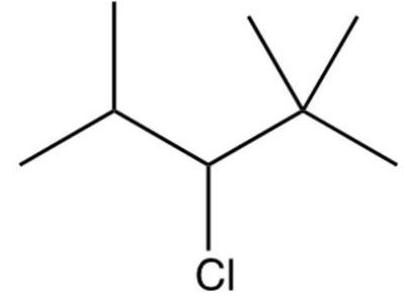
 <strong>Identify the condensed formula of the following structure:  </strong> A)  \left(\mathrm{CH}_{3}\right)_{2} \mathrm{CHCHClCH}\left(\mathrm{CH}_{3}\right)_{2}  B)  \mathrm{CH}_{3} \mathrm{CH}\left(\mathrm{CH}_{3}\right) \mathrm{CHClCH}\left(\mathrm{CH}_{3}\right)_{2}  C)  \left(\mathrm{CH}_{3}\right)_{2} \mathrm{CHCHClC}\left(\mathrm{CH}_{3}\right)_{3}  D)  \left(\mathrm{CH}_{3}\right)_{3} \mathrm{CCHClCH}\left(\mathrm{CH}_{3}\right)_{3}  <div style=padding-top: 35px>

A) (CH3)2CHCHClCH(CH3)2\left(\mathrm{CH}_{3}\right)_{2} \mathrm{CHCHClCH}\left(\mathrm{CH}_{3}\right)_{2}
B) CH3CH(CH3)CHClCH(CH3)2\mathrm{CH}_{3} \mathrm{CH}\left(\mathrm{CH}_{3}\right) \mathrm{CHClCH}\left(\mathrm{CH}_{3}\right)_{2}
C) (CH3)2CHCHClC(CH3)3\left(\mathrm{CH}_{3}\right)_{2} \mathrm{CHCHClC}\left(\mathrm{CH}_{3}\right)_{3}
D) (CH3)3CCHClCH(CH3)3\left(\mathrm{CH}_{3}\right)_{3} \mathrm{CCHClCH}\left(\mathrm{CH}_{3}\right)_{3}
Question
How many C3H8O\mathrm{C}_{3} \mathrm{H}_{8} \mathrm{O} constitutional isomers are possible?

A) one
B) two
C) three
D) four
Question
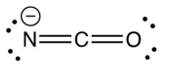
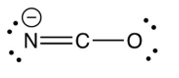
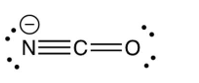
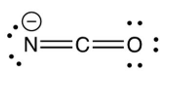
The formal charges on the nitrogen and oxygen in the following structures are, respectively
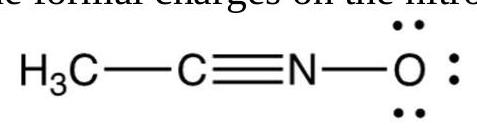
 <strong>The formal charges on the nitrogen and oxygen in the following structures are, respectively  </strong> A)  +1,-1  B)  0,-1  C)  +1,0  D) 0,0 <div style=padding-top: 35px>

A) +1,1+1,-1
B) 0,10,-1
C) +1,0+1,0
D) 0,0
Question
In which of the following compounds would you expect Cl\mathrm{Cl} to have a partial positive charge?

A) HCl\mathrm{HCl}
B) CCl4\mathrm{CCl}_{4}
C) NaCl\mathrm{NaCl}
D) HOCl\mathrm{HOCl}
Question
Which of the following species has(have) a linear geometry?
I. CO2\mathrm{CO}_{2}
II. NO2+\mathrm{NO}_{2}^{+}
III. NO2\mathrm{NO}_{2}^{-}

A) only I
B) only II
C) I and II
D) I, II, and III
Question
The HCH\mathrm{H}-\mathrm{C}-\mathrm{H} bond angles in ethylene, C2H4\mathrm{C}_{2} \mathrm{H}_{4} , are closest to

A) 9090^{\circ} .
B) 109.5109.5^{\circ} .
C) 120120^{\circ} .
D) 180180^{\circ} .
Question
Give the molecular formula of the compound shown below:
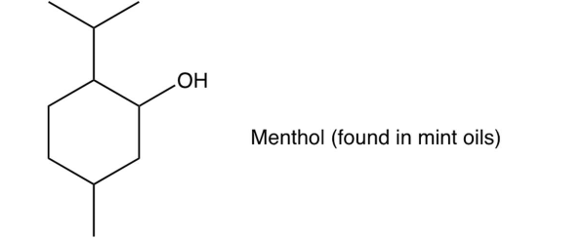
 <strong>Give the molecular formula of the compound shown below:   </strong> A)  \mathrm{C}_{8} \mathrm{H}_{16} \mathrm{O}  B)  \mathrm{C}_{9} \mathrm{H}_{18} \mathrm{O}  C)  \mathrm{C}_{10} \mathrm{H}_{18} \mathrm{O}  D)  \mathrm{C}_{10} \mathrm{H}_{20} \mathrm{O}  <div style=padding-top: 35px>

A) C8H16O\mathrm{C}_{8} \mathrm{H}_{16} \mathrm{O}
B) C9H18O\mathrm{C}_{9} \mathrm{H}_{18} \mathrm{O}
C) C10H18O\mathrm{C}_{10} \mathrm{H}_{18} \mathrm{O}
D) C10H20O\mathrm{C}_{10} \mathrm{H}_{20} \mathrm{O}
Question
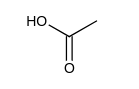
Which one of the following is the conjugate acid of ethanol?

<strong>Which one of the following is the conjugate acid of ethanol?   </strong> A) Option A B) Option B C) Option C D) Option D <div style=padding-top: 35px>

A) Option A
B) Option B
C) Option C
D) Option D
Question
In the equilibrium below, the strongest base is:
(pKaH2O=15.7,pKaNH3=36)\left(\mathrm{pK}_{\mathrm{a}} \mathrm{H}_{2} \mathrm{O}=15.7, \mathrm{pK}_{\mathrm{a}} \mathrm{NH}_{3}=36\right)
H2O+NH2OH+NH3\mathrm{H}_{2} \mathrm{O}+\stackrel{\ominus}{\mathrm{NH}_{2}} \rightleftharpoons \stackrel{\ominus}{\mathrm{OH}}+\mathrm{NH}_{3}

A) H2O\mathrm{H}_{2} \mathrm{O}
B) NH2\mathrm{NH}_{2}
C) OH\mathrm{OH}
D) NH3\mathrm{NH}_{3}
Question
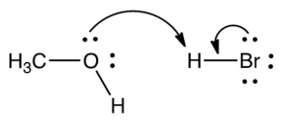
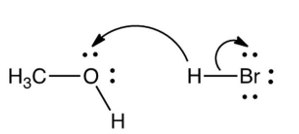
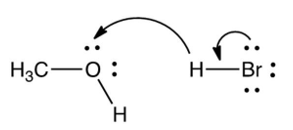
Which one of the following mechanistically depicts the protonation of methanol by hydrogen bromide?

A)
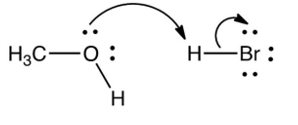
<strong>Which one of the following mechanistically depicts the protonation of methanol by hydrogen bromide? </strong> A)   B)   C)   D)   <div style=padding-top: 35px>
B)
<strong>Which one of the following mechanistically depicts the protonation of methanol by hydrogen bromide? </strong> A)   B)   C)   D)   <div style=padding-top: 35px>
C)
<strong>Which one of the following mechanistically depicts the protonation of methanol by hydrogen bromide? </strong> A)   B)   C)   D)   <div style=padding-top: 35px>
D)
<strong>Which one of the following mechanistically depicts the protonation of methanol by hydrogen bromide? </strong> A)   B)   C)   D)   <div style=padding-top: 35px>
Question
Which one of the following has the largest acid equilibrium constant, Ka\mathrm{K}_{\mathrm{a}} ?

A)  <strong>Which one of the following has the largest acid equilibrium constant,  \mathrm{K}_{\mathrm{a}}  ?</strong> A)   B)   C)   D)   <div style=padding-top: 35px>
B)  <strong>Which one of the following has the largest acid equilibrium constant,  \mathrm{K}_{\mathrm{a}}  ?</strong> A)   B)   C)   D)   <div style=padding-top: 35px>
C)  <strong>Which one of the following has the largest acid equilibrium constant,  \mathrm{K}_{\mathrm{a}}  ?</strong> A)   B)   C)   D)   <div style=padding-top: 35px>
D)  <strong>Which one of the following has the largest acid equilibrium constant,  \mathrm{K}_{\mathrm{a}}  ?</strong> A)   B)   C)   D)   <div style=padding-top: 35px>
Question
For which of the following does the equilibrium favor reactants.
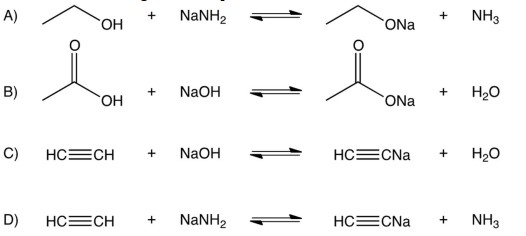
<strong>For which of the following does the equilibrium favor reactants.  </strong> A) A B) B C) C D) D <div style=padding-top: 35px>

A) A
B) B
C) C
D) D
Question
Identify the resonance structure which results from the following "electron pair movements".
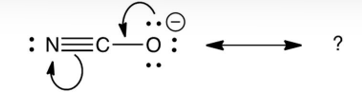
<strong>Identify the resonance structure which results from the following electron pair movements.  </strong> A)   B)   C)   D)   <div style=padding-top: 35px>

A)
<strong>Identify the resonance structure which results from the following electron pair movements.  </strong> A)   B)   C)   D)   <div style=padding-top: 35px>
B)
<strong>Identify the resonance structure which results from the following electron pair movements.  </strong> A)   B)   C)   D)   <div style=padding-top: 35px>
C)
<strong>Identify the resonance structure which results from the following electron pair movements.  </strong> A)   B)   C)   D)   <div style=padding-top: 35px>
D)
<strong>Identify the resonance structure which results from the following electron pair movements.  </strong> A)   B)   C)   D)   <div style=padding-top: 35px>
Unlock Deck
Sign up to unlock the cards in this deck!
Unlock Deck
Unlock Deck
1/15
auto play flashcards
Play
simple tutorial
Full screen (f)
exit full mode
Deck 1: Structure Determines Properties
1
What is the ground state electron configuration of carbon?

A) 1 s22 s22px11 \mathrm{~s}^{2} 2 \mathrm{~s}^{2} 2 \mathrm{p}_{\mathrm{x}}{ }^{1}

B) 1 s22 s22px1 \mathrm{~s}^{2} 2 \mathrm{~s}^{2} 2 \mathrm{p}_{\mathrm{x}}

C) 1 s22 s22px12py11 \mathrm{~s}^{2} 2 \mathrm{~s}^{2} 2 \mathrm{p}_{\mathrm{x}}{ }^{1} 2 \mathrm{p}_{\mathrm{y}}{ }^{1}

D) 1 s22 s22px22py1 \mathrm{~s}^{2} 2 \mathrm{~s}^{2} 2 \mathrm{p}_{\mathrm{x}}^{2} 2 \mathrm{p}_{\mathrm{y}}
1 s22 s22px12py11 \mathrm{~s}^{2} 2 \mathrm{~s}^{2} 2 \mathrm{p}_{\mathrm{x}}{ }^{1} 2 \mathrm{p}_{\mathrm{y}}{ }^{1}
2
Which one of the following is the conjugate base of NH3\mathrm{NH}_{3} ?

A) NH4+\mathrm{NH}_{4}{ }^{+}
B) H+\mathrm{H}^{+}
C) N3\mathrm{N}^{3-}
D) NH2\mathrm{NH}_{2}^{-}
NH2\mathrm{NH}_{2}^{-}
3
Identify the condensed formula of the following structure:
 <strong>Identify the condensed formula of the following structure:  </strong> A)  \left(\mathrm{CH}_{3}\right)_{2} \mathrm{CHCHClCH}\left(\mathrm{CH}_{3}\right)_{2}  B)  \mathrm{CH}_{3} \mathrm{CH}\left(\mathrm{CH}_{3}\right) \mathrm{CHClCH}\left(\mathrm{CH}_{3}\right)_{2}  C)  \left(\mathrm{CH}_{3}\right)_{2} \mathrm{CHCHClC}\left(\mathrm{CH}_{3}\right)_{3}  D)  \left(\mathrm{CH}_{3}\right)_{3} \mathrm{CCHClCH}\left(\mathrm{CH}_{3}\right)_{3}

A) (CH3)2CHCHClCH(CH3)2\left(\mathrm{CH}_{3}\right)_{2} \mathrm{CHCHClCH}\left(\mathrm{CH}_{3}\right)_{2}
B) CH3CH(CH3)CHClCH(CH3)2\mathrm{CH}_{3} \mathrm{CH}\left(\mathrm{CH}_{3}\right) \mathrm{CHClCH}\left(\mathrm{CH}_{3}\right)_{2}
C) (CH3)2CHCHClC(CH3)3\left(\mathrm{CH}_{3}\right)_{2} \mathrm{CHCHClC}\left(\mathrm{CH}_{3}\right)_{3}
D) (CH3)3CCHClCH(CH3)3\left(\mathrm{CH}_{3}\right)_{3} \mathrm{CCHClCH}\left(\mathrm{CH}_{3}\right)_{3}
(CH3)2CHCHClC(CH3)3\left(\mathrm{CH}_{3}\right)_{2} \mathrm{CHCHClC}\left(\mathrm{CH}_{3}\right)_{3}
4
How many C3H8O\mathrm{C}_{3} \mathrm{H}_{8} \mathrm{O} constitutional isomers are possible?

A) one
B) two
C) three
D) four
Unlock Deck
Unlock for access to all 15 flashcards in this deck.
Unlock Deck
k this deck
5
The formal charges on the nitrogen and oxygen in the following structures are, respectively
 <strong>The formal charges on the nitrogen and oxygen in the following structures are, respectively  </strong> A)  +1,-1  B)  0,-1  C)  +1,0  D) 0,0

A) +1,1+1,-1
B) 0,10,-1
C) +1,0+1,0
D) 0,0
Unlock Deck
Unlock for access to all 15 flashcards in this deck.
Unlock Deck
k this deck
6
In which of the following compounds would you expect Cl\mathrm{Cl} to have a partial positive charge?

A) HCl\mathrm{HCl}
B) CCl4\mathrm{CCl}_{4}
C) NaCl\mathrm{NaCl}
D) HOCl\mathrm{HOCl}
Unlock Deck
Unlock for access to all 15 flashcards in this deck.
Unlock Deck
k this deck
7
Which of the following species has(have) a linear geometry?
I. CO2\mathrm{CO}_{2}
II. NO2+\mathrm{NO}_{2}^{+}
III. NO2\mathrm{NO}_{2}^{-}

A) only I
B) only II
C) I and II
D) I, II, and III
Unlock Deck
Unlock for access to all 15 flashcards in this deck.

Unlock Deck
k this deck
8
The HCH\mathrm{H}-\mathrm{C}-\mathrm{H} bond angles in ethylene, C2H4\mathrm{C}_{2} \mathrm{H}_{4} , are closest to

A) 9090^{\circ} .
B) 109.5109.5^{\circ} .
C) 120120^{\circ} .
D) 180180^{\circ} .
Unlock Deck
Unlock for access to all 15 flashcards in this deck.

Unlock Deck
k this deck
9
Give the molecular formula of the compound shown below:
 <strong>Give the molecular formula of the compound shown below:   </strong> A)  \mathrm{C}_{8} \mathrm{H}_{16} \mathrm{O}  B)  \mathrm{C}_{9} \mathrm{H}_{18} \mathrm{O}  C)  \mathrm{C}_{10} \mathrm{H}_{18} \mathrm{O}  D)  \mathrm{C}_{10} \mathrm{H}_{20} \mathrm{O}

A) C8H16O\mathrm{C}_{8} \mathrm{H}_{16} \mathrm{O}
B) C9H18O\mathrm{C}_{9} \mathrm{H}_{18} \mathrm{O}
C) C10H18O\mathrm{C}_{10} \mathrm{H}_{18} \mathrm{O}
D) C10H20O\mathrm{C}_{10} \mathrm{H}_{20} \mathrm{O}
Unlock Deck
Unlock for access to all 15 flashcards in this deck.
Unlock Deck
k this deck
10
Which one of the following is the conjugate acid of ethanol?
<strong>Which one of the following is the conjugate acid of ethanol?   </strong> A) Option A B) Option B C) Option C D) Option D

A) Option A
B) Option B
C) Option C
D) Option D
Unlock Deck
Unlock for access to all 15 flashcards in this deck.
Unlock Deck
k this deck
11
In the equilibrium below, the strongest base is:
(pKaH2O=15.7,pKaNH3=36)\left(\mathrm{pK}_{\mathrm{a}} \mathrm{H}_{2} \mathrm{O}=15.7, \mathrm{pK}_{\mathrm{a}} \mathrm{NH}_{3}=36\right)
H2O+NH2OH+NH3\mathrm{H}_{2} \mathrm{O}+\stackrel{\ominus}{\mathrm{NH}_{2}} \rightleftharpoons \stackrel{\ominus}{\mathrm{OH}}+\mathrm{NH}_{3}

A) H2O\mathrm{H}_{2} \mathrm{O}
B) NH2\mathrm{NH}_{2}
C) OH\mathrm{OH}
D) NH3\mathrm{NH}_{3}
Unlock Deck
Unlock for access to all 15 flashcards in this deck.
Unlock Deck
k this deck
12
Which one of the following mechanistically depicts the protonation of methanol by hydrogen bromide?

A)
<strong>Which one of the following mechanistically depicts the protonation of methanol by hydrogen bromide? </strong> A)   B)   C)   D)
B)
<strong>Which one of the following mechanistically depicts the protonation of methanol by hydrogen bromide? </strong> A)   B)   C)   D)
C)
<strong>Which one of the following mechanistically depicts the protonation of methanol by hydrogen bromide? </strong> A)   B)   C)   D)
D)
<strong>Which one of the following mechanistically depicts the protonation of methanol by hydrogen bromide? </strong> A)   B)   C)   D)
Unlock Deck
Unlock for access to all 15 flashcards in this deck.
Unlock Deck
k this deck
13
Which one of the following has the largest acid equilibrium constant, Ka\mathrm{K}_{\mathrm{a}} ?

A)  <strong>Which one of the following has the largest acid equilibrium constant,  \mathrm{K}_{\mathrm{a}}  ?</strong> A)   B)   C)   D)
B)  <strong>Which one of the following has the largest acid equilibrium constant,  \mathrm{K}_{\mathrm{a}}  ?</strong> A)   B)   C)   D)
C)  <strong>Which one of the following has the largest acid equilibrium constant,  \mathrm{K}_{\mathrm{a}}  ?</strong> A)   B)   C)   D)
D)  <strong>Which one of the following has the largest acid equilibrium constant,  \mathrm{K}_{\mathrm{a}}  ?</strong> A)   B)   C)   D)
Unlock Deck
Unlock for access to all 15 flashcards in this deck.
Unlock Deck
k this deck
14
For which of the following does the equilibrium favor reactants.
<strong>For which of the following does the equilibrium favor reactants.  </strong> A) A B) B C) C D) D

A) A
B) B
C) C
D) D
Unlock Deck
Unlock for access to all 15 flashcards in this deck.
Unlock Deck
k this deck
15
Identify the resonance structure which results from the following "electron pair movements".
<strong>Identify the resonance structure which results from the following electron pair movements.  </strong> A)   B)   C)   D)

A)
<strong>Identify the resonance structure which results from the following electron pair movements.  </strong> A)   B)   C)   D)
B)
<strong>Identify the resonance structure which results from the following electron pair movements.  </strong> A)   B)   C)   D)
C)
<strong>Identify the resonance structure which results from the following electron pair movements.  </strong> A)   B)   C)   D)
D)
<strong>Identify the resonance structure which results from the following electron pair movements.  </strong> A)   B)   C)   D)
Unlock Deck
Unlock for access to all 15 flashcards in this deck.
Unlock Deck
k this deck
locked card icon
Unlock Deck
Unlock for access to all 15 flashcards in this deck.