Deck 15: Alcohols, Diols, and Thiols

Full screen (f)
exit full mode
Question
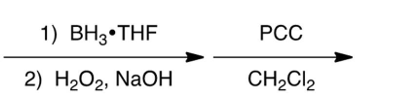
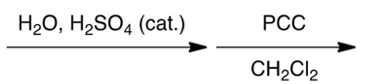
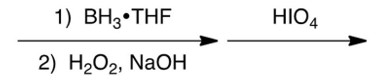
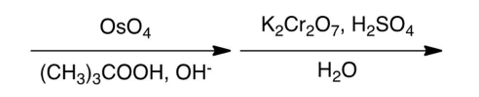
What is the product of the following reactions?
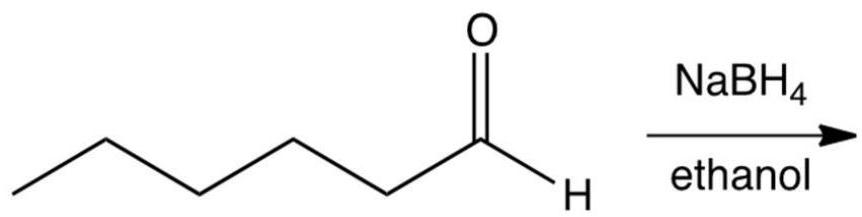
 <strong>What is the product of the following reactions?  </strong> A)  \mathrm{CH}_{3} \mathrm{CH}_{2} \mathrm{CH}_{2} \mathrm{CH}_{2} \mathrm{CH}_{2} \mathrm{CO}_{2} \mathrm{H}  B)  \mathrm{CH}_{3} \mathrm{CH}_{2} \mathrm{CH}_{2} \mathrm{CH}_{2} \mathrm{CH}_{2} \mathrm{CH}_{2} \mathrm{OH}  C)  \mathrm{CH}_{3} \mathrm{CH}_{2} \mathrm{CH}_{2} \mathrm{CH}_{2} \mathrm{CH}=\mathrm{CH}_{2}  D)  \mathrm{CH}_{3} \mathrm{CH}_{2} \mathrm{CH}_{2} \mathrm{CH}_{2} \mathrm{CH}_{2} \mathrm{CH}_{3}  <div style=padding-top: 35px>

A) CH3CH2CH2CH2CH2CO2H\mathrm{CH}_{3} \mathrm{CH}_{2} \mathrm{CH}_{2} \mathrm{CH}_{2} \mathrm{CH}_{2} \mathrm{CO}_{2} \mathrm{H}
B) CH3CH2CH2CH2CH2CH2OH\mathrm{CH}_{3} \mathrm{CH}_{2} \mathrm{CH}_{2} \mathrm{CH}_{2} \mathrm{CH}_{2} \mathrm{CH}_{2} \mathrm{OH}
C) CH3CH2CH2CH2CH=CH2\mathrm{CH}_{3} \mathrm{CH}_{2} \mathrm{CH}_{2} \mathrm{CH}_{2} \mathrm{CH}=\mathrm{CH}_{2}
D) CH3CH2CH2CH2CH2CH3\mathrm{CH}_{3} \mathrm{CH}_{2} \mathrm{CH}_{2} \mathrm{CH}_{2} \mathrm{CH}_{2} \mathrm{CH}_{3}
Use Space or
up arrow
down arrow
to flip the card.
Question
Which of the following cannot be made by the reduction of a ketone or aldehyde with NaBH4\mathrm{NaBH}_{4} in methanol?

A) 1-butanol
B) 2-butanol
C) 2-methyl-1-propanol
D) 2-methyl-2-propanol
Question
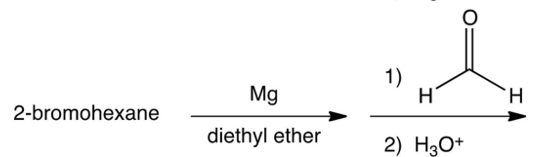
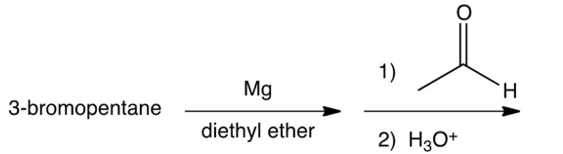
What is the product of the following reaction?
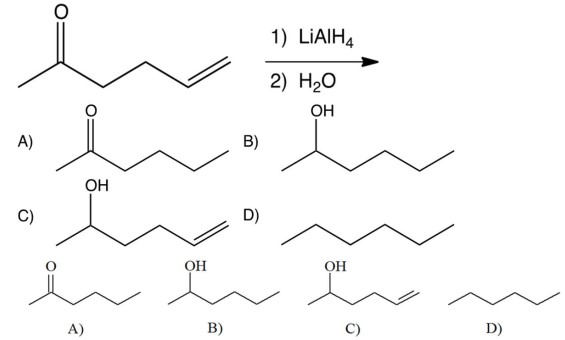
<strong>What is the product of the following reaction?  </strong> A) A B) B C) C D) D <div style=padding-top: 35px>

A) A
B) B
C) C
D) D
Question
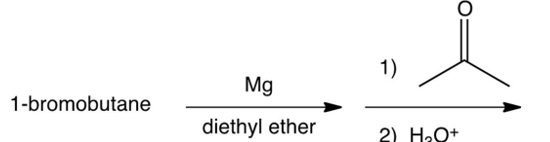
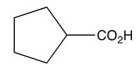
Give the product of the following reaction.
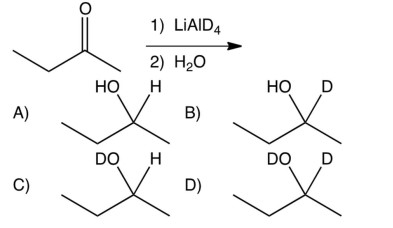
<strong>Give the product of the following reaction.  </strong> A) A B) B C) C D) D <div style=padding-top: 35px>

A) A
B) B
C) C
D) D
Question
The reaction of a Grignard reagent with ethylene oxide followed by dilute acid gives

A) a primary alcohol.
B) a secondary alcohol.
C) a tertiary alcohol.
D) methanol.
Question
Consider the conversion of 1-butanol to each of the compounds shown below. In which conversion is an oxidizing agent needed?

 <strong>Consider the conversion of 1-butanol to each of the compounds shown below. In which conversion is an oxidizing agent needed?  </strong> A)  \mathrm{CH}_{3} \mathrm{CH}_{2} \mathrm{CH}=\mathrm{CH}_{2}  B)  \mathrm{CH}_{3} \mathrm{CH}_{2} \mathrm{CH}_{2} \mathrm{CH}_{2} \mathrm{Br}  C)  \left(\mathrm{CH}_{3} \mathrm{CH}_{2} \mathrm{CH}_{2} \mathrm{CH}_{2}\right)_{2} \mathrm{O}  D)  \mathrm{CH}_{3} \mathrm{CH}_{2} \mathrm{CH}_{2} \mathrm{CH}=\mathrm{O}  <div style=padding-top: 35px>

A) CH3CH2CH=CH2\mathrm{CH}_{3} \mathrm{CH}_{2} \mathrm{CH}=\mathrm{CH}_{2}
B) CH3CH2CH2CH2Br\mathrm{CH}_{3} \mathrm{CH}_{2} \mathrm{CH}_{2} \mathrm{CH}_{2} \mathrm{Br}
C) (CH3CH2CH2CH2)2O\left(\mathrm{CH}_{3} \mathrm{CH}_{2} \mathrm{CH}_{2} \mathrm{CH}_{2}\right)_{2} \mathrm{O}
D) CH3CH2CH2CH=O\mathrm{CH}_{3} \mathrm{CH}_{2} \mathrm{CH}_{2} \mathrm{CH}=\mathrm{O}
Question
Which of the following syntheses gives 3-methyl-1-hexanol?

A)
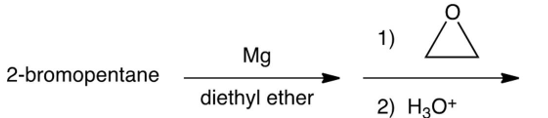
<strong>Which of the following syntheses gives 3-methyl-1-hexanol? </strong> A)   B)   C)   D)   <div style=padding-top: 35px>
B)
<strong>Which of the following syntheses gives 3-methyl-1-hexanol? </strong> A)   B)   C)   D)   <div style=padding-top: 35px>
C)
<strong>Which of the following syntheses gives 3-methyl-1-hexanol? </strong> A)   B)   C)   D)   <div style=padding-top: 35px>
D)
<strong>Which of the following syntheses gives 3-methyl-1-hexanol? </strong> A)   B)   C)   D)   <div style=padding-top: 35px>
Question
What is the product of the synthetic sequence below?

<strong>What is the product of the synthetic sequence below?  </strong> A)   B)   C)   D)   <div style=padding-top: 35px>

A)
<strong>What is the product of the synthetic sequence below?  </strong> A)   B)   C)   D)   <div style=padding-top: 35px>
B)
<strong>What is the product of the synthetic sequence below?  </strong> A)   B)   C)   D)   <div style=padding-top: 35px>
C)
<strong>What is the product of the synthetic sequence below?  </strong> A)   B)   C)   D)   <div style=padding-top: 35px>
D)
<strong>What is the product of the synthetic sequence below?  </strong> A)   B)   C)   D)   <div style=padding-top: 35px>
Question
Compound A,C6H12O\mathrm{A}, \mathrm{C}_{6} \mathrm{H}_{12} \mathrm{O} , is readily oxidized with K2Cr2O7\mathrm{K}_{2} \mathrm{Cr}_{2} \mathrm{O}_{7} in H2SO4/H2O\mathrm{H}_{2} \mathrm{SO}_{4} / \mathrm{H}_{2} \mathrm{O} to give compound B,C6H10O\mathrm{B}, \mathrm{C}_{6} \mathrm{H}_{10} \mathrm{O} . Compound B\mathrm{B} has four peaks in its C-13 NMR (broadband decoupled). Which one of the following fits the data for compound A\mathrm{A} ?
 <strong>Compound  \mathrm{A}, \mathrm{C}_{6} \mathrm{H}_{12} \mathrm{O} , is readily oxidized with  \mathrm{K}_{2} \mathrm{Cr}_{2} \mathrm{O}_{7}  in  \mathrm{H}_{2} \mathrm{SO}_{4} / \mathrm{H}_{2} \mathrm{O}  to give compound  \mathrm{B}, \mathrm{C}_{6} \mathrm{H}_{10} \mathrm{O} . Compound  \mathrm{B}  has four peaks in its C-13 NMR (broadband decoupled). Which one of the following fits the data for compound  \mathrm{A}  ?  </strong> A) A B) B C) C D) D <div style=padding-top: 35px>

A) A
B) B
C) C
D) D
Question
What is the final product of the following reactions?

<strong>What is the final product of the following reactions?  </strong> A) 2,3-dimethyl-3-pentanol B) 2,3-dimethyl-2-pentanol C) 2,4-dimethyl-3-pentanol D) 2,2-dimethyl-3-pentanol <div style=padding-top: 35px>

A) 2,3-dimethyl-3-pentanol
B) 2,3-dimethyl-2-pentanol
C) 2,4-dimethyl-3-pentanol
D) 2,2-dimethyl-3-pentanol
Question
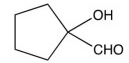
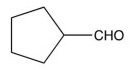
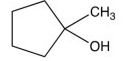
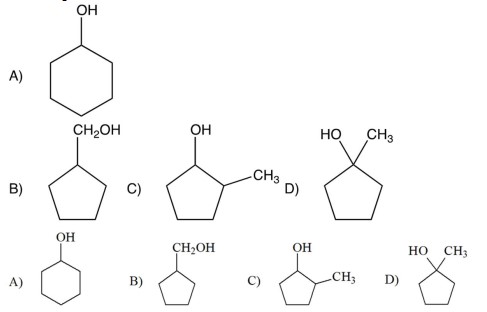
What is the product of the reaction below?
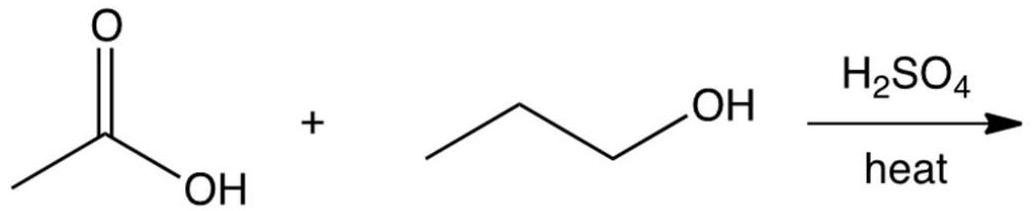
<strong>What is the product of the reaction below?   </strong> A)   B)   C)   D)   <div style=padding-top: 35px>

A)
<strong>What is the product of the reaction below?   </strong> A)   B)   C)   D)   <div style=padding-top: 35px>
B)
<strong>What is the product of the reaction below?   </strong> A)   B)   C)   D)   <div style=padding-top: 35px>
C)
<strong>What is the product of the reaction below?   </strong> A)   B)   C)   D)   <div style=padding-top: 35px>
D)
<strong>What is the product of the reaction below?   </strong> A)   B)   C)   D)   <div style=padding-top: 35px>
Question
What is the product of the following reaction sequence?
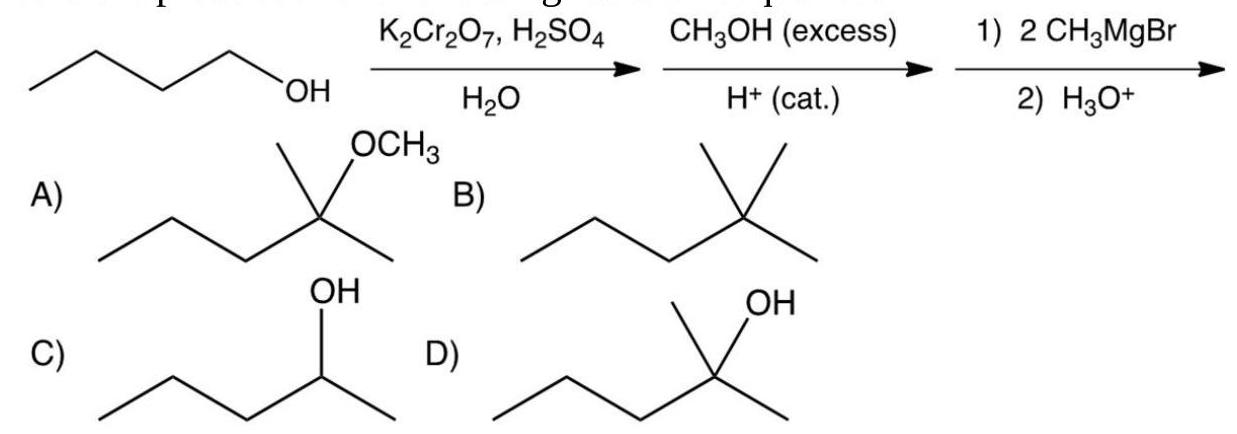
<strong>What is the product of the following reaction sequence?  </strong> A) A B) B C) C D) D <div style=padding-top: 35px>

A) A
B) B
C) C
D) D
Question
Which one of the following reaction steps work best to carry out the transformation shown below?

<strong>Which one of the following reaction steps work best to carry out the transformation shown below?  </strong> A)   B)   C)   D)   <div style=padding-top: 35px>

A)
<strong>Which one of the following reaction steps work best to carry out the transformation shown below?  </strong> A)   B)   C)   D)   <div style=padding-top: 35px>
B)
<strong>Which one of the following reaction steps work best to carry out the transformation shown below?  </strong> A)   B)   C)   D)   <div style=padding-top: 35px>
C)
<strong>Which one of the following reaction steps work best to carry out the transformation shown below?  </strong> A)   B)   C)   D)   <div style=padding-top: 35px>
D)
<strong>Which one of the following reaction steps work best to carry out the transformation shown below?  </strong> A)   B)   C)   D)   <div style=padding-top: 35px>
Question
What is the product of the following reaction sequence?
Cyclopentanone CH3OHNaBH4 heat H2SO4\xrightarrow[\mathrm{CH}_{3} \mathrm{OH}]{\mathrm{NaBH}_{4}} \xrightarrow[\text { heat }]{\mathrm{H}_{2} \mathrm{SO}_{4}}

A) cyclopentene oxide
B) cyclopentene
C) cyclopentane
D) cis-1,2-cyclopentanediol
Question
To which side, if any, would the reaction below lie?

<strong>To which side, if any, would the reaction below lie?  </strong> A) to the right B) to the left C) equally to both sides D) this reaction cannot occur <div style=padding-top: 35px>

A) to the right
B) to the left
C) equally to both sides
D) this reaction cannot occur
Unlock Deck
Sign up to unlock the cards in this deck!
Unlock Deck
Unlock Deck
1/15
auto play flashcards
Play
simple tutorial
Full screen (f)
exit full mode
Deck 15: Alcohols, Diols, and Thiols
1
What is the product of the following reactions?
 <strong>What is the product of the following reactions?  </strong> A)  \mathrm{CH}_{3} \mathrm{CH}_{2} \mathrm{CH}_{2} \mathrm{CH}_{2} \mathrm{CH}_{2} \mathrm{CO}_{2} \mathrm{H}  B)  \mathrm{CH}_{3} \mathrm{CH}_{2} \mathrm{CH}_{2} \mathrm{CH}_{2} \mathrm{CH}_{2} \mathrm{CH}_{2} \mathrm{OH}  C)  \mathrm{CH}_{3} \mathrm{CH}_{2} \mathrm{CH}_{2} \mathrm{CH}_{2} \mathrm{CH}=\mathrm{CH}_{2}  D)  \mathrm{CH}_{3} \mathrm{CH}_{2} \mathrm{CH}_{2} \mathrm{CH}_{2} \mathrm{CH}_{2} \mathrm{CH}_{3}

A) CH3CH2CH2CH2CH2CO2H\mathrm{CH}_{3} \mathrm{CH}_{2} \mathrm{CH}_{2} \mathrm{CH}_{2} \mathrm{CH}_{2} \mathrm{CO}_{2} \mathrm{H}
B) CH3CH2CH2CH2CH2CH2OH\mathrm{CH}_{3} \mathrm{CH}_{2} \mathrm{CH}_{2} \mathrm{CH}_{2} \mathrm{CH}_{2} \mathrm{CH}_{2} \mathrm{OH}
C) CH3CH2CH2CH2CH=CH2\mathrm{CH}_{3} \mathrm{CH}_{2} \mathrm{CH}_{2} \mathrm{CH}_{2} \mathrm{CH}=\mathrm{CH}_{2}
D) CH3CH2CH2CH2CH2CH3\mathrm{CH}_{3} \mathrm{CH}_{2} \mathrm{CH}_{2} \mathrm{CH}_{2} \mathrm{CH}_{2} \mathrm{CH}_{3}
CH3CH2CH2CH2CH2CH2OH\mathrm{CH}_{3} \mathrm{CH}_{2} \mathrm{CH}_{2} \mathrm{CH}_{2} \mathrm{CH}_{2} \mathrm{CH}_{2} \mathrm{OH}
2
Which of the following cannot be made by the reduction of a ketone or aldehyde with NaBH4\mathrm{NaBH}_{4} in methanol?

A) 1-butanol
B) 2-butanol
C) 2-methyl-1-propanol
D) 2-methyl-2-propanol
2-methyl-2-propanol
3
What is the product of the following reaction?
<strong>What is the product of the following reaction?  </strong> A) A B) B C) C D) D

A) A
B) B
C) C
D) D
C
4
Give the product of the following reaction.
<strong>Give the product of the following reaction.  </strong> A) A B) B C) C D) D

A) A
B) B
C) C
D) D
Unlock Deck
Unlock for access to all 15 flashcards in this deck.
Unlock Deck
k this deck
5
The reaction of a Grignard reagent with ethylene oxide followed by dilute acid gives

A) a primary alcohol.
B) a secondary alcohol.
C) a tertiary alcohol.
D) methanol.
Unlock Deck
Unlock for access to all 15 flashcards in this deck.
Unlock Deck
k this deck
6
Consider the conversion of 1-butanol to each of the compounds shown below. In which conversion is an oxidizing agent needed?
 <strong>Consider the conversion of 1-butanol to each of the compounds shown below. In which conversion is an oxidizing agent needed?  </strong> A)  \mathrm{CH}_{3} \mathrm{CH}_{2} \mathrm{CH}=\mathrm{CH}_{2}  B)  \mathrm{CH}_{3} \mathrm{CH}_{2} \mathrm{CH}_{2} \mathrm{CH}_{2} \mathrm{Br}  C)  \left(\mathrm{CH}_{3} \mathrm{CH}_{2} \mathrm{CH}_{2} \mathrm{CH}_{2}\right)_{2} \mathrm{O}  D)  \mathrm{CH}_{3} \mathrm{CH}_{2} \mathrm{CH}_{2} \mathrm{CH}=\mathrm{O}

A) CH3CH2CH=CH2\mathrm{CH}_{3} \mathrm{CH}_{2} \mathrm{CH}=\mathrm{CH}_{2}
B) CH3CH2CH2CH2Br\mathrm{CH}_{3} \mathrm{CH}_{2} \mathrm{CH}_{2} \mathrm{CH}_{2} \mathrm{Br}
C) (CH3CH2CH2CH2)2O\left(\mathrm{CH}_{3} \mathrm{CH}_{2} \mathrm{CH}_{2} \mathrm{CH}_{2}\right)_{2} \mathrm{O}
D) CH3CH2CH2CH=O\mathrm{CH}_{3} \mathrm{CH}_{2} \mathrm{CH}_{2} \mathrm{CH}=\mathrm{O}
Unlock Deck
Unlock for access to all 15 flashcards in this deck.
Unlock Deck
k this deck
7
Which of the following syntheses gives 3-methyl-1-hexanol?

A)
<strong>Which of the following syntheses gives 3-methyl-1-hexanol? </strong> A)   B)   C)   D)
B)
<strong>Which of the following syntheses gives 3-methyl-1-hexanol? </strong> A)   B)   C)   D)
C)
<strong>Which of the following syntheses gives 3-methyl-1-hexanol? </strong> A)   B)   C)   D)
D)
<strong>Which of the following syntheses gives 3-methyl-1-hexanol? </strong> A)   B)   C)   D)
Unlock Deck
Unlock for access to all 15 flashcards in this deck.
Unlock Deck
k this deck
8
What is the product of the synthetic sequence below?
<strong>What is the product of the synthetic sequence below?  </strong> A)   B)   C)   D)

A)
<strong>What is the product of the synthetic sequence below?  </strong> A)   B)   C)   D)
B)
<strong>What is the product of the synthetic sequence below?  </strong> A)   B)   C)   D)
C)
<strong>What is the product of the synthetic sequence below?  </strong> A)   B)   C)   D)
D)
<strong>What is the product of the synthetic sequence below?  </strong> A)   B)   C)   D)
Unlock Deck
Unlock for access to all 15 flashcards in this deck.
Unlock Deck
k this deck
9
Compound A,C6H12O\mathrm{A}, \mathrm{C}_{6} \mathrm{H}_{12} \mathrm{O} , is readily oxidized with K2Cr2O7\mathrm{K}_{2} \mathrm{Cr}_{2} \mathrm{O}_{7} in H2SO4/H2O\mathrm{H}_{2} \mathrm{SO}_{4} / \mathrm{H}_{2} \mathrm{O} to give compound B,C6H10O\mathrm{B}, \mathrm{C}_{6} \mathrm{H}_{10} \mathrm{O} . Compound B\mathrm{B} has four peaks in its C-13 NMR (broadband decoupled). Which one of the following fits the data for compound A\mathrm{A} ?
 <strong>Compound  \mathrm{A}, \mathrm{C}_{6} \mathrm{H}_{12} \mathrm{O} , is readily oxidized with  \mathrm{K}_{2} \mathrm{Cr}_{2} \mathrm{O}_{7}  in  \mathrm{H}_{2} \mathrm{SO}_{4} / \mathrm{H}_{2} \mathrm{O}  to give compound  \mathrm{B}, \mathrm{C}_{6} \mathrm{H}_{10} \mathrm{O} . Compound  \mathrm{B}  has four peaks in its C-13 NMR (broadband decoupled). Which one of the following fits the data for compound  \mathrm{A}  ?  </strong> A) A B) B C) C D) D

A) A
B) B
C) C
D) D
Unlock Deck
Unlock for access to all 15 flashcards in this deck.
Unlock Deck
k this deck
10
What is the final product of the following reactions?
<strong>What is the final product of the following reactions?  </strong> A) 2,3-dimethyl-3-pentanol B) 2,3-dimethyl-2-pentanol C) 2,4-dimethyl-3-pentanol D) 2,2-dimethyl-3-pentanol

A) 2,3-dimethyl-3-pentanol
B) 2,3-dimethyl-2-pentanol
C) 2,4-dimethyl-3-pentanol
D) 2,2-dimethyl-3-pentanol
Unlock Deck
Unlock for access to all 15 flashcards in this deck.
Unlock Deck
k this deck
11
What is the product of the reaction below?
<strong>What is the product of the reaction below?   </strong> A)   B)   C)   D)

A)
<strong>What is the product of the reaction below?   </strong> A)   B)   C)   D)
B)
<strong>What is the product of the reaction below?   </strong> A)   B)   C)   D)
C)
<strong>What is the product of the reaction below?   </strong> A)   B)   C)   D)
D)
<strong>What is the product of the reaction below?   </strong> A)   B)   C)   D)
Unlock Deck
Unlock for access to all 15 flashcards in this deck.
Unlock Deck
k this deck
12
What is the product of the following reaction sequence?
<strong>What is the product of the following reaction sequence?  </strong> A) A B) B C) C D) D

A) A
B) B
C) C
D) D
Unlock Deck
Unlock for access to all 15 flashcards in this deck.
Unlock Deck
k this deck
13
Which one of the following reaction steps work best to carry out the transformation shown below?
<strong>Which one of the following reaction steps work best to carry out the transformation shown below?  </strong> A)   B)   C)   D)

A)
<strong>Which one of the following reaction steps work best to carry out the transformation shown below?  </strong> A)   B)   C)   D)
B)
<strong>Which one of the following reaction steps work best to carry out the transformation shown below?  </strong> A)   B)   C)   D)
C)
<strong>Which one of the following reaction steps work best to carry out the transformation shown below?  </strong> A)   B)   C)   D)
D)
<strong>Which one of the following reaction steps work best to carry out the transformation shown below?  </strong> A)   B)   C)   D)
Unlock Deck
Unlock for access to all 15 flashcards in this deck.
Unlock Deck
k this deck
14
What is the product of the following reaction sequence?
Cyclopentanone CH3OHNaBH4 heat H2SO4\xrightarrow[\mathrm{CH}_{3} \mathrm{OH}]{\mathrm{NaBH}_{4}} \xrightarrow[\text { heat }]{\mathrm{H}_{2} \mathrm{SO}_{4}}

A) cyclopentene oxide
B) cyclopentene
C) cyclopentane
D) cis-1,2-cyclopentanediol
Unlock Deck
Unlock for access to all 15 flashcards in this deck.
Unlock Deck
k this deck
15
To which side, if any, would the reaction below lie?
<strong>To which side, if any, would the reaction below lie?  </strong> A) to the right B) to the left C) equally to both sides D) this reaction cannot occur

A) to the right
B) to the left
C) equally to both sides
D) this reaction cannot occur
Unlock Deck
Unlock for access to all 15 flashcards in this deck.
Unlock Deck
k this deck
locked card icon
Unlock Deck
Unlock for access to all 15 flashcards in this deck.