







 Chat with AI

Deck 67: Nursing Management: Shock, Systemic Inflammatory Response Syndrome, and Multiple Organ Dysfunction Syndrome
Full screen (f)

Question

Question
Question
Question
Question
Question
Question
Question
Question
Question
Question
Question
Question
Question
Question
Question
Question
Question
Question
Question
Question
Question
After reviewing the information shown in the accompanying figure for a patient with pneumonia and sepsis,which information is most important to report to the health care provider?
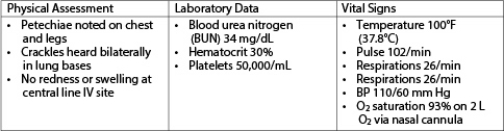
A) Temperature and IV site appearance
B) Oxygen saturation and breath sounds
C) Platelet count and presence of petechiae
D) Blood pressure, pulse rate, respiratory rate.
A) Temperature and IV site appearance
B) Oxygen saturation and breath sounds
C) Platelet count and presence of petechiae
D) Blood pressure, pulse rate, respiratory rate.
Question
Question
Question
Question
Question
Question
Question

Unlock Deck
Sign up to unlock the cards in this deck!
Unlock Deck
Unlock Deck
1/29

Play

Full screen (f)
Deck 67: Nursing Management: Shock, Systemic Inflammatory Response Syndrome, and Multiple Organ Dysfunction Syndrome
1
A nurse is assessing a patient who is receiving a nitroprusside (Nipride)infusion to treat cardiogenic shock.Which finding indicates that the medication is effective?
A) No new heart murmurs
B) Decreased troponin level
C) Warm, pink, and dry skin
D) Blood pressure 92/40 mm Hg
A) No new heart murmurs
B) Decreased troponin level
C) Warm, pink, and dry skin
D) Blood pressure 92/40 mm Hg
Warm, pink, and dry skin
2
Norepinephrine (Levophed)has been prescribed for a patient who was admitted with dehydration and hypotension.Which patient data indicate that the nurse should consult with the health care provider before starting the norepinephrine?
A) The patient's central venous pressure is 3 mm Hg.
B) The patient is in sinus tachycardia at 120 beats/min.
C) The patient is receiving low dose dopamine (Intropin).
D) The patient has had no urine output since being admitted.
A) The patient's central venous pressure is 3 mm Hg.
B) The patient is in sinus tachycardia at 120 beats/min.
C) The patient is receiving low dose dopamine (Intropin).
D) The patient has had no urine output since being admitted.
The patient's central venous pressure is 3 mm Hg.
3
A 19-year-old patient with massive trauma and possible spinal cord injury is admitted to the emergency department (ED).Which assessment finding by the nurse will help confirm a diagnosis of neurogenic shock?
A) Inspiratory crackles.
B) Cool, clammy extremities.
C) Apical heart rate 45 beats/min.
D) Temperature 101.2° F (38.4° C).
A) Inspiratory crackles.
B) Cool, clammy extremities.
C) Apical heart rate 45 beats/min.
D) Temperature 101.2° F (38.4° C).
Apical heart rate 45 beats/min.
4
A nurse is caring for a patient with shock of unknown etiology whose hemodynamic monitoring indicates BP 92/54,pulse 64,and an elevated pulmonary artery wedge pressure.Which collaborative intervention ordered by the health care provider should the nurse question?
A) Infuse normal saline at 250 mL/hr.
B) Keep head of bed elevated to 30 degrees.
C) Hold nitroprusside (Nipride) if systolic BP <90 mm Hg.
D) Titrate dobutamine (Dobutrex) to keep systolic BP >90 mm Hg.
A) Infuse normal saline at 250 mL/hr.
B) Keep head of bed elevated to 30 degrees.
C) Hold nitroprusside (Nipride) if systolic BP <90 mm Hg.
D) Titrate dobutamine (Dobutrex) to keep systolic BP >90 mm Hg.
Unlock Deck
Unlock for access to all 29 flashcards in this deck.
Unlock Deck
k this deck
5
The nurse is caring for a patient who has septic shock.Which assessment finding is most important for the nurse to report to the health care provider?
A) Blood pressure (BP) 92/56 mm Hg
B) Skin cool and clammy
C) Oxygen saturation 92%
D) Heart rate 118 beats/minute
A) Blood pressure (BP) 92/56 mm Hg
B) Skin cool and clammy
C) Oxygen saturation 92%
D) Heart rate 118 beats/minute
Unlock Deck
Unlock for access to all 29 flashcards in this deck.
Unlock Deck
k this deck
6
Which intervention will the nurse include in the plan of care for a patient who has cardiogenic shock?
A) Check temperature every 2 hours.
B) Monitor breath sounds frequently.
C) Maintain patient in supine position.
D) Assess skin for flushing and itching.
A) Check temperature every 2 hours.
B) Monitor breath sounds frequently.
C) Maintain patient in supine position.
D) Assess skin for flushing and itching.
Unlock Deck
Unlock for access to all 29 flashcards in this deck.
Unlock Deck
k this deck
7
A patient who has been involved in a motor vehicle crash arrives in the emergency department (ED)with cool,clammy skin; tachycardia; and hypotension.Which intervention ordered by the health care provider should the nurse implement first?
A) Insert two large-bore IV catheters.
B) Initiate continuous electrocardiogram (ECG) monitoring.
C) Provide oxygen at 100% per non-rebreather mask.
D) Draw blood to type and crossmatch for transfusions.
A) Insert two large-bore IV catheters.
B) Initiate continuous electrocardiogram (ECG) monitoring.
C) Provide oxygen at 100% per non-rebreather mask.
D) Draw blood to type and crossmatch for transfusions.
Unlock Deck
Unlock for access to all 29 flashcards in this deck.
Unlock Deck
k this deck
8
During change-of-shift report,the nurse is told that a patient has been admitted with dehydration and hypotension after having vomiting and diarrhea for 4 days.Which finding is most important for the nurse to report to the health care provider?
A) New onset of confusion
B) Heart rate 112 beats/minute
C) Decreased bowel sounds
D) Pale, cool, and dry extremities
A) New onset of confusion
B) Heart rate 112 beats/minute
C) Decreased bowel sounds
D) Pale, cool, and dry extremities
Unlock Deck
Unlock for access to all 29 flashcards in this deck.
Unlock Deck
k this deck
9
A patient with septic shock has a BP of 70/46 mm Hg,pulse 136,respirations 32,temperature 104° F,and blood glucose 246 mg/dL.Which intervention ordered by the health care provider should the nurse implement first?
A) Give normal saline IV at 500 mL/hr.
B) Give acetaminophen (Tylenol) 650 mg rectally.
C) Start insulin drip to maintain blood glucose at 110 to 150 mg/dL.
D) Start norepinephrine (Levophed) to keep systolic blood pressure >90 mm Hg.
A) Give normal saline IV at 500 mL/hr.
B) Give acetaminophen (Tylenol) 650 mg rectally.
C) Start insulin drip to maintain blood glucose at 110 to 150 mg/dL.
D) Start norepinephrine (Levophed) to keep systolic blood pressure >90 mm Hg.
Unlock Deck
Unlock for access to all 29 flashcards in this deck.
Unlock Deck
k this deck
10
When the nurse educator is evaluating the skills of a new registered nurse (RN)caring for patients experiencing shock,which action by the new RN indicates a need for more education?
A) Placing the pulse oximeter on the ear for a patient with septic shock
B) Keeping the head of the bed flat for a patient with hypovolemic shock
C) Increasing the nitroprusside (Nipride) infusion rate for a patient with a high SVR
D) Maintaining the room temperature at 66° to 68° F for a patient with neurogenic shock
A) Placing the pulse oximeter on the ear for a patient with septic shock
B) Keeping the head of the bed flat for a patient with hypovolemic shock
C) Increasing the nitroprusside (Nipride) infusion rate for a patient with a high SVR
D) Maintaining the room temperature at 66° to 68° F for a patient with neurogenic shock
Unlock Deck
Unlock for access to all 29 flashcards in this deck.
Unlock Deck
k this deck
11
After receiving 2 L of normal saline,the central venous pressure for a patient who has septic shock is 10 mm Hg,but the blood pressure is still 82/40 mm Hg.The nurse will anticipate an order for
A) nitroglycerine (Tridil).
B) norepinephrine (Levophed).
C) sodium nitroprusside (Nipride).
D) methylprednisolone (Solu-Medrol).
A) nitroglycerine (Tridil).
B) norepinephrine (Levophed).
C) sodium nitroprusside (Nipride).
D) methylprednisolone (Solu-Medrol).
Unlock Deck
Unlock for access to all 29 flashcards in this deck.
Unlock Deck
k this deck
12
Which assessment information is most important for the nurse to obtain to evaluate whether treatment of a patient with anaphylactic shock has been effective?
A) Heart rate
B) Orientation
C) Blood pressure
D) Oxygen saturation
A) Heart rate
B) Orientation
C) Blood pressure
D) Oxygen saturation
Unlock Deck
Unlock for access to all 29 flashcards in this deck.
Unlock Deck
k this deck
13
Which finding is the best indicator that the fluid resuscitation for a patient with hypovolemic shock has been effective?
A) Hemoglobin is within normal limits.
B) Urine output is 60 mL over the last hour.
C) Central venous pressure (CVP) is normal.
D) Mean arterial pressure (MAP) is 72 mm Hg.
A) Hemoglobin is within normal limits.
B) Urine output is 60 mL over the last hour.
C) Central venous pressure (CVP) is normal.
D) Mean arterial pressure (MAP) is 72 mm Hg.
Unlock Deck
Unlock for access to all 29 flashcards in this deck.
Unlock Deck
k this deck
14
A patient with cardiogenic shock has the following vital signs: BP 102/50,pulse 128,respirations 28.The pulmonary artery wedge pressure (PAWP)is increased and cardiac output is low.The nurse will anticipate an order for which medication?
A) 5% human albumin
B) Furosemide (Lasix) IV
C) Epinephrine (Adrenalin) drip
D) Hydrocortisone (Solu-Cortef)
A) 5% human albumin
B) Furosemide (Lasix) IV
C) Epinephrine (Adrenalin) drip
D) Hydrocortisone (Solu-Cortef)
Unlock Deck
Unlock for access to all 29 flashcards in this deck.
Unlock Deck
k this deck
15
An older patient with cardiogenic shock is cool and clammy and hemodynamic monitoring indicates a high systemic vascular resistance (SVR).Which intervention should the nurse anticipate doing next?
A) Increase the rate for the dopamine (Intropin) infusion.
B) Decrease the rate for the nitroglycerin (Tridil) infusion.
C) Increase the rate for the sodium nitroprusside (Nipride) infusion.
D) Decrease the rate for the 5% dextrose in normal saline (D5/.9 NS) infusion.
A) Increase the rate for the dopamine (Intropin) infusion.
B) Decrease the rate for the nitroglycerin (Tridil) infusion.
C) Increase the rate for the sodium nitroprusside (Nipride) infusion.
D) Decrease the rate for the 5% dextrose in normal saline (D5/.9 NS) infusion.
Unlock Deck
Unlock for access to all 29 flashcards in this deck.
Unlock Deck
k this deck
16
Which data collected by the nurse caring for a patient who has cardiogenic shock indicate that the patient may be developing multiple organ dysfunction syndrome (MODS)?
A) The patient's serum creatinine level is elevated.
B) The patient complains of intermittent chest pressure.
C) The patient's extremities are cool and pulses are weak.
D) The patient has bilateral crackles throughout lung fields.
A) The patient's serum creatinine level is elevated.
B) The patient complains of intermittent chest pressure.
C) The patient's extremities are cool and pulses are weak.
D) The patient has bilateral crackles throughout lung fields.
Unlock Deck
Unlock for access to all 29 flashcards in this deck.
Unlock Deck
k this deck
17
A 78-kg patient with septic shock has a urine output of 30 mL/hr for the past 3 hours.The pulse rate is 120/minute and the central venous pressure and pulmonary artery wedge pressure are low.Which order by the health care provider will the nurse question?
A) Give PRN furosemide (Lasix) 40 mg IV.
B) Increase normal saline infusion to 250 mL/hr.
C) Administer hydrocortisone (Solu-Cortef) 100 mg IV.
D) Titrate norepinephrine (Levophed) to keep systolic BP >90 mm Hg.
A) Give PRN furosemide (Lasix) 40 mg IV.
B) Increase normal saline infusion to 250 mL/hr.
C) Administer hydrocortisone (Solu-Cortef) 100 mg IV.
D) Titrate norepinephrine (Levophed) to keep systolic BP >90 mm Hg.
Unlock Deck
Unlock for access to all 29 flashcards in this deck.
Unlock Deck
k this deck
18
To evaluate the effectiveness of the pantoprazole (Protonix)ordered for a patient with systemic inflammatory response syndrome (SIRS),which assessment will the nurse perform?
A) Auscultate bowel sounds.
B) Palpate for abdominal pain.
C) Ask the patient about nausea.
D) Check stools for occult blood.
A) Auscultate bowel sounds.
B) Palpate for abdominal pain.
C) Ask the patient about nausea.
D) Check stools for occult blood.
Unlock Deck
Unlock for access to all 29 flashcards in this deck.
Unlock Deck
k this deck
19
A patient is admitted to the emergency department (ED)for shock of unknown etiology.The first action by the nurse should be to
A) administer oxygen.
B) obtain a 12-lead electrocardiogram (ECG).
C) obtain the blood pressure.
D) check the level of consciousness.
A) administer oxygen.
B) obtain a 12-lead electrocardiogram (ECG).
C) obtain the blood pressure.
D) check the level of consciousness.
Unlock Deck
Unlock for access to all 29 flashcards in this deck.
Unlock Deck
k this deck
20
The emergency department (ED)nurse receives report that a patient involved in a motor vehicle crash is being transported to the facility with an estimated arrival in 1 minute.In preparation for the patient's arrival,the nurse will obtain
A) hypothermia blanket.
B) lactated Ringer's solution.
C) two 14-gauge IV catheters.
D) dopamine (Intropin) infusion.
A) hypothermia blanket.
B) lactated Ringer's solution.
C) two 14-gauge IV catheters.
D) dopamine (Intropin) infusion.
Unlock Deck
Unlock for access to all 29 flashcards in this deck.
Unlock Deck
k this deck
21
The following interventions are ordered by the health care provider for a patient who has respiratory distress and syncope after eating strawberries.Which will the nurse complete first?
A) Start a normal saline infusion.
B) Give epinephrine (Adrenalin).
C) Start continuous ECG monitoring.
D) Give diphenhydramine (Benadryl).
A) Start a normal saline infusion.
B) Give epinephrine (Adrenalin).
C) Start continuous ECG monitoring.
D) Give diphenhydramine (Benadryl).
Unlock Deck
Unlock for access to all 29 flashcards in this deck.
Unlock Deck
k this deck
22
After reviewing the information shown in the accompanying figure for a patient with pneumonia and sepsis,which information is most important to report to the health care provider?
A) Temperature and IV site appearance
B) Oxygen saturation and breath sounds
C) Platelet count and presence of petechiae
D) Blood pressure, pulse rate, respiratory rate.
A) Temperature and IV site appearance
B) Oxygen saturation and breath sounds
C) Platelet count and presence of petechiae
D) Blood pressure, pulse rate, respiratory rate.
Unlock Deck
Unlock for access to all 29 flashcards in this deck.
Unlock Deck
k this deck
23
A patient with suspected neurogenic shock after a diving accident has arrived in the emergency department.A cervical collar is in place.Which actions should the nurse take ?
A) Prepare to administer atropine IV.
B) Obtain baseline body temperature.
C) Infuse large volumes of lactated Ringer's solution.
D) Provide high-flow oxygen (100%) by non-rebreather mask.
E) Prepare for emergent intubation and mechanical ventilation.
A) Prepare to administer atropine IV.
B) Obtain baseline body temperature.
C) Infuse large volumes of lactated Ringer's solution.
D) Provide high-flow oxygen (100%) by non-rebreather mask.
E) Prepare for emergent intubation and mechanical ventilation.
Unlock Deck
Unlock for access to all 29 flashcards in this deck.
Unlock Deck
k this deck
24
A 198-lb patient is to receive a dobutamine infusion at 5 mcg/kg/minute.The label on the infusion bag states: dobutamine 250 mg in 250 mL normal saline.When setting the infusion pump,the nurse will set the infusion rate at how many mL per hour?
Unlock Deck
Unlock for access to all 29 flashcards in this deck.
Unlock Deck
k this deck
25
Which finding about a patient who is receiving vasopressin (Pitressin)to treat septic shock is most important for the nurse to communicate to the health care provider?
A) The patient's urine output is 18 mL/hr.
B) The patient's heart rate is 110 beats/minute.
C) The patient is complaining of chest pain.
D) The patient's peripheral pulses are weak.
A) The patient's urine output is 18 mL/hr.
B) The patient's heart rate is 110 beats/minute.
C) The patient is complaining of chest pain.
D) The patient's peripheral pulses are weak.
Unlock Deck
Unlock for access to all 29 flashcards in this deck.
Unlock Deck
k this deck
26
After change-of-shift report in the progressive care unit,who should the nurse care for first?
A) Patient who had an inferior myocardial infarction 2 days ago and has crackles in the lung bases
B) Patient with suspected urosepsis who has new orders for urine and blood cultures and antibiotics
C) Patient who had a T5 spinal cord injury 1 week ago and currently has a heart rate of 54 beats/minute
D) Patient admitted with anaphylaxis 3 hours ago who now has clear lung sounds and a blood pressure of 108/58 mm Hg
A) Patient who had an inferior myocardial infarction 2 days ago and has crackles in the lung bases
B) Patient with suspected urosepsis who has new orders for urine and blood cultures and antibiotics
C) Patient who had a T5 spinal cord injury 1 week ago and currently has a heart rate of 54 beats/minute
D) Patient admitted with anaphylaxis 3 hours ago who now has clear lung sounds and a blood pressure of 108/58 mm Hg
Unlock Deck
Unlock for access to all 29 flashcards in this deck.
Unlock Deck
k this deck
27
The patient with neurogenic shock is receiving a phenylephrine (Neo-Synephrine)infusion through a right forearm IV.Which assessment finding obtained by the nurse indicates a need for immediate action?
A) The patient's heart rate is 58 beats/minute.
B) The patient's extremities are warm and dry.
C) The patient's IV infusion site is cool and pale.
D) The patient's urine output is 28 mL over the last hour.
A) The patient's heart rate is 58 beats/minute.
B) The patient's extremities are warm and dry.
C) The patient's IV infusion site is cool and pale.
D) The patient's urine output is 28 mL over the last hour.
Unlock Deck
Unlock for access to all 29 flashcards in this deck.
Unlock Deck
k this deck
28
The health care provider orders the following interventions for a 67-kg patient who has septic shock with a BP of 70/42 mm Hg and oxygen saturation of 90% on room air.In which order will the nurse implement the actions? (Put a comma and a space between each answer choice [A,B,C,D,E].)
A) Obtain blood and urine cultures.
B) Give vancomycin (Vancocin) 1 g IV.
C) Start norepinephrine (Levophed) 0.5 mcg/min.
D) Infuse normal saline 2000 mL over 30 minutes.
E) Titrate oxygen administration to keep O2 saturation >95%.
A) Obtain blood and urine cultures.
B) Give vancomycin (Vancocin) 1 g IV.
C) Start norepinephrine (Levophed) 0.5 mcg/min.
D) Infuse normal saline 2000 mL over 30 minutes.
E) Titrate oxygen administration to keep O2 saturation >95%.
Unlock Deck
Unlock for access to all 29 flashcards in this deck.
Unlock Deck
k this deck
29
Which preventive actions by the nurse will help limit the development of systemic inflammatory response syndrome (SIRS)in patients admitted to the hospital ?
A) Use aseptic technique when caring for invasive lines or devices.
B) Ambulate postoperative patients as soon as possible after surgery.
C) Remove indwelling urinary catheters as soon as possible after surgery.
D) Advocate for parenteral nutrition for patients who cannot take oral feedings.
E) Administer prescribed antibiotics within 1 hour for patients with possible sepsis.
A) Use aseptic technique when caring for invasive lines or devices.
B) Ambulate postoperative patients as soon as possible after surgery.
C) Remove indwelling urinary catheters as soon as possible after surgery.
D) Advocate for parenteral nutrition for patients who cannot take oral feedings.
E) Administer prescribed antibiotics within 1 hour for patients with possible sepsis.
Unlock Deck
Unlock for access to all 29 flashcards in this deck.
Unlock Deck
k this deck
Unlock Deck
Unlock for access to all 29 flashcards in this deck.






