







 Chat with AI

Deck 29: Plant Diversity I: How Plants Colonized Land
Full screen (f)

Question

Question
Question
Question
Question
Question
Question
Question
Question
Question
Question
Question
Question
Question
Question
Question
Question
Question
Question
Question
Question
Question
Question
Question
Question
Question
Question
Question
Question
Question
Question
Question
Question
Question
Question
Question
Question
Question
Question
Question
Question
Question
Question
Question
Question
Question
Question
Question
Question
Question
Question
Question
Question
Question
Question
Question
Question
Question
Question
Question
Question
Question
Question
Refer to the following information to answer the next few questions.
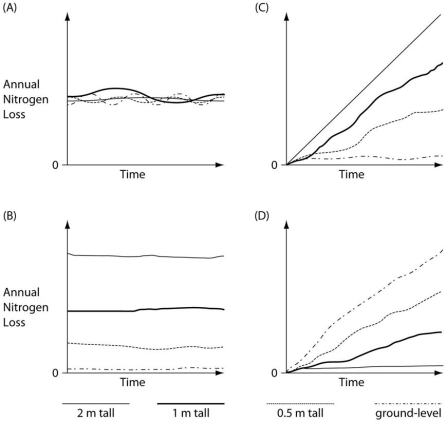
Researchers decided to test the hypothesis that if the 2-m tall Polytrichum gametophyte-sporophyte plants had acted as a physical buffer,then they would have reduced water's ability to erode the soil and carry away its nitrogen.They began with four equal-sized areas where Polytrichum mosses grew to a height of 2 m above the soil surface.One of the four areas was not modified.In the second area,the mosses were trimmed to a height of 1 m above the soil surface.In the third area,the mosses were trimmed to a height of 0.5 m above the soil surface.In the fourth area,the mosses were trimmed all the way to the ground,leaving only the rhizoids.Water,simulating rainfall,was then added in a controlled fashion to all plots over the course of one year.The figure below presents four graphs that depict potential results of this experiment.
Why should we expect the soil's nitrogen not to be contained solely within the rhizoids of the Polytrichum mosses?
A)Rhizoids are associated with fungi that inhibit mineral transfer from soil to rhizoids.
B)Rhizoids are not absorptive structures.
C)Rhizoids consist of single, tubular cells or of filaments of cells.
D)Rhizoids lack direct attachment to the moss sporophytes.
Researchers decided to test the hypothesis that if the 2-m tall Polytrichum gametophyte-sporophyte plants had acted as a physical buffer,then they would have reduced water's ability to erode the soil and carry away its nitrogen.They began with four equal-sized areas where Polytrichum mosses grew to a height of 2 m above the soil surface.One of the four areas was not modified.In the second area,the mosses were trimmed to a height of 1 m above the soil surface.In the third area,the mosses were trimmed to a height of 0.5 m above the soil surface.In the fourth area,the mosses were trimmed all the way to the ground,leaving only the rhizoids.Water,simulating rainfall,was then added in a controlled fashion to all plots over the course of one year.The figure below presents four graphs that depict potential results of this experiment.
Why should we expect the soil's nitrogen not to be contained solely within the rhizoids of the Polytrichum mosses?
A)Rhizoids are associated with fungi that inhibit mineral transfer from soil to rhizoids.
B)Rhizoids are not absorptive structures.
C)Rhizoids consist of single, tubular cells or of filaments of cells.
D)Rhizoids lack direct attachment to the moss sporophytes.
Question
Researchers tested nitrogen loss from soil where the moss Polytrichum was growing,and compared it to soil from which Polytrichum had been removed.The data are presented below.
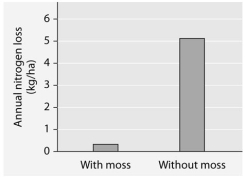
Loss of soil nitrogen via "gaseous emission" was found to be negligible.Rather,most loss of soil nitrogen was due to water erosion of the soil.Which of these hypotheses is least likely to account for the observed results?
A)If rhizoids had helped stabilize the soil, then less erosion and less loss of nitrogen would occur.
B)If protonemata had absorbed, and stored, nitrogen from the soil, then they would have reduced loss of nitrogen by erosion.
C)If the overlying mat of gametophores had slowed the entry of water into the soil, then it would have reduced water's ability to erode the soil and carry away its nitrogen.
D)If sporophyte stomata had absorbed nitrogen from the soil, then they would have reduced loss of nitrogen by erosion.
Loss of soil nitrogen via "gaseous emission" was found to be negligible.Rather,most loss of soil nitrogen was due to water erosion of the soil.Which of these hypotheses is least likely to account for the observed results?
A)If rhizoids had helped stabilize the soil, then less erosion and less loss of nitrogen would occur.
B)If protonemata had absorbed, and stored, nitrogen from the soil, then they would have reduced loss of nitrogen by erosion.
C)If the overlying mat of gametophores had slowed the entry of water into the soil, then it would have reduced water's ability to erode the soil and carry away its nitrogen.
D)If sporophyte stomata had absorbed nitrogen from the soil, then they would have reduced loss of nitrogen by erosion.
Question
Question
Question
Refer to the following information to answer the next few questions.
Researchers decided to test the hypothesis that if the 2-m tall Polytrichum gametophyte-sporophyte plants had acted as a physical buffer,then they would have reduced water's ability to erode the soil and carry away its nitrogen.They began with four equal-sized areas where Polytrichum mosses grew to a height of 2 m above the soil surface.One of the four areas was not modified.In the second area,the mosses were trimmed to a height of 1 m above the soil surface.In the third area,the mosses were trimmed to a height of 0.5 m above the soil surface.In the fourth area,the mosses were trimmed all the way to the ground,leaving only the rhizoids.Water,simulating rainfall,was then added in a controlled fashion to all plots over the course of one year.The figure below presents four graphs that depict potential results of this experiment.
Which graph of soil nitrogen loss over time in the figure most strongly supports the hypothesis that if the 2-m tall Polytrichum gametophyte-sporophyte plants had acted as a physical buffer,then they would have reduced water's ability to erode the soil and carry away its nitrogen?
A)A
B)B
C)C
D)D
Researchers decided to test the hypothesis that if the 2-m tall Polytrichum gametophyte-sporophyte plants had acted as a physical buffer,then they would have reduced water's ability to erode the soil and carry away its nitrogen.They began with four equal-sized areas where Polytrichum mosses grew to a height of 2 m above the soil surface.One of the four areas was not modified.In the second area,the mosses were trimmed to a height of 1 m above the soil surface.In the third area,the mosses were trimmed to a height of 0.5 m above the soil surface.In the fourth area,the mosses were trimmed all the way to the ground,leaving only the rhizoids.Water,simulating rainfall,was then added in a controlled fashion to all plots over the course of one year.The figure below presents four graphs that depict potential results of this experiment.
Which graph of soil nitrogen loss over time in the figure most strongly supports the hypothesis that if the 2-m tall Polytrichum gametophyte-sporophyte plants had acted as a physical buffer,then they would have reduced water's ability to erode the soil and carry away its nitrogen?
A)A
B)B
C)C
D)D
Question
Refer to the following information to answer the next few questions.
Researchers decided to test the hypothesis that if the 2-m tall Polytrichum gametophyte-sporophyte plants had acted as a physical buffer,then they would have reduced water's ability to erode the soil and carry away its nitrogen.They began with four equal-sized areas where Polytrichum mosses grew to a height of 2 m above the soil surface.One of the four areas was not modified.In the second area,the mosses were trimmed to a height of 1 m above the soil surface.In the third area,the mosses were trimmed to a height of 0.5 m above the soil surface.In the fourth area,the mosses were trimmed all the way to the ground,leaving only the rhizoids.Water,simulating rainfall,was then added in a controlled fashion to all plots over the course of one year.The figure below presents four graphs that depict potential results of this experiment.
If the actual results most closely resembled those in part (A)of the figure,then a further question arising from these data is: "Do the Polytrichum rhizoids have to be alive in order to reduce soil nitrogen loss,or do dead rhizoids have the same effect?" Arrange the following steps in the correct sequence to test this hypothesis.
1)Add metabolic poison to the soil of the experimental plot of mosses.
2)Apply water equally to the experimental and control plots.
3)Measure initial soil nitrogen contents of control and experimental plots.
4)Determine nitrogen loss from soil of control and experimental plots.
5)Establish two identical plots of Polytrichum mosses; one as a control,the other as the experimental treatment.
A)5 → 1 → 3 → 2 → 4
B)5 → 2 → 3 → 1 → 4
C)5 → 3 → 1 → 2 → 4
D)4 → 5 → 1 → 3 → 2
E)5 → 3 → 2 → 1 → 4
Researchers decided to test the hypothesis that if the 2-m tall Polytrichum gametophyte-sporophyte plants had acted as a physical buffer,then they would have reduced water's ability to erode the soil and carry away its nitrogen.They began with four equal-sized areas where Polytrichum mosses grew to a height of 2 m above the soil surface.One of the four areas was not modified.In the second area,the mosses were trimmed to a height of 1 m above the soil surface.In the third area,the mosses were trimmed to a height of 0.5 m above the soil surface.In the fourth area,the mosses were trimmed all the way to the ground,leaving only the rhizoids.Water,simulating rainfall,was then added in a controlled fashion to all plots over the course of one year.The figure below presents four graphs that depict potential results of this experiment.
If the actual results most closely resembled those in part (A)of the figure,then a further question arising from these data is: "Do the Polytrichum rhizoids have to be alive in order to reduce soil nitrogen loss,or do dead rhizoids have the same effect?" Arrange the following steps in the correct sequence to test this hypothesis.
1)Add metabolic poison to the soil of the experimental plot of mosses.
2)Apply water equally to the experimental and control plots.
3)Measure initial soil nitrogen contents of control and experimental plots.
4)Determine nitrogen loss from soil of control and experimental plots.
5)Establish two identical plots of Polytrichum mosses; one as a control,the other as the experimental treatment.
A)5 → 1 → 3 → 2 → 4
B)5 → 2 → 3 → 1 → 4
C)5 → 3 → 1 → 2 → 4
D)4 → 5 → 1 → 3 → 2
E)5 → 3 → 2 → 1 → 4
Question
Question
Use the following figure to answer the questions below.
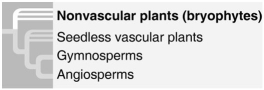
Which of the following should be most helpful in distinguishing the clades depicted on the tree in the above figure from each other?
A)the types of conducting tissues that are present
B)the types of photosynthetic pigments that are present
C)the details of reproduction
D)the concentration of stomata present on leaves of the saprophyte generation
E)whether it is the sporophyte generation or the gametophyte generation that is dominant
Which of the following should be most helpful in distinguishing the clades depicted on the tree in the above figure from each other?
A)the types of conducting tissues that are present
B)the types of photosynthetic pigments that are present
C)the details of reproduction
D)the concentration of stomata present on leaves of the saprophyte generation
E)whether it is the sporophyte generation or the gametophyte generation that is dominant
Question
Use the following figure to answer the questions below.
What is true of the phylogenetic tree in the figure above?
1)It depicts uncertainty about whether the bryophytes or the vascular plants evolved first.
2)It is hypothetical.
3)It includes polytomies.
4)It shows that ferns (phylum Pterophyta)are the closest living relatives to the seed plants.
5)It indicates that seeds are a shared ancestral character of all vascular plants.
A)1 and 2
B)2 and 3
C)1, 2, and 3
D)1, 2, and 4
E)2, 3, and 5
What is true of the phylogenetic tree in the figure above?
1)It depicts uncertainty about whether the bryophytes or the vascular plants evolved first.
2)It is hypothetical.
3)It includes polytomies.
4)It shows that ferns (phylum Pterophyta)are the closest living relatives to the seed plants.
5)It indicates that seeds are a shared ancestral character of all vascular plants.
A)1 and 2
B)2 and 3
C)1, 2, and 3
D)1, 2, and 4
E)2, 3, and 5
Question
Question
Question
Question
Refer to the following information to answer the next few questions.
Researchers decided to test the hypothesis that if the 2-m tall Polytrichum gametophyte-sporophyte plants had acted as a physical buffer,then they would have reduced water's ability to erode the soil and carry away its nitrogen.They began with four equal-sized areas where Polytrichum mosses grew to a height of 2 m above the soil surface.One of the four areas was not modified.In the second area,the mosses were trimmed to a height of 1 m above the soil surface.In the third area,the mosses were trimmed to a height of 0.5 m above the soil surface.In the fourth area,the mosses were trimmed all the way to the ground,leaving only the rhizoids.Water,simulating rainfall,was then added in a controlled fashion to all plots over the course of one year.The figure below presents four graphs that depict potential results of this experiment.
Which of these potential results of applying a metabolic poison to the rhizoids of Polytrichum should interfere the least with the ability to draw valid conclusions from this experiment?
A)if, upon dying, the rhizoids leak nitrogenous compounds into the soil before final nitrogen content is measured
B)if, upon dying, decomposition of the rhizoids introduces nitrogenous compounds to the soil before final nitrogen content is measured
C)if the metabolic poison is hydrogen cyanide (HCN)or sodium azide (NaN₃), and much of the poison remains in the soil
D)if the metabolic poison acts against the mitochondria of the rhizoid cells
E)if the metabolic poison absorbs nitrogen and strongly adheres to soil particles, acting as a sort of glue
Researchers decided to test the hypothesis that if the 2-m tall Polytrichum gametophyte-sporophyte plants had acted as a physical buffer,then they would have reduced water's ability to erode the soil and carry away its nitrogen.They began with four equal-sized areas where Polytrichum mosses grew to a height of 2 m above the soil surface.One of the four areas was not modified.In the second area,the mosses were trimmed to a height of 1 m above the soil surface.In the third area,the mosses were trimmed to a height of 0.5 m above the soil surface.In the fourth area,the mosses were trimmed all the way to the ground,leaving only the rhizoids.Water,simulating rainfall,was then added in a controlled fashion to all plots over the course of one year.The figure below presents four graphs that depict potential results of this experiment.
Which of these potential results of applying a metabolic poison to the rhizoids of Polytrichum should interfere the least with the ability to draw valid conclusions from this experiment?
A)if, upon dying, the rhizoids leak nitrogenous compounds into the soil before final nitrogen content is measured
B)if, upon dying, decomposition of the rhizoids introduces nitrogenous compounds to the soil before final nitrogen content is measured
C)if the metabolic poison is hydrogen cyanide (HCN)or sodium azide (NaN₃), and much of the poison remains in the soil
D)if the metabolic poison acts against the mitochondria of the rhizoid cells
E)if the metabolic poison absorbs nitrogen and strongly adheres to soil particles, acting as a sort of glue
Question
Question
Question
Question
Refer to the following information to answer the next few questions.
Researchers decided to test the hypothesis that if the 2-m tall Polytrichum gametophyte-sporophyte plants had acted as a physical buffer,then they would have reduced water's ability to erode the soil and carry away its nitrogen.They began with four equal-sized areas where Polytrichum mosses grew to a height of 2 m above the soil surface.One of the four areas was not modified.In the second area,the mosses were trimmed to a height of 1 m above the soil surface.In the third area,the mosses were trimmed to a height of 0.5 m above the soil surface.In the fourth area,the mosses were trimmed all the way to the ground,leaving only the rhizoids.Water,simulating rainfall,was then added in a controlled fashion to all plots over the course of one year.The figure below presents four graphs that depict potential results of this experiment.
The 2-m height attainable by Polytrichum moss is at the upper end of the size range reached by mosses.What accounts for the relative height of Polytrichum?
A)the cuticle that is found along the ridges of "leaves"
B)"leaves" that are more than one cell layer thick
C)high humidity of surrounding air that provides support against gravity
D)reduced size, mass, and persistence of the sporophytes that allows gametophores to grow taller
E)the presence of conducting tissues in the "stem"
Researchers decided to test the hypothesis that if the 2-m tall Polytrichum gametophyte-sporophyte plants had acted as a physical buffer,then they would have reduced water's ability to erode the soil and carry away its nitrogen.They began with four equal-sized areas where Polytrichum mosses grew to a height of 2 m above the soil surface.One of the four areas was not modified.In the second area,the mosses were trimmed to a height of 1 m above the soil surface.In the third area,the mosses were trimmed to a height of 0.5 m above the soil surface.In the fourth area,the mosses were trimmed all the way to the ground,leaving only the rhizoids.Water,simulating rainfall,was then added in a controlled fashion to all plots over the course of one year.The figure below presents four graphs that depict potential results of this experiment.
The 2-m height attainable by Polytrichum moss is at the upper end of the size range reached by mosses.What accounts for the relative height of Polytrichum?
A)the cuticle that is found along the ridges of "leaves"
B)"leaves" that are more than one cell layer thick
C)high humidity of surrounding air that provides support against gravity
D)reduced size, mass, and persistence of the sporophytes that allows gametophores to grow taller
E)the presence of conducting tissues in the "stem"
Question
Use the following figure to answer the questions below.
The resolution of the relationships indicated by dashed lines in the figure above will most probably come from
A)more whole-genome analyses of extant (living)species.
B)more detailed analyses of the morphologies of extant species.
C)the discovery of more fossils of extinct taxa from the time of seed-plant origins.
D)more detailed analyses of the life cycles of extant species.
E)more molecular analyses of the types and structures of photosynthetic pigments present in extant species.
The resolution of the relationships indicated by dashed lines in the figure above will most probably come from
A)more whole-genome analyses of extant (living)species.
B)more detailed analyses of the morphologies of extant species.
C)the discovery of more fossils of extinct taxa from the time of seed-plant origins.
D)more detailed analyses of the life cycles of extant species.
E)more molecular analyses of the types and structures of photosynthetic pigments present in extant species.

Unlock Deck
Sign up to unlock the cards in this deck!
Unlock Deck
Unlock Deck
1/93

Play

Full screen (f)
Deck 29: Plant Diversity I: How Plants Colonized Land
1
The following traits provide supporting evidence that charophyceans are the closest relatives of land plants,with the exception of the fact that
A)both groups have rings of cellulose synthesizing proteins.
B)in both groups, a phragmoplast forms between daughter nuclei of dividing cells.
C)both groups have alternation of generation.
D)both groups contain peroxisome enzymes.
E)the structure of flagellated sperm is similar in both groups.
A)both groups have rings of cellulose synthesizing proteins.
B)in both groups, a phragmoplast forms between daughter nuclei of dividing cells.
C)both groups have alternation of generation.
D)both groups contain peroxisome enzymes.
E)the structure of flagellated sperm is similar in both groups.
C
2
The most direct ancestors of land plants were probably ________.
A)kelp (brown alga)that formed large beds near the shorelines
B)green algae
C)photosynthesizing prokaryotes (cyanobacteria)
D)liverworts and mosses
A)kelp (brown alga)that formed large beds near the shorelines
B)green algae
C)photosynthesizing prokaryotes (cyanobacteria)
D)liverworts and mosses
B
3
Some green algae exhibit alternation of generations.All land plants exhibit alternation of generations.No charophytes exhibit alternation of generations.Keeping in mind the recent evidence from molecular systematics,the correct interpretation of these observations is that
A)charophytes are not related to either green algae or land plants.
B)plants evolved alternation of generations independently of green algae.
C)alternation of generations cannot be beneficial to charophytes.
D)land plants evolved directly from the green algae that perform alternation of generations.
E)scientists have no evidence to indicate whether or not land plants evolved from any kind of alga.
A)charophytes are not related to either green algae or land plants.
B)plants evolved alternation of generations independently of green algae.
C)alternation of generations cannot be beneficial to charophytes.
D)land plants evolved directly from the green algae that perform alternation of generations.
E)scientists have no evidence to indicate whether or not land plants evolved from any kind of alga.
B
4
A student encounters a pondweed which,judging from its appearance,seems to be a charophyte.She brings a sample back to her biology lab.Using only a compound light microscope to study the sample,which of the following features should help her to determine whether the sample comes from a charophyte or from some other type of green alga?
1)molecular structure of enzymes inside peroxisomes
2)structure of sperm cells
3)presence of phragmoplasts
4)rings of cellulose-synthesizing complexes
A)1 and 3
B)1 and 4
C)2 and 3
D)1, 3, and 4
E)2, 3, and 4
1)molecular structure of enzymes inside peroxisomes
2)structure of sperm cells
3)presence of phragmoplasts
4)rings of cellulose-synthesizing complexes
A)1 and 3
B)1 and 4
C)2 and 3
D)1, 3, and 4
E)2, 3, and 4
Unlock Deck
Unlock for access to all 93 flashcards in this deck.
Unlock Deck
k this deck
5
On a field trip,a student in a marine biology class collects an organism that has differentiated organs,cell walls of cellulose,and chloroplasts with chlorophyll a.Based on this description,the organism could be a brown alga,a red alga,a green alga,a charophyte recently washed into the ocean from a freshwater or brackish water source,or a land plant washed into the ocean.The presence of which of the following features would definitively identify this organism as a land plant?
A)alternation of generations
B)sporopollenin
C)rings of cellulose-synthesizing complexes
D)flagellated sperm
E)embryos
A)alternation of generations
B)sporopollenin
C)rings of cellulose-synthesizing complexes
D)flagellated sperm
E)embryos
Unlock Deck
Unlock for access to all 93 flashcards in this deck.
Unlock Deck
k this deck
6
Structurally,phragmoplasts should be most similar to
A)the nuclear lamina.
B)the myofilaments of muscle cells.
C)the internal support structures of microvilli.
D)the cytoskeletal elements that produce cytoplasmic streaming and amoeboid motion.
E)spindle fibres.
A)the nuclear lamina.
B)the myofilaments of muscle cells.
C)the internal support structures of microvilli.
D)the cytoskeletal elements that produce cytoplasmic streaming and amoeboid motion.
E)spindle fibres.
Unlock Deck
Unlock for access to all 93 flashcards in this deck.
Unlock Deck
k this deck
7
In animal cells and in the meristem cells of land plants,the nuclear envelope disintegrates during mitosis.This disintegration does not occur in the cells of most protists and fungi.According to our current knowledge of plant evolution,which group of organisms should feature mitosis most similar to that of land plants?
A)unicellular green algae
B)cyanobacteria
C)charophytes
D)red algae
E)multicellular green algae
A)unicellular green algae
B)cyanobacteria
C)charophytes
D)red algae
E)multicellular green algae
Unlock Deck
Unlock for access to all 93 flashcards in this deck.
Unlock Deck
k this deck
8
Which event during the evolution of land plants probably made the synthesis of secondary compounds most beneficial?
A)the greenhouse effect present throughout the Devonian period
B)the reverse-greenhouse effect during the Carboniferous period
C)the association of the roots of land plants with fungi
D)the rise of herbivory
E)the rise of wind pollination
A)the greenhouse effect present throughout the Devonian period
B)the reverse-greenhouse effect during the Carboniferous period
C)the association of the roots of land plants with fungi
D)the rise of herbivory
E)the rise of wind pollination
Unlock Deck
Unlock for access to all 93 flashcards in this deck.
Unlock Deck
k this deck
9
Given its composition and location,the phragmoplast should be directly involved in the
A)segregation of daughter chromosomes during anaphase.
B)poleward migration of centrosomes during prophase.
C)synthesis of sporopollenin during G₁ and G₂ phases.
D)construction of the cell plate during cytokinesis.
E)reinforcement of the nuclear envelope during S phase.
A)segregation of daughter chromosomes during anaphase.
B)poleward migration of centrosomes during prophase.
C)synthesis of sporopollenin during G₁ and G₂ phases.
D)construction of the cell plate during cytokinesis.
E)reinforcement of the nuclear envelope during S phase.
Unlock Deck
Unlock for access to all 93 flashcards in this deck.
Unlock Deck
k this deck
10
If the kingdom Plantae is someday expanded to include the charophytes,then the shared derived characteristics of the kingdom will include
1)rings of cellulose-synthesizing complexes.
2)chlorophylls a and b.
3)alternation of generations.
4)cell walls of cellulose.
5)ability to synthesize sporopollenin.
A)1 and 5
B)1, 2, and 3
C)1, 3, and 5
D)1, 4, and 5
E)1, 2, 4, and 5
1)rings of cellulose-synthesizing complexes.
2)chlorophylls a and b.
3)alternation of generations.
4)cell walls of cellulose.
5)ability to synthesize sporopollenin.
A)1 and 5
B)1, 2, and 3
C)1, 3, and 5
D)1, 4, and 5
E)1, 2, 4, and 5
Unlock Deck
Unlock for access to all 93 flashcards in this deck.
Unlock Deck
k this deck
11
All of the following are common to both charophytes and land plants except
A)sporopollenin.
B)lignin.
C)chlorophyll a.
D)cellulose.
E)chlorophyll b.
A)sporopollenin.
B)lignin.
C)chlorophyll a.
D)cellulose.
E)chlorophyll b.
Unlock Deck
Unlock for access to all 93 flashcards in this deck.
Unlock Deck
k this deck
12
The following are all adaptations to life on land except
A)rings of cellulose-synthesizing complexes.
B)cuticles.
C)tracheids.
D)reduced gametophyte generation.
E)seeds.
A)rings of cellulose-synthesizing complexes.
B)cuticles.
C)tracheids.
D)reduced gametophyte generation.
E)seeds.
Unlock Deck
Unlock for access to all 93 flashcards in this deck.
Unlock Deck
k this deck
13
Which of the following were probably factors that permitted early plants to successfully colonize land?
1)the relative number of potential predators (herbivores)
2)the relative number of competitors
3)the relative availability of symbiotic partners
4)air's relative lack of support,compared to water's support
A)1 and 2
B)2 and 3
C)3 and 4
D)1, 2, and 3
E)1, 2, and 4
1)the relative number of potential predators (herbivores)
2)the relative number of competitors
3)the relative availability of symbiotic partners
4)air's relative lack of support,compared to water's support
A)1 and 2
B)2 and 3
C)3 and 4
D)1, 2, and 3
E)1, 2, and 4
Unlock Deck
Unlock for access to all 93 flashcards in this deck.
Unlock Deck
k this deck
14
The structural integrity of bacteria is to peptidoglycan as the structural integrity of plant spores is to
A)lignin.
B)cellulose.
C)secondary compounds.
D)sporopollenin.
A)lignin.
B)cellulose.
C)secondary compounds.
D)sporopollenin.
Unlock Deck
Unlock for access to all 93 flashcards in this deck.
Unlock Deck
k this deck
15
What evidence do paleobotanists look for that indicates the movement of plants from water to land?
A)waxy cuticle to decrease evaporation from leaves
B)loss of structures that produce spores
C)sporopollenin to inhibit evaporation from leaves
D)remnants of chloroplasts from photosynthesizing cells
A)waxy cuticle to decrease evaporation from leaves
B)loss of structures that produce spores
C)sporopollenin to inhibit evaporation from leaves
D)remnants of chloroplasts from photosynthesizing cells
Unlock Deck
Unlock for access to all 93 flashcards in this deck.
Unlock Deck
k this deck
16
What is true of charophytes?
A)They are the ancestors of green algae.
B)They are examples of seedless vascular plants.
C)They are the closest living algal relatives of land plants.
D)They share some features in common with land plants, namely spores surrounded by sporopollenin and alternation of generations.
A)They are the ancestors of green algae.
B)They are examples of seedless vascular plants.
C)They are the closest living algal relatives of land plants.
D)They share some features in common with land plants, namely spores surrounded by sporopollenin and alternation of generations.
Unlock Deck
Unlock for access to all 93 flashcards in this deck.
Unlock Deck
k this deck
17
Mitotic activity by the apical meristem of a root makes which of the following more possible?
A)increase of the aboveground stem.
B)decreased absorption of mineral nutrients.
C)increased absorption of CO₂.
D)increased number of chloroplasts in roots.
E)effective lateral growth of the stem.
A)increase of the aboveground stem.
B)decreased absorption of mineral nutrients.
C)increased absorption of CO₂.
D)increased number of chloroplasts in roots.
E)effective lateral growth of the stem.
Unlock Deck
Unlock for access to all 93 flashcards in this deck.
Unlock Deck
k this deck
18
Which taxon is essentially equivalent to the "embryophytes"?
A)Viridiplantae
B)Plantae
C)Pterophyta
D)Bryophyta
E)Charophycea
A)Viridiplantae
B)Plantae
C)Pterophyta
D)Bryophyta
E)Charophycea
Unlock Deck
Unlock for access to all 93 flashcards in this deck.
Unlock Deck
k this deck
19
The functional role of sporopollenin is primarily to
A)comprise spore surface structures that catch the wind and assist in spore dispersal.
B)reduce dehydration.
C)make spores less dense and able to disperse more readily.
D)repel toxic chemicals.
E)provide nutrients to spores.
A)comprise spore surface structures that catch the wind and assist in spore dispersal.
B)reduce dehydration.
C)make spores less dense and able to disperse more readily.
D)repel toxic chemicals.
E)provide nutrients to spores.
Unlock Deck
Unlock for access to all 93 flashcards in this deck.
Unlock Deck
k this deck
20
Which of the following was not a challenge for survival of the first land plants?
A)sources of water
B)sperm transfer
C)desiccation
D)animal predation
E)absorbing enough light
A)sources of water
B)sperm transfer
C)desiccation
D)animal predation
E)absorbing enough light
Unlock Deck
Unlock for access to all 93 flashcards in this deck.
Unlock Deck
k this deck
21
Stomata ________.
A)occur in all land plants and define them as a monophyletic group
B)open to allow gas exchange and close to decrease water loss
C)occur in all land plants and are the same as pores
D)open to increase both water absorption and gas exchange
A)occur in all land plants and define them as a monophyletic group
B)open to allow gas exchange and close to decrease water loss
C)occur in all land plants and are the same as pores
D)open to increase both water absorption and gas exchange
Unlock Deck
Unlock for access to all 93 flashcards in this deck.
Unlock Deck
k this deck
22
The leaflike appendages of moss gametophytes may be one to two cell layers thick.Consequently,which of the following is least likely to be found associated with such appendages?
A)cuticle
B)rings of cellulose-synthesizing complexes
C)stomata
D)peroxisomes
E)phenolics
A)cuticle
B)rings of cellulose-synthesizing complexes
C)stomata
D)peroxisomes
E)phenolics
Unlock Deck
Unlock for access to all 93 flashcards in this deck.
Unlock Deck
k this deck
23
At some time during their existence,bryophytes may feature
A)microphylls.
B)true roots.
C)true leaves.
D)sporangia.
E)umbilical cells.
A)microphylls.
B)true roots.
C)true leaves.
D)sporangia.
E)umbilical cells.
Unlock Deck
Unlock for access to all 93 flashcards in this deck.
Unlock Deck
k this deck
24
Retaining the zygote on the living gametophyte of land plants ________.
A)protects the zygote from herbivores
B)evolved concurrently with pollen
C)helps in dispersal of the zygote
D)allows it to be nourished by the parent plant
A)protects the zygote from herbivores
B)evolved concurrently with pollen
C)helps in dispersal of the zygote
D)allows it to be nourished by the parent plant
Unlock Deck
Unlock for access to all 93 flashcards in this deck.
Unlock Deck
k this deck
25
Which of the following structures are in the gametophyte generation of a moss?
A)buds, leaves, spores, rhizoids
B)egg, sperm, zygote, sporangium
C)antheridia, archegonia, egg, sperm
D)foot, seta, spores, sporangium
A)buds, leaves, spores, rhizoids
B)egg, sperm, zygote, sporangium
C)antheridia, archegonia, egg, sperm
D)foot, seta, spores, sporangium
Unlock Deck
Unlock for access to all 93 flashcards in this deck.
Unlock Deck
k this deck
26
Liverworts,hornworts,and mosses are grouped together as the Bryophytes.Besides not having vascular tissue,what do they all have in common?
A)They are all wind pollinated.
B)They are heterosporous.
C)They can reproduce asexually by producing gemmae.
D)They require water for reproduction.
A)They are all wind pollinated.
B)They are heterosporous.
C)They can reproduce asexually by producing gemmae.
D)They require water for reproduction.
Unlock Deck
Unlock for access to all 93 flashcards in this deck.
Unlock Deck
k this deck
27
If researchers found that charophyte algae lack certain traits that land plants have,can we conclude that charophytes are not the closest relatives of land plants?
A)No; we can hypothesize that these traits have just skipped a generation.
B)No; we can hypothesize that these traits are derived traits of land plants.
C)Yes; we can hypothesize that if all traits are not found in both groups, then the two groups are distantly related.
D)Yes; if the traits have been lost during the course of evolution, then the two groups cannot be closely related.
A)No; we can hypothesize that these traits have just skipped a generation.
B)No; we can hypothesize that these traits are derived traits of land plants.
C)Yes; we can hypothesize that if all traits are not found in both groups, then the two groups are distantly related.
D)Yes; if the traits have been lost during the course of evolution, then the two groups cannot be closely related.
Unlock Deck
Unlock for access to all 93 flashcards in this deck.
Unlock Deck
k this deck
28
Considering that the mature sporophytes of true mosses get their nutrition from the gametophytes on which they grow,and considering these generations as individual plants,what is true of the relationship between true moss sporophytes and gametophytes?
A)Sporophytes are endosymbionts of gametophytes.
B)Sporophytes are mutualists of gametophytes.
C)Sporophytes are commensalists of gametophytes.
D)Sporophytes are parasites of gametophytes.
A)Sporophytes are endosymbionts of gametophytes.
B)Sporophytes are mutualists of gametophytes.
C)Sporophytes are commensalists of gametophytes.
D)Sporophytes are parasites of gametophytes.
Unlock Deck
Unlock for access to all 93 flashcards in this deck.
Unlock Deck
k this deck
29
Which of the following statements is true of archegonia?
A)They are the sites where male gametes are produced.
B)They may temporarily contain sporophyte embryos.
C)They are the same as sporangia.
D)They are the ancestral versions of animal gonads.
E)They are asexual reproductive structures.
A)They are the sites where male gametes are produced.
B)They may temporarily contain sporophyte embryos.
C)They are the same as sporangia.
D)They are the ancestral versions of animal gonads.
E)They are asexual reproductive structures.
Unlock Deck
Unlock for access to all 93 flashcards in this deck.
Unlock Deck
k this deck
30
You find a green organism in a pond near your house and believe it is a plant,not an alga.The mystery organism is most likely a plant and not an alga if it ________.
A)contains chloroplasts
B)is surrounded by a cuticle
C)does not contain vascular tissue
D)has cell walls that are comprised largely of cellulose
A)contains chloroplasts
B)is surrounded by a cuticle
C)does not contain vascular tissue
D)has cell walls that are comprised largely of cellulose
Unlock Deck
Unlock for access to all 93 flashcards in this deck.
Unlock Deck
k this deck
31
Assuming that they all belong to the same plant,arrange the following structures from largest to smallest.
1)antheridia
2)gametes
3)gametophytes
4)gametangia
A)1, 4, 3, 2
B)3, 1, 2, 4
C)3, 4, 2, 1
D)3, 4, 1, 2
E)4, 3, 1, 2
1)antheridia
2)gametes
3)gametophytes
4)gametangia
A)1, 4, 3, 2
B)3, 1, 2, 4
C)3, 4, 2, 1
D)3, 4, 1, 2
E)4, 3, 1, 2
Unlock Deck
Unlock for access to all 93 flashcards in this deck.
Unlock Deck
k this deck
32
In terms of evolutionary time,which phyla are the oldest and which are the most recent (respectively)?
A)Phylum Hepatophyta, Phylum Anthophyta
B)Phylum Ginkgophyta, Phylum Pterophyta
C)Phylum Cycadophyta, Phylum Lycophyta
D)Phylum Lycophyta, Phylum Bryophyta
E)Phylum Gnetophyta, Phylum Anthocerophyta
A)Phylum Hepatophyta, Phylum Anthophyta
B)Phylum Ginkgophyta, Phylum Pterophyta
C)Phylum Cycadophyta, Phylum Lycophyta
D)Phylum Lycophyta, Phylum Bryophyta
E)Phylum Gnetophyta, Phylum Anthocerophyta
Unlock Deck
Unlock for access to all 93 flashcards in this deck.
Unlock Deck
k this deck
33
Which of these time intervals,based on plant fossils,came last (most recently)?
A)extensive growth of gymnosperm forests
B)colonization of land by early liverworts and mosses
C)rise and diversification of angiosperms
D)carboniferous swamps with giant horsetails and lycophytes
A)extensive growth of gymnosperm forests
B)colonization of land by early liverworts and mosses
C)rise and diversification of angiosperms
D)carboniferous swamps with giant horsetails and lycophytes
Unlock Deck
Unlock for access to all 93 flashcards in this deck.
Unlock Deck
k this deck
34
What is a key difference between spores and seeds?
A)Spores are single-celled reproductive structures; seeds are multicellular embryos.
B)Spores are multicellular reproductive structures; seeds are unicellular embryos.
C)Spores have stored nutrients; seeds do not.
D)Spores disperse far distances; seeds are larger and disperse shorter distances.
E)Spores are adapted to mild climates; seeds can withstand dry and cold conditions.
A)Spores are single-celled reproductive structures; seeds are multicellular embryos.
B)Spores are multicellular reproductive structures; seeds are unicellular embryos.
C)Spores have stored nutrients; seeds do not.
D)Spores disperse far distances; seeds are larger and disperse shorter distances.
E)Spores are adapted to mild climates; seeds can withstand dry and cold conditions.
Unlock Deck
Unlock for access to all 93 flashcards in this deck.
Unlock Deck
k this deck
35
Which of the following is true of the life cycle of mosses?
A)The haploid generation grows on the sporophyte generation.
B)Spores are primarily distributed by water currents.
C)Antheridia and archegonia are produced by gametophytes.
D)The sporophyte generation is dominant.
E)The growing embryo gives rise to the gametophyte.
A)The haploid generation grows on the sporophyte generation.
B)Spores are primarily distributed by water currents.
C)Antheridia and archegonia are produced by gametophytes.
D)The sporophyte generation is dominant.
E)The growing embryo gives rise to the gametophyte.
Unlock Deck
Unlock for access to all 93 flashcards in this deck.
Unlock Deck
k this deck
36
Beginning with the germination of a moss spore,what is the sequence of structures that develop after germination?
1)embryo
2)gametes
3)sporophyte
4)protonema
5)gametophore
A)4 →1 → 3 → 5 → 2
B)4 → 3 → 5 → 2 → 1
C)4 → 5 → 2 → 1 → 3
D)3 → 4 → 5 → 2 → 1
E)3 → 1 → 4 → 5 → 2
1)embryo
2)gametes
3)sporophyte
4)protonema
5)gametophore
A)4 →1 → 3 → 5 → 2
B)4 → 3 → 5 → 2 → 1
C)4 → 5 → 2 → 1 → 3
D)3 → 4 → 5 → 2 → 1
E)3 → 1 → 4 → 5 → 2
Unlock Deck
Unlock for access to all 93 flashcards in this deck.
Unlock Deck
k this deck
37
As is true of the gametophytes of all land plants,the gametophytes of true mosses lack stomata.Yet,the feather moss Pleurozium harbors nitrogen-fixing cyanobacteria.Which of the following is a feature of moss gametophytes that is most important for the continued survival of these cyanobacteria in the tissues of the feather moss gametophyte?
A)lack of cuticle
B)lack of vascular tissues
C)lack of true leaves or roots
D)lack of an independent sporophyte
E)lack of multiple cell layers in "leaves" of "buds"
A)lack of cuticle
B)lack of vascular tissues
C)lack of true leaves or roots
D)lack of an independent sporophyte
E)lack of multiple cell layers in "leaves" of "buds"
Unlock Deck
Unlock for access to all 93 flashcards in this deck.
Unlock Deck
k this deck
38
Two small,poorly drained lakes lie close to each other in a northern forest.The basins of both lakes are composed of the same geologic substratum.One lake is surrounded by a dense Sphagnum mat; the other is not.Compared to the pond with Sphagnum,the pond lacking the moss mat should have
A)lower numbers of bacteria.
B)reduced rates of decomposition.
C)reduced oxygen content.
D)less-acidic water.
A)lower numbers of bacteria.
B)reduced rates of decomposition.
C)reduced oxygen content.
D)less-acidic water.
Unlock Deck
Unlock for access to all 93 flashcards in this deck.
Unlock Deck
k this deck
39
Which of the following is a true statement about plant reproduction?
A)Embryophytes are small because they are in an early developmental stage.
B)Both male and female bryophytes produce gametangia.
C)Gametangia protect gametes from excess water.
D)Eggs and sperm of bryophytes swim toward one another.
E)Bryophytes are limited to asexual reproduction.
A)Embryophytes are small because they are in an early developmental stage.
B)Both male and female bryophytes produce gametangia.
C)Gametangia protect gametes from excess water.
D)Eggs and sperm of bryophytes swim toward one another.
E)Bryophytes are limited to asexual reproduction.
Unlock Deck
Unlock for access to all 93 flashcards in this deck.
Unlock Deck
k this deck
40
If you are looking for structures that transfer water and nutrients from a bryophyte gametophyte to a bryophyte sporophyte,then on which part of the sporophyte should you focus your attention?
A)spores
B)seta
C)foot
D)sporangium
E)peristome
A)spores
B)seta
C)foot
D)sporangium
E)peristome
Unlock Deck
Unlock for access to all 93 flashcards in this deck.
Unlock Deck
k this deck
41
Assuming that they all belong to the same plant,arrange the following structures from largest to smallest (or from most inclusive to least inclusive).
1)spores
2)sporophylls
3)sporophytes
4)sporangia
A)2, 4, 3, 1
B)2, 3, 4, 1
C)3, 1, 4, 2
D)3, 4, 2, 1
E)3, 2, 4, 1
1)spores
2)sporophylls
3)sporophytes
4)sporangia
A)2, 4, 3, 1
B)2, 3, 4, 1
C)3, 1, 4, 2
D)3, 4, 2, 1
E)3, 2, 4, 1
Unlock Deck
Unlock for access to all 93 flashcards in this deck.
Unlock Deck
k this deck
42
How could you determine if a plant is heterosporous?
A)Male and female reproductive structures are located on separate plants.
B)It has vascular tissue.
C)It has multiple sporangia.
D)Its diploid sporophyte produces spores via meiosis.
A)Male and female reproductive structures are located on separate plants.
B)It has vascular tissue.
C)It has multiple sporangia.
D)Its diploid sporophyte produces spores via meiosis.
Unlock Deck
Unlock for access to all 93 flashcards in this deck.
Unlock Deck
k this deck
43
You are hiking in a forest and come upon a mysterious plant,which you determine is either a lycophyte sporophyte or a pterophyte sporophyte.Which of the following would be most helpful in determining the correct classification of the plant?
A)whether or not it has true leaves
B)whether it has microphylls or megaphylls
C)whether or not it has seeds
D)its height
E)whether or not it has chlorophyll a
A)whether or not it has true leaves
B)whether it has microphylls or megaphylls
C)whether or not it has seeds
D)its height
E)whether or not it has chlorophyll a
Unlock Deck
Unlock for access to all 93 flashcards in this deck.
Unlock Deck
k this deck
44
If a fern gametophyte is a hermaphrodite (that is,has both male and female gametangia on the same plant),then it
A)belongs to a species that is homosporous.
B)must be diploid.
C)has lost the need for a sporophyte generation.
D)has antheridia and archegonia combined into a single sex organ.
E)is actually not a fern, because fern gametophytes are always either male or female.
A)belongs to a species that is homosporous.
B)must be diploid.
C)has lost the need for a sporophyte generation.
D)has antheridia and archegonia combined into a single sex organ.
E)is actually not a fern, because fern gametophytes are always either male or female.
Unlock Deck
Unlock for access to all 93 flashcards in this deck.
Unlock Deck
k this deck
45
Arrange the following terms from most inclusive to least inclusive.
1)embryophytes
2)green plants
3)seedless vascular plants
4)ferns
5)tracheophytes
A)1, 2, 5, 3, 4
B)2, 1, 5, 3, 4
C)2, 5, 1, 3, 4
D)1, 4, 2, 5, 3
E)2, 1, 5, 4, 3
1)embryophytes
2)green plants
3)seedless vascular plants
4)ferns
5)tracheophytes
A)1, 2, 5, 3, 4
B)2, 1, 5, 3, 4
C)2, 5, 1, 3, 4
D)1, 4, 2, 5, 3
E)2, 1, 5, 4, 3
Unlock Deck
Unlock for access to all 93 flashcards in this deck.
Unlock Deck
k this deck
46
Evidence indicates that plants increase the number of stomata in their leaves as atmospheric CO₂ levels decline.Increasing the number of stomata per unit surface area should have the effect of doing which of the following?
1)increase dehydration of leaf tissues
2)decrease dehydration of leaf tissues
3)counter the effect of declining CO₂ on photosynthesis
4)reinforce the effect of declining CO₂ on photosynthesis
5)decrease the O₂ content of air next to the leaves to a level lower than it would otherwise be
6)increase the O₂ content of air next to the leaves to a level higher than it would otherwise be
A)1, 3, and 5
B)1, 3, and 6
C)1, 4, and 5
D)2, 3, and 6
E)2, 4, and 5
1)increase dehydration of leaf tissues
2)decrease dehydration of leaf tissues
3)counter the effect of declining CO₂ on photosynthesis
4)reinforce the effect of declining CO₂ on photosynthesis
5)decrease the O₂ content of air next to the leaves to a level lower than it would otherwise be
6)increase the O₂ content of air next to the leaves to a level higher than it would otherwise be
A)1, 3, and 5
B)1, 3, and 6
C)1, 4, and 5
D)2, 3, and 6
E)2, 4, and 5
Unlock Deck
Unlock for access to all 93 flashcards in this deck.
Unlock Deck
k this deck
47
Increasing the number of stomata per unit surface area of a leaf when atmospheric CO₂ levels decline is most analogous to a human
A)breathing faster as atmospheric CO₂ levels increase.
B)putting more red blood corpuscles (RBCs)into circulation when atmospheric O₂ levels decline.
C)removing RBCs from circulation when atmospheric O₂ levels increase.
D)breathing more slowly as atmospheric O₂ levels increase.
A)breathing faster as atmospheric CO₂ levels increase.
B)putting more red blood corpuscles (RBCs)into circulation when atmospheric O₂ levels decline.
C)removing RBCs from circulation when atmospheric O₂ levels increase.
D)breathing more slowly as atmospheric O₂ levels increase.
Unlock Deck
Unlock for access to all 93 flashcards in this deck.
Unlock Deck
k this deck
48
Most moss gametophytes do not have a cuticle and are 1-2 cells thick.What does this imply about moss gametophytes and their structure?
A)They use stomata for gas exchange regulation.
B)They can easily lose water to, and absorb water from, the atmosphere.
C)Photosynthesis occurs throughout the entire gametophyte surface.
D)They have branching veins in their leaves.
A)They use stomata for gas exchange regulation.
B)They can easily lose water to, and absorb water from, the atmosphere.
C)Photosynthesis occurs throughout the entire gametophyte surface.
D)They have branching veins in their leaves.
Unlock Deck
Unlock for access to all 93 flashcards in this deck.
Unlock Deck
k this deck
49
Which of the following characteristics helped seedless plants better adapt to life on land?
A)a dominant gametophyte
B)photosystem II
C)a chitinous cuticle
D)stomata on leaves
E)an unbranched sporophyte
A)a dominant gametophyte
B)photosystem II
C)a chitinous cuticle
D)stomata on leaves
E)an unbranched sporophyte
Unlock Deck
Unlock for access to all 93 flashcards in this deck.
Unlock Deck
k this deck
50
If humans had been present to build log structures during the Carboniferous period (they weren't),which plant types would have been suitable sources of logs?
A)whisk ferns and epiphytes
B)horsetails and bryophytes
C)lycophytes and bryophytes
D)ferns, horsetails, and lycophytes
E)charophytes, bryophytes, and gymnosperms
A)whisk ferns and epiphytes
B)horsetails and bryophytes
C)lycophytes and bryophytes
D)ferns, horsetails, and lycophytes
E)charophytes, bryophytes, and gymnosperms
Unlock Deck
Unlock for access to all 93 flashcards in this deck.
Unlock Deck
k this deck
51
Which of the following should have had gene sequences most similar to the charophyte that was the common ancestor of the land plants?
A)early angiosperms
B)early bryophytes
C)early gymnosperms
D)early lycophytes
E)early pterophytes
A)early angiosperms
B)early bryophytes
C)early gymnosperms
D)early lycophytes
E)early pterophytes
Unlock Deck
Unlock for access to all 93 flashcards in this deck.
Unlock Deck
k this deck
52
Which of the following are land plants that use the same means of getting sperm to egg that algae use?
A)true mosses, hornworts, and liverworts
B)ferns, whisk ferns, and horsetails
C)all land plants
D)Two of the responses above are correct.
A)true mosses, hornworts, and liverworts
B)ferns, whisk ferns, and horsetails
C)all land plants
D)Two of the responses above are correct.
Unlock Deck
Unlock for access to all 93 flashcards in this deck.
Unlock Deck
k this deck
53
What is true about the genus Sphagnum?
A)It is an economically important liverwort.
B)It grows in extensive mats in grassland areas.
C)It accumulates to form coal and is burned as a fuel.
D)It is an important carbon sink, reducing atmospheric carbon dioxide.
A)It is an economically important liverwort.
B)It grows in extensive mats in grassland areas.
C)It accumulates to form coal and is burned as a fuel.
D)It is an important carbon sink, reducing atmospheric carbon dioxide.
Unlock Deck
Unlock for access to all 93 flashcards in this deck.
Unlock Deck
k this deck
54
In which of the following taxa does the mature sporophyte depend completely on the gametophyte for nutrition?
A)Pterophyta
B)Bryophyta
C)horsetail (Equisetum)
D)Pterophyta, Bryophyta, and horsetail (Equisetum)
E)Pterophyta and Bryophyta
A)Pterophyta
B)Bryophyta
C)horsetail (Equisetum)
D)Pterophyta, Bryophyta, and horsetail (Equisetum)
E)Pterophyta and Bryophyta
Unlock Deck
Unlock for access to all 93 flashcards in this deck.
Unlock Deck
k this deck
55
A botanist discovers a new species of plant in a tropical rain forest.After observing its anatomy and life cycle,he notes the following characteristics: flagellated sperm,xylem with tracheids,separate gametophyte and sporophyte generations with the sporophyte dominant,and no seeds.This plant is probably most closely related to
A)mosses.
B)charophytes.
C)ferns.
D)gymnosperms.
E)flowering plants.
A)mosses.
B)charophytes.
C)ferns.
D)gymnosperms.
E)flowering plants.
Unlock Deck
Unlock for access to all 93 flashcards in this deck.
Unlock Deck
k this deck
56
Sporophylls can be found in which of the following?
A)mosses
B)liverworts
C)hornworts
D)pterophytes
E)charophytes
A)mosses
B)liverworts
C)hornworts
D)pterophytes
E)charophytes
Unlock Deck
Unlock for access to all 93 flashcards in this deck.
Unlock Deck
k this deck
57
When discovered in peatlands,"bog bodies" tend to be well preserved.The best explanation is that
A)peat moss is a soil conditioner and pads the bodies so they do not break apart.
B)the low temperature, pH, and oxygen level of peatlands slow down/inhibit the decomposition process.
C)peat moss is made up of partially decayed organic matter and animal and plant bodies are organic.
D)the nitrogen fixing bacteria found in peat moss helps preserve the moss and other organisms.
A)peat moss is a soil conditioner and pads the bodies so they do not break apart.
B)the low temperature, pH, and oxygen level of peatlands slow down/inhibit the decomposition process.
C)peat moss is made up of partially decayed organic matter and animal and plant bodies are organic.
D)the nitrogen fixing bacteria found in peat moss helps preserve the moss and other organisms.
Unlock Deck
Unlock for access to all 93 flashcards in this deck.
Unlock Deck
k this deck
58
You are hiking in a forest and happen upon a plant featuring a central stemlike structure from which sprout many,tiny,leaflike structures.Which of the following would be the most certain means of distinguishing whether it was a true moss or a club moss?
A)its colour
B)its height
C)if seeds are present
D)if conducting tissues are present
E)the appearance of its spore-producing structures
A)its colour
B)its height
C)if seeds are present
D)if conducting tissues are present
E)the appearance of its spore-producing structures
Unlock Deck
Unlock for access to all 93 flashcards in this deck.
Unlock Deck
k this deck
59
Which of the following is true of seedless vascular plants?
A)Extant seedless vascular plants are larger than the extinct varieties.
B)Whole forests were dominated by large, seedless vascular plants during the Carboniferous period.
C)They produce many spores, which are really the same as seeds.
D)The gametophyte is the dominant generation.
E)Sphagnum is an economically and ecologically important example.
A)Extant seedless vascular plants are larger than the extinct varieties.
B)Whole forests were dominated by large, seedless vascular plants during the Carboniferous period.
C)They produce many spores, which are really the same as seeds.
D)The gametophyte is the dominant generation.
E)Sphagnum is an economically and ecologically important example.
Unlock Deck
Unlock for access to all 93 flashcards in this deck.
Unlock Deck
k this deck
60
Which of the following statements correctly describes the alternation of generation cycle of a fern?
A)gametophyte-dominant (2n)life cycle where spores develop into photosynthetic sporophyte (n)
B)gametophyte-dominant (n)life cycle where spores develop into photosynthetic sporophyte (2n)
C)sporophyte-dominant (n)life cycle where 2 spores fuse to produce the zygote (2n)
D)sporophyte-dominant (2n)life cycle where spores develop into photosynthetic gametophytes (n)
A)gametophyte-dominant (2n)life cycle where spores develop into photosynthetic sporophyte (n)
B)gametophyte-dominant (n)life cycle where spores develop into photosynthetic sporophyte (2n)
C)sporophyte-dominant (n)life cycle where 2 spores fuse to produce the zygote (2n)
D)sporophyte-dominant (2n)life cycle where spores develop into photosynthetic gametophytes (n)
Unlock Deck
Unlock for access to all 93 flashcards in this deck.
Unlock Deck
k this deck
61
The following questions refer to the description below.
There are many advantages for plants to living in an aqueous environment.For example,water provides support,the temperature of water fluctuates much less than on land,and external fertilization is facilitated in water.Nevertheless,plants successfully invaded land and diversified.
What evidence in the fossil record would you look for that would indicate that plants had successfully colonized land?
A)spores, sporangia, cuticle
B)spores, cilia, chloroplasts
C)cuticle, stomata, thallus
D)spores, cuticle, thallus
E)Two of the above statements are correct.
There are many advantages for plants to living in an aqueous environment.For example,water provides support,the temperature of water fluctuates much less than on land,and external fertilization is facilitated in water.Nevertheless,plants successfully invaded land and diversified.
What evidence in the fossil record would you look for that would indicate that plants had successfully colonized land?
A)spores, sporangia, cuticle
B)spores, cilia, chloroplasts
C)cuticle, stomata, thallus
D)spores, cuticle, thallus
E)Two of the above statements are correct.
Unlock Deck
Unlock for access to all 93 flashcards in this deck.
Unlock Deck
k this deck
62
The next few questions are based on the following description.
A biology student hiking in a forest happens upon an erect,15-cm-tall plant that bears microphylls and a strobilus at its tallest point.When disturbed,the cone emits a dense cloud of brownish dust.A pocket magnifying glass reveals the dust to be composed of tiny spheres with a high oil content.
This organism probably belongs to the same phylum as the
A)ferns, horsetails, and whisk ferns.
B)club mosses, quillworts, and spike mosses.
C)mosses, hornworts, and liverworts.
D)conifers.
E)charophytes.
A biology student hiking in a forest happens upon an erect,15-cm-tall plant that bears microphylls and a strobilus at its tallest point.When disturbed,the cone emits a dense cloud of brownish dust.A pocket magnifying glass reveals the dust to be composed of tiny spheres with a high oil content.
This organism probably belongs to the same phylum as the
A)ferns, horsetails, and whisk ferns.
B)club mosses, quillworts, and spike mosses.
C)mosses, hornworts, and liverworts.
D)conifers.
E)charophytes.
Unlock Deck
Unlock for access to all 93 flashcards in this deck.
Unlock Deck
k this deck
63
Refer to the following information to answer the next few questions.
Researchers decided to test the hypothesis that if the 2-m tall Polytrichum gametophyte-sporophyte plants had acted as a physical buffer,then they would have reduced water's ability to erode the soil and carry away its nitrogen.They began with four equal-sized areas where Polytrichum mosses grew to a height of 2 m above the soil surface.One of the four areas was not modified.In the second area,the mosses were trimmed to a height of 1 m above the soil surface.In the third area,the mosses were trimmed to a height of 0.5 m above the soil surface.In the fourth area,the mosses were trimmed all the way to the ground,leaving only the rhizoids.Water,simulating rainfall,was then added in a controlled fashion to all plots over the course of one year.The figure below presents four graphs that depict potential results of this experiment.
Why should we expect the soil's nitrogen not to be contained solely within the rhizoids of the Polytrichum mosses?
A)Rhizoids are associated with fungi that inhibit mineral transfer from soil to rhizoids.
B)Rhizoids are not absorptive structures.
C)Rhizoids consist of single, tubular cells or of filaments of cells.
D)Rhizoids lack direct attachment to the moss sporophytes.
Researchers decided to test the hypothesis that if the 2-m tall Polytrichum gametophyte-sporophyte plants had acted as a physical buffer,then they would have reduced water's ability to erode the soil and carry away its nitrogen.They began with four equal-sized areas where Polytrichum mosses grew to a height of 2 m above the soil surface.One of the four areas was not modified.In the second area,the mosses were trimmed to a height of 1 m above the soil surface.In the third area,the mosses were trimmed to a height of 0.5 m above the soil surface.In the fourth area,the mosses were trimmed all the way to the ground,leaving only the rhizoids.Water,simulating rainfall,was then added in a controlled fashion to all plots over the course of one year.The figure below presents four graphs that depict potential results of this experiment.
Why should we expect the soil's nitrogen not to be contained solely within the rhizoids of the Polytrichum mosses?
A)Rhizoids are associated with fungi that inhibit mineral transfer from soil to rhizoids.
B)Rhizoids are not absorptive structures.
C)Rhizoids consist of single, tubular cells or of filaments of cells.
D)Rhizoids lack direct attachment to the moss sporophytes.
Unlock Deck
Unlock for access to all 93 flashcards in this deck.
Unlock Deck
k this deck
64
Researchers tested nitrogen loss from soil where the moss Polytrichum was growing,and compared it to soil from which Polytrichum had been removed.The data are presented below.
Loss of soil nitrogen via "gaseous emission" was found to be negligible.Rather,most loss of soil nitrogen was due to water erosion of the soil.Which of these hypotheses is least likely to account for the observed results?
A)If rhizoids had helped stabilize the soil, then less erosion and less loss of nitrogen would occur.
B)If protonemata had absorbed, and stored, nitrogen from the soil, then they would have reduced loss of nitrogen by erosion.
C)If the overlying mat of gametophores had slowed the entry of water into the soil, then it would have reduced water's ability to erode the soil and carry away its nitrogen.
D)If sporophyte stomata had absorbed nitrogen from the soil, then they would have reduced loss of nitrogen by erosion.
Loss of soil nitrogen via "gaseous emission" was found to be negligible.Rather,most loss of soil nitrogen was due to water erosion of the soil.Which of these hypotheses is least likely to account for the observed results?
A)If rhizoids had helped stabilize the soil, then less erosion and less loss of nitrogen would occur.
B)If protonemata had absorbed, and stored, nitrogen from the soil, then they would have reduced loss of nitrogen by erosion.
C)If the overlying mat of gametophores had slowed the entry of water into the soil, then it would have reduced water's ability to erode the soil and carry away its nitrogen.
D)If sporophyte stomata had absorbed nitrogen from the soil, then they would have reduced loss of nitrogen by erosion.
Unlock Deck
Unlock for access to all 93 flashcards in this deck.
Unlock Deck
k this deck
65
The next few questions are based on the following description.
A biology student hiking in a forest happens upon an erect,15-cm-tall plant that bears microphylls and a strobilus at its tallest point.When disturbed,the cone emits a dense cloud of brownish dust.A pocket magnifying glass reveals the dust to be composed of tiny spheres with a high oil content.
This student has probably found a(n)
A)immature pine tree.
B)bryophyte sporophyte.
C)fern sporophyte.
D)horsetail gametophyte.
E)lycophyte sporophyte.
A biology student hiking in a forest happens upon an erect,15-cm-tall plant that bears microphylls and a strobilus at its tallest point.When disturbed,the cone emits a dense cloud of brownish dust.A pocket magnifying glass reveals the dust to be composed of tiny spheres with a high oil content.
This student has probably found a(n)
A)immature pine tree.
B)bryophyte sporophyte.
C)fern sporophyte.
D)horsetail gametophyte.
E)lycophyte sporophyte.
Unlock Deck
Unlock for access to all 93 flashcards in this deck.
Unlock Deck
k this deck
66
If intelligent extraterrestrials visited Earth 475 million years ago,and then again 300 million years ago (at the close of the Carboniferous period),what trends would they have noticed in Earth's terrestrial vegetation over this period?
1)a trend from dominant gametophytes to dominant sporophytes
2)a trend from sporangia borne on modified leaves (sporophylls)to sporangia borne on stalks (seta)
3)a trend from no true leaves,to microphylls,to megaphylls
4)a trend from soil-surface-hugging plants to "overtopping" plants
5)a trend toward increased lignification of conducting systems
A)1 and 3
B)3, 4, and 5
C)1, 2, 4, and 5
D)1, 3, 4, and 5
E)2, 3, 4, and 5
1)a trend from dominant gametophytes to dominant sporophytes
2)a trend from sporangia borne on modified leaves (sporophylls)to sporangia borne on stalks (seta)
3)a trend from no true leaves,to microphylls,to megaphylls
4)a trend from soil-surface-hugging plants to "overtopping" plants
5)a trend toward increased lignification of conducting systems
A)1 and 3
B)3, 4, and 5
C)1, 2, 4, and 5
D)1, 3, 4, and 5
E)2, 3, 4, and 5
Unlock Deck
Unlock for access to all 93 flashcards in this deck.
Unlock Deck
k this deck
67
Refer to the following information to answer the next few questions.
Researchers decided to test the hypothesis that if the 2-m tall Polytrichum gametophyte-sporophyte plants had acted as a physical buffer,then they would have reduced water's ability to erode the soil and carry away its nitrogen.They began with four equal-sized areas where Polytrichum mosses grew to a height of 2 m above the soil surface.One of the four areas was not modified.In the second area,the mosses were trimmed to a height of 1 m above the soil surface.In the third area,the mosses were trimmed to a height of 0.5 m above the soil surface.In the fourth area,the mosses were trimmed all the way to the ground,leaving only the rhizoids.Water,simulating rainfall,was then added in a controlled fashion to all plots over the course of one year.The figure below presents four graphs that depict potential results of this experiment.
Which graph of soil nitrogen loss over time in the figure most strongly supports the hypothesis that if the 2-m tall Polytrichum gametophyte-sporophyte plants had acted as a physical buffer,then they would have reduced water's ability to erode the soil and carry away its nitrogen?
A)A
B)B
C)C
D)D
Researchers decided to test the hypothesis that if the 2-m tall Polytrichum gametophyte-sporophyte plants had acted as a physical buffer,then they would have reduced water's ability to erode the soil and carry away its nitrogen.They began with four equal-sized areas where Polytrichum mosses grew to a height of 2 m above the soil surface.One of the four areas was not modified.In the second area,the mosses were trimmed to a height of 1 m above the soil surface.In the third area,the mosses were trimmed to a height of 0.5 m above the soil surface.In the fourth area,the mosses were trimmed all the way to the ground,leaving only the rhizoids.Water,simulating rainfall,was then added in a controlled fashion to all plots over the course of one year.The figure below presents four graphs that depict potential results of this experiment.
Which graph of soil nitrogen loss over time in the figure most strongly supports the hypothesis that if the 2-m tall Polytrichum gametophyte-sporophyte plants had acted as a physical buffer,then they would have reduced water's ability to erode the soil and carry away its nitrogen?
A)A
B)B
C)C
D)D
Unlock Deck
Unlock for access to all 93 flashcards in this deck.
Unlock Deck
k this deck
68
Refer to the following information to answer the next few questions.
Researchers decided to test the hypothesis that if the 2-m tall Polytrichum gametophyte-sporophyte plants had acted as a physical buffer,then they would have reduced water's ability to erode the soil and carry away its nitrogen.They began with four equal-sized areas where Polytrichum mosses grew to a height of 2 m above the soil surface.One of the four areas was not modified.In the second area,the mosses were trimmed to a height of 1 m above the soil surface.In the third area,the mosses were trimmed to a height of 0.5 m above the soil surface.In the fourth area,the mosses were trimmed all the way to the ground,leaving only the rhizoids.Water,simulating rainfall,was then added in a controlled fashion to all plots over the course of one year.The figure below presents four graphs that depict potential results of this experiment.
If the actual results most closely resembled those in part (A)of the figure,then a further question arising from these data is: "Do the Polytrichum rhizoids have to be alive in order to reduce soil nitrogen loss,or do dead rhizoids have the same effect?" Arrange the following steps in the correct sequence to test this hypothesis.
1)Add metabolic poison to the soil of the experimental plot of mosses.
2)Apply water equally to the experimental and control plots.
3)Measure initial soil nitrogen contents of control and experimental plots.
4)Determine nitrogen loss from soil of control and experimental plots.
5)Establish two identical plots of Polytrichum mosses; one as a control,the other as the experimental treatment.
A)5 → 1 → 3 → 2 → 4
B)5 → 2 → 3 → 1 → 4
C)5 → 3 → 1 → 2 → 4
D)4 → 5 → 1 → 3 → 2
E)5 → 3 → 2 → 1 → 4
Researchers decided to test the hypothesis that if the 2-m tall Polytrichum gametophyte-sporophyte plants had acted as a physical buffer,then they would have reduced water's ability to erode the soil and carry away its nitrogen.They began with four equal-sized areas where Polytrichum mosses grew to a height of 2 m above the soil surface.One of the four areas was not modified.In the second area,the mosses were trimmed to a height of 1 m above the soil surface.In the third area,the mosses were trimmed to a height of 0.5 m above the soil surface.In the fourth area,the mosses were trimmed all the way to the ground,leaving only the rhizoids.Water,simulating rainfall,was then added in a controlled fashion to all plots over the course of one year.The figure below presents four graphs that depict potential results of this experiment.
If the actual results most closely resembled those in part (A)of the figure,then a further question arising from these data is: "Do the Polytrichum rhizoids have to be alive in order to reduce soil nitrogen loss,or do dead rhizoids have the same effect?" Arrange the following steps in the correct sequence to test this hypothesis.
1)Add metabolic poison to the soil of the experimental plot of mosses.
2)Apply water equally to the experimental and control plots.
3)Measure initial soil nitrogen contents of control and experimental plots.
4)Determine nitrogen loss from soil of control and experimental plots.
5)Establish two identical plots of Polytrichum mosses; one as a control,the other as the experimental treatment.
A)5 → 1 → 3 → 2 → 4
B)5 → 2 → 3 → 1 → 4
C)5 → 3 → 1 → 2 → 4
D)4 → 5 → 1 → 3 → 2
E)5 → 3 → 2 → 1 → 4
Unlock Deck
Unlock for access to all 93 flashcards in this deck.
Unlock Deck
k this deck
69
The next few questions are based on the following description.
A biology student hiking in a forest happens upon an erect,15-cm-tall plant that bears microphylls and a strobilus at its tallest point.When disturbed,the cone emits a dense cloud of brownish dust.A pocket magnifying glass reveals the dust to be composed of tiny spheres with a high oil content.
Besides oil,what other chemical should be detected in substantial amounts upon chemical analysis of these small spheres?
A)sporopollenins
B)phenolics
C)waxes
D)lignins
E)terpenes
A biology student hiking in a forest happens upon an erect,15-cm-tall plant that bears microphylls and a strobilus at its tallest point.When disturbed,the cone emits a dense cloud of brownish dust.A pocket magnifying glass reveals the dust to be composed of tiny spheres with a high oil content.
Besides oil,what other chemical should be detected in substantial amounts upon chemical analysis of these small spheres?
A)sporopollenins
B)phenolics
C)waxes
D)lignins
E)terpenes
Unlock Deck
Unlock for access to all 93 flashcards in this deck.
Unlock Deck
k this deck
70
Use the following figure to answer the questions below.
Which of the following should be most helpful in distinguishing the clades depicted on the tree in the above figure from each other?
A)the types of conducting tissues that are present
B)the types of photosynthetic pigments that are present
C)the details of reproduction
D)the concentration of stomata present on leaves of the saprophyte generation
E)whether it is the sporophyte generation or the gametophyte generation that is dominant
Which of the following should be most helpful in distinguishing the clades depicted on the tree in the above figure from each other?
A)the types of conducting tissues that are present
B)the types of photosynthetic pigments that are present
C)the details of reproduction
D)the concentration of stomata present on leaves of the saprophyte generation
E)whether it is the sporophyte generation or the gametophyte generation that is dominant
Unlock Deck
Unlock for access to all 93 flashcards in this deck.
Unlock Deck
k this deck
71
Use the following figure to answer the questions below.
What is true of the phylogenetic tree in the figure above?
1)It depicts uncertainty about whether the bryophytes or the vascular plants evolved first.
2)It is hypothetical.
3)It includes polytomies.
4)It shows that ferns (phylum Pterophyta)are the closest living relatives to the seed plants.
5)It indicates that seeds are a shared ancestral character of all vascular plants.
A)1 and 2
B)2 and 3
C)1, 2, and 3
D)1, 2, and 4
E)2, 3, and 5
What is true of the phylogenetic tree in the figure above?
1)It depicts uncertainty about whether the bryophytes or the vascular plants evolved first.
2)It is hypothetical.
3)It includes polytomies.
4)It shows that ferns (phylum Pterophyta)are the closest living relatives to the seed plants.
5)It indicates that seeds are a shared ancestral character of all vascular plants.
A)1 and 2
B)2 and 3
C)1, 2, and 3
D)1, 2, and 4
E)2, 3, and 5
Unlock Deck
Unlock for access to all 93 flashcards in this deck.
Unlock Deck
k this deck
72
During glacial periods in the early evolution of land plants,which of the following would have been a beneficial adaptation regarding the number of stomata per unit surface area,and what accounts for it?
A)increased numbers of stomata, to maximize absorption of increasing levels of atmospheric CO₂
B)increased numbers of stomata, to maximize ability to absorb low levels of atmospheric CO₂
C)decreased numbers of stomata, to retain CO₂ produced by the chloroplasts
D)decreased numbers of stomata, to maximize absorption of low levels of atmospheric CO₂
A)increased numbers of stomata, to maximize absorption of increasing levels of atmospheric CO₂
B)increased numbers of stomata, to maximize ability to absorb low levels of atmospheric CO₂
C)decreased numbers of stomata, to retain CO₂ produced by the chloroplasts
D)decreased numbers of stomata, to maximize absorption of low levels of atmospheric CO₂
Unlock Deck
Unlock for access to all 93 flashcards in this deck.
Unlock Deck
k this deck
73
The next few questions are based on the following description.
A biology student hiking in a forest happens upon an erect,15-cm-tall plant that bears microphylls and a strobilus at its tallest point.When disturbed,the cone emits a dense cloud of brownish dust.A pocket magnifying glass reveals the dust to be composed of tiny spheres with a high oil content.
A dissection of the interior of this organism's stem should reveal
A)lignified vascular tissues.
B)cuticle.
C)gametangia.
D)that it is composed of only a single, long cell.
E)a relatively high proportion of dead, water-filled cells.
A biology student hiking in a forest happens upon an erect,15-cm-tall plant that bears microphylls and a strobilus at its tallest point.When disturbed,the cone emits a dense cloud of brownish dust.A pocket magnifying glass reveals the dust to be composed of tiny spheres with a high oil content.
A dissection of the interior of this organism's stem should reveal
A)lignified vascular tissues.
B)cuticle.
C)gametangia.
D)that it is composed of only a single, long cell.
E)a relatively high proportion of dead, water-filled cells.
Unlock Deck
Unlock for access to all 93 flashcards in this deck.
Unlock Deck
k this deck
74
The following questions refer to the description below.
There are many advantages for plants to living in an aqueous environment.For example,water provides support,the temperature of water fluctuates much less than on land,and external fertilization is facilitated in water.Nevertheless,plants successfully invaded land and diversified.
Which problem with growing on land does not fit with the adaptation to survive dry terrestrial conditions?
A)avoiding dessication - cuticle
B)uptake of carbon dioxide - stomata
C)transport of water - rhizoids
D)reproduction with no water - pollen/seeds
There are many advantages for plants to living in an aqueous environment.For example,water provides support,the temperature of water fluctuates much less than on land,and external fertilization is facilitated in water.Nevertheless,plants successfully invaded land and diversified.
Which problem with growing on land does not fit with the adaptation to survive dry terrestrial conditions?
A)avoiding dessication - cuticle
B)uptake of carbon dioxide - stomata
C)transport of water - rhizoids
D)reproduction with no water - pollen/seeds
Unlock Deck
Unlock for access to all 93 flashcards in this deck.
Unlock Deck
k this deck
75
Refer to the following information to answer the next few questions.
Researchers decided to test the hypothesis that if the 2-m tall Polytrichum gametophyte-sporophyte plants had acted as a physical buffer,then they would have reduced water's ability to erode the soil and carry away its nitrogen.They began with four equal-sized areas where Polytrichum mosses grew to a height of 2 m above the soil surface.One of the four areas was not modified.In the second area,the mosses were trimmed to a height of 1 m above the soil surface.In the third area,the mosses were trimmed to a height of 0.5 m above the soil surface.In the fourth area,the mosses were trimmed all the way to the ground,leaving only the rhizoids.Water,simulating rainfall,was then added in a controlled fashion to all plots over the course of one year.The figure below presents four graphs that depict potential results of this experiment.
Which of these potential results of applying a metabolic poison to the rhizoids of Polytrichum should interfere the least with the ability to draw valid conclusions from this experiment?
A)if, upon dying, the rhizoids leak nitrogenous compounds into the soil before final nitrogen content is measured
B)if, upon dying, decomposition of the rhizoids introduces nitrogenous compounds to the soil before final nitrogen content is measured
C)if the metabolic poison is hydrogen cyanide (HCN)or sodium azide (NaN₃), and much of the poison remains in the soil
D)if the metabolic poison acts against the mitochondria of the rhizoid cells
E)if the metabolic poison absorbs nitrogen and strongly adheres to soil particles, acting as a sort of glue
Researchers decided to test the hypothesis that if the 2-m tall Polytrichum gametophyte-sporophyte plants had acted as a physical buffer,then they would have reduced water's ability to erode the soil and carry away its nitrogen.They began with four equal-sized areas where Polytrichum mosses grew to a height of 2 m above the soil surface.One of the four areas was not modified.In the second area,the mosses were trimmed to a height of 1 m above the soil surface.In the third area,the mosses were trimmed to a height of 0.5 m above the soil surface.In the fourth area,the mosses were trimmed all the way to the ground,leaving only the rhizoids.Water,simulating rainfall,was then added in a controlled fashion to all plots over the course of one year.The figure below presents four graphs that depict potential results of this experiment.
Which of these potential results of applying a metabolic poison to the rhizoids of Polytrichum should interfere the least with the ability to draw valid conclusions from this experiment?
A)if, upon dying, the rhizoids leak nitrogenous compounds into the soil before final nitrogen content is measured
B)if, upon dying, decomposition of the rhizoids introduces nitrogenous compounds to the soil before final nitrogen content is measured
C)if the metabolic poison is hydrogen cyanide (HCN)or sodium azide (NaN₃), and much of the poison remains in the soil
D)if the metabolic poison acts against the mitochondria of the rhizoid cells
E)if the metabolic poison absorbs nitrogen and strongly adheres to soil particles, acting as a sort of glue
Unlock Deck
Unlock for access to all 93 flashcards in this deck.
Unlock Deck
k this deck
76
If you were faced with the choice of eliminating all mutualistic symbioses involving plants and other organisms (besides humans),with the goal being to preserve the most plant biomass,which of the following would you save from elimination?
A)the dispersal of seeds in or on animals
B)the dispersal of male gametophytes by animals
C)plants harbouring nitrogen-fixing bacteria
D)associations between soil fungi and roots or rhizoids
A)the dispersal of seeds in or on animals
B)the dispersal of male gametophytes by animals
C)plants harbouring nitrogen-fixing bacteria
D)associations between soil fungi and roots or rhizoids
Unlock Deck
Unlock for access to all 93 flashcards in this deck.
Unlock Deck
k this deck
77
Of the following list,flagellated (swimming)sperm are generally present in which groups?
1)Lycophyta
2)Bryophyta
3)Angiosperms
4)Chlorophyta
5)Pterophyta
A)1, 2, and 3
B)1, 2, 4, and 5
C)1, 3, 4, and 5
D)2, 3, and 5
E)2, 3, 4, and 5
1)Lycophyta
2)Bryophyta
3)Angiosperms
4)Chlorophyta
5)Pterophyta
A)1, 2, and 3
B)1, 2, 4, and 5
C)1, 3, 4, and 5
D)2, 3, and 5
E)2, 3, 4, and 5
Unlock Deck
Unlock for access to all 93 flashcards in this deck.
Unlock Deck
k this deck
78
What is thought to be the correct sequence of the following events during the Carboniferous period?
1)vascular plants become more prevalent
2)megaphylls with large surface areas become more prevalent
3)atmospheric CO₂ levels decline by a factor of five
4)global cooling occurs,leading to widespread glaciations
A)1, 2, 3, 4
B)2, 1, 3, 4
C)2, 1, 4, 3
D)1, 2, 4, 3
E)3, 4, 1, 2
1)vascular plants become more prevalent
2)megaphylls with large surface areas become more prevalent
3)atmospheric CO₂ levels decline by a factor of five
4)global cooling occurs,leading to widespread glaciations
A)1, 2, 3, 4
B)2, 1, 3, 4
C)2, 1, 4, 3
D)1, 2, 4, 3
E)3, 4, 1, 2
Unlock Deck
Unlock for access to all 93 flashcards in this deck.
Unlock Deck
k this deck
79
Refer to the following information to answer the next few questions.
Researchers decided to test the hypothesis that if the 2-m tall Polytrichum gametophyte-sporophyte plants had acted as a physical buffer,then they would have reduced water's ability to erode the soil and carry away its nitrogen.They began with four equal-sized areas where Polytrichum mosses grew to a height of 2 m above the soil surface.One of the four areas was not modified.In the second area,the mosses were trimmed to a height of 1 m above the soil surface.In the third area,the mosses were trimmed to a height of 0.5 m above the soil surface.In the fourth area,the mosses were trimmed all the way to the ground,leaving only the rhizoids.Water,simulating rainfall,was then added in a controlled fashion to all plots over the course of one year.The figure below presents four graphs that depict potential results of this experiment.
The 2-m height attainable by Polytrichum moss is at the upper end of the size range reached by mosses.What accounts for the relative height of Polytrichum?
A)the cuticle that is found along the ridges of "leaves"
B)"leaves" that are more than one cell layer thick
C)high humidity of surrounding air that provides support against gravity
D)reduced size, mass, and persistence of the sporophytes that allows gametophores to grow taller
E)the presence of conducting tissues in the "stem"
Researchers decided to test the hypothesis that if the 2-m tall Polytrichum gametophyte-sporophyte plants had acted as a physical buffer,then they would have reduced water's ability to erode the soil and carry away its nitrogen.They began with four equal-sized areas where Polytrichum mosses grew to a height of 2 m above the soil surface.One of the four areas was not modified.In the second area,the mosses were trimmed to a height of 1 m above the soil surface.In the third area,the mosses were trimmed to a height of 0.5 m above the soil surface.In the fourth area,the mosses were trimmed all the way to the ground,leaving only the rhizoids.Water,simulating rainfall,was then added in a controlled fashion to all plots over the course of one year.The figure below presents four graphs that depict potential results of this experiment.
The 2-m height attainable by Polytrichum moss is at the upper end of the size range reached by mosses.What accounts for the relative height of Polytrichum?
A)the cuticle that is found along the ridges of "leaves"
B)"leaves" that are more than one cell layer thick
C)high humidity of surrounding air that provides support against gravity
D)reduced size, mass, and persistence of the sporophytes that allows gametophores to grow taller
E)the presence of conducting tissues in the "stem"
Unlock Deck
Unlock for access to all 93 flashcards in this deck.
Unlock Deck
k this deck
80
Use the following figure to answer the questions below.
The resolution of the relationships indicated by dashed lines in the figure above will most probably come from
A)more whole-genome analyses of extant (living)species.
B)more detailed analyses of the morphologies of extant species.
C)the discovery of more fossils of extinct taxa from the time of seed-plant origins.
D)more detailed analyses of the life cycles of extant species.
E)more molecular analyses of the types and structures of photosynthetic pigments present in extant species.
The resolution of the relationships indicated by dashed lines in the figure above will most probably come from
A)more whole-genome analyses of extant (living)species.
B)more detailed analyses of the morphologies of extant species.
C)the discovery of more fossils of extinct taxa from the time of seed-plant origins.
D)more detailed analyses of the life cycles of extant species.
E)more molecular analyses of the types and structures of photosynthetic pigments present in extant species.
Unlock Deck
Unlock for access to all 93 flashcards in this deck.
Unlock Deck
k this deck
Unlock Deck
Unlock for access to all 93 flashcards in this deck.






