







 Chat with AI

Deck 12: Discharging Patients From the Hospital
Full screen (f)

Question

Question
Question
Question
Question
Question
Question
Question
Question
Read the discharge summary for R.H., an 84-year-old man who is being transferred to a psychiatric facility upon discharge from the hospital. Based on the discharge summary, answer the questions that follow.
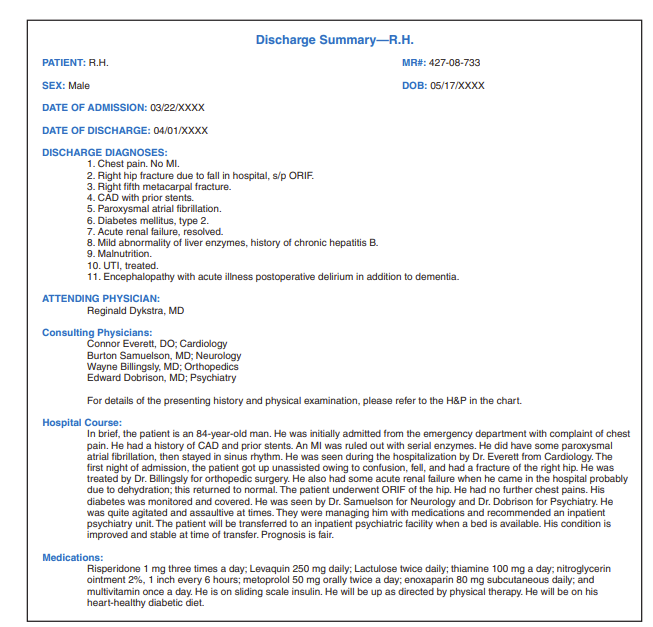
-How long was Mr. Hearst in the hospital?
-How long was Mr. Hearst in the hospital?
Question
Read the discharge summary for R.H., an 84-year-old man who is being transferred to a psychiatric facility upon discharge from the hospital. Based on the discharge summary, answer the questions that follow.
-Which discharge diagnoses listed are not addressed in the narrative of the hospital course? (list)
-Which discharge diagnoses listed are not addressed in the narrative of the hospital course? (list)
Question
Read the discharge summary for R.H., an 84-year-old man who is being transferred to a psychiatric facility upon discharge from the hospital. Based on the discharge summary, answer the questions that follow.
-Mr. Hearst will be transferred to a psychiatric facility. If you were a provider at the receiving facility, what criticisms would you have of this discharge summary?
-Mr. Hearst will be transferred to a psychiatric facility. If you were a provider at the receiving facility, what criticisms would you have of this discharge summary?
Question
Read the discharge summary for R.H., an 84-year-old man who is being transferred to a psychiatric facility upon discharge from the hospital. Based on the discharge summary, answer the questions that follow.
-What findings support that Mr. Hearst is ready for discharge from the hospital?
-What findings support that Mr. Hearst is ready for discharge from the hospital?
Question
Read the discharge summary for R.H., an 84-year-old man who is being transferred to a psychiatric facility upon discharge from the hospital. Based on the discharge summary, answer the questions that follow.
-Refer to Figure 12.2, Discharge Summary for Mr. Jensen. Identify at least three elements included in that discharge summary that are not included in Mr. Hearst's discharge summary.
-Refer to Figure 12.2, Discharge Summary for Mr. Jensen. Identify at least three elements included in that discharge summary that are not included in Mr. Hearst's discharge summary.
Question
Read the discharge summary for H.O., a 53-year-old man who was hospitalized for orthopedic surgery. Based on the discharge summary, answer the questions that follow.
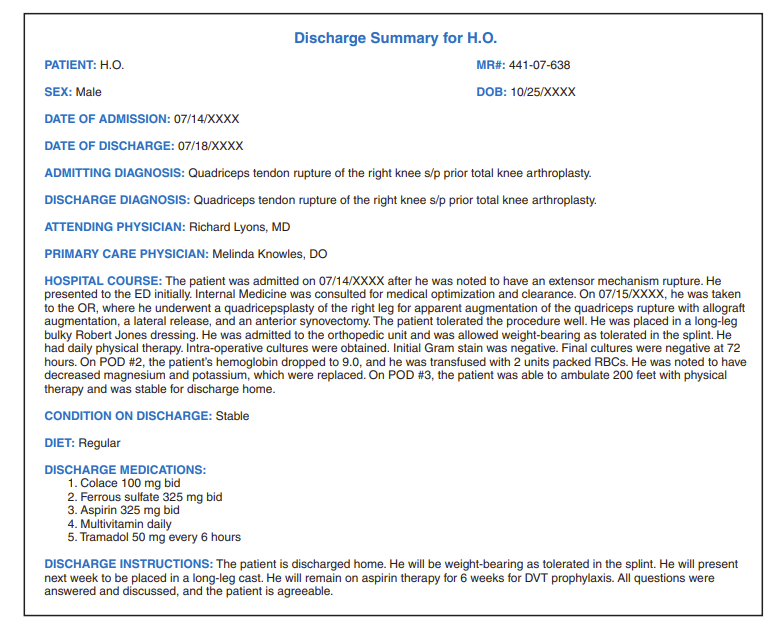
-What complications developed postoperatively that are not listed as discharge diagnoses?
-What complications developed postoperatively that are not listed as discharge diagnoses?
Question
Read the discharge summary for H.O., a 53-year-old man who was hospitalized for orthopedic surgery. Based on the discharge summary, answer the questions that follow.
-If you were Dr. Knowles, the patient's primary care provider, what information would you like to know that is not included in this discharge summary?
-If you were Dr. Knowles, the patient's primary care provider, what information would you like to know that is not included in this discharge summary?
Question
Read the discharge summary for H.O., a 53-year-old man who was hospitalized for orthopedic surgery. Based on the discharge summary, answer the questions that follow.
-What type of culture was obtained, and what is the significance of the results reported in the discharge summary?
-What type of culture was obtained, and what is the significance of the results reported in the discharge summary?
Question
Read the discharge summary for H.O., a 53-year-old man who was hospitalized for orthopedic surgery. Based on the discharge summary, answer the questions that follow.
-What findings support that Mr. Oliver is ready for discharge from the hospital?
-What findings support that Mr. Oliver is ready for discharge from the hospital?
Question
Read the discharge summary for H.O., a 53-year-old man who was hospitalized for orthopedic surgery. Based on the discharge summary, answer the questions that follow.
-What specific information is missing from the discharge instruction section of the summary?
-What specific information is missing from the discharge instruction section of the summary?
Question
Question
Question

Unlock Deck
Sign up to unlock the cards in this deck!
Unlock Deck
Unlock Deck
1/21

Play

Full screen (f)
Deck 12: Discharging Patients From the Hospital
1
List three clinical risk factors associated with re-admission within 30 days of discharge.
Any of the following: high-risk medications such as anticoagulants, steroids, and narcotics; comorbidities such as congestive heart failure, renal disease, diabetes, cancer, anemia, and weight loss
2
List four nonclinical risk factors associated with re-admission within 30 days of discharge.
Any of the following: lack of adequate support, premature discharge, nonadherence with follow-up procedures or instructions, substance abuse, homelessness, barriers to learning, delay in seeking medical treatment at the first sign of recurring symptoms
3
List three components of the discharge orders.
Any of the following: disposition, activity with specific instructions, diet, medications, follow-up instructions, notification instructions
4
List three components that should be addressed when instructing a patient on activity at the time of a hospital discharge.
Unlock Deck
Unlock for access to all 21 flashcards in this deck.
Unlock Deck
k this deck
5
List at least seven components of a discharge summary.
Unlock Deck
Unlock for access to all 21 flashcards in this deck.
Unlock Deck
k this deck
6
List at least three entities that may ask for (or are likely to receive a copy of) the discharge summary.
Unlock Deck
Unlock for access to all 21 flashcards in this deck.
Unlock Deck
k this deck
7
List at least three diagnoses for patients who are most likely to leave a hospital AMA.
Unlock Deck
Unlock for access to all 21 flashcards in this deck.
Unlock Deck
k this deck
8
List at least three elements that should be included in an AMA note.
Unlock Deck
Unlock for access to all 21 flashcards in this deck.
Unlock Deck
k this deck
9
Read the discharge summary for R.H., an 84-year-old man who is being transferred to a psychiatric facility upon discharge from the hospital. Based on the discharge summary, answer the questions that follow.
-How long was Mr. Hearst in the hospital?
-How long was Mr. Hearst in the hospital?
Unlock Deck
Unlock for access to all 21 flashcards in this deck.
Unlock Deck
k this deck
10
Read the discharge summary for R.H., an 84-year-old man who is being transferred to a psychiatric facility upon discharge from the hospital. Based on the discharge summary, answer the questions that follow.
-Which discharge diagnoses listed are not addressed in the narrative of the hospital course? (list)
-Which discharge diagnoses listed are not addressed in the narrative of the hospital course? (list)
Unlock Deck
Unlock for access to all 21 flashcards in this deck.
Unlock Deck
k this deck
11
Read the discharge summary for R.H., an 84-year-old man who is being transferred to a psychiatric facility upon discharge from the hospital. Based on the discharge summary, answer the questions that follow.
-Mr. Hearst will be transferred to a psychiatric facility. If you were a provider at the receiving facility, what criticisms would you have of this discharge summary?
-Mr. Hearst will be transferred to a psychiatric facility. If you were a provider at the receiving facility, what criticisms would you have of this discharge summary?
Unlock Deck
Unlock for access to all 21 flashcards in this deck.
Unlock Deck
k this deck
12
Read the discharge summary for R.H., an 84-year-old man who is being transferred to a psychiatric facility upon discharge from the hospital. Based on the discharge summary, answer the questions that follow.
-What findings support that Mr. Hearst is ready for discharge from the hospital?
-What findings support that Mr. Hearst is ready for discharge from the hospital?
Unlock Deck
Unlock for access to all 21 flashcards in this deck.
Unlock Deck
k this deck
13
Read the discharge summary for R.H., an 84-year-old man who is being transferred to a psychiatric facility upon discharge from the hospital. Based on the discharge summary, answer the questions that follow.
-Refer to Figure 12.2, Discharge Summary for Mr. Jensen. Identify at least three elements included in that discharge summary that are not included in Mr. Hearst's discharge summary.
-Refer to Figure 12.2, Discharge Summary for Mr. Jensen. Identify at least three elements included in that discharge summary that are not included in Mr. Hearst's discharge summary.
Unlock Deck
Unlock for access to all 21 flashcards in this deck.
Unlock Deck
k this deck
14
Read the discharge summary for H.O., a 53-year-old man who was hospitalized for orthopedic surgery. Based on the discharge summary, answer the questions that follow.
-What complications developed postoperatively that are not listed as discharge diagnoses?
-What complications developed postoperatively that are not listed as discharge diagnoses?
Unlock Deck
Unlock for access to all 21 flashcards in this deck.
Unlock Deck
k this deck
15
Read the discharge summary for H.O., a 53-year-old man who was hospitalized for orthopedic surgery. Based on the discharge summary, answer the questions that follow.
-If you were Dr. Knowles, the patient's primary care provider, what information would you like to know that is not included in this discharge summary?
-If you were Dr. Knowles, the patient's primary care provider, what information would you like to know that is not included in this discharge summary?
Unlock Deck
Unlock for access to all 21 flashcards in this deck.
Unlock Deck
k this deck
16
Read the discharge summary for H.O., a 53-year-old man who was hospitalized for orthopedic surgery. Based on the discharge summary, answer the questions that follow.
-What type of culture was obtained, and what is the significance of the results reported in the discharge summary?
-What type of culture was obtained, and what is the significance of the results reported in the discharge summary?
Unlock Deck
Unlock for access to all 21 flashcards in this deck.
Unlock Deck
k this deck
17
Read the discharge summary for H.O., a 53-year-old man who was hospitalized for orthopedic surgery. Based on the discharge summary, answer the questions that follow.
-What findings support that Mr. Oliver is ready for discharge from the hospital?
-What findings support that Mr. Oliver is ready for discharge from the hospital?
Unlock Deck
Unlock for access to all 21 flashcards in this deck.
Unlock Deck
k this deck
18
Read the discharge summary for H.O., a 53-year-old man who was hospitalized for orthopedic surgery. Based on the discharge summary, answer the questions that follow.
-What specific information is missing from the discharge instruction section of the summary?
-What specific information is missing from the discharge instruction section of the summary?
Unlock Deck
Unlock for access to all 21 flashcards in this deck.
Unlock Deck
k this deck
19
Refer back to the admission H&P in Figure 10-11 for G.M. Read the daily progress notes that follow and use the information to write a discharge summary.
HOSPITAL DAY #1, 0920
S: G.M. states that she did not sleep well last night. She attributes this to noise from the hallway. She specifically denies having any chest pain or pressure. She did ambulate 2 or 3 times yesterday with minimal dizziness. She denies any dizziness at the present time. She has not experienced any SOB. She does not have any new complaints.
O: A&O × 3. VS: BP 116/68, P 103, R 16. Neck: no JVD. Heart: rhythm still irregular. 2/6 systolic murmur;
unchanged. Lungs: clear to auscultation all fields. Ext: no peripheral edema. IV Cardizem infusing. Serial troponin levels have remained WNL. Serial ECGs show persistence of atrial fibrillation but no ischemic patterns. She received the Lantus dose this morning, 22 units. She has been on sliding-scale insulin also. Max blood glucose of 402 last evening, and she was covered with 10 units of regular insulin. Accu-Chek this morning was 385, and she received 8 units regular insulin. Cardiology consult appreciated; note reviewed and agree with starting patient on metoprolol. Wait another 24 hours to see if patient's rhythm will be restored to NSR.
A: (1) Atrial fibrillation. (2) Chest pain resolved; MI ruled out. (3) Hypertension. (4) Uncontrolled diabetes. (5) UTI.
P: Will continue IV Cardizem. Start metoprolol 50 mg PO bid. Will wait on starting back on lisinopril because the beta blocker will be started. Continue sliding-scale insulin. Consider endocrinology consult if not within acceptable range in another 24 hours. Add Cipro 500 mg PO bid for 7 days.
HOSPITAL DAY #2, 0745
S: Doing well. States no dizziness in the past 24 hours. Specifically denies chest pain.
O: A&O × 3. VS: BP 132/84, P 92, R 18. No JVD. Heart rate slower today and now regular. Remainder of physical exam unchanged. ECG shows NSR with rate of 94. BP up over the past 24 hours at all readings. Blood glucose range of 240-380 over past 24 hours. Still receiving sliding-scale insulin per routine doses. Urine culture was positive for greater than100,000 colonies E. coli.
A: (1) Atrial fibrillation resolved, now with NSR. (2) Hypertension with persistently elevated readings over past 24 hours. (3) Uncontrolled diabetes. (4) UTI with positive cultures.
P: Discontinue IV Cardizem. Restart lisinopril 5 mg PO daily. Continue with sliding-scale insulin per routine orders. Continue Cipro and all other regular medications.
HOSPITAL DAY #3, 0820
S: Patient says she did not sleep well again last night. Specifically denies any chest pain or pressure or SOB. At tributes not sleeping well to being away from home and in a different environment. She is ambulating with assistance. No further dizziness or lightheadedness. Appetite is improving.
O: A&O × 3. BP 126/84, P 88, R 16. Heart rate regular. Breath sounds clear. No change in exam. Telemetry strips reviewed; patient with mostly sinus rhythm over the past 24 hours. She did have a few runs of atrial fib but remained asymptomatic. Blood glucose range 160-230. She is requiring less sliding-scale insulin coverage. Continues on Cipro for UTI.
A: (1) Atrial fibrillation mostly resolved; doing well on metoprolol. (2) Hypertension; stable. (3) Type 2 diabetes; glucose control improving but not yet at goal. (4) UTI; currently being treated.
P: Continue present management. Social services to consult for discharge planning.
HOSPITAL DAY #4, 0750
S: Patient without any complaints. Has not had any further episodes of dizziness or lightheadedness. Denies
SOB. Ambulating without difficulty. Nurse reports that patient slept through the night. Social services note reviewed; patient has daughter who can stay with her for a few days.
O: A&O × 3. BP 134/80, P 90, R 16. Heart RRR, systolic murmur 2/6. Lungs clear all fields. No peripheral edema. All recorded blood pressures in acceptable range of less than130 systolic and less than 80 diastolic. Blood glucose range 140s to 180s. Has only required 2 interval doses of insulin in the past 24 hours.
A: (1) Atrial fib; converted and maintaining NSR on metoprolol. (2) Hypertension; stable. (3) Type 2 diabetes; better control now that UTI is resolving.
P: Continue metoprolol and present management. If glucose stays within normal range without sliding-scale coverage, anticipate discharge tomorrow.
HOSPITAL DAY #5, 0900
S: Patient denies any chest pain or pressure, dizziness, or SOB. Feels like she is ready to go home.
O: A&O × 3. All vital signs have been within normal range for the past 24 hours. Blood glucose max was 144. Patient did not require any sliding-scale doses in past 24 hours. Heart RRR, 2/6 systolic murmur. Lungs clear. Abdomen soft with bowel sounds throughout. No CVA tenderness. No peripheral edema.
A: (1) Atrial fib, controlled on metoprolol. (2) MI ruled out; no further chest pain. (3) Hypertension, stable on lisinopril. (4) Type 2 diabetes, stable on regular dose of Lantus. (5) Resolving UTI.
P: Patient asymptomatic now. Ambulating without difficulty. No recurrence of chest pain or dizziness. Stable for discharge to home. Will continue her on metoprolol 50 mg PO bid. Continue Cipro 500 mg PO bid for 2 more days. Continue Lantus 22 units daily in a.m. Continue all other regular home medications. Patient should not drive for 2 weeks, until she has had time to adjust to all medications. Otherwise, activity as toler ated. Continue on 1,800 calorie ADA, heart-healthy diet. Notify Dr. Rosenberg immediately of any episodes of chest pain or pressure, dizziness, or any new symptoms. Otherwise, follow up with Dr. Rosenberg in 1 week. Follow up with cardiologist in 2 weeks. Discharge instructions discussed with patient and daughter. All questions answered. Patient is agreeable to discharge.
Discharge Summary
• Date of admission
• Date of discharge
• Admitting diagnosis (or diagnoses)
• Discharge diagnosis (or diagnoses)
• Attending physician
• Primary provider and consulting physician(s) (if any)
• Procedures (if any)
• Brief history, pertinent physical examination findings, and pertinent laboratory values (at time of admission)
• Hospital course
• Condition at discharge
• Disposition
• Discharge medications
• Discharge instructions and follow-up instructions
HOSPITAL DAY #1, 0920
S: G.M. states that she did not sleep well last night. She attributes this to noise from the hallway. She specifically denies having any chest pain or pressure. She did ambulate 2 or 3 times yesterday with minimal dizziness. She denies any dizziness at the present time. She has not experienced any SOB. She does not have any new complaints.
O: A&O × 3. VS: BP 116/68, P 103, R 16. Neck: no JVD. Heart: rhythm still irregular. 2/6 systolic murmur;
unchanged. Lungs: clear to auscultation all fields. Ext: no peripheral edema. IV Cardizem infusing. Serial troponin levels have remained WNL. Serial ECGs show persistence of atrial fibrillation but no ischemic patterns. She received the Lantus dose this morning, 22 units. She has been on sliding-scale insulin also. Max blood glucose of 402 last evening, and she was covered with 10 units of regular insulin. Accu-Chek this morning was 385, and she received 8 units regular insulin. Cardiology consult appreciated; note reviewed and agree with starting patient on metoprolol. Wait another 24 hours to see if patient's rhythm will be restored to NSR.
A: (1) Atrial fibrillation. (2) Chest pain resolved; MI ruled out. (3) Hypertension. (4) Uncontrolled diabetes. (5) UTI.
P: Will continue IV Cardizem. Start metoprolol 50 mg PO bid. Will wait on starting back on lisinopril because the beta blocker will be started. Continue sliding-scale insulin. Consider endocrinology consult if not within acceptable range in another 24 hours. Add Cipro 500 mg PO bid for 7 days.
HOSPITAL DAY #2, 0745
S: Doing well. States no dizziness in the past 24 hours. Specifically denies chest pain.
O: A&O × 3. VS: BP 132/84, P 92, R 18. No JVD. Heart rate slower today and now regular. Remainder of physical exam unchanged. ECG shows NSR with rate of 94. BP up over the past 24 hours at all readings. Blood glucose range of 240-380 over past 24 hours. Still receiving sliding-scale insulin per routine doses. Urine culture was positive for greater than100,000 colonies E. coli.
A: (1) Atrial fibrillation resolved, now with NSR. (2) Hypertension with persistently elevated readings over past 24 hours. (3) Uncontrolled diabetes. (4) UTI with positive cultures.
P: Discontinue IV Cardizem. Restart lisinopril 5 mg PO daily. Continue with sliding-scale insulin per routine orders. Continue Cipro and all other regular medications.
HOSPITAL DAY #3, 0820
S: Patient says she did not sleep well again last night. Specifically denies any chest pain or pressure or SOB. At tributes not sleeping well to being away from home and in a different environment. She is ambulating with assistance. No further dizziness or lightheadedness. Appetite is improving.
O: A&O × 3. BP 126/84, P 88, R 16. Heart rate regular. Breath sounds clear. No change in exam. Telemetry strips reviewed; patient with mostly sinus rhythm over the past 24 hours. She did have a few runs of atrial fib but remained asymptomatic. Blood glucose range 160-230. She is requiring less sliding-scale insulin coverage. Continues on Cipro for UTI.
A: (1) Atrial fibrillation mostly resolved; doing well on metoprolol. (2) Hypertension; stable. (3) Type 2 diabetes; glucose control improving but not yet at goal. (4) UTI; currently being treated.
P: Continue present management. Social services to consult for discharge planning.
HOSPITAL DAY #4, 0750
S: Patient without any complaints. Has not had any further episodes of dizziness or lightheadedness. Denies
SOB. Ambulating without difficulty. Nurse reports that patient slept through the night. Social services note reviewed; patient has daughter who can stay with her for a few days.
O: A&O × 3. BP 134/80, P 90, R 16. Heart RRR, systolic murmur 2/6. Lungs clear all fields. No peripheral edema. All recorded blood pressures in acceptable range of less than130 systolic and less than 80 diastolic. Blood glucose range 140s to 180s. Has only required 2 interval doses of insulin in the past 24 hours.
A: (1) Atrial fib; converted and maintaining NSR on metoprolol. (2) Hypertension; stable. (3) Type 2 diabetes; better control now that UTI is resolving.
P: Continue metoprolol and present management. If glucose stays within normal range without sliding-scale coverage, anticipate discharge tomorrow.
HOSPITAL DAY #5, 0900
S: Patient denies any chest pain or pressure, dizziness, or SOB. Feels like she is ready to go home.
O: A&O × 3. All vital signs have been within normal range for the past 24 hours. Blood glucose max was 144. Patient did not require any sliding-scale doses in past 24 hours. Heart RRR, 2/6 systolic murmur. Lungs clear. Abdomen soft with bowel sounds throughout. No CVA tenderness. No peripheral edema.
A: (1) Atrial fib, controlled on metoprolol. (2) MI ruled out; no further chest pain. (3) Hypertension, stable on lisinopril. (4) Type 2 diabetes, stable on regular dose of Lantus. (5) Resolving UTI.
P: Patient asymptomatic now. Ambulating without difficulty. No recurrence of chest pain or dizziness. Stable for discharge to home. Will continue her on metoprolol 50 mg PO bid. Continue Cipro 500 mg PO bid for 2 more days. Continue Lantus 22 units daily in a.m. Continue all other regular home medications. Patient should not drive for 2 weeks, until she has had time to adjust to all medications. Otherwise, activity as toler ated. Continue on 1,800 calorie ADA, heart-healthy diet. Notify Dr. Rosenberg immediately of any episodes of chest pain or pressure, dizziness, or any new symptoms. Otherwise, follow up with Dr. Rosenberg in 1 week. Follow up with cardiologist in 2 weeks. Discharge instructions discussed with patient and daughter. All questions answered. Patient is agreeable to discharge.
Discharge Summary
• Date of admission
• Date of discharge
• Admitting diagnosis (or diagnoses)
• Discharge diagnosis (or diagnoses)
• Attending physician
• Primary provider and consulting physician(s) (if any)
• Procedures (if any)
• Brief history, pertinent physical examination findings, and pertinent laboratory values (at time of admission)
• Hospital course
• Condition at discharge
• Disposition
• Discharge medications
• Discharge instructions and follow-up instructions
Unlock Deck
Unlock for access to all 21 flashcards in this deck.
Unlock Deck
k this deck
20
Based on the discharge summary written for Worksheet 12.4, write corresponding discharge orders for G.M.
• Disposition (where the patient will go after discharge from the hospital)
• Activity with specific instructions
• Diet
• Medication reconciliation, including prehospital medications that should be resumed or stopped as well as any new medications
• Follow-up instructions (who and when)
• Notification instructions (signs or symptoms that could signal complications)
• Disposition (where the patient will go after discharge from the hospital)
• Activity with specific instructions
• Diet
• Medication reconciliation, including prehospital medications that should be resumed or stopped as well as any new medications
• Follow-up instructions (who and when)
• Notification instructions (signs or symptoms that could signal complications)
Unlock Deck
Unlock for access to all 21 flashcards in this deck.
Unlock Deck
k this deck
21
These abbreviations were introduced in Chapter 12. Beside each, write the meaning as indicated by the context of the chapter.
-AMA:
-CEA:
-H&H:
-H&P:
-PCP:
-PRN:
-AMA:
-CEA:
-H&H:
-H&P:
-PCP:
-PRN:
Unlock Deck
Unlock for access to all 21 flashcards in this deck.
Unlock Deck
k this deck
Unlock Deck
Unlock for access to all 21 flashcards in this deck.






