







 Chat with AI

Deck 5: Colonial Society on the Eve of Revolution,1700-1775
Full screen (f)

Question

Question
Question
Question
Question
Question
Question
Question
Question
Question
Question
Question
Question
Question
Question
Question
Question
Question
Question
Question
Question
Question
COMPLETION
Identify the customary eighteenth-century shipping routes for the following cargoes by reference number on the map.
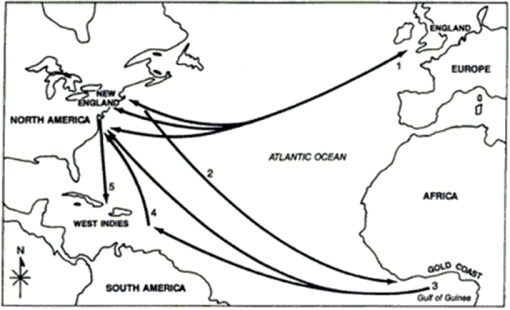
____ Slaves
Identify the customary eighteenth-century shipping routes for the following cargoes by reference number on the map.
____ Slaves
Question
Question
Question
Question
COMPLETION
Identify the customary eighteenth-century shipping routes for the following cargoes by reference number on the map.
____ Timber and foodstuffs
Identify the customary eighteenth-century shipping routes for the following cargoes by reference number on the map.
____ Timber and foodstuffs
Question
Question
COMPLETION
Identify the customary eighteenth-century shipping routes for the following cargoes by reference number on the map.
____ Sugar and molasses
Identify the customary eighteenth-century shipping routes for the following cargoes by reference number on the map.
____ Sugar and molasses
Question
Question
Question
Question
Question
Question
Question
Question
COMPLETION
Identify the customary eighteenth-century shipping routes for the following cargoes by reference number on the map.
____ Rum
Identify the customary eighteenth-century shipping routes for the following cargoes by reference number on the map.
____ Rum
Question
Question
COMPLETION
Identify the customary eighteenth-century shipping routes for the following cargoes by reference number on the map.
____ Tobacco,fish,lumber,and flour for British textiles
Identify the customary eighteenth-century shipping routes for the following cargoes by reference number on the map.
____ Tobacco,fish,lumber,and flour for British textiles
Question
Question
Question
Question
Question
Question
Question
Question
Question
Question
Question
Question
Question
Question
Question
Question
Question
Question
Question
Question
Question
Question
Question
Question
Question
Question
Question
Question
Question
Question
Question
Question
Question
Question
Match each denomination on the left with the region where it predominated. 
A) A-2, B-3, C-l
B) A-2, B-1, C-3
C) A-1, B-3, C-2
D) A-3, B-2, C-1
E) A-3, B-1, C-2
A) A-2, B-3, C-l
B) A-2, B-1, C-3
C) A-1, B-3, C-2
D) A-3, B-2, C-1
E) A-3, B-1, C-2
Question
Question
Question
Question
Question
Question
Question
Question

Unlock Deck
Sign up to unlock the cards in this deck!
Unlock Deck
Unlock Deck
1/119

Play

Full screen (f)
Deck 5: Colonial Society on the Eve of Revolution,1700-1775
1
Identify and state the historical significance of the following:
Benjamin Franklin
Benjamin Franklin
Student answers will vary.
2
Identify and state the historical significance of the following:
old and new lights
old and new lights
Student answers will vary.
3
Identify and state the historical significance of the following:
Molasses Act
Molasses Act
Student answers will vary.
4
Identify and state the historical significance of the following:
rack-renting
rack-renting
Unlock Deck
Unlock for access to all 119 flashcards in this deck.
Unlock Deck
k this deck
5
Identify and state the historical significance of the following:
triangular trade
triangular trade
Unlock Deck
Unlock for access to all 119 flashcards in this deck.
Unlock Deck
k this deck
6
Identify and state the historical significance of the following:
Benjamin West
Benjamin West
Unlock Deck
Unlock for access to all 119 flashcards in this deck.
Unlock Deck
k this deck
7
Identify and state the historical significance of the following:
Charles Wilson Peale
Charles Wilson Peale
Unlock Deck
Unlock for access to all 119 flashcards in this deck.
Unlock Deck
k this deck
8
Identify and state the historical significance of the following:
John Singleton Copley
John Singleton Copley
Unlock Deck
Unlock for access to all 119 flashcards in this deck.
Unlock Deck
k this deck
9
Identify and state the historical significance of the following:
Michel-Guillaume de Crèvecoeur
Michel-Guillaume de Crèvecoeur
Unlock Deck
Unlock for access to all 119 flashcards in this deck.
Unlock Deck
k this deck
10
Identify and state the historical significance of the following:
Phillis Wheatley
Phillis Wheatley
Unlock Deck
Unlock for access to all 119 flashcards in this deck.
Unlock Deck
k this deck
11
Identify and state the historical significance of the following:
Jonathan Edwards
Jonathan Edwards
Unlock Deck
Unlock for access to all 119 flashcards in this deck.
Unlock Deck
k this deck
12
Identify and state the historical significance of the following:
George Whitefield
George Whitefield
Unlock Deck
Unlock for access to all 119 flashcards in this deck.
Unlock Deck
k this deck
13
Identify and state the historical significance of the following:
Jacobus Arminius
Jacobus Arminius
Unlock Deck
Unlock for access to all 119 flashcards in this deck.
Unlock Deck
k this deck
14
Identify and state the historical significance of the following:
John Peter Zenger
John Peter Zenger
Unlock Deck
Unlock for access to all 119 flashcards in this deck.
Unlock Deck
k this deck
15
Identify and state the historical significance of the following:
Andrew Hamilton
Andrew Hamilton
Unlock Deck
Unlock for access to all 119 flashcards in this deck.
Unlock Deck
k this deck
16
Identify and state the historical significance of the following:
Regulator movement
Regulator movement
Unlock Deck
Unlock for access to all 119 flashcards in this deck.
Unlock Deck
k this deck
17
Identify and state the historical significance of the following:
John Trumbull
John Trumbull
Unlock Deck
Unlock for access to all 119 flashcards in this deck.
Unlock Deck
k this deck
18
Identify and state the historical significance of the following:
Anglicans
Anglicans
Unlock Deck
Unlock for access to all 119 flashcards in this deck.
Unlock Deck
k this deck
19
Identify and state the historical significance of the following:
Paxton Boys
Paxton Boys
Unlock Deck
Unlock for access to all 119 flashcards in this deck.
Unlock Deck
k this deck
20
Identify and state the historical significance of the following:
Great Awakening
Great Awakening
Unlock Deck
Unlock for access to all 119 flashcards in this deck.
Unlock Deck
k this deck
21
Identify and state the historical significance of the following:
praying towns
praying towns
Unlock Deck
Unlock for access to all 119 flashcards in this deck.
Unlock Deck
k this deck
22
COMPLETION
Identify the customary eighteenth-century shipping routes for the following cargoes by reference number on the map.
____ Slaves
Identify the customary eighteenth-century shipping routes for the following cargoes by reference number on the map.
____ Slaves
Unlock Deck
Unlock for access to all 119 flashcards in this deck.
Unlock Deck
k this deck
23
All of the following are reasons the thirteen Atlantic seaboard colonies sought independence except
A) distinctive social structures.
B) distinctive economic structures.
C) distinctive political structures.
D) distinctive ethnic or racial structures.
E) the appearance of a recognizably American way of life.
A) distinctive social structures.
B) distinctive economic structures.
C) distinctive political structures.
D) distinctive ethnic or racial structures.
E) the appearance of a recognizably American way of life.
Unlock Deck
Unlock for access to all 119 flashcards in this deck.
Unlock Deck
k this deck
24
The population growth of the American colonies by 1775 is attributed mostly to
A) white immigration from Europe.
B) the natural fertility of Native Americans.
C) the importation of slaves from Africa.
D) the influx of immigrants from Latin America.
E) the natural fertility of all Americans.
A) white immigration from Europe.
B) the natural fertility of Native Americans.
C) the importation of slaves from Africa.
D) the influx of immigrants from Latin America.
E) the natural fertility of all Americans.
Unlock Deck
Unlock for access to all 119 flashcards in this deck.
Unlock Deck
k this deck
25
Identify and state the historical significance of the following:
Presbyterian
Presbyterian
Unlock Deck
Unlock for access to all 119 flashcards in this deck.
Unlock Deck
k this deck
26
COMPLETION
Identify the customary eighteenth-century shipping routes for the following cargoes by reference number on the map.
____ Timber and foodstuffs
Identify the customary eighteenth-century shipping routes for the following cargoes by reference number on the map.
____ Timber and foodstuffs
Unlock Deck
Unlock for access to all 119 flashcards in this deck.
Unlock Deck
k this deck
27
Identify and state the historical significance of the following:
taverns
taverns
Unlock Deck
Unlock for access to all 119 flashcards in this deck.
Unlock Deck
k this deck
28
COMPLETION
Identify the customary eighteenth-century shipping routes for the following cargoes by reference number on the map.
____ Sugar and molasses
Identify the customary eighteenth-century shipping routes for the following cargoes by reference number on the map.
____ Sugar and molasses
Unlock Deck
Unlock for access to all 119 flashcards in this deck.
Unlock Deck
k this deck
29
As a result of the rapid population growth in colonial America during the eighteenth century
A) a momentous shift occurred in the balance of power between the colonies and the mother country.
B) the British government was pleased that more workers would be available to fill an increasing need for laborers in Britain.
C) the need for slave labor declined.
D) the colonists became more dependent on Britain for the goods that they needed to survive.
E) the British government granted greater autonomy to colonial governments.
A) a momentous shift occurred in the balance of power between the colonies and the mother country.
B) the British government was pleased that more workers would be available to fill an increasing need for laborers in Britain.
C) the need for slave labor declined.
D) the colonists became more dependent on Britain for the goods that they needed to survive.
E) the British government granted greater autonomy to colonial governments.
Unlock Deck
Unlock for access to all 119 flashcards in this deck.
Unlock Deck
k this deck
30
Identify and state the historical significance of the following:
jayle birds
jayle birds
Unlock Deck
Unlock for access to all 119 flashcards in this deck.
Unlock Deck
k this deck
31
Identify and state the historical significance of the following:
Scots-Irish
Scots-Irish
Unlock Deck
Unlock for access to all 119 flashcards in this deck.
Unlock Deck
k this deck
32
Identify and state the historical significance of the following:
naval stores
naval stores
Unlock Deck
Unlock for access to all 119 flashcards in this deck.
Unlock Deck
k this deck
33
One feature common to all of the eventually rebellious colonies was their
A) relatively equal wealth.
B) economic organization.
C) similar social structures.
D) rapidly growing populations.
E) support of religious freedom.
A) relatively equal wealth.
B) economic organization.
C) similar social structures.
D) rapidly growing populations.
E) support of religious freedom.
Unlock Deck
Unlock for access to all 119 flashcards in this deck.
Unlock Deck
k this deck
34
Identify the statement that is false.
A) In 1700, the Atlantic seaboard colonies contained fewer than 300,000 inhabitants.
B) In 1700, only about 20,000 inhabitants were blacks.
C) By 1775, the Atlantic seaboard colonies contained almost 2.5 million inhabitants.
D) By 1775, the black population rose to over 1 million.
E) White immigrants in 1775 made up about 400,000 of the inhabitants.
A) In 1700, the Atlantic seaboard colonies contained fewer than 300,000 inhabitants.
B) In 1700, only about 20,000 inhabitants were blacks.
C) By 1775, the Atlantic seaboard colonies contained almost 2.5 million inhabitants.
D) By 1775, the black population rose to over 1 million.
E) White immigrants in 1775 made up about 400,000 of the inhabitants.
Unlock Deck
Unlock for access to all 119 flashcards in this deck.
Unlock Deck
k this deck
35
Identify and state the historical significance of the following:
Congregational Church
Congregational Church
Unlock Deck
Unlock for access to all 119 flashcards in this deck.
Unlock Deck
k this deck
36
COMPLETION
Identify the customary eighteenth-century shipping routes for the following cargoes by reference number on the map.
____ Rum
Identify the customary eighteenth-century shipping routes for the following cargoes by reference number on the map.
____ Rum
Unlock Deck
Unlock for access to all 119 flashcards in this deck.
Unlock Deck
k this deck
37
Identify and state the historical significance of the following:
Arminians
Arminians
Unlock Deck
Unlock for access to all 119 flashcards in this deck.
Unlock Deck
k this deck
38
COMPLETION
Identify the customary eighteenth-century shipping routes for the following cargoes by reference number on the map.
____ Tobacco,fish,lumber,and flour for British textiles
Identify the customary eighteenth-century shipping routes for the following cargoes by reference number on the map.
____ Tobacco,fish,lumber,and flour for British textiles
Unlock Deck
Unlock for access to all 119 flashcards in this deck.
Unlock Deck
k this deck
39
Identify and state the historical significance of the following:
almshouses
almshouses
Unlock Deck
Unlock for access to all 119 flashcards in this deck.
Unlock Deck
k this deck
40
Identify and state the historical significance of the following:
heresies
heresies
Unlock Deck
Unlock for access to all 119 flashcards in this deck.
Unlock Deck
k this deck
41
With regard to governmental authority,the Scots-Irish colonists
A) showed remarkable willingness to follow authority.
B) supported only Britain.
C) cherished no love for the British or any other government.
D) stated a preference for Catholic authority.
E) established good relations with local Indians.
A) showed remarkable willingness to follow authority.
B) supported only Britain.
C) cherished no love for the British or any other government.
D) stated a preference for Catholic authority.
E) established good relations with local Indians.
Unlock Deck
Unlock for access to all 119 flashcards in this deck.
Unlock Deck
k this deck
42
An armed march in Philadelphia in 1764,protesting the Quaker oligarchy's lenient policy toward the Indians was known as
A) Bacon's Rebellion.
B) March of the Paxton Boys.
C) Regulator Movement.
D) Shays' Rebellion.
E) Oligarchy Revolution.
A) Bacon's Rebellion.
B) March of the Paxton Boys.
C) Regulator Movement.
D) Shays' Rebellion.
E) Oligarchy Revolution.
Unlock Deck
Unlock for access to all 119 flashcards in this deck.
Unlock Deck
k this deck
43
Colonial immigrants laid the foundations for a new multicultural American national identity by
A) merging their religious traditions with those of Native Americans
B) intermarrying with people from other ethnic groups.
C) pushing their settlements from the East Coast into the backcountry.
D) importing increasing numbers of slaves.
E) None of these
A) merging their religious traditions with those of Native Americans
B) intermarrying with people from other ethnic groups.
C) pushing their settlements from the East Coast into the backcountry.
D) importing increasing numbers of slaves.
E) None of these
Unlock Deck
Unlock for access to all 119 flashcards in this deck.
Unlock Deck
k this deck
44
Identify the statement that is false.
A) The population of the thirteen colonies, mainly Anglo-Saxon, was the least mixed to be found anywhere in the world.
B) The South, holding about 90 percent of the slaves, displayed its historic black-and-white racial composition.
C) New England, mostly staked out by the original Puritan migrants, showed the least ethnic diversity.
D) The Middle Colonies received the bulk of later white immigrants and boasted the most variety of peoples.
E) In 1775, outside of New England, about one-half the population was non-English.
A) The population of the thirteen colonies, mainly Anglo-Saxon, was the least mixed to be found anywhere in the world.
B) The South, holding about 90 percent of the slaves, displayed its historic black-and-white racial composition.
C) New England, mostly staked out by the original Puritan migrants, showed the least ethnic diversity.
D) The Middle Colonies received the bulk of later white immigrants and boasted the most variety of peoples.
E) In 1775, outside of New England, about one-half the population was non-English.
Unlock Deck
Unlock for access to all 119 flashcards in this deck.
Unlock Deck
k this deck
45
In 1760,fearful of heavy concentrations of resentful slaves,which colonial legislature unsuccessfully sought to pass legislation that would halt the further importation of slaves.?
A) South Carolina
B) North Carolina
C) Georgia
D) Virginia
E) Maryland
A) South Carolina
B) North Carolina
C) Georgia
D) Virginia
E) Maryland
Unlock Deck
Unlock for access to all 119 flashcards in this deck.
Unlock Deck
k this deck
46
In North Carolina,spearheaded by the Scotch-Irish,a small insurrection against eastern domination of the colony's affair was known as
A) Bacon's Rebellion.
B) March of the Paxton Boys.
C) Regulator Movement.
D) Shays' Rebellion.
E) Whiskey Rebellion.
A) Bacon's Rebellion.
B) March of the Paxton Boys.
C) Regulator Movement.
D) Shays' Rebellion.
E) Whiskey Rebellion.
Unlock Deck
Unlock for access to all 119 flashcards in this deck.
Unlock Deck
k this deck
47
On the eve of the American Revolution,social and economic mobility in the colonies decreased for all of the following reasons except
A) earlier wars made Northern merchants rich and created a class of widows and orphans.
B) the supply of unclaimed land in New England began to diminish
C) farmers' sons and daughters were forced to hire out as wage laborers.
D) the average size of New England farms increased dramatically.
E) the gap between owners of large Southern plantations and small farms widened.
A) earlier wars made Northern merchants rich and created a class of widows and orphans.
B) the supply of unclaimed land in New England began to diminish
C) farmers' sons and daughters were forced to hire out as wage laborers.
D) the average size of New England farms increased dramatically.
E) the gap between owners of large Southern plantations and small farms widened.
Unlock Deck
Unlock for access to all 119 flashcards in this deck.
Unlock Deck
k this deck
48
By the end of the 1700s,what was the percentage of people living in rural areas of colonial America?
A) 25 percent
B) 40 percent
C) 60 percent
D) 75 percent
E) 90 percent
A) 25 percent
B) 40 percent
C) 60 percent
D) 75 percent
E) 90 percent
Unlock Deck
Unlock for access to all 119 flashcards in this deck.
Unlock Deck
k this deck
49
The most honored profession in early colonial society was
A) medicine.
B) law.
C) the ministry.
D) farming.
E) the merchants.
A) medicine.
B) law.
C) the ministry.
D) farming.
E) the merchants.
Unlock Deck
Unlock for access to all 119 flashcards in this deck.
Unlock Deck
k this deck
50
The average age of the American colonists in 1775 was
A) 30.
B) 27.
C) 25.
D) 20.
E) 16.
A) 30.
B) 27.
C) 25.
D) 20.
E) 16.
Unlock Deck
Unlock for access to all 119 flashcards in this deck.
Unlock Deck
k this deck
51
By the mid-1700s,the number of poor people in the American colonies
A) became greater than in all of Europe.
B) had increased to the point of overpopulation.
C) had begun to decline from seventeenth-century levels.
D) remained tiny compared with the number in England.
E) was about one-third of the population.
A) became greater than in all of Europe.
B) had increased to the point of overpopulation.
C) had begun to decline from seventeenth-century levels.
D) remained tiny compared with the number in England.
E) was about one-third of the population.
Unlock Deck
Unlock for access to all 119 flashcards in this deck.
Unlock Deck
k this deck
52
The population of the thirteen American colonies was
A) about evenly divided among Anglo-Saxons, French, Scots-Irish, and Germans.
B) perhaps the most diverse in the world, although it remained predominantly Anglo-Saxon.
C) overwhelmingly African.
D) the less diverse in the world.
E) None of these
A) about evenly divided among Anglo-Saxons, French, Scots-Irish, and Germans.
B) perhaps the most diverse in the world, although it remained predominantly Anglo-Saxon.
C) overwhelmingly African.
D) the less diverse in the world.
E) None of these
Unlock Deck
Unlock for access to all 119 flashcards in this deck.
Unlock Deck
k this deck
53
The most ethnically diverse region of colonial America was ____,whereas ____ was the least ethnically diverse.
A) New England, the South
B) the middle colonies, the South
C) the South, New England
D) the middle colonies, New England
E) the frontier regions, New England
A) New England, the South
B) the middle colonies, the South
C) the South, New England
D) the middle colonies, New England
E) the frontier regions, New England
Unlock Deck
Unlock for access to all 119 flashcards in this deck.
Unlock Deck
k this deck
54
The South held about ____ percent of the slaves in the thirteen colonies of North America.
A) 100
B) 90
C) 80
D) 70
E) 50
A) 100
B) 90
C) 80
D) 70
E) 50
Unlock Deck
Unlock for access to all 119 flashcards in this deck.
Unlock Deck
k this deck
55
How did British authorities respond to efforts by colonial legislatures to restrict or halt the importation of slaves?
A) They applauded and supported these efforts.
B) British leaders vetoed such efforts.
C) They allowed only South Carolina's legislation to stand.
D) They viewed such colonial actions as morally callous.
E) The British refused to intervene and did nothing.
A) They applauded and supported these efforts.
B) British leaders vetoed such efforts.
C) They allowed only South Carolina's legislation to stand.
D) They viewed such colonial actions as morally callous.
E) The British refused to intervene and did nothing.
Unlock Deck
Unlock for access to all 119 flashcards in this deck.
Unlock Deck
k this deck
56
By 1775,the ____ were the largest non-English ethnic group in colonial America.
A) Africans
B) Germans
C) West Indians
D) Scots-Irish
E) Irish
A) Africans
B) Germans
C) West Indians
D) Scots-Irish
E) Irish
Unlock Deck
Unlock for access to all 119 flashcards in this deck.
Unlock Deck
k this deck
57
By 1775,which of the following communities could not be considered a city in colonial America?
A) New York
B) Charlestown
C) Philadelphia
D) Boston
E) Baltimore
A) New York
B) Charlestown
C) Philadelphia
D) Boston
E) Baltimore
Unlock Deck
Unlock for access to all 119 flashcards in this deck.
Unlock Deck
k this deck
58
The Scots-Irish can best be described as
A) pugnacious, lawless, and individualistic.
B) loyal to the British king.
C) people who did not like to move.
D) builders of sturdy homes and well-kept farms.
E) strong supporters of the Catholic Church.
A) pugnacious, lawless, and individualistic.
B) loyal to the British king.
C) people who did not like to move.
D) builders of sturdy homes and well-kept farms.
E) strong supporters of the Catholic Church.
Unlock Deck
Unlock for access to all 119 flashcards in this deck.
Unlock Deck
k this deck
59
The riches created by the growing slave population in the American South
A) were distributed evenly among whites.
B) helped to narrow the gap between rich and poor.
C) created a serious problem with inflation.
D) were not distributed evenly among whites.
E) enabled poor whites to escape tenant farming.
A) were distributed evenly among whites.
B) helped to narrow the gap between rich and poor.
C) created a serious problem with inflation.
D) were not distributed evenly among whites.
E) enabled poor whites to escape tenant farming.
Unlock Deck
Unlock for access to all 119 flashcards in this deck.
Unlock Deck
k this deck
60
In contrast to the seventeenth century,by 1775,colonial Americans
A) had become more stratified into social classes.
B) had all but eliminated poverty.
C) found that it was easier for ordinary people to acquire land.
D) had nearly lost their fear of slave rebellion.
E) had few people who owned small farms.
A) had become more stratified into social classes.
B) had all but eliminated poverty.
C) found that it was easier for ordinary people to acquire land.
D) had nearly lost their fear of slave rebellion.
E) had few people who owned small farms.
Unlock Deck
Unlock for access to all 119 flashcards in this deck.
Unlock Deck
k this deck
61
Which of the following was not considered to be a naval store?
A) Tar
B) Pitch
C) Rosin
D) Turpentine
E) Glass
A) Tar
B) Pitch
C) Rosin
D) Turpentine
E) Glass
Unlock Deck
Unlock for access to all 119 flashcards in this deck.
Unlock Deck
k this deck
62
What proportion of the British merchant marine fleet was American built?
A) One-fourth
B) One-third
C) Two-thirds
D) Three-fifths
E) None
A) One-fourth
B) One-third
C) Two-thirds
D) Three-fifths
E) None
Unlock Deck
Unlock for access to all 119 flashcards in this deck.
Unlock Deck
k this deck
63
As the Revolution approached,Presbyterian and Congregational ministers in general
A) remained neutral.
B) supported the Revolutionary cause.
C) sided with the Anglican clergymen.
D) opposed the idea of revolution.
E) split on the issue of independence.
A) remained neutral.
B) supported the Revolutionary cause.
C) sided with the Anglican clergymen.
D) opposed the idea of revolution.
E) split on the issue of independence.
Unlock Deck
Unlock for access to all 119 flashcards in this deck.
Unlock Deck
k this deck
64
The triangular trade of the colonial American shipping industry
A) was not that profitable.
B) involved America, France, and England.
C) relied on the Spanish fleet for protection.
D) saw the Spanish gaining the largest profits.
E) involved the trading of rum for African slaves.
A) was not that profitable.
B) involved America, France, and England.
C) relied on the Spanish fleet for protection.
D) saw the Spanish gaining the largest profits.
E) involved the trading of rum for African slaves.
Unlock Deck
Unlock for access to all 119 flashcards in this deck.
Unlock Deck
k this deck
65
Identify the statement that is false.
A) The triangular trade was infamously profitable and made up most of the colonial commerce.
B) A trader would leave New England with a cargo of rum and sail to the Gold Coast of Africa.
C) A trader would barter rum with African chiefs for captured African slaves.
D) A trader would travel to the West Indies with the African slaves for molasses.
E) A trader would travel to New England with the molasses, where it would be distilled into rum.
A) The triangular trade was infamously profitable and made up most of the colonial commerce.
B) A trader would leave New England with a cargo of rum and sail to the Gold Coast of Africa.
C) A trader would barter rum with African chiefs for captured African slaves.
D) A trader would travel to the West Indies with the African slaves for molasses.
E) A trader would travel to New England with the molasses, where it would be distilled into rum.
Unlock Deck
Unlock for access to all 119 flashcards in this deck.
Unlock Deck
k this deck
66
The Molasses Act of 1733 was intended to
A) stimulate the colonies' triangle trade with Africa and the West Indies.
B) satisfy colonial demands for earning foreign exchange money.
C) inhibit colonial trade with the French West Indies.
D) increase the colonists' standard of living and protect the livelihood of colonial merchants.
E) require Americans to sell their molasses to British merchants.
A) stimulate the colonies' triangle trade with Africa and the West Indies.
B) satisfy colonial demands for earning foreign exchange money.
C) inhibit colonial trade with the French West Indies.
D) increase the colonists' standard of living and protect the livelihood of colonial merchants.
E) require Americans to sell their molasses to British merchants.
Unlock Deck
Unlock for access to all 119 flashcards in this deck.
Unlock Deck
k this deck
67
One of the surest avenues to speedy wealth in the American colonies was
A) commercial ventures.
B) a plantation.
C) fishing.
D) manufacturing.
E) selling slaves.
A) commercial ventures.
B) a plantation.
C) fishing.
D) manufacturing.
E) selling slaves.
Unlock Deck
Unlock for access to all 119 flashcards in this deck.
Unlock Deck
k this deck
68
By the early eighteenth century,religion in colonial America was
A) stronger than at any previous time.
B) holding steadfastly to the belief that spiritual conversion was essential for church membership.
C) moving away from clerical intellectualism.
D) less fervid than when the colonies were established.
E) becoming less tolerant.
A) stronger than at any previous time.
B) holding steadfastly to the belief that spiritual conversion was essential for church membership.
C) moving away from clerical intellectualism.
D) less fervid than when the colonies were established.
E) becoming less tolerant.
Unlock Deck
Unlock for access to all 119 flashcards in this deck.
Unlock Deck
k this deck
69
Transportation in colonial America was
A) surprisingly fast for the time.
B) safer by road than by any other means.
C) slow by any of the means available.
D) so poor that no mail service was established until the 1800s.
E) fast only on the waterways.
A) surprisingly fast for the time.
B) safer by road than by any other means.
C) slow by any of the means available.
D) so poor that no mail service was established until the 1800s.
E) fast only on the waterways.
Unlock Deck
Unlock for access to all 119 flashcards in this deck.
Unlock Deck
k this deck
70
In 1775,the ____ churches were the only two established (tax-supported)churches in colonial America.
A) Methodist and Anglican
B) Presbyterian and Congregational
C) Congregational and Anglican
D) Quaker and Catholic
E) Presbyterian and Anglican
A) Methodist and Anglican
B) Presbyterian and Congregational
C) Congregational and Anglican
D) Quaker and Catholic
E) Presbyterian and Anglican
Unlock Deck
Unlock for access to all 119 flashcards in this deck.
Unlock Deck
k this deck
71
American colonists sought trade with countries other than Great Britain
A) in order to gain their independence.
B) mainly to anger the king.
C) to anger Parliament.
D) to help strengthen the French.
E) to make money to buy what they wanted in Britain.
A) in order to gain their independence.
B) mainly to anger the king.
C) to anger Parliament.
D) to help strengthen the French.
E) to make money to buy what they wanted in Britain.
Unlock Deck
Unlock for access to all 119 flashcards in this deck.
Unlock Deck
k this deck
72
Match each denomination on the left with the region where it predominated.
A) A-2, B-3, C-l
B) A-2, B-1, C-3
C) A-1, B-3, C-2
D) A-3, B-2, C-1
E) A-3, B-1, C-2
A) A-2, B-3, C-l
B) A-2, B-1, C-3
C) A-1, B-3, C-2
D) A-3, B-2, C-1
E) A-3, B-1, C-2
Unlock Deck
Unlock for access to all 119 flashcards in this deck.
Unlock Deck
k this deck
73
The least honored profession in early colonial society was
A) physician.
B) teacher.
C) minister.
D) farmer.
E) merchant.
A) physician.
B) teacher.
C) minister.
D) farmer.
E) merchant.
Unlock Deck
Unlock for access to all 119 flashcards in this deck.
Unlock Deck
k this deck
74
Colonial American taverns were all of the following except
A) frequented mainly by the lower class.
B) another cradle of democracy.
C) hotbeds of agitation for the Revolutionary movement.
D) important in crystallizing public opinion.
E) places providing amusements.
A) frequented mainly by the lower class.
B) another cradle of democracy.
C) hotbeds of agitation for the Revolutionary movement.
D) important in crystallizing public opinion.
E) places providing amusements.
Unlock Deck
Unlock for access to all 119 flashcards in this deck.
Unlock Deck
k this deck
75
Although manufacturing in the colonies was of only secondary importance,they did produce which of the following?
A) Rum
B) Beaver hats
C) Lumber
D) Iron
E) All of these
A) Rum
B) Beaver hats
C) Lumber
D) Iron
E) All of these
Unlock Deck
Unlock for access to all 119 flashcards in this deck.
Unlock Deck
k this deck
76
By the eighteenth century,the various colonial regions had distinct economic identities; the northern colonies relied on ____,the Chesapeake colonies relied on ____,and the southern colonies relied on ____.
A) cattle and grain, tobacco, rice and indigo
B) furs and skins, tobacco, iron works
C) rice and indigo, lumber and timber, tobacco
D) shipbuilding, iron works, cattle and grain
E) cattle and grain, tobacco, fishing
A) cattle and grain, tobacco, rice and indigo
B) furs and skins, tobacco, iron works
C) rice and indigo, lumber and timber, tobacco
D) shipbuilding, iron works, cattle and grain
E) cattle and grain, tobacco, fishing
Unlock Deck
Unlock for access to all 119 flashcards in this deck.
Unlock Deck
k this deck
77
The leading industry in the American colonies was
A) fishing.
B) manufacturing.
C) commerce.
D) agriculture.
E) slave trading.
A) fishing.
B) manufacturing.
C) commerce.
D) agriculture.
E) slave trading.
Unlock Deck
Unlock for access to all 119 flashcards in this deck.
Unlock Deck
k this deck
78
English officials tried to establish the Church of England in as many colonies as possible because
A) they were concerned about the eternal souls of the colonists.
B) the church would act as a major prop for royal authority.
C) such an action would restore enthusiasm for religion.
D) the American colonists supported such a move.
E) such an action brought in more money to England.
A) they were concerned about the eternal souls of the colonists.
B) the church would act as a major prop for royal authority.
C) such an action would restore enthusiasm for religion.
D) the American colonists supported such a move.
E) such an action brought in more money to England.
Unlock Deck
Unlock for access to all 119 flashcards in this deck.
Unlock Deck
k this deck
79
One feature of the American economy that strained the relationship between the colonies and Britain was the
A) British demand to halt the importation of slaves.
B) growing desire of Americans to trade with other nations in addition to Britain.
C) lack of any British regulations regarding trade with foreign nations.
D) British rejection of the Molasses Act.
E) the Americans' unwillingness to trade with the French West Indies.
A) British demand to halt the importation of slaves.
B) growing desire of Americans to trade with other nations in addition to Britain.
C) lack of any British regulations regarding trade with foreign nations.
D) British rejection of the Molasses Act.
E) the Americans' unwillingness to trade with the French West Indies.
Unlock Deck
Unlock for access to all 119 flashcards in this deck.
Unlock Deck
k this deck
80
The most important manufacturing enterprise in colonial America in the eighteenth century was
A) iron making.
B) arms and munitions production.
C) lumbering.
D) rum distilling.
E) making clothes.
A) iron making.
B) arms and munitions production.
C) lumbering.
D) rum distilling.
E) making clothes.
Unlock Deck
Unlock for access to all 119 flashcards in this deck.
Unlock Deck
k this deck
Unlock Deck
Unlock for access to all 119 flashcards in this deck.






