







 Chat with AI

Deck 7: Pain Assessment and Management in Children
Full screen (f)

Question

Question
Question
Question
Question
The nurse is completing a pain assessment on a 4-year-old child.Which of the depicted pain scale tools should the nurse use with a child this age?
A)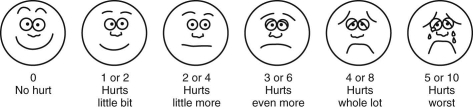
B)
C)
D)
A)
B)
C)
D)
Question
Question
Question
Question
Question
Question
Question
Question
Question
Question
Question

Unlock Deck
Sign up to unlock the cards in this deck!
Unlock Deck
Unlock Deck
1/16

Play

Full screen (f)
Deck 7: Pain Assessment and Management in Children
1
Surgery has informed a nurse that the patient returning to the floor after spinal surgery has an opioid epidural catheter for pain management.The nurse should prepare to monitor the patient for which side effects of an opioid epidural catheter? (Select all that apply.)
A)Urinary frequency
B)Nausea
C)Itching
D)Respiratory depression
A)Urinary frequency
B)Nausea
C)Itching
D)Respiratory depression
Nausea
Itching
Respiratory depression
Itching
Respiratory depression
2
Which drug is usually the best choice for patient-controlled analgesia (PCA)for a child in the immediate postoperative period?
A)Codeine
B)Morphine
C)Methadone
D)Meperidine
A)Codeine
B)Morphine
C)Methadone
D)Meperidine
Morphine
3
A 2-year-old child has been returned to the nursing unit after an inguinal hernia repair.Which pain assessment tool should the nurse use to assess this child for the presence of pain?
A)FACES pain rating tool
B)Numeric scale
C)Oucher scale
D)FLACC tool
A)FACES pain rating tool
B)Numeric scale
C)Oucher scale
D)FLACC tool
FLACC tool
4
Physiologic measurements in children's pain assessment are:
A)the best indicator of pain in children of all ages.
B)essential to determine whether a child is telling the truth about pain.
C)of most value when children also report having pain.
D)of limited value as sole indicator of pain.
A)the best indicator of pain in children of all ages.
B)essential to determine whether a child is telling the truth about pain.
C)of most value when children also report having pain.
D)of limited value as sole indicator of pain.
Unlock Deck
Unlock for access to all 16 flashcards in this deck.
Unlock Deck
k this deck
5
The nurse is completing a pain assessment on a 4-year-old child.Which of the depicted pain scale tools should the nurse use with a child this age?
A)
B)
C)
D)
A)
B)
C)
D)
Unlock Deck
Unlock for access to all 16 flashcards in this deck.
Unlock Deck
k this deck
6
Nonpharmacologic strategies for pain management:
A)may reduce pain perception.
B)make pharmacologic strategies unnecessary.
C)usually take too long to implement.
D)trick children into believing they do not have pain.
A)may reduce pain perception.
B)make pharmacologic strategies unnecessary.
C)usually take too long to implement.
D)trick children into believing they do not have pain.
Unlock Deck
Unlock for access to all 16 flashcards in this deck.
Unlock Deck
k this deck
7
A nurse is gathering a history on a school-age child admitted for a migraine headache.The child states,"I have been getting a migraine every 2 or 3 months for the last year." The nurse documents this as which type of pain?
A)Acute
B)Chronic
C)Recurrent
D)Subacute
A)Acute
B)Chronic
C)Recurrent
D)Subacute
Unlock Deck
Unlock for access to all 16 flashcards in this deck.
Unlock Deck
k this deck
8
The nurse is caring for a child receiving intravenous (IV)morphine for severe postoperative pain.The nurse observes a slower respiratory rate,and the child cannot be aroused.The most appropriate management of this child is for the nurse to:
A)administer naloxone (Narcan).
B)discontinue IV infusion.
C)discontinue morphine until child is fully awake.
D)stimulate child by calling name, shaking gently, and asking to breathe deeply.
A)administer naloxone (Narcan).
B)discontinue IV infusion.
C)discontinue morphine until child is fully awake.
D)stimulate child by calling name, shaking gently, and asking to breathe deeply.
Unlock Deck
Unlock for access to all 16 flashcards in this deck.
Unlock Deck
k this deck
9
A lumbar puncture is needed on a school-age child.The most appropriate action to provide analgesia during this procedure is to apply _____ before the procedure.
A)TAC (tetracaine-adrenaline-cocaine) 15 minutes
B)transdermal fentanyl (Duragesic) patch immediately
C)EMLA (eutectic mixture of local anesthetics) 1 hour
D)EMLA (eutectic mixture of local anesthetics) 30 minutes
A)TAC (tetracaine-adrenaline-cocaine) 15 minutes
B)transdermal fentanyl (Duragesic) patch immediately
C)EMLA (eutectic mixture of local anesthetics) 1 hour
D)EMLA (eutectic mixture of local anesthetics) 30 minutes
Unlock Deck
Unlock for access to all 16 flashcards in this deck.
Unlock Deck
k this deck
10
A nurse is monitoring a patient for side effects associated with opioid analgesics.Which side effects should the nurse expect to monitor for? (Select all that apply.)
A)Diarrhea
B)Respiratory depression
C)Hypertension
D)Pruritus
E)Sweating
A)Diarrhea
B)Respiratory depression
C)Hypertension
D)Pruritus
E)Sweating
Unlock Deck
Unlock for access to all 16 flashcards in this deck.
Unlock Deck
k this deck
11
The nurse is caring for a 6-year-old girl who had surgery 12 hours ago.The child tells the nurse that she does not have pain,but a few minutes later she tells her parents that she does.Which should the nurse consider when interpreting this?
A)Truthful reporting of pain should occur by this age.
B)Inconsistency in pain reporting suggests that pain is not present.
C)Children use pain experiences to manipulate their parents.
D)Children may be experiencing pain even though they deny it to the nurse.
A)Truthful reporting of pain should occur by this age.
B)Inconsistency in pain reporting suggests that pain is not present.
C)Children use pain experiences to manipulate their parents.
D)Children may be experiencing pain even though they deny it to the nurse.
Unlock Deck
Unlock for access to all 16 flashcards in this deck.
Unlock Deck
k this deck
12
A patient on an intravenous opioid analgesic has become apneic.The nurse should implement which interventions? Place the interventions in order from the highest priority (first intervention)to the lowest priority (last intervention).Provide your answer using lowercase letters separated by commas (e.g.,a,b,c,d).
A) Place the patient on continuous pulse oximetry to assess SaO?.
B) Administer the prescribed naloxone (Narcan) dose by slow IV push.
C) Ensure oxygen is available.
D) Prepare to calm the child as analgesia is reversed.
A) Place the patient on continuous pulse oximetry to assess SaO?.
B) Administer the prescribed naloxone (Narcan) dose by slow IV push.
C) Ensure oxygen is available.
D) Prepare to calm the child as analgesia is reversed.
Unlock Deck
Unlock for access to all 16 flashcards in this deck.
Unlock Deck
k this deck
13
A nurse recognizes which physiologic responses as a manifestation of pain in a neonate? (Select all that apply.)
A)Decreased respirations
B)Diaphoresis
C)Decreased SaO2
D)Decreased blood pressure
E)Increased heart rate
A)Decreased respirations
B)Diaphoresis
C)Decreased SaO2
D)Decreased blood pressure
E)Increased heart rate
Unlock Deck
Unlock for access to all 16 flashcards in this deck.
Unlock Deck
k this deck
14
Which dietary recommendations should a nurse make to an adolescent patient to manage constipation related to opioid analgesic administration? (Select all that apply.)
A)Bran cereal
B)Decrease fluid intake
C)Prune juice
D)Cheese
E)Vegetables
A)Bran cereal
B)Decrease fluid intake
C)Prune juice
D)Cheese
E)Vegetables
Unlock Deck
Unlock for access to all 16 flashcards in this deck.
Unlock Deck
k this deck
15
A dose of oxycodone (OxyContin)2 mg/kg has been ordered for a child weighing 33 lb.How many milligrams of OxyContin should the nurse administer? (Record your answer as a whole number.)
Unlock Deck
Unlock for access to all 16 flashcards in this deck.
Unlock Deck
k this deck
16
A nurse is using the FLACC scale to evaluate pain in a preverbal child.The nurse makes the following assessment: Face: occasional grimace; Leg: relaxed; Activity: squirming,tense; Cry: no cry; Consolability: content,relaxed.The nurse records the FLACC assessment as which number? (Record your answer as a whole number.)
Unlock Deck
Unlock for access to all 16 flashcards in this deck.
Unlock Deck
k this deck
Unlock Deck
Unlock for access to all 16 flashcards in this deck.






