







 Chat with AI

Deck 36: Plant Growth and Reproduction
Full screen (f)

Question

Question
Question
Question
Question
Question
Question
Question
Question
Question
Question
Question
Question
Question
Which of the layers shown in the diagram below of a tree trunk were most recently produced by the vascular cambium? 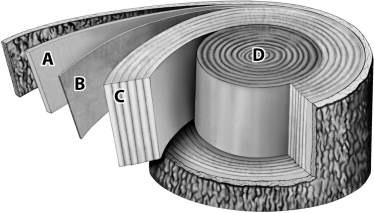
A)A and B
B)A and C
C)B and C
D)C and D
A)A and B
B)A and C
C)B and C
D)C and D
Question
Question
Question
Question
Question
Question
Question
Question
Question
Question
Question
What part(s)of the embryo sac shown in the diagram below fuse(s)with sperm from a pollen grain? 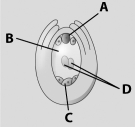
A)A
B)A and B
C)A and D
D)D
A)A
B)A and B
C)A and D
D)D
Question
Question
Question
Question
Question
Question
Flowers, like the ones in the figure below, display spectacular colors, shapes, and odors in combination with food rewards such as nectar, in order to convince pollinating animals to visit several flowers of the same species to transfer pollen for reproduction. 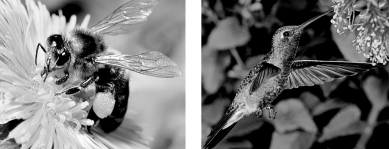
How might a flower be specialized to attract hummingbird pollinators (above right)and discourage insect pollinators (above left)?
A)have brightly colored petals
B)open only at night
C)hang downward from the branch tips
D)organize its flowers into a flat landing surface
How might a flower be specialized to attract hummingbird pollinators (above right)and discourage insect pollinators (above left)?
A)have brightly colored petals
B)open only at night
C)hang downward from the branch tips
D)organize its flowers into a flat landing surface
Question
Question
Which of the labeled structures in the figure below is where the embryo sac would be found? 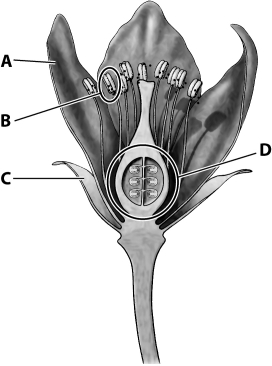
A)A
B)B
C)C
D)D
A)A
B)B
C)C
D)D
Question
Question
Question
Question
Question
Question
Question
The structure indicated by the arrow in this diagram of a fruit developed from the 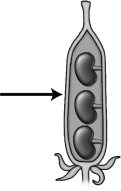
A)ovule.
B)ovary.
C)pollen grain.
D)anther.
A)ovule.
B)ovary.
C)pollen grain.
D)anther.
Question
Question
Question
Question
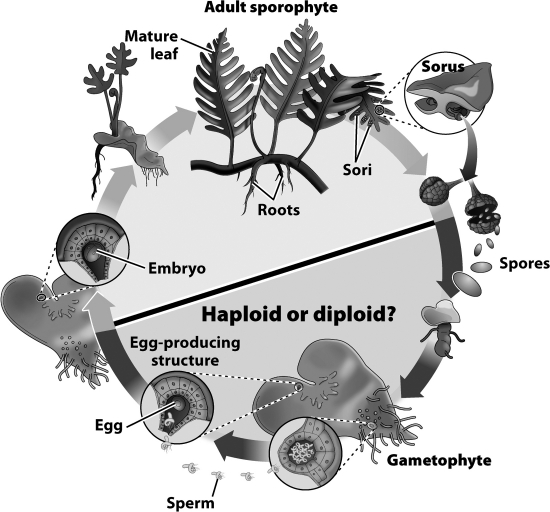
The line through the center of the diagram below separates the haploid and diploid life stages of the plant life cycle. The part of the cycle that exists below the line consists of plants that are ____________________.
Question
Question
Question
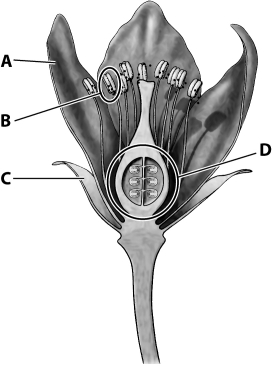
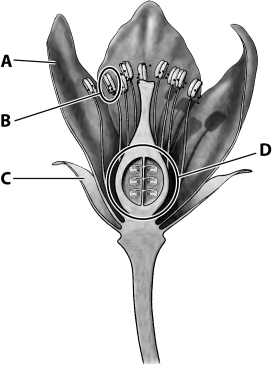
The structure labeled B in the diagram below of a flower is known as the ____________________ and produces ____________________.
Question
Question
Question
Question
Question
Question
Question
Question
Why are the structures indicated by the arrow in the diagram below of a seedling somewhat shriveled at this stage in germination? 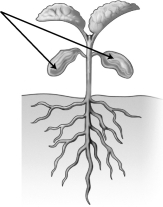
A)These structures die as a result of exposure to sunlight when the seedling breaks the surface of the ground.
B)These structures formed the protective coat of the seed and are no longer needed.
C)These structures originally held food for the embryo, which is mostly used up by this stage of germination.
D)The cells of the meristem moved out of these structures as the seedling began primary growth.
A)These structures die as a result of exposure to sunlight when the seedling breaks the surface of the ground.
B)These structures formed the protective coat of the seed and are no longer needed.
C)These structures originally held food for the embryo, which is mostly used up by this stage of germination.
D)The cells of the meristem moved out of these structures as the seedling began primary growth.
Question
Question
Question
Question
The figure below illustrates the results of a laboratory experiment that simulates potted irises being exposed to differing lengths of darkness. 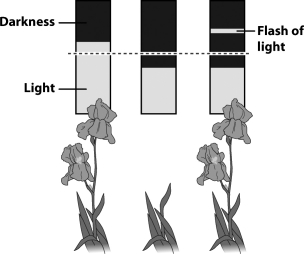
How would flowering in these irises be affected by disrupting the length of their light exposure?
A)It would stimulate flowering.
B)It would suppress flowering.
C)It would stimulate branching and increase total flower production.
D)There would be no effect because irises use the length of darkness to coordinate flowering.
How would flowering in these irises be affected by disrupting the length of their light exposure?
A)It would stimulate flowering.
B)It would suppress flowering.
C)It would stimulate branching and increase total flower production.
D)There would be no effect because irises use the length of darkness to coordinate flowering.
Question
Question
Question
Question
Question
Question
Question
Question
Question
Question
Question
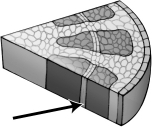
The region of the diagram below indicated by the arrow is involved in the production of wood.
Question
Question
The structure labeled A in this figure is usually designed to attract pollinators.
Question
Question
Question
Question
Question
Question
Question
Question

Unlock Deck
Sign up to unlock the cards in this deck!
Unlock Deck
Unlock Deck
1/80

Play

Full screen (f)
Deck 36: Plant Growth and Reproduction
1
The growth of cells within the cork cambium results in the production of
A)heartwood.
B)bark.
C)secondary phloem.
D)sapwood.
A)heartwood.
B)bark.
C)secondary phloem.
D)sapwood.
B
2
Groups of perpetually young, undifferentiated cells from which new cells arise are called
A)seeds.
B)meristems.
C)root caps.
D)phloem.
A)seeds.
B)meristems.
C)root caps.
D)phloem.
B
3
Plant growth is indeterminate and animal growth is determinant. Why is indeterminate growth more beneficial to plants than to animals?
A)Plants are stationary in their habitat, whereas animals can move; indeterminate growth allows a plant to respond to environmental conditions.
B)Plants are commonly eaten by animals, whereas animals are rarely eaten by plants.
C)Indeterminate growth allows plants to become larger than animals.
D)Indeterminate growth allows plants to avoid reproducing when environmental conditions are unfavorable.
A)Plants are stationary in their habitat, whereas animals can move; indeterminate growth allows a plant to respond to environmental conditions.
B)Plants are commonly eaten by animals, whereas animals are rarely eaten by plants.
C)Indeterminate growth allows plants to become larger than animals.
D)Indeterminate growth allows plants to avoid reproducing when environmental conditions are unfavorable.
A
4
If you were to drive a nail into the trunk of a tree and come back 10 years later, where would you find the nail?
A)Higher than where you drove it in because, as the trunk lengthens, the nail will move upward.
B)At the same height that you originally placed it because trees grow in length only at their tips.
C)Lower than where you drove it in because plants grow down from their shoot apical meristems, continuously pushing the trunk underground.
D)In the branches because the dermal tissues move up the trunk, whereas the ground tissues move down as a result of growth.
A)Higher than where you drove it in because, as the trunk lengthens, the nail will move upward.
B)At the same height that you originally placed it because trees grow in length only at their tips.
C)Lower than where you drove it in because plants grow down from their shoot apical meristems, continuously pushing the trunk underground.
D)In the branches because the dermal tissues move up the trunk, whereas the ground tissues move down as a result of growth.
Unlock Deck
Unlock for access to all 80 flashcards in this deck.
Unlock Deck
k this deck
5
Which of the following would be haploid?
A)pollen
B)guard cells
C)root hairs
D)all of the above
A)pollen
B)guard cells
C)root hairs
D)all of the above
Unlock Deck
Unlock for access to all 80 flashcards in this deck.
Unlock Deck
k this deck
6
Imagine driving a nail into a tree trunk. Which of the following tissues would the nail point first contact?
A)heartwood
B)cork cambium
C)vascular cambium
D)sapwood
A)heartwood
B)cork cambium
C)vascular cambium
D)sapwood
Unlock Deck
Unlock for access to all 80 flashcards in this deck.
Unlock Deck
k this deck
7
Plants grow in length
A)from lateral meristems located within the stem.
B)due to the elongation of cells throughout the body of the plant.
C)from vascular cambium located just under the bark.
D)only at the tips of the roots and the shoots where apical meristems are located.
A)from lateral meristems located within the stem.
B)due to the elongation of cells throughout the body of the plant.
C)from vascular cambium located just under the bark.
D)only at the tips of the roots and the shoots where apical meristems are located.
Unlock Deck
Unlock for access to all 80 flashcards in this deck.
Unlock Deck
k this deck
8
After plant gametes fuse, they undergo mitosis to produce the
A)spore.
B)sporophyte.
C)gametophyte.
D)flower.
A)spore.
B)sporophyte.
C)gametophyte.
D)flower.
Unlock Deck
Unlock for access to all 80 flashcards in this deck.
Unlock Deck
k this deck
9
The flower is an organ found on the _____ of a flowering plant.
A)cotyledon
B)gametophyte
C)sporophyte
D)cambium
A)cotyledon
B)gametophyte
C)sporophyte
D)cambium
Unlock Deck
Unlock for access to all 80 flashcards in this deck.
Unlock Deck
k this deck
10
Pollen is produced in the
A)ovules.
B)anthers.
C)style.
D)stigma.
A)ovules.
B)anthers.
C)style.
D)stigma.
Unlock Deck
Unlock for access to all 80 flashcards in this deck.
Unlock Deck
k this deck
11
At what point in the plant life cycle does cell division convert diploid cells into haploid cells?
A)when the gametophyte produces gametes
B)when the sporophyte produces spores
C)when the egg and sperm fuse to form a zygote
D)when the germinating spore grows to become the gametophyte
A)when the gametophyte produces gametes
B)when the sporophyte produces spores
C)when the egg and sperm fuse to form a zygote
D)when the germinating spore grows to become the gametophyte
Unlock Deck
Unlock for access to all 80 flashcards in this deck.
Unlock Deck
k this deck
12
Which of the following would not be derived from vascular cambium?
A)bark
B)xylem
C)more undifferentiated cells
D)phloem
A)bark
B)xylem
C)more undifferentiated cells
D)phloem
Unlock Deck
Unlock for access to all 80 flashcards in this deck.
Unlock Deck
k this deck
13
In plants, the diploid stage of the life cycle produces _____ by _____.
A)spores; meiosis
B)spores; mitosis
C)gametes; meiosis
D)gametes; mitosis
A)spores; meiosis
B)spores; mitosis
C)gametes; meiosis
D)gametes; mitosis
Unlock Deck
Unlock for access to all 80 flashcards in this deck.
Unlock Deck
k this deck
14
Which of the layers shown in the diagram below of a tree trunk were most recently produced by the vascular cambium?
A)A and B
B)A and C
C)B and C
D)C and D
A)A and B
B)A and C
C)B and C
D)C and D
Unlock Deck
Unlock for access to all 80 flashcards in this deck.
Unlock Deck
k this deck
15
At the tip of a filament within a flower you would find a(n)
A)petal.
B)anther.
C)carpel.
D)ovary.
A)petal.
B)anther.
C)carpel.
D)ovary.
Unlock Deck
Unlock for access to all 80 flashcards in this deck.
Unlock Deck
k this deck
16
Because its cells are diploid, the ovule is considered to be a part of the
A)gametophyte.
B)carpal.
C)embryo sac.
D)sporophyte.
A)gametophyte.
B)carpal.
C)embryo sac.
D)sporophyte.
Unlock Deck
Unlock for access to all 80 flashcards in this deck.
Unlock Deck
k this deck
17
Plant growth aboveground can be accomplished by adding new
A)leaf units.
B)bud units.
C)stem units.
D)bud-stem-leaf units.
A)leaf units.
B)bud units.
C)stem units.
D)bud-stem-leaf units.
Unlock Deck
Unlock for access to all 80 flashcards in this deck.
Unlock Deck
k this deck
18
The outer bark on trees often appears cracked and uneven because
A)different regions of the bark grow at different rates.
B)the cork cambium reabsorbs some of the bark.
C)increases in stem length stretch the bark.
D)increases in stem thickness stretch the bark.
A)different regions of the bark grow at different rates.
B)the cork cambium reabsorbs some of the bark.
C)increases in stem length stretch the bark.
D)increases in stem thickness stretch the bark.
Unlock Deck
Unlock for access to all 80 flashcards in this deck.
Unlock Deck
k this deck
19
Plants exhibit indeterminate growth. This means that
A)they are perennials.
B)they may complete their life cycles in 1, 2, or 3 years.
C)the length of time it takes to grow to reach maturity is variable.
D)the final form of the plant is not entirely predictable.
A)they are perennials.
B)they may complete their life cycles in 1, 2, or 3 years.
C)the length of time it takes to grow to reach maturity is variable.
D)the final form of the plant is not entirely predictable.
Unlock Deck
Unlock for access to all 80 flashcards in this deck.
Unlock Deck
k this deck
20
Growth of the cells of the lateral meristem is responsible for increasing the
A)number of lateral roots.
B)number of formant buds.
C)thickness of the stem.
D)length of the stem.
A)number of lateral roots.
B)number of formant buds.
C)thickness of the stem.
D)length of the stem.
Unlock Deck
Unlock for access to all 80 flashcards in this deck.
Unlock Deck
k this deck
21
Pollen grains develop from
A)haploid male spores.
B)the ovum.
C)haploid sperm.
D)embryo sacs.
A)haploid male spores.
B)the ovum.
C)haploid sperm.
D)embryo sacs.
Unlock Deck
Unlock for access to all 80 flashcards in this deck.
Unlock Deck
k this deck
22
Sexual reproduction in mosses and angiosperms result in a zygote and seed, respectively. In what way(s)is the seed superior to the zygote?
A)The zygote must grow immediately, but the seed can lie dormant until growth conditions are favorable.
B)The seed carries its own food to start life, whereas the zygote is nourished by the female gametophyte.
C)The seed has a coat, which protects it from the environment, whereas the zygote lacks a coat.
D)all of the above
A)The zygote must grow immediately, but the seed can lie dormant until growth conditions are favorable.
B)The seed carries its own food to start life, whereas the zygote is nourished by the female gametophyte.
C)The seed has a coat, which protects it from the environment, whereas the zygote lacks a coat.
D)all of the above
Unlock Deck
Unlock for access to all 80 flashcards in this deck.
Unlock Deck
k this deck
23
What is the purpose for the endosperm found within a seed?
A)Endosperm is the tissue specialized to form roots.
B)It creates a waterproof covering that permits the seed to become dormant.
C)It is a water-storage tissue.
D)It is used as a food source for the developing embryo.
A)Endosperm is the tissue specialized to form roots.
B)It creates a waterproof covering that permits the seed to become dormant.
C)It is a water-storage tissue.
D)It is used as a food source for the developing embryo.
Unlock Deck
Unlock for access to all 80 flashcards in this deck.
Unlock Deck
k this deck
24
Which of the following would be the least likely pollinator?
A)a butterfly
B)a bat
C)a rattlesnake
D)a human
A)a butterfly
B)a bat
C)a rattlesnake
D)a human
Unlock Deck
Unlock for access to all 80 flashcards in this deck.
Unlock Deck
k this deck
25
What part(s)of the embryo sac shown in the diagram below fuse(s)with sperm from a pollen grain?
A)A
B)A and B
C)A and D
D)D
A)A
B)A and B
C)A and D
D)D
Unlock Deck
Unlock for access to all 80 flashcards in this deck.
Unlock Deck
k this deck
26
Embryo sacs are found in the
A)stamen.
B)carpel.
C)anther.
D)sepal.
A)stamen.
B)carpel.
C)anther.
D)sepal.
Unlock Deck
Unlock for access to all 80 flashcards in this deck.
Unlock Deck
k this deck
27
Horticulturists often remove the anthers from flowers. This technique would most likely
A)promote branching.
B)prevent self-fertilization.
C)increase egg production.
D)attract pollinators.
A)promote branching.
B)prevent self-fertilization.
C)increase egg production.
D)attract pollinators.
Unlock Deck
Unlock for access to all 80 flashcards in this deck.
Unlock Deck
k this deck
28
Which of the following animals would be least likely to disperse seeds?
A)deer
B)mice
C)honeybees
D)humans
A)deer
B)mice
C)honeybees
D)humans
Unlock Deck
Unlock for access to all 80 flashcards in this deck.
Unlock Deck
k this deck
29
When a plant germinates from a seed it has
A)two root apical meristems and two shoot apical meristems.
B)one root apical meristem and one shoot apical meristem.
C)two root apical meristems and four shoot apical meristems.
D)four root apical meristems and two shoot apical meristems.
A)two root apical meristems and two shoot apical meristems.
B)one root apical meristem and one shoot apical meristem.
C)two root apical meristems and four shoot apical meristems.
D)four root apical meristems and two shoot apical meristems.
Unlock Deck
Unlock for access to all 80 flashcards in this deck.
Unlock Deck
k this deck
30
During pollination, pollen is moved from
A)stigmas to sepals.
B)anthers to stigmas.
C)ovules to anthers.
D)carpels to stamens.
A)stigmas to sepals.
B)anthers to stigmas.
C)ovules to anthers.
D)carpels to stamens.
Unlock Deck
Unlock for access to all 80 flashcards in this deck.
Unlock Deck
k this deck
31
Flowers, like the ones in the figure below, display spectacular colors, shapes, and odors in combination with food rewards such as nectar, in order to convince pollinating animals to visit several flowers of the same species to transfer pollen for reproduction.
How might a flower be specialized to attract hummingbird pollinators (above right)and discourage insect pollinators (above left)?
A)have brightly colored petals
B)open only at night
C)hang downward from the branch tips
D)organize its flowers into a flat landing surface
How might a flower be specialized to attract hummingbird pollinators (above right)and discourage insect pollinators (above left)?
A)have brightly colored petals
B)open only at night
C)hang downward from the branch tips
D)organize its flowers into a flat landing surface
Unlock Deck
Unlock for access to all 80 flashcards in this deck.
Unlock Deck
k this deck
32
The flesh of an apple forms from the
A)stamen.
B)ovule.
C)carpel.
D)ovary.
A)stamen.
B)ovule.
C)carpel.
D)ovary.
Unlock Deck
Unlock for access to all 80 flashcards in this deck.
Unlock Deck
k this deck
33
Which of the labeled structures in the figure below is where the embryo sac would be found?
A)A
B)B
C)C
D)D
A)A
B)B
C)C
D)D
Unlock Deck
Unlock for access to all 80 flashcards in this deck.
Unlock Deck
k this deck
34
If a mutation resulted in the formation of pollen that could not form a pollen tube, when the pollen landed on the stigma,
A)sperm could not move from filaments to anthers.
B)the zygote could not leave the embryo sac.
C)sperm would be unable to enter the ovule.
D)anthers could not produce pollen.
A)sperm could not move from filaments to anthers.
B)the zygote could not leave the embryo sac.
C)sperm would be unable to enter the ovule.
D)anthers could not produce pollen.
Unlock Deck
Unlock for access to all 80 flashcards in this deck.
Unlock Deck
k this deck
35
Anthers are typically attached to filaments and elevated within the flower to
A)improve the transfer of pollen to a pollinator.
B)improve the transfer of pollen to the adjacent stigma.
C)prevent pollen from becoming stuck in the nectar.
D)prevent the pollen from being blown away from the flower.
A)improve the transfer of pollen to a pollinator.
B)improve the transfer of pollen to the adjacent stigma.
C)prevent pollen from becoming stuck in the nectar.
D)prevent the pollen from being blown away from the flower.
Unlock Deck
Unlock for access to all 80 flashcards in this deck.
Unlock Deck
k this deck
36
In plants double fertilization means that
A)the zygote has twice the diploid number of chromosomes.
B)two pollen grains are needed to fertilize an egg.
C)one sperm fertilizes two eggs.
D)one sperm fertilizes an egg, another sperm fertilizes another cell in the embryo sac.
A)the zygote has twice the diploid number of chromosomes.
B)two pollen grains are needed to fertilize an egg.
C)one sperm fertilizes two eggs.
D)one sperm fertilizes an egg, another sperm fertilizes another cell in the embryo sac.
Unlock Deck
Unlock for access to all 80 flashcards in this deck.
Unlock Deck
k this deck
37
The central cell of the embryo sac contains
A)the egg nucleus.
B)the endosperm.
C)two nuclei.
D)pollen grains.
A)the egg nucleus.
B)the endosperm.
C)two nuclei.
D)pollen grains.
Unlock Deck
Unlock for access to all 80 flashcards in this deck.
Unlock Deck
k this deck
38
In what way does endosperm differ from sperm?
A)Endosperm is triploid rather than haploid.
B)Endosperm is the immature sperm prior to its release from the anther.
C)Endosperm develops only in self-pollinating plants.
D)Endosperm is produced by the sporophyte, and sperm by the gametophyte.
A)Endosperm is triploid rather than haploid.
B)Endosperm is the immature sperm prior to its release from the anther.
C)Endosperm develops only in self-pollinating plants.
D)Endosperm is produced by the sporophyte, and sperm by the gametophyte.
Unlock Deck
Unlock for access to all 80 flashcards in this deck.
Unlock Deck
k this deck
39
Which of the following components is correctly matched with its location?
A)A carpel is part of a style.
B)A sepal is part of a stamen.
C)A stigma is part of a carpel.
D)An anther is part of a stigma.
A)A carpel is part of a style.
B)A sepal is part of a stamen.
C)A stigma is part of a carpel.
D)An anther is part of a stigma.
Unlock Deck
Unlock for access to all 80 flashcards in this deck.
Unlock Deck
k this deck
40
The structure indicated by the arrow in this diagram of a fruit developed from the
A)ovule.
B)ovary.
C)pollen grain.
D)anther.
A)ovule.
B)ovary.
C)pollen grain.
D)anther.
Unlock Deck
Unlock for access to all 80 flashcards in this deck.
Unlock Deck
k this deck
41
Mature pollen grains contain ____________________ sperm cells.
Unlock Deck
Unlock for access to all 80 flashcards in this deck.
Unlock Deck
k this deck
42
The typical conifer growth pattern of narrow tops and broad bases is strongly associated with the action of
A)abscisic acid.
B)gibberellin.
C)auxin.
D)ethylene.
A)abscisic acid.
B)gibberellin.
C)auxin.
D)ethylene.
Unlock Deck
Unlock for access to all 80 flashcards in this deck.
Unlock Deck
k this deck
43
When you prune a rose plant by cutting off the tips of all the branches, the plant becomes more bushy because
A)auxins are then produced by the shoot to promote secondary growth.
B)the auxins normally produced by the shoot tip were inhibiting the growth of lateral buds.
C)pruning would stimulate the production of auxin that increases apical meristem growth.
D)removing the source of auxin leads to the formation of new lateral buds.
A)auxins are then produced by the shoot to promote secondary growth.
B)the auxins normally produced by the shoot tip were inhibiting the growth of lateral buds.
C)pruning would stimulate the production of auxin that increases apical meristem growth.
D)removing the source of auxin leads to the formation of new lateral buds.
Unlock Deck
Unlock for access to all 80 flashcards in this deck.
Unlock Deck
k this deck
44
The line through the center of the diagram below separates the haploid and diploid life stages of the plant life cycle. The part of the cycle that exists below the line consists of plants that are ____________________.
Unlock Deck
Unlock for access to all 80 flashcards in this deck.
Unlock Deck
k this deck
45
Spores undergo mitosis to form the haploid ____________________, one of the two stages in the life cycle of plants.
Unlock Deck
Unlock for access to all 80 flashcards in this deck.
Unlock Deck
k this deck
46
Double fertilization results in the formation of a(n)____________________ and a(n)____________________.
Unlock Deck
Unlock for access to all 80 flashcards in this deck.
Unlock Deck
k this deck
47
The structure labeled B in the diagram below of a flower is known as the ____________________ and produces ____________________.
Unlock Deck
Unlock for access to all 80 flashcards in this deck.
Unlock Deck
k this deck
48
Which of the following is not a concern about the assisted migration of trees to Canada?
A)Fungi that are essential to the success of the trees may not be present in their new location.
B)Moving forests northward might speed global climate change.
C)Pollinators for that species of tree may not be able to migrate northward.
D)Species moved by assisted migration may not be able to spread through asexual reproduction.
A)Fungi that are essential to the success of the trees may not be present in their new location.
B)Moving forests northward might speed global climate change.
C)Pollinators for that species of tree may not be able to migrate northward.
D)Species moved by assisted migration may not be able to spread through asexual reproduction.
Unlock Deck
Unlock for access to all 80 flashcards in this deck.
Unlock Deck
k this deck
49
Which of the following does not help a plant deter herbivores, insects, or bacteria?
A)antimicrobial chemicals embedded in the cuticle
B)the production of auxin
C)dermal hairs on the stem and leaves
D)the death of cells around the site of a wound or infection
A)antimicrobial chemicals embedded in the cuticle
B)the production of auxin
C)dermal hairs on the stem and leaves
D)the death of cells around the site of a wound or infection
Unlock Deck
Unlock for access to all 80 flashcards in this deck.
Unlock Deck
k this deck
50
How might the observation that the percentage of plant species with red foliage is greatest among high-elevation plants be explained?
A)Atmospheric composition at high elevation reduces the strength of the wavelengths that normally support photosynthesis.
B)High-elevation soils have above-average concentrations of iron, which accumulated to produce iron oxide within the foliage.
C)The red wavelengths exacerbate dehydration at high elevation, so mountain plants reflect it from their surfaces.
D)Red pigments absorb ultraviolet radiation, which is more intense at high elevation.
A)Atmospheric composition at high elevation reduces the strength of the wavelengths that normally support photosynthesis.
B)High-elevation soils have above-average concentrations of iron, which accumulated to produce iron oxide within the foliage.
C)The red wavelengths exacerbate dehydration at high elevation, so mountain plants reflect it from their surfaces.
D)Red pigments absorb ultraviolet radiation, which is more intense at high elevation.
Unlock Deck
Unlock for access to all 80 flashcards in this deck.
Unlock Deck
k this deck
51
In order to fertilize an egg, a pollen grain must first arrive at the ____________________.
Unlock Deck
Unlock for access to all 80 flashcards in this deck.
Unlock Deck
k this deck
52
The growth of a plant zygote into an embryo occurs within the ____________________.
Unlock Deck
Unlock for access to all 80 flashcards in this deck.
Unlock Deck
k this deck
53
Aboveground, plants grow by adding new bud-stem-____________________ units.
Unlock Deck
Unlock for access to all 80 flashcards in this deck.
Unlock Deck
k this deck
54
Meristem cells in plants are similar to ____________________ cells in vertebrates.
Unlock Deck
Unlock for access to all 80 flashcards in this deck.
Unlock Deck
k this deck
55
Why are the structures indicated by the arrow in the diagram below of a seedling somewhat shriveled at this stage in germination?
A)These structures die as a result of exposure to sunlight when the seedling breaks the surface of the ground.
B)These structures formed the protective coat of the seed and are no longer needed.
C)These structures originally held food for the embryo, which is mostly used up by this stage of germination.
D)The cells of the meristem moved out of these structures as the seedling began primary growth.
A)These structures die as a result of exposure to sunlight when the seedling breaks the surface of the ground.
B)These structures formed the protective coat of the seed and are no longer needed.
C)These structures originally held food for the embryo, which is mostly used up by this stage of germination.
D)The cells of the meristem moved out of these structures as the seedling began primary growth.
Unlock Deck
Unlock for access to all 80 flashcards in this deck.
Unlock Deck
k this deck
56
Gene-for-gene recognition develops when a plant's resistance gene
A)produces a protein that binds to protein produced by a pathogen.
B)can bind directly to a complementary gene within the pathogen.
C)mutates in such a way as to alter its distinctive chemistry.
D)is activated by the attachment of a pathogen to the plant's cuticle.
A)produces a protein that binds to protein produced by a pathogen.
B)can bind directly to a complementary gene within the pathogen.
C)mutates in such a way as to alter its distinctive chemistry.
D)is activated by the attachment of a pathogen to the plant's cuticle.
Unlock Deck
Unlock for access to all 80 flashcards in this deck.
Unlock Deck
k this deck
57
Increases in length due to cell divisions at apical meristems are called ____________________ growth.
Unlock Deck
Unlock for access to all 80 flashcards in this deck.
Unlock Deck
k this deck
58
Which of the following is not a plant hormone?
A)abscisic acid
B)gibberellin
C)nicotine
D)ethylene
A)abscisic acid
B)gibberellin
C)nicotine
D)ethylene
Unlock Deck
Unlock for access to all 80 flashcards in this deck.
Unlock Deck
k this deck
59
The figure below illustrates the results of a laboratory experiment that simulates potted irises being exposed to differing lengths of darkness.
How would flowering in these irises be affected by disrupting the length of their light exposure?
A)It would stimulate flowering.
B)It would suppress flowering.
C)It would stimulate branching and increase total flower production.
D)There would be no effect because irises use the length of darkness to coordinate flowering.
How would flowering in these irises be affected by disrupting the length of their light exposure?
A)It would stimulate flowering.
B)It would suppress flowering.
C)It would stimulate branching and increase total flower production.
D)There would be no effect because irises use the length of darkness to coordinate flowering.
Unlock Deck
Unlock for access to all 80 flashcards in this deck.
Unlock Deck
k this deck
60
The gene-for-gene recognition immune response involves
A)plant alleles that attack matching alleles in pathogens.
B)crossing-over between plant alleles and pathogen alleles.
C)production of antibodies by plants in response to antigens produced by pathogens.
D)production of proteins by plants that protect against pathogens with a particular genetic makeup.
A)plant alleles that attack matching alleles in pathogens.
B)crossing-over between plant alleles and pathogen alleles.
C)production of antibodies by plants in response to antigens produced by pathogens.
D)production of proteins by plants that protect against pathogens with a particular genetic makeup.
Unlock Deck
Unlock for access to all 80 flashcards in this deck.
Unlock Deck
k this deck
61
Endosperm is the origin of the sperm that fertilize the embryo.
Unlock Deck
Unlock for access to all 80 flashcards in this deck.
Unlock Deck
k this deck
62
In flowering plants, seeds are haploid.
Unlock Deck
Unlock for access to all 80 flashcards in this deck.
Unlock Deck
k this deck
63
Sapwood is xylem that is too clogged to transport water.
Unlock Deck
Unlock for access to all 80 flashcards in this deck.
Unlock Deck
k this deck
64
Most flowering plants rely on animals rather than wind to transport pollen.
Unlock Deck
Unlock for access to all 80 flashcards in this deck.
Unlock Deck
k this deck
65
Seed coats develop from the outer portion of the ____________________.
Unlock Deck
Unlock for access to all 80 flashcards in this deck.
Unlock Deck
k this deck
66
The plant body is modular, formed by the repeated addition of the same basic units.
Unlock Deck
Unlock for access to all 80 flashcards in this deck.
Unlock Deck
k this deck
67
Apical dominance develops when the shoot apex produces ____________________, a hormone that suppresses the outgrowth of lateral buds.
Unlock Deck
Unlock for access to all 80 flashcards in this deck.
Unlock Deck
k this deck
68
Forests hold more heat than the grasses and shrubs of the tundra.
Unlock Deck
Unlock for access to all 80 flashcards in this deck.
Unlock Deck
k this deck
69
A plant's physiological response to day length is called ____________________.
Unlock Deck
Unlock for access to all 80 flashcards in this deck.
Unlock Deck
k this deck
70
The region of the diagram below indicated by the arrow is involved in the production of wood.
Unlock Deck
Unlock for access to all 80 flashcards in this deck.
Unlock Deck
k this deck
71
Plants produce hormones that regulate growth responses like gravitropism.
Unlock Deck
Unlock for access to all 80 flashcards in this deck.
Unlock Deck
k this deck
72
The structure labeled A in this figure is usually designed to attract pollinators.
Unlock Deck
Unlock for access to all 80 flashcards in this deck.
Unlock Deck
k this deck
73
An apical meristem produces lateral roots.
Unlock Deck
Unlock for access to all 80 flashcards in this deck.
Unlock Deck
k this deck
74
In flowering plants, sperm is found within the pollen grains.
Unlock Deck
Unlock for access to all 80 flashcards in this deck.
Unlock Deck
k this deck
75
In flowering plants, sperm form the pollen grain.
Unlock Deck
Unlock for access to all 80 flashcards in this deck.
Unlock Deck
k this deck
76
Some plants can sense the duration of light or dark during a 24-hour period.
Unlock Deck
Unlock for access to all 80 flashcards in this deck.
Unlock Deck
k this deck
77
The practice of moving plants to more northern locations in anticipation of the effects of global climate change is known as ____________________.
Unlock Deck
Unlock for access to all 80 flashcards in this deck.
Unlock Deck
k this deck
78
In the alternation of generations, plants have a diploid life stage that produces haploid spores through the process of mitosis.
Unlock Deck
Unlock for access to all 80 flashcards in this deck.
Unlock Deck
k this deck
79
The energy used by seedlings before they begin photosynthesis is stored in the ____________________.
Unlock Deck
Unlock for access to all 80 flashcards in this deck.
Unlock Deck
k this deck
80
Plants that use animals for pollination always provide a reward.
Unlock Deck
Unlock for access to all 80 flashcards in this deck.
Unlock Deck
k this deck
Unlock Deck
Unlock for access to all 80 flashcards in this deck.






