







 Chat with AI

Deck 35: Dysrhythmias
Full screen (f)

Question

Question
Question
Question
Question
Question
Question
Question
Question
Question
Question
Question
Question
Question
Question
Question
Question
Question
Question
Question
Question
Question
Question
Question
Question
Question
Question
Question
Question
Question
A patient who is complaining of a "racing" heart and feeling "anxious" comes to the emergency department. The nurse places the patient on a heart monitor and obtains the following electrocardiographic (ECG)tracing. 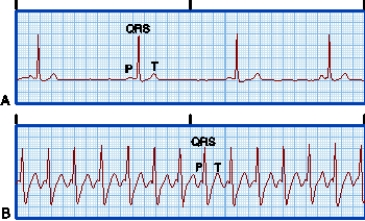
Which action should the nurse take next?
A)Prepare to perform electrical cardioversion.
B)Have the patient perform the Valsalva maneuver.
C)Obtain the patient's vital signs including O2 saturation.
D)Prepare to give a b-blocker medication to slow the heart rate.
Which action should the nurse take next?
A)Prepare to perform electrical cardioversion.
B)Have the patient perform the Valsalva maneuver.
C)Obtain the patient's vital signs including O2 saturation.
D)Prepare to give a b-blocker medication to slow the heart rate.
Question

Unlock Deck
Sign up to unlock the cards in this deck!
Unlock Deck
Unlock Deck
1/31

Play

Full screen (f)
Deck 35: Dysrhythmias
1
The nurse notes that a patient's heart monitor shows that every other beat is earlier than expected,has no visible P wave,and has a QRS complex that is wide and bizarre in shape. How will the nurse document the rhythm?
A)Ventricular couplets
B)Ventricular bigeminy
C)Ventricular R-on-T phenomenon
D)Multifocal premature ventricular contractions
A)Ventricular couplets
B)Ventricular bigeminy
C)Ventricular R-on-T phenomenon
D)Multifocal premature ventricular contractions
Ventricular bigeminy
2
A patient has ST segment changes that suggest an acute inferior wall myocardial infarction. Which lead would be best for monitoring the patient?
A)I
B)II
C)V2
D)V6
A)I
B)II
C)V2
D)V6
II
3
Which intervention by a new nurse who is caring for a patient who has just had an implantable cardioverter-defibrillator (ICD)inserted indicates a need for more teaching about the care of patients with ICDs?
A)The nurse administers amiodarone (Cordarone) to the patient.
B)The nurse helps the patient fill out the application for obtaining a Medic Alert device.
C)The nurse encourages the patient to do active range of motion exercises for all extremities.
D)The nurse teaches the patient that sexual activity can be resumed when the incision is healed.
A)The nurse administers amiodarone (Cordarone) to the patient.
B)The nurse helps the patient fill out the application for obtaining a Medic Alert device.
C)The nurse encourages the patient to do active range of motion exercises for all extremities.
D)The nurse teaches the patient that sexual activity can be resumed when the incision is healed.
The nurse encourages the patient to do active range of motion exercises for all extremities.
4
The nurse knows that discharge teaching about the management of a new permanent pacemaker has been most effective when the patient states
A)"It will be several weeks before I can return to my usual activities."
B)"I will avoid cooking with a microwave oven or being near one in use."
C)"I will notify the airlines when I make a reservation that I have a pacemaker."
D)"I won't lift the arm on the pacemaker side until I see the health care provider."
A)"It will be several weeks before I can return to my usual activities."
B)"I will avoid cooking with a microwave oven or being near one in use."
C)"I will notify the airlines when I make a reservation that I have a pacemaker."
D)"I won't lift the arm on the pacemaker side until I see the health care provider."
Unlock Deck
Unlock for access to all 31 flashcards in this deck.
Unlock Deck
k this deck
5
A patient has a sinus rhythm and a heart rate of 72 beats/min. The nurse determines that the PR interval is 0.24 seconds. The most appropriate intervention by the nurse would be to
A)notify the health care provider immediately.
B)document the finding and monitor the patient.
C)give atropine per agency dysrhythmia protocol.
D)prepare the patient for temporary pacemaker insertion.
A)notify the health care provider immediately.
B)document the finding and monitor the patient.
C)give atropine per agency dysrhythmia protocol.
D)prepare the patient for temporary pacemaker insertion.
Unlock Deck
Unlock for access to all 31 flashcards in this deck.
Unlock Deck
k this deck
6
A patient has a junctional escape rhythm on the monitor. The nurse will expect the patient to have a heart rate of _____ beats/min.
A)15 to 20
B)20 to 40
C)40 to 60
D)60 to 100
A)15 to 20
B)20 to 40
C)40 to 60
D)60 to 100
Unlock Deck
Unlock for access to all 31 flashcards in this deck.
Unlock Deck
k this deck
7
The nurse obtains a rhythm strip on a patient who has had a myocardial infarction and makes the following analysis: no visible P waves,PR interval not measurable,ventricular rate of 162,R-R interval regular,and QRS complex wide and distorted,and QRS duration of 0.18 second. The nurse interprets the patient's cardiac rhythm as
A)atrial flutter.
B)sinus tachycardia.
C)ventricular fibrillation.
D)ventricular tachycardia.
A)atrial flutter.
B)sinus tachycardia.
C)ventricular fibrillation.
D)ventricular tachycardia.
Unlock Deck
Unlock for access to all 31 flashcards in this deck.
Unlock Deck
k this deck
8
Which action should the nurse perform when preparing a patient with supraventricular tachycardia for cardioversion who is alert and has a blood pressure of 110/66 mm Hg?
A)Turn the synchronizer switch to the "off" position.
B)Give a sedative before cardioversion is implemented.
C)Set the defibrillator/cardioverter energy to 360 joules.
D)Provide assisted ventilations with a bag-valve-mask device.
A)Turn the synchronizer switch to the "off" position.
B)Give a sedative before cardioversion is implemented.
C)Set the defibrillator/cardioverter energy to 360 joules.
D)Provide assisted ventilations with a bag-valve-mask device.
Unlock Deck
Unlock for access to all 31 flashcards in this deck.
Unlock Deck
k this deck
9
Which laboratory result for a patient with multifocal premature ventricular contractions (PVCs)is most important for the nurse to communicate to the health care provider?
A)Blood glucose of 243 mg/dL
B)Serum chloride of 92 mEq/L
C)Serum sodium of 134 mEq/L
D)Serum potassium of 2.9 mEq/L
A)Blood glucose of 243 mg/dL
B)Serum chloride of 92 mEq/L
C)Serum sodium of 134 mEq/L
D)Serum potassium of 2.9 mEq/L
Unlock Deck
Unlock for access to all 31 flashcards in this deck.
Unlock Deck
k this deck
10
A patient's heart monitor shows sinus rhythm,rate 64. The PR interval is 0.18 seconds at 1:00 AM,0.22 seconds at 2:30 PM,and 0.28 seconds at 4:00 PM. Which action should the nurse take next?
A)Place the transcutaneous pacemaker pads on the patient.
B)Give atropine sulfate 1 mg IV per agency dysrhythmia protocol.
C)Call the health care provider before giving scheduled metoprolol (Lopressor).
D)Document the patient's rhythm and assess the patient's response to the rhythm.
A)Place the transcutaneous pacemaker pads on the patient.
B)Give atropine sulfate 1 mg IV per agency dysrhythmia protocol.
C)Call the health care provider before giving scheduled metoprolol (Lopressor).
D)Document the patient's rhythm and assess the patient's response to the rhythm.
Unlock Deck
Unlock for access to all 31 flashcards in this deck.
Unlock Deck
k this deck
11
A patient with dilated cardiomyopathy has new onset atrial fibrillation that has been unresponsive to drug therapy for several days. Teaching for this patient would include information about
A)anticoagulant therapy.
B)permanent pacemakers.
C)emergency cardioversion.
D)IV adenosine (Adenocard).
A)anticoagulant therapy.
B)permanent pacemakers.
C)emergency cardioversion.
D)IV adenosine (Adenocard).
Unlock Deck
Unlock for access to all 31 flashcards in this deck.
Unlock Deck
k this deck
12
When analyzing the rhythm of a patient's electrocardiogram (ECG),the nurse will need to investigate further upon finding a(n)
A)isoelectric ST segment.
B)PR interval of 0.18 second.
C)QT interval of 0.38 second.
D)QRS interval of 0.14 second.
A)isoelectric ST segment.
B)PR interval of 0.18 second.
C)QT interval of 0.38 second.
D)QRS interval of 0.14 second.
Unlock Deck
Unlock for access to all 31 flashcards in this deck.
Unlock Deck
k this deck
13
The nurse needs to quickly estimate the heart rate for a patient with a regular heart rhythm. Which method will be best to use?
A)Count the number of large squares in the R-R interval and divide by 300.
B)Print a 1-minute electrocardiogram (ECG) strip and count the number of QRS complexes.
C)Use the 3-second markers to count the number of QRS complexes in 6 seconds and multiply by 10.
D)Calculate the number of small squares between one QRS complex and the next and divide into 1500.
A)Count the number of large squares in the R-R interval and divide by 300.
B)Print a 1-minute electrocardiogram (ECG) strip and count the number of QRS complexes.
C)Use the 3-second markers to count the number of QRS complexes in 6 seconds and multiply by 10.
D)Calculate the number of small squares between one QRS complex and the next and divide into 1500.
Unlock Deck
Unlock for access to all 31 flashcards in this deck.
Unlock Deck
k this deck
14
Which information will the nurse include when teaching a patient who is scheduled for a radiofrequency catheter ablation for treatment of atrial flutter?
A)The procedure prevents or minimizes the risk for sudden cardiac death.
B)The procedure uses cold therapy to stop the formation of the flutter waves.
C)The procedure uses electrical energy to destroy areas of the conduction system.
D)The procedure stimulates the growth of new conduction pathways between the atria.
A)The procedure prevents or minimizes the risk for sudden cardiac death.
B)The procedure uses cold therapy to stop the formation of the flutter waves.
C)The procedure uses electrical energy to destroy areas of the conduction system.
D)The procedure stimulates the growth of new conduction pathways between the atria.
Unlock Deck
Unlock for access to all 31 flashcards in this deck.
Unlock Deck
k this deck
15
A patient's heart monitor shows a pattern of undulations of varying contours and amplitude with no measurable ECG pattern. The patient is unconscious,apneic,and pulseless. Which action should the nurse take first?
A)Give epinephrine (Adrenalin) IV.
B)Perform immediate defibrillation.
C)Prepare for endotracheal intubation.
D)Ventilate with a bag-valve-mask device.
A)Give epinephrine (Adrenalin) IV.
B)Perform immediate defibrillation.
C)Prepare for endotracheal intubation.
D)Ventilate with a bag-valve-mask device.
Unlock Deck
Unlock for access to all 31 flashcards in this deck.
Unlock Deck
k this deck
16
A patient who was admitted with a myocardial infarction experiences a 45-second episode of ventricular tachycardia,then converts to sinus rhythm with a heart rate of 98 beats/min. Which action should the nurse take next?
A)Immediately notify the health care provider.
B)Document the rhythm and continue to monitor the patient.
C)Prepare to give IV amiodarone per agency dysrhythmia protocol.
D)Perform synchronized cardioversion per agency dysrhythmia protocol.
A)Immediately notify the health care provider.
B)Document the rhythm and continue to monitor the patient.
C)Prepare to give IV amiodarone per agency dysrhythmia protocol.
D)Perform synchronized cardioversion per agency dysrhythmia protocol.
Unlock Deck
Unlock for access to all 31 flashcards in this deck.
Unlock Deck
k this deck
17
After the nurse gives IV atropine to a patient with symptomatic type 1,second-degree atrioventricular (AV)block,which finding indicates that the drug has been effective?
A)Increase in the patient's heart rate
B)Increase in strength of peripheral pulses
C)Decrease in premature atrial contractions
D)Decrease in premature ventricular contractions
A)Increase in the patient's heart rate
B)Increase in strength of peripheral pulses
C)Decrease in premature atrial contractions
D)Decrease in premature ventricular contractions
Unlock Deck
Unlock for access to all 31 flashcards in this deck.
Unlock Deck
k this deck
18
To determine whether there is a delay in impulse conduction through the ventricles,the nurse will measure the duration of the patient's
A)P wave.
B)Q wave.
C)PR interval.
D)QRS complex.
A)P wave.
B)Q wave.
C)PR interval.
D)QRS complex.
Unlock Deck
Unlock for access to all 31 flashcards in this deck.
Unlock Deck
k this deck
19
A 20-yr-old patient has a mandatory electrocardiogram (ECG)before participating on a college soccer team and is found to have sinus bradycardia,rate 52. Blood pressure (BP)is 114/54 mm Hg,and the student denies any health problems. What action by the nurse is most appropriate?
A)Allow the student to participate on the soccer team.
B)Refer the student to a cardiologist for further testing.
C)Tell the student to stop playing immediately if any dyspnea occurs.
D)Obtain more detailed information about the student's family health history.
A)Allow the student to participate on the soccer team.
B)Refer the student to a cardiologist for further testing.
C)Tell the student to stop playing immediately if any dyspnea occurs.
D)Obtain more detailed information about the student's family health history.
Unlock Deck
Unlock for access to all 31 flashcards in this deck.
Unlock Deck
k this deck
20
A patient develops sinus bradycardia at a rate of 32 beats/min,has a blood pressure (BP)of 80/42 mm Hg,and is complaining of feeling faint. Which action should the nurse take next?
A)Recheck the heart rhythm and BP in 5 minutes.
B)Have the patient perform the Valsalva maneuver.
C)Give the scheduled dose of diltiazem (Cardizem).
D)Apply the transcutaneous pacemaker (TCP) pads.
A)Recheck the heart rhythm and BP in 5 minutes.
B)Have the patient perform the Valsalva maneuver.
C)Give the scheduled dose of diltiazem (Cardizem).
D)Apply the transcutaneous pacemaker (TCP) pads.
Unlock Deck
Unlock for access to all 31 flashcards in this deck.
Unlock Deck
k this deck
21
A 19-yr-old student comes to the student health center at the end of the semester complaining that,"My heart is skipping beats." An electrocardiogram (ECG)shows occasional unifocal premature ventricular contractions (PVCs). What action should the nurse take next?
A)Insert an IV catheter for emergency use.
B)Start supplemental O2 at 2 to 3 L/min via nasal cannula.
C)Ask the patient about current stress level and caffeine use.
D)Have the patient taken to the nearest emergency department (ED).
A)Insert an IV catheter for emergency use.
B)Start supplemental O2 at 2 to 3 L/min via nasal cannula.
C)Ask the patient about current stress level and caffeine use.
D)Have the patient taken to the nearest emergency department (ED).
Unlock Deck
Unlock for access to all 31 flashcards in this deck.
Unlock Deck
k this deck
22
A patient whose heart monitor shows sinus tachycardia,rate 132,is apneic,and has no palpable pulses. What action should the nurse take next?
A)Perform synchronized cardioversion.
B)Start cardiopulmonary resuscitation (CPR).
C)Give atropine per agency dysrhythmia protocol.
D)Provide supplemental O2 via non-rebreather mask.
A)Perform synchronized cardioversion.
B)Start cardiopulmonary resuscitation (CPR).
C)Give atropine per agency dysrhythmia protocol.
D)Provide supplemental O2 via non-rebreather mask.
Unlock Deck
Unlock for access to all 31 flashcards in this deck.
Unlock Deck
k this deck
23
Which nursing action can the registered nurse (RN)delegate to experienced unlicensed assistive personnel (UAP)working as telemetry technicians on the cardiac care unit?
A)Decide whether a patient's heart rate of 116 requires urgent treatment.
B)Observe heart rhythms for multiple patients who have telemetry monitoring.
C)Monitor a patient's level of consciousness during synchronized cardioversion.
D)Select the best lead for monitoring a patient admitted with acute coronary syndrome.
A)Decide whether a patient's heart rate of 116 requires urgent treatment.
B)Observe heart rhythms for multiple patients who have telemetry monitoring.
C)Monitor a patient's level of consciousness during synchronized cardioversion.
D)Select the best lead for monitoring a patient admitted with acute coronary syndrome.
Unlock Deck
Unlock for access to all 31 flashcards in this deck.
Unlock Deck
k this deck
24
Which action by a new registered nurse (RN)who is orienting to the telemetry unit indicates a good understanding of the treatment of heart dysrhythmias?
A)Prepares defibrillator settings at 360 joules for a patient whose monitor shows asystole.
B)Injects IV adenosine (Adenocard) over 2 seconds to a patient with supraventricular tachycardia
C)Turns the synchronizer switch to the "on" position before defibrillating a patient with ventricular fibrillation
D)Gives the prescribed dose of diltiazem (Cardizem) to a patient with new-onset type II second degree AV block
A)Prepares defibrillator settings at 360 joules for a patient whose monitor shows asystole.
B)Injects IV adenosine (Adenocard) over 2 seconds to a patient with supraventricular tachycardia
C)Turns the synchronizer switch to the "on" position before defibrillating a patient with ventricular fibrillation
D)Gives the prescribed dose of diltiazem (Cardizem) to a patient with new-onset type II second degree AV block
Unlock Deck
Unlock for access to all 31 flashcards in this deck.
Unlock Deck
k this deck
25
When analyzing an electrocardiographic (ECG)rhythm strip of a patient with a regular heart rhythm,the nurse counts 30 small blocks from one R wave to the next. The nurse calculates the patient's heart rate as ____.
Unlock Deck
Unlock for access to all 31 flashcards in this deck.
Unlock Deck
k this deck
26
A patient who is on the telemetry unit develops atrial flutter,rate 150,with associated dyspnea and chest pain. Which action that is included in the hospital dysrhythmia protocol should the nurse do first?
A)Obtain a 12-lead electrocardiogram (ECG).
B)Notify the health care provider of the change in rhythm.
C)Give supplemental O2 at 2 to 3 L/min via nasal cannula.
D)Assess the patient's vital signs including O2 saturation.
A)Obtain a 12-lead electrocardiogram (ECG).
B)Notify the health care provider of the change in rhythm.
C)Give supplemental O2 at 2 to 3 L/min via nasal cannula.
D)Assess the patient's vital signs including O2 saturation.
Unlock Deck
Unlock for access to all 31 flashcards in this deck.
Unlock Deck
k this deck
27
When preparing to defibrillate a patient,in which order will the nurse perform the following steps? (Put a comma and a space between each answer choice [A,B,C,D,E].)
A)Turn the defibrillator on.
B)Deliver the electrical charge.
C)Select the appropriate energy level.
D)Place the hands-free, multifunction defibrillator pads on the patient's chest.
E)Check the location of other staff and call out "all clear."
A)Turn the defibrillator on.
B)Deliver the electrical charge.
C)Select the appropriate energy level.
D)Place the hands-free, multifunction defibrillator pads on the patient's chest.
E)Check the location of other staff and call out "all clear."
Unlock Deck
Unlock for access to all 31 flashcards in this deck.
Unlock Deck
k this deck
28
A patient reports dizziness and shortness of breath for several days. During heart monitoring in the emergency department (ED),the nurse obtains the following electrocardiographic (ECG)tracing. The nurse interprets this heart rhythm as
A)junctional escape rhythm.
B)accelerated idioventricular rhythm.
C)third-degree atrioventricular (AV) block.
D)sinus rhythm with premature atrial contractions (PACs).
A)junctional escape rhythm.
B)accelerated idioventricular rhythm.
C)third-degree atrioventricular (AV) block.
D)sinus rhythm with premature atrial contractions (PACs).
Unlock Deck
Unlock for access to all 31 flashcards in this deck.
Unlock Deck
k this deck
29
Which action will the nurse include in the plan of care for a patient who was admitted with syncopal episodes of unknown origin?
A)Explain the association between dysrhythmias and syncope.
B)Instruct the patient to call for assistance before getting out of bed.
C)Teach the patient about the need to avoid caffeine and other stimulants.
D)Tell the patient about the benefits of implantable cardioverter-defibrillators.
A)Explain the association between dysrhythmias and syncope.
B)Instruct the patient to call for assistance before getting out of bed.
C)Teach the patient about the need to avoid caffeine and other stimulants.
D)Tell the patient about the benefits of implantable cardioverter-defibrillators.
Unlock Deck
Unlock for access to all 31 flashcards in this deck.
Unlock Deck
k this deck
30
A patient who is complaining of a "racing" heart and feeling "anxious" comes to the emergency department. The nurse places the patient on a heart monitor and obtains the following electrocardiographic (ECG)tracing.
Which action should the nurse take next?
A)Prepare to perform electrical cardioversion.
B)Have the patient perform the Valsalva maneuver.
C)Obtain the patient's vital signs including O2 saturation.
D)Prepare to give a b-blocker medication to slow the heart rate.
Which action should the nurse take next?
A)Prepare to perform electrical cardioversion.
B)Have the patient perform the Valsalva maneuver.
C)Obtain the patient's vital signs including O2 saturation.
D)Prepare to give a b-blocker medication to slow the heart rate.
Unlock Deck
Unlock for access to all 31 flashcards in this deck.
Unlock Deck
k this deck
31
The nurse has received change-of-shift report about the following patients on the progressive care unit. Which patient should the nurse see first?
A)A patient with atrial fibrillation, rate 88 and irregular, who has a dose of warfarin (Coumadin) due
B)A patient with second-degree atrioventricular (AV) block, type 1, rate 60, who is dizzy when ambulating
C)A patient who is in a sinus rhythm, rate 98 and regular, recovering from an elective cardioversion 2 hours ago
D)A patient whose implantable cardioverter-defibrillator (ICD) fired twice today and has a dose of amiodarone (Cordarone) due
A)A patient with atrial fibrillation, rate 88 and irregular, who has a dose of warfarin (Coumadin) due
B)A patient with second-degree atrioventricular (AV) block, type 1, rate 60, who is dizzy when ambulating
C)A patient who is in a sinus rhythm, rate 98 and regular, recovering from an elective cardioversion 2 hours ago
D)A patient whose implantable cardioverter-defibrillator (ICD) fired twice today and has a dose of amiodarone (Cordarone) due
Unlock Deck
Unlock for access to all 31 flashcards in this deck.
Unlock Deck
k this deck
Unlock Deck
Unlock for access to all 31 flashcards in this deck.






