







 Chat with AI

Deck 30: Money Growth and Inflation
Full screen (f)

Question

Question
Question
Question
Question
Question
Question
Question
Question
Question
Question
Question
Question
Question
Question
Question
Question
Question
Question
Question
Question
Question
Question
Question
Question
Question
Question
Question
Question
Question
Question
Question
Question
Question
Question
Question
Question
Question
Question
Question
Question
Use the figure below for the following questions.
Figure 30-1
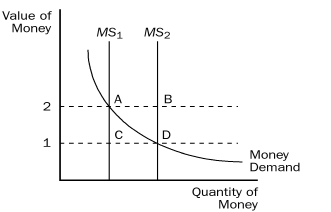
Refer to Figure 30-1.If the current money supply is located at MS₁,
A)there is no excess supply or excess demand if the value of money is 2.
B)the equilibrium is at point C.
C)there is an excess supply of money if the value of money is 1.
D)None of the above is correct.
Figure 30-1
Refer to Figure 30-1.If the current money supply is located at MS₁,
A)there is no excess supply or excess demand if the value of money is 2.
B)the equilibrium is at point C.
C)there is an excess supply of money if the value of money is 1.
D)None of the above is correct.
Question
Use the figure below for the following questions.
Figure 30-1
Refer to Figure 30-1.If the money supply is MS₂ and the value of money is 2,
A)the value of money is less than its equilibrium level.
B)the price level is higher than its equilibrium level.
C)the quantity of money demanded is greater than the quantity of money supplied.
D)the quantity of money supplied is greater than the quantity of money demanded.
Figure 30-1
Refer to Figure 30-1.If the money supply is MS₂ and the value of money is 2,
A)the value of money is less than its equilibrium level.
B)the price level is higher than its equilibrium level.
C)the quantity of money demanded is greater than the quantity of money supplied.
D)the quantity of money supplied is greater than the quantity of money demanded.
Question
Question
Question
Question
Use the figure below for the following questions.
Figure 30-1
Refer to Figure 30-1.If the money supply is MS₂ and the value of money is 2,there is excess
A)demand equal to the distance between A and C.
B)demand equal to the distance between A and B.
C)supply equal to the distance between A and C.
D)supply equal to the distance between A and B.
Figure 30-1
Refer to Figure 30-1.If the money supply is MS₂ and the value of money is 2,there is excess
A)demand equal to the distance between A and C.
B)demand equal to the distance between A and B.
C)supply equal to the distance between A and C.
D)supply equal to the distance between A and B.
Question
Question
Question
Use the figure below for the following questions.
Figure 30-1
Refer to Figure 30-1.When the money supply curve shifts from MS₁ to MS₂,the graph shows that
A)the demand for goods and services decreases.
B)the economy's ability to produce goods and services increases.
C)the equilibrium price level increases.
D)the equilibrium value of money increases.
Figure 30-1
Refer to Figure 30-1.When the money supply curve shifts from MS₁ to MS₂,the graph shows that
A)the demand for goods and services decreases.
B)the economy's ability to produce goods and services increases.
C)the equilibrium price level increases.
D)the equilibrium value of money increases.
Question
Question
Question
Question
Use the figure below for the following questions.
Figure 30-1
Refer to Figure 30-1.When the money supply curve shifts from MS₁ to MS₂,
A)the equilibrium value of money decreases.
B)the equilibrium price level decreases.
C)the supply of money has decreased.
D)the demand for goods and services will decrease.
Figure 30-1
Refer to Figure 30-1.When the money supply curve shifts from MS₁ to MS₂,
A)the equilibrium value of money decreases.
B)the equilibrium price level decreases.
C)the supply of money has decreased.
D)the demand for goods and services will decrease.
Question
Question
Question
Question
Question
Question
Question
Question
Question
Question
Question
Question
Question
Question
Question
Question
Question
Question
Question
Question
Question
Question
Question
Question
Question
Question
Question

Unlock Deck
Sign up to unlock the cards in this deck!
Unlock Deck
Unlock Deck
1/224

Play

Full screen (f)
Deck 30: Money Growth and Inflation
1
When the price level rises,the number of dollars needed to buy a representative basket of goods
A)increases, and so the value of money rises.
B)increases, and so the value of money falls.
C)decreases, and so the value of money rises.
D)decreases, and so the value of money falls
A)increases, and so the value of money rises.
B)increases, and so the value of money falls.
C)decreases, and so the value of money rises.
D)decreases, and so the value of money falls
B
2
An increase in the price level makes the value of money
A)increase, so people want to hold more of it.
B)increase, so people want to hold less of it.
C)decrease, so people want to hold more of it.
D)decrease, so people want to hold less of it.
A)increase, so people want to hold more of it.
B)increase, so people want to hold less of it.
C)decrease, so people want to hold more of it.
D)decrease, so people want to hold less of it.
C
3
The price level rises from 120 to 126.What is the inflation rate?
A)3%
B)5%
C)6%
D)None of the above is correct.
A)3%
B)5%
C)6%
D)None of the above is correct.
B
4
Over the last 70 years the average annual U.S.inflation rate was about
A)2 percent.
B)4 percent.
C)6 percent.
D)8 percent.
A)2 percent.
B)4 percent.
C)6 percent.
D)8 percent.
Unlock Deck
Unlock for access to all 224 flashcards in this deck.
Unlock Deck
k this deck
5
The quantity theory of money
A)is a fairly recent addition to economic theory.
B)can explain both moderate inflation and hyperinflation.
C)argues that inflation is caused by too little money in the economy.
D)All of the above are correct.
A)is a fairly recent addition to economic theory.
B)can explain both moderate inflation and hyperinflation.
C)argues that inflation is caused by too little money in the economy.
D)All of the above are correct.
Unlock Deck
Unlock for access to all 224 flashcards in this deck.
Unlock Deck
k this deck
6
Over the last 70 years the average annual U.S.inflation rate was about
A)2 percent implying that prices have increased 10-fold.
B)4 percent implying that prices have increased 10-fold.
C)2 percent implying that prices have increased 16-fold.
D)4 percent implying that prices increased about 16-fold.
A)2 percent implying that prices have increased 10-fold.
B)4 percent implying that prices have increased 10-fold.
C)2 percent implying that prices have increased 16-fold.
D)4 percent implying that prices increased about 16-fold.
Unlock Deck
Unlock for access to all 224 flashcards in this deck.
Unlock Deck
k this deck
7
Deflation
A)increases the ability to pay debts and raises the value of money.
B)increases the ability to pay debts and lowers the value of money.
C)reduces the ability to pay debts and raises the value of money.
D)reduces the ability to pay debts and lowers the value of money.
A)increases the ability to pay debts and raises the value of money.
B)increases the ability to pay debts and lowers the value of money.
C)reduces the ability to pay debts and raises the value of money.
D)reduces the ability to pay debts and lowers the value of money.
Unlock Deck
Unlock for access to all 224 flashcards in this deck.
Unlock Deck
k this deck
8
When prices are falling,economists say that there is
A)disinflation.
B)deflation.
C)a contraction.
D)an inverted inflation.
A)disinflation.
B)deflation.
C)a contraction.
D)an inverted inflation.
Unlock Deck
Unlock for access to all 224 flashcards in this deck.
Unlock Deck
k this deck
9
Inflation can be measured by the
A)change in the consumer price index.
B)percentage change in the consumer price index.
C)percentage change in the price of a specific commodity.
D)change in the price of a specific commodity.
A)change in the consumer price index.
B)percentage change in the consumer price index.
C)percentage change in the price of a specific commodity.
D)change in the price of a specific commodity.
Unlock Deck
Unlock for access to all 224 flashcards in this deck.
Unlock Deck
k this deck
10
Which of the following concerning the history of U.S.inflation is not correct?
A)Prices rose at an average annual rate of about 4 percent over the last 70 years.
B)There was about a 16-fold increase in the price level over the last 70 years.
C)Inflation in the 1970s was below the average over the last 70 years.
D)During it's history the United States has experienced periods of deflation.
A)Prices rose at an average annual rate of about 4 percent over the last 70 years.
B)There was about a 16-fold increase in the price level over the last 70 years.
C)Inflation in the 1970s was below the average over the last 70 years.
D)During it's history the United States has experienced periods of deflation.
Unlock Deck
Unlock for access to all 224 flashcards in this deck.
Unlock Deck
k this deck
11
There was hyperinflation
A)during 1880-1896 in the United States.
B)in post-World War I Germany.
C)during the 1970s in the United States.
D)All of the above are correct.
A)during 1880-1896 in the United States.
B)in post-World War I Germany.
C)during the 1970s in the United States.
D)All of the above are correct.
Unlock Deck
Unlock for access to all 224 flashcards in this deck.
Unlock Deck
k this deck
12
The classical theory of inflation
A)is also known as the quantity theory of money.
B)was developed by some of the earliest economic thinkers.
C)is used by most modern economists to explain the long-run determinants of the inflation rate.
D)All of the above are correct.
A)is also known as the quantity theory of money.
B)was developed by some of the earliest economic thinkers.
C)is used by most modern economists to explain the long-run determinants of the inflation rate.
D)All of the above are correct.
Unlock Deck
Unlock for access to all 224 flashcards in this deck.
Unlock Deck
k this deck
13
If the price index in some country were falling over time,economists would say that country had
A)disinflation.
B)deflation.
C)a contraction.
D)an inverted inflation.
A)disinflation.
B)deflation.
C)a contraction.
D)an inverted inflation.
Unlock Deck
Unlock for access to all 224 flashcards in this deck.
Unlock Deck
k this deck
14
As the price level decreases,the value of money
A)increases, so people want to hold more of it.
B)increases, so people want to hold less of it.
C)decreases, so people want to hold more of it.
D)decreases, so people want to hold less of it.
A)increases, so people want to hold more of it.
B)increases, so people want to hold less of it.
C)decreases, so people want to hold more of it.
D)decreases, so people want to hold less of it.
Unlock Deck
Unlock for access to all 224 flashcards in this deck.
Unlock Deck
k this deck
15
Economists all agree that
A)neither high inflation nor moderate inflation is very costly.
B)both high and moderate inflation are quite costly.
C)high inflation is costly, but disagree about the costs of moderate inflation.
D)moderate inflation is as costly as high inflation.
A)neither high inflation nor moderate inflation is very costly.
B)both high and moderate inflation are quite costly.
C)high inflation is costly, but disagree about the costs of moderate inflation.
D)moderate inflation is as costly as high inflation.
Unlock Deck
Unlock for access to all 224 flashcards in this deck.
Unlock Deck
k this deck
16
The price level rises from 120 to 150.What was the inflation rate?
A)30%
B)25%
C)20%
D)None of the above is correct.
A)30%
B)25%
C)20%
D)None of the above is correct.
Unlock Deck
Unlock for access to all 224 flashcards in this deck.
Unlock Deck
k this deck
17
When the price level falls,the number of dollars needed to buy a representative basket of goods
A)increases, so the value of money rises.
B)increases, so the value of money falls.
C)decreases, so the value of money rises.
D)decreases, so the value of money falls.
A)increases, so the value of money rises.
B)increases, so the value of money falls.
C)decreases, so the value of money rises.
D)decreases, so the value of money falls.
Unlock Deck
Unlock for access to all 224 flashcards in this deck.
Unlock Deck
k this deck
18
The supply of money is determined by
A)the price level.
B)the Treasury and Congressional Budget Office.
C)the Federal Reserve System.
D)the demand for money.
A)the price level.
B)the Treasury and Congressional Budget Office.
C)the Federal Reserve System.
D)the demand for money.
Unlock Deck
Unlock for access to all 224 flashcards in this deck.
Unlock Deck
k this deck
19
Which of the following statements about U.S.inflation is not correct?
A)Low inflation was viewed as a triumph of President Carter's economic policy.
B)There were long periods in the nineteenth century during which prices fell.
C)The U.S.public has viewed inflation of even 7 percent as a major economic problem.
D)The U.S.inflation rate has varied over time, but international data shows even more variation.
A)Low inflation was viewed as a triumph of President Carter's economic policy.
B)There were long periods in the nineteenth century during which prices fell.
C)The U.S.public has viewed inflation of even 7 percent as a major economic problem.
D)The U.S.inflation rate has varied over time, but international data shows even more variation.
Unlock Deck
Unlock for access to all 224 flashcards in this deck.
Unlock Deck
k this deck
20
Which of the following is correct?
A)hyperinflation is a period of extraordinarily high inflation.
B)deflation is negative inflation, not just a decrease in the inflation rate.
C)during the 1990s US inflation averaged 2% per year.
D)All of the above are correct.
A)hyperinflation is a period of extraordinarily high inflation.
B)deflation is negative inflation, not just a decrease in the inflation rate.
C)during the 1990s US inflation averaged 2% per year.
D)All of the above are correct.
Unlock Deck
Unlock for access to all 224 flashcards in this deck.
Unlock Deck
k this deck
21
When the money market is drawn with the value of money on the vertical axis,as the price level increases the quantity of money
A)demanded increases.
B)demanded decreases.
C)supplied increases.
D)supplied decreases.
A)demanded increases.
B)demanded decreases.
C)supplied increases.
D)supplied decreases.
Unlock Deck
Unlock for access to all 224 flashcards in this deck.
Unlock Deck
k this deck
22
When the money market is drawn with the value of money on the vertical axis,
A)money demand slopes up and money supply is horizontal.
B)money demand slopes down and money supply is vertical.
C)money demand slopes up and money supply is vertical.
D)money demand slopes down and money supply is horizontal.
A)money demand slopes up and money supply is horizontal.
B)money demand slopes down and money supply is vertical.
C)money demand slopes up and money supply is vertical.
D)money demand slopes down and money supply is horizontal.
Unlock Deck
Unlock for access to all 224 flashcards in this deck.
Unlock Deck
k this deck
23
When the money market is drawn with the value of money on the vertical axis,if the value of money is below the equilibrium level,
A)the price level will rise.
B)the value of money will rise.
C)money demand will shift left.
D)money demand will shift right.
A)the price level will rise.
B)the value of money will rise.
C)money demand will shift left.
D)money demand will shift right.
Unlock Deck
Unlock for access to all 224 flashcards in this deck.
Unlock Deck
k this deck
24
When the money market is drawn with the value of money on the vertical axis,long-run equilibrium is obtained when the quantity demanded and quantity supplied of money are equal due to adjustments in the
A)the value of money.
B)real interest rates.
C)nominal interest rates.
D)money supply.
A)the value of money.
B)real interest rates.
C)nominal interest rates.
D)money supply.
Unlock Deck
Unlock for access to all 224 flashcards in this deck.
Unlock Deck
k this deck
25
The supply curve of money is vertical because the quantity of money supplied increases
A)when the value of money increases.
B)when the value of money decreases.
C)only if people desire to hold more money.
D)only if the central bank increases the money supply.
A)when the value of money increases.
B)when the value of money decreases.
C)only if people desire to hold more money.
D)only if the central bank increases the money supply.
Unlock Deck
Unlock for access to all 224 flashcards in this deck.
Unlock Deck
k this deck
26
The supply of money increases when
A)the value of money increases.
B)the interest rate increases.
C)the Fed makes open-market purchases.
D)None of the above is correct.
A)the value of money increases.
B)the interest rate increases.
C)the Fed makes open-market purchases.
D)None of the above is correct.
Unlock Deck
Unlock for access to all 224 flashcards in this deck.
Unlock Deck
k this deck
27
When the money market is drawn with the value of money on the vertical axis,an increase in the money supply causes the equilibrium value of money
A)and equilibrium quantity of money to increase.
B)and equilibrium quantity of money to decrease.
C)to increase, while the equilibrium quantity of money decreases.
D)to decrease, while the equilibrium quantity of money increases.
A)and equilibrium quantity of money to increase.
B)and equilibrium quantity of money to decrease.
C)to increase, while the equilibrium quantity of money decreases.
D)to decrease, while the equilibrium quantity of money increases.
Unlock Deck
Unlock for access to all 224 flashcards in this deck.
Unlock Deck
k this deck
28
Which of the following is correct?
A)If the Fed purchases bonds in the open market, then the money supply curve shifts right.A change in the price level does not shift the money supply curve.
B)If the Fed sells bonds in the open market, then the money supply curve shifts right.A change in the price level does not shift the money supply curve.
C)If the Fed purchases bonds, then the money supply curve shifts right.An increase in the price level shifts the money supply curve right.
D)If the Fed sells bonds, then the money supply curve shifts right.A decrease in the price level shifts the money supply curve right.
A)If the Fed purchases bonds in the open market, then the money supply curve shifts right.A change in the price level does not shift the money supply curve.
B)If the Fed sells bonds in the open market, then the money supply curve shifts right.A change in the price level does not shift the money supply curve.
C)If the Fed purchases bonds, then the money supply curve shifts right.An increase in the price level shifts the money supply curve right.
D)If the Fed sells bonds, then the money supply curve shifts right.A decrease in the price level shifts the money supply curve right.
Unlock Deck
Unlock for access to all 224 flashcards in this deck.
Unlock Deck
k this deck
29
When the money market is drawn with the value of money on the vertical axis,the money demand curve slopes
A)upward because at higher prices people want to hold more money.
B)downward because at higher prices people want to hold more money.
C)downward because at higher price people want to hold less money.
D)upward, because at higher prices people want to hold less money.
A)upward because at higher prices people want to hold more money.
B)downward because at higher prices people want to hold more money.
C)downward because at higher price people want to hold less money.
D)upward, because at higher prices people want to hold less money.
Unlock Deck
Unlock for access to all 224 flashcards in this deck.
Unlock Deck
k this deck
30
When the money market is drawn with the value of money on the vertical axis,as the price level increases,the value of money
A)increases, so the quantity of money demanded increases.
B)increases, so the quantity of money demanded decreases.
C)decreases, so the quantity of money demanded decreases.
D)decreases, so the quantity of money demanded increases.
A)increases, so the quantity of money demanded increases.
B)increases, so the quantity of money demanded decreases.
C)decreases, so the quantity of money demanded decreases.
D)decreases, so the quantity of money demanded increases.
Unlock Deck
Unlock for access to all 224 flashcards in this deck.
Unlock Deck
k this deck
31
When the money market is drawn with the value of money on the vertical axis,an increase in the price level causes a
A)shift to the right of the money demand curve.
B)shift to the left of the money demand curve.
C)movement to the left along the money demand curve.
D)movement to the right along the money demand curve.
A)shift to the right of the money demand curve.
B)shift to the left of the money demand curve.
C)movement to the left along the money demand curve.
D)movement to the right along the money demand curve.
Unlock Deck
Unlock for access to all 224 flashcards in this deck.
Unlock Deck
k this deck
32
Suppose the money market,drawn with the value of money on the vertical axis,is in equilibrium.If the money supply increases,then at the old value of money there is
A)a shortage that will increase spending.
B)a shortage that will reduce spending.
C)a surplus that will increase spending.
D)a surplus that will reduce spending.
A)a shortage that will increase spending.
B)a shortage that will reduce spending.
C)a surplus that will increase spending.
D)a surplus that will reduce spending.
Unlock Deck
Unlock for access to all 224 flashcards in this deck.
Unlock Deck
k this deck
33
When the money market is drawn with the value of money on the vertical axis,if the price level is above the equilibrium level,there is an
A)excess demand for money, so the price level will rise.
B)excess demand for money, so the price level will fall.
C)excess supply of money, so the price level will rise.
D)excess supply of money, so the price level will fall.
A)excess demand for money, so the price level will rise.
B)excess demand for money, so the price level will fall.
C)excess supply of money, so the price level will rise.
D)excess supply of money, so the price level will fall.
Unlock Deck
Unlock for access to all 224 flashcards in this deck.
Unlock Deck
k this deck
34
When the money market is drawn with the value of money on the vertical axis,an increase in the money supply shifts the money supply curve to the
A)right, lowering the price level.
B)right, raising the price level.
C)left, raising the price level.
D)left, lowering the price level.
A)right, lowering the price level.
B)right, raising the price level.
C)left, raising the price level.
D)left, lowering the price level.
Unlock Deck
Unlock for access to all 224 flashcards in this deck.
Unlock Deck
k this deck
35
When the money market is drawn with the value of money on the vertical axis,an increase in the money supply
A)increases the price level and the value of money.
B)increases the price level and decreases the value of money.
C)decreases the price level and increases the value of money.
D)decreases the price level and the value of money.
A)increases the price level and the value of money.
B)increases the price level and decreases the value of money.
C)decreases the price level and increases the value of money.
D)decreases the price level and the value of money.
Unlock Deck
Unlock for access to all 224 flashcards in this deck.
Unlock Deck
k this deck
36
When the money market is drawn with the value of money on the vertical axis,the price level increases if
A)either money demand or money supply shifts right.
B)either money demand or money supply shifts left.
C)money demand shifts right or money supply shifts left.
D)money demand shifts left or money supply shifts right.
A)either money demand or money supply shifts right.
B)either money demand or money supply shifts left.
C)money demand shifts right or money supply shifts left.
D)money demand shifts left or money supply shifts right.
Unlock Deck
Unlock for access to all 224 flashcards in this deck.
Unlock Deck
k this deck
37
When the money market is drawn with the value of money on the vertical axis,if the Fed sells bonds then
A)the money supply and the price level increase.
B)the money supply and the price level decrease.
C)the money supply increases and the price level decreases.
D)the money supply increases and the price level increases.
A)the money supply and the price level increase.
B)the money supply and the price level decrease.
C)the money supply increases and the price level decreases.
D)the money supply increases and the price level increases.
Unlock Deck
Unlock for access to all 224 flashcards in this deck.
Unlock Deck
k this deck
38
Money demand refers to
A)the total quantity of financial assets that people want to hold.
B)how much income people want to make per year.
C)how much wealth people want to hold in liquid form.
D)how much currency the Federal Reserve decides to print.
A)the total quantity of financial assets that people want to hold.
B)how much income people want to make per year.
C)how much wealth people want to hold in liquid form.
D)how much currency the Federal Reserve decides to print.
Unlock Deck
Unlock for access to all 224 flashcards in this deck.
Unlock Deck
k this deck
39
When the money market is drawn with the value of money on the vertical axis,the value of money increases if
A)either money demand or money supply shifts right.
B)either money demand or money supply shifts left.
C)money demand shifts right or money supply shifts left.
D)money demand shifts left or money supply shifts right.
A)either money demand or money supply shifts right.
B)either money demand or money supply shifts left.
C)money demand shifts right or money supply shifts left.
D)money demand shifts left or money supply shifts right.
Unlock Deck
Unlock for access to all 224 flashcards in this deck.
Unlock Deck
k this deck
40
If the Fed raises the money supply,then 1/P
A)falls, so the value of money falls.
B)falls, so the value of money rises.
C)rises, so the value of money falls.
D)rises, so the value of money rises.
A)falls, so the value of money falls.
B)falls, so the value of money rises.
C)rises, so the value of money falls.
D)rises, so the value of money rises.
Unlock Deck
Unlock for access to all 224 flashcards in this deck.
Unlock Deck
k this deck
41
Use the figure below for the following questions.
Figure 30-1
Refer to Figure 30-1.If the current money supply is located at MS₁,
A)there is no excess supply or excess demand if the value of money is 2.
B)the equilibrium is at point C.
C)there is an excess supply of money if the value of money is 1.
D)None of the above is correct.
Figure 30-1
Refer to Figure 30-1.If the current money supply is located at MS₁,
A)there is no excess supply or excess demand if the value of money is 2.
B)the equilibrium is at point C.
C)there is an excess supply of money if the value of money is 1.
D)None of the above is correct.
Unlock Deck
Unlock for access to all 224 flashcards in this deck.
Unlock Deck
k this deck
42
Use the figure below for the following questions.
Figure 30-1
Refer to Figure 30-1.If the money supply is MS₂ and the value of money is 2,
A)the value of money is less than its equilibrium level.
B)the price level is higher than its equilibrium level.
C)the quantity of money demanded is greater than the quantity of money supplied.
D)the quantity of money supplied is greater than the quantity of money demanded.
Figure 30-1
Refer to Figure 30-1.If the money supply is MS₂ and the value of money is 2,
A)the value of money is less than its equilibrium level.
B)the price level is higher than its equilibrium level.
C)the quantity of money demanded is greater than the quantity of money supplied.
D)the quantity of money supplied is greater than the quantity of money demanded.
Unlock Deck
Unlock for access to all 224 flashcards in this deck.
Unlock Deck
k this deck
43
In the fourteenth century,the Western African Emperor Kankan Musa traveled to Cairo where he gave away much gold,which was in use as a medium of exchange.We would predict that this increase in gold
A)raised both the price level and the value of gold in Cairo.
B)raised the price level, but decreased the value of gold in Cairo.
C)lowered the price level, but increased the value of gold in Cairo.
D)lowered both the price level and the value of gold in Cairo.
A)raised both the price level and the value of gold in Cairo.
B)raised the price level, but decreased the value of gold in Cairo.
C)lowered the price level, but increased the value of gold in Cairo.
D)lowered both the price level and the value of gold in Cairo.
Unlock Deck
Unlock for access to all 224 flashcards in this deck.
Unlock Deck
k this deck
44
Nominal GDP measures
A)the total quantity of final goods and services produced.
B)the dollar value of the economy's output of final goods and services.
C)the total income received from producing final goods and services measured in constant dollars.
D)None of the above is correct.
A)the total quantity of final goods and services produced.
B)the dollar value of the economy's output of final goods and services.
C)the total income received from producing final goods and services measured in constant dollars.
D)None of the above is correct.
Unlock Deck
Unlock for access to all 224 flashcards in this deck.
Unlock Deck
k this deck
45
The price of a Honda Accord
A)and the price of a Honda Accord divided by the price of a Honda Civic are both real variables.
B)and the price of a Honda Accord divided by the price of Honda Civic are both nominal variables.
C)is a real variable, and the price of a Honda Accord divided by a Honda Civic is a nominal variable.
D)is a nominal variable and the price of a Honda Accord divided by the price of a Honda Civic is a real variable.
A)and the price of a Honda Accord divided by the price of a Honda Civic are both real variables.
B)and the price of a Honda Accord divided by the price of Honda Civic are both nominal variables.
C)is a real variable, and the price of a Honda Accord divided by a Honda Civic is a nominal variable.
D)is a nominal variable and the price of a Honda Accord divided by the price of a Honda Civic is a real variable.
Unlock Deck
Unlock for access to all 224 flashcards in this deck.
Unlock Deck
k this deck
46
Use the figure below for the following questions.
Figure 30-1
Refer to Figure 30-1.If the money supply is MS₂ and the value of money is 2,there is excess
A)demand equal to the distance between A and C.
B)demand equal to the distance between A and B.
C)supply equal to the distance between A and C.
D)supply equal to the distance between A and B.
Figure 30-1
Refer to Figure 30-1.If the money supply is MS₂ and the value of money is 2,there is excess
A)demand equal to the distance between A and C.
B)demand equal to the distance between A and B.
C)supply equal to the distance between A and C.
D)supply equal to the distance between A and B.
Unlock Deck
Unlock for access to all 224 flashcards in this deck.
Unlock Deck
k this deck
47
Consider the money market drawn with the value of money on the vertical axis.If money demand is unchanged and the price level rises,then
A)the money supply must have increased, perhaps because the Fed bought bonds.
B)the money supply must have increased, perhaps because the Fed sold bonds.
C)the money supply must have decreased, perhaps because the Fed bought bonds.
D)the money supply must have decreased, perhaps because the Fed sold bonds.
A)the money supply must have increased, perhaps because the Fed bought bonds.
B)the money supply must have increased, perhaps because the Fed sold bonds.
C)the money supply must have decreased, perhaps because the Fed bought bonds.
D)the money supply must have decreased, perhaps because the Fed sold bonds.
Unlock Deck
Unlock for access to all 224 flashcards in this deck.
Unlock Deck
k this deck
48
When the money market is drawn with the value of money on the vertical axis,an increase in the money supply creates an excess
A)supply of money causing people to spend more.
B)supply of money causing people to spend less.
C)demand for money causing people to spend more.
D)demand for money causing people to spend less.
A)supply of money causing people to spend more.
B)supply of money causing people to spend less.
C)demand for money causing people to spend more.
D)demand for money causing people to spend less.
Unlock Deck
Unlock for access to all 224 flashcards in this deck.
Unlock Deck
k this deck
49
Use the figure below for the following questions.
Figure 30-1
Refer to Figure 30-1.When the money supply curve shifts from MS₁ to MS₂,the graph shows that
A)the demand for goods and services decreases.
B)the economy's ability to produce goods and services increases.
C)the equilibrium price level increases.
D)the equilibrium value of money increases.
Figure 30-1
Refer to Figure 30-1.When the money supply curve shifts from MS₁ to MS₂,the graph shows that
A)the demand for goods and services decreases.
B)the economy's ability to produce goods and services increases.
C)the equilibrium price level increases.
D)the equilibrium value of money increases.
Unlock Deck
Unlock for access to all 224 flashcards in this deck.
Unlock Deck
k this deck
50
Sally sells 40 bags of lettuce for a total of $80 at the farmers' market.
A)The $80 is a real variable.The quantity of lettuce is a nominal variable.
B)The $80 is a nominal variable.The quantity of lettuce is a real variable.
C)Both the $80 and the quantity of lettuce are nominal variables.
D)Both the $80 and the quantity of lettuce are real variables.
A)The $80 is a real variable.The quantity of lettuce is a nominal variable.
B)The $80 is a nominal variable.The quantity of lettuce is a real variable.
C)Both the $80 and the quantity of lettuce are nominal variables.
D)Both the $80 and the quantity of lettuce are real variables.
Unlock Deck
Unlock for access to all 224 flashcards in this deck.
Unlock Deck
k this deck
51
Real GDP measures
A)the total quantity of final goods and services produced.
B)the dollar value of the economy's output of final goods and services.
C)the total income received from producing final goods and services at current prices.
D)All of the above are correct.
A)the total quantity of final goods and services produced.
B)the dollar value of the economy's output of final goods and services.
C)the total income received from producing final goods and services at current prices.
D)All of the above are correct.
Unlock Deck
Unlock for access to all 224 flashcards in this deck.
Unlock Deck
k this deck
52
When the money market is drawn with the value of money on the vertical axis,the price level decreases if
A)either money demand or money supply shifts right.
B)either money demand or money supply shifts left.
C)money demand shifts right or money supply shifts left.
D)money demand shifts left or money supply shifts right.
A)either money demand or money supply shifts right.
B)either money demand or money supply shifts left.
C)money demand shifts right or money supply shifts left.
D)money demand shifts left or money supply shifts right.
Unlock Deck
Unlock for access to all 224 flashcards in this deck.
Unlock Deck
k this deck
53
Use the figure below for the following questions.
Figure 30-1
Refer to Figure 30-1.When the money supply curve shifts from MS₁ to MS₂,
A)the equilibrium value of money decreases.
B)the equilibrium price level decreases.
C)the supply of money has decreased.
D)the demand for goods and services will decrease.
Figure 30-1
Refer to Figure 30-1.When the money supply curve shifts from MS₁ to MS₂,
A)the equilibrium value of money decreases.
B)the equilibrium price level decreases.
C)the supply of money has decreased.
D)the demand for goods and services will decrease.
Unlock Deck
Unlock for access to all 224 flashcards in this deck.
Unlock Deck
k this deck
54
Economic variables whose values are measured in goods are called
A)dichotomous variables.
B)nominal variables.
C)classical variables.
D)real variables.
A)dichotomous variables.
B)nominal variables.
C)classical variables.
D)real variables.
Unlock Deck
Unlock for access to all 224 flashcards in this deck.
Unlock Deck
k this deck
55
A decrease in the money supply creates an excess
A)supply of money that is eliminated by rising prices.
B)supply of money that is eliminated by falling prices.
C)demand for money that is eliminated by rising prices.
D)demand for money that is eliminated by falling prices.
A)supply of money that is eliminated by rising prices.
B)supply of money that is eliminated by falling prices.
C)demand for money that is eliminated by rising prices.
D)demand for money that is eliminated by falling prices.
Unlock Deck
Unlock for access to all 224 flashcards in this deck.
Unlock Deck
k this deck
56
In the 1970s in response to recessions caused by an increase in the price of oil,the central banks in many countries increased the money supply.The central banks might have done this by
A)selling bonds on the open market, which would have raised the value of money.
B)purchasing bonds on the open market, which would have raised the value of money.
C)selling bonds on the open market, which would have raised the value of money.
D)purchasing bonds on the open market, which would have lowered the value of money.
A)selling bonds on the open market, which would have raised the value of money.
B)purchasing bonds on the open market, which would have raised the value of money.
C)selling bonds on the open market, which would have raised the value of money.
D)purchasing bonds on the open market, which would have lowered the value of money.
Unlock Deck
Unlock for access to all 224 flashcards in this deck.
Unlock Deck
k this deck
57
Open-market purchases by the Fed make the money supply
A)increase, which makes the value of money increase.
B)increase, which makes the value of money decrease.
C)decrease, which makes the value of money decrease.
D)decrease, which makes the value of money increase.
A)increase, which makes the value of money increase.
B)increase, which makes the value of money decrease.
C)decrease, which makes the value of money decrease.
D)decrease, which makes the value of money increase.
Unlock Deck
Unlock for access to all 224 flashcards in this deck.
Unlock Deck
k this deck
58
When the money market is drawn with the value of money on the vertical axis,the price level increases if
A)money demand shifts right and decreases if money supply shifts right.
B)money demand shifts right and decreases if money supply shifts left.
C)money demand shifts left and decreases if money supply shifts right.
D)money demand shifts left and decreases if money supply shifts left.
A)money demand shifts right and decreases if money supply shifts right.
B)money demand shifts right and decreases if money supply shifts left.
C)money demand shifts left and decreases if money supply shifts right.
D)money demand shifts left and decreases if money supply shifts left.
Unlock Deck
Unlock for access to all 224 flashcards in this deck.
Unlock Deck
k this deck
59
The price level is a
A)relative variable.
B)dichotomous variable
C)real variable.
D)nominal variable.
A)relative variable.
B)dichotomous variable
C)real variable.
D)nominal variable.
Unlock Deck
Unlock for access to all 224 flashcards in this deck.
Unlock Deck
k this deck
60
Economic variables whose values are measured in monetary units are called
A)dichotomous variables.
B)nominal variables.
C)classical variables.
D)real variables.
A)dichotomous variables.
B)nominal variables.
C)classical variables.
D)real variables.
Unlock Deck
Unlock for access to all 224 flashcards in this deck.
Unlock Deck
k this deck
61
The classical dichotomy refers to the idea that the supply of money
A)is irrelevant for understanding the determinants of nominal and real variables.
B)determines nominal variables, but not real variables.
C)determines real variables, but not nominal variables.
D)is a determinant of both real and nominal variables.
A)is irrelevant for understanding the determinants of nominal and real variables.
B)determines nominal variables, but not real variables.
C)determines real variables, but not nominal variables.
D)is a determinant of both real and nominal variables.
Unlock Deck
Unlock for access to all 224 flashcards in this deck.
Unlock Deck
k this deck
62
The principle of monetary neutrality implies that an increase in the money supply will
A)increase real GDP and the price level.
B)increase real GDP, but not the price level.
C)increase the price level, but not real GDP.
D)increase neither the price level nor real GDP.
A)increase real GDP and the price level.
B)increase real GDP, but not the price level.
C)increase the price level, but not real GDP.
D)increase neither the price level nor real GDP.
Unlock Deck
Unlock for access to all 224 flashcards in this deck.
Unlock Deck
k this deck
63
The idea that nominal variables are heavily influenced by the quantity of money and that money is largely irrelevant for understanding the determinants of real variables is called the
A)velocity concept.
B)Fisher effect.
C)classical dichotomy.
D)Mankiw effect.
A)velocity concept.
B)Fisher effect.
C)classical dichotomy.
D)Mankiw effect.
Unlock Deck
Unlock for access to all 224 flashcards in this deck.
Unlock Deck
k this deck
64
According to the classical dichotomy,which of the following is not influenced by monetary factors?
A)the price level
B)real GDP
C)nominal interest rates
D)All of the above are correct.
A)the price level
B)real GDP
C)nominal interest rates
D)All of the above are correct.
Unlock Deck
Unlock for access to all 224 flashcards in this deck.
Unlock Deck
k this deck
65
According to the classical dichotomy,which of the following is influenced by monetary factors?
A)real GDP
B)unemployment
C)nominal interest rates
D)All of the above are correct.
A)real GDP
B)unemployment
C)nominal interest rates
D)All of the above are correct.
Unlock Deck
Unlock for access to all 224 flashcards in this deck.
Unlock Deck
k this deck
66
The classical dichotomy argues that changes in the money supply
A)affect both nominal and real variables.
B)affect neither nominal nor real variables.
C)affect nominal variables, but not real variables.
D)do not affect nominal variables, but do affect real variables.
A)affect both nominal and real variables.
B)affect neither nominal nor real variables.
C)affect nominal variables, but not real variables.
D)do not affect nominal variables, but do affect real variables.
Unlock Deck
Unlock for access to all 224 flashcards in this deck.
Unlock Deck
k this deck
67
According to the principle of monetary neutrality,a decrease in the money supply will not change
A)nominal GDP.
B)the price level.
C)unemployment.
D)All of the above are correct.
A)nominal GDP.
B)the price level.
C)unemployment.
D)All of the above are correct.
Unlock Deck
Unlock for access to all 224 flashcards in this deck.
Unlock Deck
k this deck
68
Monetary neutrality implies that an increase in the quantity of money will
A)increase employment.
B)increase the price level.
C)increase the incentive to save.
D)Not increase any of the above.
A)increase employment.
B)increase the price level.
C)increase the incentive to save.
D)Not increase any of the above.
Unlock Deck
Unlock for access to all 224 flashcards in this deck.
Unlock Deck
k this deck
69
Changes in nominal variables are determined mostly by the quantity of money and the monetary system according to
A)both the classical dichotomy and the quantity theory of money.
B)the classical dichotomy, but not the quantity theory of money.
C)the quantity theory of money, but not the classical dichotomy.
D)neither the classical dichotomy nor the quantity theory of money.
A)both the classical dichotomy and the quantity theory of money.
B)the classical dichotomy, but not the quantity theory of money.
C)the quantity theory of money, but not the classical dichotomy.
D)neither the classical dichotomy nor the quantity theory of money.
Unlock Deck
Unlock for access to all 224 flashcards in this deck.
Unlock Deck
k this deck
70
Interest rates adjusted for the effects of inflation
A)and inflation are nominal variables.
B)and inflation are real variables.
C)are real variables; inflation is a nominal variable.
D)are nominal variables; inflation is a real variable.
A)and inflation are nominal variables.
B)and inflation are real variables.
C)are real variables; inflation is a nominal variable.
D)are nominal variables; inflation is a real variable.
Unlock Deck
Unlock for access to all 224 flashcards in this deck.
Unlock Deck
k this deck
71
Interest rates for savings accounts listed on your bank's website
A)and a price index are real variables.
B)and a price index are nominal variables.
C)are real variable and a price index is a nominal variable.
D)are nominal variables, and price index is a real variable
A)and a price index are real variables.
B)and a price index are nominal variables.
C)are real variable and a price index is a nominal variable.
D)are nominal variables, and price index is a real variable
Unlock Deck
Unlock for access to all 224 flashcards in this deck.
Unlock Deck
k this deck
72
An associate professor of economics gets a $100 a month raise.She figures that with her current monthly salary she can't buy as many goods as she could last year.
A)Her real and nominal salary have risen.
B)Her real and nominal salary have fallen.
C)Her real salary has risen and her nominal salary has fallen.
D)Her real salary has fallen and her nominal salary has risen.
A)Her real and nominal salary have risen.
B)Her real and nominal salary have fallen.
C)Her real salary has risen and her nominal salary has fallen.
D)Her real salary has fallen and her nominal salary has risen.
Unlock Deck
Unlock for access to all 224 flashcards in this deck.
Unlock Deck
k this deck
73
Most economists believe the principle of monetary neutrality is
A)relevant to both the short and long run.
B)irrelevant to both the short and long run.
C)mostly relevant to the short run.
D)mostly relevant to the long run.
A)relevant to both the short and long run.
B)irrelevant to both the short and long run.
C)mostly relevant to the short run.
D)mostly relevant to the long run.
Unlock Deck
Unlock for access to all 224 flashcards in this deck.
Unlock Deck
k this deck
74
According to the classical dichotomy,when the money supply doubles which of the following double?
A)the price level and nominal GDP
B)the price level and real GDP
C)only real GDP
D)only the price level
A)the price level and nominal GDP
B)the price level and real GDP
C)only real GDP
D)only the price level
Unlock Deck
Unlock for access to all 224 flashcards in this deck.
Unlock Deck
k this deck
75
According to the classical dichotomy,which of the following increases when the money supply increases?
A)the real interest rate
B)real GDP
C)the real wage
D)None of the above increases.
A)the real interest rate
B)real GDP
C)the real wage
D)None of the above increases.
Unlock Deck
Unlock for access to all 224 flashcards in this deck.
Unlock Deck
k this deck
76
You put money in the bank.The increase in the dollar value of your savings
A)and the change in the number of goods you can buy with your savings are both nominal variables.
B)and the change in the number of goods you can buy with your savings are both real variables.
C)is a nominal variable, but the change in the number goods you can buy with your savings is a real variable.
D)is a real variable, but the change in the number of goods you buy with your savings is a nominal variable.
A)and the change in the number of goods you can buy with your savings are both nominal variables.
B)and the change in the number of goods you can buy with your savings are both real variables.
C)is a nominal variable, but the change in the number goods you can buy with your savings is a real variable.
D)is a real variable, but the change in the number of goods you buy with your savings is a nominal variable.
Unlock Deck
Unlock for access to all 224 flashcards in this deck.
Unlock Deck
k this deck
77
According to the classical dichotomy,which of the following is not influenced by monetary factors?
A)nominal GDP and nominal interest rates
B)real wages and real GDP
C)the price level and nominal GDP
D)None of the above is correct.
A)nominal GDP and nominal interest rates
B)real wages and real GDP
C)the price level and nominal GDP
D)None of the above is correct.
Unlock Deck
Unlock for access to all 224 flashcards in this deck.
Unlock Deck
k this deck
78
According to the classical dichotomy,when the money supply doubles,which of the following also double?
A)the price level and nominal wages
B)the price level, but not the nominal wage
C)the nominal wage, but not the price level
D)neither the nominal wage nor the price level
A)the price level and nominal wages
B)the price level, but not the nominal wage
C)the nominal wage, but not the price level
D)neither the nominal wage nor the price level
Unlock Deck
Unlock for access to all 224 flashcards in this deck.
Unlock Deck
k this deck
79
Your boss gives you an increase in the number of dollars you earn per hour.This increase in pay makes
A)your nominal wage increase.If your nominal wage rose by a greater percentage than the price level, then your real wage also increased.
B)your nominal wage increase.If your nominal wage rose by a greater percentage than the price level, then your real wage decreased.
C)your real wage increase.If your real wage rose by a greater percentage than the price level, then your nominal wage also increased.
D)your real wage decrease.If your real wage rose by a greater percentage than the price level, then your nominal wage decreased.
A)your nominal wage increase.If your nominal wage rose by a greater percentage than the price level, then your real wage also increased.
B)your nominal wage increase.If your nominal wage rose by a greater percentage than the price level, then your real wage decreased.
C)your real wage increase.If your real wage rose by a greater percentage than the price level, then your nominal wage also increased.
D)your real wage decrease.If your real wage rose by a greater percentage than the price level, then your nominal wage decreased.
Unlock Deck
Unlock for access to all 224 flashcards in this deck.
Unlock Deck
k this deck
80
According to the classical dichotomy,which of the following is influenced by monetary factors?
A)the real wage
B)the real interest rate
C)the nominal wage
D)All of the above are correct.
A)the real wage
B)the real interest rate
C)the nominal wage
D)All of the above are correct.
Unlock Deck
Unlock for access to all 224 flashcards in this deck.
Unlock Deck
k this deck
Unlock Deck
Unlock for access to all 224 flashcards in this deck.






