







 Chat with AI

Deck 8: International Trade
Full screen (f)

Question

Question
Question
Question
Question
Question
Question
Question
Question
Question
Question
Question
Question
Question
Question
Question
Question
Question
Question
Question
Question
Question
Question
Question
Question
Question
Question
Question
Question
Question
Question
Question
Question
Question
Question
Question
Question
Question
Question
Question
Question
The table is an example of: 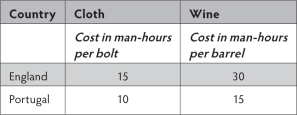
A)negative externality.
B)comparative advantage.
C)trade bargaining.
D)the Prisoner's Dilemma.
E)Stag Hunt.
A)negative externality.
B)comparative advantage.
C)trade bargaining.
D)the Prisoner's Dilemma.
E)Stag Hunt.
Question
Line Qs to Qd in the figure represents what occurring under liberalization? 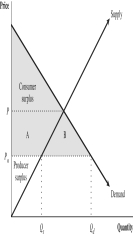
A)Increased revenue for the state.
B)The new price of the good within the state.
C)How much of the good consumers will demand.
D)How much of the good will be imported by the state.
E)How much domestic firms will produce for domestic consumption.
A)Increased revenue for the state.
B)The new price of the good within the state.
C)How much of the good consumers will demand.
D)How much of the good will be imported by the state.
E)How much domestic firms will produce for domestic consumption.
Question
Line Qd ᵗ to Qd represents what occurring under the tariff in the figure? 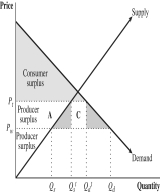
A)Increased revenue for the state.
B)The new price of the good within the state.
C)How much of the good consumers will demand.
D)How much of the good that will be imported by the state.
E)How much less the consumers would demand when compared to the world price.
A)Increased revenue for the state.
B)The new price of the good within the state.
C)How much of the good consumers will demand.
D)How much of the good that will be imported by the state.
E)How much less the consumers would demand when compared to the world price.
Question
Question
Which is true of Portugal in the table? 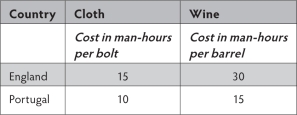
A)Portugal has an absolute advantage over England in both cloth and wine.
B)England's opportunity cost for producing wine is lower than Portugal's.
C)Portugal can produce more wine than England.
D)Neither country has a comparative advantage in the production of cloth.
E)Neither country has a comparative advantage in the production of wine.
A)Portugal has an absolute advantage over England in both cloth and wine.
B)England's opportunity cost for producing wine is lower than Portugal's.
C)Portugal can produce more wine than England.
D)Neither country has a comparative advantage in the production of cloth.
E)Neither country has a comparative advantage in the production of wine.
Question
Question
Question
Question
Question
According to Ricardo's theory on trade,in the example described by the table,Portugal should: 
A)let England produce everything.
B)produce wine exclusively.
C)produce cloth exclusively.
D)produce everything itself.
E)produce half the wine and half the cloth needed by both parties.
A)let England produce everything.
B)produce wine exclusively.
C)produce cloth exclusively.
D)produce everything itself.
E)produce half the wine and half the cloth needed by both parties.
Question
In the figure,at what level will domestic firms produce under the tariff? 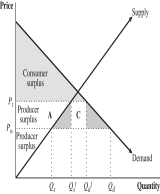
A)Qst.
B)Qd t.
C)A.
D)C.
E)Pw.
A)Qst.
B)Qd t.
C)A.
D)C.
E)Pw.
Question
What is true of a state that adopts a tariff in the scenario depicted in the figure? 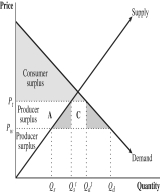
A)It will increase domestic consumption of the good.
B)It will have no effect on domestic consumption of the good.
C)It will decrease domestic production of the good.
D)It will increase domestic production of the good.
E)It will have no effect on domestic production of the good.
A)It will increase domestic consumption of the good.
B)It will have no effect on domestic consumption of the good.
C)It will decrease domestic production of the good.
D)It will increase domestic production of the good.
E)It will have no effect on domestic production of the good.
Question
Question
Question
Question
Question
Question
What is true of an autarkic state in the example depicted in the figure,where Pw is the world price of a good? 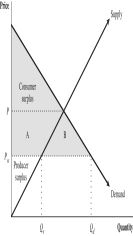
A)Protectionism is ideal for the state.
B)If the state liberalizes,it would be a price setter.
C)If the state liberalizes,it would be a price taker.
D)Consumers will be hurt by liberalization.
E)There are no possible gains from liberalization or further protectionism.
A)Protectionism is ideal for the state.
B)If the state liberalizes,it would be a price setter.
C)If the state liberalizes,it would be a price taker.
D)Consumers will be hurt by liberalization.
E)There are no possible gains from liberalization or further protectionism.
Question
Question
In the figure,at what level will domestic firms produce under liberalization? 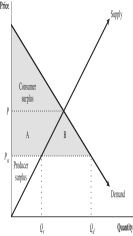
A)Qs.
B)Qd.
C)A.
D)B.
E)P.
A)Qs.
B)Qd.
C)A.
D)B.
E)P.
Question
Question
Question
Question
Question
Question
Question
Question
Question
Question
Question

Unlock Deck
Sign up to unlock the cards in this deck!
Unlock Deck
Unlock Deck
1/71

Play

Full screen (f)
Deck 8: International Trade
1
All of the following are examples of protectionism EXCEPT:
A)a quota on the number of Japanese cars imported into the United States.
B)a ban on computers imported into Brazil.
C)a tax on steel imports into the United States.
D)the United States limiting the sale of valuable military equipment to other countries.
E)the Mexican government limiting the number of tons of sugar imported into Mexico.
A)a quota on the number of Japanese cars imported into the United States.
B)a ban on computers imported into Brazil.
C)a tax on steel imports into the United States.
D)the United States limiting the sale of valuable military equipment to other countries.
E)the Mexican government limiting the number of tons of sugar imported into Mexico.
D
2
Which of the following statements best describes the opinion of most economists about trade?
A)Trade barriers are bad for economic growth and well-being.
B)Trade barriers have no discernible effect on domestic production.
C)Trade barriers have no long-term effect on exports.
D)Trade barriers are "a rising tide that lifts all boats."
E)Trade barriers disproportionately hurt low-skilled labor.
A)Trade barriers are bad for economic growth and well-being.
B)Trade barriers have no discernible effect on domestic production.
C)Trade barriers have no long-term effect on exports.
D)Trade barriers are "a rising tide that lifts all boats."
E)Trade barriers disproportionately hurt low-skilled labor.
A
3
The trade protection that the United States steel industry receives has which of the following effects?
A)It raises the cost of steel for American consumers.
B)It lowers the profits of American steel companies.
C)It makes American steelworkers' salaries unpredictable.
D)It leads to less support from the steel industry for the government.
E)It increases the sales of foreign steel products in the United States.
A)It raises the cost of steel for American consumers.
B)It lowers the profits of American steel companies.
C)It makes American steelworkers' salaries unpredictable.
D)It leads to less support from the steel industry for the government.
E)It increases the sales of foreign steel products in the United States.
A
4
Developing countries have been surprisingly receptive to free trade since the 1970s.According to scholars this is likely because of which other development?
A)Developed nations offered incentives to encourage free trade.
B)More developing countries became democratic rather than authoritarian.
C)The United Nations mandated free trade among developing countries.
D)Developing nations began doing more trade with each other.
E)Offshoring of jobs from developed nations encouraged developing countries to embrace free trade.
A)Developed nations offered incentives to encourage free trade.
B)More developing countries became democratic rather than authoritarian.
C)The United Nations mandated free trade among developing countries.
D)Developing nations began doing more trade with each other.
E)Offshoring of jobs from developed nations encouraged developing countries to embrace free trade.
Unlock Deck
Unlock for access to all 71 flashcards in this deck.
Unlock Deck
k this deck
5
What is comparative advantage?
A)The ability of countries to benefit from specializing in what they do best.
B)The capacity of some countries to produce everything better than other countries.
C)The advantage that countries that export many products have over more specialized economies.
D)The fact that industrialized countries have advanced economies that are comparable.
E)The benefit that workers in an industrialized country have over workers in a less developed country.
A)The ability of countries to benefit from specializing in what they do best.
B)The capacity of some countries to produce everything better than other countries.
C)The advantage that countries that export many products have over more specialized economies.
D)The fact that industrialized countries have advanced economies that are comparable.
E)The benefit that workers in an industrialized country have over workers in a less developed country.
Unlock Deck
Unlock for access to all 71 flashcards in this deck.
Unlock Deck
k this deck
6
Given the following exports,which of these is most likely a rich,developed country?
A)A country that exports shoes.
B)A country that exports computer chips.
C)A country that exports copper.
D)A country that exports oil.
E)A country that exports jeans.
A)A country that exports shoes.
B)A country that exports computer chips.
C)A country that exports copper.
D)A country that exports oil.
E)A country that exports jeans.
Unlock Deck
Unlock for access to all 71 flashcards in this deck.
Unlock Deck
k this deck
7
All of the following are economic characteristics,or factors of production,EXCEPT:
A)land.
B)military power.
C)unskilled labor.
D)skilled labor.
E)investment capital.
A)land.
B)military power.
C)unskilled labor.
D)skilled labor.
E)investment capital.
Unlock Deck
Unlock for access to all 71 flashcards in this deck.
Unlock Deck
k this deck
8
Which kind of state is LEAST likely to benefit from trade?
A)A state that has a comparative advantage at producing a few goods.
B)A state that has a comparative advantage at producing one good.
C)A state that has powerful business interests that produce goods that are more expensive than the global price.
D)A state that has powerful business interests that produce goods that are cheaper than the global price.
E)A state that can produce everything it wants to consume and does it more cheaply than the other alternatives.
A)A state that has a comparative advantage at producing a few goods.
B)A state that has a comparative advantage at producing one good.
C)A state that has powerful business interests that produce goods that are more expensive than the global price.
D)A state that has powerful business interests that produce goods that are cheaper than the global price.
E)A state that can produce everything it wants to consume and does it more cheaply than the other alternatives.
Unlock Deck
Unlock for access to all 71 flashcards in this deck.
Unlock Deck
k this deck
9
All of the following are more likely to have higher levels of trade than other similar countries EXCEPT:
A)two countries that have a dispute over ownership of a border region.
B)two countries that use the same currency.
C)a country that buys many bonds issued by another country.
D)two countries with embassies in each other's country.
E)two members of a military alliance.
A)two countries that have a dispute over ownership of a border region.
B)two countries that use the same currency.
C)a country that buys many bonds issued by another country.
D)two countries with embassies in each other's country.
E)two members of a military alliance.
Unlock Deck
Unlock for access to all 71 flashcards in this deck.
Unlock Deck
k this deck
10
Which of the following is an example of specialization and division of labor?
A)A farm family building its own tractor.
B)A worker in a Toyota plant welding a rear axle on a Corolla all day,every day.
C)A popular motorcycle manufacturer beginning to produce small automobiles.
D)Workers in a bottling plant rotating positions on the assembly line in order to master the entire process.
E)Managers in a computer factory making sure that every employee can work more than one job.
A)A farm family building its own tractor.
B)A worker in a Toyota plant welding a rear axle on a Corolla all day,every day.
C)A popular motorcycle manufacturer beginning to produce small automobiles.
D)Workers in a bottling plant rotating positions on the assembly line in order to master the entire process.
E)Managers in a computer factory making sure that every employee can work more than one job.
Unlock Deck
Unlock for access to all 71 flashcards in this deck.
Unlock Deck
k this deck
11
Which of the following statements about trade policy is true?
A)No country in the world currently maintains trade barriers.
B)Few countries in the world maintain trade barriers.
C)A bare majority of countries in the world maintain some trade barriers.
D)A large majority of countries in the world maintain some trade barriers.
E)Every country in the world maintains some trade barriers.
A)No country in the world currently maintains trade barriers.
B)Few countries in the world maintain trade barriers.
C)A bare majority of countries in the world maintain some trade barriers.
D)A large majority of countries in the world maintain some trade barriers.
E)Every country in the world maintains some trade barriers.
Unlock Deck
Unlock for access to all 71 flashcards in this deck.
Unlock Deck
k this deck
12
Which of the following would be expected by the Heckscher-Ohlin trade theory?
A)A country with abundant fertile land exporting agricultural products.
B)A country with abundant capital importing manufactured goods.
C)A country with abundant fertile land importing agricultural goods.
D)A country with abundant labor exporting agricultural products.
E)A country with abundant capital exporting agricultural goods.
A)A country with abundant fertile land exporting agricultural products.
B)A country with abundant capital importing manufactured goods.
C)A country with abundant fertile land importing agricultural goods.
D)A country with abundant labor exporting agricultural products.
E)A country with abundant capital exporting agricultural goods.
Unlock Deck
Unlock for access to all 71 flashcards in this deck.
Unlock Deck
k this deck
13
What is trade liberalization?
A)Being tolerant of exporting to other countries.
B)Increasing taxes on manufacturers of exports.
C)Strengthening government oversight of imports.
D)Reducing barriers to trade between countries.
E)Imposing controls on the free flow of goods.
A)Being tolerant of exporting to other countries.
B)Increasing taxes on manufacturers of exports.
C)Strengthening government oversight of imports.
D)Reducing barriers to trade between countries.
E)Imposing controls on the free flow of goods.
Unlock Deck
Unlock for access to all 71 flashcards in this deck.
Unlock Deck
k this deck
14
Which of the following is a tariff?
A)A toll on land and sea traffic entering a country.
B)A regulation that restricts the type of products that can be imported.
C)A ban on imports from another country.
D)A limit to the amount of a foreign good that can be sold in a country.
E)A tax on imports levied at the border,paid by the importer.
A)A toll on land and sea traffic entering a country.
B)A regulation that restricts the type of products that can be imported.
C)A ban on imports from another country.
D)A limit to the amount of a foreign good that can be sold in a country.
E)A tax on imports levied at the border,paid by the importer.
Unlock Deck
Unlock for access to all 71 flashcards in this deck.
Unlock Deck
k this deck
15
Why do countries restrict trade?
A)Some influential interest groups may benefit from tariffs.
B)Trade restrictions do not come with any costs for the country imposing them.
C)Trade restrictions usually are the best way to improve a country's overall economy.
D)Free trade hurts industries that make use of the most abundant resource in a country.
E)Trade restrictions are more important to consumers than to producers of products.
A)Some influential interest groups may benefit from tariffs.
B)Trade restrictions do not come with any costs for the country imposing them.
C)Trade restrictions usually are the best way to improve a country's overall economy.
D)Free trade hurts industries that make use of the most abundant resource in a country.
E)Trade restrictions are more important to consumers than to producers of products.
Unlock Deck
Unlock for access to all 71 flashcards in this deck.
Unlock Deck
k this deck
16
Which of the following is an example of absolute advantage?
A)Since Turkey controls the Bosporus Strait,the countries on the Black Sea are completely dependent on it for access to the Mediterranean.
B)India is more efficient at producing cloth than Portugal,but Portugal is more efficient at producing wine than India.
C)Portugal is better at producing wine than producing cloth.
D)The United States makes software more efficiently than any other country.
E)Saudi Arabia has one-fifth of the world's proven oil reserves,but oil refineries in the United States can produce oil more efficiently.
A)Since Turkey controls the Bosporus Strait,the countries on the Black Sea are completely dependent on it for access to the Mediterranean.
B)India is more efficient at producing cloth than Portugal,but Portugal is more efficient at producing wine than India.
C)Portugal is better at producing wine than producing cloth.
D)The United States makes software more efficiently than any other country.
E)Saudi Arabia has one-fifth of the world's proven oil reserves,but oil refineries in the United States can produce oil more efficiently.
Unlock Deck
Unlock for access to all 71 flashcards in this deck.
Unlock Deck
k this deck
17
What is protectionism?
A)The creation of alliances to ward off threats to a country.
B)Excessive worry about attacks from other countries.
C)The use of conscious measures to shield domestic producers from imports.
D)The use of free trade to improve the efficiency of domestic producers.
E)The dumping of goods in other countries.
A)The creation of alliances to ward off threats to a country.
B)Excessive worry about attacks from other countries.
C)The use of conscious measures to shield domestic producers from imports.
D)The use of free trade to improve the efficiency of domestic producers.
E)The dumping of goods in other countries.
Unlock Deck
Unlock for access to all 71 flashcards in this deck.
Unlock Deck
k this deck
18
Why does division of labor make international trade profitable?
A)Countries can always trade with other countries.
B)Every country can produce all the products it needs.
C)The countries that are most efficient at producing particular products produce them.
D)Countries can learn to create products that they are inefficient at producing.
E)Workers always benefit when their labor is divided.
A)Countries can always trade with other countries.
B)Every country can produce all the products it needs.
C)The countries that are most efficient at producing particular products produce them.
D)Countries can learn to create products that they are inefficient at producing.
E)Workers always benefit when their labor is divided.
Unlock Deck
Unlock for access to all 71 flashcards in this deck.
Unlock Deck
k this deck
19
Which of the following is NOT a trade barrier?
A)Subsidies.
B)Tariffs.
C)Quantitative restrictions.
D)Import licenses.
E)Nontariff barriers.
A)Subsidies.
B)Tariffs.
C)Quantitative restrictions.
D)Import licenses.
E)Nontariff barriers.
Unlock Deck
Unlock for access to all 71 flashcards in this deck.
Unlock Deck
k this deck
20
Which of these is most likely a poor,developing country?
A)A country that exports machinery for producing shoes.
B)A country that exports aircraft.
C)A country that exports copper.
D)A country that exports computer chips.
E)A country that exports automobiles and trucks.
A)A country that exports machinery for producing shoes.
B)A country that exports aircraft.
C)A country that exports copper.
D)A country that exports computer chips.
E)A country that exports automobiles and trucks.
Unlock Deck
Unlock for access to all 71 flashcards in this deck.
Unlock Deck
k this deck
21
Which of the following international organizations was formed in the wake of World War II as a response to the devastation of European economies during the war?
A)United Nations.
B)Warsaw Pact.
C)European Union.
D)North Atlantic Treaty Organization.
E)World Trade Organization.
A)United Nations.
B)Warsaw Pact.
C)European Union.
D)North Atlantic Treaty Organization.
E)World Trade Organization.
Unlock Deck
Unlock for access to all 71 flashcards in this deck.
Unlock Deck
k this deck
22
Which statement best describes the position of the United States toward free trade?
A)The United States has always promoted free trade.
B)The United States has always been a highly protectionist country.
C)The United States was initially in favor of free trade but then became more protectionist,and is currently highly protectionist.
D)The United States was initially in favor of free trade,became protectionist but currently promotes free trade.
E)The United States was initially strongly protectionist but has since favored free trade.
A)The United States has always promoted free trade.
B)The United States has always been a highly protectionist country.
C)The United States was initially in favor of free trade but then became more protectionist,and is currently highly protectionist.
D)The United States was initially in favor of free trade,became protectionist but currently promotes free trade.
E)The United States was initially strongly protectionist but has since favored free trade.
Unlock Deck
Unlock for access to all 71 flashcards in this deck.
Unlock Deck
k this deck
23
Which of the following is most likely to benefit from protectionism?
A)Consumers of all goods,because they are protected from inferior products.
B)Consumers of imported products.
C)Domestic producers of goods that are also imported from foreign countries.
D)Domestic producers of goods that are exported to other countries.
E)Foreign producers of goods that are exported to other countries.
A)Consumers of all goods,because they are protected from inferior products.
B)Consumers of imported products.
C)Domestic producers of goods that are also imported from foreign countries.
D)Domestic producers of goods that are exported to other countries.
E)Foreign producers of goods that are exported to other countries.
Unlock Deck
Unlock for access to all 71 flashcards in this deck.
Unlock Deck
k this deck
24
Which of the following trade policy results would be most expected,given the logic of collective action?
A)Factory workers successfully lobbying for lower tariffs on imported automobiles.
B)Agricultural workers successfully lobbying for lower tariffs on imported wheat.
C)Consumers successfully lobbying for higher tariffs on imported corn.
D)Consumers successfully lobbying for lower tariffs on imported televisions.
E)Automobile manufacturers successfully lobbying for higher tariffs on imported automobiles.
A)Factory workers successfully lobbying for lower tariffs on imported automobiles.
B)Agricultural workers successfully lobbying for lower tariffs on imported wheat.
C)Consumers successfully lobbying for higher tariffs on imported corn.
D)Consumers successfully lobbying for lower tariffs on imported televisions.
E)Automobile manufacturers successfully lobbying for higher tariffs on imported automobiles.
Unlock Deck
Unlock for access to all 71 flashcards in this deck.
Unlock Deck
k this deck
25
Which scenario represents strategic interaction in trade?
A)The United States creating a quota on sugar imports,due to lobbying from sugar manufacturers.
B)The European Union instigating a case against genetically modified organisms in the World Trade Organization to prevent U.S.agricultural imports.
C)Japan not raising tariffs on U.S.automobiles,as it fears retaliation from the United States.
D)France creating new tariffs on U.S.goods,due to concerns over domestic production.
E)Great Britain unilaterally liberalizing its agricultural sector.
A)The United States creating a quota on sugar imports,due to lobbying from sugar manufacturers.
B)The European Union instigating a case against genetically modified organisms in the World Trade Organization to prevent U.S.agricultural imports.
C)Japan not raising tariffs on U.S.automobiles,as it fears retaliation from the United States.
D)France creating new tariffs on U.S.goods,due to concerns over domestic production.
E)Great Britain unilaterally liberalizing its agricultural sector.
Unlock Deck
Unlock for access to all 71 flashcards in this deck.
Unlock Deck
k this deck
26
What is the Ricardo-Viner explanation for trade-policy preferences?
A)A country's government will usually prefer to protect owners of capital.
B)The interests of groups in society toward trade are determined by the factor of production of which they are part.
C)The interests of factors of production are often determined by the industry sector,rather than by the factor of production.
D)A country will import goods that make intensive use of the resources a country has in abundance.
E)A country will impose tariffs on goods that compete with goods made using its most abundant factor intensively.
A)A country's government will usually prefer to protect owners of capital.
B)The interests of groups in society toward trade are determined by the factor of production of which they are part.
C)The interests of factors of production are often determined by the industry sector,rather than by the factor of production.
D)A country will import goods that make intensive use of the resources a country has in abundance.
E)A country will impose tariffs on goods that compete with goods made using its most abundant factor intensively.
Unlock Deck
Unlock for access to all 71 flashcards in this deck.
Unlock Deck
k this deck
27
Which of these periods was most characterized by trade liberalization?
A)The early to mid-1800s.
B)The late 1800s until World War I.
C)During World War I.
D)Between World War I and World War II.
E)During World War II.
A)The early to mid-1800s.
B)The late 1800s until World War I.
C)During World War I.
D)Between World War I and World War II.
E)During World War II.
Unlock Deck
Unlock for access to all 71 flashcards in this deck.
Unlock Deck
k this deck
28
Which of the following is explained well by the Stolper-Samuelson theorem?
A)Farmers in land-poor France tend to favor liberal trade policies.
B)Farmers in land-rich Argentina tend to favor liberal trade policies.
C)Workers in the scarce-labor United States tend to oppose protectionist trade policies.
D)Workers in labor-rich Bangladesh tend to favor protectionist trade policies.
E)Owners of capital in capital-poor Thailand favor liberal trade policies.
A)Farmers in land-poor France tend to favor liberal trade policies.
B)Farmers in land-rich Argentina tend to favor liberal trade policies.
C)Workers in the scarce-labor United States tend to oppose protectionist trade policies.
D)Workers in labor-rich Bangladesh tend to favor protectionist trade policies.
E)Owners of capital in capital-poor Thailand favor liberal trade policies.
Unlock Deck
Unlock for access to all 71 flashcards in this deck.
Unlock Deck
k this deck
29
The creation of the European Common Market and the subsequent growth of the customs union in Europe is best an example of the importance of ________ in international trade.
A)interests
B)institutions
C)ideas
D)interactions
E)identities
A)interests
B)institutions
C)ideas
D)interactions
E)identities
Unlock Deck
Unlock for access to all 71 flashcards in this deck.
Unlock Deck
k this deck
30
Which of the following countries is most likely to follow a liberal trade policy?
A)A country led by a dictator who suppresses national political parties.
B)A country led by a dictator who allows limited elections to take place.
C)A country led by a small group of military officers.
D)A democratic country with strong national political parties and a powerful executive.
E)A democratic country with weak political parties and a weak national executive.
A)A country led by a dictator who suppresses national political parties.
B)A country led by a dictator who allows limited elections to take place.
C)A country led by a small group of military officers.
D)A democratic country with strong national political parties and a powerful executive.
E)A democratic country with weak political parties and a weak national executive.
Unlock Deck
Unlock for access to all 71 flashcards in this deck.
Unlock Deck
k this deck
31
Which of the following is a quota?
A)A toll on land and sea traffic entering a country.
B)A regulation that restricts the type of products that can be imported.
C)A ban on imports from another country.
D)A limit to the amount of a foreign good that can be sold in a country.
E)A tax on imports levied at the border,paid by the importer.
A)A toll on land and sea traffic entering a country.
B)A regulation that restricts the type of products that can be imported.
C)A ban on imports from another country.
D)A limit to the amount of a foreign good that can be sold in a country.
E)A tax on imports levied at the border,paid by the importer.
Unlock Deck
Unlock for access to all 71 flashcards in this deck.
Unlock Deck
k this deck
32
Which of the following is explained well by the specific-factor approach (Ricardo-Viner model)?
A)Steel workers and steel factory owners both lobby for tariffs on imported steel.
B)Steel workers and agricultural workers join together to oppose tariffs.
C)Owners of factories in a country with abundant fertile land promote free trade.
D)Car manufacturers and owners of megafarms collude in lobbying for tariffs on car and wheat imports.
E)Workers in an automobile factory promote free trade while the factory owners lobby for tariffs on imported cars.
A)Steel workers and steel factory owners both lobby for tariffs on imported steel.
B)Steel workers and agricultural workers join together to oppose tariffs.
C)Owners of factories in a country with abundant fertile land promote free trade.
D)Car manufacturers and owners of megafarms collude in lobbying for tariffs on car and wheat imports.
E)Workers in an automobile factory promote free trade while the factory owners lobby for tariffs on imported cars.
Unlock Deck
Unlock for access to all 71 flashcards in this deck.
Unlock Deck
k this deck
33
All of the following statements about dumping are true EXCEPT:
A)dumping consists of selling goods below their true costs.
B)exporters use dumping to put competitors out of business.
C)dumping is widely seen as unfair.
D)dumping is easy to define and measure.
E)governments can aid dumping by subsidizing industries.
A)dumping consists of selling goods below their true costs.
B)exporters use dumping to put competitors out of business.
C)dumping is widely seen as unfair.
D)dumping is easy to define and measure.
E)governments can aid dumping by subsidizing industries.
Unlock Deck
Unlock for access to all 71 flashcards in this deck.
Unlock Deck
k this deck
34
What is the Stolper-Samuelson theorem?
A)The theory that protection hurts the scarce sector.
B)The theory that protection hurts the scarce factor of production.
C)The theory that protection benefits the scarce sector.
D)The theory that protection benefits the abundant factor of production.
E)The theory that protection benefits the scarce factor of production.
A)The theory that protection hurts the scarce sector.
B)The theory that protection hurts the scarce factor of production.
C)The theory that protection benefits the scarce sector.
D)The theory that protection benefits the abundant factor of production.
E)The theory that protection benefits the scarce factor of production.
Unlock Deck
Unlock for access to all 71 flashcards in this deck.
Unlock Deck
k this deck
35
Which of the following groups in the United States is most likely to have experienced stagnant or declining wages since the 1970s?
A)Workers in a chicken processing plant in Louisiana.
B)Workers doing computer coding in California's "Silicon Valley."
C)Film editors in Los Angeles.
D)Book editors in New York City.
E)Workers in a pharmacy in Minnesota.
A)Workers in a chicken processing plant in Louisiana.
B)Workers doing computer coding in California's "Silicon Valley."
C)Film editors in Los Angeles.
D)Book editors in New York City.
E)Workers in a pharmacy in Minnesota.
Unlock Deck
Unlock for access to all 71 flashcards in this deck.
Unlock Deck
k this deck
36
Which of the following is a deadweight cost?
A)The debt burden that developing countries have incurred because of protectionist policies.
B)The difference between the domestic price and the international market price of goods.
C)The amount of money Uruguayan consumers pay for cars that exceeds the profits Uruguayan car manufacturers make because of trade protection.
D)The amount of money it will cost a country's economy to switch from protectionist to liberal trade policies.
E)The price of a good before adding the cost of tariffs or other forms of protection.
A)The debt burden that developing countries have incurred because of protectionist policies.
B)The difference between the domestic price and the international market price of goods.
C)The amount of money Uruguayan consumers pay for cars that exceeds the profits Uruguayan car manufacturers make because of trade protection.
D)The amount of money it will cost a country's economy to switch from protectionist to liberal trade policies.
E)The price of a good before adding the cost of tariffs or other forms of protection.
Unlock Deck
Unlock for access to all 71 flashcards in this deck.
Unlock Deck
k this deck
37
Which of the following is most likely a developed country?
A)A country with no trade restrictions of any kind on imports.
B)A country with no quotas on manufactured goods.
C)A country that imposes a tax on technology exports.
D)A country that has trade restrictions on agricultural imports.
E)A country that has high tariffs on manufactured goods.
A)A country with no trade restrictions of any kind on imports.
B)A country with no quotas on manufactured goods.
C)A country that imposes a tax on technology exports.
D)A country that has trade restrictions on agricultural imports.
E)A country that has high tariffs on manufactured goods.
Unlock Deck
Unlock for access to all 71 flashcards in this deck.
Unlock Deck
k this deck
38
When the United States established steel tariffs in 2002,who benefited?
A)Steel exporters in other countries.
B)Consumers in the United States.
C)Producers in the United States that used steel as an input.
D)Steel importers in the United States.
E)Steel exporters in the United States.
A)Steel exporters in other countries.
B)Consumers in the United States.
C)Producers in the United States that used steel as an input.
D)Steel importers in the United States.
E)Steel exporters in the United States.
Unlock Deck
Unlock for access to all 71 flashcards in this deck.
Unlock Deck
k this deck
39
What is the effect of trade barriers?
A)Imports become less expensive for domestic producers.
B)A glut of imported products develops.
C)Domestic producers of the protected good can sell their product at a higher price.
D)Domestic producers of the protected good have to lower the wages paid to their workers.
E)Domestic producers of the protected good can sell less of the good.
A)Imports become less expensive for domestic producers.
B)A glut of imported products develops.
C)Domestic producers of the protected good can sell their product at a higher price.
D)Domestic producers of the protected good have to lower the wages paid to their workers.
E)Domestic producers of the protected good can sell less of the good.
Unlock Deck
Unlock for access to all 71 flashcards in this deck.
Unlock Deck
k this deck
40
Which of the following would be a movement toward the Pareto frontier with regard to the benefits of trade?
A)Steel workers losing their jobs because of steel imports get free training,paid for by the government,so they can get jobs in another industry.
B)Agricultural workers facing wage decreases because of imported food successfully lobby the government to institute tariffs.
C)Workers in a clothing factory in Mexico being laid off go to the United States to find work.
D)South Korean semiconductor manufacturers sell their products at a lower-than-market price in Japan.
E)The wages of Bangladeshi shoe makers rise when the United States imposes tariffs on shoe imports.
A)Steel workers losing their jobs because of steel imports get free training,paid for by the government,so they can get jobs in another industry.
B)Agricultural workers facing wage decreases because of imported food successfully lobby the government to institute tariffs.
C)Workers in a clothing factory in Mexico being laid off go to the United States to find work.
D)South Korean semiconductor manufacturers sell their products at a lower-than-market price in Japan.
E)The wages of Bangladeshi shoe makers rise when the United States imposes tariffs on shoe imports.
Unlock Deck
Unlock for access to all 71 flashcards in this deck.
Unlock Deck
k this deck
41
The table is an example of:
A)negative externality.
B)comparative advantage.
C)trade bargaining.
D)the Prisoner's Dilemma.
E)Stag Hunt.
A)negative externality.
B)comparative advantage.
C)trade bargaining.
D)the Prisoner's Dilemma.
E)Stag Hunt.
Unlock Deck
Unlock for access to all 71 flashcards in this deck.
Unlock Deck
k this deck
42
Line Qs to Qd in the figure represents what occurring under liberalization?
A)Increased revenue for the state.
B)The new price of the good within the state.
C)How much of the good consumers will demand.
D)How much of the good will be imported by the state.
E)How much domestic firms will produce for domestic consumption.
A)Increased revenue for the state.
B)The new price of the good within the state.
C)How much of the good consumers will demand.
D)How much of the good will be imported by the state.
E)How much domestic firms will produce for domestic consumption.
Unlock Deck
Unlock for access to all 71 flashcards in this deck.
Unlock Deck
k this deck
43
Line Qd ᵗ to Qd represents what occurring under the tariff in the figure?
A)Increased revenue for the state.
B)The new price of the good within the state.
C)How much of the good consumers will demand.
D)How much of the good that will be imported by the state.
E)How much less the consumers would demand when compared to the world price.
A)Increased revenue for the state.
B)The new price of the good within the state.
C)How much of the good consumers will demand.
D)How much of the good that will be imported by the state.
E)How much less the consumers would demand when compared to the world price.
Unlock Deck
Unlock for access to all 71 flashcards in this deck.
Unlock Deck
k this deck
44
What is the theory of hegemonic stability?
A)The hegemonic spread of the belief in the benefits of free trade will lead to a liberal world trading system.
B)The spread of free trade throughout the world will lead to a stable single trading system.
C)The longer countries keep their free-trade policies,the more likely they are to remain pro-free trade.
D)Having one single hegemonic source of information can improve the chances of stability in international trade.
E)One large state that is willing and powerful enough can solve the collective action problems of international trade.
A)The hegemonic spread of the belief in the benefits of free trade will lead to a liberal world trading system.
B)The spread of free trade throughout the world will lead to a stable single trading system.
C)The longer countries keep their free-trade policies,the more likely they are to remain pro-free trade.
D)Having one single hegemonic source of information can improve the chances of stability in international trade.
E)One large state that is willing and powerful enough can solve the collective action problems of international trade.
Unlock Deck
Unlock for access to all 71 flashcards in this deck.
Unlock Deck
k this deck
45
Which is true of Portugal in the table?
A)Portugal has an absolute advantage over England in both cloth and wine.
B)England's opportunity cost for producing wine is lower than Portugal's.
C)Portugal can produce more wine than England.
D)Neither country has a comparative advantage in the production of cloth.
E)Neither country has a comparative advantage in the production of wine.
A)Portugal has an absolute advantage over England in both cloth and wine.
B)England's opportunity cost for producing wine is lower than Portugal's.
C)Portugal can produce more wine than England.
D)Neither country has a comparative advantage in the production of cloth.
E)Neither country has a comparative advantage in the production of wine.
Unlock Deck
Unlock for access to all 71 flashcards in this deck.
Unlock Deck
k this deck
46
What is most-favored-nation trading status?
A)When countries give each other the same trade concessions they give to all other countries.
B)When a country gives special trade privileges to a close ally.
C)When a country spares no expense to increase trade with another country.
D)When a country has the wealthiest and most developed economy.
E)When a country promotes trade with military allies.
A)When countries give each other the same trade concessions they give to all other countries.
B)When a country gives special trade privileges to a close ally.
C)When a country spares no expense to increase trade with another country.
D)When a country has the wealthiest and most developed economy.
E)When a country promotes trade with military allies.
Unlock Deck
Unlock for access to all 71 flashcards in this deck.
Unlock Deck
k this deck
47
Explain how interests,institutions,and interactions affect the likelihood of trade liberalization or trade restriction in domestic politics.
Unlock Deck
Unlock for access to all 71 flashcards in this deck.
Unlock Deck
k this deck
48
Which of the following statements about the World Trade Organization (WTO)is FALSE?
A)All countries have equal votes in decision making in the WTO.
B)The WTO has helped achieve the liberalization of agricultural trade in developed countries.
C)The largest member countries dominate negotiations in the WTO.
D)Developing countries often find that discussions of issues of concern to them are blocked in the WTO.
E)The WTO has helped countries reduce barriers to trade.
A)All countries have equal votes in decision making in the WTO.
B)The WTO has helped achieve the liberalization of agricultural trade in developed countries.
C)The largest member countries dominate negotiations in the WTO.
D)Developing countries often find that discussions of issues of concern to them are blocked in the WTO.
E)The WTO has helped countries reduce barriers to trade.
Unlock Deck
Unlock for access to all 71 flashcards in this deck.
Unlock Deck
k this deck
49
How does the Stolper-Samuelson theorem explain why some countries are protectionist and others are not?
Unlock Deck
Unlock for access to all 71 flashcards in this deck.
Unlock Deck
k this deck
50
According to Ricardo's theory on trade,in the example described by the table,Portugal should:
A)let England produce everything.
B)produce wine exclusively.
C)produce cloth exclusively.
D)produce everything itself.
E)produce half the wine and half the cloth needed by both parties.
A)let England produce everything.
B)produce wine exclusively.
C)produce cloth exclusively.
D)produce everything itself.
E)produce half the wine and half the cloth needed by both parties.
Unlock Deck
Unlock for access to all 71 flashcards in this deck.
Unlock Deck
k this deck
51
In the figure,at what level will domestic firms produce under the tariff?
A)Qst.
B)Qd t.
C)A.
D)C.
E)Pw.
A)Qst.
B)Qd t.
C)A.
D)C.
E)Pw.
Unlock Deck
Unlock for access to all 71 flashcards in this deck.
Unlock Deck
k this deck
52
What is true of a state that adopts a tariff in the scenario depicted in the figure?
A)It will increase domestic consumption of the good.
B)It will have no effect on domestic consumption of the good.
C)It will decrease domestic production of the good.
D)It will increase domestic production of the good.
E)It will have no effect on domestic production of the good.
A)It will increase domestic consumption of the good.
B)It will have no effect on domestic consumption of the good.
C)It will decrease domestic production of the good.
D)It will increase domestic production of the good.
E)It will have no effect on domestic production of the good.
Unlock Deck
Unlock for access to all 71 flashcards in this deck.
Unlock Deck
k this deck
53
Why would transparency affect trade cooperation?
A)A country would be more reluctant to enter into a free-trade agreement if it has little information about another country's subsidies to domestic producers.
B)Two countries with too much information about each other's tax policies would find it difficult to negotiate a free-trade agreement.
C)Countries that negotiate simpler trade agreements are more likely to suspect the other side of cheating.
D)Countries with more reasonable negotiators are more likely to negotiate effective trade agreements.
E)Countries try to conceal information about their domestic policies to improve the likelihood of negotiating an effective free-trade agreement.
A)A country would be more reluctant to enter into a free-trade agreement if it has little information about another country's subsidies to domestic producers.
B)Two countries with too much information about each other's tax policies would find it difficult to negotiate a free-trade agreement.
C)Countries that negotiate simpler trade agreements are more likely to suspect the other side of cheating.
D)Countries with more reasonable negotiators are more likely to negotiate effective trade agreements.
E)Countries try to conceal information about their domestic policies to improve the likelihood of negotiating an effective free-trade agreement.
Unlock Deck
Unlock for access to all 71 flashcards in this deck.
Unlock Deck
k this deck
54
Which of the following is an example of absolute advantage?
A)Japan makes cars more efficiently than the United States.
B)Germany makes cars more efficiently than the United States,and the United States makes software more efficiently than Germany.
C)The United States is likely to win in a trade war against either Germany or Japan.
D)Japan makes cars more efficiently than any other country.
E)All countries are equally efficient at making software.
A)Japan makes cars more efficiently than the United States.
B)Germany makes cars more efficiently than the United States,and the United States makes software more efficiently than Germany.
C)The United States is likely to win in a trade war against either Germany or Japan.
D)Japan makes cars more efficiently than any other country.
E)All countries are equally efficient at making software.
Unlock Deck
Unlock for access to all 71 flashcards in this deck.
Unlock Deck
k this deck
55
Why are those who favor free trade concerned about regional trade agreements?
A)They think there are too few regional trade agreements.
B)They think regional trade agreements are biased toward workers' rights.
C)They think the signers of regional trade agreements will become more protectionist in general.
D)They think regional trade agreements will be stepping stones toward a more integrated world economy.
E)They think regional trade agreements may result in the members trading only among themselves.
A)They think there are too few regional trade agreements.
B)They think regional trade agreements are biased toward workers' rights.
C)They think the signers of regional trade agreements will become more protectionist in general.
D)They think regional trade agreements will be stepping stones toward a more integrated world economy.
E)They think regional trade agreements may result in the members trading only among themselves.
Unlock Deck
Unlock for access to all 71 flashcards in this deck.
Unlock Deck
k this deck
56
Which of the following is most likely to help countries overcome trade problems with each other?
A)When a large number of countries participate in trade negotiations so they can gain broader consensus.
B)When countries have limited interactions over time and therefore little chance for disputes.
C)When countries are able to restrict the information that other countries have about their products.
D)When the countries have concluded a limited war fought with each other to resolve a dispute over trade routes.
E)When countries can negotiate concessions in different industries to achieve an agreement.
A)When a large number of countries participate in trade negotiations so they can gain broader consensus.
B)When countries have limited interactions over time and therefore little chance for disputes.
C)When countries are able to restrict the information that other countries have about their products.
D)When the countries have concluded a limited war fought with each other to resolve a dispute over trade routes.
E)When countries can negotiate concessions in different industries to achieve an agreement.
Unlock Deck
Unlock for access to all 71 flashcards in this deck.
Unlock Deck
k this deck
57
Antiglobalization critics criticize the WTO because they think it:
A)favors domestic workers over other actors.
B)disregards environmental and safety issues.
C)is overly concerned about workers' health and safety.
D)is not doing enough to reduce government subsidies for domestic producers in developing countries.
E)has too little authority in regulating international trade.
A)favors domestic workers over other actors.
B)disregards environmental and safety issues.
C)is overly concerned about workers' health and safety.
D)is not doing enough to reduce government subsidies for domestic producers in developing countries.
E)has too little authority in regulating international trade.
Unlock Deck
Unlock for access to all 71 flashcards in this deck.
Unlock Deck
k this deck
58
What is true of an autarkic state in the example depicted in the figure,where Pw is the world price of a good?
A)Protectionism is ideal for the state.
B)If the state liberalizes,it would be a price setter.
C)If the state liberalizes,it would be a price taker.
D)Consumers will be hurt by liberalization.
E)There are no possible gains from liberalization or further protectionism.
A)Protectionism is ideal for the state.
B)If the state liberalizes,it would be a price setter.
C)If the state liberalizes,it would be a price taker.
D)Consumers will be hurt by liberalization.
E)There are no possible gains from liberalization or further protectionism.
Unlock Deck
Unlock for access to all 71 flashcards in this deck.
Unlock Deck
k this deck
59
Which of the following is an example of "reciprocity" in international trade?
A)Most of the countries in the European Union have adopted the same currency.
B)France reduced tariffs on wheat imports after Great Britain reduced tariffs on wheat imports.
C)Argentina,Brazil,Uruguay,and Paraguay collectively agreed to a common tariff on external goods.
D)A majority of the world's countries have joined the World Trade Organization.
E)Oil-producing states cooperate on how much oil they will export.
A)Most of the countries in the European Union have adopted the same currency.
B)France reduced tariffs on wheat imports after Great Britain reduced tariffs on wheat imports.
C)Argentina,Brazil,Uruguay,and Paraguay collectively agreed to a common tariff on external goods.
D)A majority of the world's countries have joined the World Trade Organization.
E)Oil-producing states cooperate on how much oil they will export.
Unlock Deck
Unlock for access to all 71 flashcards in this deck.
Unlock Deck
k this deck
60
In the figure,at what level will domestic firms produce under liberalization?
A)Qs.
B)Qd.
C)A.
D)B.
E)P.
A)Qs.
B)Qd.
C)A.
D)B.
E)P.
Unlock Deck
Unlock for access to all 71 flashcards in this deck.
Unlock Deck
k this deck
61
How do international institutions contribute to trade liberalization by increasing transparency and providing information?
Unlock Deck
Unlock for access to all 71 flashcards in this deck.
Unlock Deck
k this deck
62
How does the WTO both help and hurt the world's poor?
Unlock Deck
Unlock for access to all 71 flashcards in this deck.
Unlock Deck
k this deck
63
Explain hegemonic stability theory and how one or a few powerful countries can affect the international trading system.
Unlock Deck
Unlock for access to all 71 flashcards in this deck.
Unlock Deck
k this deck
64
Demonstrate mathematically how comparative advantage suggests two countries should specialize and trade.Despite the math,why would countries refuse to partake in trade?
Unlock Deck
Unlock for access to all 71 flashcards in this deck.
Unlock Deck
k this deck
65
Explain how trade bargaining problems can resemble a Prisoner's Dilemma.
Unlock Deck
Unlock for access to all 71 flashcards in this deck.
Unlock Deck
k this deck
66
What factors make it more likely that countries will have trade agreements? How do strategic interactions make it more or less likely that a country will erect a trade barrier?
Unlock Deck
Unlock for access to all 71 flashcards in this deck.
Unlock Deck
k this deck
67
Why do economists believe that free trade would be beneficial for the world economy? Why do nations still erect barriers in the face of those arguments?
Unlock Deck
Unlock for access to all 71 flashcards in this deck.
Unlock Deck
k this deck
68
How do domestic political institutions affect whether a country will adopt trade liberalization or protectionism?
Unlock Deck
Unlock for access to all 71 flashcards in this deck.
Unlock Deck
k this deck
69
How do international institutions affect whether the world trading system is more or less open?
Unlock Deck
Unlock for access to all 71 flashcards in this deck.
Unlock Deck
k this deck
70
Imagine that you are the economic adviser to the executive of a state.What factors would you tell him or her to consider before announcing a new policy on trade? Which groups in society would you expect to be in favor of protectionism? Which groups would you expect to be in favor of free trade?
Unlock Deck
Unlock for access to all 71 flashcards in this deck.
Unlock Deck
k this deck
71
Why do powerful countries like the United States abide by WTO rules,even when the WTO rules against them?
Unlock Deck
Unlock for access to all 71 flashcards in this deck.
Unlock Deck
k this deck
Unlock Deck
Unlock for access to all 71 flashcards in this deck.






