







 Chat with AI

Deck 17: Issues in International Trade and Finance
Full screen (f)

Question
Scenario 17.1
The data in the table tell us that both the United States and Mexico produce wheat and beef. The United States can make 6 bushels of wheat or 1 pound of beef in a day. Mexico can make 2 bushels of wheat or 4 pounds of beef in a day.

In the table in Scenario 17.1, the United States has an absolute advantage in
A) beef and an absolute disadvantage in wheat.
B) wheat only.
C) both wheat and beef.
D) neither wheat nor beef.
E) beef only.
The data in the table tell us that both the United States and Mexico produce wheat and beef. The United States can make 6 bushels of wheat or 1 pound of beef in a day. Mexico can make 2 bushels of wheat or 4 pounds of beef in a day.
In the table in Scenario 17.1, the United States has an absolute advantage in
A) beef and an absolute disadvantage in wheat.
B) wheat only.
C) both wheat and beef.
D) neither wheat nor beef.
E) beef only.

Question
Scenario 17.1
The data in the table tell us that both the United States and Mexico produce wheat and beef. The United States can make 6 bushels of wheat or 1 pound of beef in a day. Mexico can make 2 bushels of wheat or 4 pounds of beef in a day.
In the table in Scenario 17.1, Mexico has an absolute advantage in
A) beef only.
B) neither wheat nor beef.
C) both wheat and beef.
D) wheat only.
E) wheat and an absolute disadvantage in beef.
The data in the table tell us that both the United States and Mexico produce wheat and beef. The United States can make 6 bushels of wheat or 1 pound of beef in a day. Mexico can make 2 bushels of wheat or 4 pounds of beef in a day.
In the table in Scenario 17.1, Mexico has an absolute advantage in
A) beef only.
B) neither wheat nor beef.
C) both wheat and beef.
D) wheat only.
E) wheat and an absolute disadvantage in beef.
Question
Scenario 17.1
The data in the table tell us that both the United States and Mexico produce wheat and beef. The United States can make 6 bushels of wheat or 1 pound of beef in a day. Mexico can make 2 bushels of wheat or 4 pounds of beef in a day.
In the table in Scenario 17.1, what is the opportunity cost of 1 pound of beef in the United States?
A) 1/2 bushel of wheat
B) 1/6 bushel of wheat
C) 2 bushels of wheat
D) 6 bushels of wheat
E) 1 bushel of wheat
The data in the table tell us that both the United States and Mexico produce wheat and beef. The United States can make 6 bushels of wheat or 1 pound of beef in a day. Mexico can make 2 bushels of wheat or 4 pounds of beef in a day.
In the table in Scenario 17.1, what is the opportunity cost of 1 pound of beef in the United States?
A) 1/2 bushel of wheat
B) 1/6 bushel of wheat
C) 2 bushels of wheat
D) 6 bushels of wheat
E) 1 bushel of wheat
Question
Question
Scenario 17.1
The data in the table tell us that both the United States and Mexico produce wheat and beef. The United States can make 6 bushels of wheat or 1 pound of beef in a day. Mexico can make 2 bushels of wheat or 4 pounds of beef in a day.
In the table in Scenario 17.1, Mexico has a comparative advantage in
A) beef only.
B) neither wheat nor beef.
C) both wheat and beef.
D) wheat only.
E) beef and an absolute advantage in wheat.
The data in the table tell us that both the United States and Mexico produce wheat and beef. The United States can make 6 bushels of wheat or 1 pound of beef in a day. Mexico can make 2 bushels of wheat or 4 pounds of beef in a day.
In the table in Scenario 17.1, Mexico has a comparative advantage in
A) beef only.
B) neither wheat nor beef.
C) both wheat and beef.
D) wheat only.
E) beef and an absolute advantage in wheat.
Question
Scenario 17.1
The data in the table tell us that both the United States and Mexico produce wheat and beef. The United States can make 6 bushels of wheat or 1 pound of beef in a day. Mexico can make 2 bushels of wheat or 4 pounds of beef in a day.
In the table in Scenario 17.1, what is the opportunity cost of 1 pound of beef in Mexico?
A) 1/2 bushel of wheat
B) 6 bushels of wheat
C) 2 bushels of wheat
D) 1 bushel of wheat
The data in the table tell us that both the United States and Mexico produce wheat and beef. The United States can make 6 bushels of wheat or 1 pound of beef in a day. Mexico can make 2 bushels of wheat or 4 pounds of beef in a day.
In the table in Scenario 17.1, what is the opportunity cost of 1 pound of beef in Mexico?
A) 1/2 bushel of wheat
B) 6 bushels of wheat
C) 2 bushels of wheat
D) 1 bushel of wheat
Question
Question
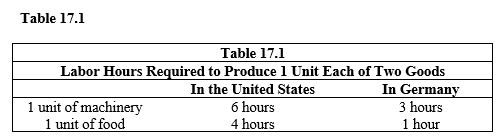
According to the data in Table 17.1, Germany has a comparative advantage in producing
A) machinery.
B) food.
C) both machinery and food.
D) neither machinery nor food.
E) Cannot be determined from the information provided.
Question
According to the data in Table 17.1, the United States has a comparative advantage in producing
A) machinery.
B) food.
C) both machinery and food.
D) neither machinery nor food.
E) Cannot be determined with the information provided.
Question
Question
Question
Scenario 17.1
The data in the table tell us that both the United States and Mexico produce wheat and beef. The United States can make 6 bushels of wheat or 1 pound of beef in a day. Mexico can make 2 bushels of wheat or 4 pounds of beef in a day.
In the table in Scenario 17.1, the United States has a comparative advantage in
A) neither wheat nor beef.
B) wheat only.
C) both wheat and beef.
D) beef only.
E) wheat and an absolute advantage in beef.
The data in the table tell us that both the United States and Mexico produce wheat and beef. The United States can make 6 bushels of wheat or 1 pound of beef in a day. Mexico can make 2 bushels of wheat or 4 pounds of beef in a day.
In the table in Scenario 17.1, the United States has a comparative advantage in
A) neither wheat nor beef.
B) wheat only.
C) both wheat and beef.
D) beef only.
E) wheat and an absolute advantage in beef.
Question
Refer to Table 17.1. In the United States, producing an additional unit of machinery would require shifting ____ hour(s) of labor from food production.
A) 1
B) 2
C) 4
D) 6
E) 10
Question
Refer to Table 17.1. Germany's opportunity cost of producing one unit of machinery is ____ unit(s) of food.
A) 1
B) 2
C) 3
D) 4
E) 5
Question
According to the data in Table 17.1, Germany has an absolute advantage in producing
A) machinery, but not food.
B) food, but not machinery.
C) both machinery and food.
D) neither machinery nor food.
E) Cannot be determined from the information provided.
Question
Question
Question
Question
According to the data in Table 17.1, the United States has an absolute advantage in producing
A) machinery, but not food.
B) food, but not machinery.
C) neither machinery nor food.
D) food and a comparative advantage in producing machinery.
E) both machinery and food.
Question
Question
Question
Question
Question
Scenario 17.1
The data in the table tell us that both the United States and Mexico produce wheat and beef. The United States can make 6 bushels of wheat or 1 pound of beef in a day. Mexico can make 2 bushels of wheat or 4 pounds of beef in a day.
In the table in Scenario 17.1, what is the opportunity cost of 1 bushel of wheat in Mexico?
A) 1 pound of beef
B) 1/2 pound of beef
C) 1/6 pound of beef
D) 2 pounds of beef
E) 6 pounds of beef
The data in the table tell us that both the United States and Mexico produce wheat and beef. The United States can make 6 bushels of wheat or 1 pound of beef in a day. Mexico can make 2 bushels of wheat or 4 pounds of beef in a day.
In the table in Scenario 17.1, what is the opportunity cost of 1 bushel of wheat in Mexico?
A) 1 pound of beef
B) 1/2 pound of beef
C) 1/6 pound of beef
D) 2 pounds of beef
E) 6 pounds of beef
Question
Question
Question
Question
Question
Question
Scenario 17.1
The data in the table tell us that both the United States and Mexico produce wheat and beef. The United States can make 6 bushels of wheat or 1 pound of beef in a day. Mexico can make 2 bushels of wheat or 4 pounds of beef in a day.
In the table in Scenario 17.1, what is the opportunity cost of 1 bushel of wheat in the United States?
A) 1/6 pound of beef
B) 1 pound of beef
C) 6 pounds of beef
D) 2 pounds of beef
E) None of these
The data in the table tell us that both the United States and Mexico produce wheat and beef. The United States can make 6 bushels of wheat or 1 pound of beef in a day. Mexico can make 2 bushels of wheat or 4 pounds of beef in a day.
In the table in Scenario 17.1, what is the opportunity cost of 1 bushel of wheat in the United States?
A) 1/6 pound of beef
B) 1 pound of beef
C) 6 pounds of beef
D) 2 pounds of beef
E) None of these
Question
Question
Question
Question
Question
Question
Question
Question
Question
Question
Question
Question
Question
Question
Question
Question
Question
Question
Question
Question
Question
Question
Question
Question
Question
Question
Question
Question
Question
Question
Question
Question
Question
Question
Question
Question
Question
Question
Question
Question
Question
Question
Question
Question
Question
Question
Question
Question
Question
Question

Unlock Deck
Sign up to unlock the cards in this deck!
Unlock Deck
Unlock Deck
1/126

Play

Full screen (f)
Deck 17: Issues in International Trade and Finance
1
Scenario 17.1
The data in the table tell us that both the United States and Mexico produce wheat and beef. The United States can make 6 bushels of wheat or 1 pound of beef in a day. Mexico can make 2 bushels of wheat or 4 pounds of beef in a day.
In the table in Scenario 17.1, the United States has an absolute advantage in
A) beef and an absolute disadvantage in wheat.
B) wheat only.
C) both wheat and beef.
D) neither wheat nor beef.
E) beef only.
The data in the table tell us that both the United States and Mexico produce wheat and beef. The United States can make 6 bushels of wheat or 1 pound of beef in a day. Mexico can make 2 bushels of wheat or 4 pounds of beef in a day.
In the table in Scenario 17.1, the United States has an absolute advantage in
A) beef and an absolute disadvantage in wheat.
B) wheat only.
C) both wheat and beef.
D) neither wheat nor beef.
E) beef only.
wheat only.
2
Scenario 17.1
The data in the table tell us that both the United States and Mexico produce wheat and beef. The United States can make 6 bushels of wheat or 1 pound of beef in a day. Mexico can make 2 bushels of wheat or 4 pounds of beef in a day.
In the table in Scenario 17.1, Mexico has an absolute advantage in
A) beef only.
B) neither wheat nor beef.
C) both wheat and beef.
D) wheat only.
E) wheat and an absolute disadvantage in beef.
The data in the table tell us that both the United States and Mexico produce wheat and beef. The United States can make 6 bushels of wheat or 1 pound of beef in a day. Mexico can make 2 bushels of wheat or 4 pounds of beef in a day.
In the table in Scenario 17.1, Mexico has an absolute advantage in
A) beef only.
B) neither wheat nor beef.
C) both wheat and beef.
D) wheat only.
E) wheat and an absolute disadvantage in beef.
beef only.
3
Scenario 17.1
The data in the table tell us that both the United States and Mexico produce wheat and beef. The United States can make 6 bushels of wheat or 1 pound of beef in a day. Mexico can make 2 bushels of wheat or 4 pounds of beef in a day.
In the table in Scenario 17.1, what is the opportunity cost of 1 pound of beef in the United States?
A) 1/2 bushel of wheat
B) 1/6 bushel of wheat
C) 2 bushels of wheat
D) 6 bushels of wheat
E) 1 bushel of wheat
The data in the table tell us that both the United States and Mexico produce wheat and beef. The United States can make 6 bushels of wheat or 1 pound of beef in a day. Mexico can make 2 bushels of wheat or 4 pounds of beef in a day.
In the table in Scenario 17.1, what is the opportunity cost of 1 pound of beef in the United States?
A) 1/2 bushel of wheat
B) 1/6 bushel of wheat
C) 2 bushels of wheat
D) 6 bushels of wheat
E) 1 bushel of wheat
6 bushels of wheat
4
For purposes of determining comparative advantage, the cost of producing a good in each of two countries is measured in terms of
A) metric units only.
B) opportunity costs.
C) total costs.
D) the currency of the importing country.
E) the currency of the exporting country.
A) metric units only.
B) opportunity costs.
C) total costs.
D) the currency of the importing country.
E) the currency of the exporting country.
Unlock Deck
Unlock for access to all 126 flashcards in this deck.
Unlock Deck
k this deck
5
Scenario 17.1
The data in the table tell us that both the United States and Mexico produce wheat and beef. The United States can make 6 bushels of wheat or 1 pound of beef in a day. Mexico can make 2 bushels of wheat or 4 pounds of beef in a day.
In the table in Scenario 17.1, Mexico has a comparative advantage in
A) beef only.
B) neither wheat nor beef.
C) both wheat and beef.
D) wheat only.
E) beef and an absolute advantage in wheat.
The data in the table tell us that both the United States and Mexico produce wheat and beef. The United States can make 6 bushels of wheat or 1 pound of beef in a day. Mexico can make 2 bushels of wheat or 4 pounds of beef in a day.
In the table in Scenario 17.1, Mexico has a comparative advantage in
A) beef only.
B) neither wheat nor beef.
C) both wheat and beef.
D) wheat only.
E) beef and an absolute advantage in wheat.
Unlock Deck
Unlock for access to all 126 flashcards in this deck.
Unlock Deck
k this deck
6
Scenario 17.1
The data in the table tell us that both the United States and Mexico produce wheat and beef. The United States can make 6 bushels of wheat or 1 pound of beef in a day. Mexico can make 2 bushels of wheat or 4 pounds of beef in a day.
In the table in Scenario 17.1, what is the opportunity cost of 1 pound of beef in Mexico?
A) 1/2 bushel of wheat
B) 6 bushels of wheat
C) 2 bushels of wheat
D) 1 bushel of wheat
The data in the table tell us that both the United States and Mexico produce wheat and beef. The United States can make 6 bushels of wheat or 1 pound of beef in a day. Mexico can make 2 bushels of wheat or 4 pounds of beef in a day.
In the table in Scenario 17.1, what is the opportunity cost of 1 pound of beef in Mexico?
A) 1/2 bushel of wheat
B) 6 bushels of wheat
C) 2 bushels of wheat
D) 1 bushel of wheat
Unlock Deck
Unlock for access to all 126 flashcards in this deck.
Unlock Deck
k this deck
7
Trade occurs because it
A) keeps transportation companies, such as airlines and railroads, economically viable.
B) reflects individual consumers' dollar votes in favor of imported rather than domestic goods and services.
C) meets foreign policy goals for governments.
D) justifies the many "trade missions" politicians in most countries take, which are really foreign vacations at their governments' expense.
E) makes people better off.
A) keeps transportation companies, such as airlines and railroads, economically viable.
B) reflects individual consumers' dollar votes in favor of imported rather than domestic goods and services.
C) meets foreign policy goals for governments.
D) justifies the many "trade missions" politicians in most countries take, which are really foreign vacations at their governments' expense.
E) makes people better off.
Unlock Deck
Unlock for access to all 126 flashcards in this deck.
Unlock Deck
k this deck
8
According to the data in Table 17.1, Germany has a comparative advantage in producing
A) machinery.
B) food.
C) both machinery and food.
D) neither machinery nor food.
E) Cannot be determined from the information provided.
Unlock Deck
Unlock for access to all 126 flashcards in this deck.
Unlock Deck
k this deck
9
According to the data in Table 17.1, the United States has a comparative advantage in producing
A) machinery.
B) food.
C) both machinery and food.
D) neither machinery nor food.
E) Cannot be determined with the information provided.
Unlock Deck
Unlock for access to all 126 flashcards in this deck.
Unlock Deck
k this deck
10
Comparative advantage is based on the
A) "gains from trade" concept.
B) idea of economic superiority.
C) absolute opportunity costs of producing goods in different countries.
D) relative opportunity costs of producing any good in one country.
E) relative opportunity costs of producing goods in different countries.
A) "gains from trade" concept.
B) idea of economic superiority.
C) absolute opportunity costs of producing goods in different countries.
D) relative opportunity costs of producing any good in one country.
E) relative opportunity costs of producing goods in different countries.
Unlock Deck
Unlock for access to all 126 flashcards in this deck.
Unlock Deck
k this deck
11
Comparative advantage is found by comparing the
A) relative costs of production in each country.
B) absolute costs of production in each country.
C) labor hours used to produce a standardized product in each country.
D) level of interest rates in each country.
E) transportation and shipping capabilities of each country.
A) relative costs of production in each country.
B) absolute costs of production in each country.
C) labor hours used to produce a standardized product in each country.
D) level of interest rates in each country.
E) transportation and shipping capabilities of each country.
Unlock Deck
Unlock for access to all 126 flashcards in this deck.
Unlock Deck
k this deck
12
Scenario 17.1
The data in the table tell us that both the United States and Mexico produce wheat and beef. The United States can make 6 bushels of wheat or 1 pound of beef in a day. Mexico can make 2 bushels of wheat or 4 pounds of beef in a day.
In the table in Scenario 17.1, the United States has a comparative advantage in
A) neither wheat nor beef.
B) wheat only.
C) both wheat and beef.
D) beef only.
E) wheat and an absolute advantage in beef.
The data in the table tell us that both the United States and Mexico produce wheat and beef. The United States can make 6 bushels of wheat or 1 pound of beef in a day. Mexico can make 2 bushels of wheat or 4 pounds of beef in a day.
In the table in Scenario 17.1, the United States has a comparative advantage in
A) neither wheat nor beef.
B) wheat only.
C) both wheat and beef.
D) beef only.
E) wheat and an absolute advantage in beef.
Unlock Deck
Unlock for access to all 126 flashcards in this deck.
Unlock Deck
k this deck
13
Refer to Table 17.1. In the United States, producing an additional unit of machinery would require shifting ____ hour(s) of labor from food production.
A) 1
B) 2
C) 4
D) 6
E) 10
Unlock Deck
Unlock for access to all 126 flashcards in this deck.
Unlock Deck
k this deck
14
Refer to Table 17.1. Germany's opportunity cost of producing one unit of machinery is ____ unit(s) of food.
A) 1
B) 2
C) 3
D) 4
E) 5
Unlock Deck
Unlock for access to all 126 flashcards in this deck.
Unlock Deck
k this deck
15
According to the data in Table 17.1, Germany has an absolute advantage in producing
A) machinery, but not food.
B) food, but not machinery.
C) both machinery and food.
D) neither machinery nor food.
E) Cannot be determined from the information provided.
Unlock Deck
Unlock for access to all 126 flashcards in this deck.
Unlock Deck
k this deck
16
A country has a comparative advantage when the opportunity cost of producing a good in terms of the
A) monetary value of other forgone goods is lower than that of other countries.
B) monetary value of other forgone goods is greater than that of other countries.
C) forgone output of other goods is higher than that of other countries.
D) forgone output of other goods is lower than that of other countries.
E) forgone output of other goods is equal to that of other countries.
A) monetary value of other forgone goods is lower than that of other countries.
B) monetary value of other forgone goods is greater than that of other countries.
C) forgone output of other goods is higher than that of other countries.
D) forgone output of other goods is lower than that of other countries.
E) forgone output of other goods is equal to that of other countries.
Unlock Deck
Unlock for access to all 126 flashcards in this deck.
Unlock Deck
k this deck
17
A country has an absolute advantage when it can produce a good ____ than other countries can.
A) at a greater monetary cost
B) at a lower monetary cost
C) with fewer hours of labor
D) at a greater input cost
E) at a lower input cost
A) at a greater monetary cost
B) at a lower monetary cost
C) with fewer hours of labor
D) at a greater input cost
E) at a lower input cost
Unlock Deck
Unlock for access to all 126 flashcards in this deck.
Unlock Deck
k this deck
18
If firms in the United States can produce both airplanes and corn with a lower input cost of production compared to firms in Russia, the United States has
A) an absolute advantage.
B) a selective strategy.
C) a decreasing returns-to-scale industry.
D) an intraindustry advantage.
E) a comparative advantage.
A) an absolute advantage.
B) a selective strategy.
C) a decreasing returns-to-scale industry.
D) an intraindustry advantage.
E) a comparative advantage.
Unlock Deck
Unlock for access to all 126 flashcards in this deck.
Unlock Deck
k this deck
19
According to the data in Table 17.1, the United States has an absolute advantage in producing
A) machinery, but not food.
B) food, but not machinery.
C) neither machinery nor food.
D) food and a comparative advantage in producing machinery.
E) both machinery and food.
Unlock Deck
Unlock for access to all 126 flashcards in this deck.
Unlock Deck
k this deck
20
Comparative advantage is an advantage derived from
A) a country's potential military superiority over another.
B) diplomatic initiatives, not economic theory.
C) a lower absolute input cost of producing a particular good than that of another country.
D) comparing the opportunity costs of production in two countries.
E) a country that exports more than it imports.
A) a country's potential military superiority over another.
B) diplomatic initiatives, not economic theory.
C) a lower absolute input cost of producing a particular good than that of another country.
D) comparing the opportunity costs of production in two countries.
E) a country that exports more than it imports.
Unlock Deck
Unlock for access to all 126 flashcards in this deck.
Unlock Deck
k this deck
21
The Ricardian model of international trade is named after the nineteenth-century English economist who first explained and analyzed the idea of productivity-based comparative advantage. The name of this economist was
A) Ricardo Friedman.
B) Ricardo Marx.
C) Ricardo Maynard Keynes.
D) Ricky Ricardo.
E) David Ricardo.
A) Ricardo Friedman.
B) Ricardo Marx.
C) Ricardo Maynard Keynes.
D) Ricky Ricardo.
E) David Ricardo.
Unlock Deck
Unlock for access to all 126 flashcards in this deck.
Unlock Deck
k this deck
22
Comparative advantage due to productivity differences between countries is known as the
A) factor abundance model of comparative advantage.
B) human skills model of comparative advantage.
C) Adam Smith model of comparative advantage.
D) Ricardian model of comparative advantage.
E) Obama model of comparative advantage.
A) factor abundance model of comparative advantage.
B) human skills model of comparative advantage.
C) Adam Smith model of comparative advantage.
D) Ricardian model of comparative advantage.
E) Obama model of comparative advantage.
Unlock Deck
Unlock for access to all 126 flashcards in this deck.
Unlock Deck
k this deck
23
Workers in industrial countries earn much higher wages than workers in developing countries because of the
A) differing political regimes in developing countries.
B) differing social norms in developing countries.
C) progressive tax structure in developing countries.
D) lower productivity of labor in industrial countries.
E) higher productivity of labor in industrial countries.
A) differing political regimes in developing countries.
B) differing social norms in developing countries.
C) progressive tax structure in developing countries.
D) lower productivity of labor in industrial countries.
E) higher productivity of labor in industrial countries.
Unlock Deck
Unlock for access to all 126 flashcards in this deck.
Unlock Deck
k this deck
24
Scenario 17.1
The data in the table tell us that both the United States and Mexico produce wheat and beef. The United States can make 6 bushels of wheat or 1 pound of beef in a day. Mexico can make 2 bushels of wheat or 4 pounds of beef in a day.
In the table in Scenario 17.1, what is the opportunity cost of 1 bushel of wheat in Mexico?
A) 1 pound of beef
B) 1/2 pound of beef
C) 1/6 pound of beef
D) 2 pounds of beef
E) 6 pounds of beef
The data in the table tell us that both the United States and Mexico produce wheat and beef. The United States can make 6 bushels of wheat or 1 pound of beef in a day. Mexico can make 2 bushels of wheat or 4 pounds of beef in a day.
In the table in Scenario 17.1, what is the opportunity cost of 1 bushel of wheat in Mexico?
A) 1 pound of beef
B) 1/2 pound of beef
C) 1/6 pound of beef
D) 2 pounds of beef
E) 6 pounds of beef
Unlock Deck
Unlock for access to all 126 flashcards in this deck.
Unlock Deck
k this deck
25
We benefit from trade if we can obtain a good from a foreign country by
A) military force.
B) giving up less than we would have to give up to obtain the good at home.
C) giving up more than we would have to give up to obtain the good at home.
D) diplomatic initiatives.
E) eliminating domestic surpluses of other goods.
A) military force.
B) giving up less than we would have to give up to obtain the good at home.
C) giving up more than we would have to give up to obtain the good at home.
D) diplomatic initiatives.
E) eliminating domestic surpluses of other goods.
Unlock Deck
Unlock for access to all 126 flashcards in this deck.
Unlock Deck
k this deck
26
The standard interpretation of the Ricardian model is that differences in labor productivity among countries are due to
A) different quantities of labor.
B) the amount of skilled labor a country possesses.
C) geographic location.
D) technological differences.
E) different quantities of capital.
A) different quantities of labor.
B) the amount of skilled labor a country possesses.
C) geographic location.
D) technological differences.
E) different quantities of capital.
Unlock Deck
Unlock for access to all 126 flashcards in this deck.
Unlock Deck
k this deck
27
The comparative advantage in production of a specific good can shift over time from one country to another because
A) goods experience a product life cycle.
B) skilled labor tends to "follow the market."
C) resources, especially natural resources, are eventually used up; therefore, production must shift.
D) capital stocks depreciate, thus shifting production to countries with more modern plants and equipment.
E) of changing international trade agreements.
A) goods experience a product life cycle.
B) skilled labor tends to "follow the market."
C) resources, especially natural resources, are eventually used up; therefore, production must shift.
D) capital stocks depreciate, thus shifting production to countries with more modern plants and equipment.
E) of changing international trade agreements.
Unlock Deck
Unlock for access to all 126 flashcards in this deck.
Unlock Deck
k this deck
28
Countries export goods in which they have
A) a tremendous surplus.
B) a comparative advantage.
C) an absolute advantage.
D) national pride.
E) a comparative disadvantage.
A) a tremendous surplus.
B) a comparative advantage.
C) an absolute advantage.
D) national pride.
E) a comparative disadvantage.
Unlock Deck
Unlock for access to all 126 flashcards in this deck.
Unlock Deck
k this deck
29
In recent years, Chinese manufacturers have duplicated or acquired manufacturing technology that meets global standards. Combined with very low-cost labor, these Chinese manufacturers
A) utilized subsidies to create a value quota.
B) have an absolute advantage over international competitors.
C) have created a decreasing returns-to-scale industry.
D) used increasing returns-to-scale to offset tariff restrictions.
E) simulated an intraindustry advantage.
A) utilized subsidies to create a value quota.
B) have an absolute advantage over international competitors.
C) have created a decreasing returns-to-scale industry.
D) used increasing returns-to-scale to offset tariff restrictions.
E) simulated an intraindustry advantage.
Unlock Deck
Unlock for access to all 126 flashcards in this deck.
Unlock Deck
k this deck
30
Scenario 17.1
The data in the table tell us that both the United States and Mexico produce wheat and beef. The United States can make 6 bushels of wheat or 1 pound of beef in a day. Mexico can make 2 bushels of wheat or 4 pounds of beef in a day.
In the table in Scenario 17.1, what is the opportunity cost of 1 bushel of wheat in the United States?
A) 1/6 pound of beef
B) 1 pound of beef
C) 6 pounds of beef
D) 2 pounds of beef
E) None of these
The data in the table tell us that both the United States and Mexico produce wheat and beef. The United States can make 6 bushels of wheat or 1 pound of beef in a day. Mexico can make 2 bushels of wheat or 4 pounds of beef in a day.
In the table in Scenario 17.1, what is the opportunity cost of 1 bushel of wheat in the United States?
A) 1/6 pound of beef
B) 1 pound of beef
C) 6 pounds of beef
D) 2 pounds of beef
E) None of these
Unlock Deck
Unlock for access to all 126 flashcards in this deck.
Unlock Deck
k this deck
31
With regard to those goods that can be produced most efficiently with modern technology, the countries with a comparative advantage will be those with the
A) largest stock of natural resources.
B) most favorable trade policies.
C) largest labor force.
D) most advanced technology.
E) strictest adherence to "tried and true" manufacturing processes.
A) largest stock of natural resources.
B) most favorable trade policies.
C) largest labor force.
D) most advanced technology.
E) strictest adherence to "tried and true" manufacturing processes.
Unlock Deck
Unlock for access to all 126 flashcards in this deck.
Unlock Deck
k this deck
32
Which of the following concepts is irrelevant in making international trade decisions?
A) Absolute advantage
B) Comparative advantage
C) Relative opportunity cost
D) Domestic surpluses and shortages
E) Opportunity costs
A) Absolute advantage
B) Comparative advantage
C) Relative opportunity cost
D) Domestic surpluses and shortages
E) Opportunity costs
Unlock Deck
Unlock for access to all 126 flashcards in this deck.
Unlock Deck
k this deck
33
The basic idea behind the human skills theory of comparative advantage is that countries with a relatively abundant stock of highly skilled labor have
A) high wages and thus suffer a comparative disadvantage.
B) low wages and thus suffer a comparative disadvantage.
C) an absolute advantage in producing goods that require relatively large amounts of skilled labor.
D) a comparative advantage in producing goods that require relatively large amounts of skilled labor.
E) so much productivity relative to other countries that they have a comparative advantage in everything they produce.
A) high wages and thus suffer a comparative disadvantage.
B) low wages and thus suffer a comparative disadvantage.
C) an absolute advantage in producing goods that require relatively large amounts of skilled labor.
D) a comparative advantage in producing goods that require relatively large amounts of skilled labor.
E) so much productivity relative to other countries that they have a comparative advantage in everything they produce.
Unlock Deck
Unlock for access to all 126 flashcards in this deck.
Unlock Deck
k this deck
34
According to the factor abundance theory of comparative advantage, if a country has a long coastline relative to its area, it has a(n)
A) comparative advantage in producing maritime products such as fish.
B) comparative disadvantage in providing ocean-related tourist services.
C) comparative advantage in producing timber and other land-based natural resources.
D) absolute advantage in providing skilled seafarers to other maritime countries.
E) vested interest in maintaining free and open access to trade routes, especially those routes that end or begin in the country.
A) comparative advantage in producing maritime products such as fish.
B) comparative disadvantage in providing ocean-related tourist services.
C) comparative advantage in producing timber and other land-based natural resources.
D) absolute advantage in providing skilled seafarers to other maritime countries.
E) vested interest in maintaining free and open access to trade routes, especially those routes that end or begin in the country.
Unlock Deck
Unlock for access to all 126 flashcards in this deck.
Unlock Deck
k this deck
35
According to the factor abundance theory of comparative advantage, countries have a comparative advantage in producing those goods that
A) use relatively large amounts of their least abundant factor of production.
B) use relatively large amounts of their most abundant factor of production.
C) use proportionately equal amounts of each factor of production.
D) are in the shortest relative supply.
E) are in the greatest demand.
A) use relatively large amounts of their least abundant factor of production.
B) use relatively large amounts of their most abundant factor of production.
C) use proportionately equal amounts of each factor of production.
D) are in the shortest relative supply.
E) are in the greatest demand.
Unlock Deck
Unlock for access to all 126 flashcards in this deck.
Unlock Deck
k this deck
36
Which of the following statements is false?
A) All nations are interdependent.
B) An understanding of international trade and finance is critical to understanding the domestic economy.
C) When countries trade, everyone gains.
D) Technological differences between countries account for differences in labor productivity.
E) Trade results in countries becoming more dependent on each other.
A) All nations are interdependent.
B) An understanding of international trade and finance is critical to understanding the domestic economy.
C) When countries trade, everyone gains.
D) Technological differences between countries account for differences in labor productivity.
E) Trade results in countries becoming more dependent on each other.
Unlock Deck
Unlock for access to all 126 flashcards in this deck.
Unlock Deck
k this deck
37
According to the Ricardian model, differences in labor productivity are due to
A) relative shortages of natural resources, such as oil.
B) discrimination in the hiring and training of labor.
C) technological differences among countries.
D) shortages of capital stock, which is reflected in a low capital-to-labor ratio.
E) inefficient and unproductive trade union rules.
A) relative shortages of natural resources, such as oil.
B) discrimination in the hiring and training of labor.
C) technological differences among countries.
D) shortages of capital stock, which is reflected in a low capital-to-labor ratio.
E) inefficient and unproductive trade union rules.
Unlock Deck
Unlock for access to all 126 flashcards in this deck.
Unlock Deck
k this deck
38
Which of the following emphasizes that production differences among countries are due to the availability of skilled and unskilled labor?
A) The Ricardian model
B) Preferences
C) The product life cycle theory
D) The factor abundance theory
E) The human skills approach
A) The Ricardian model
B) Preferences
C) The product life cycle theory
D) The factor abundance theory
E) The human skills approach
Unlock Deck
Unlock for access to all 126 flashcards in this deck.
Unlock Deck
k this deck
39
According to the human skills theory of comparative advantage, developing countries would be expected to have a(n)
A) absolute advantage in industries requiring a large amount of unskilled labor.
B) absolute advantage in industries requiring a large amount of skilled labor.
C) comparative advantage in industries requiring a large amount of natural resources.
D) comparative advantage in industries requiring minimal use of entrepreneurial or managerial talent.
E) comparative advantage in industries requiring a relatively large amount of unskilled labor.
A) absolute advantage in industries requiring a large amount of unskilled labor.
B) absolute advantage in industries requiring a large amount of skilled labor.
C) comparative advantage in industries requiring a large amount of natural resources.
D) comparative advantage in industries requiring minimal use of entrepreneurial or managerial talent.
E) comparative advantage in industries requiring a relatively large amount of unskilled labor.
Unlock Deck
Unlock for access to all 126 flashcards in this deck.
Unlock Deck
k this deck
40
The oldest theory on the source of comparative advantage is based on
A) factor abundance.
B) productivity differences.
C) product life cycles.
D) preferences.
E) human skills.
A) factor abundance.
B) productivity differences.
C) product life cycles.
D) preferences.
E) human skills.
Unlock Deck
Unlock for access to all 126 flashcards in this deck.
Unlock Deck
k this deck
41
Developing countries often justify tariffs as an important source of
A) government revenue.
B) national pride and identity.
C) protection for domestic industries.
D) information regarding their foreign trade.
E) additional bureaucratic jobs to administer the tariffs.
A) government revenue.
B) national pride and identity.
C) protection for domestic industries.
D) information regarding their foreign trade.
E) additional bureaucratic jobs to administer the tariffs.
Unlock Deck
Unlock for access to all 126 flashcards in this deck.
Unlock Deck
k this deck
42
International trade on the basis of comparative advantage maximizes
A) domestic output and allows consumers access to better-quality products at lower prices than would be available in the domestic market alone.
B) foreign output and allows consumers access to better-quality products at lower prices than would be available in the domestic market alone.
C) world output and allows consumers access to better-quality products at lower prices than would be available in the domestic market alone.
D) world output, but gives consumers access to lower-quality products at higher prices than would be available in the domestic market alone.
E) foreign output and product quality in all markets.
A) domestic output and allows consumers access to better-quality products at lower prices than would be available in the domestic market alone.
B) foreign output and allows consumers access to better-quality products at lower prices than would be available in the domestic market alone.
C) world output and allows consumers access to better-quality products at lower prices than would be available in the domestic market alone.
D) world output, but gives consumers access to lower-quality products at higher prices than would be available in the domestic market alone.
E) foreign output and product quality in all markets.
Unlock Deck
Unlock for access to all 126 flashcards in this deck.
Unlock Deck
k this deck
43
Industries that are truly critical to national defense should be protected from foreign competition if
A) the cost of procuring such defense items would otherwise rise.
B) adequate trade agreements with friendly countries cannot be implemented.
C) the military-industrial complex is to thrive.
D) the country's stock of vital human capital would suffer without these defense industries.
E) that is the only way to ensure their existence.
A) the cost of procuring such defense items would otherwise rise.
B) adequate trade agreements with friendly countries cannot be implemented.
C) the military-industrial complex is to thrive.
D) the country's stock of vital human capital would suffer without these defense industries.
E) that is the only way to ensure their existence.
Unlock Deck
Unlock for access to all 126 flashcards in this deck.
Unlock Deck
k this deck
44
Which of the following is the most valid argument for restricting international trade?
A) Government revenue will be reduced.
B) Consumers will benefit at the expense of domestic producers.
C) More jobs can be created abroad in developing countries.
D) Key defense-related industries need to be protected.
E) Protection ensures a level playing field.
A) Government revenue will be reduced.
B) Consumers will benefit at the expense of domestic producers.
C) More jobs can be created abroad in developing countries.
D) Key defense-related industries need to be protected.
E) Protection ensures a level playing field.
Unlock Deck
Unlock for access to all 126 flashcards in this deck.
Unlock Deck
k this deck
45
It is often argued that if foreign goods are kept out of the domestic economy,
A) jobs will be lost at home.
B) jobs will be created abroad.
C) foreign consumers will enjoy product surpluses.
D) jobs will be created at home.
E) foreign consumers will suffer product shortages.
A) jobs will be lost at home.
B) jobs will be created abroad.
C) foreign consumers will enjoy product surpluses.
D) jobs will be created at home.
E) foreign consumers will suffer product shortages.
Unlock Deck
Unlock for access to all 126 flashcards in this deck.
Unlock Deck
k this deck
46
Tariffs are a popular tax in developing countries because of the
A) long history of foreign trade in such countries.
B) incidence of the tax, which is paid by exporters but rests on importers.
C) observability of trade flows.
D) strong political message such tariffs send.
E) job creation that ensues because customs agents and inspectors are hired to collect the tariff.
A) long history of foreign trade in such countries.
B) incidence of the tax, which is paid by exporters but rests on importers.
C) observability of trade flows.
D) strong political message such tariffs send.
E) job creation that ensues because customs agents and inspectors are hired to collect the tariff.
Unlock Deck
Unlock for access to all 126 flashcards in this deck.
Unlock Deck
k this deck
47
The product life cycle theory of comparative advantage predicts that a new product will be first produced and exported by the
A) country that first demanded the new product.
B) first firm to successfully copy the technology.
C) country in which it was invented.
D) countries with the most stable economies and fewest restrictions on foreign trade.
E) company with the most extensive network of international distributors for the product.
A) country that first demanded the new product.
B) first firm to successfully copy the technology.
C) country in which it was invented.
D) countries with the most stable economies and fewest restrictions on foreign trade.
E) company with the most extensive network of international distributors for the product.
Unlock Deck
Unlock for access to all 126 flashcards in this deck.
Unlock Deck
k this deck
48
People who call for the creation of a "level playing field" believe that
A) all workers worldwide should receive the same pay for the same work.
B) product quality should be standardized worldwide.
C) the price paid for any good or service should be the same worldwide when adjusted for currency fluctuations.
D) the domestic government should take steps to offset the perceived advantage of the foreign firm.
E) an official agency such as the World Trade Organization should standardize the quality and price of all products worldwide.
A) all workers worldwide should receive the same pay for the same work.
B) product quality should be standardized worldwide.
C) the price paid for any good or service should be the same worldwide when adjusted for currency fluctuations.
D) the domestic government should take steps to offset the perceived advantage of the foreign firm.
E) an official agency such as the World Trade Organization should standardize the quality and price of all products worldwide.
Unlock Deck
Unlock for access to all 126 flashcards in this deck.
Unlock Deck
k this deck
49
The notion of reciprocity means that country A imposes import restrictions on country B's products to
A) stimulate an increase in trade restrictions in country B.
B) stimulate a reduction of trade restrictions in country B.
C) eliminate trade restrictions immediately in both countries.
D) enhance government A's revenue through tariffs.
E) enforce standards of product quality.
A) stimulate an increase in trade restrictions in country B.
B) stimulate a reduction of trade restrictions in country B.
C) eliminate trade restrictions immediately in both countries.
D) enhance government A's revenue through tariffs.
E) enforce standards of product quality.
Unlock Deck
Unlock for access to all 126 flashcards in this deck.
Unlock Deck
k this deck
50
Governments often find that political pressures favor policies that
A) enhance existing comparative advantages.
B) partially offset existing comparative advantages.
C) complement existing comparative advantages.
D) eliminate existing comparative advantages.
E) create new absolute advantages.
A) enhance existing comparative advantages.
B) partially offset existing comparative advantages.
C) complement existing comparative advantages.
D) eliminate existing comparative advantages.
E) create new absolute advantages.
Unlock Deck
Unlock for access to all 126 flashcards in this deck.
Unlock Deck
k this deck
51
The preferences theory of comparative advantage is based on the concept of
A) product standardization and mass marketing.
B) intraindustry competition.
C) product differentiation.
D) international advertising and product positioning.
E) altering supply to meet changing demand conditions.
A) product standardization and mass marketing.
B) intraindustry competition.
C) product differentiation.
D) international advertising and product positioning.
E) altering supply to meet changing demand conditions.
Unlock Deck
Unlock for access to all 126 flashcards in this deck.
Unlock Deck
k this deck
52
Which of the following statements about international trade restrictions is true?
A) They ensure that only efficient producers survive.
B) They ensure that countries specialize in those products that they can produce most efficiently.
C) In the majority of cases, they harm consumers.
D) They typically benefit foreign producers at the expense of domestic consumers.
E) They ensure that higher-quality goods are provided at lower prices.
A) They ensure that only efficient producers survive.
B) They ensure that countries specialize in those products that they can produce most efficiently.
C) In the majority of cases, they harm consumers.
D) They typically benefit foreign producers at the expense of domestic consumers.
E) They ensure that higher-quality goods are provided at lower prices.
Unlock Deck
Unlock for access to all 126 flashcards in this deck.
Unlock Deck
k this deck
53
The "creation of domestic jobs" argument for protection holds that domestic firms will produce the goods that otherwise would have been produced abroad, thus
A) increasing the opportunity cost of producing the good abroad.
B) decreasing the opportunity cost of producing the good abroad.
C) employing domestic workers instead of foreign workers.
D) employing foreign workers instead of domestic workers.
E) achieving full employment in domestic industries.
A) increasing the opportunity cost of producing the good abroad.
B) decreasing the opportunity cost of producing the good abroad.
C) employing domestic workers instead of foreign workers.
D) employing foreign workers instead of domestic workers.
E) achieving full employment in domestic industries.
Unlock Deck
Unlock for access to all 126 flashcards in this deck.
Unlock Deck
k this deck
54
Which of the following looks at the demand side of the market to explain some of the patterns observed in international trade?
A) Preferences
B) The factor abundance theory
C) The product life cycle theory
D) The Ricardian model
E) The human skills approach
A) Preferences
B) The factor abundance theory
C) The product life cycle theory
D) The Ricardian model
E) The human skills approach
Unlock Deck
Unlock for access to all 126 flashcards in this deck.
Unlock Deck
k this deck
55
The protection of domestic workers from the competition of low-wage foreign workers is an argument put forward by
A) those who favor protection for an infant industry.
B) those who favor protection of national defense industries.
C) people who support free trade.
D) advocates of the "level playing field" trade policy.
E) those who support a strategic trade policy.
A) those who favor protection for an infant industry.
B) those who favor protection of national defense industries.
C) people who support free trade.
D) advocates of the "level playing field" trade policy.
E) those who support a strategic trade policy.
Unlock Deck
Unlock for access to all 126 flashcards in this deck.
Unlock Deck
k this deck
56
Which of the following may be an explanation for intraindustry trade?
A) The product life cycle theory
B) Preferences
C) The factor abundance theory
D) The Ricardian model
E) The human skills approach
A) The product life cycle theory
B) Preferences
C) The factor abundance theory
D) The Ricardian model
E) The human skills approach
Unlock Deck
Unlock for access to all 126 flashcards in this deck.
Unlock Deck
k this deck
57
Generally speaking, protection from foreign competition benefits
A) both domestic producers and foreign producers.
B) both domestic consumers and foreign consumers.
C) domestic producers and foreign consumers.
D) neither domestic producers nor foreign producers.
E) domestic producers at the expense of domestic consumers.
A) both domestic producers and foreign producers.
B) both domestic consumers and foreign consumers.
C) domestic producers and foreign consumers.
D) neither domestic producers nor foreign producers.
E) domestic producers at the expense of domestic consumers.
Unlock Deck
Unlock for access to all 126 flashcards in this deck.
Unlock Deck
k this deck
58
Governments restrict foreign trade to
A) influence international events, such as superpower summit meetings.
B) protect foreign producers from domestic competition.
C) ease burdens on the economy caused by excessive aggregate demand.
D) improve their balance of payments.
E) protect domestic producers from foreign competition.
A) influence international events, such as superpower summit meetings.
B) protect foreign producers from domestic competition.
C) ease burdens on the economy caused by excessive aggregate demand.
D) improve their balance of payments.
E) protect domestic producers from foreign competition.
Unlock Deck
Unlock for access to all 126 flashcards in this deck.
Unlock Deck
k this deck
59
Realistically, international trade is
A) rarely determined solely by comparative advantage and the free market forces of supply and demand.
B) determined solely by the theories of comparative advantage.
C) determined solely by the free market forces of supply and demand.
D) determined by the influence of exchange rates on the balance of payments.
E) determined by foreign trade ministers' negotiations.
A) rarely determined solely by comparative advantage and the free market forces of supply and demand.
B) determined solely by the theories of comparative advantage.
C) determined solely by the free market forces of supply and demand.
D) determined by the influence of exchange rates on the balance of payments.
E) determined by foreign trade ministers' negotiations.
Unlock Deck
Unlock for access to all 126 flashcards in this deck.
Unlock Deck
k this deck
60
Government policy aimed at influencing international trade flows is called
A) most-favored-nation status policy.
B) trade embargoes.
C) commercial policy.
D) monetary policy.
E) fiscal policy
A) most-favored-nation status policy.
B) trade embargoes.
C) commercial policy.
D) monetary policy.
E) fiscal policy
Unlock Deck
Unlock for access to all 126 flashcards in this deck.
Unlock Deck
k this deck
61
The United States does not employ export tariffs because
A) the GATT prohibits them.
B) of producer pressures.
C) the U.S. Constitution prohibits them.
D) of consumer pressures.
E) the Smoot-Hawley Tariff Act prohibits them.
A) the GATT prohibits them.
B) of producer pressures.
C) the U.S. Constitution prohibits them.
D) of consumer pressures.
E) the Smoot-Hawley Tariff Act prohibits them.
Unlock Deck
Unlock for access to all 126 flashcards in this deck.
Unlock Deck
k this deck
62
Strategic trade policy is aimed at offsetting the
A) marketing advantage enjoyed by foreign producers.
B) legal advantages enjoyed by foreign producers.
C) decreasing-cost advantage enjoyed by foreign producers.
D) effects of reciprocal trade agreements.
E) tax advantages enjoyed by foreign producers.
A) marketing advantage enjoyed by foreign producers.
B) legal advantages enjoyed by foreign producers.
C) decreasing-cost advantage enjoyed by foreign producers.
D) effects of reciprocal trade agreements.
E) tax advantages enjoyed by foreign producers.
Unlock Deck
Unlock for access to all 126 flashcards in this deck.
Unlock Deck
k this deck
63
Protection of a new industry until it becomes strong enough to compete with foreign producers is based on the argument of
A) national defense.
B) government revenue creation.
C) reciprocity.
D) infant industries.
E) creation of a "level playing field."
A) national defense.
B) government revenue creation.
C) reciprocity.
D) infant industries.
E) creation of a "level playing field."
Unlock Deck
Unlock for access to all 126 flashcards in this deck.
Unlock Deck
k this deck
64
In 1995, a formal permanent international organization to oversee world trade, the ____, was created.
A) General Agreement on Tariffs and Trade (GATT)
B) U.S. Export-Import Bank
C) International Monetary Fund (IMF)
D) World Trade Organization (WTO)
E) World Bank (WB)
A) General Agreement on Tariffs and Trade (GATT)
B) U.S. Export-Import Bank
C) International Monetary Fund (IMF)
D) World Trade Organization (WTO)
E) World Bank (WB)
Unlock Deck
Unlock for access to all 126 flashcards in this deck.
Unlock Deck
k this deck
65
A decreasing-cost industry is an industry in which the costs of producing
A) total output fall as more output is produced.
B) total output rise as more output is produced.
C) a unit of output rise as more output is produced.
D) for export markets decrease as imports offset shipping costs.
E) a unit of output falls as more output is produced.
A) total output fall as more output is produced.
B) total output rise as more output is produced.
C) a unit of output rise as more output is produced.
D) for export markets decrease as imports offset shipping costs.
E) a unit of output falls as more output is produced.
Unlock Deck
Unlock for access to all 126 flashcards in this deck.
Unlock Deck
k this deck
66
Using government tariffs or subsidies to give an advantage to domestic firms in a decreasing-cost industry over foreign rivals is associated with those who
A) believe in free trade.
B) favor protection for infant industries.
C) want to create a "level playing field."
D) support a strategic trade policy.
E) favor protection of national defense industries.
A) believe in free trade.
B) favor protection for infant industries.
C) want to create a "level playing field."
D) support a strategic trade policy.
E) favor protection of national defense industries.
Unlock Deck
Unlock for access to all 126 flashcards in this deck.
Unlock Deck
k this deck
67
If the world price of a good is lower than its domestic equilibrium price, the country
A) imports a quantity of the good equal to the difference between the quantity demanded domestically and the quantity supplied domestically.
B) exports a quantity of the good equal to the difference between the quantity demanded domestically and the quantity supplied domestically.
C) imports a quantity of the good equal to the difference between the quantity demanded domestically and the quantity supplied by foreign producers.
D) imports a quantity of the good equal to the difference between the quantity demanded by foreign consumers and the quantity supplied domestically.
E) imports a quantity of the good equal to the difference between the quantity demanded by foreign consumers and the quantity supplied by foreign producers.
A) imports a quantity of the good equal to the difference between the quantity demanded domestically and the quantity supplied domestically.
B) exports a quantity of the good equal to the difference between the quantity demanded domestically and the quantity supplied domestically.
C) imports a quantity of the good equal to the difference between the quantity demanded domestically and the quantity supplied by foreign producers.
D) imports a quantity of the good equal to the difference between the quantity demanded by foreign consumers and the quantity supplied domestically.
E) imports a quantity of the good equal to the difference between the quantity demanded by foreign consumers and the quantity supplied by foreign producers.
Unlock Deck
Unlock for access to all 126 flashcards in this deck.
Unlock Deck
k this deck
68
Subsidies mean that infant industry firms can charge
A) higher prices while competing with foreign producers.
B) higher prices than foreign producers are able to receive.
C) a price equal to the world price and still earn a profit.
D) a price equal to marginal revenue.
E) the tariff to other customers of the foreign firm.
A) higher prices while competing with foreign producers.
B) higher prices than foreign producers are able to receive.
C) a price equal to the world price and still earn a profit.
D) a price equal to marginal revenue.
E) the tariff to other customers of the foreign firm.
Unlock Deck
Unlock for access to all 126 flashcards in this deck.
Unlock Deck
k this deck
69
A tariff is a tax on
A) imports only.
B) exports only.
C) domestically produced items only.
D) imports or exports.
E) shipping containers.
A) imports only.
B) exports only.
C) domestically produced items only.
D) imports or exports.
E) shipping containers.
Unlock Deck
Unlock for access to all 126 flashcards in this deck.
Unlock Deck
k this deck
70
Decreasing-cost industries tend to
A) stimulate competition in the domestic market.
B) stimulate competition in the foreign market.
C) employ large work forces in the domestic market.
D) concentrate production in the hands of a few very large firms.
E) spread production across many competitive firms.
A) stimulate competition in the domestic market.
B) stimulate competition in the foreign market.
C) employ large work forces in the domestic market.
D) concentrate production in the hands of a few very large firms.
E) spread production across many competitive firms.
Unlock Deck
Unlock for access to all 126 flashcards in this deck.
Unlock Deck
k this deck
71
Subsidies are payments made by government to
A) foreign firms to encourage imports.
B) foreign firms to encourage exports.
C) domestic firms to encourage exports.
D) domestic firms to encourage imports.
E) domestic firms to ensure domestic consumption of their goods.
A) foreign firms to encourage imports.
B) foreign firms to encourage exports.
C) domestic firms to encourage exports.
D) domestic firms to encourage imports.
E) domestic firms to ensure domestic consumption of their goods.
Unlock Deck
Unlock for access to all 126 flashcards in this deck.
Unlock Deck
k this deck
72
The national defense argument could be applied to which of the following industries?
A) Textbooks
B) Shrimp
C) Oil
D) Motorcycles
E) Sugar
A) Textbooks
B) Shrimp
C) Oil
D) Motorcycles
E) Sugar
Unlock Deck
Unlock for access to all 126 flashcards in this deck.
Unlock Deck
k this deck
73
The Smoot-Hawley Act increased tariffs, which many economists believe
A) contributed to the global war on terror.
B) decreased real income during the Depression.
C) expanded trade deficits experienced by the United States since 2000.
D) was a major policy mistake by the Carter administration.
E) helped balance the budget during the Great Depression.
A) contributed to the global war on terror.
B) decreased real income during the Depression.
C) expanded trade deficits experienced by the United States since 2000.
D) was a major policy mistake by the Carter administration.
E) helped balance the budget during the Great Depression.
Unlock Deck
Unlock for access to all 126 flashcards in this deck.
Unlock Deck
k this deck
74
The infamous U.S. trade policy implemented during the Great Depression is known as the
A) Simpson's Act.
B) Carter Global Accountability Act.
C) Smoot-Hawley Tariff Act.
D) Reagan-Feingold Supply Side Tariff Act.
E) Works Project Quota Act.
A) Simpson's Act.
B) Carter Global Accountability Act.
C) Smoot-Hawley Tariff Act.
D) Reagan-Feingold Supply Side Tariff Act.
E) Works Project Quota Act.
Unlock Deck
Unlock for access to all 126 flashcards in this deck.
Unlock Deck
k this deck
75
Protection is rarely withdrawn from infant industries because such firms
A) will go bankrupt in the long run without them.
B) need the protection to ensure continued domestic employment.
C) are necessary to ensure a "level playing field."
D) come to wield more political power as they grow larger.
E) are necessary to ensure that important permanent national defense goals are achieved.
A) will go bankrupt in the long run without them.
B) need the protection to ensure continued domestic employment.
C) are necessary to ensure a "level playing field."
D) come to wield more political power as they grow larger.
E) are necessary to ensure that important permanent national defense goals are achieved.
Unlock Deck
Unlock for access to all 126 flashcards in this deck.
Unlock Deck
k this deck
76
Commercial policy utilizes all of the following except:
A) Tariffs
B) Quotas
C) Health and safety standards
D) Government procurement
E) Monetary policy
A) Tariffs
B) Quotas
C) Health and safety standards
D) Government procurement
E) Monetary policy
Unlock Deck
Unlock for access to all 126 flashcards in this deck.
Unlock Deck
k this deck
77
Protection of an infant industry should be withdrawn once that industry
A) charges the same price as foreign competitors.
B) goes public on the stock exchange.
C) raises a large amount of sales revenue.
D) achieves sufficient size to compete with foreign firms.
E) earns enough profit as a result of the subsidies to remain in business.
A) charges the same price as foreign competitors.
B) goes public on the stock exchange.
C) raises a large amount of sales revenue.
D) achieves sufficient size to compete with foreign firms.
E) earns enough profit as a result of the subsidies to remain in business.
Unlock Deck
Unlock for access to all 126 flashcards in this deck.
Unlock Deck
k this deck
78
The argument of protecting key national defense industries basically states that a country should protect them because
A) these industries will be needed in the event of a war, when international trade is not reliable.
B) these industries create many jobs.
C) military secrets cannot be traded internationally.
D) these industries represent role models for the nation.
E) military workers might not know how to work in other fields if they were to be laid off.
A) these industries will be needed in the event of a war, when international trade is not reliable.
B) these industries create many jobs.
C) military secrets cannot be traded internationally.
D) these industries represent role models for the nation.
E) military workers might not know how to work in other fields if they were to be laid off.
Unlock Deck
Unlock for access to all 126 flashcards in this deck.
Unlock Deck
k this deck
79
What are two of the three main objectives of the World Trade Organization?
A) To help global trade flow as freely as possible and provide an impartial means of settling disputes
B) To help global trade flow as freely as possible and make loans to poor countries that are opening to trade
C) To achieve gradual reductions in trade restrictions and make loans to poor countries that are opening to trade
D) To achieve gradual reductions in trade restrictions and promote World Trade Fairs.
E) To reestablish trust in world trade agreements and provide an impartial means of settling disputes
A) To help global trade flow as freely as possible and provide an impartial means of settling disputes
B) To help global trade flow as freely as possible and make loans to poor countries that are opening to trade
C) To achieve gradual reductions in trade restrictions and make loans to poor countries that are opening to trade
D) To achieve gradual reductions in trade restrictions and promote World Trade Fairs.
E) To reestablish trust in world trade agreements and provide an impartial means of settling disputes
Unlock Deck
Unlock for access to all 126 flashcards in this deck.
Unlock Deck
k this deck
80
A quantity quota is a limit on the
A) number of foreign workers allowed to work in the country.
B) number of ships, airplanes, or trains allowed to enter the country.
C) amount of low-priced, low-value foreign goods allowed into the country.
D) physical amount of a good that may be imported or exported.
E) monetary value of a good that may be imported or exported.
A) number of foreign workers allowed to work in the country.
B) number of ships, airplanes, or trains allowed to enter the country.
C) amount of low-priced, low-value foreign goods allowed into the country.
D) physical amount of a good that may be imported or exported.
E) monetary value of a good that may be imported or exported.
Unlock Deck
Unlock for access to all 126 flashcards in this deck.
Unlock Deck
k this deck
Unlock Deck
Unlock for access to all 126 flashcards in this deck.






